Supplements · September 30, 2026 · Memios · 13 min read
Boswellia
The most developed evidence is in osteoarthritis, where a 2020 meta-analysis of seven small trials found reductions in pain and stiffness and a 2014 Cochrane review rated the evidence moderate quality for a slight improvement in pain and function. Both reviews flag small samples and bias problems.
TLDR
- Limited evidence. The most developed evidence is in osteoarthritis, where a 2020 meta-analysis of seven small trials found reductions in pain and stiffness and a 2014 Cochrane review rated the evidence moderate quality for a slight improvement in pain and function. Both reviews flag small samples and bias problems.
- What it is: Boswellia serrata is a tree in the Burseraceae family whose trunk exudes a gum resin. The resin's characteristic compounds are pentacyclic triterpene acids known as boswellic acids, principally 3-acetyl-11-keto-beta-boswellic acid, 11-keto-beta-boswellic acid, beta-boswellic acid and 3-acetyl-beta-boswellic acid.
- Main use, supported: A Cochrane review of oral herbal therapies for osteoarthritis found moderate-quality evidence that Boswellia serrata slightly improved pain and function. (moderate certainty)
- Other use, supported: The same Crohn's trial reported no safety disadvantage for Boswellia over placebo across 52 weeks. (moderate certainty)
- Claim NOT supported by research: A 52-week randomised placebo-controlled trial of a Boswellia serrata extract for maintaining remission in Crohn's disease was stopped early because it could not be separated from placebo. (moderate certainty)
- Recommended dose: not established. No reference intake exists. Boswellia is a plant resin extract, not a nutrient, and Cochrane reviewers state that even the doses that produce benefit without adverse events remain undetermined.
- Studied dose (a trial dose, not a recommendation): The Crohn's disease maintenance trial gave six 400 mg capsules a day of the Boswellia serrata extract Boswelan (PS0201Bo) for 52 weeks. Findings citing that trial: 1 for, 1 against.
- Upper limit: No tolerable upper intake level or acceptable daily intake was found in the reviews reached.
- What goes wrong: 2 findings on harm. A systematic review of Boswellia adverse events found gastrointestinal disorders and skin allergy the commonest harms, and identified two patients with serious events.
- Common myth: Boswellia is a natural anti-inflammatory that works for any inflammatory condition, and being a resin it cannot hurt you.
What it is
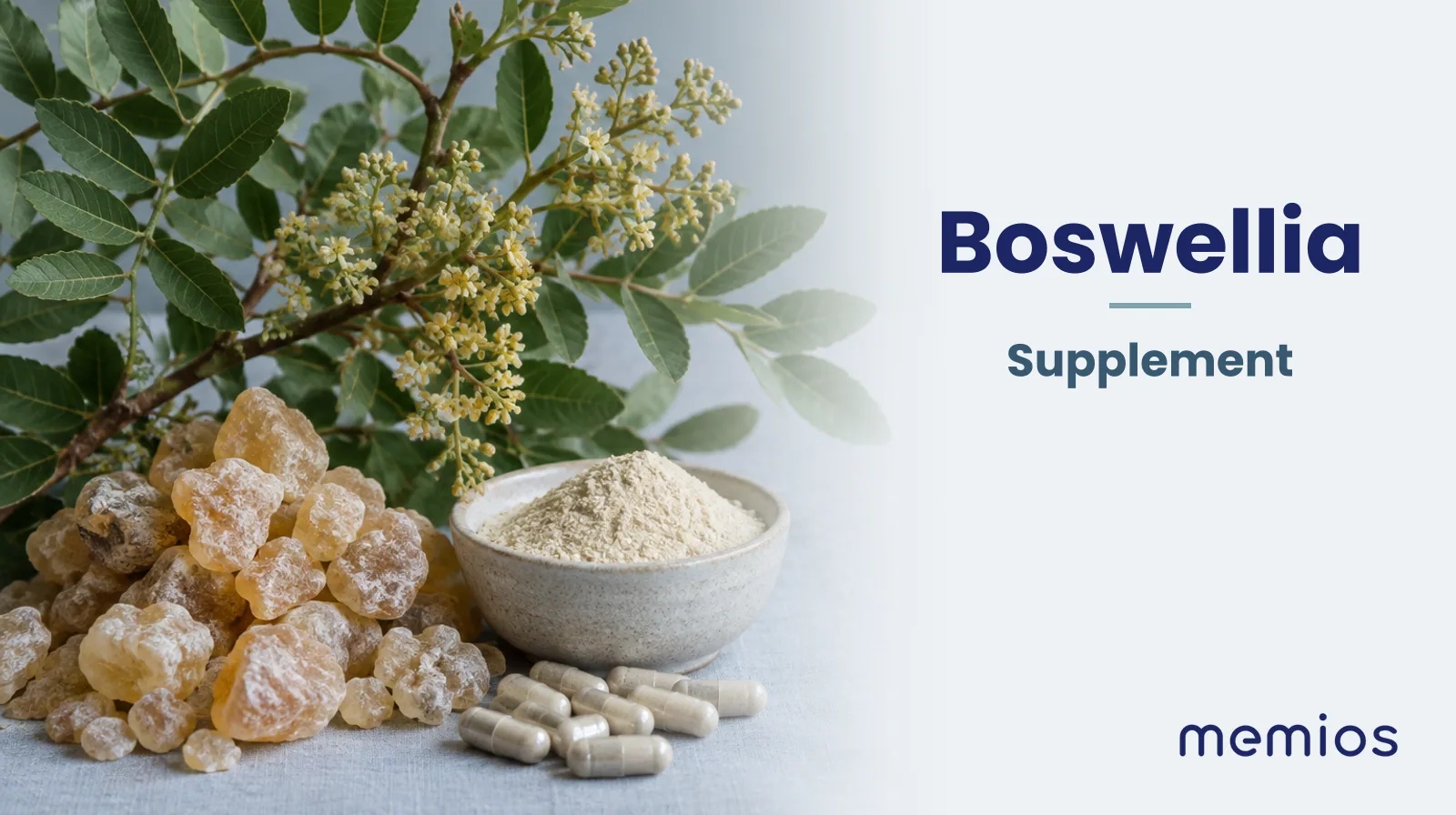
Boswellia serrata is a tree in the Burseraceae family whose trunk exudes a gum resin. The resin's characteristic compounds are pentacyclic triterpene acids known as boswellic acids, principally 3-acetyl-11-keto-beta-boswellic acid, 11-keto-beta-boswellic acid, beta-boswellic acid and 3-acetyl-beta-boswellic acid. It has a long history of use in Ayurvedic medicine as an anti-inflammatory agent. Modern supplements are standardised extracts of that resin rather than the raw gum.
What the research says
The most developed evidence is in osteoarthritis, where a 2020 meta-analysis of seven small trials found reductions in pain and stiffness and a 2014 Cochrane review rated the evidence moderate quality for a slight improvement in pain and function. Both reviews flag small samples and bias problems, and Cochrane framed the result as a trend warranting further investigation. Outside joint pain the picture is weaker: a 52-week randomised trial in Crohn's disease was stopped early because Boswellia could not be separated from placebo. Adverse effects are usually mild and gastrointestinal, but a systematic review of harms found two serious cases.
Evidence grade: Limited evidence.
What goes wrong
A systematic review of Boswellia adverse events found gastrointestinal disorders and skin allergy the commonest harms, and identified two patients with serious events. (Source 1)
- Systematic review, Low certainty.
- Size: 62 clinical trials, 10 case reports and 26 spontaneous reports.
- Who: Users of Boswellia preparations across trials, case reports and pharmacovigilance reports.
- How long: Varied.
- Result: 25 of 62 trials reported side effects, 27 reported none, 10 did not mention them; two patients developed hypersensitivity pneumonitis and bezoar formation respectively.
- Funding: not stated.
The most common adverse effects were gastrointestinal disorders and cutaneous allergic reactions. Although most detected adverse effects were mild to moderate, two patients developed hypersensitivity pneumonitis and bezoar formation, respectively.
A reported case of serious injury involved a 13-year-old girl who developed hypersensitivity pneumonitis and recurrent pneumonia attributed to Boswellia overuse. (Source 2)
- Case report, Very low certainty.
- Size: 1 patient.
- Who: 13-year-old girl with no underlying disease.
- How long: not stated.
- Result: Hypersensitivity pneumonitis with prolonged recurrent pneumonia, treated with systemic corticosteroids and cessation.
- Funding: not stated.
Limit of this finding: This is one reported case, described inside a systematic review of adverse events rather than counted against any number of users, so it says nothing about how often this happens. The clinical detail comes from an underlying case report the review cites, not from the review's own observation.
The youngest case was a 13-year-old girl who had no underlying diseases and developed hypersensitivity pneumonitis and prolonged recurrent pneumonia with Boswellia overuse; she was successfully treated with systemic corticosteroids and quit the consumption of the plant.
What the evidence supports
A 2020 systematic review and meta-analysis of randomised trials found Boswellia and its extracts reduced osteoarthritis pain, stiffness and functional impairment versus control. (Source 3)
- Meta-analysis, Low certainty.
- Size: 7 trials, 545 patients.
- Who: Adults with osteoarthritis.
- How long: Reviewers concluded a treatment duration of at least 4 weeks.
- Result: VAS pain WMD -8.33 (95% CI -11.19, -5.46; P<0.00001); WOMAC pain WMD -14.22 (95% CI -22.34, -6.09; P = 0.0006); WOMAC stiffness WMD -10.04 (95% CI -15.86, -4.22; P = 0.0007); WOMAC function WMD -10.75 (95% CI -15.06, -6.43; P<0.00001); Lequesne index WMD -2.27 (95% CI -3.08, -1.45; P<0.00001)
- Funding: not stated.
Seven trials involving 545 patients were included. Compared with the control group, Boswellia and its extract may relieve the pain
A Cochrane review of oral herbal therapies for osteoarthritis found moderate-quality evidence that Boswellia serrata slightly improved pain and function. (Source 4)
- Systematic review, Moderate certainty.
- Size: Not separately stated for Boswellia in the summary text reached.
- Who: People with osteoarthritis.
- How long: not stated.
- Result: Described as a slight improvement in pain and function; further research may change the estimates.
- Funding: not stated.
Limit of this finding: The same Cochrane summary says the improvement is slight and that further research may change the estimate, and adds that herbal therapies may cause side effects while the reviewers are uncertain whether they raise the risk of these. The benefit and that uncertainty about harm come from the same review and belong together.
There is moderate-quality evidence that in people with osteoarthritis Boswellia serrata slightly improved pain and function.
The same Crohn's trial reported no safety disadvantage for Boswellia over placebo across 52 weeks. (Source 5)
- Randomized trial, Moderate certainty.
- Size: 82 randomised.
- Who: Adults with Crohn's disease in remission.
- How long: 52 weeks.
- Result: No disadvantages observed versus placebo; no rates given in the abstract.
- Funding: not stated.
Regarding safety concerns, no disadvantages of taking the drug compared to placebo were observed.
What the evidence does not support
A 52-week randomised placebo-controlled trial of a Boswellia serrata extract for maintaining remission in Crohn's disease was stopped early because it could not be separated from placebo. (Source 5)
- Randomized trial, Moderate certainty.
- Size: 108 patients enrolled, 82 randomised, 66 analysable for efficacy.
- Who: Outpatients with Crohn's disease in clinical remission at 22 German centres.
- How long: 52 weeks.
- Result: Remission maintained in 59.9% on Boswelan vs 55.3% on placebo (P = 0.85); mean time to relapse 171 days vs 185 days (P = 0.69); no advantage on CDAI, IBDQ or inflammatory markers.
- Funding: not stated.
The trial was prematurely terminated due to insufficient discrimination of drug and placebo with regard to the primary efficacy endpoint.
Where the evidence is mixed
The authors of that meta-analysis said their own result should be read with caution because of bias in the included trials and the small numbers. (Source 6)
- Meta-analysis, Low certainty.
- Size: 7 trials, 545 patients.
- Who: Adults with osteoarthritis.
- How long: not stated.
- Result: Unclear risk for selection and attrition bias, high risk for selective reporting.
- Funding: not stated.
While this finding seems promising, it should be interpreted with caution mainly due to the unclear risk of bias for selection bias (random sequence generation, allocation concealment) and attrition bias (incomplete outcome data), the high risk of bias for reporting bias (selective reporting), and the small number of participants.
The same Cochrane review framed the Boswellia result as a trend of benefit warranting further investigation rather than an established treatment effect. (Source 7)
- Systematic review, Moderate certainty.
- Size: not stated.
- Who: People with osteoarthritis.
- How long: not stated.
- Result: No pooled effect size given in the conclusions text; optimum daily doses described as undetermined.
- Funding: not stated.
Several other medicinal plant products, including extracts of Boswellia serrata, have moderate-quality evidence for trends of benefits that warrant further investigation in light of the fact that the risk of adverse events appear low.
The 2020 meta-analysis found no statistically significant difference in adverse event risk between Boswellia and control, but that comparison pools only two trials, because three of the five trials reporting adverse events recorded none in either arm. (Source 8)
- Meta-analysis, Very low certainty.
- Size: 2 trials contributed to the pooled adverse event estimate, out of 5 that reported adverse events among the 7 included trials.
- Who: Adults with osteoarthritis.
- How long: not stated.
- Result: RR 0.63 (95% CI 0.22, 1.83); P = 0.39, pooled from 2 trials.
- Funding: not stated.
Limit of this finding: A confidence interval running from 0.22 to 1.83 on two small trials is compatible with Boswellia causing fewer side effects, the same number, or nearly twice as many. This is an absence of evidence about safety, not evidence that Boswellia is as safe as the comparator.
Five studies reported AEs. Three of them were excluded because they reported no events in both arms. According to the results, there is also not strong evidence that which one is safer because there was no statistical difference (RR 0.63; 95% CI 0.22, 1.83; P = 0.39).
The Cochrane reviewers stated that the daily doses producing benefit without adverse events have not been determined. (Source 7)
- Systematic review, Moderate certainty.
- Size: not stated.
- Who: People with osteoarthritis taking oral herbal products.
- How long: not stated.
- Result: No optimum dose identified.
- Funding: not stated.
Further investigations are required to determine optimum daily doses producing clinical benefits without adverse events.
Where the research disagrees
How much confidence the osteoarthritis evidence deserves
- Yu and colleagues, BMC Complementary Medicine and Therapies, 2020, meta-analysis of 7 trials, 545 patients: Based on current evidence, Boswellia and its extract may be an effective and safe treatment option for patient with OA, and the recommended duration of treatment with Boswellia and its extract is at least 4 weeks. (Source 3)
- Cochrane review of oral herbal therapies for osteoarthritis, 2014, systematic review with GRADE: Several other medicinal plant products, including extracts of Boswellia serrata, have moderate-quality evidence for trends of benefits that warrant further investigation in light of the fact that the risk of adverse events appear low. (Source 7)
How much
- Reference intake: No reference intake exists. Boswellia is a plant resin extract, not a nutrient, and Cochrane reviewers state that even the doses that produce benefit without adverse events remain undetermined. (Source 7)
- Upper limit: No tolerable upper intake level or acceptable daily intake was found in the reviews reached. The published harms review instead concludes that severe effects are possible and recommends specialist supervision rather than setting a numeric ceiling. (Source 1)
- Studied: The Crohn's disease maintenance trial gave six 400 mg capsules a day of the Boswellia serrata extract Boswelan (PS0201Bo) for 52 weeks. (Source 5)
- Studied: The osteoarthritis meta-analysis concluded that treatment in the included trials needed to run at least 4 weeks. (Source 3)
A common belief, and what the research shows
The belief: Boswellia is a natural anti-inflammatory that works for any inflammatory condition, and being a resin it cannot hurt you.
What the research shows: The benefit signal is confined to osteoarthritis pain and function and is rated only moderate quality by Cochrane, with the meta-analysts themselves warning about bias. Where it has been tested against a hard inflammatory endpoint it failed: in Crohn's disease 'The trial was prematurely terminated due to insufficient discrimination of drug and placebo with regard to the primary efficacy endpoint.' And a harms review concluded that 'The most common adverse effects were gastrointestinal disorders and cutaneous allergic reactions. Although most detected adverse effects were mild to moderate, two patients developed hypersensitivity pneumonitis and bezoar formation, respectively.'
Questions and answers
What is it?
Boswellia serrata is a tree of the Burseraceae family, and the material used is the gum resin that exudes from its bark, known as Indian frankincense or olibanum. Its characteristic compounds are triterpenes called boswellic acids. It has a long history in Ayurvedic medicine. The chemistry here is taken from a 2024 Frontiers in Pharmacology paper several of whose authors were employed by Sami-Sabinsa Group Limited and Sabinsa Corporation, which makes the extract it tested; only its chemistry is used here, not its efficacy results. (Source 9)
What does it do in the body?
The resin's activity is attributed to a group of pentacyclic triterpene acids, the best studied of which is 3-acetyl-11-keto-beta-boswellic acid. These are the compounds supplement extracts are standardised to. What they do in the body is described mechanistically rather than demonstrated outcome by outcome. This description comes from a paper part-authored by employees of an extract manufacturer, Sami-Sabinsa, and is used for chemistry only. (Source 9)
Is it good or bad for you?
For osteoarthritis pain and function, a Cochrane review found moderate-quality evidence of a slight improvement, which is the strongest thing that can be said for it. Outside that setting the picture is weaker or negative, and a harms review found that while most side effects are mild, serious ones have occurred. It is best read as a modest joint-pain option, not a general anti-inflammatory. (Source 4)
How do you get more of it?
It is taken as standardised extract capsules of the gum resin; it is not obtained from ordinary diet. Trials have used fixed capsule regimens, for example six 400 mg capsules a day for a year in the Crohn's disease study, while the osteoarthritis meta-analysis concluded that at least four weeks of treatment was needed. (Source 5)
If it is harmful, what reduces it?
Boswellia is not retained in the body, so reducing it means stopping the supplement. The one documented mechanical harm, a bezoar from excessive intake, required surgical removal rather than any clearance measure. The harms review's own recommendation is that it be used under specialist supervision. (Source 1)
Why might someone be low in it or missing it?
Does not apply. Boswellia is not a nutrient and there is no deficiency state, so nobody can be low in it. Someone does not have it in their system simply because they are not taking a Boswellia preparation; it is a traditional medicinal resin, not something the body requires. (Source 9)
Which whole foods contain it or feed it?
No whole food contains it. The source material is the gum resin that exudes from the trunk of Boswellia serrata trees, used as frankincense, and it reaches people only as an extract or resin preparation, not as part of a normal diet. (Source 9)
What happens if you do not have it?
Nothing happens, because Boswellia is not essential to human physiology. Not taking it simply means forgoing whatever modest joint-pain effect the trials suggest, an effect Cochrane described as a trend warranting further investigation. (Source 7)
How can you test for it?
There is no clinical test for Boswellia or boswellic acid status. The reviews we reached assess it only by symptom scales such as VAS pain, WOMAC and the Lequesne index in trials, not by any measurement in a person. (Source 3)
We searched: Searched the 2020 BMC Complementary Medicine and Therapies meta-analysis, the 2014 Cochrane review of oral herbal therapies for osteoarthritis, the 2011 Crohn's disease trial and a systematic review of Boswellia adverse events for any blood test, biomarker or diagnostic assay; none is described.
References
- Traditional and Integrative Medicine (Knowledge E). Boswellia: A Systematic Review of the Adverse Events. 2025. Read the source
- Traditional and Integrative Medicine (Knowledge E). Boswellia: A Systematic Review of the Adverse Events (serious case description). 2025. Read the source
- BMC Complementary Medicine and Therapies. Effectiveness of Boswellia and Boswellia extract for osteoarthritis patients: a systematic review and meta-analysis. 2020. PMID 32680575, DOI 10.1186/s12906-020-02985-6. Read the source
- Cochrane Database of Systematic Reviews / Cochrane. Oral herbal therapies for treating osteoarthritis (Quality of the evidence). 2014. PMID 24848732, DOI 10.1002/14651858.CD002947.pub2. Read the source
- Inflammatory Bowel Diseases (Oxford Academic). Randomized, placebo-controlled, double-blind trial of Boswellia serrata in maintaining remission of Crohn's disease: good safety profile but lack of efficacy. 2011. PMID 20848527, DOI 10.1002/ibd.21345. Read the source
- BMC Complementary Medicine and Therapies. Effectiveness of Boswellia and Boswellia extract for osteoarthritis patients: a systematic review and meta-analysis (risk of bias). 2020. PMID 32680575, DOI 10.1186/s12906-020-02985-6. Read the source
- Cochrane Database of Systematic Reviews / Cochrane. Oral herbal therapies for treating osteoarthritis (Authors' conclusions). 2014. PMID 24848732, DOI 10.1002/14651858.CD002947.pub2. Read the source
- BMC Complementary Medicine and Therapies. Effectiveness of Boswellia and Boswellia extract for osteoarthritis patients: a systematic review and meta-analysis (adverse events). 2020. PMID 32680575, DOI 10.1186/s12906-020-02985-6. Read the source
- Frontiers in Pharmacology. A standardized Boswellia serrata extract shows improvements in knee osteoarthritis within five days-a double-blind, randomized, three-arm, parallel-group, multi-center, placebo-controlled trial (Introduction). 2024. DOI 10.3389/fphar.2024.1428440. Read the source