Supplements · September 30, 2026 · Memios · 10 min read
Biotin
Biotin is essential, and true deficiency causes hair thinning, rash and neurological symptoms. But the popular claim that biotin supplements improve hair.
TLDR
- Not supported by the research. Biotin is essential, and true deficiency causes hair thinning, rash and neurological symptoms. But the popular claim that biotin supplements improve hair, skin or nails in people who are not deficient is not supported: a 2026 systematic review found no consistent benefit of biotin alone on hair growth.
- What it is: Biotin is a water-soluble B vitamin that is an essential nutrient, present naturally in some foods and sold as a dietary supplement.
- Main use, supported: Position (NIH ODS, updated 2022): biotinidase deficiency, a rare inherited disorder that blocks release of free biotin, is screened for in newborns and is a recognised setting where biotin matters clinically.
- Claim NOT supported by research: In a phase 3 randomised placebo-controlled trial, high-dose biotin (MD1003) did not significantly improve disability or walking speed in progressive multiple sclerosis. (moderate certainty)
- Another claim NOT supported: The SPI2 trial's own numbers show only a small, non-significant difference in the share of people who improved. (moderate certainty)
- Recommended dose: not established. Adequate Intake of 30 mcg/day for adults (US Food and Nutrition Board, as reported by NIH ODS 2022). No RDA exists.
- Studied dose (a trial dose, not a recommendation): SPI2 trial gave 100 mg biotin three times daily (300 mg/day) or placebo for 15 months. Findings citing that trial: 2 against.
- Upper limit: No UL set by the US Food and Nutrition Board, because no evidence of toxicity in humans at high intakes was found (NIH ODS 2022).
- What goes wrong: 6 findings on harm. The same review found no serious adverse events attributable to biotin, but flagged that high-dose biotin can interfere with immunoassays and produce false lab results.
- Common myth: Biotin supplements make hair and nails grow in anyone.
What it is
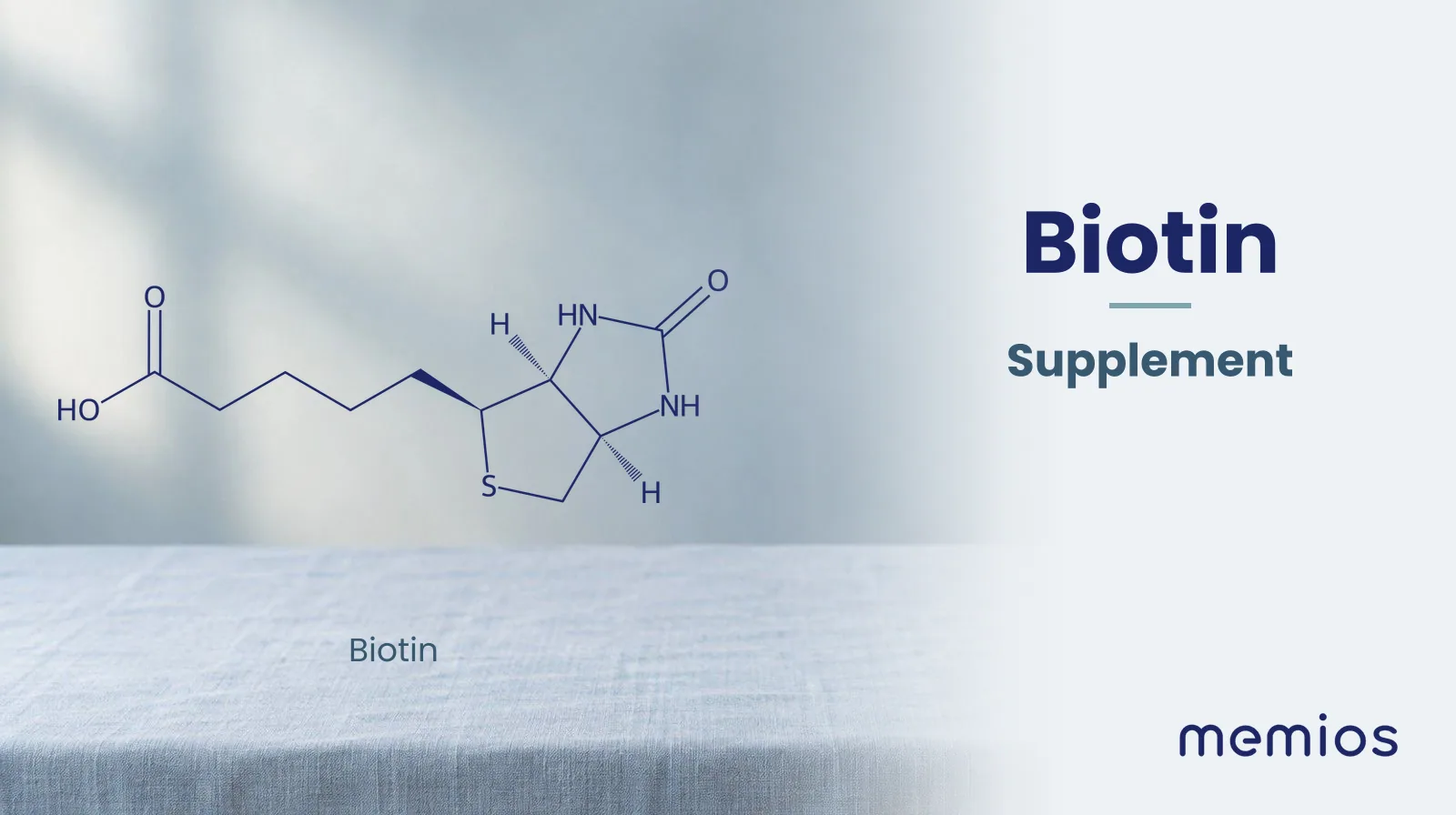
Biotin is a water-soluble B vitamin that is an essential nutrient, present naturally in some foods and sold as a dietary supplement. It acts as a co-factor for carboxylase enzymes involved in fatty acid metabolism, leucine breakdown and glucose production.
What the research says
Biotin is essential, and true deficiency causes hair thinning, rash and neurological symptoms. But the popular claim that biotin supplements improve hair, skin or nails in people who are not deficient is not supported: a 2026 systematic review found no consistent benefit of biotin alone on hair growth, and a large phase 3 trial of very high-dose biotin in progressive multiple sclerosis was negative. The main well-documented harm of high-dose biotin is that it distorts many blood tests, including thyroid and heart (troponin) tests.
Evidence grade: Not supported by the research.
What goes wrong
The same review found no serious adverse events attributable to biotin, but flagged that high-dose biotin can interfere with immunoassays and produce false lab results. (Source 1)
- Systematic review, Low certainty.
- Size: 10 studies.
- Who: People with hair loss.
- How long: Varied.
- Result: No serious adverse events; laboratory interference risk.
- Funding: Not stated.
high-dose biotin may interfere with immunoassays, potentially leading to clinically relevant false laboratory results
In a four-case series, 20-30 mg/day biotin produced thyroid test results that falsely suggested Graves' disease in people without hyperthyroid symptoms; results normalised within 24-48 hours of stopping. (Source 2)
- Case series, Low certainty.
- Size: 4 people.
- Who: Adults taking 20-30 mg/day biotin (for hair, nails, or a volunteer)
- How long: 1 week to 3 months.
- Result: All four cases returned to baseline within 24-48 hours after biotin withdrawal.
- Funding: Not stated.
the ingestion of 20 mg or more of biotin may lead to a clinically relevant thyroid assay interference
A case report with literature review showed biotin can make immunoassay results falsely high or falsely low, depending on the test design, risking misdiagnosis. (Source 3)
- Case report, Low certainty.
- Size: 1 patient plus literature review.
- Who: Patient at a New Zealand tertiary endocrine service.
- How long: Not stated.
- Result: Abnormal thyroid tests normalised after biotin was stopped.
- Funding: Not stated.
Depending on the assay format, biotin interference can result in either falsely high or low values.
A single case report linked a biotin plus pantothenic acid (B5) supplement to life-threatening eosinophilic inflammation around the lungs and heart, which resolved after the vitamins were stopped; causation cannot be established from one case. (Source 4)
- Case report, Very low certainty.
- Size: 1 patient.
- Who: 76-year-old woman.
- How long: About two months of vitamins B5 and H.
- Result: Pericardial tamponade; recovery after withdrawal.
- Funding: Not stated.
This case suggests that vitamins B5 and H may cause symptomatic, life-threatening, eosinophilic pleuropericarditis.
Position (NIH ODS, updated 2022, reporting FDA): a person taking high-dose biotin died after a troponin heart-attack test gave a falsely low result due to biotin interference. (Source 5)
- Official position, Certainty not rated.
- Size: 1 reported death.
- Who: People taking high-dose biotin supplements.
- How long: Not applicable.
- Result: Falsely low troponin result.
- Funding: Government.
a patient with a high intake of supplemental biotin died following a troponin test (to help diagnose a heart attack) that gave a falsely low result
Position (NIH ODS, updated 2022): in a study of 264 people with epilepsy, at least a year of anticonvulsant treatment was associated with lower blood biotin than in controls; ODS suggests, but does not establish, that the drugs increase biotin breakdown. (Source 5)
- Official position, Certainty not rated.
- Size: Not stated.
- Who: People on anticonvulsant drugs.
- How long: At least 1 year.
- Result: Significantly lower serum biotin.
- Funding: Government.
anticonvulsant treatment for at least 1 year was associated with significantly lower serum biotin levels than in control group patients.
What the evidence supports
Position (NIH ODS, updated 2022): biotinidase deficiency, a rare inherited disorder that blocks release of free biotin, is screened for in newborns and is a recognised setting where biotin matters clinically. (Source 5)
- Official position, Certainty not rated.
- Size: Not applicable.
- Who: Newborns.
- How long: Not applicable.
- Result: Not applicable.
- Funding: Government.
Biotinidase deficiency is a rare autosomal recessive disorder that prevents the body from releasing free biotin, leading to biotin deficiency despite normal intake.
What the evidence does not support
In a phase 3 randomised placebo-controlled trial, high-dose biotin (MD1003) did not significantly improve disability or walking speed in progressive multiple sclerosis. (Source 6)
- Randomized trial, Moderate certainty.
- Size: 642 participants (326 MD1003, 316 placebo)
- Who: Adults with progressive multiple sclerosis, 90 clinics in 13 countries.
- How long: Primary endpoint at month 12, confirmed at month 15.
- Result: 39 (12%) of 326 on MD1003 vs 29 (9%) of 316 on placebo improved; not statistically significant.
- Funding: Industry-funded (MedDay Pharmaceuticals, the manufacturer)
MD1003 did not significantly improve disability or walking speed in patients with progressive multiple sclerosis
The SPI2 trial's own numbers show only a small, non-significant difference in the share of people who improved. (Source 6)
- Randomized trial, Moderate certainty.
- Size: 642 participants.
- Who: Adults with progressive multiple sclerosis.
- How long: 15 months.
- Result: 12% vs 9% improved.
- Funding: Industry-funded (MedDay Pharmaceuticals)
39 (12%) of 326 patients in the MD1003 group compared with 29 (9%) of 316 in the placebo group improved
A 2026 PRISMA systematic review of ten studies found biotin taken alone did not consistently improve objective hair growth; reported benefits came from combination products. (Source 1)
- Systematic review, Low certainty.
- Size: 10 studies.
- Who: People with alopecia or hair loss.
- How long: Varied.
- Result: Qualitative synthesis only (heterogeneity prevented meta-analysis)
- Funding: Not stated.
biotin monotherapy did not show consistent benefit on objective hair growth outcomes
Controlled studies in telogen effluvium (a common shedding type of hair loss) found no difference in blood biotin levels versus controls, which undercuts the idea that such hair loss stems from low biotin. (Source 1)
- Systematic review, Low certainty.
- Size: Subset of 10 included studies.
- Who: People with telogen effluvium vs controls.
- How long: Cross-sectional comparisons.
- Result: No significant difference in serum biotin.
- Funding: Not stated.
controlled studies in telogen effluvium found no significant differences in serum biotin versus controls
Position (NIH ODS, updated 2022): claims that biotin supplements help hair, nails and skin rest on only a few case reports and small studies. (Source 5)
- Official position, Certainty not rated.
- Size: Not applicable.
- Who: General population.
- How long: Not applicable.
- Result: Not applicable.
- Funding: Government.
these claims are supported, at best, by only a few case reports and small studies.
Where the evidence is mixed
Where hair improvements were reported, they occurred with multi-ingredient regimens and could not be attributed to biotin specifically. (Source 1)
- Systematic review, Low certainty.
- Size: 10 studies.
- Who: People with alopecia or hair loss.
- How long: Varied.
- Result: No pooled effect.
- Funding: Not stated.
when improvements were reported, they typically occurred in combined regimens and were difficult to attribute specifically to biotin
The review authors said the evidence neither shows a clear benefit nor rules out biological activity, leaving open a possible modest supportive role in some contexts and in combination products. (Source 1)
- Systematic review, Low certainty.
- Size: 10 studies.
- Who: People with hair loss.
- How long: Varied.
- Result: Not quantified.
- Funding: Not stated.
leaves open the possibility of a modest supportive role in selected contexts and as part of combination regimens
Where the research disagrees
Whether biotin supplements help hair loss in people who are not deficient
- Moltó-Balado et al. systematic review, 2026, Systematic review of 10 studies: Current evidence does not support routine biotin supplementation for alopecia in the absence of documented deficiency (Source 1)
- Same review authors, Systematic review of 10 studies: Importantly, the current evidence base does not demonstrate a clear lack of biological activity either; rather, it leaves open the possibility of a modest supportive role in selected contexts and as part of combination regimens. (Source 1)
How much
- Reference intake: Adequate Intake of 30 mcg/day for adults (US Food and Nutrition Board, as reported by NIH ODS 2022). No RDA exists. (Source 5)
- Upper limit: No UL set by the US Food and Nutrition Board, because no evidence of toxicity in humans at high intakes was found (NIH ODS 2022). This does not address laboratory test interference. (Source 5)
- Studied: SPI2 trial gave 100 mg biotin three times daily (300 mg/day) or placebo for 15 months. (Source 6)
- Studied: Case series participants took 20-30 mg/day for one week to three months. (Source 2)
A common belief, and what the research shows
The belief: Biotin supplements make hair and nails grow in anyone.
What the research shows: A 2026 systematic review found "biotin monotherapy did not show consistent benefit on objective hair growth outcomes", and NIH ODS says such claims "are supported, at best, by only a few case reports and small studies."
Questions and answers
What is it?
Biotin is a water-soluble B vitamin, sometimes called vitamin B7 or vitamin H. It is an essential nutrient found in some foods and sold as a supplement. (Source 5)
What does it do in the body?
Biotin is a helper (co-factor) for enzymes that break down fats and some amino acids and make glucose. It also has roles in gene regulation. (Source 3)
Is it good or bad for you?
Biotin is essential, so enough of it is good. Extra biotin in people who are not deficient has not been shown to help hair, and high doses (20 mg or more a day in reported cases) can distort blood tests, which has led to misdiagnosis. (Source 2)
How do you get more of it?
Biotin comes from foods such as organ meats, eggs, fish, meat, seeds and nuts, and from supplements. Raw egg white contains avidin, which blocks biotin absorption; cooking inactivates it. (Source 5)
If it is harmful, what reduces it?
Biotin itself is not considered toxic, and no upper limit has been set. The documented problem is lab test interference; in a case series, thyroid results returned to baseline within 24-48 hours of stopping biotin. (Source 2)
Why might someone be low in it or missing it?
Low biotin is uncommon with a balanced diet. Causes studied include the inherited disorder biotinidase deficiency, long-term anticonvulsant drugs (which NIH ODS says may speed biotin breakdown), and regularly eating raw egg whites. (Source 5)
Which whole foods contain it or feed it?
Organ meats, eggs, fish, meat, seeds, nuts and some vegetables such as sweet potatoes are among the richest sources listed by NIH ODS. (Source 5)
What happens if you do not have it?
Deficiency causes thinning hair that can progress to total hair loss, a scaly red rash around body openings, and neurological symptoms such as depression, lethargy and hallucinations. (Source 5)
How can you test for it?
Low urinary excretion of biotin indicates deficiency; blood biotin levels do not reliably detect marginal deficiency. Newborns in the US and many countries are screened for biotinidase deficiency. People taking biotin should know it can distort other lab tests. (Source 5)
References
- Dermato (MDPI). Effectiveness of Biotin Supplementation for Hair Growth in Patients with Alopecia: A Systematic Review. 2026. DOI 10.3390/dermato6020017. Read the source
- Cureus. How Biotin Induces Misleading Results in Thyroid Bioassays: Case Series. 2019. DOI 10.7759/cureus.4727. Read the source
- The Journal of Clinical Endocrinology & Metabolism. Factitious Graves' Disease Due to Biotin Immunoassay Interference-A Case and Review of the Literature. 2016. DOI 10.1210/jc.2016-1971. Read the source
- Annals of Pharmacotherapy. Life-Threatening Eosinophilic Pleuropericardial Effusion Related to Vitamins B5 and H. 2001. PMID 11302404, DOI 10.1345/aph.10213. Read the source
- NIH Office of Dietary Supplements. Biotin: Fact Sheet for Health Professionals. 2022. Read the source
- The Lancet Neurology. Safety and efficacy of MD1003 (high-dose biotin) in patients with progressive multiple sclerosis (SPI2): a randomised, double-blind, placebo-controlled, phase 3 trial. 2020. PMID 33222767, DOI 10.1016/S1474-4422(20)30347-1. Read the source