Supplements · September 30, 2026 · Memios · 17 min read
Beta-alanine
Supplementation raises muscle carnosine, and pooled trials show a small ergogenic effect: a meta-analysis of 40 placebo-controlled studies in 1,461 participants found an overall effect size of 0.18 (95% CI 0.08 to 0.28), largest for exercise capacity in efforts of about half a minute to ten minutes.
TLDR
- Limited evidence. Supplementation raises muscle carnosine, and pooled trials show a small ergogenic effect: a meta-analysis of 40 placebo-controlled studies in 1,461 participants found an overall effect size of 0.18 (95% CI 0.08 to 0.28), largest for exercise capacity in efforts of about half a minute to ten minutes.
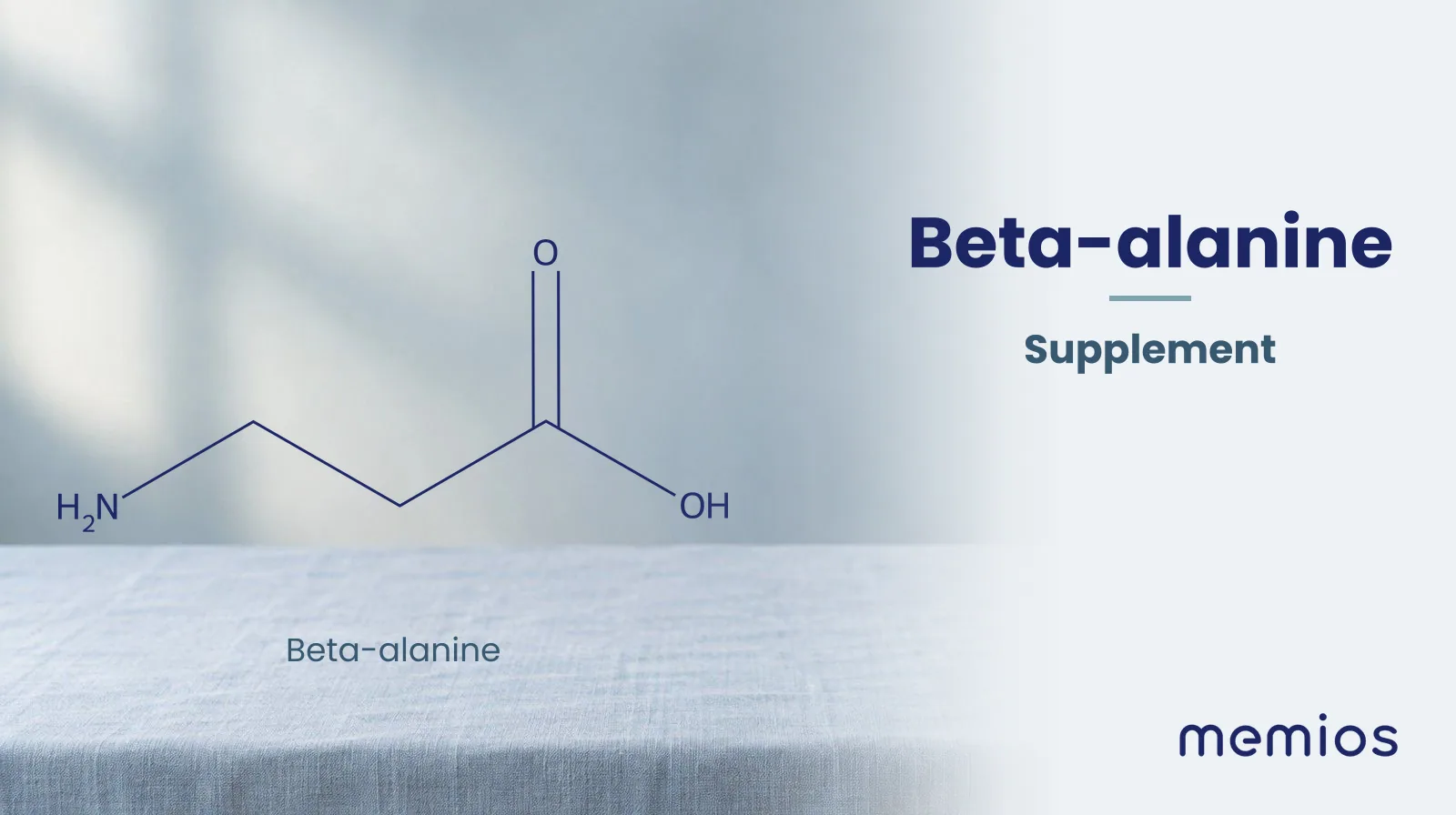
- What it is: Beta-alanine is an amino acid the body does not incorporate into proteins.
- Main use, supported: The overall conclusion of the systematic risk assessment was that beta-alanine at the doses studied does not adversely affect those taking it. (moderate certainty)
- Other use, supported: A systematic review and meta-analysis of 40 placebo-controlled studies found a small but statistically significant overall ergogenic effect of beta-alanine. (low certainty)
- Claim NOT supported by research: A 2026 multilevel meta-analysis of 17 randomised trials found no effect of chronic beta-alanine on repeated sprint ability on any of three outcomes. (low certainty)
- Another claim NOT supported: The authors of that null meta-analysis concluded beta-alanine does not clearly improve work capacity, anaerobic power or fatigue resistance in repeated sprinting. (low certainty)
- Recommended dose: not established. No Recommended Dietary Allowance or Adequate Intake exists for beta-alanine, which is not a protein-forming amino acid. NIH estimates dietary intakes ranging from none in vegans to about 1 g/day in heavy meat eaters.
- Studied dose (a trial dose, not a recommendation): The ISSN position stand describes four weeks of 4-6 g daily as the protocol that raises muscle carnosine. No finding here cites that trial.
- Upper limit: No Tolerable Upper Intake Level or Acceptable Daily Intake has been set by a body we could reach.
- What goes wrong: 7 findings on harm. A systematic risk assessment of 101 human and 50 animal studies found paraesthesia was the only reported side effect, with roughly nine times the odds on beta-alanine than placebo.
- Common myth: The tingling means the beta-alanine is working.
What it is
Beta-alanine is an amino acid the body does not incorporate into proteins. It is the rate-limiting precursor for carnosine, a dipeptide of histidine and beta-alanine stored in skeletal muscle, where carnosine buffers the fall in pH caused by anaerobic glycolysis. It is produced in the liver and present in small amounts in meat, poultry and fish, with estimated intakes ranging from none in vegans to about 1 g/day in heavy meat eaters.
What the research says
Supplementation raises muscle carnosine, and pooled trials show a small ergogenic effect: a meta-analysis of 40 placebo-controlled studies in 1,461 participants found an overall effect size of 0.18 (95% CI 0.08 to 0.28), largest for exercise capacity in efforts of about half a minute to ten minutes. The effect does not hold everywhere: a 2026 meta-analysis of 17 randomised trials found no effect on repeated sprint ability on any outcome, and the ISSN position stand says more research is needed on strength and on endurance beyond 25 minutes. The consistent side effect is paraesthesia, with odds about nine times those on placebo.
Evidence grade: Limited evidence.
What goes wrong
A systematic risk assessment of 101 human and 50 animal studies found paraesthesia was the only reported side effect, with roughly nine times the odds on beta-alanine than placebo. (Source 1)
- Systematic review, Moderate certainty.
- Size: 101 human and 50 animal studies.
- Who: People and animals given isolated oral beta-alanine.
- How long: Acute and longitudinal trials.
- Result: Odds ratio 8.9 (95% credible interval 2.2 to 32.6) for paraesthesia versus placebo; dropout rates similar between active and placebo groups.
- Funding: not stated.
Paraesthesia was the only reported side effect and had an estimated OR of 8.9 [95% credible interval (CrI): 2.2, 32.6] with supplementation relative to placebo.
The same risk assessment found a small rise in circulating alanine aminotransferase with beta-alanine, though mean values stayed within clinical reference ranges. (Source 2)
- Systematic review, Low certainty.
- Size: Human studies within the 101 included.
- Who: People given oral beta-alanine.
- How long: Acute and longitudinal trials.
- Result: Alanine aminotransferase effect size 0.274 (credible interval 0.04 to 0.527)
- Funding: not stated.
β-Alanine supplementation caused a small increase in circulating alanine aminotransferase concentration (effect size, ES: 0.274, CrI: 0.04, 0.527), although mean data remained well within clinical reference ranges.
A 30-day randomised double-blind trial of a high 15 g/day sustained-release dose found paraesthesia in most of the active group, and rises in triglycerides, LDL cholesterol and urea nitrogen from baseline. (Source 3)
- Randomized trial, Very low certainty.
- Size: 19 participants (10 active, 9 placebo)
- Who: Recreationally trained men, mean age 22.5 years.
- How long: 30 days at 15 g/day in three divided intakes.
- Result: Paraesthesia in the majority of the active group but with VAS scores under 3/10 in almost all; statistically significant within-group increases in serum triglycerides, LDL cholesterol and urea nitrogen with no difference versus control.
- Funding: not stated (product-formulation trial of a sustained-release microgranule blend)
In the β-alanine group, there were statistically increases in serum triglycerides, LDLcholesterol, and urea nitrogen at the end of the study as compared with baseline, although there were no differences with the control group.
In that trial the paraesthesia, though common, was mild on a visual analogue scale. (Source 3)
- Randomized trial, Very low certainty.
- Size: 19 participants.
- Who: Recreationally trained men.
- How long: 30 days.
- Result: Paraesthesia described mainly as tickling, with VAS score under 3/10 in almost all subjects.
- Funding: not stated.
The occurrence of paresthesia, described above all as tickling, was the majority but presented VAS score less than 3/10 in almost all subjects.
NIH records paraesthesia at single doses of at least 800 mg or above 10 mg/kg body mass, and states there are no safety data beyond one year. (Source 4)
- Official position, Certainty not rated.
- Size: Not applicable.
- Who: People taking beta-alanine supplements.
- How long: Safe range given as up to 8 weeks; no data beyond 1 year.
- Result: 1.6-6.4 g/day for up to 8 weeks described as safe; paraesthesia typically lasting 60-90 minutes; pruritus also reported.
- Funding: government agency.
This tingling, prickling, or burning sensation is common in the face, neck, back of the hands, and upper trunk and typically lasts 60–90 minutes but is not a painful, serious, or harmful reaction.
Most top-selling pre-workout products contain beta-alanine, but the average serving falls below the dose the review considered effective. (Source 5)
- Survey study, Low certainty.
- Size: 100 commercially available pre-workout products.
- Who: Top-selling multi-ingredient pre-workout supplements.
- How long: Single snapshot of supplement facts panels.
- Result: Beta-alanine present in 87% of products at an average 2.0 +/- 0.8 g per serving, below the recommended efficacious dose.
- Funding: not stated.
The average amount of beta-alanine per serving size was below the recommended efficacious dose.
The ISSN describes paraesthesia as commonly experienced above 800 mg in a non-sustained-release form, resolving within 60 to 90 minutes. (Source 6)
- Official position, Certainty not rated.
- Size: Not applicable - a society position stand.
- Who: People taking beta-alanine.
- How long: Symptoms reported to disappear within 60 to 90 minutes after a dose.
- Result: Threshold given as more than 800 mg in a non-sustained release form; substantially reduced with sustained-release formulations.
- Funding: professional society (ISSN)
Paraesthesia (i.e., tingling) is the most widely known side effect of beta-alanine and is commonly experienced in individuals consuming more than 800 mg of beta-alanine in a non-sustained release form.
What the evidence supports
A systematic review and meta-analysis of 40 placebo-controlled studies found a small but statistically significant overall ergogenic effect of beta-alanine. (Source 7)
- Meta-analysis, Low certainty.
- Size: 1461 participants across 40 studies, 65 exercise protocols and 70 exercise measures.
- Who: Healthy participants taking chronic beta-alanine protocols; crossover designs excluded.
- How long: Chronic ingestion protocols; NIH records total doses of 84-414 g over 28-90 days.
- Result: Overall effect size 0.18 (95% CI 0.08 to 0.28); exercise duration moderated effects (p=0.004); capacity 0.4998 (95% CI 0.246 to 0.753) versus performance 0.1078 (95% CI -0.201 to 0.416) within 0.5-10 min.
- Funding: not stated.
40 individual studies employing 65 different exercise protocols and totalling 70 exercise measures in 1461 participants were included in the analyses. A significant overall effect size of 0.18 (95% CI 0.08 to 0.28) was shown.
The overall conclusion of the systematic risk assessment was that beta-alanine at the doses studied does not adversely affect those taking it. (Source 2)
- Systematic review, Moderate certainty.
- Size: 101 human and 50 animal studies.
- Who: People and animals given isolated oral beta-alanine.
- How long: The range of durations used in the available research.
- Result: No adverse effect beyond paraesthesia identified.
- Funding: not stated.
The results of this review indicate that β-alanine supplementation within the doses used in the available research designs, does not adversely affect those consuming it.
What the evidence does not support
The same 2015 position stand states that more research is needed on strength and on endurance performance beyond 25 minutes. (Source 8)
- Official position, Certainty not rated.
- Size: Not applicable.
- Who: People using beta-alanine for strength or long endurance events.
- How long: Not applicable.
- Result: No effect estimate; an explicit statement of missing evidence.
- Funding: professional society (ISSN)
- More research is needed to determine the effects of beta-alanine on strength, endurance performance beyond 25 min in duration, and other health-related benefits associated with carnosine.
A 2026 multilevel meta-analysis of 17 randomised trials found no effect of chronic beta-alanine on repeated sprint ability on any of three outcomes. (Source 9)
- Meta-analysis, Low certainty.
- Size: 17 randomised controlled trials.
- Who: Healthy populations taking oral beta-alanine for 2 weeks or more versus placebo.
- How long: At least 2 weeks of supplementation.
- Result: Mean RSA performance SMD -0.018 (95% CI -0.207 to 0.170), p = 0.841; peak RSA SMD 0.205 (95% CI -0.073 to 0.483), p = 0.130; fatigue decrement SMD -0.020 (95% CI -0.516 to 0.476), p = 0.929.
- Funding: not stated.
Among 17 included RCTs, the meta-analysis revealed no statistically significant improvements in Mean RSA Performance (SMD = −0.018, 95% CI [−0.207, 0.170], p = 0.841), Peak RSA Performance (SMD = 0.205, 95% CI [−0.073, 0.483], p = 0.130), or Fatigue Decrement (SMD = −0.020, 95% CI [−0.516, 0.476], p = 0.929).
The authors of that null meta-analysis concluded beta-alanine does not clearly improve work capacity, anaerobic power or fatigue resistance in repeated sprinting. (Source 10)
- Meta-analysis, Low certainty.
- Size: 17 randomised controlled trials assessed with Cochrane RoB 2.0 and GRADE.
- Who: Healthy populations.
- How long: At least 2 weeks.
- Result: Null across all three pooled outcomes and across dose, duration, modality and training status subgroups.
- Funding: not stated.
In conclusion, chronic β-alanine supplementation does not provide a clear improvement in total work capacity, maximal anaerobic power, or fatigue resistance during repeated sprinting.
The widely repeated worry that beta-alanine depletes muscle taurine was not supported in pooled human data. (Source 2)
- Systematic review, Low certainty.
- Size: Human studies within the 101 included.
- Who: People given oral beta-alanine.
- How long: Acute and longitudinal trials.
- Result: Skeletal muscle taurine effect size 0.156 (95% CrI -0.38 to 0.72); histidine -0.15 (95% CrI -0.64 to 0.33); a taurine effect appeared in mice only at doses of 3% or more beta-alanine in drinking water.
- Funding: not stated.
Meta-analysis of human data showed no main effect of β-alanine supplementation on skeletal muscle taurine (ES: 0.156; 95% CrI: −0.38, 0.72) or histidine (ES: −0.15; 95% CrI: −0.64, 0.33) concentration.
Where the evidence is mixed
In that meta-analysis the total amount of beta-alanine ingested did not moderate the effect, and the largest effect came from co-supplementation with sodium bicarbonate. (Source 7)
- Meta-analysis, Low certainty.
- Size: 1461 participants across 40 studies.
- Who: Healthy participants.
- How long: Chronic protocols.
- Result: No moderating effect of training status (p=0.559), intermittent or continuous exercise (p=0.436) or total beta-alanine ingested (p=0.438); sodium bicarbonate co-supplementation effect size 0.43 (95% CI 0.22 to 0.64)
- Funding: not stated.
There was no moderating effect of training status (p=0.559), intermittent or continuous exercise (p=0.436) or total amount of β-alanine ingested (p=0.438).
NIH points out that this literature is dominated by small, short studies using many different exercise and supplement protocols. (Source 11)
- Official position, Certainty not rated.
- Size: The 40 placebo-controlled studies in 1,461 participants that NIH describes.
- Who: Participants in beta-alanine exercise studies.
- How long: Studies lasting 28-90 days with total doses of 84 to 414 g.
- Result: No new effect estimate; a quality comment on the underlying trials.
- Funding: government agency.
However, this review also highlighted the fact that small studies of short duration using varied exercise and supplement protocols dominate this scientific literature.
What official bodies say
The International Society of Sports Nutrition position is that four weeks of 4-6 g/day raises muscle carnosine and that beta-alanine appears safe in healthy people at recommended doses. (Source 12)
- Official position, Certainty not rated.
- Size: Not applicable - a society position stand.
- Who: Healthy people using beta-alanine.
- How long: Four weeks or more at 4-6 g daily.
- Result: No pooled effect size in the position points themselves.
- Funding: professional society (ISSN)
- Four weeks of beta-alanine supplementation (4–6 g daily) significantly augments muscle carnosine concentrations, thereby acting as an intracellular pH buffer; 2) Beta-alanine supplementation currently appears to be safe in healthy populations at recommended doses;
Where the research disagrees
Whether beta-alanine helps repeated sprint work
- Saunders and colleagues, British Journal of Sports Medicine 2017, meta-analysis of 40 placebo-controlled studies: A significant overall effect size of 0.18 (95% CI 0.08 to 0.28) was shown. Meta-regression demonstrated that exercise duration significantly (p=0.004) moderated effect sizes. (Source 7)
- 2026 Frontiers in Nutrition multilevel meta-analysis, meta-analysis of 17 randomised trials with RoB 2.0 and GRADE: In conclusion, chronic β-alanine supplementation does not provide a clear improvement in total work capacity, maximal anaerobic power, or fatigue resistance during repeated sprinting. (Source 10)
How much
- Reference intake: No Recommended Dietary Allowance or Adequate Intake exists for beta-alanine, which is not a protein-forming amino acid. NIH estimates dietary intakes ranging from none in vegans to about 1 g/day in heavy meat eaters. (Source 13)
- Upper limit: No Tolerable Upper Intake Level or Acceptable Daily Intake has been set by a body we could reach. NIH states supplementation appears safe at 1.6-6.4 g/day for up to 8 weeks and that there are no safety data on use beyond one year. (Source 4)
- Studied: The ISSN position stand describes four weeks of 4-6 g daily as the protocol that raises muscle carnosine. (Source 12)
- Studied: NIH records total doses of 84 to 414 g consumed across studies lasting 28-90 days. (Source 11)
- Studied: A randomised trial gave 15 g/day of a sustained-release formulation in three divided intakes for 30 days. (Source 3)
A common belief, and what the research shows
The belief: The tingling means the beta-alanine is working.
What the research shows: The tingling is a side effect, not a marker of effect, and it can be removed while keeping the dose. The ISSN position stand records that "The only reported side effect is paraesthesia (tingling), but studies indicate this can be attenuated by using divided lower doses (1.6 g) or using a sustained-release formula;" and NIH describes it as a sensation that "typically lasts 60–90 minutes but is not a painful, serious, or harmful reaction."
Questions and answers
What is it?
Beta-alanine is an amino acid that the body does not build into proteins. It is the rate-limiting building block for carnosine, a dipeptide of histidine and beta-alanine stored in skeletal muscle. It is made in the liver and eaten in small amounts in meat, poultry and fish. (Source 14)
What does it do in the body?
Carnosine buffers the fall in muscle pH during hard anaerobic exercise. Raising muscle carnosine by taking beta-alanine is the proposed way to blunt that acidity and delay fatigue in short, intense efforts. (Source 14)
Is it good or bad for you?
For short, intense exercise the pooled effect is real but small, and a 2026 meta-analysis found no effect at all on repeated sprint ability. On safety, the largest risk assessment found paraesthesia was the only reported side effect and concluded that at the doses studied it does not harm those taking it, but there are no safety data beyond one year. (Source 2)
How do you get more of it?
Trials used supplements rather than food. The ISSN position stand describes 4-6 g daily for at least two to four weeks; NIH describes total doses of 84 to 414 g across studies lasting 28-90 days. Eating carnosine itself is inefficient because it is digested back into its component amino acids. (Source 15)
If it is harmful, what reduces it?
The thing people want to reduce is the tingling, not the beta-alanine itself. The ISSN position stand says the paraesthesia can be attenuated by splitting the dose into lower amounts of about 1.6 g or by using a sustained-release formula, and NIH says the same. (Source 12)
Why might someone be low in it or missing it?
Dietary beta-alanine comes almost entirely from animal foods, so intake ranges from none in vegans to about a gram a day in people who eat a lot of meat. The body also produces it in the liver, so a low dietary intake is not the same as a deficiency. (Source 13)
Which whole foods contain it or feed it?
Meat, poultry and fish supply beta-alanine in small amounts; beef and pork supply carnosine directly. Carnosine from food is not an efficient route to higher muscle carnosine because digestion splits it apart. (Source 15)
What happens if you do not have it?
No deficiency disease from a lack of dietary beta-alanine is described in the literature we searched. It is made in the liver, and vegans who take in none from food are not reported to develop a defined deficiency state; what differs is muscle carnosine content. (Source 13)
We searched: Searched the ISSN 2015 position stand, the Advances in Nutrition systematic risk assessment and the NIH ODS fact sheet for a described beta-alanine deficiency state; none reports one.
How can you test for it?
What is actually measured in research is muscle carnosine, not beta-alanine, and it is measured in study settings rather than as a routine clinical test. NIH notes the response varies widely between people, so a dose does not predict an individual's muscle carnosine. We found no validated consumer test. (Source 16)
We searched: Searched NIH ODS, the ISSN 2015 position stand and the Advances in Nutrition risk assessment for a validated test of beta-alanine or carnosine status available outside research; none describes one.
References
- Advances in Nutrition. A Systematic Risk Assessment and Meta-Analysis on the Use of Oral β-Alanine Supplementation. 2019. DOI 10.1093/advances/nmy115. Read the source
- Advances in Nutrition. A Systematic Risk Assessment and Meta-Analysis on the Use of Oral β-Alanine Supplementation (biomarker and taurine passage). 2019. DOI 10.1093/advances/nmy115. Read the source
- Frontiers in Nutrition. Effect of a sustained-release formulation of β-alanine on laboratory parameters and paresthesia in recreational trained men: a randomized double-blind placebo-controlled study (abstract, Results section). 2023. PMID 37766731, DOI 10.3389/fnut.2023.1213105. Read the source
- Office of Dietary Supplements, National Institutes of Health. Dietary Supplements for Exercise and Athletic Performance – Health Professional Fact Sheet (beta-alanine, safety). no revision date captured from the fetched page; accessed 23 September 2026. Read the source
- Nutrients. Common Ingredient Profiles of Multi-Ingredient Pre-Workout Supplements. 2019. PMID 30678328, DOI 10.3390/nu11020254. Read the source
- Journal of the International Society of Sports Nutrition. International society of sports nutrition position stand: Beta-Alanine (paraesthesia passage). 2015. PMID 26175657, DOI 10.1186/s12970-015-0090-y. Read the source
- British Journal of Sports Medicine. β-alanine supplementation to improve exercise capacity and performance: a systematic review and meta-analysis. 2017. PMID 27797728, DOI 10.1136/bjsports-2016-096396. Read the source
- Journal of the International Society of Sports Nutrition. International society of sports nutrition position stand: Beta-Alanine (position statement points 6–7). 2015. PMID 26175657, DOI 10.1186/s12970-015-0090-y. Read the source
- Frontiers in Nutrition. No ergogenic effect of β-alanine on repeated sprint ability: a systematic review and multilevel meta-analysis of randomized controlled trials. 2026. DOI 10.3389/fnut.2026.1818755. Read the source
- Frontiers in Nutrition. No ergogenic effect of β-alanine on repeated sprint ability: a systematic review and multilevel meta-analysis of randomized controlled trials (conclusion passage). 2026. DOI 10.3389/fnut.2026.1818755. Read the source
- Office of Dietary Supplements, National Institutes of Health. Dietary Supplements for Exercise and Athletic Performance – Health Professional Fact Sheet (beta-alanine, efficacy). no revision date captured from the fetched page; accessed 23 September 2026. Read the source
- Journal of the International Society of Sports Nutrition. International society of sports nutrition position stand: Beta-Alanine (position statement points 1–3). 2015. PMID 26175657, DOI 10.1186/s12970-015-0090-y. Read the source
- Office of Dietary Supplements, National Institutes of Health. Dietary Supplements for Exercise and Athletic Performance – Health Professional Fact Sheet (beta-alanine, dietary sources). no revision date captured from the fetched page; accessed 23 September 2026. Read the source
- Office of Dietary Supplements, National Institutes of Health. Dietary Supplements for Exercise and Athletic Performance – Health Professional Fact Sheet (beta-alanine, introductory paragraph). no revision date captured from the fetched page; accessed 23 September 2026. Read the source
- Office of Dietary Supplements, National Institutes of Health. Dietary Supplements for Exercise and Athletic Performance – Health Professional Fact Sheet (beta-alanine, carnosine in foods). no revision date captured from the fetched page; accessed 23 September 2026. Read the source
- Office of Dietary Supplements, National Institutes of Health. Dietary Supplements for Exercise and Athletic Performance – Health Professional Fact Sheet (beta-alanine, muscle carnosine response). no revision date captured from the fetched page; accessed 23 September 2026. Read the source