Supplements · September 30, 2026 · Memios · 11 min read
Beetroot and dietary nitrate
Meta-analyses back a real but modest fall in systolic blood pressure: about 4.4 mmHg in Siervo 2013 (16 short crossover trials, 254 people) and about 5 mmHg in people with hypertension (moderate-certainty GRADE).
TLDR
- Limited evidence. Meta-analyses back a real but modest fall in systolic blood pressure: about 4.4 mmHg in Siervo 2013 (16 short crossover trials, 254 people) and about 5 mmHg in people with hypertension (moderate-certainty GRADE), with diastolic changes small or not significant.
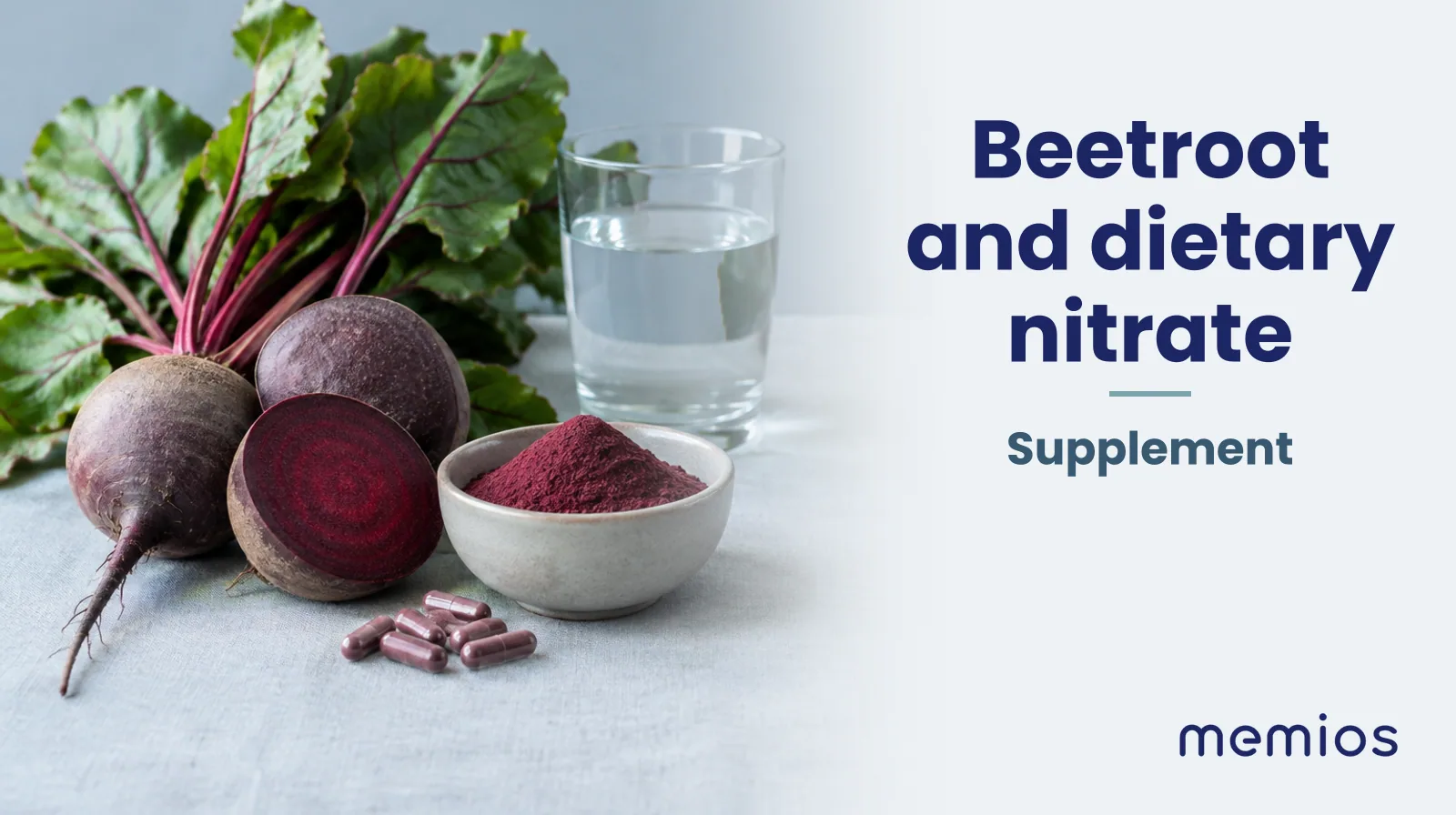
- What it is: Beetroot is a root vegetable rich in inorganic nitrate; it is sold as juice, concentrated "shots" and powder.
- Main use, supported: A 2022 meta-analysis of 7 trials in people with hypertension found beetroot juice lowered systolic blood pressure by about 5 mmHg (moderate certainty) but did not significantly change diastolic pressure. (moderate certainty)
- Other use, supported: Siervo 2013 pooled 16 randomized crossover trials and found inorganic nitrate and beetroot juice lowered systolic blood pressure by 4.4 mmHg; diastolic change was not significant. (low certainty)
- Claim NOT supported by research: A randomized, placebo-controlled crossover trial in 27 people already treated for hypertension found one week of nitrate-rich beetroot juice did not change home or 24-hour blood pressure. (low certainty)
- Another claim NOT supported: In seven healthy volunteers, a chlorhexidine mouthwash before a nitrate dose abolished conversion of nitrate to nitrite in saliva and markedly blunted the rise in blood nitrite. (low certainty)
- Recommended dose: not established. No recommended intake exists for nitrate or beetroot; nitrate is not an essential nutrient.
- Studied dose (a trial dose, not a recommendation): Hypertension trials gave 70 to 250 mL of beetroot juice daily for 3 to 60 days. Findings citing that trial: 1 for.
- Upper limit: EFSA (2017) kept an acceptable daily intake for nitrate of 3.7 mg per kg body weight per day, and noted it may be exceeded when all dietary sources are counted.
- What goes wrong: 3 findings on harm. In 19 healthy volunteers, a week of antiseptic mouthwash cut oral nitrite production by 90% and raised blood pressure by 2 to 3.5 mmHg.
- Common myth: Beetroot juice lowers blood pressure for everyone who drinks it.
What it is
Beetroot is a root vegetable rich in inorganic nitrate; it is sold as juice, concentrated "shots" and powder. Nitrate from beetroot and green leafy vegetables is taken up into saliva and turned into nitrite by bacteria in the mouth, which the body can then convert to nitric oxide.
What the research says
Meta-analyses back a real but modest fall in systolic blood pressure: about 4.4 mmHg in Siervo 2013 (16 short crossover trials, 254 people) and about 5 mmHg in people with hypertension (moderate-certainty GRADE), with diastolic changes small or not significant. Not every trial agrees: a one-week trial in people already on blood pressure treatment found no change. For exercise, an umbrella review found gains in time-to-exhaustion tests and a few other measures but not in most performance outcomes, and rated most of the underlying reviews low to critically low quality. The effect depends on mouth bacteria; antiseptic mouthwash largely blocks nitrate turning into nitrite. Beetroot juice raises urinary N-nitroso compounds, can colour urine red, and nitrate intake has an EFSA acceptable daily intake.
Evidence grade: Limited evidence.
What goes wrong
In 19 healthy volunteers, a week of antiseptic mouthwash cut oral nitrite production by 90% and raised blood pressure by 2 to 3.5 mmHg. (Source 1)
- Randomized trial, Low certainty.
- Size: 19 healthy volunteers.
- Who: Healthy adults.
- How long: 7-day control then 7-day mouthwash.
- Result: Oral nitrite production −90%; plasma nitrite −25%; SBP and DBP +2–3.5 mmHg.
- Funding: not stated.
Antiseptic mouthwash treatment reduced oral nitrite production by 90% (p < 0.001) and plasma nitrite levels by 25% (p = 0.001) compared to the control period.
A randomized trial in 29 active volunteers found beetroot juice sharply raised urinary N-nitroso compounds, a class that is carcinogenic in animals; vitamin C blunted this after one dose but not after seven. (Source 2)
- Randomized trial, Low certainty.
- Size: 29 healthy recreationally active volunteers.
- Who: Healthy adults.
- How long: 1 week.
- Result: Urinary ATNC 5 to 47 nmol/mmol after one dose, 104 nmol/mmol after seven doses (p < 0.0001)
- Funding: not stated.
A significant increase of urinary apparent total N-nitroso Compounds (ATNC) was found after one dose (5 to 47 nmol/mmol: p < 0.0001) and a further increase was found after seven consecutive doses of BRJ (104 nmol/mmol: p < 0.0001).
Pink to deep red urine after eating beets (beeturia) occurs in about 10 to 14% of people, more often in those who are iron deficient or have malabsorptive diseases. (Source 3)
- Official position, Certainty not rated.
- Size: Not applicable.
- Who: General population.
- How long: Not applicable.
- Result: Prevalence 10%-14%.
- Funding: not applicable.
this phenomenon is prevalent in 10%-14% of the population, with increased frequency noted those who are iron deficient or afflicted with malabsorptive diseases.
What the evidence supports
Siervo 2013 pooled 16 randomized crossover trials and found inorganic nitrate and beetroot juice lowered systolic blood pressure by 4.4 mmHg; diastolic change was not significant. (Source 4)
- Meta-analysis, Low certainty.
- Size: 254 participants across 16 trials (7 to 30 per trial)
- Who: Adults, mostly healthy.
- How long: 2 hours to 15 days.
- Result: SBP −4.4 mmHg (95% CI −5.9, −2.8); DBP −1.1 mmHg (95% CI −2.2, 0.1; P = 0.06)
- Funding: not stated in the abstract.
Inorganic nitrate and beetroot juice consumption were associated with greater changes in systolic BP [−4.4 mm Hg (95% CI: −5.9, −2.8); P < 0.001] than diastolic BP [−1.1 mm Hg (95% CI: −2.2, 0.1); P = 0.06].
A 2022 meta-analysis of 7 trials in people with hypertension found beetroot juice lowered systolic blood pressure by about 5 mmHg (moderate certainty) but did not significantly change diastolic pressure. (Source 5)
- Meta-analysis, Moderate certainty.
- Size: 218 participants across 7 RCTs.
- Who: Adults with arterial hypertension.
- How long: 3 to 60 days; 70 to 250 mL/day.
- Result: SBP −4.95 (95% CI −8.88; −1.01); DBP −0.90 mmHg (95% CI −3.16; 1.36; p = 0.06)
- Funding: not stated.
The NO3 derived from BRJ reduces SBP, but not DBP in patients with arterial hypertension.
A 2024 umbrella review and updated meta-analysis of 113 studies found dietary nitrate lowered both systolic and diastolic blood pressure, with larger effects at higher doses and longer durations, but said long-term safety needs study. (Source 6)
- Review of reviews, Certainty not rated.
- Size: 2013 participants across 113 studies.
- Who: Adults.
- How long: Varied.
- Result: Reductions in resting systolic and diastolic BP; effect grew with duration and dose.
- Funding: no specific grant.
The BP-lowering effect became more pronounced with increased study duration and nitrate dosage.
What the evidence does not support
A randomized, placebo-controlled crossover trial in 27 people already treated for hypertension found one week of nitrate-rich beetroot juice did not change home or 24-hour blood pressure, despite large rises in nitrate and nitrite. (Source 7)
- Randomized trial, Low certainty.
- Size: 27 participants.
- Who: Men and women with treated hypertension, Australia.
- How long: 1 week per arm.
- Result: No difference in home or 24-h ambulatory BP vs nitrate-depleted juice.
- Funding: not stated in the abstract; trial registered ACTRN 12613000116729.
However, no differences in home blood pressure and 24-h ambulatory blood pressure were observed with 1-wk intake of nitrate-rich beetroot juice in comparison with the placebo.
In seven healthy volunteers, a chlorhexidine mouthwash before a nitrate dose abolished conversion of nitrate to nitrite in saliva and markedly blunted the rise in blood nitrite. (Source 8)
- Randomized trial, Low certainty.
- Size: 7 healthy volunteers.
- Who: Healthy adults.
- How long: Single-dose crossover.
- Result: Salivary nitrite conversion abolished; plasma nitrite rise markedly attenuated.
- Funding: not stated.
Rinsing the mouth with the antibacterial mouthwash prior to the nitrate load had no effect on nitrate accumulation in saliva or plasma but abolished its conversion to nitrite in saliva and markedly attenuated the rise in plasma nitrite.
Where the evidence is mixed
Siervo 2013 noted that all trials were short and said the findings needed testing in long-term trials and in higher-risk people. (Source 4)
- Meta-analysis, Low certainty.
- Size: 254 participants.
- Who: Adults.
- How long: 2 hours to 15 days.
- Result: Not applicable.
- Funding: not stated.
These findings need to be tested in long-term trials and in individuals at greater cardiovascular risk.
An umbrella review of 20 meta-analyses on exercise found nitrate improved time-to-exhaustion tests modestly, but most other performance outcomes showed no significant improvement and most reviews were low to critically low quality. (Source 9)
- Review of reviews, Low certainty.
- Size: 180 primary studies; 2672 participants.
- Who: Mostly healthy adults; some athletes.
- How long: Acute and chronic dosing.
- Result: Time-to-exhaustion SMD 0.33 (95% CI 0.19–0.47); other outcomes all p > 0.05.
- Funding: not stated.
no significant improvements were found for other performance outcomes (all p > 0.05). The AMSTAR-2 ratings of most included reviews ranged from low to critically low.
Where the research disagrees
Whether dietary nitrate lowers blood pressure in people already treated for hypertension
- Benjamim et al. 2022 meta-analysis, meta-analysis of 7 RCTs: The NO3 derived from BRJ reduces SBP, but not DBP in patients with arterial hypertension. (Source 5)
- Bondonno et al. 2015 trial, RCT, 27 people: An increase in dietary nitrate intake may not be an effective short-term approach to further lower blood pressure in treated hypertensive subjects. (Source 7)
Whether nitrate is a health risk or a benefit
- Berends et al. 2019, RCT, 29 people, urinary biomarker: This is the first study that shows that BRJ supplementation leads to an increase in formation of potentially carcinogenic NOCs. (Source 2)
- EFSA 2017, regulatory assessment: Nitrite is also linked to the formation of a group of compounds known as nitrosamines, some of which cause cancer. (Source 10)
How much
- Reference intake: No recommended intake exists for nitrate or beetroot; nitrate is not an essential nutrient. (Source 10)
- Upper limit: EFSA (2017) kept an acceptable daily intake for nitrate of 3.7 mg per kg body weight per day, and noted it may be exceeded when all dietary sources are counted. (Source 10)
- Studied: Hypertension trials gave 70 to 250 mL of beetroot juice daily for 3 to 60 days. (Source 5)
- Studied: Exercise benefits were larger with at least 6 mmol (372 mg) of nitrate a day taken for more than 3 days. (Source 9)
A common belief, and what the research shows
The belief: Beetroot juice lowers blood pressure for everyone who drinks it.
What the research shows: The pooled effect is modest and not universal; in treated hypertensive adults one trial found "no differences in home blood pressure and 24-h ambulatory blood pressure were observed with 1-wk intake of nitrate-rich beetroot juice in comparison with the placebo."
Questions and answers
What is it?
Beetroot is a root vegetable high in inorganic nitrate. Nitrate is concentrated in saliva and turned into nitrite by mouth bacteria. (Source 1)
What does it do in the body?
Nitrate can be converted to nitric oxide, which widens blood vessels. In trials it lowered systolic blood pressure by around 4 to 5 mmHg on average, with smaller or no effects on diastolic pressure. (Source 4)
Is it good or bad for you?
Modestly good for blood pressure in many trials, but not in every group, and exercise benefits are limited. The same chemistry raises N-nitroso compounds in urine, and EFSA sets an acceptable daily intake for nitrate. (Source 2)
How do you get more of it?
From beetroot, beetroot juice and green leafy vegetables. Trials in hypertension gave 70 to 250 mL of beetroot juice a day. (Source 7)
If it is harmful, what reduces it?
The concern is N-nitroso compound formation. In one trial vitamin C taken with beetroot juice reduced the rise after a single dose, but not after a week of daily doses. (Source 2)
Why might someone be low in it or missing it?
Nitrate is not an essential nutrient, but its benefit depends on mouth bacteria. Antiseptic mouthwash removes those bacteria and blocks nitrate turning into nitrite. (Source 8)
Which whole foods contain it or feed it?
Beetroot and green leafy vegetables are the main whole-food sources; EFSA notes some vegetables contain nitrate in high concentrations. (Source 10)
What happens if you do not have it?
There is no known deficiency. When the mouth bacteria that recycle nitrate were removed with mouthwash, blood pressure rose slightly in healthy volunteers. (Source 1)
How can you test for it?
Research studies measure nitrate and nitrite in blood, saliva and urine; these show recent intake but are not routine clinical tests, and in one trial large rises did not come with lower blood pressure. (Source 7)
References
- Free Radical Biology and Medicine. Physiological role for nitrate-reducing oral bacteria in blood pressure control. 2013. PMID 23183324, DOI 10.1016/j.freeradbiomed.2012.11.013. Read the source
- International Journal of Molecular Sciences. Consumption of Nitrate-Rich Beetroot Juice with or without Vitamin C Supplementation Increases the Excretion of Urinary Nitrate, Nitrite, and N-nitroso Compounds in Humans. 2019. DOI 10.3390/ijms20092277. Read the source
- StatPearls Publishing, NCBI Bookshelf. Beeturia (StatPearls). 2023. PMID 30725697. Read the source
- The Journal of Nutrition. Inorganic Nitrate and Beetroot Juice Supplementation Reduces Blood Pressure in Adults: A Systematic Review and Meta-Analysis. 2013. PMID 23596162, DOI 10.3945/jn.112.170233. Read the source
- Frontiers in Nutrition. Nitrate Derived From Beetroot Juice Lowers Blood Pressure in Patients With Arterial Hypertension: A Systematic Review and Meta-Analysis. 2022. DOI 10.3389/fnut.2022.823039. Read the source
- Journal of Functional Foods. The effects of dietary nitrate on blood pressure and vascular Health: An umbrella review and updated Meta-Analysis and meta-regression. 2024. DOI 10.1016/j.jff.2024.106082. Read the source
- The American Journal of Clinical Nutrition. Absence of an effect of high nitrate intake from beetroot juice on blood pressure in treated hypertensive individuals: a randomized controlled trial. 2015. PMID 26135348, DOI 10.3945/ajcn.114.101188. Read the source
- Nitric Oxide. The increase in plasma nitrite after a dietary nitrate load is markedly attenuated by an antibacterial mouthwash. 2008. PMID 18793740, DOI 10.1016/j.niox.2008.08.003. Read the source
- Sports Medicine. Dietary Nitrate Supplementation and Exercise Performance: An Umbrella Review of 20 Published Systematic Reviews with Meta-analyses. 2025. PMID 40085422, DOI 10.1007/s40279-025-02194-6. Read the source
- European Food Safety Authority. Nitrites and nitrates added to food (EFSA news, 15 June 2017). 2017. Read the source