Supplements · September 29, 2026 · Memios · 16 min read
Bacopa monnieri
Limited evidence. The honest summary is that the effect, if real, is small and narrow.
TLDR
- Limited evidence. The honest summary is that the effect, if real, is small and narrow.
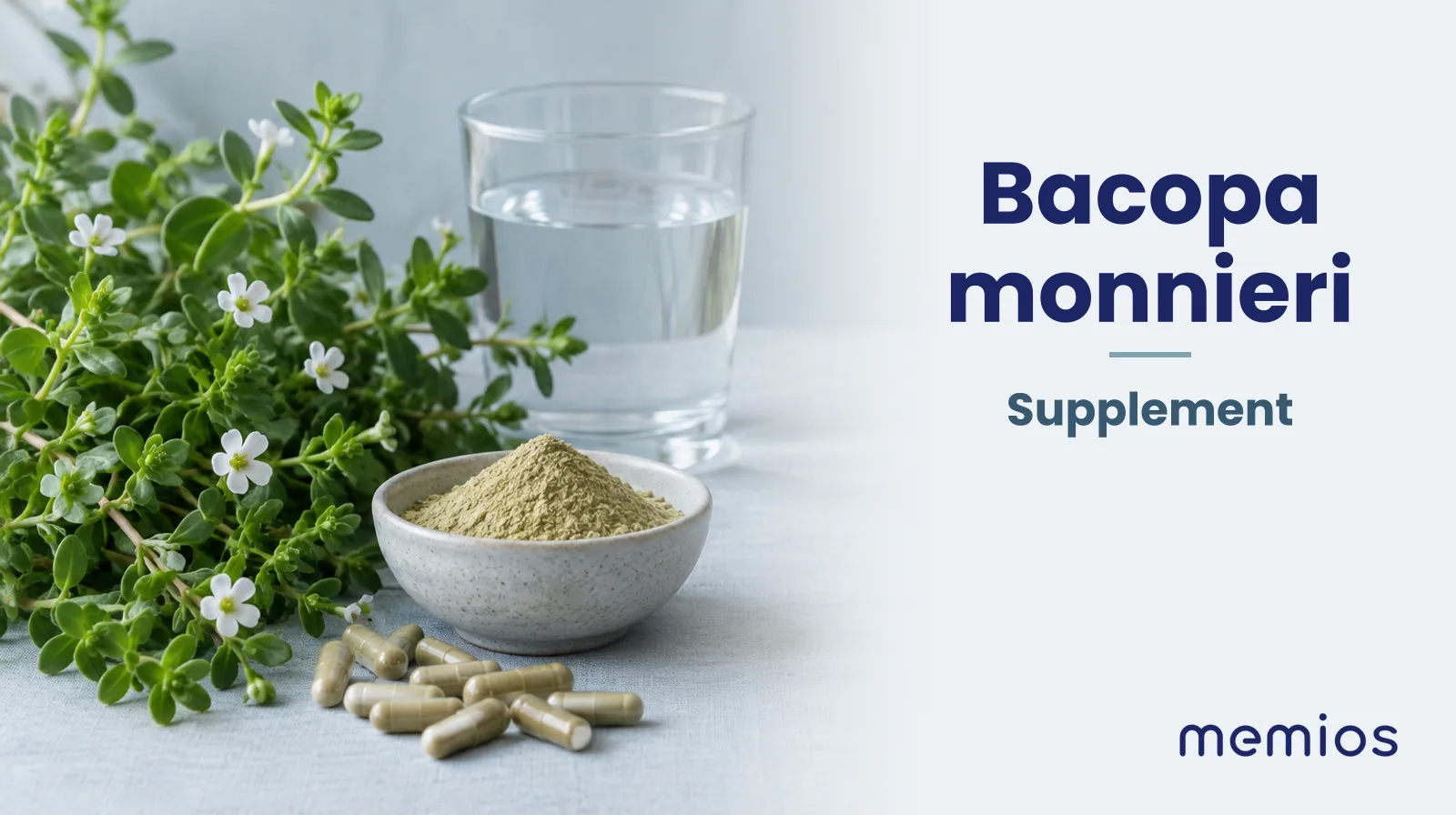
- What it is: Bacopa monnieri is a small creeping marsh plant with oblong leaves and white to purple flowers, native to India, Indochina, Australia and Sri Lanka.
- Main use, supported: A meta-analysis of randomised trials found Bacopa monnieri shortened Trail B completion time and choice reaction time versus placebo. (low certainty)
- Other use, supported: In a 12-week randomised placebo-controlled trial in older adults, 300 mg/day of standardised extract improved delayed word recall and Stroop performance. (low certainty)
- Claim NOT supported by research: A randomised, double-blind, placebo-controlled trial in healthy older adults found no cognitive benefit, and slower reaction time on one task in the Bacopa group. (moderate certainty)
- Another claim NOT supported: The same meta-analysis reports no improvement on the memory outcomes it pooled, and calls the memory result inconclusive because of high heterogeneity. (low certainty)
- Recommended dose: not established. No reference intake (RDA or AI) has been set for Bacopa monnieri by any body, because it is a medicinal herb rather than a nutrient: it has a traditional role in Ayurvedic medicine, not a dietary requirement.
- Studied dose (a trial dose, not a recommendation): A reference chapter gives the typical adult range as 300 to 450 mg per day of Bacopa extract standardised to 24% to 55% bacosides, alongside traditional crude herb and tincture doses. No finding here cites that trial.
- Upper limit: No tolerable upper intake level or acceptable daily intake has been set.
- What goes wrong: 6 findings on harm. One-fifth of Ayurvedic medicines bought over the internet - the product category in which Bacopa is sold as brahmi - contained detectable lead, mercury or arsenic.
- Common myth: Bacopa is a proven memory enhancer - the studies show it improves memory.
What it is
Bacopa monnieri is a small creeping marsh plant with oblong leaves and white to purple flowers, native to India, Indochina, Australia and Sri Lanka. In Ayurvedic medicine it is known as "brahmi" and used as a "brain tonic". Its characteristic constituents are triterpenoid saponins called bacosides, which are what commercial extracts are standardised to. A reference chapter gives the typical adult range as 300 to 450 mg per day of extract standardised to 24% to 55% bacosides.
What the research says
The honest summary is that the effect, if real, is small and narrow. The largest meta-analysis found faster performance on two timed tasks but could not find improvement in most memory outcomes it examined. An earlier systematic review found improvement on 9 of 17 free-recall tests and 'little evidence of enhancement in any other cognitive domains'. A 2021 randomised trial in healthy older adults found no benefit and, on one task, slower reaction times in the Bacopa group. Gastrointestinal side effects - increased stool frequency, nausea, cramps, diarrhoea - are the consistently reported downside, and the plant is sold within an Ayurvedic product category in which one-fifth of internet-purchased medicines have been found to contain detectable lead, mercury or arsenic.
Evidence grade: Limited evidence.
What goes wrong
Gastrointestinal adverse events are the consistently reported harm in Bacopa trials. (Source 1)
- Meta-analysis, Low certainty.
- Size: Nine randomised trials, 518 subjects.
- Who: Trial participants receiving Bacopa monnieri extract.
- How long: Trials generally 12 weeks.
- Result: Eight of the included studies reported no serious adverse events in either arm; the events commonly reported in the Bacopa groups were gastrointestinal, including increased stool frequency, nausea, abdominal cramps and diarrhoea. The review does not give pooled rates.
- Funding: not stated.
The adverse events commonly reported in Bacopa monnieri group were gastrointestinal problems including increased stool frequency, nausea, abdominal cramps, and diarrhea.
In a 12-week randomised trial, adverse events occurred in both arms and were mainly stomach upset. (Source 2)
- Randomized trial, Low certainty.
- Size: Bacopa n = 9 and placebo n = 10 participants with adverse events.
- Who: Elderly trial participants.
- How long: 12 weeks.
- Result: Adverse events in 9 Bacopa and 10 placebo participants, primarily stomach upset.
- Funding: not stated.
The dose was well tolerated with few adverse events (Bacopa n = 9, placebo n = 10), primarily stomach upset.
Bacopa inhibits several human cytochrome P450 enzymes in laboratory work, which creates a route for herb-drug interactions. (Source 3)
- Expert review, not systematic, Low certainty.
- Size: n/a (review of laboratory and clinical literature)
- Who: People taking medicines metabolised by CYP1A2, CYP2C9, CYP3A4 or CYP2C19.
- How long: n/a.
- Result: Inhibition of CYP1A2, CYP2C9, CYP3A4 and CYP2C19 reported; interaction with thyroid hormone also flagged.
- Funding: not stated.
Bacopa has been shown to inhibit human cytochrome P450 enzymes, which could contribute to herb-drug interactions when co-administered orally with medications metabolized by CYP1A2, CYP2C9, CYP3A4, and CYP2C19.
A reference chapter flags a possible interaction with thyroid hormone, resting on a mouse finding rather than on human data. (Source 3)
- Expert review, not systematic, Very low certainty.
- Size: n/a.
- Who: People taking thyroid hormone.
- How long: n/a.
- Result: Thyroxine (T4) reported raised by about 40% in mice; the chapter advises caution or avoidance in people with a thyroid condition or taking thyroid hormone medicines. No human trial data cited.
- Funding: not stated.
Animal research suggests Bacopa may increase thyroxine levels (T4) in mice by about 40%. It should be used cautiously (or avoided) in those with a thyroid condition or who take thyroid hormone medications.
A reference chapter describes Bacopa as generally well tolerated, with gastrointestinal upset as the most common side effect. (Source 4)
- Expert review, not systematic, Low certainty.
- Size: n/a (reference review of the clinical literature)
- Who: People taking Bacopa monnieri preparations.
- How long: n/a.
- Result: Most common side effects gastrointestinal: increased stool frequency, nausea and abdominal cramps. The same chapter reports reduced sperm count, motility and viability in animals at 250 mg/kg/day, and mild sedation.
- Funding: not stated.
The most common side effects are gastrointestinal, including increased stool frequency, nausea, and abdominal cramps.
One-fifth of Ayurvedic medicines bought over the internet - the product category in which Bacopa is sold as brahmi - contained detectable lead, mercury or arsenic. (Source 5)
- Survey study, Moderate certainty.
- Size: 193 Ayurvedic medicines purchased from 25 internet sites.
- Who: US- and Indian-manufactured Ayurvedic medicines sold online (not specifically Bacopa products)
- How long: n/a.
- Result: 20.7% (95% CI 15.2%-27.1%) contained detectable lead, mercury or arsenic; 21.7% of US-made versus 19.5% of Indian-made products; rasa shastra medicines 40.6% versus 17.1% for others (P = .007)
- Funding: not stated.
One-fifth of both US-manufactured and Indian-manufactured Ayurvedic medicines purchased via the Internet contain detectable lead, mercury, or arsenic.
What the evidence supports
A meta-analysis of randomised trials found Bacopa monnieri shortened Trail B completion time and choice reaction time versus placebo. (Source 6)
- Meta-analysis, Low certainty.
- Size: Nine trials, 518 subjects; meta-analysis of 437 eligible subjects.
- Who: Healthy volunteers and people with memory impairment.
- How long: Trials generally 12 weeks.
- Result: Trail B test shortened: -17.9 ms (95% CI -24.6 to -11.2; p<0.001). Choice reaction time decreased: printed as 10.6 ms (95% CI -12.1 to -9.2; p<0.001). Both are reductions in milliseconds, as reported by the authors.
- Funding: not stated.
Limit of this finding: Two problems with the numbers as the source prints them. First, both results are reductions in time, but the choice-reaction-time estimate is printed as 10.6 ms with no minus sign while its own 95% confidence interval, -12.1 to -9.2, is entirely below zero, so the point estimate as printed falls outside its own interval; the same figure is printed the same way in the published abstract record. Read it as a shortening of about 10.6 ms, not a slowing. Second, the review labels both outcomes in milliseconds, including the Trail Making Test B, a pencil-and-paper task whose completion time is normally recorded in seconds; the review uses 'ms' consistently, so it does not contradict itself, but a 17.9 millisecond change is not a quantity anyone would notice, and the unit should not be taken at face value. Treat these as small changes in test speed of uncertain real-world size.
Meta-analysis of 437 eligible subjects showed improved cognition by shortened Trail B test
In a 12-week randomised placebo-controlled trial in older adults, 300 mg/day of standardised extract improved delayed word recall and Stroop performance. (Source 2)
- Randomized trial, Low certainty.
- Size: Randomised older adults (trial as reported; arm sizes not given in the abstract)
- Who: Elderly participants.
- How long: 12 weeks.
- Result: Enhanced AVLT delayed word recall versus placebo; Stroop improved in the Bacopa group and unchanged in placebo. The abstract reports no p values or effect sizes.
- Funding: not stated.
Bacopa participants had enhanced AVLT delayed word recall memory scores relative to placebo. Stroop results were similarly significant, with the Bacopa group improving and the placebo group unchanged.
What the evidence does not support
The same meta-analysis reports no improvement on the memory outcomes it pooled, and calls the memory result inconclusive because of high heterogeneity. (Source 7)
- Meta-analysis, Low certainty.
- Size: Nine trials, 518 subjects.
- Who: Healthy volunteers and people with memory impairment.
- How long: Trials generally 12 weeks.
- Result: No improvement in picture recognition, numeric working memory, AVLT, word recognition or spatial working memory; the authors attribute the inconclusive memory result to high heterogeneity.
- Funding: not stated.
Based on our meta-analysis, Bacopa monnieri did not improve the memory function in terms of picture recognition, numeric working memory, AVLT, word recognition, and spatial working memory.
An earlier systematic review found benefit confined to memory free recall, with little sign of enhancement elsewhere. (Source 8)
- Systematic review, Low certainty.
- Size: Randomised controlled human trials; 9 of 17 free-recall tests improved.
- Who: Adults in randomised controlled trials of Bacopa.
- How long: Varied across included trials.
- Result: Improvement on 9 of 17 memory free-recall tests; no consistent improvement in other cognitive domains.
- Funding: not stated.
Across studies, Bacopa improved performance on 9 of 17 tests in the domain of memory free recall. There was little evidence of enhancement in any other cognitive domains.
A randomised, double-blind, placebo-controlled trial in healthy older adults found no cognitive benefit, and slower reaction time on one task in the Bacopa group. (Source 9)
- Randomized trial, Moderate certainty.
- Size: 28 healthy adults aged over 55.
- Who: Healthy older adults, all doing cognitive training three hours weekly.
- How long: 12 weeks.
- Result: Slower reaction time on an image discrimination task in the Bacopa group and faster reaction time on a spatial working memory task in the placebo group; no other outcome reached statistical significance.
- Funding: not stated.
Results demonstrated slower reaction time in an image discrimination task in the BM group and faster reaction time in a spatial working memory task in the placebo group.
The US Department of Defense's supplement safety programme holds that the evidence for bacopa and cognitive performance is inconclusive. (Source 10)
- Official position, Certainty not rated.
- Size: n/a.
- Who: Military service members and general consumers.
- How long: Position as published, page updated 04 January 2021.
- Result: Evidence judged inconclusive; listed side effects dry mouth, nausea, diarrhoea and fatigue.
- Funding: US Department of Defense / Uniformed Services University.
The evidence is inconclusive as to whether bacopa can help Military Service Members reach their health goals for cognitive performance and brain health.
Where the research disagrees
Whether Bacopa monnieri improves cognition, and in what domain
- Kongkeaw and colleagues, Journal of Ethnopharmacology meta-analysis, meta-analysis of nine RCTs, 518 subjects: This meta-analysis suggests that Bacopa monnieri has the potential to improve cognition, particularly speed of attention but only a large well designed 'head-to-head' trial against an existing medication will provide definitive data on its efficacy on healthy or dementia patients using a standardized preparation. (Source 11)
- Pase and colleagues, systematic review, systematic review of randomised controlled human trials: There is some evidence to suggest that Bacopa improves memory free recall with evidence for enhancement in other cognitive abilities currently lacking perhaps due to inconsistent measures employed by studies across these cognitive domains. (Source 8)
- McPhee and colleagues, randomised placebo-controlled trial in healthy older adults, randomised, double-blind, placebo-controlled trial, 28 adults over 55, 12 weeks: No other outcomes reached statistical significance. (Source 9)
How safe Bacopa monnieri is
- StatPearls reference chapter, narrative reference review of the clinical literature: There has been no human toxicity demonstrated with the use of Bacopa monniera in humans. (Source 12)
- The trial literature as summarised by Kongkeaw and colleagues, meta-analysis of nine randomised trials: The adverse events commonly reported in Bacopa monnieri group were gastrointestinal problems including increased stool frequency, nausea, abdominal cramps, and diarrhea. (Source 1)
How much
- Reference intake: No reference intake (RDA or AI) has been set for Bacopa monnieri by any body, because it is a medicinal herb rather than a nutrient: it has a traditional role in Ayurvedic medicine, not a dietary requirement. (Source 10)
- Upper limit: No tolerable upper intake level or acceptable daily intake has been set. The closest statement in the reference literature is that human toxicity has not been demonstrated, which is an absence of evidence rather than a defined safe ceiling. (Source 12)
- Studied: A reference chapter gives the typical adult range as 300 to 450 mg per day of Bacopa extract standardised to 24% to 55% bacosides, alongside traditional crude herb and tincture doses. (Source 13)
- Studied: A randomised trial in older adults gave standardised B. monnieri extract 300 mg/day, or matching placebo, for 12 weeks. (Source 2)
- Studied: A trial in healthy adults over 55 combined the extract with three hours of weekly cognitive training over 12 weeks. (Source 9)
A common belief, and what the research shows
The belief: Bacopa is a proven memory enhancer - the studies show it improves memory.
What the research shows: The improvement that survives pooling is in speed on timed tasks, not memory in general. The largest meta-analysis states that 'Bacopa monnieri did not improve the memory function in terms of picture recognition, numeric working memory, AVLT, word recognition, and spatial working memory.' The earlier systematic review found 'little evidence of enhancement in any other cognitive domains' beyond free recall, and a 2021 randomised trial in healthy older adults reported that 'No other outcomes reached statistical significance.'
Questions and answers
What is it?
Bacopa monnieri is a small creeping marsh plant with oblong leaves and white to purple flowers. It is best known in Ayurvedic medicine, where it is called brahmi, and it also goes by water hyssop and the herb of grace. Supplements are made from extracts of the plant, standardised to their bacoside content. (Source 14)
What does it do in the body?
Its characteristic constituents are triterpenoid saponins called bacosides, and the reference literature attributes most of the plant's pharmacological activity to them. StatPearls states that purified bacosides A and B, as well as bacopa alcoholic extract, may facilitate learning ability, memory and cognitive performance. In human trials the measurable effects are modest and mostly on speed of task completion rather than on memory itself. (Source 15)
Is it good or bad for you?
Neither clearly. The evidence for a cognitive benefit is thin and domain-specific - some improvement in free recall and in timed tasks, nothing consistent elsewhere. Against that sit reliable gastrointestinal side effects, laboratory evidence of cytochrome P450 inhibition that could affect other medicines, and the contamination risk of the Ayurvedic product category. (Source 8)
How do you get more of it?
Bacopa reaches people almost entirely through standardised extracts sold as capsules or powders, and in traditional use as crude herb or a tincture. A reference chapter gives the typical range for adults as 300 to 450 mg per day of extract standardised to 24% to 55% bacosides. Trials of the extract have generally run for about 12 weeks. That is a description of what is used and what was studied, not a recommendation. (Source 13)
If it is harmful, what reduces it?
This largely does not apply: Bacopa is not something the body accumulates or needs to clear, and stopping the supplement ends the exposure. The reference literature states that human toxicity has not been demonstrated, although gastrointestinal effects during use are common and resolve when it is stopped. (Source 12)
Why might someone be low in it or missing it?
Nobody is deficient in Bacopa. It is a medicinal herb rather than a nutrient, so there is no requirement to fall short of and no deficiency state described in the literature. A person simply has none unless they take it. (Source 10)
Which whole foods contain it or feed it?
Bacopa is a wetland plant native to India, Indochina, Australia and Sri Lanka, used medicinally rather than as a staple food. It is not a meaningful component of an ordinary diet anywhere outside traditional use, and no common whole food supplies bacosides. (Source 15)
What happens if you do not have it?
Nothing happens, because there is no deficiency state. The question that matters is whether taking it adds anything, and on that the US Department of Defense's supplement safety programme judges the evidence inconclusive. (Source 10)
How can you test for it?
There is no clinical test of a person’s Bacopa status, because there is no status to measure. What is measured is the product: extracts are standardised by laboratory assay to a stated percentage of bacosides, which a reference chapter gives as 24% to 55% for adult products. That is a quality-control measure for the supplement, not a health test for the person taking it. (Source 13)
We searched: Searched PubMed, the DARE review record, Frontiers, the StatPearls chapter and the US Department of Defense OPSS page for a Bacopa biomarker, blood test, bacoside assay in humans or monitoring recommendation; found only product standardisation.
References
- Journal of Ethnopharmacology (full-text PDF read at gwern.net mirror). Meta-analysis of randomized controlled trials on cognitive effects of Bacopa monnieri extract (full text, section 3.7 Adverse effects of Bacopa monnieri). 2014. PMID 24252493, DOI 10.1016/j.jep.2013.11.008. Read the source
- The Journal of Alternative and Complementary Medicine. Effects of a standardized Bacopa monnieri extract on cognitive performance, anxiety, and depression in the elderly: a randomized, double-blind, placebo-controlled trial. 2008. PMID 18611150, DOI 10.1089/acm.2008.0018. Read the source
- StatPearls Publishing, NCBI Bookshelf; last update 17 March 2023. Bacopa monnieri (StatPearls). 2023. Read the source
- StatPearls Publishing, NCBI Bookshelf; last update 17 March 2023. Bacopa monnieri (StatPearls). 2023. Read the source
- JAMA. Lead, Mercury, and Arsenic in US- and Indian-Manufactured Ayurvedic Medicines Sold via the Internet. 2008. PMID 18728265, DOI 10.1001/jama.300.8.915. Read the source
- Journal of Ethnopharmacology (record read at NCBI Bookshelf DARE NBK174753). Meta-analysis of randomized controlled trials on cognitive effects of Bacopa monnieri extract (abstract, Results section). 2014. PMID 24252493, DOI 10.1016/j.jep.2013.11.008. Read the source
- Journal of Ethnopharmacology (full-text PDF read at gwern.net mirror). Meta-analysis of randomized controlled trials on cognitive effects of Bacopa monnieri extract (full text, Discussion paragraph on memory outcomes). 2014. PMID 24252493, DOI 10.1016/j.jep.2013.11.008. Read the source
- Journal of Alternative and Complementary Medicine; record in the Database of Abstracts of Reviews of Effects (DARE), NCBI Bookshelf. The cognitive-enhancing effects of Bacopa monnieri: a systematic review of randomized, controlled human clinical trials (DARE structured abstract). 2012. PMID 22747190. Read the source
- Frontiers in Aging Neuroscience. The Neurocognitive Effects of Bacopa monnieri and Cognitive Training on Markers of Brain Microstructure in Healthy Older Adults. 2021. DOI 10.3389/fnagi.2021.638109. Read the source
- Operation Supplement Safety (OPSS), Consortium for Health and Military Performance, Uniformed Services University; page updated 04 January 2021. Bacopa Monnieri: Dietary Supplements for Brain Health. 2021. Read the source
- Journal of Ethnopharmacology (record read at NCBI Bookshelf DARE NBK174753). Meta-analysis of randomized controlled trials on cognitive effects of Bacopa monnieri extract (abstract, Conclusion section). 2014. PMID 24252493, DOI 10.1016/j.jep.2013.11.008. Read the source
- StatPearls Publishing, NCBI Bookshelf; last update 17 March 2023. Bacopa monnieri (StatPearls). 2023. Read the source
- StatPearls Publishing, NCBI Bookshelf; last update 17 March 2023. Bacopa monnieri (StatPearls). 2023. Read the source
- StatPearls Publishing, NCBI Bookshelf; last update 17 March 2023. Bacopa monnieri (StatPearls). 2023. Read the source
- StatPearls Publishing, NCBI Bookshelf; last update 17 March 2023. Bacopa monnieri (StatPearls). 2023. Read the source