Supplements · September 29, 2026 · Memios · 10 min read
Astragalus
Limited evidence. The evidence is limited and mostly low quality.
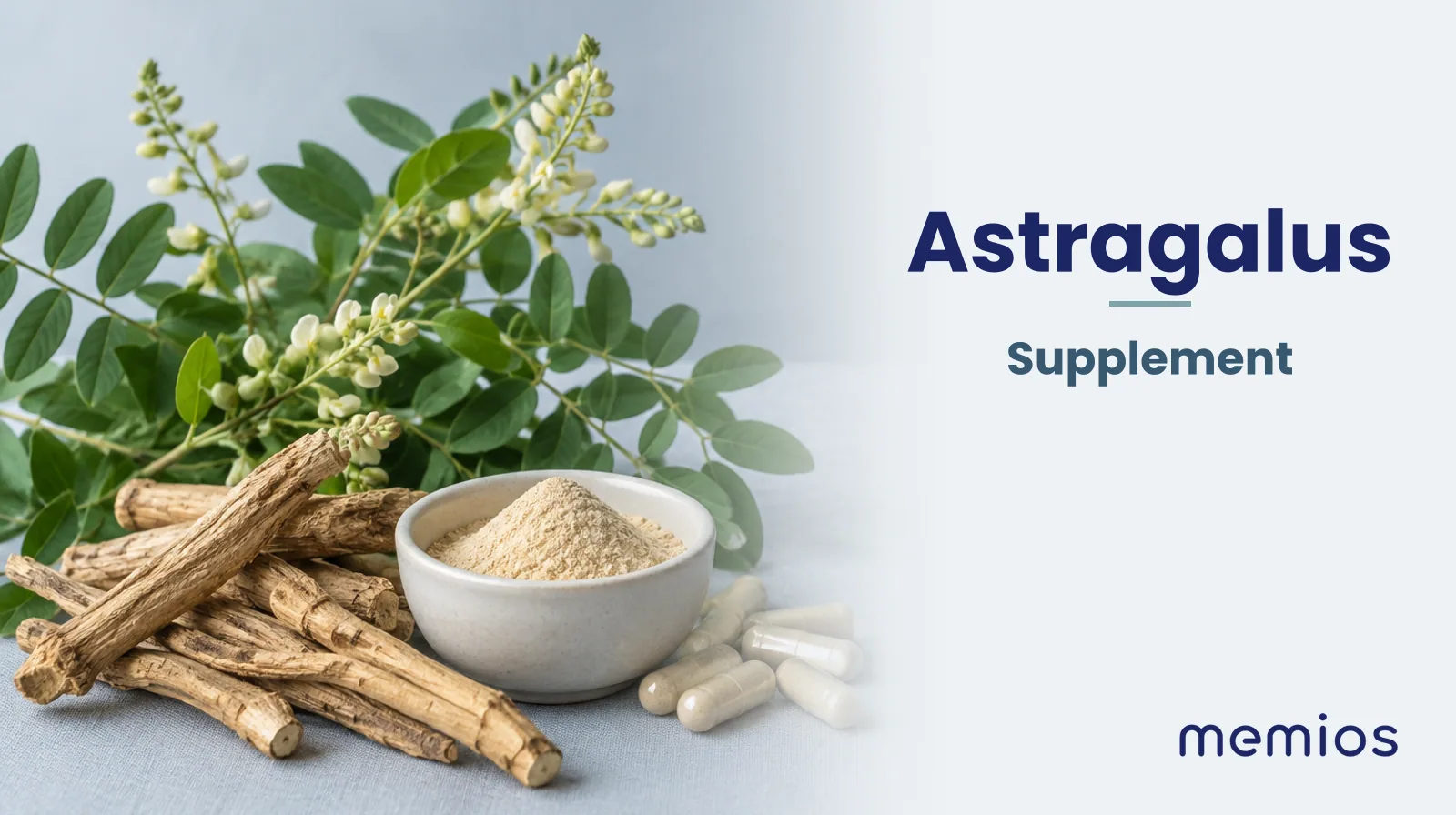
TLDR
- Limited evidence. The evidence is limited and mostly low quality.
- What it is: Astragalus is a traditional Chinese herbal medicine made from the dried roots of Astragalus species native to China, Korea and North America. It is sold as root slices, powders, capsules and extracts; in Asian hospitals it is also given as an intravenous injection or as purified polysaccharides (PG2).
- Main use, supported: A meta-analysis of 14 RCTs reported that astragalus-containing Chinese herbal medicine added to Western treatment for lupus nephritis improved response and lowered adverse events; 11 of 14 trials had some concerns for bias. (low certainty)
- Other use, supported: A CAM-Cancer evidence summary concluded intravenous astragalus during chemotherapy probably improves fatigue in advanced cancer; the evidence mainly concerns injections in Chinese trials, not oral supplements. (low certainty)
- Claim NOT supported by research: In a placebo-controlled phase 2 trial, injected astragalus polysaccharides (PG2) did not change the primary fatigue score in women having chemotherapy for early breast cancer; benefit appeared only in a premenopausal subgroup. (low certainty)
- Another claim NOT supported: The same PG2 trial found no difference in severe blood toxicity, dose reductions or treatment delays versus placebo. (low certainty)
- Recommended dose: not established. No RDA or AI exists: astragalus is an herb, not an essential nutrient. NCCIH (2025) notes a thorough safety evaluation has not been done.
- Studied dose (a trial dose, not a recommendation): Breast cancer trial: PG2 (astragalus polysaccharides) 500 mg by injection on days 1, 3 and 8 of each 21-day chemotherapy cycle. Findings citing that trial: 2 against, 1 on harm.
- Upper limit: No official upper limit has been set.
- What goes wrong: 5 findings on harm. Seven adverse events in the PG2 trial were judged caused by the drug, including fever, hypersensitivity, rash and urticaria.
- Common myth: Astragalus is a proven immune booster that works for everyone and is completely safe.
What it is
Astragalus is a traditional Chinese herbal medicine made from the dried roots of Astragalus species native to China, Korea and North America. It is sold as root slices, powders, capsules and extracts; in Asian hospitals it is also given as an intravenous injection or as purified polysaccharides (PG2).
What the research says
The evidence is limited and mostly low quality. Reviews of mainly Chinese trials, often of astragalus injections added to conventional drugs, report better lab markers in kidney disease and lupus nephritis and less fatigue during chemotherapy, but Cochrane rated the kidney evidence low quality. A placebo-controlled trial in breast cancer found no difference in its main fatigue outcome. NIH's NCCIH says there is not enough reliable evidence that it helps any condition. It is generally well tolerated, but formal safety testing is thin and herb-drug interaction data in humans are sparse.
Evidence grade: Limited evidence.
What goes wrong
Seven adverse events in the PG2 trial were judged caused by the drug, including fever, hypersensitivity, rash and urticaria. (Source 1)
- Randomized trial, Low certainty.
- Size: 66 patients.
- Who: Women with early breast cancer.
- How long: Cycles 1-4.
- Result: 7 treatment-related adverse events: pyrexia (2), adverse drug reaction, cold, hypersensitivity, rash, urticaria (1 each)
- Funding: industry-funded (PhytoHealth Co.)
Only seven AEs were causally related to PG2 treatment, including pyrexia (two participants), adverse drug reactions, cold, hypersensitivity, rash, and urticaria (one participant for each AE).
Reported adverse effects in the literature summarised by CAM-Cancer include rash, itching and hypersensitivity; human interaction data are insufficient. (Source 2)
- Systematic review, Low certainty.
- Size: Summary of published studies.
- Who: People with cancer.
- How long: Varied.
- Result: Qualitative list of adverse effects; no rates given.
- Funding: independent.
rash, eczema, pruritus, feeling cold, chills, and hypersensitivity.
In a test-tube study, a product combining astragalus, eleuthero and Phlomis extracts inhibited the drug-metabolising enzyme CYP2B6; whether this matters in people is unknown. (Source 3)
- Lab study in cells, Very low certainty.
- Size: Enzyme assay.
- Who: Recombinant human P450 enzymes.
- How long: Not applicable.
- Result: Only CYP2B6 markedly inhibited (IC50 10.62 µg/ml, reported); inhibition attributed to shanzhiside methylester, not the astragalus component.
- Funding: not stated.
Among the six P450 enzymes (1A2, 2A6, 2B6, 2D6, 2C9, and 3A4), only P450 2B6 activity was markedly decreased by AEM HT042 addition.
LiverTox (position, 2019) rates astragalus an unlikely cause of liver injury; published human studies reported no liver enzyme rises or hepatotoxicity. (Source 4)
- Official position, Certainty not rated.
- Size: Not applicable.
- Who: Not applicable.
- How long: Not applicable.
- Result: Likelihood score E.
- Funding: government (NIH)
Astragalus is considered generally safe and without major adverse effects. In the few human studies that have been published there were no reports of serum enzyme elevations occurring during therapy and no mention of serious adverse events or hepatotoxicity.
NCCIH (position, updated May 2025) says there is not enough reliable evidence that astragalus helps any condition, advises that people with autoimmune disease avoid it, and warns of possible interactions with immunosuppressant drugs. (Source 5)
- Official position, Certainty not rated.
- Size: Not applicable.
- Who: Not applicable.
- How long: Not applicable.
- Result: Not applicable.
- Funding: government (NIH)
Astragalus may interact with medications that suppress the immune system.
What the evidence supports
A meta-analysis of 14 RCTs reported that astragalus-containing Chinese herbal medicine added to Western treatment for lupus nephritis improved response and lowered adverse events; 11 of 14 trials had some concerns for bias. (Source 6)
- Meta-analysis, Low certainty.
- Size: 800 patients in 14 RCTs.
- Who: Adults with lupus nephritis.
- How long: Varied.
- Result: Adverse events RR 0.56 (95% CI 0.42-0.73) vs Western medicine alone; only one trial at low risk of bias.
- Funding: no funding received (stated)
The analysis included 14 RCTs, with a total of 800 patients (417 in the treatment group and 383 in the control group)
A CAM-Cancer evidence summary concluded intravenous astragalus during chemotherapy probably improves fatigue in advanced cancer; the evidence mainly concerns injections in Chinese trials, not oral supplements. (Source 2)
- Systematic review, Low certainty.
- Size: Multiple reviews and RCTs summarised.
- Who: People with advanced cancer on chemotherapy.
- How long: Varied.
- Result: Qualitative: 'probably improves' fatigue; 'probably improve objective response and 1-year survival' in advanced NSCLC on platinum chemotherapy.
- Funding: independent (CAM-Cancer collaboration)
IV infusion of Astragalus three times weekly during chemotherapy probably improves fatigue for people with advanced cancer.
A small 6-month placebo-controlled trial of an astragalus-based supplement reported longer telomeres; telomere length is a lab marker, not a health outcome, and 40 people is a very small sample. (Source 7)
- Randomized trial, Very low certainty.
- Size: 40 healthy volunteers.
- Who: Middle-aged adults (mean age 56)
- How long: 6 months.
- Result: Median telomere length longer vs placebo (reported p = 0.01); no adverse effects reported.
- Funding: no external funding stated; product was a commercial astragalus-based supplement.
In this study, we conducted a randomized, double-blind, placebo-controlled trial over six months to compare the effects of the Astragalus-based supplement versus a placebo on telomere length (TL) in 40 healthy volunteers (mean age 56.1 ± 6.0 years).
What the evidence does not support
In a placebo-controlled phase 2 trial, injected astragalus polysaccharides (PG2) did not change the primary fatigue score in women having chemotherapy for early breast cancer; benefit appeared only in a premenopausal subgroup. (Source 1)
- Randomized trial, Low certainty.
- Size: 66 patients.
- Who: Women with stage II/III breast cancer on anthracycline chemotherapy.
- How long: First four 21-day cycles.
- Result: Mean change in fatigue global score and fatigue intensity: no significant difference between groups.
- Funding: industry-funded (PhytoHealth Co., the PG2 maker)
The mean change in the FGS and fatigue intensity did not significantly differ between both groups.
The same PG2 trial found no difference in severe blood toxicity, dose reductions or treatment delays versus placebo. (Source 1)
- Randomized trial, Low certainty.
- Size: 66 patients.
- Who: Women with early breast cancer on chemotherapy.
- How long: Cycles 1-4.
- Result: No significant difference in grade 3/4 haematologic toxicity, dose reductions or delays.
- Funding: industry-funded (PhytoHealth Co.)
The incidence of participants with grade 3/4 hematologic toxicities, chemotherapy dose reductions, treatment delays, or granulocyte colony-stimulating factor treatment from cycles 1–4 did not significantly differ among the study groups.
Where the evidence is mixed
A Cochrane review found astragalus added to usual care may lower serum creatinine and urine protein in chronic kidney disease, but judged the evidence low quality. (Source 8)
- Systematic review, Low certainty.
- Size: 22 included studies.
- Who: People with chronic kidney disease, mostly in China.
- How long: Varied.
- Result: Direction favoured astragalus for creatinine and proteinuria; authors say study flaws likely biased results.
- Funding: independent (Cochrane)
evidence quality was low. We found that errors and omissions in study methods and reporting were likely to have flawed results among the studies we assessed.
Where the research disagrees
Whether astragalus has proven benefit for any condition
- Lupus nephritis meta-analysis authors (2024), meta-analysis of 14 RCTs, mostly with some risk-of-bias concerns: The inclusion of Astragalus-containing CHM alongside Western medicine may be a promising strategy for to improve the therapeutic effectiveness and reduce toxicity in the treatment of LN. (Source 6)
- NCCIH (NIH), 2025, position based on review of the literature: There is not sufficient reliable scientific evidence to know whether astragalus is useful for any health condition. (Source 5)
How much
- Reference intake: No RDA or AI exists: astragalus is an herb, not an essential nutrient. NCCIH (2025) notes a thorough safety evaluation has not been done. (Source 5)
- Upper limit: No official upper limit has been set. NCCIH (2025) reports that up to 60 g per day for as long as 4 months does not seem to cause adverse effects; this is a position, not a formal UL. (Source 5)
- Studied: Breast cancer trial: PG2 (astragalus polysaccharides) 500 mg by injection on days 1, 3 and 8 of each 21-day chemotherapy cycle. (Source 1)
- Studied: Kidney disease trials: mostly astragalus injection given with conventional treatment. (Source 8)
A common belief, and what the research shows
The belief: Astragalus is a proven immune booster that works for everyone and is completely safe.
What the research shows: Most human evidence comes from small, low-quality trials of injected products added to other treatment. Cochrane wrote that 'evidence quality was low', and NCCIH says 'a thorough safety evaluation has not been done.'
Questions and answers
What is it?
Astragalus is an herbal medicine made from the dried root of Astragalus plants, used in traditional Chinese medicine for more than 2,000 years. It is sold as dried root, powder, capsules and extracts. In some Asian hospitals it is also given by injection. (Source 4)
What does it do in the body?
It is claimed to support the immune system. In trials, mostly of injected forms given alongside standard treatment, it changed some kidney and immune markers and may have reduced chemotherapy fatigue. The evidence is low quality, and NCCIH says it is not known to help any condition. (Source 5)
Is it good or bad for you?
Taken by mouth, it seems to be well tolerated in short studies, and LiverTox found no liver injury in published studies. Possible downsides include allergic-type reactions, possible worsening of autoimmune disease, and possible interactions with drugs that suppress the immune system. Animal studies raise concerns about use in pregnancy. (Source 5)
How do you get more of it?
Astragalus is not found in ordinary Western foods. People get it from root preparations, capsules or extracts. Studies have also used hospital injections and purified polysaccharides (PG2). (Source 1)
If it is harmful, what reduces it?
Does not apply in the usual sense. Astragalus is not made by the body and is not considered harmful at studied doses. It is only present if someone takes it. No reported liver injury has been linked to it. (Source 4)
Why might someone be low in it or missing it?
Does not apply. Astragalus is not a nutrient the body needs, so nobody is 'low' in it. We found no literature describing deficiency. (Source 5)
We searched: NCCIH, LiverTox, Cochrane CKD review and CAM-Cancer summary; no deficiency concept in any source
Which whole foods contain it or feed it?
No whole Western food supplies astragalus. It is used as a dried root, including in traditional Chinese soups, but we found no source on food content that we could quote. (Source 4)
We searched: NCCIH, LiverTox, CAM-Cancer and review searches for dietary sources
What happens if you do not have it?
Nothing is known to happen. Astragalus is not an essential nutrient, and no source describes effects from not taking it. (Source 5)
We searched: NCCIH and LiverTox monographs
How can you test for it?
No clinical test measures astragalus in the body. Research labs can measure its compounds in blood, but no validated test exists for consumers or doctors. (Source 4)
We searched: NCCIH, LiverTox, CAM-Cancer; no clinical assay described
References
- Scientific Reports. Astragalus polysaccharides improve adjuvant chemotherapy-induced fatigue for patients with early breast cancer. 2024. DOI 10.1038/s41598-024-76627-z. Read the source
- CAM-Cancer Collaboration (Conte E). Astragalus spp (CAM-Cancer evidence summary). 2020. Read the source
- Toxicological Research. Inhibition of cytochrome P450 2B6 by Astragalus extract mixture HT042. 2020. PMID 32685423, DOI 10.1007/s43188-019-00027-z. Read the source
- NIDDK / NCBI Bookshelf. Astragalus - LiverTox: Clinical and Research Information on Drug-Induced Liver Injury. 2019. Read the source
- National Center for Complementary and Integrative Health (NIH). Astragalus: Usefulness and Safety. 2025. Read the source
- Frontiers in Pharmacology. Astragalus-containing Chinese herbal medicine used with Western medicine for lupus nephritis: a systematic review and meta-analysis of randomized controlled trials. 2025. DOI 10.3389/fphar.2024.1395844. Read the source
- Nutrients (MDPI). A Natural Astragalus-Based Nutritional Supplement Lengthens Telomeres in a Middle-Aged Population: A Randomized, Double-Blind, Placebo-Controlled Study. 2024. DOI 10.3390/nu16172963. Read the source
- Cochrane Database of Systematic Reviews (Zhang HW et al.). Astragalus (a traditional Chinese medicine) for treating chronic kidney disease. 2014. DOI 10.1002/14651858.CD008369.pub2. Read the source