Supplements · September 29, 2026 · Memios · 17 min read
Asian ginseng
Claims made for Asian ginseng cover vitality, immunity, cognition, physical performance, blood sugar and sexual function. The evidence is mixed and mostly rests on small short trials.
TLDR
- Limited evidence. Claims made for Asian ginseng cover vitality, immunity, cognition, physical performance, blood sugar and sexual function. The evidence is mixed and mostly rests on small short trials.
- What it is: Asian ginseng is the root of Panax ginseng C.A.
- Main use, supported: A meta-analysis of randomised trials of the genus Panax found a small statistically significant reduction in fasting blood glucose, with unexplained heterogeneity. (low certainty)
- Claim NOT supported by research: A Cochrane review found no convincing evidence that Panax ginseng enhances cognition in healthy people, and no high-quality evidence in dementia. (low certainty)
- Another claim NOT supported: A systematic review of 57 randomised trials of ginseng monopreparations concluded that ginseng is not effective for enhancing physical performance. (low certainty)
- Recommended dose: not established. No reference intake (RDA or AI) exists for Asian ginseng; it is a herbal root preparation rather than an essential nutrient, and NCCIH describes it only as a supplement studied mostly in small short trials (February 2025).
- Studied dose (a trial dose, not a recommendation): The pooled glycaemic trials were randomised controlled trials of 30 days or more, with 67% lasting under 12 weeks; doses varied by trial and dose-response could not be assessed. Findings citing that trial: 1 for, 1 mixed.
- Upper limit: No tolerable upper intake level or acceptable daily intake was located from the bodies we could reach.
- What goes wrong: 6 findings on harm. A systematic review of safety data found that adverse event rates with ginseng monopreparations resemble placebo, with headache, sleep and gastrointestinal disorders commonest.
- Common myth: Ginseng is a proven energy and performance booster.
What it is
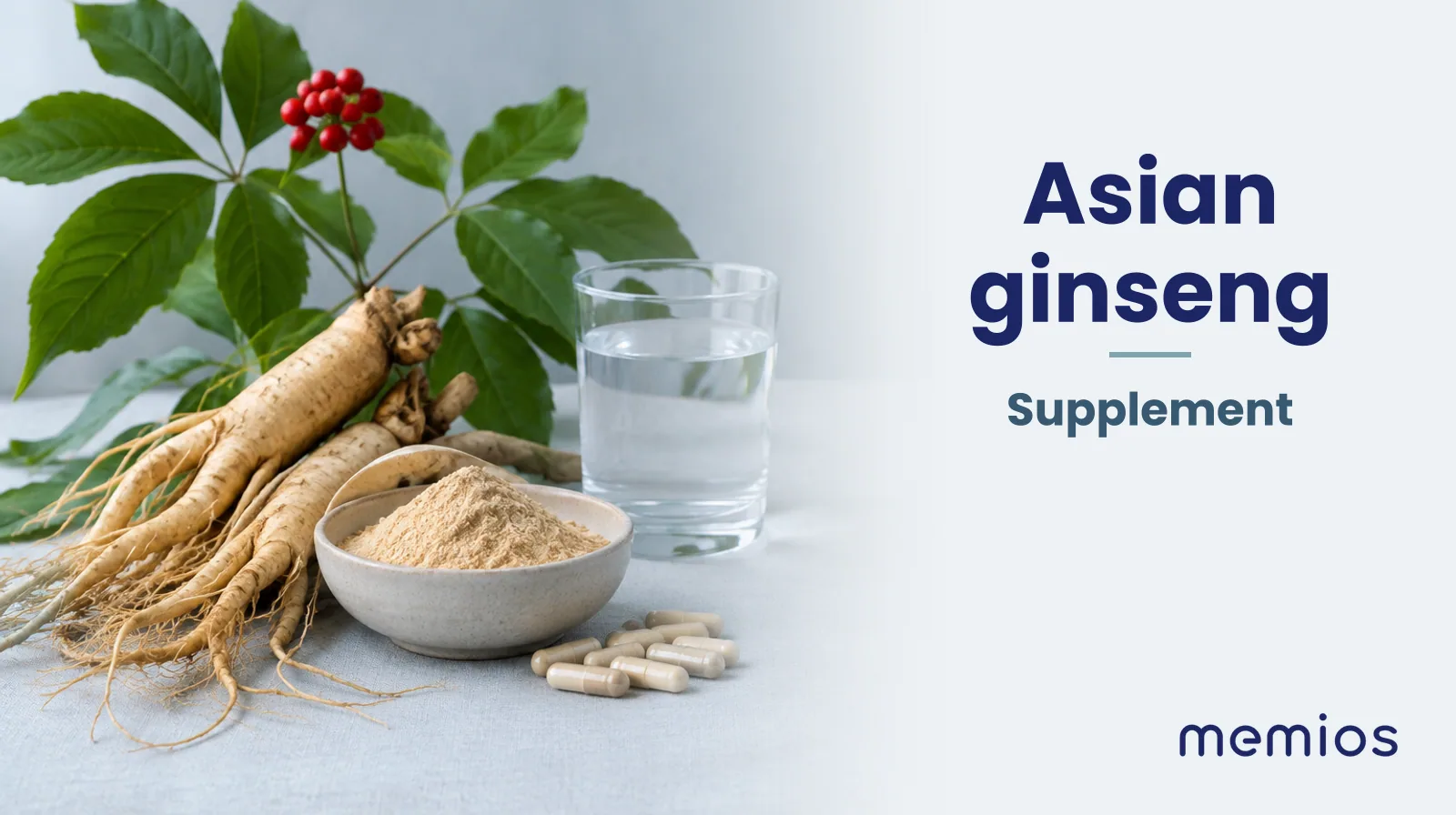
Asian ginseng is the root of Panax ginseng C.A. Meyer, a perennial herb native to Korea and China that has been used as a herbal remedy in eastern Asia for thousands of years. Its characteristic constituents are triterpene saponins called ginsenosides, and commercial products are sold as dried root, powders, teas and standardised extracts. It is a different species from American ginseng (Panax quinquefolius) and from Siberian eleuthero, which is not a Panax at all. Analyses of over-the-counter ginseng products have found detectable cadmium, lead and nickel in the majority of samples and variable chlorinated pesticide levels.
What the research says
Claims made for Asian ginseng cover vitality, immunity, cognition, physical performance, blood sugar and sexual function. The evidence is mixed and mostly rests on small short trials. A Cochrane review of ginseng for cognition concluded there is a lack of convincing evidence of a cognitive-enhancing effect in healthy people and no high-quality evidence in dementia. A meta-analysis of 16 randomised trials found a small but statistically significant reduction in fasting blood glucose, with very high heterogeneity that subgroup analysis could not explain. A systematic review of 57 randomised trials found no benefit for physical performance. Adverse events in monopreparation trials are similar in frequency to placebo and usually mild, but serious events, liver injury and drug interactions are documented in case reports.
Evidence grade: Limited evidence.
What goes wrong
A systematic review of safety data found that adverse event rates with ginseng monopreparations resemble placebo, with headache, sleep and gastrointestinal disorders commonest. (Source 1)
- Systematic review, Low certainty.
- Size: All available safety data located in five databases plus WHO and national spontaneous reporting schemes and 12 manufacturers.
- Who: Users of P. ginseng root extracts.
- How long: not applicable.
- Result: Incidence of adverse events with monopreparations similar to placebo; serious events appear in isolated case reports and spontaneous reports where causality is often unclear.
- Funding: not stated.
The most commonly experienced adverse events are headache, sleep and gastrointestinal disorders.
The same review found that ginseng-containing combination products have been associated with serious adverse events and fatalities, and that interactions with warfarin, phenelzine and alcohol have been reported. (Source 1)
- Systematic review, Very low certainty.
- Size: Case reports and spontaneous reporting scheme data; numbers not pooled.
- Who: Users of ginseng combination products and of ginseng alongside medicines.
- How long: not applicable.
- Result: Serious adverse events and fatalities reported with combination products; causal attribution usually not possible because other ingredients may be responsible.
- Funding: not stated.
Combination products containing ginseng as one of several constituents have been associated with serious adverse events and even fatalities.
A published case report describes acute liver injury in a woman who had taken ginseng tea and supplements for about three months. (Source 2)
- Case report, Very low certainty.
- Size: 1 patient.
- Who: A 45-year-old previously healthy woman taking ginseng for menopausal symptoms.
- How long: About three months of ginseng use; six weeks of follow-up.
- Result: AST 717 U/L and ALT 343 U/L at presentation against baseline AST 21 U/L and ALT 18 U/L six months earlier; total bilirubin 5 mg/dL; symptoms resolved after stopping.
- Funding: not stated.
After 6 weeks of follow-up, the patient improved physically, and the abdomen pain resolved.
An analysis of 21 over-the-counter Panax ginseng products detected cadmium, lead and nickel in most samples and pesticide totals above 100 ppb in five. (Source 3)
- Lab study in cells, Certainty not rated.
- Size: 21 over-the-counter ginseng products in various dosage forms.
- Who: Commercial ginseng products.
- How long: not applicable.
- Result: Chromium, mercury and arsenic undetectable; cadmium, lead and nickel present in the majority of samples; total pesticide concentration below 100 ppb in most samples but above 100 ppb in 5.
- Funding: not stated (herbal medicine quality assessment programme)
while cadmium, lead, and nickel were present in the majority of samples
A 2020-2022 residue survey of ginseng from northeastern China identified 39 pesticides and 3 metabolites, including unregistered soil pesticides, while estimating that dietary risks stayed well below the alert level. (Source 4)
- Survey study, Certainty not rated.
- Size: 325 fresh ginseng samples, screened for 325 pesticides and related compounds, from 15 counties and 3 commercial markets.
- Who: Ginseng grown in northeastern China, 2020-2022.
- How long: not applicable.
- Result: 39 pesticides and 3 metabolites identified; the acute dietary risk of carbofuran and chlorpyrifos was the highest, ranging from 0.34% to 6.9%, and the chronic dietary risk of phoxim, quintozene and chlorpyrifos was the highest, ranging from 0.038% to 0.47%, all far below the 100% alert value.
- Funding: not stated.
irrational use of pesticides in ginseng cultivation in China is relatively common
The US NCCIH page, current at February 2025, lists insomnia as Asian ginseng's commonest side effect, names severe rash, liver damage and severe allergic reactions as uncommon ones, and says some studies suggest oral use may be unsafe in pregnancy. (Source 5)
- Official position, Certainty not rated.
- Size: not applicable.
- Who: General public.
- How long: Page last updated February 2025.
- Result: Agency lists insomnia as the most common side effect; severe rash, liver damage and severe allergic reactions as uncommon; and warns it may worsen autoimmune disorders, interfere with blood clotting, lower blood sugar, interact with medicines, and that one of its chemicals has caused birth defects in animals.
- Funding: US government agency.
Uncommon side effects that have been reported include severe rash, liver damage, and severe allergic reactions.
What the evidence supports
A meta-analysis of randomised trials of the genus Panax found a small statistically significant reduction in fasting blood glucose, with unexplained heterogeneity. (Source 6)
- Meta-analysis, Low certainty.
- Size: 16 trials; 16 fasting blood glucose comparisons (n = 770), 10 fasting insulin (n = 349), 9 HbA1c (n = 264), 7 HOMA-IR (n = 305)
- Who: People with and without diabetes.
- How long: Trials of 30 days or more; 67% of trials were shorter than 12 weeks.
- Result: Fasting blood glucose MD = −0.31 mmol/L [95% CI: −0.59 to −0.03], P = 0.03; inter-study heterogeneity I2 = 89%, P <0.001.
- Funding: mixed: 8 trials (50%) agency funded, 4 (25%) industry supported, 1 (6.3%) agency-industry, 3 (18.7%) unspecified.
Ginseng significantly reduced fasting blood glucose compared to control (MD = −0.31 mmol/L [95% CI: −0.59 to −0.03], P = 0.03)
What the evidence does not support
A Cochrane review found no convincing evidence that Panax ginseng enhances cognition in healthy people, and no high-quality evidence in dementia. (Source 7)
- Systematic review, Low certainty.
- Size: Nine randomised, double-blind, placebo-controlled trials identified; only five had extractable data.
- Who: Eight trials in healthy participants; one in people with age-associated memory impairment.
- How long: varied by trial.
- Result: Some aspects of cognitive function, behaviour and quality of life appeared to improve, but the authors judged the evidence unconvincing; no serious adverse events associated with ginseng were found.
- Funding: not stated.
Currently, there is a lack of convincing evidence to show a cognitive enhancing effect of Panax ginseng in healthy participants and no high quality evidence about its efficacy in patients with dementia.
A systematic review of 57 randomised trials of ginseng monopreparations concluded that ginseng is not effective for enhancing physical performance. (Source 8)
- Systematic review, Low certainty.
- Size: 57 randomised clinical trials out of 411 potentially relevant studies.
- Who: Trials of Panax ginseng or P. quinquefolium monopreparations across glucose metabolism, physical performance, psychomotor function, sexual function, cardiac function, pulmonary disease and cerebrovascular disease.
- How long: varied by trial.
- Result: Authors report strong evidence of a positive effect on glucose metabolism, psychomotor function and pulmonary disease, but no effect on physical performance; no GRADE ratings were applied.
- Funding: not stated.
whereas evidence suggests that ginseng is not effective at enhancing physical performance
In a third, separate statement on the same page, NCCIH says the majority of research shows Asian ginseng does not improve athletic performance. (Source 9)
- Official position, Certainty not rated.
- Size: not stated; an agency summary of the research as a whole.
- Who: Not specified by the agency.
- How long: Page last updated February 2025.
- Result: No effect on athletic performance in the majority of research, as characterised by the agency; no numbers given.
- Funding: US government agency.
The majority of research shows that Asian ginseng does not improve athletic performance.
Where the evidence is mixed
The same meta-analysis reported that its heterogeneity could not be explained and that most trials were short, limiting confidence in the estimate. (Source 6)
- Meta-analysis, Low certainty.
- Size: 16 trials.
- Who: People with and without diabetes, most with relatively good glycaemic control at baseline.
- How long: 67% of trials under 12 weeks.
- Result: I2 = 89% overall; 11 trials (68.8%) rated high quality on the Methodological Quality Score.
- Funding: mixed, see above; the lead author declared grant support for ginseng research from the Canadian Diabetes Association and from the National Institute of Horticultural and Herbal Science, RDA, Korea.
Heterogeneity remained significant, and could not be explained away by any of the subgroup analyses
NCCIH cites a 2022 review reporting improvement in several cardiometabolic measures in prediabetes and diabetes, while describing the blood-sugar evidence overall as inconclusive and conflicting. (Source 10)
- Official position, Certainty not rated.
- Size: Agency summary of a 2022 review of 20 studies (1,295 participants)
- Who: People with prediabetes and diabetes.
- How long: Page last updated February 2025.
- Result: Improvement reported in fasting blood glucose levels, total cholesterol and certain inflammatory markers; the agency states the evidence on blood sugar control in diabetes is overall inconclusive and conflicting.
- Funding: US government agency.
A 2022 review of 20 studies (1,295 participants) found that Asian ginseng improved many cardiometabolic factors in people with prediabetes and diabetes, including fasting blood glucose levels, total cholesterol, and certain inflammatory markers. But research on the use of Asian ginseng for improving blood sugar control in people with diabetes is overall inconclusive and conflicting.
In a separate section of the same agency page, NCCIH says some research shows oral Asian ginseng seems to improve sexual function in erectile dysfunction, with one small study in men whose symptoms accompanied an enlarged prostate. (Source 11)
- Official position, Certainty not rated.
- Size: not stated by the agency beyond 'some research' and 'one small study'
- Who: Adults with erectile dysfunction, including symptoms associated with an enlarged prostate.
- How long: Page last updated February 2025.
- Result: No numbers are given on the page; the agency reports only that sexual function 'seems to improve' and that one small study suggested improvement in some aspects of sexual function.
- Funding: US government agency.
Some research shows that taking oral Asian ginseng seems to improve sexual function in people with erectile dysfunction (ED). Asian ginseng has also been studied in adults with symptoms of ED associated with an enlarged prostate, and one small study suggested it may improve some aspects of sexual function.
Where the research disagrees
Whether ginseng improves psychomotor and cognitive function
- Lee and Son (2011) systematic review of 57 randomised trials, systematic-review without GRADE certainty ratings: We found strong evidence of a positive effect of ginseng on glucose metabolism, psychomotor function, and pulmonary disease, whereas evidence suggests that ginseng is not effective at enhancing physical performance. (Source 8)
- Cochrane review authors (Geng and colleagues, 2010), Cochrane systematic-review; only five of nine identified trials had extractable data: Currently, there is a lack of convincing evidence to show a cognitive enhancing effect of Panax ginseng in healthy participants and no high quality evidence about its efficacy in patients with dementia. (Source 7)
How much
- Reference intake: No reference intake (RDA or AI) exists for Asian ginseng; it is a herbal root preparation rather than an essential nutrient, and NCCIH describes it only as a supplement studied mostly in small short trials (February 2025). (Source 12)
- Upper limit: No tolerable upper intake level or acceptable daily intake was located from the bodies we could reach. NCCIH states only that short-term oral use by mouth, up to 6 months, in recommended amounts appears to be safe for most people, that questions have been raised about its long-term safety, and that some experts recommend against its use for infants, children, and women who are pregnant or breastfeeding (February 2025). (Source 13)
- Studied: The pooled glycaemic trials were randomised controlled trials of 30 days or more, with 67% lasting under 12 weeks; doses varied by trial and dose-response could not be assessed. (Source 6)
- Studied: The Cochrane cognition review covered nine randomised, double-blind, placebo-controlled trials, eight of them in healthy participants. (Source 14)
A common belief, and what the research shows
The belief: Ginseng is a proven energy and performance booster.
What the research shows: The randomised evidence does not support a performance effect. A systematic review of 57 randomised trials of ginseng monopreparations reported that evidence suggests that ginseng is not effective at enhancing physical performance, and the US NCCIH states that the majority of research shows that Asian ginseng does not improve athletic performance. NCCIH also notes that most of the clinical trials have been small, with fewer than 200 participants, and shorter than 3 months, so even the positive findings rest on thin evidence.
Questions and answers
What is it?
Asian ginseng is the root of Panax ginseng C.A. Meyer, a perennial herb from Korea and China used in eastern Asia for thousands of years. It is sold as dried root, tea, powder and standardised extract. Its marker compounds are ginsenosides. (Source 1)
What does it do in the body?
It is claimed to affect vitality, immunity, cancer, cardiovascular disease, cognition, physical performance and sexual function. In trials the clearest measurable effect is a small reduction in fasting blood glucose; cognitive claims are not convincingly supported and physical performance claims are not supported. (Source 1)
Is it good or bad for you?
Neither simply. Short-term use of the root alone in usual amounts looks well tolerated, with adverse event rates similar to placebo in trials, and it produces a small drop in fasting blood glucose. Against that, insomnia is common, rare severe reactions including liver damage are reported, combination products have been linked to serious events and deaths, and interactions with warfarin, phenelzine and alcohol are documented. (Source 1)
How do you get more of it?
Asian ginseng is obtained only from the plant itself: dried root, ginseng tea, and standardised root extracts. It is not a component of a normal Western diet. Trials pooled in the glycaemic meta-analysis used a range of preparations for at least 30 days, and the review called for standardised preparations because products differ. This describes what was studied, not a recommendation. (Source 6)
If it is harmful, what reduces it?
Exposure ends when the product is stopped; ginseng is not stored in the body as a nutrient. In the published liver-injury case report the patient's symptoms resolved over six weeks of follow-up after the ginseng was discontinued. (Source 2)
Why might someone be low in it or missing it?
This does not apply. Asian ginseng is not made by the body and is not an essential nutrient, so there is no deficiency state; a person either takes ginseng or does not. What varies instead is the content of the products themselves, which is why reviews call for standardised preparations. (Source 15)
Which whole foods contain it or feed it?
The food form is the ginseng root itself, eaten or drunk as root, tea or soup, mainly in Korea and China. There is no other whole food that supplies ginsenosides. Note that analyses of commercial ginseng products have found lead, cadmium and nickel in most samples tested. (Source 3)
What happens if you do not have it?
Nothing is known to happen if you do not take Asian ginseng: it is not a nutrient and has no established role in normal physiology. In the Cochrane review of ginseng for cognition the trials could not be combined at all, because they differed too much in outcome measures, length and dose, so the suggestion of improvement in some aspects of cognition is not a pooled result. The same review found no serious adverse events either way. (Source 16)
How can you test for it?
There is no clinical blood or urine test for ginseng status, because no normal body level exists. Testing in this field is applied to the product rather than the person: laboratories measure ginsenoside content and screen for pesticide residues and heavy metals, which is how contamination in commercial ginseng has been documented. (Source 3)
We searched: Searched for ginseng biomarkers, ginsenoside status testing and ginseng deficiency testing; found only product quality and contaminant analyses (J AOAC Int 2001 metals and pesticides survey; Foods 2025 residue survey), no validated human status test.
References
- Drug Safety (Coon JT, Ernst E). Panax ginseng: a systematic review of adverse effects and drug interactions. 2002. PMID 12020172, DOI 10.2165/00002018-200225050-00003. Read the source
- Case Reports in Gastroenterology (Lin K, Lin AN, Linn S, Hlaing PP, Vasudevan V, Reddy M). Ginseng-Related Drug-Induced Liver Injury. 2018. PMID 30186097, DOI 10.1159/000490525. Read the source
- Journal of AOAC International (Khan IA, Allgood J, Walker LA, Abourashed EA, Schlenk D, Benson WH). Determination of Heavy Metals and Pesticides in Ginseng Products. 2001. PMID 11417656, DOI 10.1093/jaoac/84.3.936. Read the source
- Foods (Xu X, Zhang M, Meng X, Chen Y, Leng X, Liang S, Zhao D). Assessment of Pesticide Residues and Dietary Risks in Ginseng from Northeastern China. 2025. DOI 10.3390/foods14081381. Read the source
- US National Center for Complementary and Integrative Health (NCCIH), National Institutes of Health. Asian Ginseng: Usefulness and Safety. 2025. Read the source
- PLOS ONE. The Effect of Ginseng (The Genus Panax) on Glycemic Control: A Systematic Review and Meta-Analysis of Randomized Controlled Clinical Trials. 2014. PMID 25265315, DOI 10.1371/journal.pone.0107391. Read the source
- Cochrane Database of Systematic Reviews (Geng J, Dong J, Ni H, Lee MS, Wu T, Jiang K, Wang G, Zhou AL, Malouf R). Ginseng for cognition. 2010. PMID 21154383, DOI 10.1002/14651858.CD007769.pub2. Read the source
- Journal of Acupuncture and Meridian Studies (Lee NH, Son CG). Systematic Review of Randomized Controlled Trials Evaluating the Efficacy and Safety of Ginseng. 2011. PMID 21704950, DOI 10.1016/S2005-2901(11)60013-7. Read the source
- US National Center for Complementary and Integrative Health (NCCIH), National Institutes of Health. Asian Ginseng: Usefulness and Safety. 2025. Read the source
- US National Center for Complementary and Integrative Health (NCCIH), National Institutes of Health. Asian Ginseng: Usefulness and Safety. 2025. Read the source
- US National Center for Complementary and Integrative Health (NCCIH), National Institutes of Health. Asian Ginseng: Usefulness and Safety. 2025. Read the source
- US National Center for Complementary and Integrative Health (NCCIH), National Institutes of Health. Asian Ginseng: Usefulness and Safety. 2025. Read the source
- US National Center for Complementary and Integrative Health (NCCIH), National Institutes of Health. Asian Ginseng: Usefulness and Safety. 2025. Read the source
- Cochrane Database of Systematic Reviews (Geng J, Dong J, Ni H, Lee MS, Wu T, Jiang K, Wang G, Zhou AL, Malouf R). Ginseng for cognition. 2010. PMID 21154383, DOI 10.1002/14651858.CD007769.pub2. Read the source
- European Journal of Nutrition (Vuksan V, Xu ZZ, Jovanovski E, Jenkins AL, Beljan-Zdravkovic U, Sievenpiper JL, Stavro PM, Zurbau A, Duvnjak L, Li MZC). Efficacy and safety of American ginseng (Panax quinquefolius L.) extract on glycemic control and cardiovascular risk factors in individuals with type 2 diabetes: a double-blind, randomized, cross-over clinical trial. 2019. PMID 29478187, DOI 10.1007/s00394-018-1642-0. Read the source
- Cochrane Database of Systematic Reviews (Geng J, Dong J, Ni H, Lee MS, Wu T, Jiang K, Wang G, Zhou AL, Malouf R). Ginseng for cognition. 2010. PMID 21154383, DOI 10.1002/14651858.CD007769.pub2. Read the source