Supplements · September 29, 2026 · Memios · 14 min read
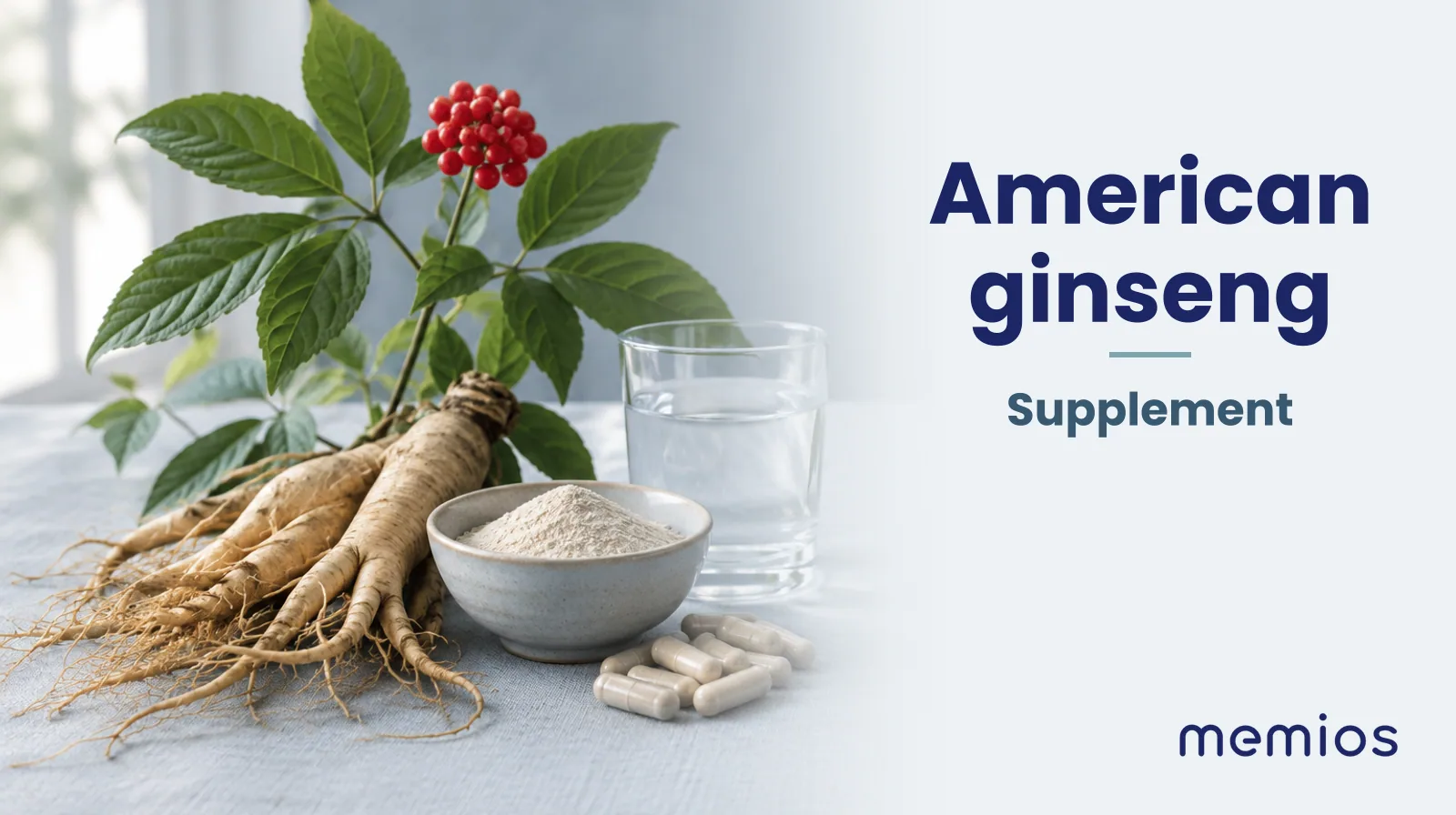
American ginseng
American ginseng has been tested mainly for blood glucose, cancer-related fatigue and prevention of colds.
TLDR
- Limited evidence. American ginseng has been tested mainly for blood glucose, cancer-related fatigue and prevention of colds.
- What it is: American ginseng is the root of Panax quinquefolius L., a Panax species native to eastern North America and cultivated commercially in Ontario, British Columbia and Wisconsin. Like Asian ginseng it contains ginsenosides.
- Main use, supported: The same trial found a statistically significant difference on the secondary 8-week fatigue endpoint. (moderate certainty)
- Other use, supported: The same review found North American ginseng shortened the duration of colds or acute respiratory infections. (low certainty)
- Claim NOT supported by research: In a randomised double-blind trial in cancer survivors, American ginseng 2000 mg daily did not beat placebo on the primary 4-week fatigue endpoint. (moderate certainty)
- Another claim NOT supported: In the cancer-related fatigue trial, graded toxicity did not differ between American ginseng and placebo. (moderate certainty)
- Recommended dose: not established. No reference intake (RDA or AI) exists for American ginseng; it is a herbal root, not an essential nutrient, and the reviews we located treat it only as an optional preparation whose efficacy is still being tested.
- Studied dose (a trial dose, not a recommendation): The cancer-related fatigue trial gave 2000 mg of American ginseng daily for 8 weeks. Findings citing that trial: 1 for, 2 against.
- Upper limit: No tolerable upper intake level or acceptable daily intake was located for Panax quinquefolius from the bodies we could reach; the closest authoritative statement we found is a poison centre listing of side effects and interactions rather than a numeric limit.
- What goes wrong: 4 findings on harm. A pooled analysis of randomised trials across the genus Panax, which included American ginseng trials, found a small reduction in fasting blood glucose but could not assess safety because most trials did not report it.
- Common myth: American ginseng is proven to stop you catching colds.
What it is
American ginseng is the root of Panax quinquefolius L., a Panax species native to eastern North America and cultivated commercially in Ontario, British Columbia and Wisconsin. Like Asian ginseng it contains ginsenosides, but in different proportions, and its ginsenoside profile varies enough between batches that one batch with a depressed profile behaved differently in human glycaemic testing. It is sold as dried root, capsules and standardised extracts, including polysaccharide-rich extracts marketed for colds. It is a distinct species from Panax ginseng.
What the research says
American ginseng has been tested mainly for blood glucose, cancer-related fatigue and prevention of colds. A double-blind crossover trial in 24 people with type 2 diabetes found small reductions in HbA1c and fasting glucose; that trial was half-funded by a ginseng company that also supplied the material. A 364-person randomised trial in cancer survivors missed its primary 4-week endpoint but found a difference at 8 weeks. A systematic review concluded there is insufficient evidence that ginseng reduces the incidence or severity of colds, although North American ginseng appeared to shorten cold duration. Safety data specific to this species are thin; reported side effects overlap with Asian ginseng.
Evidence grade: Limited evidence.
What goes wrong
A pooled analysis of randomised trials across the genus Panax, which included American ginseng trials, found a small reduction in fasting blood glucose but could not assess safety because most trials did not report it. (Source 1)
- Meta-analysis, Low certainty.
- Size: 16 trials; 770 participants in the fasting glucose comparisons.
- Who: People with and without diabetes.
- How long: Trials of 30 days or more.
- Result: Only 4 of the 16 trials reported safety parameters, so tolerability could not be assessed; fasting blood glucose MD = −0.31 mmol/L [95% CI: −0.59 to −0.03], P = 0.03.
- Funding: mixed agency and industry, see the Asian ginseng entry.
Assessment of the safety and tolerability of ginseng was not possible in this systematic review and meta-analysis, as only 4 of the 16 trials reported safety parameters
A poison centre review states that side effects reported for both Asian and American ginseng include nervousness, insomnia, blood pressure changes, vaginal bleeding, vomiting, diarrhoea and mania, with rare severe reactions. (Source 2)
- Expert review, not systematic, Certainty not rated.
- Size: not applicable; based on collected reports.
- Who: Users of ginseng supplements.
- How long: not applicable.
- Result: Listed side effects are nervousness, insomnia, changes in blood pressure, breast pain, vaginal bleeding, vomiting, diarrhoea and mania; the same section reports rare cerebral arteritis, Stevens-Johnson syndrome, cholestatic hepatitis and anaphylaxis. No frequencies are given.
- Funding: US National Capital Poison Center.
Side effects associated with both Asian and American ginseng include nervousness, insomnia, changes in blood pressure, breast pain, vaginal bleeding, vomiting, diarrhea, and mania.
The same source reports rare but serious adverse reactions attributed to ginseng supplements. (Source 2)
- Expert review, not systematic, Certainty not rated.
- Size: not applicable.
- Who: Users of ginseng supplements.
- How long: not applicable.
- Result: Cerebral arteritis, Stevens-Johnson syndrome, cholestatic hepatitis and anaphylactic reactions described as rare.
- Funding: US National Capital Poison Center.
There have been rare reports of patients experiencing severe symptoms like inflammation of the arteries in the brain (cerebral arteritis), severe skin reactions (Stevens-Johnson syndrome), inflammation of the liver (cholestatic hepatitis), and anaphylactic allergic reactions.
Under a separate heading on the same page, the poison centre lists medicines, foods and other herbs that ginseng has been shown to interact with. (Source 3)
- Expert review, not systematic, Certainty not rated.
- Size: not applicable; a compiled interaction list, not a study.
- Who: Users of ginseng supplements taking other medicines or substances.
- How long: not applicable.
- Result: Interactions listed with caffeine, alcohol, blood thinners, ibuprofen, HIV medicines, diabetic medicines, immunosuppressants, antidepressants, bitter orange, ephedra and bitter mallow; no effect sizes or frequencies are given.
- Funding: US National Capital Poison Center.
Ginseng has also been shown to interact with other herbal products, prescribed and over-the-counter medications, and foods. This list includes caffeine, alcohol, blood thinners, ibuprofen, medications for the treatment of HIV, diabetic medications, immunosuppressants, antidepressants, bitter orange, ephedra, and bitter mallow.
What the evidence supports
The same trial found a statistically significant difference on the secondary 8-week fatigue endpoint. (Source 4)
- Randomized trial, Moderate certainty.
- Size: 364 participants.
- Who: Fatigued cancer survivors, with greater benefit reported in those still on active cancer treatment.
- How long: 8 weeks.
- Result: Change score at 8 weeks 20 (SD = 27) ginseng vs 10.3 (SD = 26.1) placebo, P = .003.
- Funding: not stated in the abstract.
A statistically significant difference was seen at 8 weeks with a change score of 20 (SD = 27) for the ginseng group and 10.3 (SD = 26.1) for the placebo group (P = .003).
The same review found North American ginseng shortened the duration of colds or acute respiratory infections. (Source 5)
- Systematic review, Low certainty.
- Size: Two trials for the duration outcome, within five trials of 747 participants.
- Who: Healthy adults taking ginseng preventively.
- How long: 8 to 16 weeks of preventive dosing.
- Result: Compared to placebo, ginseng significantly shortened the duration of colds or ARIs by 6.2 days (two trials; 95% CI: 3.4-9.0); one trial reported the total number of common colds reduced by 25% compared to placebo (one trial; 95% CI: 5-45)
- Funding: not stated; several trials of the proprietary North American ginseng extract were manufacturer-linked.
North American ginseng appears to be effective in shortening the duration of colds or ARIs in healthy adults when taken preventatively for durations of 8-16 weeks.
A double-blind crossover trial in type 2 diabetes found small reductions in HbA1c, fasting glucose and systolic blood pressure with American ginseng extract. (Source 6)
- Randomized trial, Low certainty.
- Size: 24 participants completed.
- Who: Adults with type 2 diabetes on conventional treatment (age 64 +/- 7 years, baseline HbA1c 7.1 +/- 1.2%)
- How long: 8 weeks per arm with a washout of 4 weeks or more.
- Result: HbA1c − 0.29%, p = 0.041; fasting blood glucose − 0.71 mmol/L, p = 0.008; systolic blood pressure − 5.6 +/- 2.7 mmHg, p < 0.001.
- Funding: industry co-funded: half from the Ontario Ministry of Agriculture, Food and Rural Affairs and Agriculture and Agri-Food Canada, the rest from Chai-Na-Ta Corp, which also supplied the extract and placebo.
Compared to placebo, AG significantly reduced HbA1c (− 0.29%; p = 0.041) and fasting blood glucose (− 0.71 mmol/L; p = 0.008).
What the evidence does not support
In a randomised double-blind trial in cancer survivors, American ginseng 2000 mg daily did not beat placebo on the primary 4-week fatigue endpoint. (Source 4)
- Randomized trial, Moderate certainty.
- Size: 364 participants enrolled from 40 institutions.
- Who: Fatigued cancer survivors.
- How long: 8 weeks, primary endpoint at 4 weeks.
- Result: Change from baseline on the MFSI-SF general subscale at 4 weeks 14.4 (SD = 27.1) ginseng vs 8.2 (SD = 24.8) placebo, P = .07.
- Funding: not stated in the abstract (multisite North Central Cancer Treatment Group trial)
Changes from baseline in the general subscale of the MFSI-SF were 14.4 (standard deviation [SD] = 27.1) in the ginseng arm vs 8.2 (SD = 24.8) in the placebo arm at 4 weeks (P = .07).
A systematic review concluded there is insufficient evidence that ginseng preparations reduce the incidence or severity of common colds in healthy adults. (Source 5)
- Systematic review, Low certainty.
- Size: Five trials involving 747 participants of North American ginseng.
- Who: Healthy adults.
- How long: Preventive courses of 8 to 16 weeks.
- Result: There was a tendency toward a lower incidence of having at least one common cold or other acute respiratory infection (ARI) in the ginseng group compared to the placebo group (five trials; relative risk: 0.70; 95% CI: 0.48-1.02), not statistically significant; the methodological quality of the trials varied widely.
- Funding: not stated.
There is insufficient evidence to conclude that ginseng reduces the incidence or severity of common colds.
In the cancer-related fatigue trial, graded toxicity did not differ between American ginseng and placebo. (Source 4)
- Randomized trial, Moderate certainty.
- Size: 364 participants.
- Who: Fatigued cancer survivors.
- How long: 8 weeks.
- Result: Toxicities assessed by self-report and CTCAE provider grading showed no statistically significant difference between arms.
- Funding: not stated in the abstract.
There were no discernible toxicities associated with the treatment.
Where the evidence is mixed
That trial's funding and materials came in part from a ginseng manufacturer, which the paper discloses. (Source 6)
- Randomized trial, Low certainty.
- Size: 24 participants.
- Who: Adults with type 2 diabetes.
- How long: 8 weeks per arm.
- Result: Funding split 50% public agency, remainder from the ginseng company supplying the study material.
- Funding: industry-funded in part.
This study was financially supported by the Ontario Ministry of Agriculture, Food and Rural Affairs, Agriculture and Agri-Food Canada (Ontario Tobacco Diversification Program) with 50% of funding, and the rest was provided by Chai-Na-Ta Corp. Langley, BC, Canada, which also provided the study materials, CNT 2000 ginseng extract and placebo capsules.
Where the research disagrees
Whether North American ginseng does anything useful for common colds
- Seida and colleagues (2011) systematic review, as abstracted by the NIHR Centre for Reviews and Dissemination, systematic-review of five trials, 747 participants, relative risk 0.70 (95% CI 0.48-1.02): There is insufficient evidence to conclude that ginseng reduces the incidence or severity of common colds. (Source 5)
- The same review, on duration rather than incidence, systematic-review, two trials for the duration outcome, quality varying widely: North American ginseng appears to be effective in shortening the duration of colds or ARIs in healthy adults when taken preventatively for durations of 8-16 weeks. (Source 5)
How much
- Reference intake: No reference intake (RDA or AI) exists for American ginseng; it is a herbal root, not an essential nutrient, and the reviews we located treat it only as an optional preparation whose efficacy is still being tested. (Source 5)
- Upper limit: No tolerable upper intake level or acceptable daily intake was located for Panax quinquefolius from the bodies we could reach; the closest authoritative statement we found is a poison centre listing of side effects and interactions rather than a numeric limit. (Source 2)
- Studied: The cancer-related fatigue trial gave 2000 mg of American ginseng daily for 8 weeks. (Source 4)
- Studied: The type 2 diabetes crossover trial gave 1 g of American ginseng extract per meal, 3 g per day, for 8 weeks alongside existing treatment. (Source 6)
- Studied: The cold-prevention trials pooled in the systematic review gave North American ginseng preventively for 8 to 16 weeks. (Source 5)
A common belief, and what the research shows
The belief: American ginseng is proven to stop you catching colds.
What the research shows: The pooled trials did not show that. The systematic review states there is insufficient evidence to conclude that ginseng reduces the incidence or severity of common colds, with a non-significant relative risk: 0.70; 95% CI: 0.48-1.02 for catching at least one cold. What it did find was shorter illness: North American ginseng appears to be effective in shortening the duration of colds or ARIs in healthy adults when taken preventatively for durations of 8-16 weeks, across two trials whose methodological quality varied widely.
Questions and answers
What is it?
American ginseng is the root of Panax quinquefolius L., a North American relative of Asian ginseng. It is grown commercially in Ontario, British Columbia and Wisconsin and sold as root, capsules and standardised extracts. Its active markers are ginsenosides, in different proportions from Panax ginseng. (Source 6)
What does it do in the body?
It has been tested as an add-on for blood sugar control, for cancer-related fatigue and for preventing colds. The measurable effects reported are small: a 0.29 percentage point fall in HbA1c in one 24-person crossover trial, a fatigue difference at 8 but not 4 weeks in a 364-person trial, and shorter rather than fewer colds. (Source 6)
Is it good or bad for you?
Context decides. In the largest trial, graded toxicity did not differ from placebo over 8 weeks, and the diabetes trial reported unaffected liver and kidney safety markers. But because it lowers blood glucose it can matter for people on diabetes medicines, poison centre sources list insomnia, blood pressure changes and mania among reported effects, and rare severe reactions including cholestatic hepatitis and Stevens-Johnson syndrome have been reported for ginseng. (Source 4)
How do you get more of it?
Only from the plant: American ginseng root, capsules or standardised extract. Trials used 2000 mg daily of Wisconsin ginseng for 8 weeks in cancer survivors, and 1 g per meal of extract in type 2 diabetes. These are the doses studied, not a recommendation. (Source 4)
If it is harmful, what reduces it?
There is nothing to clear: American ginseng is not stored in the body and exposure ends when the product is stopped. Where harm is a concern, it is the continuing use and its interactions, particularly with glucose-lowering drugs and blood thinners, rather than an accumulated burden. (Source 3)
Why might someone be low in it or missing it?
This does not apply; American ginseng is not an essential nutrient and there is no deficiency state. What does vary is the product: the ginsenoside profile differs between batches and preparations, which is why trial authors call for physiologically standardised material before results can be generalised. (Source 6)
Which whole foods contain it or feed it?
The root itself is the only whole-food source, eaten or brewed as tea; there is no other food that supplies ginsenosides. No ordinary Western food contains it, and the trial evidence all comes from concentrated root preparations rather than food. (Source 6)
What happens if you do not have it?
Nothing is known to happen if you never take American ginseng. The placebo groups in its trials showed no deficiency: in the cold-prevention review, people not taking it were not shown to catch significantly more colds, and in the fatigue trial the placebo group also improved, by 10.3 points at 8 weeks. (Source 5)
How can you test for it?
No validated clinical test exists for American ginseng status in a person, because it has no normal physiological level. Laboratory testing in this field is applied to the product, verifying ginsenoside profile and screening for residues, which is why researchers ask for physiologically standardised preparations. (Source 6)
We searched: Searched for Panax quinquefolius biomarkers, ginsenoside status testing and American ginseng deficiency tests; found only product standardisation and contaminant analyses, no human status test.
References
- PLOS ONE. The Effect of Ginseng (The Genus Panax) on Glycemic Control: A Systematic Review and Meta-Analysis of Randomized Controlled Clinical Trials. 2014. PMID 25265315, DOI 10.1371/journal.pone.0107391. Read the source
- National Capital Poison Center (Poison Control), authors Lindsy Liu PharmD and William G. Troutman PharmD. Side effects of ginseng supplements. 2026. Read the source
- National Capital Poison Center (Poison Control), authors Lindsy Liu PharmD and William G. Troutman PharmD. Side effects of ginseng supplements. 2026. Read the source
- JNCI: Journal of the National Cancer Institute (Barton DL, Liu H, Dakhil SR, Linquist B, Sloan JA, Nichols CR, McGinn TW, Stella PJ, Seeger GR, Sood A, Loprinzi CL). Wisconsin Ginseng (Panax quinquefolius) to Improve Cancer-Related Fatigue: A Randomized, Double-Blind Trial, N07C2. 2013. PMID 23853057, DOI 10.1093/jnci/djt181. Read the source
- Database of Abstracts of Reviews of Effects (DARE), Centre for Reviews and Dissemination, NCBI Bookshelf; original review in Evidence-Based Complementary and Alternative Medicine (Seida JK, Durec T, Kuhle S). North American (Panax quinquefolius) and Asian ginseng (Panax ginseng) preparations for prevention of the common cold in healthy adults: a systematic review - CRD abstract record. 2011. PMID 19592479, DOI 10.1093/ecam/nep068. Read the source
- European Journal of Nutrition (Vuksan V, Xu ZZ, Jovanovski E, Jenkins AL, Beljan-Zdravkovic U, Sievenpiper JL, Stavro PM, Zurbau A, Duvnjak L, Li MZC). Efficacy and safety of American ginseng (Panax quinquefolius L.) extract on glycemic control and cardiovascular risk factors in individuals with type 2 diabetes: a double-blind, randomized, cross-over clinical trial. 2019. PMID 29478187, DOI 10.1007/s00394-018-1642-0. Read the source