Supplements · September 30, 2026 · Memios · 13 min read
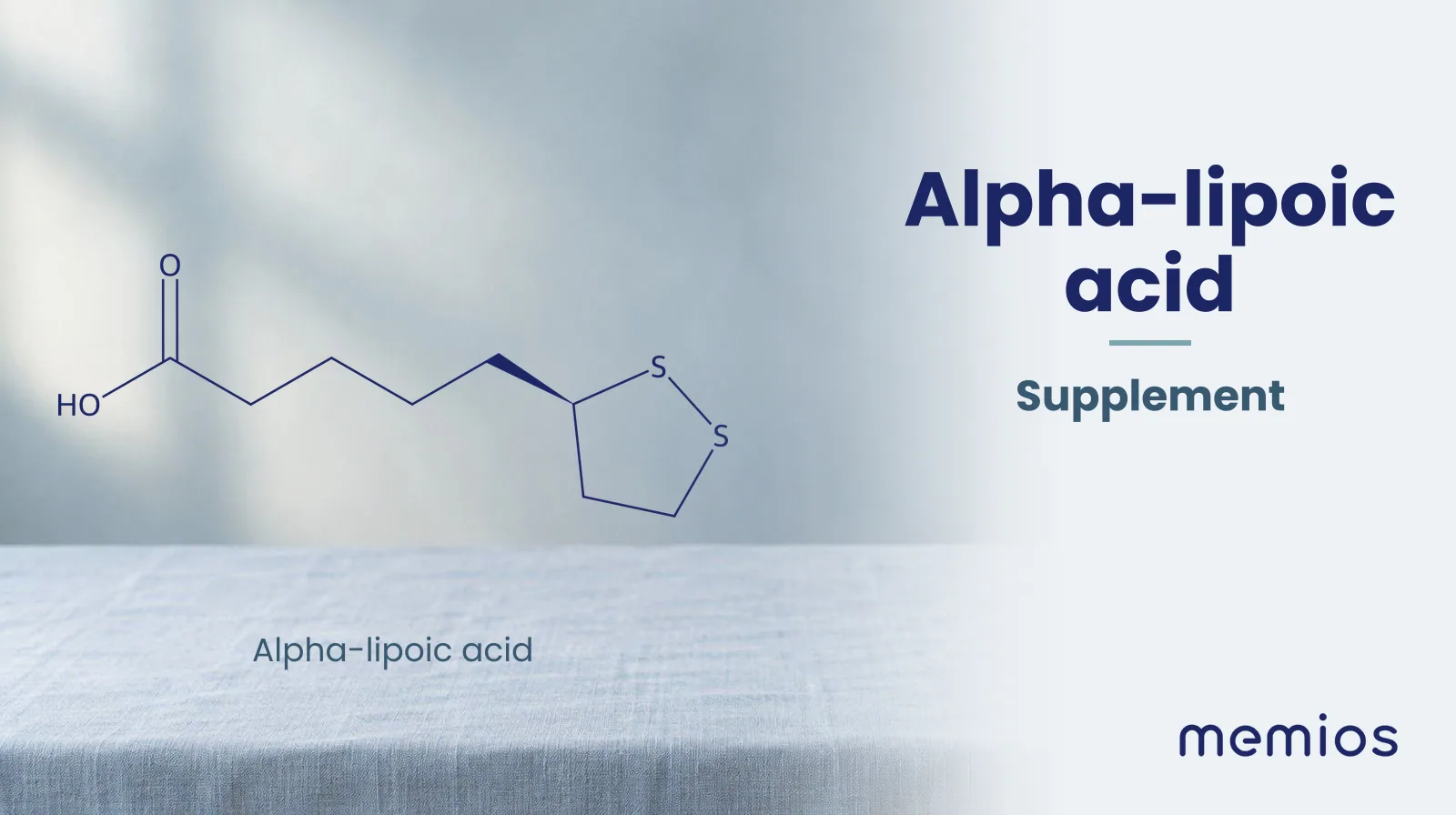
Alpha-lipoic acid
The claim most often made is that it treats diabetic nerve pain. The 2024 Cochrane review of three randomised trials in 816 adults concluded that alpha-lipoic acid probably has little or no effect on neuropathy symptoms at six months.
TLDR
- Disputed. The claim most often made is that it treats diabetic nerve pain. The 2024 Cochrane review of three randomised trials in 816 adults concluded that alpha-lipoic acid probably has little or no effect on neuropathy symptoms at six months.
- What it is: Alpha-lipoic acid is a sulfur-containing compound made in human mitochondria from octanoic acid, where it works as a cofactor for several enzyme complexes.
- Main use, supported: A dose-response meta-analysis of 11 randomised trials reported lower systolic and diastolic blood pressure with alpha-lipoic acid, with the significant effects confined to doses under 800 mg/day given for 12 weeks or less. (low certainty)
- Other use, supported: An updated meta-analysis in diabetic neuropathy pooled nine randomised trials and reported a reduction in HbA1c, but with very high heterogeneity. (very low certainty)
- Claim NOT supported by research: The 2024 Cochrane review found alpha-lipoic acid probably has little or no effect on diabetic neuropathy symptoms at six months. (moderate certainty)
- Another claim NOT supported: Cochrane also found probably no difference from placebo in adverse events severe enough to stop treatment. (moderate certainty)
- Recommended dose: not established. No reference intake or recommended amount exists, because alpha-lipoic acid is synthesised endogenously in mitochondria and is not classed as an essential nutrient.
- Studied dose (a trial dose, not a recommendation): A four-year observational study used 400, 600, 800 and 1200 mg/day as a food supplement. Findings citing that trial: 1 on harm.
- Upper limit: No upper limit has been set.
- What goes wrong: 4 findings on harm. EFSA reviewed 49 published case reports in which insulin autoimmune syndrome developed after alpha-lipoic acid consumption.
- Common myth: Alpha-lipoic acid is a proven treatment for diabetic nerve pain.
What it is
Alpha-lipoic acid is a sulfur-containing compound made in human mitochondria from octanoic acid, where it works as a cofactor for several enzyme complexes. It is also present in food, most richly in organ meats and, among plants, spinach. Reviews describe it as a short-chain fatty acid that has attracted attention as an antioxidant molecule. Supplements usually contain the racemic synthetic form at doses far above anything obtainable from food.
What the research says
The claim most often made is that it treats diabetic nerve pain. The 2024 Cochrane review of three randomised trials in 816 adults concluded that alpha-lipoic acid probably has little or no effect on neuropathy symptoms at six months, and found no trials at all on quality of life or on ulceration and amputation. Smaller meta-analyses do report reductions in blood pressure and in HbA1c, with high statistical heterogeneity. A large safety meta-analysis of 71 studies found no overall excess of adverse events, but the European Food Safety Authority concluded in 2021 that alpha-lipoic acid added to foods and supplements probably raises the risk of insulin autoimmune syndrome in genetically susceptible people.
Evidence grade: Disputed.
What goes wrong
EFSA reviewed 49 published case reports in which insulin autoimmune syndrome developed after alpha-lipoic acid consumption. (Source 1)
- Official position, Low certainty.
- Size: 49 case reports.
- Who: people consuming alpha-lipoic acid added to foods or supplements.
- How long: cases resolved over weeks to months after stopping.
- Result: IAS resolved after discontinuation in all cases; European incidence low and likely below the Japanese estimate of 0.017 per 100,000 inhabitants in 2017-2018.
- Funding: European Food Safety Authority, opinion published 2021.
In all cases, IAS resolved after a few weeks to months when ALA was discontinued.
EFSA's 2021 position is that alpha-lipoic acid added to foods and supplements is likely to increase the risk of insulin autoimmune syndrome in people with certain genetic polymorphisms, while noting that the incidence of the syndrome in Europe is low. (Source 1)
- Official position, Low certainty.
- Size: not applicable.
- Who: European consumers of foods and supplements with added alpha-lipoic acid.
- How long: opinion published 2021.
- Result: no safe dose could be determined and susceptible individuals cannot be identified without genetic testing; incidence in Europe stated to be low and lower than Japan's estimated 0.017 per 100,000 inhabitants in 2017-2018.
- Funding: European Food Safety Authority, NDA Panel, at the request of the European Commission.
The Panel concludes that the consumption of ALA added to foods, including food supplements, is likely to increase the risk of developing IAS in individuals with certain genetic polymorphisms, who cannot be readily identified without genetic testing. The plausible mechanism of such an effect has not yet been fully elucidated. The incidence of IAS in Europe is low and likely lower than in Japan where it has been estimated to be 0.017 per 100,000 inhabitants in 2017–2018.
A four-year observational study of 322 people taking 400 to 1200 mg/day recorded nausea, vomiting, dizziness, rash, hypoglycaemia and hypotension. (Source 2)
- Cohort study, Very low certainty.
- Size: 322 patients (83, 78, 80 and 81 in the four dose groups)
- Who: subjects with euglycaemia or dysglycaemia in primary prevention.
- How long: 4 years.
- Result: adverse events did not differ among the four dose groups; hypoglycaemia and hypotension were among those recorded.
- Funding: not stated; retrospective observational design.
Adverse events of patients during alpha lipoic acid treatment included nausea, vomiting, dizziness, cutaneous rash, hypoglycemia, and hypotension.
EFSA could not identify any dose of added alpha-lipoic acid below which insulin autoimmune syndrome would not be expected. (Source 1)
- Official position, Very low certainty.
- Size: not applicable.
- Who: European consumers.
- How long: opinion published 2021.
- Result: no threshold dose determinable from available data.
- Funding: European Food Safety Authority.
An ALA dose below which IAS is not expected to occur is likely to vary between individuals and cannot be determined from the available data.
What the evidence supports
A dose-response meta-analysis of 11 randomised trials reported lower systolic and diastolic blood pressure with alpha-lipoic acid, with the significant effects confined to doses under 800 mg/day given for 12 weeks or less. (Source 3)
- Meta-analysis, Low certainty.
- Size: 11 RCTs, 674 patients.
- Who: adults, mostly with metabolic conditions.
- How long: effects seen when given for 12 weeks or less.
- Result: systolic WMD about -5.46 mmHg (95% CI -9.27 to -1.65; p < 0.001); diastolic WMD about -3.36 mmHg (95% CI -4.99 to -1.74; p < 0.001); significant at doses under 800 mg/day.
- Funding: not stated.
The result of the meta-analysis indicated that using ALA supplementation significantly reduced the SBP (WMD = −5.46 mmHg; 95% CI: −9.27, −1.65; p < 0.001) and DBP (WMD = −3.36 mmHg, 95% CI: −4.99, −1.74; p < 0.001). The ALA administrations significantly reduced SBP and DBP at the dosages of <800 mg/day, when administered for ≤12 weeks.
An updated meta-analysis in diabetic neuropathy pooled nine randomised trials and reported a reduction in HbA1c, but with very high heterogeneity. (Source 4)
- Meta-analysis, Very low certainty.
- Size: 9 randomised controlled trials, 1,345 subjects.
- Who: people with diabetic neuropathy.
- How long: varied across included trials.
- Result: HbA1c inverse variance about -0.66 (95% CI -0.81 to -0.51), p < 0.00001, I2 = 92%.
- Funding: not stated.
nine randomized controlled trials (RCTs) comprising 1,345 subjects were selected
What the evidence does not support
The 2024 Cochrane review found alpha-lipoic acid probably has little or no effect on diabetic neuropathy symptoms at six months. (Source 5)
- Systematic review, Moderate certainty.
- Size: 3 randomised trials, 816 adults.
- Who: adults with type 1 and type 2 diabetes and peripheral neuropathy.
- How long: six months.
- Result: little or no effect on symptoms (moderate certainty) and may have little or no effect on impairment (low certainty)
- Funding: Cochrane review; independent.
probably has little or no effect on the symptoms of nerve damage and may have little or no effect on impairment after six months of treatment
The same Cochrane review found no trials addressing quality of life or the complications that matter most, ulceration and amputation. (Source 6)
- Systematic review, Certainty not rated.
- Size: no eligible studies for these outcomes.
- Who: people with diabetes and peripheral neuropathy.
- How long: not applicable.
- Result: no evidence available.
- Funding: Cochrane review; independent.
We found no studies to help us answer whether alpha-lipoic acid treatment can improve quality of life or complications of nerve damage (ulceration, amputation, or both) in people with diabetes.
Cochrane also found probably no difference from placebo in adverse events severe enough to stop treatment. (Source 7)
- Systematic review, Moderate certainty.
- Size: 3 randomised trials, 816 adults.
- Who: adults with diabetic peripheral neuropathy.
- How long: six months.
- Result: probably little or no difference in treatment-stopping adverse effects.
- Funding: Cochrane review; independent.
There is probably little or no difference between alpha-lipoic acid and placebo in the occurrence of unwanted effects that cause people to stop using treatment.
A meta-analysis pooling 71 randomised placebo-controlled studies found no increased risk of treatment-emergent adverse events with alpha-lipoic acid. (Source 8)
- Meta-analysis, Moderate certainty.
- Size: 71 clinical studies, 155 treatment arms, 4749 subjects (2558 ALA, 2294 placebo)
- Who: adults and some children/adolescents across diabetes, cardiovascular, renal, rheumatic, neurological and pregnancy subgroups.
- How long: varied across included studies.
- Result: no increased risk of any treatment-emergent adverse event (all p > 0.05)
- Funding: not stated.
A meta-analysis of extracted data suggested that supplementation with ALA was not associated with an increased risk of any treatment-emergent adverse event (all p > 0.05).
Where the research disagrees
Whether alpha-lipoic acid supplementation is safe enough to add to foods and supplements
- EFSA NDA Panel, 2021, scientific opinion built on 49 published case reports: The Panel concludes that the consumption of ALA added to foods, including food supplements, is likely to increase the risk of developing IAS in individuals with certain genetic polymorphisms, who cannot be readily identified without genetic testing. (Source 1)
- Fogacci and colleagues, Antioxidants 2020, systematic review and meta-analysis of 71 randomised placebo-controlled studies, 4749 subjects: A meta-analysis of extracted data suggested that supplementation with ALA was not associated with an increased risk of any treatment-emergent adverse event (all p > 0.05). (Source 8)
How much
- Reference intake: No reference intake or recommended amount exists, because alpha-lipoic acid is synthesised endogenously in mitochondria and is not classed as an essential nutrient. (Source 9)
- Upper limit: No upper limit has been set. EFSA stated in its 2021 opinion that a dose below which insulin autoimmune syndrome is not expected to occur is likely to vary between individuals and cannot be determined from the available data. (Source 1)
- Studied: A four-year observational study used 400, 600, 800 and 1200 mg/day as a food supplement. (Source 2)
- Studied: Blood-pressure trials pooled in a 2023 meta-analysis found significant effects at doses under 800 mg/day given for 12 weeks or less. (Source 3)
A common belief, and what the research shows
The belief: Alpha-lipoic acid is a proven treatment for diabetic nerve pain.
What the research shows: The Cochrane review of the randomised evidence says the opposite about symptoms: alpha-lipoic acid "probably has little or no effect on the symptoms of nerve damage and may have little or no effect on impairment after six months of treatment", and the reviewers add that "We found no studies to help us answer whether alpha-lipoic acid treatment can improve quality of life or complications of nerve damage (ulceration, amputation, or both) in people with diabetes."
Questions and answers
What is it?
Alpha-lipoic acid, also called thioctic acid, is a small sulfur-containing molecule the body makes inside its own mitochondria from octanoic acid. It was first isolated in 1951. It works there as a cofactor for enzymes that release energy from carbohydrate. Supplements usually supply a synthetic version at doses much larger than any food provides. (Source 9)
What does it do in the body?
Inside cells it acts as an enzyme cofactor in energy metabolism. The reason it is sold as a supplement is a separate claim: that in the free form it behaves as an antioxidant. Reviews describe it in exactly those terms, as a compound that has attracted attention as an antioxidant molecule, but attention is not the same as proven clinical benefit. (Source 8)
Is it good or bad for you?
Mixed, and dose and context matter. For diabetic neuropathy symptoms, Cochrane found it probably does little or nothing over six months. Meta-analyses do report modest blood-pressure and HbA1c reductions, with heavy statistical heterogeneity. Against that, EFSA concluded that added alpha-lipoic acid probably raises the risk of insulin autoimmune syndrome in genetically susceptible people, and case series record hypoglycaemia. (Source 5)
How do you get more of it?
Food provides only small amounts. Spinach is the richest plant source, followed by broccoli, tomatoes, peas, Brussels sprouts and rice. Trials have used capsules at 400 to 1200 mg/day, and absorption is reduced when taken with a meal. This describes what has been studied, not a recommendation. (Source 9)
If it is harmful, what reduces it?
When alpha-lipoic acid has caused harm, the reported remedy is stopping it. In EFSA's review of 49 case reports of insulin autoimmune syndrome, the syndrome resolved over weeks to months in every case once the supplement was discontinued; some patients also needed treatment for hypoglycaemia. (Source 1)
Why might someone be low in it or missing it?
There is no recognised deficiency state, because the body synthesises it. What reviews describe instead is that the amount obtainable from food is small: dietary absorption from food sources is considered insufficient to deliver substantial amounts into the bloodstream, which is why supplement doses are orders of magnitude higher. (Source 9)
Which whole foods contain it or feed it?
The richest natural sources are metabolically active animal tissues, that is heart, liver and kidney. Among plants, spinach is highest, then broccoli, tomatoes, peas, Brussels sprouts and rice. The quantities in all of these are small compared with supplement doses. (Source 9)
What happens if you do not have it?
Nothing is described as happening from not supplementing it, because the molecule is produced endogenously in mitochondria and no dietary deficiency syndrome is defined. We found no trial or review reporting a clinical consequence of low dietary alpha-lipoic acid intake. (Source 9)
We searched: Searched the Cochrane 2024 neuropathy review, the Antioxidants 2020 safety meta-analysis, the Antioxidants 2024 mechanisms review and the EFSA 2021 opinion for any described deficiency state; none defines one.
How can you test for it?
There is no validated clinical test of alpha-lipoic acid status. Plasma concentrations can be measured in pharmacokinetic research, where the compound circulates bound to albumin and peaks within about an hour of a dose, but that is a research measurement of a recent dose, not a measure of body stores or need. (Source 10)
We searched: Searched the Cochrane 2024 review, the EFSA 2021 opinion and pharmacokinetic sections of the Antioxidants 2024 review for any validated status assay; only research pharmacokinetic measurement was described.
References
- EFSA Journal (EFSA Panel on Nutrition, Novel Foods and Food Allergens). Scientific opinion on the relationship between intake of alpha-lipoic acid (thioctic acid) and the risk of insulin autoimmune syndrome. 2021. DOI 10.2903/j.efsa.2021.6577. Read the source
- Drug Design, Development and Therapy. Safety and Efficacy of Alpha Lipoic Acid During 4 Years of Observation: A Retrospective, Clinical Trial in Healthy Subjects in Primary Prevention. 2020. DOI 10.2147/DDDT.S280802. Read the source
- Frontiers in Cardiovascular Medicine. The effects of alpha lipoic acid (ALA) supplementation on blood pressure in adults: a GRADE-assessed systematic review and dose-response meta-analysis of randomized controlled trials. 2023. DOI 10.3389/fcvm.2023.1272837. Read the source
- Exploration of Neuroprotective Therapy. Alpha lipoic acid: advancing insights in diabetic neuropathy through updated systematic review and meta-analysis. 2025. DOI 10.37349/ent.2025.1004125. Read the source
- Cochrane Database of Systematic Reviews / Cochrane. Alpha-lipoic acid for diabetic peripheral neuropathy (plain language summary, key messages). 2024. PMID 38205823, DOI 10.1002/14651858.CD012967.pub2. Read the source
- Cochrane Database of Systematic Reviews / Cochrane. Alpha-lipoic acid for diabetic peripheral neuropathy (plain language summary, missing outcomes). 2024. PMID 38205823, DOI 10.1002/14651858.CD012967.pub2. Read the source
- Cochrane Database of Systematic Reviews / Cochrane. Alpha-lipoic acid for diabetic peripheral neuropathy (plain language summary, adverse effects). 2024. PMID 38205823, DOI 10.1002/14651858.CD012967.pub2. Read the source
- Antioxidants. Safety Evaluation of alpha-Lipoic Acid Supplementation: A Systematic Review and Meta-Analysis of Randomized Placebo-Controlled Clinical Studies. 2020. DOI 10.3390/antiox9101011. Read the source
- Antioxidants. Alpha-Lipoic Acid: Biological Mechanisms and Health Benefits (dietary sources passage). 2024. DOI 10.3390/antiox13101228. Read the source
- Antioxidants. Alpha-Lipoic Acid: Biological Mechanisms and Health Benefits (pharmacokinetics passage). 2024. DOI 10.3390/antiox13101228. Read the source