Supplements · September 30, 2026 · Memios · 9 min read
Acerola cherry
Almost everything acerola is claimed to do rests on its vitamin C. Human evidence on acerola itself is limited: a 2026 review calls it limited.
TLDR
- Limited evidence. Almost everything acerola is claimed to do rests on its vitamin C. Human evidence on acerola itself is limited: a 2026 review calls it limited, and the main human data are small absorption studies suggesting the fruit matrix changes how vitamin C is absorbed and excreted.
- What it is: Acerola is a tropical fruit, Malpighia emarginata DC., described in a 2026 review as one of the richest natural sources of vitamin C, and also a source of phenolic compounds and carotenoids.
- Main use, supported: A 2026 narrative review (not a systematic review) describes human evidence on acerola as limited, with suggested matrix-dependent effects on vitamin C bioavailability and some cardiometabolic markers. (low certainty)
- Other use, supported: A 2026 narrative review summarises an uncontrolled acute pharmacokinetic study (not randomised) in which acerola juice containing 50 mg of ascorbic acid gave greater plasma exposure and lower urinary excretion than isolated... (very low certainty)
- Claim NOT supported by research: For vitamin C, the main active in acerola products, a Cochrane review found regular supplementation did not reduce common cold incidence in the ordinary population. (moderate certainty)
- Another claim NOT supported: In the same Cochrane review, high-dose vitamin C started after cold symptoms began showed no consistent effect on duration or severity. (moderate certainty)
- Recommended dose: not established. No intake reference exists for acerola itself. For vitamin C, the US RDA is 90 mg/day for adult men and 75 mg/day for adult women, with 35 mg/day more for smokers (NIH ODS fact sheet, updated 2025, based on Institute of Medicine values).
- Studied dose (a trial dose, not a recommendation): Acerola juice containing 50 mg ascorbic acid, compared with isolated ascorbic acid, in an absorption study. Findings citing that trial: 2 for.
- Upper limit: No upper limit exists for acerola itself.
- What goes wrong: 4 findings on harm. A 2022 laboratory study found acerola fruit, commercial juice and a vitamin C powder contain an allergenic lipid transfer protein (LTP) and concluded acerola products carry a risk for LTP-sensitised patients.
- Common myth: Acerola vitamin C is a fundamentally different, superior form of vitamin C.
What it is
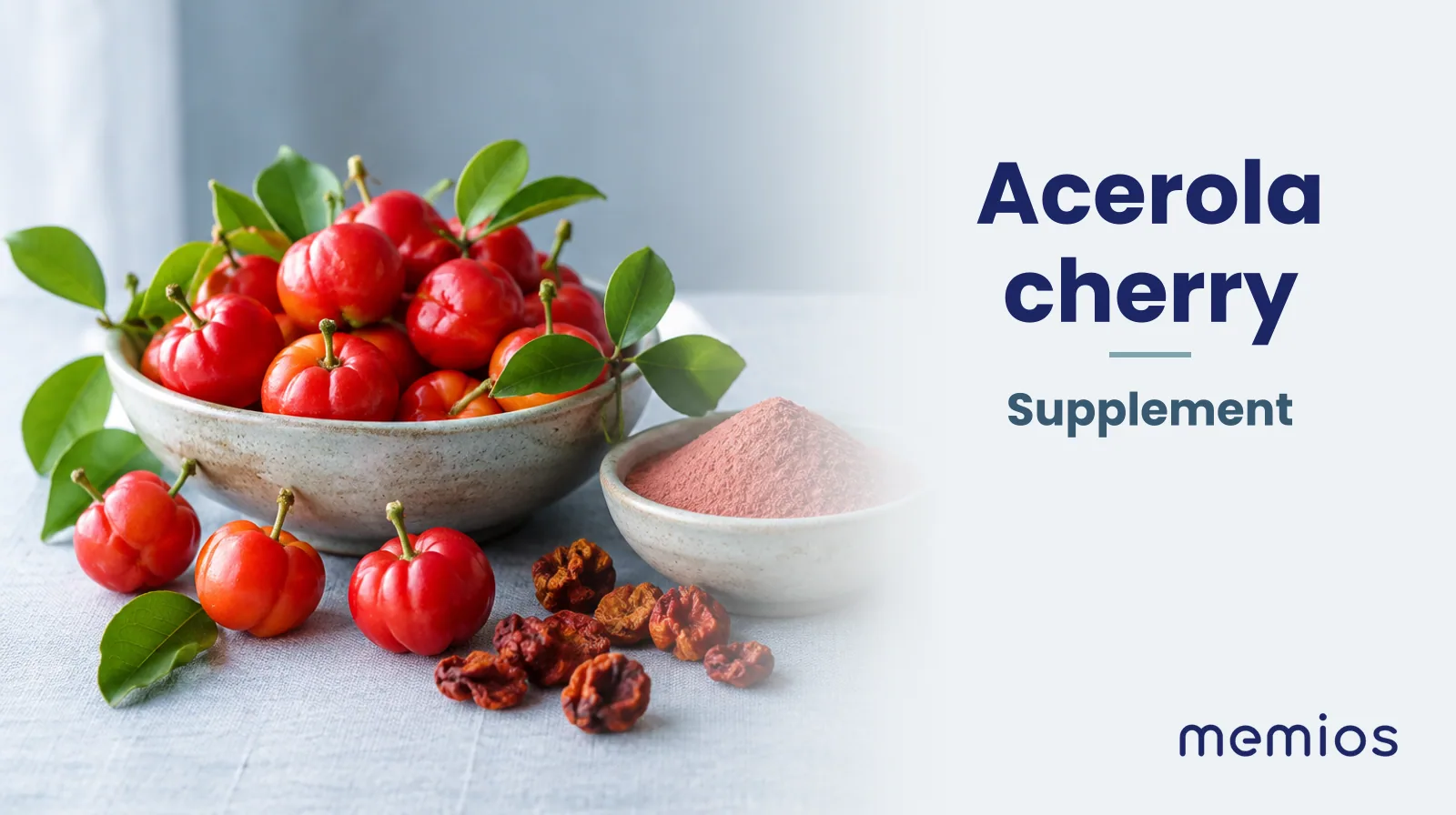
Acerola is a tropical fruit, Malpighia emarginata DC., described in a 2026 review as one of the richest natural sources of vitamin C, and also a source of phenolic compounds and carotenoids. It is sold as tablets and powders for its vitamin C content and added to juices and compotes. Some sources name the plant Malpighia glabra L.
What the research says
Almost everything acerola is claimed to do rests on its vitamin C. Human evidence on acerola itself is limited: a 2026 review calls it limited, and the main human data are small absorption studies suggesting the fruit matrix changes how vitamin C is absorbed and excreted. Natural and synthetic ascorbic acid are chemically identical. For vitamin C in general, a Cochrane review found regular supplements did not reduce how often ordinary people catch colds, though they modestly shortened colds. Harms are mainly allergic: acerola contains an allergenic lipid transfer protein, and one case of reaction linked to latex cross-reactivity is on record.
Evidence grade: Limited evidence.
What goes wrong
A 2022 laboratory study found acerola fruit, commercial juice and a vitamin C powder contain an allergenic lipid transfer protein (LTP) and concluded acerola products carry a risk for LTP-sensitised patients. (Source 1)
- Lab study in cells, Low certainty.
- Size: sera from patients sensitised to LTPs (number not recorded)
- Who: LTP-sensitised allergic patients.
- How long: not applicable.
- Result: IgE reactivity at low molecular mass corresponding to LTPs; no incidence rate.
- Funding: not stated.
Acerola fruit and juice as well as derived products containing acerola carries a risk for LTP sensitized patients.
One published case describes a skin reaction after apple juice supplemented with acerola, with oral itching and lip swelling on exposure to acerola pulp, attributed to cross-reactivity with the latex allergen prohevein. (Source 2)
- Case report, Very low certainty.
- Size: 1 patient.
- Who: latex-sensitised patient.
- How long: reaction within 5 minutes of exposure.
- Result: itching and swelling of lips; skin rash.
- Funding: not stated.
There is only one case of a patient who developed a skin rash after drinking a glass of apple juice supplemented with acerola
US NIH ODS (updated 31 July 2025) states high vitamin C intakes cause gastrointestinal complaints and can contribute to kidney stones, especially with renal disorders; this applies to high-dose acerola vitamin C products. (Source 3)
- Official position, Certainty not rated.
- Size: not applicable.
- Who: adults taking high vitamin C intakes.
- How long: not stated.
- Result: no rates given in the text recorded.
- Funding: government.
contribute to the formation of kidney stones, especially in individuals with renal disorders
Interaction: NIH ODS notes vitamin C may blunt the HDL rise from niacin plus simvastatin, and advises oncologist consultation during chemotherapy or radiation. (Source 3)
- Official position, Certainty not rated.
- Size: not applicable.
- Who: people on niacin/simvastatin therapy.
- How long: not stated.
- Result: attenuated HDL increase; magnitude not recorded.
- Funding: government.
may attenuate the increase in high-density lipoprotein levels
What the evidence supports
A 2026 narrative review (not a systematic review) describes human evidence on acerola as limited, with suggested matrix-dependent effects on vitamin C bioavailability and some cardiometabolic markers. (Source 4)
- Expert review, not systematic, Low certainty.
- Size: not stated; the review does not report a pooled sample Narrative review, not a systematic review.
- Who: experimental and clinical studies of acerola and its by-products.
- How long: not applicable.
- Result: qualitative; no pooled effect size.
- Funding: independent (CAPES and CNPq, Brazil)
Human evidence remains limited but suggests matrix-dependent effects on vitamin C bioavailability and selected cardiometabolic markers.
A 2026 narrative review summarises an uncontrolled acute pharmacokinetic study (not randomised) in which acerola juice containing 50 mg of ascorbic acid gave greater plasma exposure and lower urinary excretion than isolated ascorbic acid; the acute design limits what can be concluded. (Source 4)
- Blood level study, Very low certainty.
- Size: not stated in the review Acute pharmacokinetic study summarised in a narrative review; recorded as a small uncontrolled series because the design list has no pharmacokinetic or narrative-review value.
- Who: human volunteers; the review gives no participant details on this page.
- How long: acute, single dose.
- Result: greater plasma exposure and lower urinary excretion of ascorbic acid with acerola juice; no numbers given in the review; no functional clinical endpoints.
- Funding: not stated.
Limit of this finding: This was a short absorption study: it measured vitamin C in blood and urine over hours after a single drink, not any health outcome. The review itself says the acute design and absence of clinical endpoints limit what can be inferred about sustained effects.
ingestion of acerola juice containing 50 mg of ascorbic acid resulted in greater plasma exposure and lower urinary excretion compared with isolated ascorbic acid
What the evidence does not support
Natural and synthetic vitamin C are the same molecule with no known difference in biological activity, which undercuts claims that acerola vitamin C is inherently superior. (Source 5)
- Official position, Certainty not rated.
- Size: not applicable.
- Who: not applicable.
- How long: not applicable.
- Result: no known difference in biological activity.
- Funding: independent (university institute)
Natural and synthetic L-ascorbic acid are chemically identical, and there are no known differences in their biological activity.
For vitamin C, the main active in acerola products, a Cochrane review found regular supplementation did not reduce common cold incidence in the ordinary population. (Source 6)
- Systematic review, Moderate certainty.
- Size: not recorded in the text fetched.
- Who: ordinary population (not acerola-specific trials)
- How long: regular supplementation trials.
- Result: no effect on incidence; modest reduction in duration.
- Funding: independent (Cochrane)
Regular ingestion of vitamin C had no effect on common cold incidence in the ordinary population
In the same Cochrane review, high-dose vitamin C started after cold symptoms began showed no consistent effect on duration or severity. (Source 6)
- Systematic review, Moderate certainty.
- Size: not recorded in the text fetched.
- Who: people with colds in therapeutic trials.
- How long: therapeutic dosing after onset.
- Result: no consistent effect.
- Funding: independent (Cochrane)
Trials of high doses of vitamin C administered therapeutically, starting after the onset of symptoms, showed no consistent effect on the duration or severity of common cold symptoms
Where the research disagrees
Whether vitamin C from acerola is better than synthetic vitamin C
- Aquino et al. 2026 review, small human absorption studies: "ingestion of acerola juice containing 50 mg of ascorbic acid resulted in greater plasma exposure and lower urinary excretion compared with isolated ascorbic acid" (Source 4)
- Linus Pauling Institute, narrative review of bioavailability studies: "Natural and synthetic L-ascorbic acid are chemically identical, and there are no known differences in their biological activity." (Source 5)
How much
- Reference intake: No intake reference exists for acerola itself. For vitamin C, the US RDA is 90 mg/day for adult men and 75 mg/day for adult women, with 35 mg/day more for smokers (NIH ODS fact sheet, updated 2025, based on Institute of Medicine values). (Source 3)
- Upper limit: No upper limit exists for acerola itself. The US Tolerable Upper Intake Level for vitamin C is 2,000 mg/day for adults aged 19 and over (NIH ODS, 2025). (Source 3)
- Studied: Acerola juice containing 50 mg ascorbic acid, compared with isolated ascorbic acid, in an absorption study. (Source 4)
- Studied: 300 g/day acerola pulp for three weeks in 22 athletes (Vitek et al., as summarised in the 2026 review). (Source 4)
A common belief, and what the research shows
The belief: Acerola vitamin C is a fundamentally different, superior form of vitamin C.
What the research shows: The molecule is the same: "Natural and synthetic L-ascorbic acid are chemically identical, and there are no known differences in their biological activity." Small studies suggest the fruit matrix may change absorption, but "Human evidence remains limited".
Questions and answers
What is it?
Acerola is a small tropical fruit (Malpighia emarginata) best known for its very high vitamin C content. It also contains plant pigments and phenolic compounds. As a supplement it is sold as powders, tablets and juice. (Source 4)
What does it do in the body?
In the body, acerola mainly delivers vitamin C. The few human studies suggest the fruit's other components may change how vitamin C is absorbed and excreted, but the human evidence is described as limited. (Source 4)
Is it good or bad for you?
As a food it is a rich vitamin C source. Benefits beyond vitamin C are not established in people. It can be a problem for people allergic to lipid transfer proteins, and very high vitamin C intakes carry their own risks. (Source 1)
How do you get more of it?
People get acerola as the fresh fruit, as juice, as an additive in juices and compotes, and as tablets or powders sold for vitamin C. (Source 1)
If it is harmful, what reduces it?
Does not apply for most people; acerola is not something the body needs to clear. For people with an LTP or latex-related allergy, the literature identifies acerola-containing products themselves as the risk. (Source 1)
Why might someone be low in it or missing it?
Acerola itself is not required. Low vitamin C, which acerola supplies, is linked to smoking, limited food variety, and malabsorption or some chronic diseases, according to NIH ODS. (Source 3)
Which whole foods contain it or feed it?
The acerola fruit itself is the whole-food source; it is described as 20 to 30 times richer in vitamin C than oranges. (Source 1)
What happens if you do not have it?
Nothing happens from lacking acerola specifically. Lacking vitamin C from any source over time leads to scurvy, with bleeding under the skin, joint pain and poor wound healing. (Source 3)
How can you test for it?
There is no test for acerola intake. Vitamin C status is usually measured with a plasma vitamin C blood test, which reflects recent intake. (Source 3)
References
- Revue Française d'Allergologie. L'acérola, un fruit exotique riche en vitamine C contient une LTP allergénique (Acerola, a vitamin C-rich-exotic-fruit contains an allergenic LTP). 2022. DOI 10.1016/j.reval.2022.03.008. Read the source
- University of Manchester (InformAll). Acerola - allergy information (InformAll), summarising Raulf-Heimsoth M et al., Anaphylactic reaction to apple juice containing acerola: cross-reactivity to latex due to prohevein, J Allergy Clin Immunol 2002;109(4):715-6. not stated. PMID 11941325. Read the source
- NIH Office of Dietary Supplements. Vitamin C - Fact Sheet for Health Professionals. 2025. Read the source
- Molecules (MDPI). Acerola and Its By-Products as Sources of Bioactive Compounds: Phytochemical Profile and Biological Effects in Experimental and Clinical Studies. 2026. PMID 42280099, DOI 10.3390/molecules31111792. Read the source
- Linus Pauling Institute, Oregon State University. Vitamin C: Supplemental Forms. not stated. Read the source
- Cochrane. Vitamin C for preventing and treating the common cold (CD000980), plain-language summary. 2013. DOI 10.1002/14651858.CD000980.pub4. Read the source