Medications · September 30, 2026 · Memios · 25 min read
Zolpidem
The best evidence for zolpidem is short-term trial evidence in insomnia, and the measured effect is modest: pooled analysis of the trials submitted to the FDA found it shortened the time to fall asleep by about 22 minutes versus placebo.
TLDR
- Boxed warning: Some of these events may result in serious injuries, including death.
- Limited evidence. The best evidence for zolpidem is short-term trial evidence in insomnia, and the measured effect is modest: pooled analysis of the trials submitted to the FDA found it shortened the time to fall asleep by about 22 minutes versus placebo.
- What it is: Zolpidem is a synthetic imidazopyridine hypnotic drug, a prescription-only controlled substance (CIV in the United States), taken as a tablet, sublingual tablet or oral spray.
- Main use: Short-term treatment of insomnia with difficulty falling asleep (limited evidence).
- Uses NOT supported by research: Recovery of consciousness in disorders of consciousness after brain injury.
- Recommended dose (official position): There is no reference intake for a medicine. Dose is set by the prescriber.
- Studied dose (a trial dose, not a recommendation): The trials pooled by AHRQ used zolpidem 5-10 mg. Findings citing that trial: 1 for.
- Upper limit: As a position, the US label (revised 2/2023, section 2.1) states that the total dose should not exceed 10 mg once daily immediately before bedtime, and that long-term use is not recommended.
- What goes wrong: 6 findings on harm. In the AHRQ review daytime somnolence was more than three times as common on zolpidem as on placebo.
- Interactions: 3 recorded, including Alcohol, Food (a meal taken with or just before the dose), St John's wort (Hypericum perforatum).
- Common myth: Zolpidem is a sleeping pill that reliably adds hours of sleep and is safe because it is not a benzodiazepine.
What it is
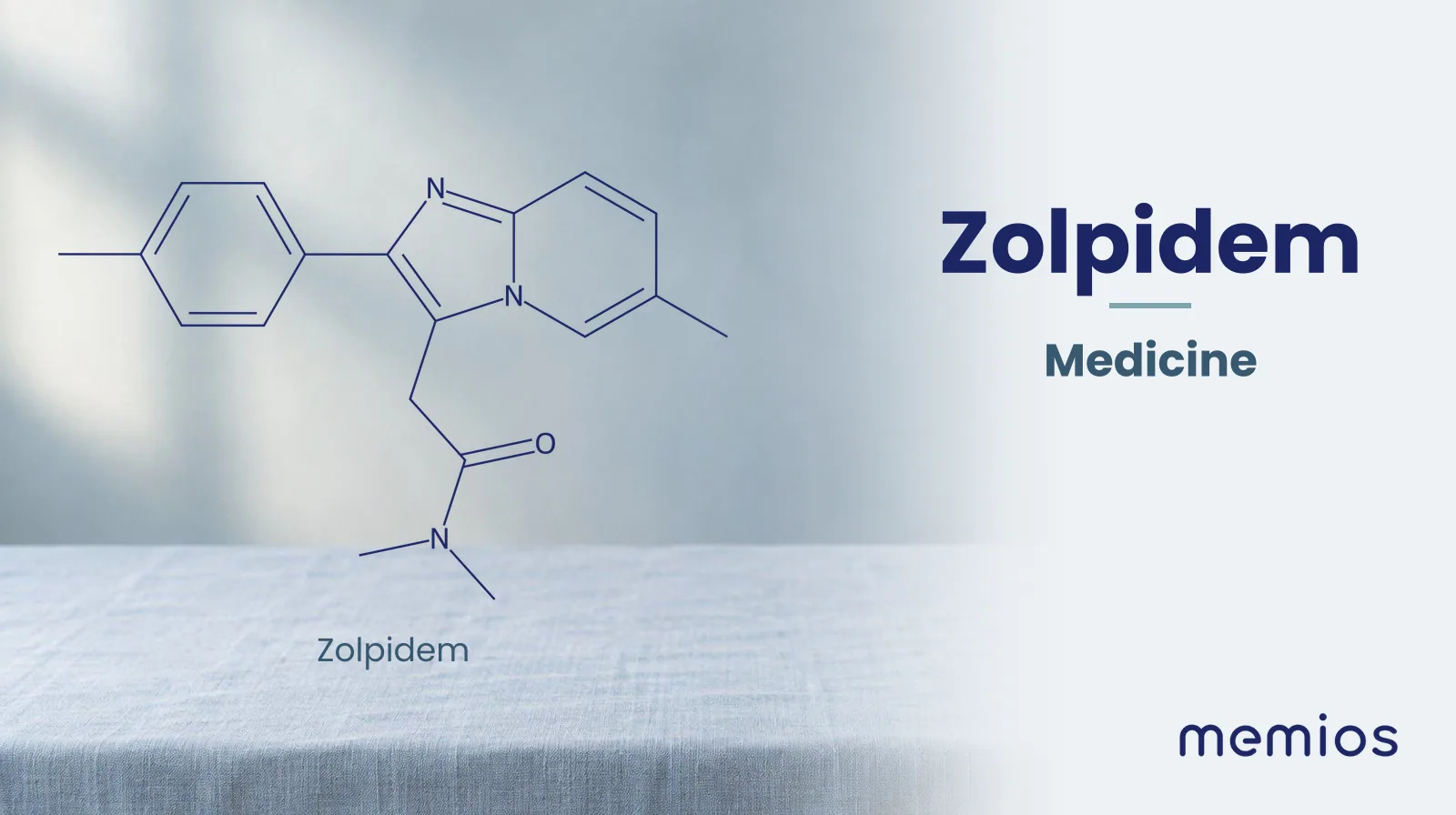
Zolpidem is a synthetic imidazopyridine hypnotic drug, a prescription-only controlled substance (CIV in the United States), taken as a tablet, sublingual tablet or oral spray. It is one of the so-called Z-drugs, which are chemically unrelated to benzodiazepines but act at the same receptor site. The US label describes it as a GABA A receptor positive modulator indicated for short-term treatment of insomnia with difficulty initiating sleep.
What the research says
The best evidence for zolpidem is short-term trial evidence in insomnia, and the measured effect is modest: pooled analysis of the trials submitted to the FDA found it shortened the time to fall asleep by about 22 minutes versus placebo, and the authors of that analysis called both the drug effect and the placebo response small and of questionable clinical importance on their own. Longer-term benefit is not established - the one trial running beyond eight months found no advantage over placebo - the American Academy of Sleep Medicine rated the overall certainty of evidence as very low and made only a weak recommendation, and large observational studies link hypnotic prescriptions to higher mortality, though those are associations and not proof of cause. Harms measured against placebo include daytime somnolence, more withdrawals for adverse effects, next-morning driving impairment in older drivers in a simulator, and a boxed warning for complex sleep behaviours such as sleep-driving.
Evidence grade: Limited evidence.
How it works
Drug class: Imidazopyridine non-benzodiazepine hypnotic (Z-drug); GABA A receptor positive modulator
Zolpidem attaches to the same site on the brain's GABA-A receptors that benzodiazepines use, mainly the type containing the alpha-1 subunit, and increases the effect of GABA, the brain's main calming signal. The result is sedation and faster sleep onset. (Source 1)
Boxed warning
Complex sleep behaviors including sleep-walking, sleep-driving, and engaging in other activities while not fully awake may occur following use of zolpidem tartrate. Some of these events may result in serious injuries, including death. Discontinue zolpidem tartrate immediately if a patient experiences a complex sleep behavior.
(Source 2)
What it is used for
- Short-term trials show a real but modest benefit: about 15 to 22 minutes less time to fall asleep than placebo, 23 minutes more total sleep, and 69% versus 49% reporting a better night's sleep. The one trial beyond eight months found no advantage over placebo. The AASM rated the overall certainty very low and recommends it only weakly, and the label itself says long-term use is not recommended. Evidence: limited. (Source 3)
- A retrospective series found only 5 of 79 zolpidem trials (6.3%) produced a response, a lower rate than lorazepam's 14.0%, and none of the 30 patients with anoxic brain injury responded to zolpidem at all. The authors call for prospective study. There is no adequate randomised evidence for this use. Evidence: not-supported. (Source 4)
Interactions
- Alcohol (label): Taking zolpidem with alcohol adds to the loss of coordination and reaction speed beyond what either causes alone. (Source 5)
- Food (a meal taken with or just before the dose) (label): Taking zolpidem with or right after food slows how fast it starts working, because absorption is delayed. (Source 6)
- St John's wort (Hypericum perforatum) (pharmacokinetic study): Two weeks of St John's wort lowered average zolpidem blood levels by about a third in 14 healthy men by speeding up the CYP3A4 enzyme that clears it, which would be expected to make it work less well. In 3 of the 14 men the exposure went up instead, so the direction was not the same in everyone. (Source 7)
Stopping it
- The AHRQ evidence review found two trials in which stopping zolpidem produced more withdrawal symptoms and more rebound insomnia than stopping placebo, while two other trials found no difference, so a return of poor sleep after stopping can be a drug effect and not only the original insomnia. (Source 8)
- The US label takes the position that use should be kept as short as possible and that long-term use is not recommended, which is the regulator's position as of the February 2023 revision, not a trial result. (Source 9)
What goes wrong
In the AHRQ review daytime somnolence was more than three times as common on zolpidem as on placebo. (Source 10)
- Systematic review, Moderate certainty.
- Size: not stated in the passage recorded.
- Who: adults with insomnia disorder in placebo-controlled trials.
- How long: short-term trials.
- Result: somnolence 10% with zolpidem versus 3% with placebo.
- Funding: independent (US Agency for Healthcare Research and Quality)
Among adverse effects reported, somnolence was greater with zolpidem than placebo (10% vs. 3%).
Three times as many people stopped zolpidem as stopped placebo because of adverse effects. (Source 11)
- Systematic review, Moderate certainty.
- Size: not stated in the passage recorded.
- Who: adults with insomnia disorder in placebo-controlled trials.
- How long: short-term trials.
- Result: withdrawals due to adverse effects 6% with zolpidem versus 2% with placebo.
- Funding: independent (US Agency for Healthcare Research and Quality)
Moderate-strength evidences suggests that zolpidem resulted in more withdrawals due to adverse effects than placebo (6% vs. 2%).
Two of four trials in the AHRQ review reported more withdrawal symptoms and rebound insomnia after zolpidem was stopped than after placebo; the other two found no difference. (Source 8)
- Systematic review, Low certainty.
- Size: four trials in total, two reporting a higher incidence and two reporting none; numbers not given in the passage recorded.
- Who: adults with insomnia disorder.
- How long: after discontinuation of short-term treatment.
- Result: higher incidence of withdrawal symptoms and rebound insomnia versus placebo in two trials, no difference in the other two; no pooled estimate given.
- Funding: independent (US Agency for Healthcare Research and Quality)
Two trials reported a higher incidence of withdrawal symptoms and rebound insomnia following discontinuation of zolpidem compared with placebo. Incidence of withdrawal symptoms and rebound insomnia did not differ between treatment groups in the other two trials.
In a four-arm double-blind crossover study in 16 healthy people aged 55 to 65, a single 10 mg night-time dose of zolpidem significantly worsened next-morning performance in a one-hour driving simulator compared with placebo, to much the same degree as zopiclone 7.5 mg. (Source 12)
- Randomized trial, Moderate certainty.
- Size: 16 healthy subjects, each receiving all four conditions.
- Who: healthy volunteers 55 to 65 years of age; four conditions were given - zopiclone 7.5 mg, zolpidem 10 mg, flunitrazepam 1 mg, or placebo.
- How long: single dose at 11.00 pm at home, one hour of simulated driving from 9.00 am the next morning.
- Result: significant impairment of standard deviation of lateral position, standard deviation of speed and number of road exits versus placebo; the abstract does not give the numerical values.
- Funding: not stated.
In comparison to placebo, Zp and Zc equivalently and significantly impaired the standard deviation of lateral position, the standard deviation of speed and the number of road exits.
A matched cohort study found hypnotic prescriptions, including zolpidem, associated with more than threefold higher hazard of death, an association the authors say does not establish cause. (Source 13)
- Cohort study, Low certainty.
- Size: 10 529 patients prescribed hypnotics and 23 676 matched controls.
- Who: patients in a large integrated US health system, mean age 54 years.
- How long: average follow-up 2.5 years, between January 2002 and January 2007.
- Result: hazard ratios 3.60 (2.92 to 4.44), 4.43 (3.67 to 5.36) and 5.32 (4.50 to 6.30) across increasing dose bands; incident cancer HR 1.35 (95% CI 1.18 to 1.55) in the upper third.
- Funding: not stated in the passage recorded.
Receiving hypnotic prescriptions was associated with greater than threefold increased hazards of death even when prescribed <18 pills/year.
A pharmacokinetic study in 14 healthy men found 14 days of St John's wort lowered zolpidem exposure by about a third on average, with significantly reduced area under the curve and peak concentration. (Source 7)
- Blood level study, Moderate certainty.
- Size: 14 healthy male subjects.
- Who: healthy male volunteers given a single 10 mg oral dose of zolpidem.
- How long: single zolpidem dose before and after 14 days of St John's wort 300 mg three times daily.
- Result: AUC 380.3 ± 181.4 vs 265.4 ± 134.2 ng h/mL, P = 0.001; Cmax 83.1 ± 30.1 vs 55.1 ± 24.8 ng/mL, P printed as 0.000; CL/F 38.4 ± 31.5 vs 56.9 ± 57.2 mL/min, P = 0.040; in 3 of the 14 subjects AUC rose instead.
- Funding: not stated in the passage recorded.
Limit of this finding: The paper prints one of its p-values as 'P = 0.000', which cannot be literally true - a p-value is never exactly zero, and journals normally print 'P < 0.001'. It is a rounding or typesetting artefact, not a stronger result. The same paragraph also reports that in 3 of the 14 men the exposure went up rather than down, so the effect was not uniform.
Repeated administration of SJW decreases the plasma concentration of zolpidem, probably by enhancing CYP3A4 activity.
What the evidence supports
Pooled analysis of the non-benzodiazepine hypnotic trials submitted to the FDA found zolpidem and related Z-drugs shortened objectively measured time to fall asleep by about 22 minutes compared with placebo. (Source 3)
- Meta-analysis, Moderate certainty.
- Size: 4378 participants across 13 studies, 65 drug-placebo comparisons.
- Who: adults with insomnia enrolled in registration trials of Z-drugs submitted to the FDA.
- How long: varying lengths of treatment; short-term registration trials.
- Result: polysomnographic sleep latency weighted mean raw difference 22 minutes (−33 to −11 minutes) versus placebo; subjective sleep latency standardised mean difference −0.33 (−0.62 to −0.04)
- Funding: independent analysis of industry data submitted to the FDA.
Limit of this finding: The BMJ abstract gives a confidence interval for objectively measured sleep latency (-0.57 to -0.16) but never prints the central estimate that interval belongs to. Read the 22-minute figure, which does have its own interval, as the usable number; the standardised effect size for that outcome cannot be read off the abstract at all.
Analyses of weighted mean raw differences showed that Z drugs decreased polysomnographic sleep latency by 22 minutes (−33 to −11 minutes) compared with placebo.
The AHRQ evidence review graded the evidence for zolpidem shortening sleep onset latency as moderate strength, at about 15 minutes more than placebo across four short trials. (Source 14)
- Systematic review, Moderate certainty.
- Size: four trials reporting poolable data; participant total not given in the passage recorded.
- Who: adults with insomnia disorder in placebo-controlled trials.
- How long: trials lasting 4-6 weeks.
- Result: sleep onset latency reduced by 15 minutes compared with placebo.
- Funding: independent (US Agency for Healthcare Research and Quality)
Moderate strength evidence showed that zolpidem 5-10 mg reduced sleep onset latency by 15 minutes compared with placebo in four trials lasting 4-6 weeks and reporting poolable data.
The same review found zolpidem increased total sleep time by about 23 minutes more than placebo in the short term, again on moderate strength evidence. (Source 15)
- Systematic review, Moderate certainty.
- Size: three trials reporting poolable data.
- Who: adults with insomnia disorder in placebo-controlled trials.
- How long: short-term trials.
- Result: total sleep time increased by 23 minutes compared with placebo.
- Funding: independent (US Agency for Healthcare Research and Quality)
Short-term, moderate strength evidence showed that zolpidem 5-10 mg increased total sleep time by 23 minutes compared with placebo in three trials reporting poolable data.
The review also found more people on zolpidem than on placebo reported getting a better night's sleep, 69% against 49%. (Source 16)
- Systematic review, Moderate certainty.
- Size: not stated in the passage recorded.
- Who: adults with insomnia disorder in placebo-controlled trials.
- How long: short-term trials.
- Result: 69% of participants on zolpidem versus 49% on placebo.
- Funding: independent (US Agency for Healthcare Research and Quality)
Moderate strength evidence shows that zolpidem improved sleep quality or the proportion of participants 'getting a better night's sleep' more than placebo (69% vs. 49%).
The American Academy of Sleep Medicine makes only a weak suggestion in favour of zolpidem for insomnia in adults. (Source 17)
- Official position, Very low certainty.
- Size: not stated in the passage recorded.
- Who: adults with chronic insomnia disorder.
- How long: trials of varying length reviewed to 2016.
- Result: a WEAK recommendation; the guideline rated the quality of evidence for zolpidem Very low.
- Funding: professional body (American Academy of Sleep Medicine)
We suggest that clinicians use zolpidem as a treatment for sleep onset and sleep maintenance insomnia (versus no treatment) in adults.
The same guideline's pooled figures put zolpidem's reduction in time spent awake after falling asleep at about 25 minutes more than placebo. (Source 18)
- Official position, Very low certainty.
- Size: not stated in the passage recorded.
- Who: adults with chronic insomnia disorder.
- How long: trials of varying length reviewed to 2016.
- Result: wake after sleep onset 25 min greater reduction than placebo (95% CI 18 to 33 min); sleep latency 5–12 min greater (95% CI 0 to 19 min); total sleep time 29 min longer (95% CI 11 to 47 min); quality of evidence Very low.
- Funding: professional body (American Academy of Sleep Medicine)
Limit of this finding: The guideline's own interval for sleep latency runs from 0 to 19 minutes, so it includes no benefit at all. The wake-after-sleep-onset interval (18 to 33 minutes) does not include zero. A reader should treat the sleep-latency figure as much less certain than the printed 5 to 12 minutes suggests, which is consistent with the guideline rating the evidence Very low.
Wake After Sleep Onset: Mean reduction was 25 min greater, compared to placebo (95% CI: 18 to 33 min reduction)
What the evidence does not support
In the one longer trial the review found, zolpidem was no more effective than placebo for sleep onset latency beyond eight months. (Source 19)
- Systematic review, Low certainty.
- Size: one longer-term trial (Randall et al.); participant number not given in the passage recorded.
- Who: adults with insomnia disorder.
- How long: over 8 months.
- Result: no greater effect than placebo on sleep onset latency at over 8 months.
- Funding: independent (US Agency for Healthcare Research and Quality)
The one longer-term trial by Randall et al. reported that zolpidem was no more effective than placebo in improving sleep onset latency at over 8 months.
Against that, the same review found that overall study withdrawals and the proportion reporting any adverse effect at all were no higher on zolpidem than on placebo. (Source 20)
- Systematic review, Moderate certainty.
- Size: not stated in the passage recorded.
- Who: adults with insomnia disorder in placebo-controlled trials.
- How long: short-term trials.
- Result: study withdrawals for any reason 15% versus 12%; at least one adverse effect 68% versus 67%.
- Funding: independent (US Agency for Healthcare Research and Quality)
Study withdrawals for any reason (15% vs. 12%) or reporting of at least one adverse effect (68% vs. 67%) were not greater with zolpidem than with placebo.
A nationwide Taiwanese case-crossover analysis in older people did not find zolpidem associated with increased fracture risk once medicines and comorbidities were accounted for. (Source 21)
- Case-control study, Low certainty.
- Size: 6010 elderly enrollees.
- Who: elderly people in Taiwan's National Health Insurance Research Database using zolpidem or a benzodiazepine.
- How long: case-crossover windows within the insurance database period.
- Result: no significant association with all-site fractures after adjustment; hip and spine associations became insignificant after adjusting for comorbidities.
- Funding: not stated in the passage recorded.
Limit of this finding: This abstract contradicts itself. It says neither zolpidem nor benzodiazepines were linked to more fractures, and then says diazepam - which is a benzodiazepine - was linked to more fractures. Take from it that zolpidem specifically showed no fracture signal in this analysis; do not take it as a clean all-clear for benzodiazepines as a group.
neither zolpidem nor benzodiazepine was found to be associated with increased risk in all-sites fractures
In a retrospective series of brain-injured patients with disorders of consciousness given zolpidem or lorazepam off-label, 6.3% of zolpidem trials produced a response, a lower rate than the 14.0% seen with lorazepam. (Source 4)
- Cohort study, Very low certainty.
- Size: 95 patients given at least one medication trial; 79 zolpidem trials and 43 lorazepam trials.
- Who: patients with disorders of consciousness after haemorrhagic stroke, traumatic brain injury or anoxic brain injury.
- How long: single or repeated medication trials during a specialised rehabilitation admission.
- Result: overall positive rate 11.6% (11/95); zolpidem 6.3% (5/79); lorazepam 14.0% (6/43)
- Funding: not stated in the passage recorded.
The overall positive rate was 11.6% (11/95), with 6.3% (5/79) for zolpidem and 14.0% (6/43) for lorazepam.
In the same series not one of the 30 patients with anoxic brain injury responded to zolpidem, while 28.6% responded to lorazepam. (Source 4)
- Cohort study, Very low certainty.
- Size: 30 zolpidem trials and 14 lorazepam trials in patients with anoxic brain injury.
- Who: patients with disorders of consciousness after anoxic brain injury.
- How long: medication trials during a specialised rehabilitation admission.
- Result: zolpidem 0% (0/30) versus lorazepam 28.6% (4/14), p = 0.007.
- Funding: not stated in the passage recorded.
Among ABI patients, the positive rate of the lorazepam trial (28.6%, 4/14) was significantly higher than that of the zolpidem trial (0%, 0/30; p = 0.007).
Where the evidence is mixed
The authors of that meta-analysis judged both the drug effect and the placebo response to be small and of questionable clinical importance on their own. (Source 22)
- Meta-analysis, Moderate certainty.
- Size: 4378 participants across 13 studies.
- Who: adults with insomnia in Z-drug registration trials.
- How long: short-term.
- Result: no separate estimate; the authors' own summary judgement of the size of the drug effect and of the placebo response.
- Funding: independent analysis of industry data submitted to the FDA.
Although the drug effect and the placebo response were rather small and of questionable clinical importance, the two together produced to a reasonably large clinical response.
The same authors state in the journal's limitations box that a cohort study showing an association does not necessarily mean the drug caused the deaths, and that a randomised trial of hypnotic risks may not be practical. (Source 23)
- Cohort study, Low certainty.
- Size: 10 529 exposed and 23 676 matched controls.
- Who: patients in a large integrated US health system.
- How long: average follow-up 2.5 years.
- Result: no effect estimate; a stated limitation of the design.
- Funding: not stated in the passage recorded.
Cohort studies demonstrating association do not necessarily imply causality, but the preferable randomised controlled trial method for assessing hypnotic risks may be impractical due to ethical and funding limitations.
Where the research disagrees
Whether zolpidem should be used at all for chronic insomnia
- American Academy of Sleep Medicine (2017 clinical practice guideline), position based on a systematic review the guideline rated as very low quality evidence: We suggest that clinicians use zolpidem as a treatment for sleep onset and sleep maintenance insomnia (versus no treatment) in adults. (Source 17)
- Huedo-Medina and colleagues (BMJ 2012, meta-analysis of data submitted to the FDA), meta-analysis of 13 registration studies, 4378 participants: Compared with placebo, Z drugs produce slight improvements in subjective and polysomnographic sleep latency (Source 22)
How much
- Reference intake: There is no reference intake for a medicine. Dose is set by the prescriber. As a position, the US label (DailyMed, revised 2/2023) states that elderly or debilitated patients may be especially sensitive to zolpidem and sets their dose at 5 mg once daily immediately before bedtime. (Source 24)
- Upper limit: As a position, the US label (revised 2/2023, section 2.1) states that the total dose should not exceed 10 mg once daily immediately before bedtime, and that long-term use is not recommended. (Source 9)
- Studied: The trials pooled by AHRQ used zolpidem 5-10 mg. (Source 14)
- Studied: The driving study in 55 to 65 year olds gave zopiclone 7.5 mg, zolpidem 10 mg, flunitrazepam 1 mg or a placebo at 11.00 pm at each subject's home. (Source 25)
A common belief, and what the research shows
The belief: Zolpidem is a sleeping pill that reliably adds hours of sleep and is safe because it is not a benzodiazepine.
What the research shows: The measured benefit is minutes, not hours: the FDA-data meta-analysis found Z drugs "decreased polysomnographic sleep latency by 22 minutes (−33 to −11 minutes) compared with placebo." It acts at the same receptor site as benzodiazepines, carries a boxed warning that "Complex sleep behaviors including sleep-walking, sleep-driving, and engaging in other activities while not fully awake may occur following use of zolpidem tartrate.", and in trials "somnolence was greater with zolpidem than placebo (10% vs. 3%)".
Questions and answers
What is it?
Zolpidem is a prescription-only hypnotic tablet, one of the Z-drugs. The US label describes it as a GABA A receptor positive modulator approved for short-term treatment of insomnia in which the problem is getting to sleep. It is a controlled substance in the United States. (Source 26)
What does it do in the body?
It binds the benzodiazepine site on GABA-A receptors that contain the alpha-1 subunit and boosts GABA, the brain's main inhibitory signal. That dampens arousal and brings sleep on faster. It does not act on the underlying cause of insomnia. (Source 1)
Is it good or bad for you?
In the short term it shortens time to fall asleep by roughly 15 to 22 minutes more than placebo, which is a real but small benefit. Against that, daytime sleepiness and stopping for side effects are more common than on placebo, next-day driving is measurably worse in older people, and there is a boxed warning for sleep-walking and sleep-driving. It looks least favourable when used nightly for long periods, which the label advises against. (Source 11)
How do you get more of it?
This does not apply the way it does to a nutrient. Zolpidem is a prescription medicine and the amount a person takes is decided by a prescriber, not chosen by the person. As a position, the label states the starting dose and says the total should not exceed 10 mg daily. (Source 9)
If it is harmful, what reduces it?
If the drug is causing harm, the exposure is reduced by stopping it, which is a prescriber's decision. The evidence review found that stopping produced more withdrawal symptoms and rebound insomnia than stopping placebo, so the days after stopping can be worse than before starting. The label also states that use should be as short as possible. (Source 9)
Why might someone be low in it or missing it?
Zolpidem is not something a body makes or needs, so nobody is deficient in it. Someone would only be without it because it was never prescribed, was stopped, or was stopped because of side effects, which in trials happened to 6% of people on the drug against 2% on placebo. (Source 11)
Which whole foods contain it or feed it?
No food contains zolpidem. Food does matter for how it behaves: the label states that taking it with or straight after a meal slows its onset. Alcohol is the other consumable that matters, because the label records an additive loss of psychomotor performance. (Source 6)
What happens if you do not have it?
Nothing is lost physiologically, because zolpidem is not a nutrient. What the trials suggest is that without it a person with insomnia takes on average about 15 to 22 minutes longer to fall asleep than they would on the drug, and the authors of the FDA-data meta-analysis described that drug effect as small and of questionable clinical importance on its own. (Source 14)
How can you test for it?
No validated blood test is used to guide zolpidem treatment in the literature we reached; the outcome measured in trials is sleep itself, recorded by polysomnography or by the patient's own report of how long it took to fall asleep. (Source 3)
We searched: Searched for zolpidem meta-analyses, the AHRQ insomnia evidence report and the AASM guideline; all report polysomnographic and self-reported sleep outcomes and none describe a diagnostic or monitoring blood test for zolpidem.
References
- DailyMed (US National Library of Medicine), FDA-approved labelling, Revised: 2/2023. ZOLPIDEM TARTRATE tablets, for oral use, CIV — section 12.1 Mechanism of Action. 2023. Read the source
- DailyMed (US National Library of Medicine), FDA-approved labelling, Revised: 2/2023. ZOLPIDEM TARTRATE tablets, for oral use, CIV — BOXED WARNING. 2023. Read the source
- BMJ. Effectiveness of non-benzodiazepine hypnotics in treatment of adult insomnia: meta-analysis of data submitted to the Food and Drug Administration — Data synthesis section of the structured abstract. 2012. PMID 23248080, DOI 10.1136/bmj.e8343. Read the source
- Brain Sciences (MDPI). A Retrospective Analysis on Clinical Practice-Based Approaches Using Zolpidem and Lorazepam in Disorders of Consciousness — the abstract in full. 2021. DOI 10.3390/brainsci11060726. Read the source
- DailyMed (US National Library of Medicine), FDA-approved labelling, Revised: 2/2023. ZOLPIDEM TARTRATE tablets, for oral use, CIV — section 7.1 Drug Interactions, Alcohol. 2023. Read the source
- DailyMed (US National Library of Medicine), FDA-approved labelling, Revised: 2/2023. ZOLPIDEM TARTRATE tablets, for oral use, CIV — section 2.4 Administration. 2023. Read the source
- Journal of Clinical Pharmacy and Therapeutics. Drug interaction between St John's wort and zolpidem in healthy subjects — the abstract in full, with its subsection headings. 2011. PMID 21058968, DOI 10.1111/j.1365-2710.2010.01223.x. Read the source
- Agency for Healthcare Research and Quality (US), NCBI Bookshelf NBK343508. Management of Insomnia Disorder (Comparative Effectiveness Review) — zolpidem adverse effects, withdrawal symptoms and rebound insomnia after discontinuation. 2015. Read the source
- DailyMed (US National Library of Medicine), FDA-approved labelling, Revised: 2/2023. ZOLPIDEM TARTRATE tablets, for oral use, CIV — section 2.1 Dosage in Adults, in full. 2023. Read the source
- Agency for Healthcare Research and Quality (US), NCBI Bookshelf NBK343508. Management of Insomnia Disorder (Comparative Effectiveness Review) — zolpidem adverse effects, somnolence. 2015. Read the source
- Agency for Healthcare Research and Quality (US), NCBI Bookshelf NBK343508. Management of Insomnia Disorder (Comparative Effectiveness Review) — zolpidem adverse effects, withdrawals due to adverse effects. 2015. Read the source
- Psychopharmacology. Zolpidem and zopiclone impair similarly monotonous driving performance after a single nighttime intake in aged subjects — Results section of the abstract, in full. 2011. DOI 10.1007/s00213-010-2075-5. Read the source
- BMJ Open. Hypnotics' association with mortality or cancer: a matched cohort study — opening sentence of the abstract's Conclusions. 2012. PMID 22371848, DOI 10.1136/bmjopen-2012-000850. Read the source
- Agency for Healthcare Research and Quality (US), NCBI Bookshelf NBK343508. Management of Insomnia Disorder (Comparative Effectiveness Review) — zolpidem sleep outcomes, sleep onset latency. 2015. Read the source
- Agency for Healthcare Research and Quality (US), NCBI Bookshelf NBK343508. Management of Insomnia Disorder (Comparative Effectiveness Review) — zolpidem sleep outcomes, total sleep time. 2015. Read the source
- Agency for Healthcare Research and Quality (US), NCBI Bookshelf NBK343508. Management of Insomnia Disorder (Comparative Effectiveness Review) — zolpidem sleep outcomes, sleep quality. 2015. Read the source
- Journal of Clinical Sleep Medicine / American Academy of Sleep Medicine. Clinical Practice Guideline for the Pharmacologic Treatment of Chronic Insomnia in Adults: An American Academy of Sleep Medicine Clinical Practice Guideline — the zolpidem recommendation statement. 2017. PMID 27998379, DOI 10.5664/jcsm.6470. Read the source
- Journal of Clinical Sleep Medicine / American Academy of Sleep Medicine. Clinical Practice Guideline for the Pharmacologic Treatment of Chronic Insomnia in Adults: An American Academy of Sleep Medicine Clinical Practice Guideline — rows of the zolpidem summary-of-findings block, reproduced in printed order as row label followed by the row's text; this is a table, not continuous prose. 2017. PMID 27998379, DOI 10.5664/jcsm.6470. Read the source
- Agency for Healthcare Research and Quality (US), NCBI Bookshelf NBK343508. Management of Insomnia Disorder (Comparative Effectiveness Review) — zolpidem sleep outcomes, the longer-term trial and the 15 mg dose. 2015. Read the source
- Agency for Healthcare Research and Quality (US), NCBI Bookshelf NBK343508. Management of Insomnia Disorder (Comparative Effectiveness Review) — zolpidem adverse effects, outcomes that were not greater than placebo. 2015. Read the source
- PLOS ONE. Is Zolpidem Associated with Increased Risk of Fractures in the Elderly with Sleep Disorders? A Nationwide Case Cross-Over Study in Taiwan — Results subsection of the abstract. 2015. DOI 10.1371/journal.pone.0146030. Read the source
- BMJ. Effectiveness of non-benzodiazepine hypnotics in treatment of adult insomnia: meta-analysis of data submitted to the Food and Drug Administration — Conclusions section of the structured abstract, in full. 2012. PMID 23248080, DOI 10.1136/bmj.e8343. Read the source
- BMJ Open. Hypnotics' association with mortality or cancer: a matched cohort study — bullet from the journal's 'Strengths and limitations of this study' box on design and causality. 2012. PMID 22371848, DOI 10.1136/bmjopen-2012-000850. Read the source
- DailyMed (US National Library of Medicine), FDA-approved labelling, Revised: 2/2023. ZOLPIDEM TARTRATE tablets, for oral use, CIV — section 2.2 Special Populations, in full. 2023. Read the source
- Psychopharmacology. Zolpidem and zopiclone impair similarly monotonous driving performance after a single nighttime intake in aged subjects — Methods section of the abstract, in full. 2011. DOI 10.1007/s00213-010-2075-5. Read the source
- DailyMed (US National Library of Medicine), FDA-approved labelling, Revised: 2/2023. ZOLPIDEM TARTRATE tablets, for oral use, CIV — HIGHLIGHTS, Indications and Usage. 2023. Read the source