Medications · September 29, 2026 · Memios · 15 min read
Warfarin
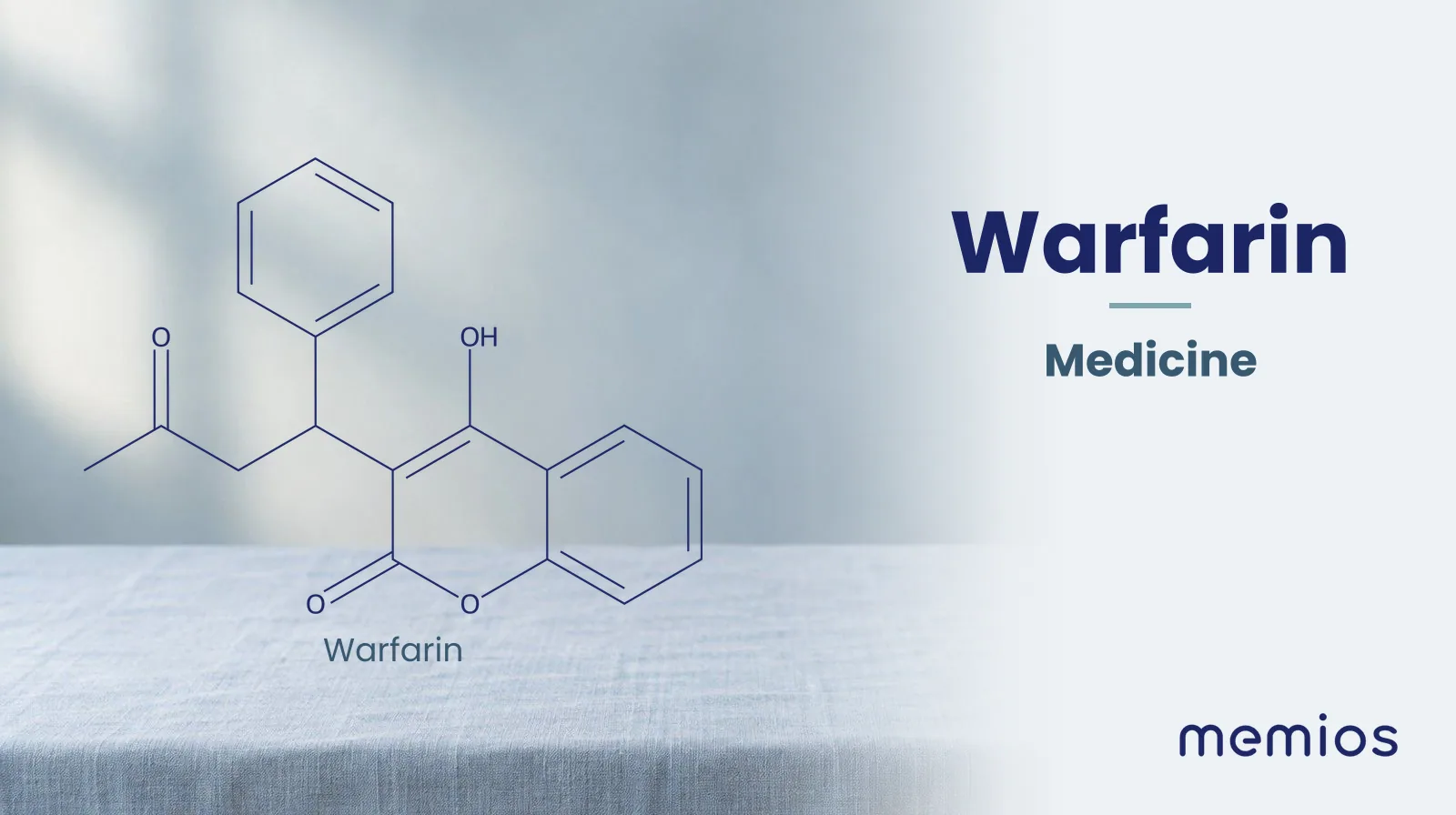
Warfarin blocks an enzyme the liver needs to activate vitamin K, which reduces the liver's production of several clotting factors and thins the blood over several days.
TLDR
- Boxed warning: Perform regular monitoring of INR in all treated patients.
- Well established. Warfarin blocks an enzyme the liver needs to activate vitamin K, which reduces the liver's production of several clotting factors and thins the blood over several days.
- What it is: Warfarin is a synthetic oral anticoagulant derived from coumarin, sold under brand names such as Coumadin and Jantoven. It has been used clinically since the 1950s to reduce blood clotting in people at risk of stroke, venous thromboembolism, or recurrent heart attack.
- Main use: Prevention of stroke and systemic embolism in nonvalvular atrial fibrillation (well supported).
- Other approved uses: Treatment and extended prevention of venous thromboembolism (DVT and pulmonary embolism) (well supported); Reduction of death, reinfarction and thromboembolic stroke after myocardial infarction (well supported); Thromboprophylaxis in mechanical heart valve replacement (limited evidence).
- Recommended dose (official position): Dosing is set and individualized by the prescriber against a target INR, not a fixed reference intake. The FDA label (DailyMed, revised January 22, 2025) states typical maintenance doses of 2 mg to 10 mg once daily.
- Studied dose (a trial dose, not a recommendation): WARIS-II used warfarin alone targeted to INR 2.8-4.2, or warfarin targeted to INR 2.0-2.5 combined with 75 mg aspirin daily. Findings citing that trial: 1 for, 1 on harm.
- Upper limit: The label does not set a fixed milligram ceiling; dose is titrated to INR response under prescriber supervision rather than capped at a stated maximum (DailyMed, 2025).
- What goes wrong: 3 findings on harm. Warfarin (with or without aspirin) causes significantly more major, nonfatal bleeding than aspirin alone after myocardial infarction.
- Interactions: 5 recorded, including Vitamin K (dietary intake), Cranberry juice, Alcohol, Grapefruit juice.
- Common myth: Warfarin is 'just rat poison' and is more dangerous than helpful.
What it is
Warfarin is a synthetic oral anticoagulant derived from coumarin, sold under brand names such as Coumadin and Jantoven. It has been used clinically since the 1950s to reduce blood clotting in people at risk of stroke, venous thromboembolism, or recurrent heart attack. Dosing is individualized and monitored with the INR blood test rather than given at a fixed dose for everyone.
What the research says
Warfarin blocks an enzyme the liver needs to activate vitamin K, which reduces the liver's production of several clotting factors and thins the blood over several days. The evidence base is outcome trials for each approved use (stroke prevention in atrial fibrillation, treatment/prevention of venous thromboembolism, and secondary prevention after myocardial infarction), not the FDA label itself, which only records a regulatory position.
Evidence grade: Well established.
How it works
Drug class: Vitamin K antagonist (coumarin) oral anticoagulant
Boxed warning
WARNING: BLEEDING RISK Warfarin sodium can cause major or fatal bleeding. Perform regular monitoring of INR in all treated patients. Drugs, dietary changes, and other factors affect INR levels achieved with warfarin sodium therapy. Instruct patients about prevention measures to minimize risk of bleeding and to report signs and symptoms of bleeding.
(Source 1)
What it is used for
- A Cochrane-based pooled analysis of five placebo-controlled trials found warfarin reduced stroke in nonvalvular atrial fibrillation, at the cost of an increased major bleeding rate; effect sizes are numeric (see findings) rather than one absolute figure that fits every patient. Evidence: established. (Source 2)
- A network meta-analysis of 11 RCTs found longer vitamin K antagonist therapy further reduces VTE recurrence compared with shorter courses, but with a higher major bleeding rate, so duration is a trade-off rather than a one-directional benefit. Evidence: established. (Source 3)
- The WARIS-II randomized trial found warfarin alone, and warfarin plus low-dose aspirin, each reduced a composite outcome versus aspirin alone after MI, with a corresponding increase in major bleeding. Evidence: established. (Source 4)
- This use is listed on the FDA label, but this research session did not independently retrieve a dedicated outcome trial for valve-replacement thromboprophylaxis; treat this line as a labeled position pending direct trial verification. Evidence: limited. (Source 1)
Interactions
- Vitamin K (dietary intake) (theoretical): Dietary vitamin K opposes warfarin's mechanism: warfarin works by blocking the recycling of vitamin K, so large or inconsistent intake of vitamin K-rich foods such as kale, spinach and brussels sprouts shifts the INR. The pharmacology reference states that patients should be educated on keeping vitamin K intake consistent, rather than avoiding these foods. Limit: The source contradicts itself here. In one sentence it tells patients to limit cranberry juice and alcohol, and in the very next sentence it says grapefruit juice and alcohol are what enhance warfarin's effect — two different juices named in two adjacent sentences, with no explanation of the switch. A reader should take from this page only that some juices and alcohol are flagged as able to affect warfarin, and should not treat either cranberry juice or grapefruit juice as an established warfarin interaction on the strength of this source alone. (Source 5)
- Cranberry juice (case reports): A published case report links daily cranberry juice with a dangerous rise in INR and major bleeding in a warfarin patient, resolving after the juice was stopped; evidence is a single case, not a controlled trial. (Source 6)
- Alcohol (theoretical): A pharmacology reference names alcohol in both of its adjacent dietary sentences — once among the things to limit, and once as able to enhance warfarin's anticoagulant effect and so increase bleeding complications. Alcohol is the one item the passage is consistent about; the juice named alongside it changes between the two sentences. Limit: The source contradicts itself here. In one sentence it tells patients to limit cranberry juice and alcohol, and in the very next sentence it says grapefruit juice and alcohol are what enhance warfarin's effect — two different juices named in two adjacent sentences, with no explanation of the switch. A reader should take from this page only that some juices and alcohol are flagged as able to affect warfarin, and should not treat either cranberry juice or grapefruit juice as an established warfarin interaction on the strength of this source alone. (Source 5)
- Grapefruit juice (theoretical): A pharmacology reference names grapefruit juice as able to enhance warfarin's anticoagulant effect and so increase bleeding complications. The same passage separately tells patients to limit cranberry juice rather than grapefruit juice, so which juice the page means is not settled by this source. Limit: The source contradicts itself here. In one sentence it tells patients to limit cranberry juice and alcohol, and in the very next sentence it says grapefruit juice and alcohol are what enhance warfarin's effect — two different juices named in two adjacent sentences, with no explanation of the switch. A reader should take from this page only that some juices and alcohol are flagged as able to affect warfarin, and should not treat either cranberry juice or grapefruit juice as an established warfarin interaction on the strength of this source alone. (Source 5)
- St John's wort (pharmacokinetic study): St John's wort induces the cytochrome P450 enzymes that clear warfarin, lowering warfarin exposure and INR in a controlled pharmacokinetic study; the reviewing author judged the average magnitude clinically minor but still recommended INR monitoring. (Source 7)
Stopping it
- Case literature describes a rebound hypercoagulable state after abrupt withdrawal of warfarin (and related vitamin K antagonists), distinct from a withdrawal syndrome in the addiction sense; this is a pharmacological rebound in clotting tendency. (Source 8)
- In the reviewed oral-anticoagulant discontinuation literature (largely DOAC cohorts, with warfarin/vitamin K antagonist data included), longer gaps off anticoagulation were associated with more thrombotic events. (Source 8)
What goes wrong
Warfarin (with or without aspirin) causes significantly more major, nonfatal bleeding than aspirin alone after myocardial infarction. (Source 4)
- Randomized trial, Moderate certainty.
- Size: 3,630 patients (WARIS-II)
- Who: adults surviving an acute myocardial infarction.
- How long: average about 4 years follow-up.
- Result: 0.62% major nonfatal bleeds per treatment-year on warfarin vs 0.17% on aspirin (P<0.001)
- Funding: not stated in the summary reviewed.
Episodes of major, nonfatal bleeding were significantly higher in patients per treatment-year among patients treated with warfarin (0.62%) compared to 0.17 % of patients receiving aspirin (P<0.001).
A published case report links daily cranberry juice consumption in a warfarin patient to major bleeding and a dangerously elevated INR that resolved after stopping the juice. (Source 6)
- Case report, Very low certainty.
- Size: 1 patient.
- Who: adult on stable long-term warfarin therapy.
- How long: single case, timeline of days to weeks.
- Result: major bleeding with markedly elevated INR temporally linked to daily cranberry juice; resolved on discontinuation.
- Funding: not stated.
We encountered a patient taking stable doses of warfarin who developed major bleeding and high INR soon after starting daily cranberry juice.
Stopping warfarin (or other vitamin K antagonists) has been linked in case reports and cohort data to a rebound hypercoagulable state and thrombotic events, particularly with abrupt cessation. (Source 8)
- Systematic review, Low certainty.
- Size: 16 case reports and 14 original studies reviewed (mixed anticoagulants, includes warfarin/nicoumalone data)
- Who: patients discontinuing vitamin K antagonist or other oral anticoagulant therapy.
- How long: varies; risk described within days after stopping.
- Result: temporal clustering of stroke/TIA with anticoagulant discontinuation; longer gaps after stopping associated with higher event rates.
- Funding: not stated.
The hypercoagulability rebound has already been described in cases of abrupt withdrawal from long-term nicoumalone therapy and the cessation and subsequent resumption of warfarin therapy.
What the evidence supports
In pooled randomized trials, warfarin reduces stroke in people with nonvalvular atrial fibrillation compared with placebo/control. (Source 2)
- Meta-analysis, High certainty.
- Size: 2,313 participants across 5 trials.
- Who: adults with nonvalvular atrial fibrillation, mean age 69, 74% male.
- How long: mean 1.5 years per participant.
- Result: Cochrane-derived pooled analysis; TheNNT reports 1 stroke prevented for roughly every 25 patients treated over the trial period.
- Funding: not stated in the summary reviewed.
Five high quality trials with 2313 participant were included, most examining warfarin versus placebo.
After myocardial infarction, warfarin alone and warfarin plus aspirin each reduced a composite of death, reinfarction and thromboembolic stroke compared with aspirin alone, in a large randomized trial. (Source 4)
- Randomized trial, Moderate certainty.
- Size: 3,630 patients (WARIS-II)
- Who: adults surviving an acute myocardial infarction.
- How long: average about 4 years follow-up.
- Result: warfarin vs aspirin: 16.7% vs 20.0% composite events (RR 0.81, 95% CI 0.69-0.95, P=0.03); warfarin+aspirin vs aspirin: 15.0% vs 20.0% (RR 0.71, 95% CI 0.60-0.83, P=0.001)
- Funding: not stated in the summary reviewed.
203 of 1216 receiving warfarin (16.7 %; RR compared with aspirin, 0.81; 95 % CI 0.69 to 0.95; P=0.03)
What the evidence does not support
In the WARCEF randomized trial, warfarin did not significantly reduce the composite outcome of ischemic stroke, intracerebral hemorrhage or death from any cause compared with aspirin in patients with reduced ejection fraction heart failure who were in sinus rhythm. (Source 9)
- Randomized trial, Moderate certainty.
- Size: 2,305 patients (WARCEF trial)
- Who: adults with reduced left-ventricular ejection fraction heart failure and sinus rhythm (no atrial fibrillation)
- How long: followed for up to 6 years (mean 3.5±1.8 years)
- Result: Primary composite outcome 7.47 vs 7.93 events per 100 patient-years, HR 0.93 (95% CI 0.79 to 1.10, P = 0.40). Within that null overall result, warfarin lowered ischemic stroke (0.72 vs 1.36 events per 100 patient-years, HR 0.52, 95% CI 0.33 to 0.82, P = 0.005) but raised major hemorrhage (1.78 vs 0.87 events per 100 patient-years, P<0.001); intracerebral and intracranial hemorrhage did not differ (0.27 vs 0.22 events per 100 patient-years, P = 0.82).
- Funding: not stated in the abstract.
The rates of the primary outcome were 7.47 events per 100 patient-years in the warfarin group and 7.93 in the aspirin group (hazard ratio with warfarin, 0.93; 95% confidence interval [CI], 0.79 to 1.10; P = 0.40). Thus, there was no significant overall difference between the two treatments.
Where the evidence is mixed
Longer duration of vitamin K antagonist therapy after venous thromboembolism further lowers recurrence but raises major bleeding risk versus shorter courses. (Source 3)
- Meta-analysis, Moderate certainty.
- Size: 3,109 patients across 11 RCTs.
- Who: adults treated for venous thromboembolism (DVT/PE)
- How long: durations compared from 3 months to 24+ months.
- Result: VTE recurrence OR 0.75 (95% CI 0.57-0.99) favoring longer therapy; major bleeding risk correspondingly higher with longer therapy (OR 2.31, 95% CI 1.17-4.56)
- Funding: not stated in the summary reviewed.
Longer VKA therapy was associated with significantly lower rates of VTE recurrence compared with shorter duration of VKA therapy (OR 0.75, 95%CI 0.57–0.99)
St John's wort induces the liver enzymes that clear warfarin, lowering warfarin blood levels and INR in a controlled pharmacokinetic study, though the authors judge the average effect clinically minor. (Source 7)
- Blood level study, Low certainty.
- Size: healthy volunteer study (Jiang et al. 2004)
- Who: healthy adult volunteers given single-dose warfarin.
- How long: short-term pharmacokinetic study.
- Result: about 20% decrease in warfarin AUC with concomitant St John's wort.
- Funding: not stated in the summary reviewed.
St John's wort induces CYP enzymes with a resultant increase in warfarin clearance and decrease in INR.
For major bleeding on warfarin, activated prothrombin complex concentrate achieved hemostasis in roughly two-thirds of patients in a single-center case series, with a measurable rate of subsequent clotting complications. (Source 10)
- Case series, Low certainty.
- Size: 67 patients.
- Who: adults with warfarin-associated major bleeding (mostly intracerebral or GI hemorrhage)
- How long: acute reversal setting.
- Result: hemostasis in 68.7%; INR <1.5 in 58.2%; thromboembolic complications in 7.5%.
- Funding: not stated.
Clinical hemostasis was achieved in 46 (68.7%) patients.
How much
- Reference intake: Dosing is set and individualized by the prescriber against a target INR, not a fixed reference intake. The FDA label (DailyMed, revised January 22, 2025) states typical maintenance doses of 2 mg to 10 mg once daily. (Source 1)
- Upper limit: The label does not set a fixed milligram ceiling; dose is titrated to INR response under prescriber supervision rather than capped at a stated maximum (DailyMed, 2025). (Source 1)
- Studied: WARIS-II used warfarin alone targeted to INR 2.8-4.2, or warfarin targeted to INR 2.0-2.5 combined with 75 mg aspirin daily. (Source 4)
- Studied: The pooled atrial-fibrillation trials summarized by TheNNT/Cochrane generally targeted an INR of about 2.0-3.0. (Source 2)
A common belief, and what the research shows
The belief: Warfarin is 'just rat poison' and is more dangerous than helpful.
What the research shows: Warfarin and rat poison formulations share the same drug class and mechanism, but at prescribed, INR-monitored doses, randomized trial evidence shows a net reduction in stroke and clot-related death for the approved indications, alongside a real and quantified bleeding risk described in its boxed warning.
Questions and answers
What is it?
Warfarin is a synthetic, prescription-only oral anticoagulant in the vitamin K antagonist (coumarin) class, marketed as Coumadin and Jantoven among other names. It works by blocking an enzyme the liver needs to activate vitamin K, which is required to build several clotting factors. (Source 11)
What does it do in the body?
By inhibiting VKORC1, warfarin reduces the liver's synthesis of vitamin K-dependent clotting factors II, VII, IX and X, and of the regulatory proteins C and S, which thins the blood over several days and lowers the risk of clot-related events such as stroke in atrial fibrillation, recurrent venous thromboembolism, and reinfarction after a heart attack. (Source 11)
Is it good or bad for you?
Trial evidence supports real benefit for the conditions it is approved for: fewer strokes in atrial fibrillation, fewer recurrent clots after venous thromboembolism, and fewer reinfarctions/deaths after a heart attack. That benefit is paired with a quantified, sometimes fatal, bleeding risk, which is why the FDA label carries a boxed warning and why the trials above report both benefit and harm side by side rather than one being 'the answer.' (Source 1)
How do you get more of it?
Warfarin is available only by prescription; it is not something a person increases on their own. Because its effect depends on interacting foods, drugs and individual metabolism, dose changes are made by a prescriber using regular INR blood tests, as the label itself instructs. (Source 1)
If it is harmful, what reduces it?
For the harmful effect of warfarin (bleeding), reversal agents exist: vitamin K restores clotting factor synthesis, and prothrombin complex concentrate replaces the missing clotting factors directly. In a case series of major bleeding on warfarin, activated prothrombin complex concentrate achieved bleeding control in most, but not all, patients, and carried its own clotting risk. (Source 10)
Why might someone be low in it or missing it?
This question does not apply in the literal sense: warfarin is a synthetic drug, not a substance the body makes or needs, so no one is naturally 'missing' it. People are prescribed it because they have (or are at risk for) a specific clotting-related condition, such as atrial fibrillation or a history of venous thromboembolism, not because of a deficiency. (Source 1)
Which whole foods contain it or feed it?
Does not apply. Warfarin is a manufactured pharmaceutical, not a nutrient, and is not obtained from food; some foods instead interact with it by supplying vitamin K, which opposes its mechanism. (Source 11)
What happens if you do not have it?
If warfarin is not taken when it is indicated, a person keeps the untreated risk of the condition it was prescribed for. In the pooled atrial-fibrillation trials, the placebo (essentially untreated) groups had a materially higher stroke rate than the warfarin groups, which is the basis for the trial's reported benefit. (Source 2)
How can you test for it?
Warfarin's effect is monitored with the INR (International Normalized Ratio) blood test, either in a laboratory or with a point-of-care device. Point-of-care INR devices generally track laboratory INR reasonably well within the usual therapeutic range, but published comparisons show they can diverge meaningfully from the lab result, especially at higher INR values, so results near clinical decision points may need lab confirmation. (Source 12)
References
- DailyMed (U.S. National Library of Medicine) / FDA label. Warfarin Sodium Tablet — FDA prescribing information. 2025. Read the source
- TheNNT.com. Warfarin for Atrial Fibrillation Stroke Prevention (summarizing Aguilar & Hart, Cochrane Database Syst Rev 2005). 2005. Read the source
- BMC Cardiovascular Disorders. Optimal duration of Vitamin K antagonists anticoagulant therapy after venous thromboembolism: a systematic review and network meta-analysis of randomized controlled trials. 2020. DOI 10.1186/s12872-020-01345-z. Read the source
- American College of Cardiology. WARIS-II (Warfarin-Aspirin Reinfarction Study II) trial summary. 2002. Read the source
- StatPearls / NCBI Bookshelf. Warfarin — Dietary considerations. 2024. Read the source
- American Journal of Therapeutics (PubMed). Warfarin-cranberry juice interaction resulting in profound hypoprothrombinemia and bleeding. 2006. PMID 16772772. Read the source
- Australian Prescriber. Warfarin, St John's wort and INR. not stated on page. Read the source
- PMC (journal systematic review). Prothrombotic Rebound After Discontinuation of Direct Oral Anticoagulants Therapy: A Systematic Review. 2024. Read the source
- New England Journal of Medicine. Warfarin and aspirin in patients with heart failure and sinus rhythm. 2012. PMID 22551105, DOI 10.1056/NEJMoa1202299. Read the source
- Scientific Reports (Nature). Efficacy and safety of activated prothrombin complex concentrate for the reversal of vitamin K antagonist major bleeding. 2022. PMID 35110612. Read the source
- StatPearls / NCBI Bookshelf. Warfarin — Mechanism of Action. 2024. Read the source
- Clinical Laboratory News (AACC/ADLM). Point-of-Care or Clinical Lab INR for Anticoagulation Monitoring: Which to Believe?. 2017. Read the source