Supplements · September 29, 2026 · Memios · 12 min read
Vitamin K2
The evidence is thin and much of the positive fracture data comes from Japanese trials of MK-4.
TLDR
- Limited evidence. The evidence is thin and much of the positive fracture data comes from Japanese trials of MK-4.
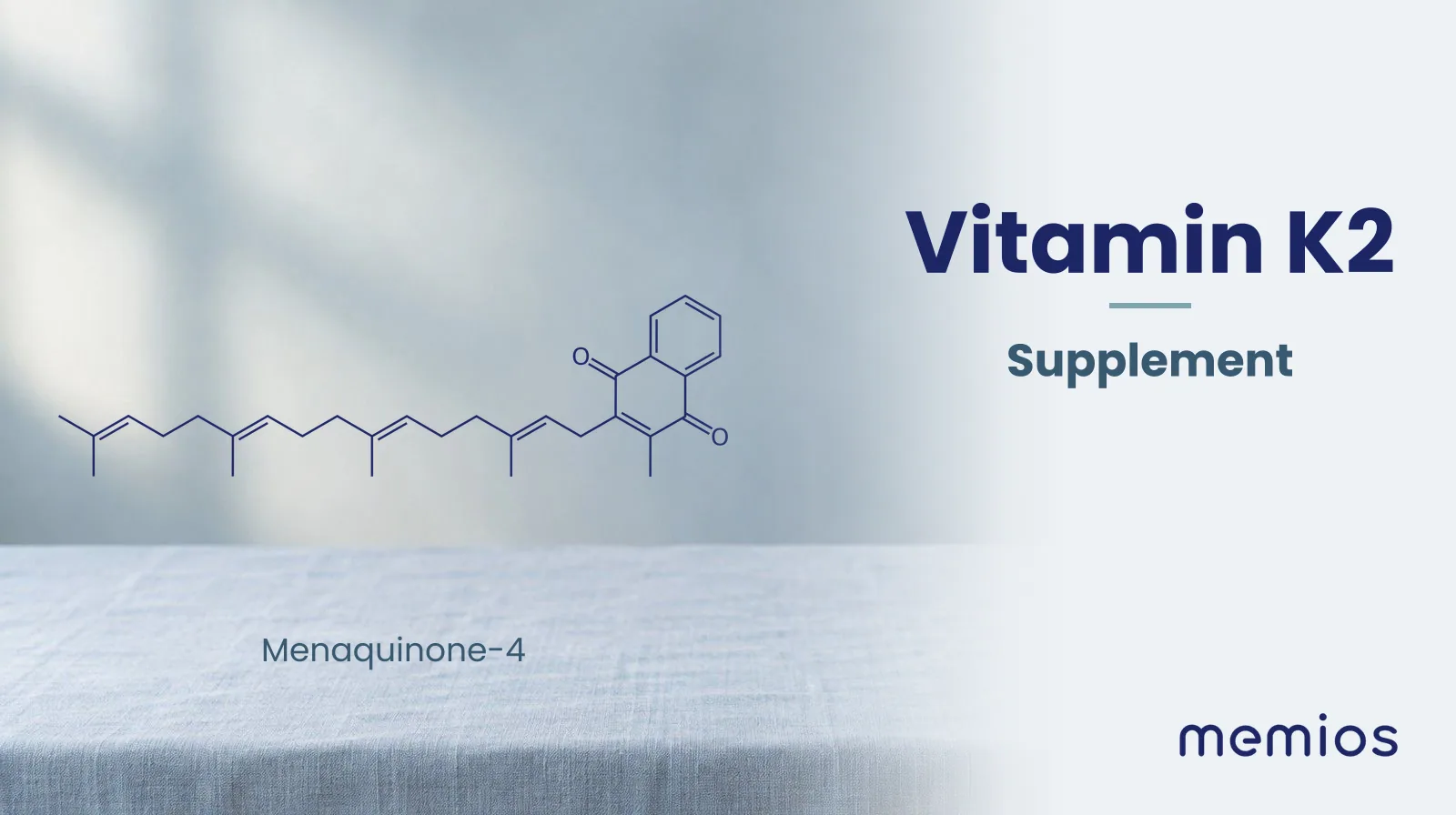
- What it is: Vitamin K2 is the menaquinone family of vitamin K, distinguished from vitamin K1 (phylloquinone) by an unsaturated isoprenyl side chain; the members are numbered MK-4 to MK-13 by side-chain length, and MK-4, MK-7 and MK-9 are the best studied.
- Main use, supported: In a 2006 meta-analysis of 13 vitamin K trials, supplementation was associated with significantly fewer hip, vertebral and non-vertebral fractures. (low certainty)
- Other use, supported: Three years of 180 micrograms a day of MK-7 slowed the age-related decline in bone mineral density at the spine and femoral neck, but not at the total hip. (low certainty)
- Claim NOT supported by research: In men with established aortic valve calcification, two years of 720 micrograms a day of MK-7 with vitamin D did not slow calcification progression. (moderate certainty)
- Another claim NOT supported: A meta-analysis of vitamin K trials in chronic kidney disease found changes in blood markers but no significant change in imaging measures of calcification. (low certainty)
- Recommended dose: not established. No Recommended Dietary Allowance exists for vitamin K or for menaquinones specifically.
- Studied dose (a trial dose, not a recommendation): A three-year trial in healthy postmenopausal women gave 180 micrograms of MK-7 per day. Findings citing that trial: 1 for.
- Upper limit: No Tolerable Upper Intake Level has been set: the Food and Nutrition Board did not establish ULs for vitamin K because of its low potential for toxicity.
- What goes wrong: 1 finding on harm. Vitamin K, including supplemental menaquinone, antagonises warfarin and similar anticoagulants, so changing intake changes the drug's effect.
- Common myth: Vitamin K2 directs calcium away from arteries into bone, so it prevents arterial calcification.
What it is
Vitamin K2 is the menaquinone family of vitamin K, distinguished from vitamin K1 (phylloquinone) by an unsaturated isoprenyl side chain; the members are numbered MK-4 to MK-13 by side-chain length, and MK-4, MK-7 and MK-9 are the best studied. Phylloquinone from green leafy vegetables is the main dietary form of vitamin K, while menaquinones come mostly from fermented foods, notably natto. In the body menaquinone acts as a cofactor for carboxylation of vitamin K-dependent proteins, including the matrix Gla protein involved in inhibiting arterial calcification.
What the research says
The evidence is thin and much of the positive fracture data comes from Japanese trials of MK-4. A 2006 meta-analysis found large reductions in fractures with menaquinone-4, but the included trials were mostly small, from one country and poorly concealed. A three-year trial of 180 micrograms a day of MK-7 in postmenopausal women slowed bone density loss at spine and femoral neck but not at the total hip. The vascular calcification claim is not supported by the trials tested so far: MK-7 with vitamin D did not slow aortic valve calcification over two years, and a meta-analysis in chronic kidney disease found no change in radiological calcification scores. Vitamin K in any form opposes warfarin-type anticoagulants.
Evidence grade: Limited evidence.
What goes wrong
Vitamin K, including supplemental menaquinone, antagonises warfarin and similar anticoagulants, so changing intake changes the drug's effect. (Source 1)
- Official position, Certainty not rated.
- Size: Not applicable - agency review of drug-nutrient interactions.
- Who: People taking warfarin and similar anticoagulants.
- How long: Not applicable.
- Result: No numeric effect given; the agency describes that sudden changes in vitamin K intake can increase or decrease the anticoagulant effect.
- Funding: US government agency.
People taking warfarin and similar anticoagulants need to maintain a consistent intake of vitamin K from food and supplements because sudden changes in vitamin K intakes can increase or decrease the anticoagulant effect.
What the evidence supports
In a 2006 meta-analysis of 13 vitamin K trials, supplementation was associated with significantly fewer hip, vertebral and non-vertebral fractures, but the hip result was no longer statistically significant once high-risk populations were removed. (Source 2)
- Meta-analysis, Low certainty.
- Size: 13 randomised controlled trials, n=1,366; 7 trials reported fractures.
- Who: Mostly Japanese patients, including high-risk populations.
- How long: Varied by trial.
- Result: Hip fracture OR 0.23 (95% CI: 0.12, 0.47); vertebral OR 0.40 (0.25, 0.65); all non-vertebral OR 0.19 (0.11, 0.35). Excluding high-risk populations, hip fracture was not statistically significant, while vertebral (4 RCTs; OR 0.40, 0.25 to 0.65) and all non-vertebral fractures (2 RCTs; OR 0.24, 0.07 to 0.84) remained significant.
- Funding: not stated in the DARE abstract.
Vitamin K supplementation significantly reduced hip (OR 0.23, 95% CI: 0.12, 0.47), vertebral (OR 0.40, 95% CI: 0.25, 0.65) and all nonvertebral (OR 0.19, 95% CI: 0.11, 0.35) fractures.
Three years of 180 micrograms a day of MK-7 slowed the age-related decline in bone mineral density at the spine and femoral neck, but not at the total hip. (Source 3)
- Randomized trial, Low certainty.
- Size: 244 healthy postmenopausal women.
- Who: Healthy postmenopausal women.
- How long: 3 years.
- Result: The published abstract reports significant improvement in vitamin K status and reduced decline in bone mineral content and density at lumbar spine and femoral neck, with no effect at total hip; no effect sizes or confidence intervals are given in the abstract.
- Funding: not stated in the abstract.
MK-7 intake significantly improved vitamin K status and decreased the age-related decline in BMC and BMD at the lumbar spine and femoral neck, but not at the total hip.
In the two-year MK-7 plus vitamin D trial there was no excess of deaths, cardiovascular events or valve surgery, though the trial was small for safety outcomes. (Source 4)
- Randomized trial, Low certainty.
- Size: 365 men.
- Who: Older men with aortic valve calcification.
- How long: 24 months.
- Result: Heart valve surgery 1 versus 2 patients (P=0.99); all-cause death 1 versus 4 (P=0.37); cardiovascular events 10 versus 10 (P=0.99)
- Funding: not stated in the abstract.
There was no difference in the rate of heart valve surgery (1 versus 2 patients; P=0.99), all-cause death (1 versus 4 patients; P=0.37), or cardiovascular events (10 versus 10 patients; P=0.99).
The US Food and Nutrition Board set no upper limit for vitamin K, citing low toxicity and an absence of reported adverse effects from food or supplements. (Source 5)
- Official position, Certainty not rated.
- Size: Not applicable - agency review.
- Who: General population.
- How long: Not applicable.
- Result: No UL established.
- Funding: US government agency.
The FNB did not establish ULs for vitamin K because of its low potential for toxicity.
What the evidence does not support
In men with established aortic valve calcification, two years of 720 micrograms a day of MK-7 with vitamin D did not slow calcification progression. (Source 4)
- Randomized trial, Moderate certainty.
- Size: 365 men randomised.
- Who: Community-dwelling men, mean age 71.0 years, aortic valve calcification score above 300 arbitrary units.
- How long: 24 months.
- Result: Mean difference in aortic valve calcification progression 17 AU (95% CI -86 to 53 AU; P=0.64), despite a large fall in dp-ucMGP (-212 pmol/L versus 45 pmol/L; P<0.001)
- Funding: not stated in the abstract.
In elderly men with an AVC score >300 AU, 2 years MK-7 plus vitamin D supplementation did not influence AVC progression.
A meta-analysis of vitamin K trials in chronic kidney disease found changes in blood markers but no significant change in imaging measures of calcification. (Source 6)
- Meta-analysis, Low certainty.
- Size: 10 randomised controlled trials, 733 patients.
- Who: Patients with chronic kidney disease, including dialysis populations.
- How long: Varied by trial.
- Result: No significant change in calcification scores from radiology examinations; mild improvement in pulse wave velocity; half the trials at low risk of bias.
- Funding: Partly funded by a clinical research grant of Sichuan Provincial People's Hospital (2020LY02)
Pooled results indicated a decrease in serum biomarkers relevant to vascular calcification to a certain extent, mild improvement in vascular elasticity reflected by PWV, yet, no significant change in calcification scores derived from radiology examinations.
The authors of that review concluded the protective effect on vascular calcification is not established. (Source 6)
- Systematic review, Low certainty.
- Size: 10 randomised controlled trials, 733 patients.
- Who: Patients with chronic kidney disease.
- How long: Varied.
- Result: No pooled benefit on radiological calcification; the review calls for results of ongoing trials.
- Funding: Partly funded by a clinical research grant of Sichuan Provincial People's Hospital (2020LY02)
Therefore, there is not yet solid evidence to support protective effects of vitamin K supplementation against vascular calcification in CKD.
Where the evidence is mixed
The same review reported weak trial methods, which limits confidence in the fracture result. (Source 2)
- Systematic review, Low certainty.
- Size: Same 7 fracture trials.
- Who: Mostly Japanese patients.
- How long: Varied.
- Result: Only two trials reported allocation concealment; attrition ranged from 0 to 30%; heterogeneity present for risk differences in non-vertebral fractures.
- Funding: not stated in the DARE abstract.
Only 2 studies reported using a method of allocation concealment. Attrition rates ranged from 0 to 30%.
Where the research disagrees
Whether vitamin K2 protects arteries and heart valves from calcification
- Mechanistic rationale stated by the Circulation trial investigators, rct: Menaquinone-7 (MK-7), also known as vitamin K2, is a cofactor for the carboxylation of proteins involved in the inhibition of arterial calcification and has been suggested to reduce the progression rate of aortic valve calcification (AVC) in patients with aortic stenosis. (Source 4)
- The same trial's result, and the chronic kidney disease meta-analysis, rct: In elderly men with an AVC score >300 AU, 2 years MK-7 plus vitamin D supplementation did not influence AVC progression. (Source 4)
Whether menaquinone prevents fractures
- Cockayne and colleagues, 2006 meta-analysis, meta-analysis: Supplementation with phytonadione and menaquinone-4 may reduce bone loss, while the latter reduced fractures in Japanese patients. (Source 7)
- The same review on trial quality, systematic-review: Only 2 studies reported using a method of allocation concealment. Attrition rates ranged from 0 to 30%. (Source 2)
How much
- Reference intake: No Recommended Dietary Allowance exists for vitamin K or for menaquinones specifically. Table 1 of the NIH Office of Dietary Supplements vitamin K fact sheet lists Food and Nutrition Board Adequate Intakes for total vitamin K of 120 mcg/day for adult men and 90 mcg/day for adult women; these values are given in a table rather than in prose, and they are not set separately for K2. (Source 5)
- Upper limit: No Tolerable Upper Intake Level has been set: the Food and Nutrition Board did not establish ULs for vitamin K because of its low potential for toxicity. (Source 5)
- Studied: A three-year trial in healthy postmenopausal women gave 180 micrograms of MK-7 per day. (Source 3)
- Studied: A two-year trial in older men gave 720 micrograms of MK-7 plus 25 micrograms of vitamin D daily. (Source 4)
A common belief, and what the research shows
The belief: Vitamin K2 directs calcium away from arteries into bone, so it prevents arterial calcification.
What the research shows: The carboxylation mechanism is real, but the clinical tests failed. A randomised trial of 720 micrograms MK-7 with vitamin D reported that "In elderly men with an AVC score >300 AU, 2 years MK-7 plus vitamin D supplementation did not influence AVC progression.", even though the vitamin K marker dp-ucMGP fell sharply, and a meta-analysis in kidney disease found "no significant change in calcification scores derived from radiology examinations".
Questions and answers
What is it?
Vitamin K2 is the menaquinone branch of the vitamin K family. Menaquinones are numbered by the length of their side chain, from MK-4 to MK-13, and MK-4, MK-7 and MK-9 are the ones most studied. Supplements usually contain MK-4 (menatetrenone) or MK-7, which is derived from fermented soya. (Source 8)
What does it do in the body?
Vitamin K works as a cofactor for carboxylation of vitamin K-dependent proteins. Two of those jobs drive the marketing: clotting factors, and matrix Gla protein, which is involved in inhibiting arterial calcification. Supplementing MK-7 measurably changes those markers, but changing the markers did not change calcification on imaging in trials. (Source 4)
Is it good or bad for you?
The honest answer is that the evidence is thin either way. Fracture reduction rests largely on small Japanese MK-4 trials with weak allocation concealment and up to 30% attrition, and the vascular claims failed in the trials that tested them. The main documented risk is interference with warfarin-type anticoagulants. (Source 6)
How do you get more of it?
Menaquinones come from fermented foods and from supplements. Natto, fermented soya beans, has high amounts; other fermented foods such as cheese contain some. Trials have used 180 micrograms a day of MK-7 for three years and 720 micrograms a day for two years. (Source 8)
If it is harmful, what reduces it?
Menaquinone is not regarded as toxic, so there is no general reason to lower it, and no upper limit has been set. The one setting where intake is deliberately kept steady or limited is treatment with warfarin and similar anticoagulants, where vitamin K opposes the drug. (Source 1)
Why might someone be low in it or missing it?
Clinically significant vitamin K deficiency in adults is described as very rare, and is usually confined to people with malabsorption disorders or those on drugs that interfere with vitamin K metabolism. Newborns are the classic at-risk group, which is why vitamin K is given at birth. (Source 9)
Which whole foods contain it or feed it?
For menaquinones specifically: natto, and to a lesser degree other fermented foods such as cheese, plus small amounts in animal foods. Most dietary vitamin K overall is phylloquinone from green leafy vegetables, not K2. (Source 8)
What happens if you do not have it?
The recognised consequence of vitamin K deficiency is impaired clotting. It is judged clinically relevant when prothrombin time lengthens because prothrombin activity falls, and bleeding and haemorrhage are the classic signs, although the NIH states these occur only in severe cases. No specific disease of menaquinone deficiency, separate from vitamin K deficiency as a whole, is established in the sources we reached. (Source 10)
How can you test for it?
There is no routine test of vitamin K2 status. Status is not usually assessed except in people on anticoagulants or with bleeding disorders, and the only clinically significant indicator is prothrombin time, which ordinary changes in vitamin K intake have rarely been shown to alter. The fact sheet also states that no data on normal ranges of menaquinones are available. Research trials instead use indirect markers such as undercarboxylated osteocalcin or dp-ucMGP, which are not validated clinical tests. (Source 11)
References
- NIH Office of Dietary Supplements. Vitamin K - Health Professional Fact Sheet. 2025. Read the source
- Database of Abstracts of Reviews of Effects (DARE), NCBI Bookshelf; review published in Archives of Internal Medicine. Vitamin K and the prevention of fractures: systematic review and meta-analysis of randomized controlled trials (DARE structured abstract). 2006. PMID 16801507, DOI 10.1001/archinte.166.12.1256. Read the source
- Osteoporosis International. Three-year low-dose menaquinone-7 supplementation helps decrease bone loss in healthy postmenopausal women. 2013. PMID 23525894, DOI 10.1007/s00198-013-2325-6. Read the source
- Circulation. Vitamin K2 and D in Patients With Aortic Valve Calcification: A Randomized Double-Blinded Clinical Trial.. 2022. PMID 35465686, DOI 10.1161/CIRCULATIONAHA.121.057008. Read the source
- NIH Office of Dietary Supplements. Vitamin K - Health Professional Fact Sheet. 2025. Read the source
- Frontiers in Nutrition. Effects of vitamin K supplementation on vascular calcification in chronic kidney disease: A systematic review and meta-analysis of randomized controlled trials. 2022. PMID 36704782, DOI 10.3389/fnut.2022.1001826. Read the source
- Database of Abstracts of Reviews of Effects (DARE), NCBI Bookshelf; review published in Archives of Internal Medicine. Vitamin K and the prevention of fractures: systematic review and meta-analysis of randomized controlled trials (DARE structured abstract). 2006. PMID 16801507, DOI 10.1001/archinte.166.12.1256. Read the source
- NIH Office of Dietary Supplements. Vitamin K - Health Professional Fact Sheet. 2025. Read the source
- NIH Office of Dietary Supplements. Vitamin K - Health Professional Fact Sheet. 2025. Read the source
- NIH Office of Dietary Supplements. Vitamin K - Health Professional Fact Sheet. 2025. Read the source
- NIH Office of Dietary Supplements. Vitamin K - Health Professional Fact Sheet. 2025. Read the source