Medications · September 29, 2026 · Memios · 21 min read
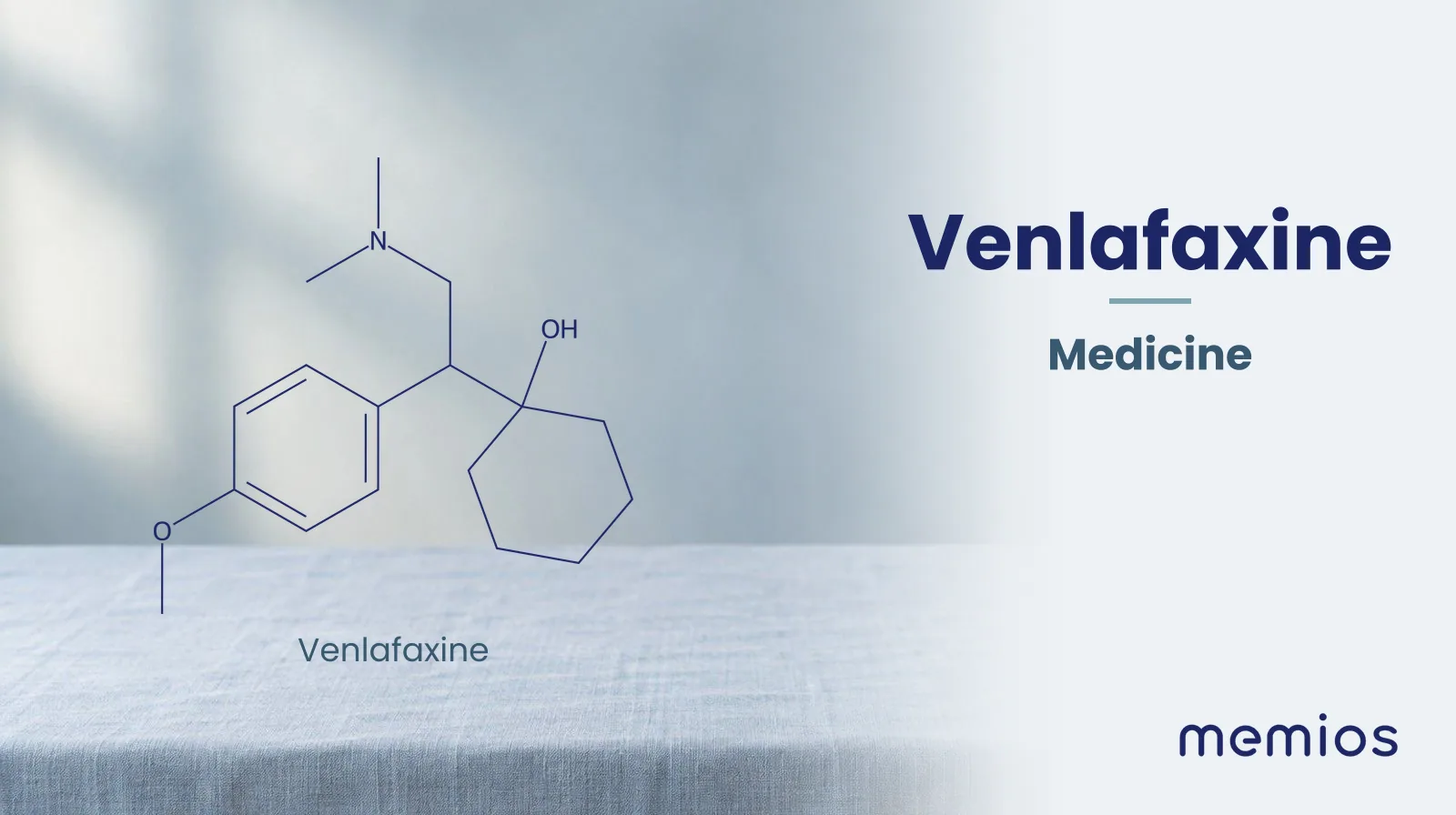
Venlafaxine
Well established. The strongest evidence is for major depressive disorder and generalised anxiety disorder.
TLDR
- Boxed warning: Venlafaxine Extended Release Tablets are not approved for use in pediatric patients.
- Well established. The strongest evidence is for major depressive disorder and generalised anxiety disorder.
- What it is: Venlafaxine is a synthetic antidepressant taken by mouth as immediate-release tablets or extended-release tablets and capsules.
- Main use: Major depressive disorder (well supported).
- Other approved uses: Generalised anxiety disorder (well supported).
- Off-label uses (not on the FDA label): Menopausal hot flushes and night sweats (vasomotor symptoms) (limited evidence); Neuropathic pain (limited evidence).
- Recommended dose: not established. There is no reference intake for a prescription medicine; the dose is set by the prescriber.
- Studied dose (a trial dose, not a recommendation): The generalised anxiety disorder meta-analysis pooled trials of venlafaxine XR at 75 to 225 mg/day. Findings citing that trial: 1 for, 1 on harm.
- Upper limit: As a position, the same 10/2016 FDA label states that dose increases may go to a maximum of approximately 225 mg/day for these extended-release tablets, in increments of up to 75 mg/day at intervals of not less than 4 days.
- What goes wrong: 6 findings on harm. Withdrawal symptoms follow discontinuation of any SNRI and appear to be more common with venlafaxine than with the others.
- Interactions: 5 recorded, including St John's wort (Hypericum perforatum), Serotonergic drugs and supplements: triptans, tricyclics, fentanyl, lithium, tramadol, buspirone, tryptophan, amphetamines and St John's Wort, Alcohol, NSAIDs, aspirin and warfarin (and, by the same mechanism, anything else that impairs clotting).
- Common myth: Antidepressants are not addictive, so venlafaxine can simply be stopped when you feel better.
What it is
Venlafaxine is a synthetic antidepressant taken by mouth as immediate-release tablets or extended-release tablets and capsules. It is classed as a serotonin and norepinephrine reuptake inhibitor (SNRI). The liver converts it, mainly through the enzyme CYP2D6, into an active metabolite called O-desmethylvenlafaxine (ODV), which is itself sold as a separate antidepressant, desvenlafaxine. Parent drug and metabolite have similar activity, so a person's CYP2D6 status changes the balance between the two in the blood.
What the research says
The strongest evidence is for major depressive disorder and generalised anxiety disorder. A meta-analysis of dozens of randomised trials found venlafaxine produced more responses and remissions than SSRIs and prevented relapse compared with placebo, though it reported relative odds rather than absolute numbers needed to treat. A separate meta-analysis of 14 studies in generalised anxiety disorder found it beat placebo on anxiety scores, response and remission, but also that nearly three times as many people stopped it for side effects. It is widely used off-label for menopausal hot flushes, where one large randomised trial found a real but modest benefit, and for neuropathic pain, where a Cochrane review found little compelling evidence. Its main documented harms are a dose-dependent rise in diastolic blood pressure, a boxed warning about suicidal thinking in people under 25, greater toxicity in overdose than SSRIs, and discontinuation symptoms that a systematic review found were more common with venlafaxine than with other SNRIs.
Evidence grade: Well established.
How it works
Drug class: Serotonin-norepinephrine reuptake inhibitor (SNRI) antidepressant
Venlafaxine blocks the transporter proteins that pull serotonin and noradrenaline back into nerve endings, so more of those signalling chemicals stay in the gap between nerve cells. The liver turns it into an active metabolite, ODV, using the CYP2D6 enzyme, and that metabolite does much the same job. (Source 1)
Boxed warning
Antidepressants increased the risk compared to placebo of suicidal thinking and behavior (suicidality) in children, adolescents, and young adults in short-term studies of Major Depressive Disorder (MDD) and other psychiatric disorders. Anyone considering the use of Venlafaxine Extended Release Tablets or any other antidepressant in a child, adolescent, or young adult must balance this risk with the clinical need. Short-term studies did not show an increase in the risk of suicidality with antidepressants compared to placebo in adults beyond age 24; there was a reduction in risk with antidepressants compared to placebo in adults aged 65 and older. Depression and certain other psychiatric disorders are themselves associated with increases in the risk of suicide. Patients of all ages who are started on antidepressant therapy should be monitored appropriately and observed closely for clinical worsening, suicidality, or unusual changes in behavior. Families and caregivers should be advised of the need for close observation and communication with the prescriber. Venlafaxine Extended Release Tablets are not approved for use in pediatric patients.
(Source 2)
What it is used for
- Pooled randomised trials show venlafaxine produces more responses and remissions than SSRIs and fewer relapses than placebo in maintenance. The pooled record reports odds ratios only; it does not give absolute risk reductions or numbers needed to treat, so how much difference this makes to an individual cannot be read off it. Evidence: established. (Source 3)
- A meta-analysis of 14 short-term studies found venlafaxine XR beat placebo on the Hamilton Anxiety scale, on response and on remission. The same analysis found people stopped venlafaxine for side effects almost three times as often as placebo. Evidence: established. (Source 4)
- In one 8-week randomised trial, venlafaxine cut hot flush frequency by 1.8 per day more than placebo, slightly less than low-dose oral estradiol. This is a single trial with a short follow-up, so the finding is real but thin. Evidence: limited. (Source 5)
- A Cochrane review of six small trials in 460 people found little compelling evidence of benefit, with considerable risk of bias and strong placebo effects, although individual studies showed moderate benefit. The reviewers said they could not recommend it as a first-line treatment for this use. Evidence: limited. (Source 6)
Interactions
- St John's wort (Hypericum perforatum) (case reports): St John's wort is itself serotonergic, so combining it with a serotonin reuptake inhibitor adds to serotonin signalling and has been linked to serotonin syndrome. The only evidence behind this entry is a regulator's case-report summary, not a study: Medsafe, the New Zealand medicines safety authority, described a single reported case in which a patient developed moderate serotonin syndrome after two doses of citalopram taken a day after drinking a St John's wort tea, and stated that the herb interacts with SSRIs and with other serotonergic drugs in the same way. That case involved an SSRI rather than venlafaxine, so the risk to someone taking venlafaxine is inferred from the shared mechanism, not observed. (Source 7)
- Serotonergic drugs and supplements: triptans, tricyclics, fentanyl, lithium, tramadol, buspirone, tryptophan, amphetamines and St John's Wort (label): Taking venlafaxine with any of these raises the risk of serotonin syndrome, most of all when starting treatment or increasing the dose. Combining it with MAOIs used for psychiatric conditions is contraindicated outright. (Source 8)
- Alcohol (pharmacokinetic study): In a small human study, a single dose of alcohol did not change venlafaxine blood levels, and venlafaxine did not make alcohol's effects on psychomotor performance worse. This was 15 healthy men given a single 0.5 g/kg dose, so it does not speak to heavy or repeated drinking. (Source 9)
- NSAIDs, aspirin and warfarin (and, by the same mechanism, anything else that impairs clotting) (label): Serotonin reuptake inhibitors are associated with upper gastrointestinal bleeding in observational studies, and taking an NSAID or aspirin on top may increase that risk. Bleeding has also been reported when SNRIs are combined with warfarin. (Source 10)
- Drugs that block CYP2D6 (for example paroxetine, fluoxetine, bupropion, quinidine) (pharmacokinetic study): CYP2D6 makes the active metabolite ODV. Blocking that enzyme, or lacking it genetically, raises venlafaxine and lowers ODV in the blood, changing the ratio of the two. (Source 1)
Stopping it
- Withdrawal symptoms follow discontinuation of any SNRI, usually starting within a few days and lasting weeks, and a systematic review found they occurred even when the drug was tapered gradually. (Source 11)
- The same review reported that some people had symptoms that started late or persisted for a long time, rather than settling within the usual few weeks. (Source 11)
- Stopping is not only about withdrawal: in three randomised trials, staying on venlafaxine prevented relapse of depression compared with placebo. (Source 3)
What goes wrong
People taking venlafaxine XR for anxiety stopped the drug because of side effects almost three times as often as people on placebo. (Source 4)
- Meta-analysis, Certainty not rated.
- Size: 10 articles covering 14 studies.
- Who: adults with generalised anxiety disorder without depression.
- How long: short-term studies.
- Result: Discontinuation for adverse events OR 2.80 (95% CI 2.21 to 3.54, P<0.00001). All-cause discontinuation was not different (OR 1.17, 95% CI 0.92 to 1.49). Most frequent adverse events: nausea, dry mouth, dizziness, insomnia, somnolence, headache.
- Funding: independent (National Natural Science Foundation of China, per the article's funding statement)
discontinuation due to adverse events was statistically higher in the venlafaxine XR group compared with the placebo treatment (OR = 2.80, 95%CI 2.21–3.54, P<0.00001)
Venlafaxine raises diastolic blood pressure in a dose-dependent way, with clinically significant rises concentrated at high doses. (Source 12)
- Meta-analysis, Certainty not rated.
- Size: 3,744 depressed patients (original patient data pooled)
- Who: depressed patients in venlafaxine trials, compared with imipramine and placebo.
- How long: acute phase and continuation therapy.
- Result: Small but statistically significant increases in supine diastolic blood pressure in acute treatment; a greater proportion of persistent elevations than imipramine or placebo during continuation; incidence statistically and clinically significant only above 300 mg/day. The abstract does not give the percentage affected.
- Funding: not stated.
The effect of venlafaxine was highly dose dependent, and the incidence of elevated SDBP was statistically and clinically significant only at dosages above 300 mg/day.
Withdrawal symptoms follow discontinuation of any SNRI and appear to be more common with venlafaxine than with the others. (Source 11)
- Systematic review, Low certainty.
- Size: 61 reports: 22 double-blind RCTs, 6 open-then-randomised studies, 8 open trials, 1 prospective naturalistic study, 1 retrospective study and 23 case reports.
- Who: people discontinuing duloxetine, venlafaxine, desvenlafaxine, milnacipran or levomilnacipran.
- How long: symptoms typically began within days and lasted weeks.
- Result: The review reports no pooled incidence; it states prevalence varied across reports and appeared higher with venlafaxine, and that symptoms occurred even with gradual tapering.
- Funding: not stated.
The prevalence of withdrawal symptoms varied across reports and appeared to be higher with venlafaxine.
People who deliberately overdosed on venlafaxine were more likely to become confused and develop dilated pupils than people who overdosed on SSRIs, and one died. (Source 13)
- Cohort study, Low certainty.
- Size: two groups of deliberate self-poisoners (venlafaxine versus SSRIs); group sizes not given in the abstract read.
- Who: hospital-presenting deliberate self-poisoning cases.
- How long: single admission.
- Result: Confusion 25% versus 0% (p = 0); mydriasis 19.4% versus 2% (p <= 0.02); median dose taken 35 defined daily doses versus 19.4 for SSRIs; one death in the venlafaxine group.
- Funding: not stated.
Limit of this finding: The paper prints the confusion result as "p = 0". A p-value can never actually be zero; this is the journal's own rounding or typesetting of a very small number, and we have quoted it as printed rather than repairing it. Read it as "much smaller than 0.05", not as certainty. Note also that the abstract gives no group sizes, and a 0% rate in the SSRI group means the comparison rests on very few events, so the size of the difference is not reliable.
Those who ingested venlafaxine were more likely to become confused (25% versus 0%; p = 0) and have mydriasis (19.4% versus 2%; p ≤ 0.02), than those who took SSRIs
The FDA-approved label carries a boxed warning that antidepressants increased suicidal thinking and behaviour versus placebo in children, adolescents and young adults. (Source 2)
- Official position, Certainty not rated.
- Size: pooled short-term trials summarised by the regulator; numbers not given in the boxed warning.
- Who: children, adolescents and adults in short-term antidepressant trials.
- How long: short-term studies.
- Result: The warning states there was no increase in adults beyond age 24 and a reduction in risk in adults aged 65 and older. No rates are given in the warning text.
- Funding: regulatory position, U.S. Food and Drug Administration, label revision 10/2016.
Antidepressants increased the risk compared to placebo of suicidal thinking and behavior (suicidality) in children, adolescents, and young adults in short-term studies of Major Depressive Disorder (MDD) and other psychiatric disorders.
The label cites case-control and cohort studies linking serotonin reuptake inhibitors to upper gastrointestinal bleeding, with the risk potentiated by NSAIDs or aspirin. (Source 10)
- Official position, Certainty not rated.
- Size: not stated in the label.
- Who: users of psychotropic drugs that interfere with serotonin reuptake.
- How long: not stated.
- Result: No rates or risk estimates are given in the label text; it also reports altered anticoagulant effects, including increased bleeding, with warfarin.
- Funding: regulatory position, DailyMed FDA label.
Epidemiological studies of the case-control and cohort design that have demonstrated an association between use of psychotropic drugs that interfere with serotonin reuptake and the occurrence of upper gastrointestinal bleeding have also shown that concurrent use of an NSAID or aspirin may potentiate this risk of bleeding.
What the evidence supports
Pooled randomised trials found venlafaxine produced more responses and remissions than SSRIs in major depression and fewer relapses than placebo in maintenance treatment. (Source 3)
- Meta-analysis, Certainty not rated.
- Size: 7,155 participants across 34 RCTs versus SSRIs; 973 participants across 3 RCTs versus placebo for relapse prevention.
- Who: adults with major depression, including a treatment-resistant subgroup.
- How long: not stated in the record read.
- Result: Versus SSRIs: response OR 1.15 (95% CI 1.02 to 1.29, 29 studies); remission OR 1.19 (95% CI 1.06 to 1.34, 23 studies). Versus placebo for relapse prevention: OR 0.37 (95% CI 0.27 to 0.51, three studies). No absolute risk differences or numbers needed to treat are reported in this record.
- Funding: not stated.
Limit of this finding: The record this is read from (the DARE structured abstract) reports 4,754 patients across just five treatment-resistant-depression trials, which is larger than the 34-trial SSRI comparison it also reports (7,155) and is therefore probably wrong. The original 2009 paper’s abstract does not state a patient total for that comparison, so we could not confirm or correct the figure. No claim made here rests on it: the numbers used above are the SSRI comparison (7,155 across 34 trials) and the relapse-prevention comparison (973 across three trials). Do not treat 4,754 as a verified count.
Compared to placebo, venlafaxine was associated with a significant increase in relapse prevention (OR 0.37, 95% CI 0.27 to 0.51; three studies).
Venlafaxine extended release beat placebo on anxiety score, response and remission in generalised anxiety disorder without depression. (Source 4)
- Meta-analysis, Certainty not rated.
- Size: 10 articles covering 14 studies.
- Who: adults with generalised anxiety disorder without depression.
- How long: short-term studies.
- Result: Hamilton Anxiety total score mean difference 3.31 (95% CI 1.44 to 5.18, P = 0.0005); response OR 1.83 (95% CI 1.58 to 2.12); remission OR 2.55 (95% CI 1.36 to 4.78). Absolute response rates are not given in the abstract.
- Funding: independent (National Natural Science Foundation of China, per the article's funding statement)
venlafaxine XR was significantly more effective than placebo according to mean change of the Hamilton Rating Scale for Anxiety total scores [mean difference = 3.31, 95% confidence interval(CI) 1.44–5.18, P = 0.0005], response [odds ratio(OR) = 1.83, 95%CI 1.58–2.12, P<0.00001], and remission (OR = 2.55, 95%CI 1.36–4.78, P = 0.003).
In a randomised trial of menopausal women, venlafaxine cut hot flush frequency more than placebo but slightly less than low-dose oral estradiol. (Source 5)
- Randomized trial, Moderate certainty.
- Size: three randomised groups (estradiol, venlafaxine, placebo); participant numbers not given in the quoted abstract text.
- Who: perimenopausal and postmenopausal women in midlife with vasomotor symptoms.
- How long: 8 weeks.
- Result: Venlafaxine reduced hot flush frequency by 1.8 more per day than placebo (P = .005); estradiol by 2.3 more per day (P < .001). Absolute frequencies at week 8: 4.4/day venlafaxine (47.6% reduction), 5.5/day placebo (28.6% reduction).
- Funding: not stated in the abstract read.
Compared with baseline, the mean VMS frequency at week 8 decreased to 3.9 (95% CI, 2.9-4.9) VMS per day (52.9% reduction) in the estradiol group, to 4.4 (95% CI, 3.5-5.3) VMS per day (47.6% reduction) in the venlafaxine group, and to 5.5 (95% CI, 4.7-6.3) VMS per day (28.6% reduction) in the placebo group.
What the evidence does not support
A Cochrane review found little compelling evidence that venlafaxine helps neuropathic pain. (Source 6)
- Systematic review, Very low certainty.
- Size: 460 participants across six randomised double-blind trials.
- Who: adults with neuropathic pain, mostly painful diabetic neuropathy.
- How long: two to eight weeks.
- Result: In the largest trial 56% on venlafaxine 150 to 225 mg achieved at least 50% pain reduction versus 34% on placebo, number needed to treat 4.5, but that trial was subject to significant selection bias. The reviewers describe the supporting evidence as third-tier.
- Funding: not stated.
We found little compelling evidence to support the use of venlafaxine in neuropathic pain.
Where the evidence is mixed
The same Cochrane review notes that every included neuropathic pain trial individually showed some moderate benefit, but all had limitations that could overestimate efficacy. (Source 14)
- Systematic review, Very low certainty.
- Size: 460 adults across six trials.
- Who: adults with neuropathic pain.
- How long: four of six trials very small, five of short duration.
- Result: No pooled estimate was possible. Benefit was usually achieved at doses of 75 to 225 mg per day.
- Funding: not stated.
Although it was not possible to combine the results of all trials to make an overall conclusion, individually they did all show some, albeit moderate, benefit for venlafaxine in treating neuropathic pain.
Where the research disagrees
Whether venlafaxine's tolerability and withdrawal profile should change where it sits in treatment
- Fava and colleagues, systematic review of SNRI withdrawal (2018), systematic review of 61 reports including 22 double-blind RCTs and 23 case reports: The results of this study challenge the use of SNRI as first-line treatment for mood and anxiety disorders. (Source 11)
- Authors of the generalised anxiety disorder meta-analysis (2017), meta-analysis of 14 short-term randomised studies: We concluded that venlafaxine XR (75–225 mg/day) is an effective and well-tolerated pharmacological treatment option for adult patients with GAD. (Source 4)
How much
- Reference intake: There is no reference intake for a prescription medicine; the dose is set by the prescriber. As a position, the FDA-approved prescribing information for venlafaxine extended-release tablets (revision 10/2016) states a recommended starting dose of 75 mg/day in a single dose, with the option of 37.5 mg/day for 4 to 7 days first. (Source 15)
- Upper limit: As a position, the same 10/2016 FDA label states that dose increases may go to a maximum of approximately 225 mg/day for these extended-release tablets, in increments of up to 75 mg/day at intervals of not less than 4 days. This is a regulator's ceiling, not a trial result. (Source 15)
- Studied: The generalised anxiety disorder meta-analysis pooled trials of venlafaxine XR at 75 to 225 mg/day. (Source 4)
- Studied: In the neuropathic pain trials, benefit was usually achieved at doses of 75 to 225 mg per day. (Source 14)
- Studied: The largest neuropathic pain trial (Rowbotham 2004) used venlafaxine 150 to 225 mg. (Source 6)
- Studied: The blood pressure meta-analysis found elevated diastolic pressure became clinically significant only above 300 mg/day. (Source 12)
A common belief, and what the research shows
The belief: Antidepressants are not addictive, so venlafaxine can simply be stopped when you feel better.
What the research shows: Dependence in the addiction sense is not the issue, but stopping causes a documented withdrawal syndrome. A systematic review of 61 reports found that "Withdrawal symptoms occurred after discontinuation of any type of SNRI." and that "The prevalence of withdrawal symptoms varied across reports and appeared to be higher with venlafaxine." Symptoms usually start within days and last weeks, and the review found they still occurred with gradual tapering.
Questions and answers
What is it?
Venlafaxine is a prescription antidepressant tablet or capsule in the SNRI class. Once swallowed it is processed by the liver into an active breakdown product called ODV, which is itself an approved antidepressant sold as desvenlafaxine. So a person taking venlafaxine actually has two active drugs circulating. (Source 1)
What does it do in the body?
It blocks the transporter proteins that recycle serotonin and noradrenaline back into nerve endings, so more of these messengers remain active between nerve cells. That change in signalling is the presumed basis of its effect on mood and anxiety, though the link between the chemistry and the clinical effect is an inference rather than a measured chain. (Source 1)
Is it good or bad for you?
Both, depending on the situation. In depression and generalised anxiety disorder, pooled randomised trials show it works better than placebo and at least as well as SSRIs. Against that, in the anxiety meta-analysis almost three times as many people stopped it for side effects as stopped placebo, it raises diastolic blood pressure at higher doses, it is more toxic in overdose than SSRIs, and it carries a boxed warning about suicidal thinking in people under 25. (Source 4)
How do you get more of it?
This question does not apply in the way it does to a nutrient. Venlafaxine is not present in food and is only available on prescription; there is no dietary or behavioural way to raise it, and the amount in the body is set by the dose a prescriber chooses. For reference, the trials pooled in reviews used 75 to 225 mg per day. (Source 14)
If it is harmful, what reduces it?
Clearing venlafaxine from the body is a matter of stopping the drug, which is a prescriber's decision. The relevant literature is about how that is done: a systematic review found withdrawal symptoms typically began within a few days of stopping and lasted weeks, and occurred even when the dose was reduced gradually. (Source 11)
Why might someone be low in it or missing it?
Levels in the blood differ between people mainly because of the CYP2D6 enzyme, which converts venlafaxine into ODV. People with little or no CYP2D6 activity, or who take a drug that blocks it, end up with relatively more venlafaxine and less ODV. Missed doses are the other common reason levels fall, and that is what triggers discontinuation symptoms. (Source 1)
Which whole foods contain it or feed it?
No whole food contains venlafaxine or supplies it. Food matters only through interactions: St John's wort adds to serotonin signalling and has been linked to serotonin syndrome with serotonin reuptake inhibitors. Alcohol is the other common question, and a small study in 15 healthy men found venlafaxine did not worsen alcohol's effects on psychomotor performance. (Source 9)
What happens if you do not have it?
For someone who has never taken it, nothing: venlafaxine is not a nutrient and the body has no requirement for it. For someone already taking it, stopping brings two documented consequences. Withdrawal symptoms are common, and in three randomised maintenance trials people who continued venlafaxine relapsed less often than those switched to placebo. (Source 3)
How can you test for it?
There is no routine test for venlafaxine in ordinary care. Where it is measured, plasma concentrations of venlafaxine and its metabolite ODV are read together: a venlafaxine-to-ODV ratio above one is a strong pointer to someone with little or no CYP2D6 activity. CYP2D6 genotyping is the other option. Neither test is a measure of whether the drug is working. (Source 1)
References
- National Center for Biotechnology Information, NCBI Bookshelf. Venlafaxine Therapy and CYP2D6 Genotype (Medical Genetics Summaries). 2020. Read the source
- U.S. Food and Drug Administration. Venlafaxine Extended Release Tablets — BOXED WARNING (FDA-approved prescribing information, application 022104). 2016. Read the source
- European Archives of Psychiatry and Clinical Neuroscience (record in Database of Abstracts of Reviews of Effects, NCBI Bookshelf). The effect of venlafaxine compared with other antidepressants and placebo in the treatment of major depression: a meta-analysis. 2009. Read the source
- PLOS ONE. Short-term efficacy and tolerability of venlafaxine extended release in adults with generalized anxiety disorder without depression: A meta-analysis. 2017. DOI 10.1371/journal.pone.0185865. Read the source
- JAMA Internal Medicine. Low-Dose Estradiol and the Serotonin-Norepinephrine Reuptake Inhibitor Venlafaxine for Vasomotor Symptoms: A Randomized Clinical Trial. 2014. PMID 24861828, DOI 10.1001/jamainternmed.2014.1891. Read the source
- Cochrane Library. Venlafaxine for neuropathic pain in adults (Cochrane Database of Systematic Reviews, CD011091). 2015. DOI 10.1002/14651858.CD011091.pub2. Read the source
- Medsafe, New Zealand Medicines and Medical Devices Safety Authority. Complementary Corner: St John's Wort and Serotonin Syndrome (Prescriber Update). 2012. Read the source
- REMEDYREPACK INC. (repackager label hosted on DailyMed, U.S. National Library of Medicine). Venlafaxine Tablets, USP — Contraindications and Warnings: MAOIs and other serotonergic drugs (FDA prescribing information, DailyMed version 13, effective 28 July 2026). 2026. Read the source
- REMEDYREPACK INC. (repackager label hosted on DailyMed, U.S. National Library of Medicine). Venlafaxine Tablets, USP — Drug Interactions: alcohol (FDA prescribing information, DailyMed version 13, effective 28 July 2026). 2026. Read the source
- REMEDYREPACK INC. (repackager label hosted on DailyMed, U.S. National Library of Medicine). Venlafaxine Tablets, USP — Warnings: abnormal bleeding with NSAIDs, aspirin and warfarin (FDA prescribing information, DailyMed version 13, effective 28 July 2026). 2026. Read the source
- Psychotherapy and Psychosomatics. Withdrawal Symptoms after Serotonin-Noradrenaline Reuptake Inhibitor Discontinuation: Systematic Review. 2018. DOI 10.1159/000491524. Read the source
- The Journal of Clinical Psychiatry. Effects of Venlafaxine on Blood Pressure: A Meta-Analysis of Original Data From 3744 Depressed Patients. 1998. PMID 9818630. Read the source
- Journal of Medical Toxicology. A Comparison of Venlafaxine and SSRIs in Deliberate Self-poisoning. 2010. DOI 10.1007/s13181-010-0013-x. Read the source
- Cochrane Library. Venlafaxine for neuropathic pain in adults — Plain language summary (Cochrane Database of Systematic Reviews, CD011091). 2015. DOI 10.1002/14651858.CD011091.pub2. Read the source
- U.S. Food and Drug Administration. Venlafaxine Extended Release Tablets — Dosage and Administration (FDA-approved prescribing information, application 022104). 2016. Read the source