Medications · September 29, 2026 · Memios · 18 min read
Valsartan
The evidence is strongest for what valsartan does to numbers and to hospitalisations rather than to survival.
TLDR
- Boxed warning: When pregnancy is detected, discontinue valsartan tablets as soon as possible.
- Well established. The evidence is strongest for what valsartan does to numbers and to hospitalisations rather than to survival.
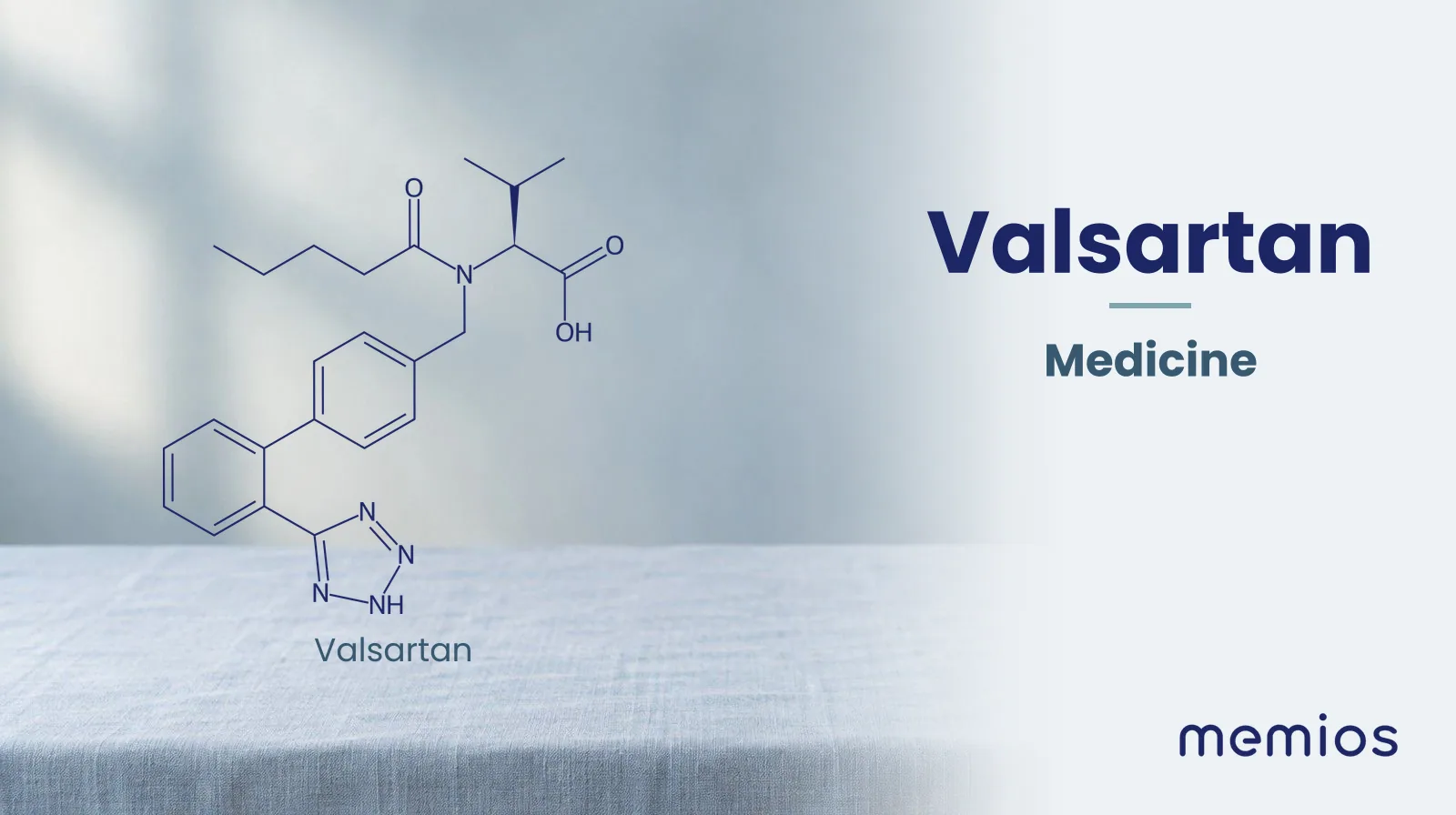
- What it is: Valsartan is a synthetic, non-peptide small molecule taken by mouth as a tablet or oral solution. It belongs to the angiotensin receptor blocker class and binds selectively to the angiotensin II type 1 (AT1) receptor.
- Main use: High blood pressure (hypertension) in adults and children aged 1 year and older (well supported).
- Other approved uses: Chronic heart failure, NYHA class II to IV (well supported); Left ventricular failure or dysfunction after a myocardial infarction (well supported).
- Off-label uses (not on the FDA label): Proteinuric chronic kidney disease, including diabetic kidney disease (limited evidence).
- Recommended dose (official position): There is no reference intake for a prescription medicine. The dose is set by the prescriber.
- Studied dose (a trial dose, not a recommendation): Val-HeFT gave valsartan 160 mg twice daily on top of conventional heart failure therapy in 5,010 patients. Findings citing that trial: 1 for, 1 against, 1 on harm.
- Upper limit: No toxicological upper limit is set for consumers.
- What goes wrong: 5 findings on harm. The same review reports that valsartan caused more hypotension and renal dysfunction leading to a dose reduction or discontinuation than captopril, but fewer such dose reductions or discontinuations for cough, rash and taste disturbance.
- Interactions: 5 recorded, including Potassium supplements, potassium-containing salt substitutes and potassium-sparing diuretics, Non-steroidal anti-inflammatory drugs including selective COX-2 inhibitors (for example diclofenac, ibuprofen), Lithium, Other renin-angiotensin blockers: ACE inhibitors and aliskiren.
- Common myth: Valsartan makes you live longer if you have heart failure.
What it is
Valsartan is a synthetic, non-peptide small molecule taken by mouth as a tablet or oral solution. It belongs to the angiotensin receptor blocker class and binds selectively to the angiotensin II type 1 (AT1) receptor. It has been on the US market since 1996 and is now widely available as a generic. It is also sold in fixed combinations with hydrochlorothiazide, amlodipine and sacubitril.
What the research says
The evidence is strongest for what valsartan does to numbers and to hospitalisations rather than to survival. It reliably lowers blood pressure, and in chronic heart failure a large trial found a 13.2% reduction in a combined endpoint of death plus morbidity with no difference in death alone. After a heart attack with left ventricular dysfunction it matched an ACE inhibitor for mortality rather than beating it. Two of the large Japanese valsartan outcome trials were later found by the host universities to contain manipulated data, so part of the published benefit literature for this drug cannot be relied on.
Evidence grade: Well established.
How it works
Drug class: Angiotensin II receptor blocker (ARB), selective for the AT1 receptor subtype
Angiotensin II is a hormone that tightens blood vessels and makes the body hold on to salt and water. Valsartan sits on the receptor angiotensin II normally binds to (the AT1 receptor) and blocks it, so vessels relax and blood pressure falls, and the strain on a failing heart is reduced. (Source 1)
Boxed warning
When pregnancy is detected, discontinue valsartan tablets as soon as possible. Drugs that act directly on the renin-angiotensin system can cause injury and death to the developing fetus.
(Source 2)
What it is used for
- The label approves valsartan for lowering blood pressure, and reviews describe dose-dependent falls in blood pressure across 80-320 mg daily. Blood pressure is a surrogate; valsartan's own hypertension outcome literature is weakened because two large Japanese outcome trials in hypertensive patients were found to contain manipulated data. Evidence: established. (Source 3)
- In Val-HeFT (5,010 patients) valsartan added to usual therapy cut a combined endpoint of death plus morbidity by 13.2% versus placebo, driven by fewer heart failure hospitalisations, but overall mortality was not different. The benefit was largest in people not taking an ACE inhibitor. Evidence: established. (Source 4)
- VALIANT compared valsartan with captopril in clinically stable patients after a heart attack. All-cause mortality was about 20% in each group and the hazard ratio for valsartan versus captopril was 1.00. Valsartan was non-inferior, not superior, and adding it to captopril produced no extra benefit. Evidence: established. (Source 5)
- A drug review reports meaningful reductions in urinary albumin and protein excretion with valsartan in chronic kidney disease. This is a laboratory marker rather than a hard outcome such as dialysis or death, and valsartan is not FDA-approved for this indication in the United States. Evidence: limited. (Source 1)
Interactions
- Potassium supplements, potassium-containing salt substitutes and potassium-sparing diuretics (label): Valsartan itself raises blood potassium. Adding potassium from a supplement, a salt substitute or a potassium-sparing water tablet can push it higher, and in heart failure can also raise creatinine. (Source 6)
- Non-steroidal anti-inflammatory drugs including selective COX-2 inhibitors (for example diclofenac, ibuprofen) (label): Taken together with valsartan, NSAIDs can worsen kidney function, including possible acute kidney failure, and can blunt the blood-pressure-lowering effect. (Source 7)
- Lithium (case reports): Blood lithium levels can rise and lithium toxicity has been reported when lithium is taken with an angiotensin receptor blocker. (Source 8)
- Other renin-angiotensin blockers: ACE inhibitors and aliskiren (clinical trial): Blocking the same hormone system twice raises the risk of low blood pressure, high potassium and kidney impairment. A 2004 drug review of the VALIANT trial reports that adding valsartan to captopril produced no extra survival benefit. (Source 9)
- Food (pharmacokinetic study): Taking the tablet with food substantially reduces how much valsartan reaches the bloodstream, which is why trials and labelling specify consistent timing. (Source 10)
Stopping it
- No dependence or withdrawal syndrome is described for valsartan in the sources searched, but stopping a renin-angiotensin blocker is not neutral in kidney disease: pooled observational data found discontinuation associated with higher death, end-stage kidney disease and cardiovascular event rates, although the review rates the evidence low to very low certainty. (Source 11)
- The one circumstance where the label directs immediate stopping is pregnancy, because drugs acting on the renin-angiotensin system can injure or kill a developing fetus. (Source 2)
What goes wrong
The same review reports that in the subgroup already taking both an ACE inhibitor and a beta-blocker, deaths were higher on valsartan than on placebo. (Source 4)
- Expert review, not systematic, Low certainty.
- Size: 1,610 patients in that subgroup.
- Who: heart failure patients on an ACE inhibitor plus a beta-blocker at baseline.
- How long: trial duration.
- Result: mortality significantly higher in the valsartan group than in the placebo group; this is a subgroup finding and the review does not give the numbers.
- Funding: not stated.
In the subgroup of patients who were taking an ACE inhibitor and a β-blocker at baseline (n = 1610), mortality was significantly higher in the valsartan group than in the placebo group.
The same review reports that valsartan caused more hypotension and renal dysfunction leading to a dose reduction or discontinuation than captopril, but fewer such dose reductions or discontinuations for cough, rash and taste disturbance. (Source 12)
- Expert review, not systematic, Moderate certainty.
- Size: VALIANT population.
- Who: post-MI patients.
- How long: trial duration.
- Result: significantly higher incidence of hypotension and renal dysfunction leading to dose reduction or discontinuation; significantly less cough, rash and taste disturbance; the review gives no percentages.
- Funding: not stated.
The valsartan group had a significantly higher incidence of hypotension leading to dosage reduction or treatment discontinuation and significantly more renal dysfunction leading to dosage reduction, but significantly less cough, rash, and taste disturbance leading to dosage reduction or discontinuation than the captopril group.
Valsartan raises serum potassium more often than placebo, and much more often in heart failure than in hypertension. (Source 10)
- Official position, Moderate certainty.
- Size: pooled placebo-controlled label trials.
- Who: hypertensive and heart failure patients.
- How long: not stated.
- Result: greater than 20% rises in serum potassium in 4.4% of valsartan versus 2.9% of placebo patients with hypertension, and 10.0% versus 5.1% in heart failure.
- Funding: manufacturer-sponsored registration trials.
In hypertensive patients, greater than 20% increases in serum potassium were observed in 4.4% of valsartan-treated patients compared to 2.9% of placebo-treated patients. In heart failure patients, greater than 20% increases in serum potassium were observed in 10.0% of valsartan-treated patients compared to 5.1% of placebo-treated patients.
In hypertension trials the commonest adverse reactions more frequent on valsartan than placebo were uncommon and mild. (Source 10)
- Official position, Moderate certainty.
- Size: valsartan n=2,316 versus placebo n=888.
- Who: adults with hypertension.
- How long: not stated.
- Result: viral infection 3% vs 2%, fatigue 2% vs 1%, abdominal pain 2% vs 1%.
- Funding: manufacturer-sponsored registration trials.
The adverse reactions that occurred in placebo-controlled clinical trials in at least 1% of patients treated with valsartan and at a higher incidence in valsartan (n=2,316) than placebo (n=888) patients included viral infection (3% vs. 2%), fatigue (2% vs. 1%), and abdominal pain (2% vs. 1%).
Two large Japanese valsartan outcome trials were found by the host universities to contain manipulated data. (Source 13)
- Official position, Certainty not rated.
- Size: the Kyoto Heart Study and the Jikei Heart Study.
- Who: Japanese hypertensive patients.
- How long: not applicable.
- Result: the Japanese Society of Hypertension reports that university investigations found evidence of data manipulation and conflicts of interest; the papers were subsequently retracted.
- Funding: the studies received support from Novartis Japan.
evidence of data manipulation and conflicts of interest in the articles
What the evidence supports
A 2002 drug review of the Val-HeFT trial reports that valsartan added to usual heart failure therapy reduced a combined endpoint of death plus morbidity by 13.2% compared with placebo. (Source 4)
- Expert review, not systematic, Moderate certainty.
- Size: 5,010 patients in Val-HeFT, as reported by this review.
- Who: adults with chronic heart failure on conventional therapy.
- How long: median follow-up about 23 months in Val-HeFT.
- Result: 13.2% relative reduction in the combined mortality-plus-morbidity endpoint versus placebo; the review reports no absolute risk reduction or number needed to treat.
- Funding: not stated.
Results from the Valsartan Heart Failure Trial (Val-HeFT) showed that in patients with chronic heart failure (CHF) [n = 5010], valsartan 160mg twice daily, when used in combination with conventional therapy for heart failure, reduced the risk of the combined endpoint of mortality and morbidity by 13.2% compared with placebo.
A 2009 drug review reports that valsartan causes cough significantly less often than ACE inhibitors, with only rare reports of angio-oedema. (Source 14)
- Expert review, not systematic, Moderate certainty.
- Size: not stated.
- Who: patients treated with valsartan across trials.
- How long: not stated.
- Result: significantly lower incidence of cough; only rare reports of angio-oedema; no rates given.
- Funding: not stated.
valsartan has a more favourable tolerability profile, with a significantly lower incidence of cough and only rare reports of angio-oedema, both class effects of ACE inhibitor use.
Stopping renin-angiotensin system inhibitors in chronic kidney disease was associated with higher mortality in observational data, but the evidence is very weak. (Source 11)
- Meta-analysis, Very low certainty.
- Size: 1 randomised trial and 6 observational studies, 248,963 patients.
- Who: adults with chronic kidney disease taking an ACE inhibitor or ARB.
- How long: varied.
- Result: all-cause mortality HR 1.41 (95% CI 1.23-1.62), end-stage kidney disease 1.32 (1.10-1.57), MACE 1.20 (1.15-1.25), hyperkalemia 0.79 (0.55-1.15) after discontinuation.
- Funding: not stated.
The meta-analysis of observational studies showed that discontinuation of RAS inhibitors was associated with a higher risk of all-cause mortality (HR, 1.41 [95% CI, 1.23–1.62]; I2 = 97%), ESKD (1.32 [95% CI, 1.10–1.57]; I2 = 94%) and MACE (1.20 [95% CI 1.15–1.25]; I2 = 38%), but not with hyperkalemia (0.79 [95% CI 0.55–1.15]; I2 = 90%).
What the evidence does not support
The same review reports that in that trial valsartan did not reduce death from any cause. (Source 4)
- Expert review, not systematic, Moderate certainty.
- Size: 5,010 patients.
- Who: adults with chronic heart failure.
- How long: as above.
- Result: no significant difference in overall mortality between valsartan and placebo.
- Funding: not stated.
However, there was no significant difference in overall mortality between the valsartan and placebo groups.
Danish valsartan users exposed to NDMA-contaminated product showed no clear short-term increase in overall cancer. (Source 15)
- Cohort study, Low certainty.
- Size: 5,150 people, 104 cancers among unexposed and 198 among exposed person-time.
- Who: Danish valsartan users 2012-2018.
- How long: median 4.6 years.
- Result: adjusted hazard ratio for overall cancer 1.09 (95% confidence interval 0.85 to 1.41), no dose-response (P=0.70); colorectal cancer 1.46 (0.79 to 2.73); uterine cancer 1.81 (0.55 to 5.90)
- Funding: None.
With 104 cancer outcomes among NDMA unexposed participants and 198 among exposed participants, the adjusted hazard ratio for overall cancer was 1.09 (95% confidence interval 0.85 to 1.41), with no evidence of a dose-response relation (P=0.70).
Where the evidence is mixed
A 2004 drug review of the VALIANT trial reports that after myocardial infarction valsartan was no better and no worse than captopril for death from any cause. (Source 5)
- Expert review, not systematic, Moderate certainty.
- Size: VALIANT, three treatment groups.
- Who: clinically stable patients with heart failure and/or left ventricular systolic dysfunction after MI.
- How long: median about 2 years.
- Result: all-cause mortality approximately 20% in each group; hazard ratio valsartan versus captopril 1.00 (97.5% CI 0.90, 1.11; p = 0.98); valsartan plus captopril versus captopril 0.98 (97.5% CI 0.89, 1.09; p = 0.73)
- Funding: not stated.
The rate of mortality from any cause (primary endpoint) was similar for all three treatment groups (≈20%). The hazard ratio for death for valsartan compared with captopril was 1.00 (97.5% CI 0.90, 1.11; p = 0.98), and that for valsartan plus captopril compared with captopril 0.98 (97.5% CI 0.89, 1.09; p = 0.73).
The authors of that cancer study say the follow-up was too short to exclude long-term risk. (Source 15)
- Cohort study, Low certainty.
- Size: as above.
- Who: as above.
- How long: median 4.6 years.
- Result: no markedly increased short term overall cancer risk; uncertainty remains for single cancer outcomes.
- Funding: None.
The results do not imply a markedly increased short term overall risk of cancer in users of valsartan contaminated with NDMA. However, uncertainty persists about single cancer outcomes, and studies with longer follow-up are needed to assess long term cancer risk.
Where the research disagrees
Whether valsartan helps people with heart failure who are already on an ACE inhibitor and a beta-blocker
- Val-HeFT overall result as reported in this review, randomised controlled trial reported in a narrative review: Results from the Valsartan Heart Failure Trial (Val-HeFT) showed that in patients with chronic heart failure (CHF) [n = 5010], valsartan 160mg twice daily, when used in combination with conventional therapy for heart failure, reduced the risk of the combined endpoint of mortality and morbidity by 13.2% compared with placebo. (Source 4)
- The same trial's triple-therapy subgroup, subgroup analysis of the same randomised trial: In the subgroup of patients who were taking an ACE inhibitor and a β-blocker at baseline (n = 1610), mortality was significantly higher in the valsartan group than in the placebo group. (Source 4)
Whether the large Japanese valsartan outcome trials can be used as evidence at all
- Japanese Society of Hypertension, 2013, society position statement following university investigations: Modification of data used in papers reporting clinical trials, no matter whether it is minor or otherwise, is unethical and unacceptable behavior, which negatively impacts on perceptions of reliability and trust of the drug being tested, and the people involved. (Source 13)
- The pre-retraction drug literature, for example this 2009 review, narrative review written before the misconduct findings: Valsartan and valsartan/HCTZ are well tolerated. In clinical trials, adverse events during valsartan treatment were similar to those occurring with placebo. (Source 1)
How much
- Reference intake: There is no reference intake for a prescription medicine. The dose is set by the prescriber. The FDA label, as a regulatory position dated 10/2023, sets the adult hypertension range at 80-320 mg once daily, heart failure at 40-160 mg twice daily and post-myocardial infarction at 20-160 mg twice daily, and a drug review notes the once-daily versus twice-daily split by indication. (Source 16)
- Upper limit: No toxicological upper limit is set for consumers. The label's maximum stated adult dose is 320 mg daily for hypertension and 160 mg twice daily for heart failure and post-myocardial infarction; this is a regulatory position of 10/2023, not a safety threshold derived from the literature. (Source 2)
- Studied: Val-HeFT gave valsartan 160 mg twice daily on top of conventional heart failure therapy in 5,010 patients. (Source 4)
- Studied: Food reduces valsartan exposure: with the tablet, AUC falls by about 40% and peak plasma concentration by about 50%. (Source 10)
A common belief, and what the research shows
The belief: Valsartan makes you live longer if you have heart failure.
What the research shows: The large placebo-controlled heart failure trial did not show that. It reduced a combined endpoint of death plus morbidity by 13.2%, but on mortality alone the source states: "However, there was no significant difference in overall mortality between the valsartan and placebo groups." After a heart attack it matched an ACE inhibitor rather than beating it, with the hazard ratio for death reported as 1.00 (97.5% CI 0.90, 1.11; p = 0.98).
Questions and answers
What is it?
Valsartan is a prescription tablet in the angiotensin receptor blocker family. It is a synthetic, non-peptide molecule that selectively blocks one receptor for the hormone angiotensin II. It has been sold since 1996, is available as a generic, and also appears inside combination tablets with hydrochlorothiazide, amlodipine or sacubitril. (Source 1)
What does it do in the body?
Angiotensin II narrows blood vessels and makes the body retain salt and water. Valsartan occupies the AT1 receptor so that signal cannot land, which relaxes blood vessels and lowers blood pressure. In a failing heart this reduces the load the heart works against. In the kidney, a 2009 drug review reports meaningful reductions in urinary albumin and protein excretion in people with type 2 diabetes and in people with chronic kidney disease who do not have diabetes. (Source 17)
Is it good or bad for you?
It depends entirely on the situation. In heart failure it reduced a combined death-plus-illness endpoint by 13.2% but did not reduce death alone, and in the subgroup already on an ACE inhibitor plus a beta-blocker deaths were higher on valsartan. After a heart attack it equalled an ACE inhibitor. It is harmful in pregnancy. It raises potassium, and it can drop blood pressure and worsen kidney function. (Source 4)
How do you get more of it?
Valsartan is not a nutrient and there is no way to get more of it other than a prescription. The dose is chosen by a prescriber; the label sets ranges by indication, and the trials used specific doses, for example 160 mg twice daily in the heart failure trial. Food matters for absorption: taking the tablet with food cuts exposure by about 40%. (Source 10)
If it is harmful, what reduces it?
The question of reducing valsartan applies when it causes harm, above all in pregnancy, where the label directs that it be stopped as soon as pregnancy is detected. Outside that, stopping is a prescriber decision: in chronic kidney disease, observational data associate discontinuation with worse outcomes, so stopping is not automatically safer than continuing. (Source 2)
Why might someone be low in it or missing it?
People end up without valsartan for practical reasons rather than deficiency: it was never prescribed, it was stopped for side effects such as dizziness, low blood pressure or worsening kidney function, or supply was interrupted. Batches contaminated with N-nitrosodimethylamine were recalled worldwide from 2018, which removed some products from the market. (Source 4)
Which whole foods contain it or feed it?
No food contains valsartan. Food is still relevant in two ways: eating with the tablet reduces how much drug is absorbed, and potassium-rich foods, potassium supplements and potassium-based salt substitutes add to valsartan's own tendency to raise blood potassium. (Source 6)
What happens if you do not have it?
Not taking valsartan is only a problem if you have a condition it treats. In chronic kidney disease, pooled observational studies found that people who stopped a renin-angiotensin inhibitor had higher rates of death, end-stage kidney disease and major cardiovascular events, though the review graded that evidence low to very low certainty because the studies were not randomised. (Source 11)
How can you test for it?
There is no routine blood test for valsartan itself in ordinary care. What is monitored instead is its effects: blood pressure, serum potassium and kidney function. Those checks matter because rises in potassium of more than 20% occurred in 4.4% of hypertensive and 10.0% of heart failure patients on valsartan versus 2.9% and 5.1% on placebo. (Source 10)
References
- Drugs. Valsartan. 2009. DOI 10.2165/11319460-000000000-00000. Read the source
- DailyMed, US National Library of Medicine. VALSARTAN- valsartan tablet, film coated (FDA prescribing information): BOXED WARNING. 2023. Read the source
- DailyMed, US National Library of Medicine. VALSARTAN- valsartan tablet, film coated (FDA prescribing information): section 1 INDICATIONS AND USAGE. 2023. Read the source
- American Journal of Cardiovascular Drugs. Valsartan. 2002. DOI 10.2165/00129784-200202040-00006. Read the source
- American Journal of Cardiovascular Drugs. Valsartan: A Review of its Use in Patients with Heart Failure and/or Left Ventricular Systolic Dysfunction After Myocardial Infarction. 2004. DOI 10.2165/00129784-200404060-00008. Read the source
- DailyMed, US National Library of Medicine. VALSARTAN- valsartan tablet, film coated (FDA prescribing information): section 7 DRUG INTERACTIONS, agents increasing serum potassium. 2023. Read the source
- DailyMed, US National Library of Medicine. VALSARTAN- valsartan tablet, film coated (FDA prescribing information): section 7 DRUG INTERACTIONS, NSAIDs including selective COX-2 inhibitors. 2023. Read the source
- DailyMed, US National Library of Medicine. VALSARTAN- valsartan tablet, film coated (FDA prescribing information): section 7 DRUG INTERACTIONS, lithium. 2023. Read the source
- DailyMed, US National Library of Medicine. VALSARTAN- valsartan tablet, film coated (FDA prescribing information): section 7 DRUG INTERACTIONS, dual blockade of the renin-angiotensin system. 2023. Read the source
- DailyMed, US National Library of Medicine. VALSARTAN tablet (FDA prescribing information): adverse reactions and clinical pharmacology. 2023. Read the source
- Hypertension Research. A systematic review and meta-analysis of the clinical impact of stopping renin–angiotensin system inhibitor in patients with chronic kidney disease. 2023. DOI 10.1038/s41440-023-01260-8. Read the source
- American Journal of Cardiovascular Drugs. Valsartan: A Review of its Use in Patients with Heart Failure and/or Left Ventricular Systolic Dysfunction After Myocardial Infarction. 2004. DOI 10.2165/00129784-200404060-00008. Read the source
- Hypertension Research. Japanese Society of Hypertension official comment on valsartan papers. 2013. DOI 10.1038/hr.2013.128. Read the source
- Drugs. Valsartan. 2009. DOI 10.2165/11319460-000000000-00000. Read the source
- BMJ. Use of N-nitrosodimethylamine (NDMA) contaminated valsartan products and risk of cancer: Danish nationwide cohort study. 2018. PMID 30209057, DOI 10.1136/bmj.k3851. Read the source
- Drugs. Valsartan. 2009. DOI 10.2165/11319460-000000000-00000. Read the source
- Drugs. Valsartan. 2009. DOI 10.2165/11319460-000000000-00000. Read the source