Medications · September 29, 2026 · Memios · 14 min read
Valacyclovir
The state of the evidence is that valacyclovir shortens and reduces herpes outbreaks and, taken daily, lowers how often outbreaks happen and how often an infected partner passes genital herpes to someone else.
TLDR
- Well established. The state of the evidence is that valacyclovir shortens and reduces herpes outbreaks and, taken daily, lowers how often outbreaks happen and how often an infected partner passes genital herpes to someone else; it is not a cure and does not clear the virus from the body.
- What it is: Valacyclovir is a prescription antiviral medicine taken by mouth.
- Main use: Herpes zoster (shingles) in immunocompetent adults (well supported).
- Other approved uses: Genital herpes: reduction of transmission to a susceptible partner (well supported); Genital herpes: suppression of recurrent outbreaks (well supported); Herpes labialis (cold sores): episodic treatment (well supported).
- Off-label uses (not on the FDA label): Bell's palsy (idiopathic facial paralysis), added to a corticosteroid (disputed).
- Recommended dose (official position): Dosing is set by the prescriber and varies by indication (cold sores, genital herpes initial/recurrent/suppressive, herpes zoster) and by renal function; the FDA label states these regimens as the manufacturer's position, current as of the November 2025 label revision.
- Studied dose (a trial dose, not a recommendation): Herpes zoster trial: valacyclovir vs acyclovir regimens compared for time to pain resolution. Findings citing that trial: 1 for.
- Upper limit: The label's own trials used up to 8 grams per day in immunocompromised transplant/HIV-1 populations, where TTP/HUS occurred.
- What goes wrong: 1 finding on harm. Valacyclovir has caused thrombotic thrombocytopenic purpura (TTP), a rare but serious harm.
- Interactions: 2 recorded, including Cimetidine and probenecid (co-administered), Food, alcohol, and common supplements (grapefruit, St John's wort, calcium, iron, magnesium, potassium, vitamin K, fish oil, turmeric, red yeast rice).
- Common myth: People often believe valacyclovir cures herpes or completely prevents passing it to a partner.
What it is
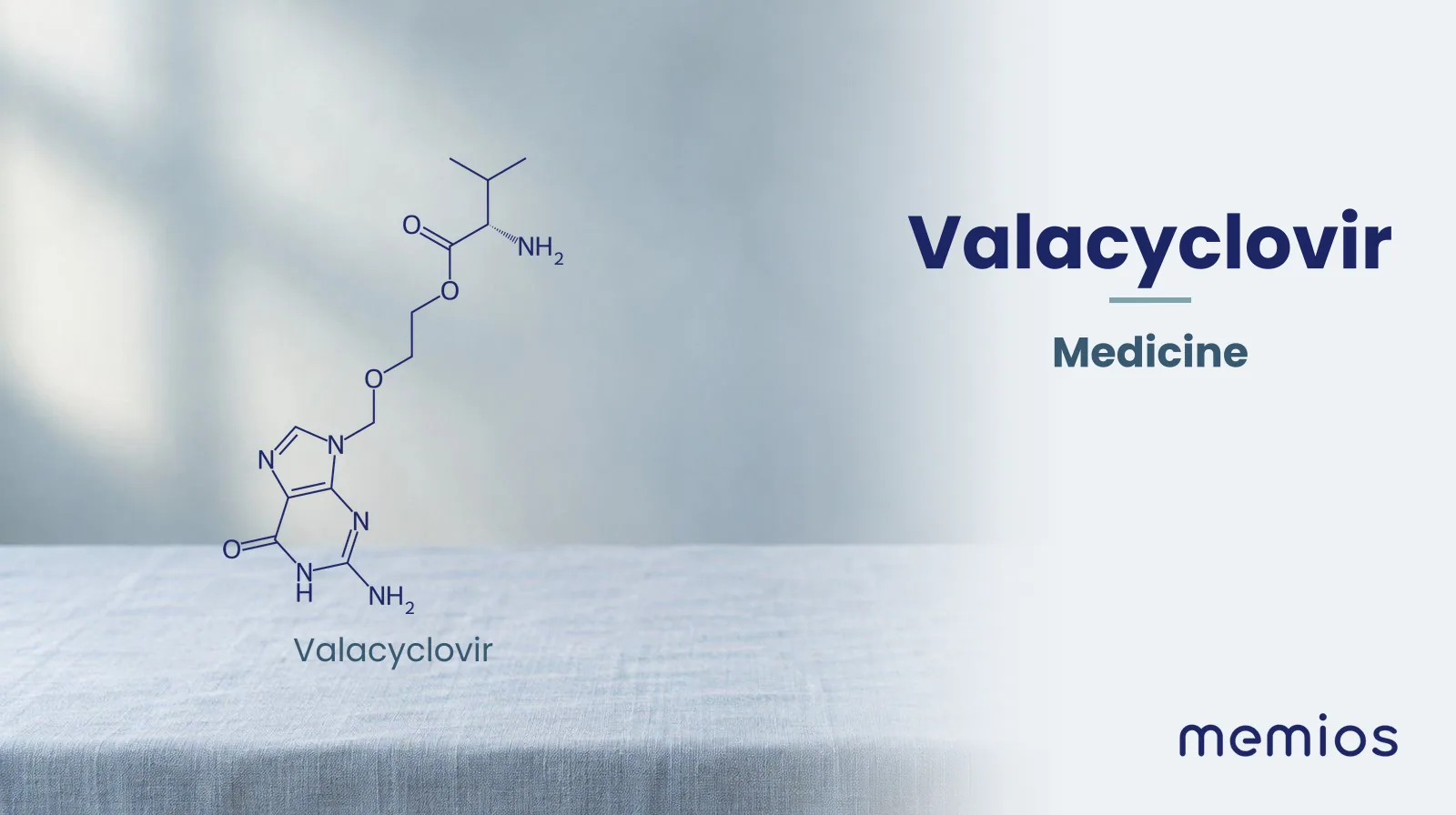
Valacyclovir is a prescription antiviral medicine taken by mouth. It is the L-valine ester of acyclovir, meaning it is chemically acyclovir with an extra valine molecule attached so that it is absorbed more efficiently; the body removes that valine group and converts it to acyclovir. It is used against herpesviruses: herpes simplex virus types 1 and 2, and varicella-zoster virus (the virus that causes chickenpox and shingles).
What the research says
The state of the evidence is that valacyclovir shortens and reduces herpes outbreaks and, taken daily, lowers how often outbreaks happen and how often an infected partner passes genital herpes to someone else; it is not a cure and does not clear the virus from the body. Marketing sometimes implies it prevents all transmission or eliminates the virus, but the pivotal trial itself found it reduced, rather than eliminated, transmission risk.
Evidence grade: Well established.
How it works
Drug class: Antiviral, L-valine ester prodrug of acyclovir (a nucleoside analogue / synthetic purine nucleoside analogue)
Valacyclovir itself has little antiviral activity. After swallowing, it is absorbed and almost completely converted by intestinal and liver enzymes into acyclovir, which reaches much higher blood levels than acyclovir taken by mouth. Inside a cell infected with herpes simplex (HSV-1, HSV-2) or varicella-zoster virus (VZV), a viral enzyme adds phosphate groups to acyclovir, and the resulting molecule blocks the viral DNA polymerase, stopping the virus from copying its DNA. It does not eliminate latent virus from nerve tissue, so it treats and suppresses outbreaks rather than curing the infection. (Source 1)
What it is used for
- In a randomized trial against acyclovir in adults 50 and older with zoster, valacyclovir resolved zoster-associated pain faster than standard-dose acyclovir (roughly a week faster to complete pain resolution), supporting its approved use for shingles. Evidence: established. (Source 2)
- A large randomized, placebo-controlled trial of monogamous heterosexual couples (one partner infected) over eight months found once-daily valacyclovir roughly halved the risk that the uninfected partner acquired genital herpes compared with placebo, and also roughly halved symptomatic recurrences in the infected partner; the trial authors stressed it does not block transmission in all users. Evidence: established. (Source 3)
- In dose-ranging suppressive-therapy trials, valacyclovir 500 mg once daily reduced recurrence by about 71% compared with placebo, supporting daily suppressive use to reduce how often outbreaks occur. Evidence: established. (Source 4)
- Two randomized, double-blind, placebo-controlled trials of high-dose, short (1-day) valacyclovir started at the first symptom found a statistically significant but modest benefit: about 1 day shorter median episode duration and faster healing/pain resolution than placebo, not an overnight cure. Evidence: established. (Source 5)
- This use is off-label. A Cochrane systematic review (2019 update) found low-certainty evidence that adding an antiviral such as valacyclovir to a corticosteroid may make no clear difference to the chance of incomplete recovery compared with a corticosteroid alone, though the review is moderately confident the combination reduced long-term after-effects; in people with severe Bell's palsy it had no clear effect on recovery. Evidence: disputed. (Source 6)
Interactions
- Cimetidine and probenecid (co-administered) (pharmacokinetic study): This combination inhibits renal (kidney) elimination of acyclovir, increasing its blood levels; the label states this is not considered clinically significant in patients with normal kidney function, but caution and dose adjustment are advised in renal impairment. (Source 1)
- Food, alcohol, and common supplements (grapefruit, St John's wort, calcium, iron, magnesium, potassium, vitamin K, fish oil, turmeric, red yeast rice) (label): The manufacturer states no clinically significant drug-food interactions are known for valacyclovir, and this research did not locate published pharmacokinetic studies or case reports of interaction between valacyclovir and alcohol or the specific supplements this app tracks; this is reported as an absence of evidence rather than proof of no interaction. (Source 1)
Stopping it
- Valacyclovir does not clear latent virus, so stopping suppressive therapy is expected to let genital herpes recurrences return toward their pre-treatment frequency; this research could not locate a published trial specifically quantifying the rebound rate after stopping suppressive valacyclovir (as opposed to during active treatment), and this is flagged as a gap rather than a documented absence of rebound. (Source 4)
What goes wrong
Valacyclovir has caused thrombotic thrombocytopenic purpura (TTP), a rare but serious harm. (Source 1)
- Case report, Very low certainty.
- Size: 1 patient (case report); label references cluster in HIV-1/transplant clinical trials at 8 g/day.
- Who: Case report: a 37-year-old immunocompetent patient on low-dose (1000 mg/day) valacyclovir; label: patients with advanced HIV-1 disease and bone-marrow/renal transplant recipients on high-dose (8 g/day) valacyclovir.
- How long: Case report: prolonged low-dose use; label: clinical trials of high-dose valacyclovir.
- Result: TTP/HUS reported, in some cases resulting in death, at high doses in immunocompromised patients; a separate case report describes TTP even at low dose (1000 mg/day) in an immunocompetent patient.
- Funding: not stated.
TTP/HUS, in some cases resulting in death, has occurred in patients with advanced HIV-1 disease and also in allogeneic bone marrow transplant and renal transplant recipients participating in clinical trials of VALTREX at doses of 8 grams per day.
What the evidence supports
In older adults with acute shingles, valacyclovir resolves zoster-associated pain faster than standard-dose acyclovir. (Source 2)
- Randomized trial, Moderate certainty.
- Size: not fully reported in this secondary source.
- Who: Immunocompetent adults 50 years and older with acute herpes zoster.
- How long: Acute treatment course, pain followed to complete resolution.
- Result: Mean time to complete resolution of pain: 44 days (valacyclovir) vs 51 days for acyclovir.
- Funding: not stated in this secondary source.
mean times to complete resolution of pain were 44 days for valacyclovir and 51 days for acyclovir
Once-daily suppressive valacyclovir roughly halves the risk that an infected partner transmits genital herpes to a susceptible partner over eight months. (Source 7)
- Randomized trial, Moderate certainty.
- Size: 1,484 couples; 743 couples had a member taking valacyclovir.
- Who: Heterosexual, monogamous, immunocompetent couples discordant for HSV-2.
- How long: 8 months.
- Result: Partner acquisition of genital herpes: 14 of 743 (1.9%) with valacyclovir vs 27 (3.6%) with placebo; genital recurrence in the treated partner 39% vs 77%.
- Funding: not stated in this secondary source.
Limit of this finding: This is a trade press report of the trial, not the trial paper. One number in it is unclear: it gives time to recurrence as "0.11 vs. 0.4" with no unit, and does not say what those values measure, so that particular figure should not be relied on.
Of the 743 couples with a member taking valacyclovir, 14 of the mates acquired the virus (1.9%) versus 27 of the partners of those receiving placebo (3.6%).
Daily suppressive valacyclovir substantially reduces recurrence of genital herpes outbreaks compared with placebo. (Source 4)
- Randomized trial, Moderate certainty.
- Size: not fully reported in this secondary source.
- Who: Adults with recurrent genital herpes.
- How long: Suppressive dosing over a defined trial period (dose-ranging study)
- Result: 500 mg once daily associated with a 71% reduction in recurrence versus placebo.
- Funding: not stated in this secondary source.
Valaciclovir in a dosage of 500 mg once daily was associated with a reduction of 71 percent.
Short, high-dose valacyclovir started at the first sign of a cold sore modestly shortens the episode compared with placebo. (Source 5)
- Randomized trial, Moderate certainty.
- Size: Two multicenter trials (combined n not extracted)
- Who: Immunocompetent adults with recurrent herpes labialis, self-initiating treatment at prodrome.
- How long: Single-day (2 g twice in one day) regimen, episode followed to healing.
- Result: Median episode duration reduced by 1.0 day (P = 0.001); mean duration reduced by 1.1 days; time to healing and to symptom resolution also significantly reduced.
- Funding: not stated in this secondary source.
the median duration of the episode (primary endpoint) was reduced by 1.0 day (P = 0.001) with 1-day treatment
What the evidence does not support
Adding an antiviral to a corticosteroid for Bell's palsy may make no clear difference to the chance of incomplete recovery, on low-certainty evidence, though the combination probably reduced long-term after-effects. (Source 6)
- Systematic review, Low certainty.
- Size: 3 trials, 766 people (incomplete-recovery comparison)
- Who: People with Bell's palsy of various degrees of severity.
- How long: Varies by included trial; recovery assessed to final follow-up.
- Result: No clear difference in incomplete recovery vs corticosteroids alone (low certainty, 3 trials, 766 people); the review is moderately confident the combination reduced long-term after-effects (excessive tearing of the eyes or abnormal facial movement) compared with corticosteroid treatment alone. The plain-language summary states the direction and certainty but not the risk ratios.
- Funding: Cochrane review; funding of individual included trials not stated in this summary.
The review showed that there may be no clear difference in rates of incomplete recovery from Bell's palsy after treatment with the combination of antivirals and corticosteroids, compared to corticosteroids alone.
In people with severe Bell's palsy, adding antivirals to a corticosteroid had no clear effect on recovery compared with a corticosteroid alone. (Source 8)
- Systematic review, Certainty not rated.
- Size: 2 studies, 98 participants.
- Who: People with severe Bell's palsy (complete or almost complete facial paralysis)
- How long: Varies by included trial.
- Result: No clear effect on recovery compared with corticosteroid treatment alone; the plain-language summary gives no risk ratio or certainty rating for this subgroup, and it rests on only 98 participants.
- Funding: Cochrane review; funding of individual included trials not stated in this summary.
Data from two studies (98 participants) showed that in people with severe Bell's palsy (complete or almost complete facial paralysis), combined antivirals and corticosteroids had no clear effect on recovery compared with corticosteroid treatment alone.
How much
- Reference intake: Dosing is set by the prescriber and varies by indication (cold sores, genital herpes initial/recurrent/suppressive, herpes zoster) and by renal function; the FDA label states these regimens as the manufacturer's position, current as of the November 2025 label revision. (Source 1)
- Upper limit: The label's own trials used up to 8 grams per day in immunocompromised transplant/HIV-1 populations, where TTP/HUS occurred; standard approved regimens are lower (e.g., 500 mg-1 g doses), and the label states dosage reduction is recommended in renal impairment. This is the label's position, not a target for a member to self-select. (Source 1)
- Studied: Herpes zoster trial: valacyclovir vs acyclovir regimens compared for time to pain resolution. (Source 2)
- Studied: Transmission-reduction trial: valacyclovir 500 mg once daily for 8 months in HSV-2-discordant couples. (Source 7)
- Studied: Suppression trial: valacyclovir 500 mg once daily. (Source 4)
- Studied: Cold sore trial: valacyclovir 2 g twice in a single day (high-dose, short-duration regimen). (Source 5)
A common belief, and what the research shows
The belief: People often believe valacyclovir cures herpes or completely prevents passing it to a partner.
What the research shows: Valacyclovir suppresses viral replication during outbreaks and reduces (not eliminates) transmission risk; the pivotal transmission trial itself reported roughly half the risk with the drug, not zero, and its authors said it 'does not block viral transmission in all users' per the secondary source summarizing the NEJM 2004 trial.
Questions and answers
What is it?
Valacyclovir is a prescription oral antiviral drug. It is chemically acyclovir with an extra valine molecule attached, which the body strips off after absorption, converting it into acyclovir in the bloodstream. It is used against herpes simplex virus (cold sores, genital herpes) and varicella-zoster virus (shingles, chickenpox). (Source 1)
What does it do in the body?
Inside a cell already infected by a herpesvirus, the converted drug (acyclovir) is activated by a viral enzyme and then blocks the virus's DNA-copying machinery, so the virus cannot make more copies of itself. This shortens outbreaks, and taken daily it can reduce how often outbreaks occur and how often an infected person passes the virus to a partner. It does not remove the virus from the nerve tissue where it hides between outbreaks. (Source 1)
Is it good or bad for you?
For its approved uses (cold sores, genital herpes, shingles, chickenpox), valacyclovir is generally well tolerated and the trial evidence supports real, if partial, benefit: faster healing, fewer recurrences, and lower transmission risk. It is not risk-free: rare but serious harm (thrombotic thrombocytopenic purpura, TTP/HUS) has occurred, mainly at high doses in immunocompromised patients, though a case report describes it even at a low dose in an otherwise healthy person. (Source 1)
How do you get more of it?
Not applicable in the usual sense: valacyclovir is a manufactured drug obtained only by prescription, not a nutrient found in foods. 'Getting more' of it means only what a prescriber decides for a specific indication and dose; the trials studied specific regimens (for example 500 mg once daily for suppression, or 2 g twice in one day for cold sores) rather than a range for a reader to choose from. (Source 4)
If it is harmful, what reduces it?
If a harm occurs (such as TTP/HUS), the case-report and label evidence indicate the drug should be stopped immediately and, in the case of TTP/HUS, treated medically (for example with plasma exchange); stopping the drug removes the ongoing exposure. For routine side effects, they generally resolve once the course ends. (Source 9)
Why might someone be low in it or missing it?
This question does not apply to valacyclovir the way it applies to a nutrient or organism the body needs — nobody is naturally 'low' in it. The relevant question is why someone would or wouldn't be prescribed it, which depends on having an active or recurrent herpesvirus infection (genital herpes, cold sores, shingles) or being on it for suppression or transmission reduction, as described in its approved uses. (Source 1)
We searched: Searched the label and trial literature for a 'deficiency' framing; none exists because this is a prescription antiviral, not an endogenous substance.
Which whole foods contain it or feed it?
There are no whole foods that contain or substitute for valacyclovir; it is a synthetic pharmaceutical, not a nutrient. The label states no clinically significant drug-food interactions are known, and this research did not find documented interactions with specific foods. (Source 1)
What happens if you do not have it?
This question does not directly apply since valacyclovir is a treatment, not a body substance one can lack. If someone with a herpesvirus infection does not take it, outbreaks (cold sores, genital herpes, shingles) run their natural, generally slower and sometimes more painful course, and, for a genital herpes-discordant couple, the risk of transmitting to a partner is higher than with suppressive therapy, per the transmission trial. (Source 3)
How can you test for it?
There is no blood or lab test for valacyclovir 'levels' relevant to a member; testing in this context is for the underlying infection (HSV or VZV), for example viral PCR or culture of a lesion, or HSV type-specific serology, not for the drug itself. This research did not find a validated test framework for the drug in the general-public literature searched. (Source 1)
We searched: Searched label and general antiviral literature for a monitoring/test framework specific to valacyclovir; none found relevant to a member (therapeutic drug monitoring is not standard practice for this drug).
References
- DailyMed (NIH/NLM) / GlaxoSmithKline label. VALTREX (valacyclovir hydrochloride) tablets - full prescribing information. 2025. Read the source
- American Family Physician (AAFP). Treatment of Herpes Zoster. 2006. Read the source
- University of Washington News (reporting NEJM 2004;350:11-20). Once-Daily Valacyclovir to Reduce the Risk of Transmission of Genital Herpes (UW news coverage of Corey et al., NEJM 2004). 2004. Read the source
- American Family Physician (AAFP). Valaciclovir for Suppression of Recurrent Genital Herpes. 1999. Read the source
- Antimicrobial Agents and Chemotherapy. High-Dose, Short-Duration, Early Valacyclovir Therapy for Episodic Treatment of Cold Sores: Results of Two Randomized, Placebo-Controlled, Multicenter Studies. 2003. Read the source
- Cochrane Database of Systematic Reviews, 2019 update (pub9); Gagyor I, Madhok VB, Daly F, Sullivan F. Antiviral treatment for Bell's palsy (idiopathic facial paralysis) - Cochrane plain-language summary, Key results. 2019. DOI 10.1002/14651858.CD001869.pub9. Read the source
- Contemporary OB/GYN. Valacyclovir reduces transmission of genital herpes (coverage of Corey et al., NEJM 2004;350:11-20). 2004. Read the source
- Cochrane Database of Systematic Reviews, 2019 update (pub9); Gagyor I, Madhok VB, Daly F, Sullivan F. Antiviral treatment for Bell's palsy (idiopathic facial paralysis) - Cochrane plain-language summary, severe Bell's palsy. 2019. DOI 10.1002/14651858.CD001869.pub9. Read the source
- PMC (case report). Valacyclovir-Induced Thrombotic Thrombocytopenic Purpura (case report) - Conclusions. 2020. PMID 32550073. Read the source