Supplements · September 29, 2026 · Memios · 15 min read
Urolithin A
Limited evidence. The honest summary is that human evidence is thin and mostly inconclusive.
TLDR
- Limited evidence. The honest summary is that human evidence is thin and mostly inconclusive.
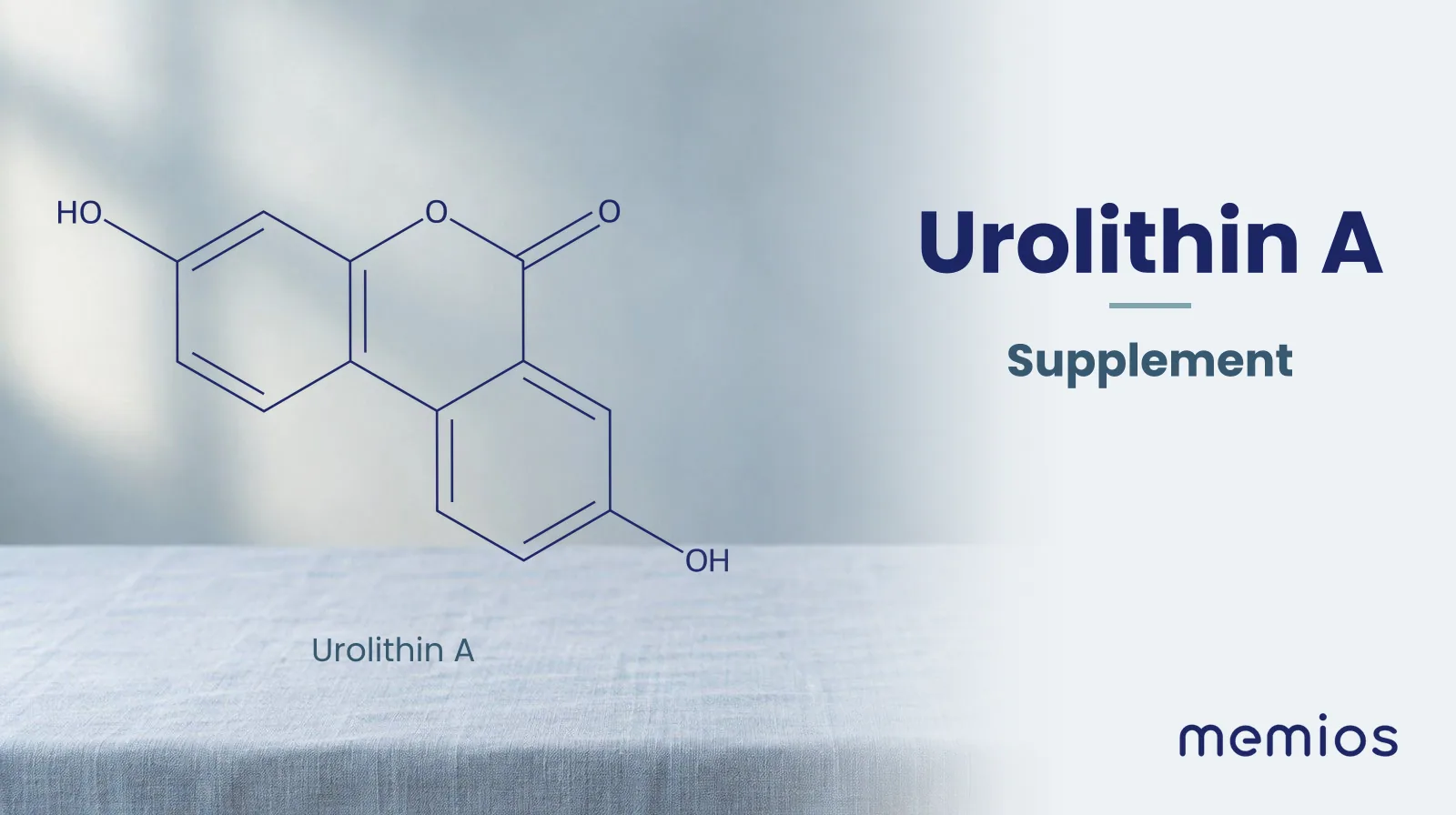
- What it is: Urolithin A is a small molecule that gut bacteria make from ellagitannins and ellagic acid, the polyphenols found in pomegranates, nuts and some berries.
- Main use, supported: In a four-month randomised trial in older adults, urolithin A improved muscle endurance in two small muscles at two months compared with placebo. (moderate certainty)
- Other use, supported: A four-week randomised trial in healthy middle-aged adults found small changes in T-cell populations with urolithin A. (low certainty)
- Claim NOT supported by research: The same trial's two co-primary endpoints, six-minute walk distance and maximal ATP production in hand muscle, were not significantly better with urolithin A than placebo. (moderate certainty)
- Another claim NOT supported: The primary endpoint of that middle-aged adult trial, peak power output, was not significantly improved. (moderate certainty)
- Recommended dose: not established. No recommended dietary allowance or adequate intake exists for urolithin A from any national body. It is not a nutrient; it is a bacterial metabolite of dietary ellagitannins and ellagic acid, which come from pomegranates, nuts and some berries.
- Studied dose (a trial dose, not a recommendation): 1000 mg urolithin A daily by mouth for 4 months in adults aged 65 to 90. No finding here cites that trial.
- Upper limit: No tolerable upper intake level or acceptable daily intake has been set by a food safety body.
- What goes wrong: 2 findings on harm. In the four-month trial in older adults, adverse events were common in both arms but none were serious and there was no excess in the urolithin A group.
- Common myth: Urolithin A has been proven to reverse age-related muscle decline.
What it is
Urolithin A is a small molecule that gut bacteria make from ellagitannins and ellagic acid, the polyphenols found in pomegranates, nuts and some berries. It is not made by the human body itself and it is not present in food in any meaningful amount; it appears only after gut microbes transform the plant precursors. Supplement-grade urolithin A is made by chemical synthesis rather than extracted from fruit. In the laboratory it acts as a mitophagy activator, meaning it promotes the recycling of damaged mitochondria.
What the research says
The honest summary is that human evidence is thin and mostly inconclusive. A 2026 systematic review and meta-analysis found only five small randomised trials, could pool just one outcome, and rated the certainty of that evidence as low. Individual manufacturer-funded trials report improvements in muscle strength and muscle endurance, but both of the two largest trials missed their own pre-specified primary endpoint. Short-term tolerability in trials has been good, with no serious adverse events reported.
Evidence grade: Limited evidence.
What goes wrong
In the four-month trial in older adults, adverse events were common in both arms but none were serious and there was no excess in the urolithin A group. (Source 1)
- Randomized trial, Moderate certainty.
- Size: 66 participants; 33 adverse events recorded in total.
- Who: adults aged 65 to 90 years.
- How long: 4 months.
- Result: 33 adverse events in total; 31 treatment-emergent adverse events (93.9%) across urolithin A (n = 16) and placebo (n = 15) participants; no serious adverse events; no significant changes in vital signs, blood biochemistry, haematology or urinalysis.
- Funding: industry-funded (Amazentis SA)
In total, 33 AEs were recorded during the study, of which a total of 31 treatment-emergent AEs (93.9%) were reported by participants in the urolithin A (n = 16) and placebo (n = 15) groups.
A four-week randomised trial recorded few adverse events in either arm, most of them respiratory infections. (Source 2)
- Randomized trial, Low certainty.
- Size: 50 participants; 9 adverse events in total.
- Who: healthy middle-aged adults.
- How long: 28 days.
- Result: 9 adverse events in total: 4 in the urolithin A group, 5 in placebo; 6 were upper respiratory tract infections, 3 of them SARS-CoV-2 infections.
- Funding: not stated in the abstract retrieved.
Only a total of nine adverse events were recorded during the 28 day study period in both groups.
What the evidence supports
In a four-month randomised trial in older adults, urolithin A improved muscle endurance in two small muscles at two months compared with placebo. (Source 3)
- Randomized trial, Moderate certainty.
- Size: 66 participants (33 urolithin A, 33 placebo)
- Who: adults aged 65 to 90 years, mean age 71.7 years, 75.8% women, all White, Seattle, Washington.
- How long: 4 months.
- Result: Change in contractions to fatigue at 2 months: urolithin A FDI 95.3 (115.5) and TA 41.4 (65.5); placebo FDI 11.6 (147.4) and TA 5.7 (127.1)
- Funding: industry-funded (Amazentis SA, which also employed several authors and held related patents)
Urolithin A, compared with placebo, significantly improved muscle endurance (ie, increase in the number of muscle contractions until fatigue from baseline) in the FDI and TA at 2 months
A four-week randomised trial in healthy middle-aged adults found small changes in T-cell populations with urolithin A. (Source 4)
- Randomized trial, Low certainty.
- Size: 50 healthy middle-aged adults.
- Who: healthy middle-aged adults.
- How long: 4 weeks.
- Result: Naive-like, less terminally exhausted CD8+ cells: treatment difference 0.50 percentage points (95% CI 0.16 to 0.83; P = 0.0437); CD8+ fatty acid oxidation capacity: 14.72 percentage points (95% CI 6.46 to 22.99; P = 0.0061)
- Funding: not stated in the abstract retrieved.
UA expanded peripheral naive-like, less terminally exhausted CD8+ cells (treatment difference 0.50 percentage points; 95% CI = 0.16 to 0.83; P = 0.0437)
In rats, synthetic urolithin A was not genotoxic and produced no target-organ toxicity up to the highest dose tested over 90 days. (Source 5)
- Animal study, Low certainty.
- Size: rat 28-day and 90-day feeding studies plus a genotoxicity battery.
- Who: rats (not humans)
- How long: 28 days and 90 days.
- Result: NOAEL was the highest dose tested: 5% urolithin A by weight in the diet, equal to 3451 mg/kg bw/day in males and 3826 mg/kg bw/day in females.
- Funding: not stated in the abstract retrieved; the work was conducted to support commercial use.
The NOAEL was the highest dose tested, 5% UA by weight in the diet, or 3451 mg/kg bw/day in males and 3826 mg/kg bw/day in females in the 90-day oral study.
What the evidence does not support
Pooling the only outcome that could be combined across trials, urolithin A did not significantly improve six-minute walk distance, and the reviewers rated that evidence as low certainty. (Source 6)
- Meta-analysis, Low certainty.
- Size: 5 randomised controlled trials, n = 236; pooling possible for 2 trials.
- Who: clinically heterogeneous adult populations across the included trials.
- How long: trials ranged from 8 weeks to 4 months.
- Result: Pooled mean difference +17.03 m (95% CI -5.33 to 39.40 m; p = 0.135; I2 = 0%); sensitivity analysis +18.80 m (95% CI -3.24 to 40.85 m; p = 0.095)
- Funding: independent (Korean ARPA-H / Korea Health Industry Development Institute and National Research Foundation of Korea)
the pooled mean difference was +17.03 m (95% CI −5.33 to 39.40 m; p = 0.135; I2 = 0%)
The same review judged all non-walking-test outcomes, including strength and mitochondrial biomarkers, to be exploratory rather than established. (Source 7)
- Meta-analysis, Low certainty.
- Size: 5 randomised controlled trials, n = 236.
- Who: middle-aged and older adults, plus one trial in a clinical population.
- How long: 8 weeks to 4 months.
- Result: No quantitative pooling was possible for strength, endurance, aerobic capacity or biomarkers because of heterogeneity in populations, doses and measurement methods.
- Funding: independent.
Narrative findings on strength, endurance, and mitochondrial-related biomarkers are exploratory and hypothesis-generating, not reproducible evidence of efficacy.
The same trial's two co-primary endpoints, six-minute walk distance and maximal ATP production in hand muscle, were not significantly better with urolithin A than placebo. (Source 3)
- Randomized trial, Moderate certainty.
- Size: 66 participants.
- Who: adults aged 65 to 90 years.
- How long: 4 months.
- Result: 6-minute walk distance increased 60.8 (67.2) m with urolithin A vs 42.5 (73.3) m with placebo; maximal ATP production in FDI changed 0.07 (0.23) mM/s vs 0.06 (0.20) mM/s.
- Funding: industry-funded (Amazentis SA)
These results showed no significant improvement with urolithin A supplementation compared with placebo.
The primary endpoint of that middle-aged adult trial, peak power output, was not significantly improved. (Source 8)
- Randomized trial, Moderate certainty.
- Size: 88 randomised participants (NCT03464500)
- Who: middle-aged adults.
- How long: 4 months.
- Result: No significant improvement in peak power output, the pre-specified primary endpoint, despite gains on secondary measures.
- Funding: industry-funded (Amazentis SA)
but do not notice a significant improvement on peak power output (primary endpoint)
Where the evidence is mixed
A four-month randomised trial in middle-aged adults reported about a 12 per cent improvement in muscle strength but missed its own primary endpoint of peak power output. (Source 8)
- Randomized trial, Moderate certainty.
- Size: 88 randomised participants reported in the trial (NCT03464500)
- Who: middle-aged adults.
- How long: 4 months at two doses.
- Result: Muscle strength improved by approximately 12%; peak power output, the primary endpoint, did not improve significantly; plasma acylcarnitines and C-reactive protein were significantly lower.
- Funding: industry-funded (Amazentis SA; Mitopure is the company's branded urolithin A)
The data show significant improvements in muscle strength (∼12%) with intake of Urolithin A.
A UK Food Standards Agency committee was asked in a discussion paper dated 16 September 2025 to advise on whether urolithin A is safe as a novel food; the paper reaches no conclusion and records no decision. (Source 9)
- Official position, Certainty not rated.
- Size: not applicable.
- Who: UK population, proposed food and supplement uses.
- How long: Discussion paper page last updated 16 September 2025.
- Result: No determination of any kind. The document is a discussion paper that puts questions to Committee members about novel food application RP1777 from Amazentis SA; it states no Committee view, no conclusion and no authorisation.
- Funding: UK government advisory committee; the applicant is Amazentis SA.
Limit of this finding: This is not a safety approval. The words quoted are the question the committee was asked, not its answer. The page is a discussion paper dated 16 September 2025 that reaches no conclusion, and it ends with a list of questions for committee members. Nothing on it says that urolithin A has been found safe, and urolithin A has not been authorised as a novel food in the UK on the strength of this document.
The Committee is asked to advise on whether the available data provides an adequate basis for a risk assessment, and whether the novel food is safe and not nutritionally disadvantageous under the proposed use and use levels.
People differ in whether their gut bacteria can make urolithin A at all, and a subset produce none. (Source 10)
- Survey study, Low certainty.
- Size: 49 participants classified in this study (29 UM-A, 14 UM-B, 6 UM-0)
- Who: mild dyslipidaemic overweight and obese adults.
- How long: cross-sectional classification within an intervention study.
- Result: Three urolithin metabotypes were identified: UM-A, UM-B and UM-0 (non-producers); 6 of 49 participants in this study were non-producers.
- Funding: not stated in the text retrieved.
The gut microbial metabolism of ellagitannins (ETs) and ellagic acid (EA) produces urolithins (Uros), yielding three metabotypes with quantitative and qualitative differences based on dissimilar Uro-producing profiles (UM-A, UM-B, and UM-0, i.e., non-producers).
Where the research disagrees
Whether urolithin A meaningfully improves physical function in humans
- Manufacturer-funded trial authors (Amazentis SA), randomised controlled trial that missed its own primary endpoint: The data show significant improvements in muscle strength (∼12%) with intake of Urolithin A. (Source 8)
- Independent systematic reviewers (2026 meta-analysis), systematic review and meta-analysis with GRADE rating: Narrative findings on strength, endurance, and mitochondrial-related biomarkers are exploratory and hypothesis-generating, not reproducible evidence of efficacy. (Source 7)
How much
- Reference intake: No recommended dietary allowance or adequate intake exists for urolithin A from any national body. It is not a nutrient; it is a bacterial metabolite of dietary ellagitannins and ellagic acid, which come from pomegranates, nuts and some berries. (Source 5)
- Upper limit: No tolerable upper intake level or acceptable daily intake has been set by a food safety body. The only quantitative safety ceiling in the literature is an animal no-observed-adverse-effect level: 5% urolithin A by weight in the diet, equal to 3451 mg/kg bw/day in male and 3826 mg/kg bw/day in female rats over 90 days. (Source 5)
- Studied: 1000 mg urolithin A daily by mouth for 4 months in adults aged 65 to 90 (Source 11)
- Studied: 500 mg or 1,000 mg urolithin A daily for 4 months in middle-aged adults, and 1 g/day for 8 weeks in another trial (Source 6)
- Studied: 1,000 mg urolithin A daily for 4 weeks in healthy middle-aged adults (Source 4)
A common belief, and what the research shows
The belief: Urolithin A has been proven to reverse age-related muscle decline.
What the research shows: No trial has shown that. The two largest randomised trials both missed their own pre-specified primary endpoints, and the 2026 meta-analysis could pool only one outcome across two trials, finding "the pooled mean difference was +17.03 m (95% CI −5.33 to 39.40 m; p = 0.135; I2 = 0%)" with the reviewers concluding that the rest is "exploratory and hypothesis-generating, not reproducible evidence of efficacy." A second misconception is that eating pomegranate reliably delivers urolithin A: it does not, because "UM-0 individuals cannot produce intermediate and final Uros in the ET–EA metabolic pathway."
Questions and answers
What is it?
Urolithin A is not a plant compound you eat directly. It is a metabolite that gut bacteria produce after you eat ellagitannins and ellagic acid, which are found in pomegranates, nuts and certain berries. Supplement forms are made by chemical synthesis so that the dose does not depend on your gut bacteria. (Source 5)
What does it do in the body?
In laboratory and animal work urolithin A activates mitophagy, the process by which cells clear out damaged mitochondria. Human trials have tested whether this translates into better muscle function. The measured human effects have been small and inconsistent, and the biggest trials missed their main endpoints. (Source 8)
Is it good or bad for you?
On current evidence it looks safe in short trials but unproven for benefit. Five small randomised trials totalling 236 people is a thin base, only one outcome could be pooled, and the certainty of that pooled result was rated low. No serious adverse events have been reported in the published trials. (Source 7)
How do you get more of it?
Two routes have been studied. One is eating ellagitannin-rich foods and relying on gut bacteria to convert them, which works for some people and not others. The other is taking synthetic urolithin A directly; trials have given 500 mg or 1,000 mg a day for up to four months. (Source 11)
If it is harmful, what reduces it?
Nothing in the published human literature suggests a need to reduce urolithin A. In the longest trial there were no serious adverse events and no changes in blood chemistry, haematology or urinalysis compared with placebo. Because it is not stored in the body, blood levels fall once intake of the supplement or the precursor foods stops. (Source 1)
Why might someone be low in it or missing it?
The commonest reason is the make-up of your gut bacteria. Researchers classify people into urolithin metabotypes, and one group, called UM-0, cannot make urolithins from ellagitannins at all. Low intake of pomegranate, nuts and berries is the other obvious reason. (Source 12)
Which whole foods contain it or feed it?
No whole food contains urolithin A itself. Foods rich in the precursors, ellagitannins and ellagic acid, are pomegranates, nuts and certain berries. Whether eating them raises your urolithin A depends on your gut bacteria. (Source 5)
What happens if you do not have it?
There is no described deficiency state. Urolithin A is not an essential nutrient and no study has followed non-producers to see whether they come to harm. The whole human evidence base is five small short trials, none of which was designed to answer this. (Source 7)
We searched: Searched for urolithin A deficiency, non-producer outcomes and metabotype health consequences via WebSearch and Europe PMC; the 2026 systematic review and the metabotype literature describe variability in production but no deficiency syndrome or outcome study.
How can you test for it?
There is no validated clinical test. Researchers classify people as urolithin producers or non-producers by measuring urolithins in urine or faeces after a controlled dose of pomegranate or nut, but this is a research method, not a diagnostic test, and the published work says data on this variability are scant. (Source 10)
We searched: Searched for urolithin A testing, urolithin metabotype assays and clinical measurement via WebSearch, Europe PMC and the Food & Function metabotype paper; only research-grade urinary and faecal urolithin profiling was found.
References
- JAMA Network Open. Effect of Urolithin A Supplementation on Muscle Endurance and Mitochondrial Health in Older Adults: A Randomized Clinical Trial (adverse events passage, full text). 2022. PMID 35050355, DOI 10.1001/jamanetworkopen.2021.44279. Read the source
- Nature Aging. Effect of the mitophagy inducer urolithin A on age-related immune decline: a randomized, placebo-controlled trial (adverse events passage). 2025. DOI 10.1038/s43587-025-00996-x. Read the source
- JAMA Network Open. Effect of Urolithin A Supplementation on Muscle Endurance and Mitochondrial Health in Older Adults: A Randomized Clinical Trial (Results section of the abstract, via the Europe PMC REST record). 2022. PMID 35050355, DOI 10.1001/jamanetworkopen.2021.44279. Read the source
- Nature Aging. Effect of the mitophagy inducer urolithin A on age-related immune decline: a randomized, placebo-controlled trial (abstract). 2025. DOI 10.1038/s43587-025-00996-x. Read the source
- Food and Chemical Toxicology. Safety assessment of Urolithin A, a metabolite produced by the human gut microbiota upon dietary intake of plant derived ellagitannins and ellagic acid. 2017. PMID 28757461, DOI 10.1016/j.fct.2017.07.050. Read the source
- Frontiers in Nutrition. Effects of Urolithin A supplementation on muscle health outcomes in humans from randomized controlled trials (Results section of the abstract). 2026. DOI 10.3389/fnut.2026.1834344. Read the source
- Frontiers in Nutrition. Effects of Urolithin A supplementation on muscle health outcomes in humans from randomized controlled trials (Conclusion section of the abstract). 2026. DOI 10.3389/fnut.2026.1834344. Read the source
- Cell Reports Medicine. Urolithin A improves muscle strength, exercise performance, and biomarkers of mitochondrial health in a randomized trial in middle-aged adults. 2022. PMID 35584623, DOI 10.1016/j.xcrm.2022.100633. Read the source
- UK Advisory Committee on Novel Foods and Processes / Food Standards Agency. Urolithin A Discussion Paper - novel food application RP1777 (applicant Amazentis SA), discussion paper putting questions to the Advisory Committee on Novel Foods and Processes. 2025. Read the source
- Food & Function (Royal Society of Chemistry). Urolithin A production drives the effects of pomegranate on the gut microbial metabolism of bile acids and cholesterol in mild dyslipidaemic overweight and obese individuals (abstract). 2024. DOI 10.1039/D3FO05014A. Read the source
- JAMA Network Open. Effect of Urolithin A Supplementation on Muscle Endurance and Mitochondrial Health in Older Adults: A Randomized Clinical Trial (Interventions section of the abstract, via the Europe PMC REST record). 2022. PMID 35050355, DOI 10.1001/jamanetworkopen.2021.44279. Read the source
- Food & Function (Royal Society of Chemistry). Urolithin A production drives the effects of pomegranate on the gut microbial metabolism of bile acids and cholesterol in mild dyslipidaemic overweight and obese individuals (urolithin metabotypes passage). 2024. DOI 10.1039/D3FO05014A. Read the source