Medications · September 29, 2026 · Memios · 16 min read
Triamcinolone
Disputed. The evidence differs sharply by route, so the routes have to be judged separately.
TLDR
- Disputed. The evidence differs sharply by route, so the routes have to be judged separately.
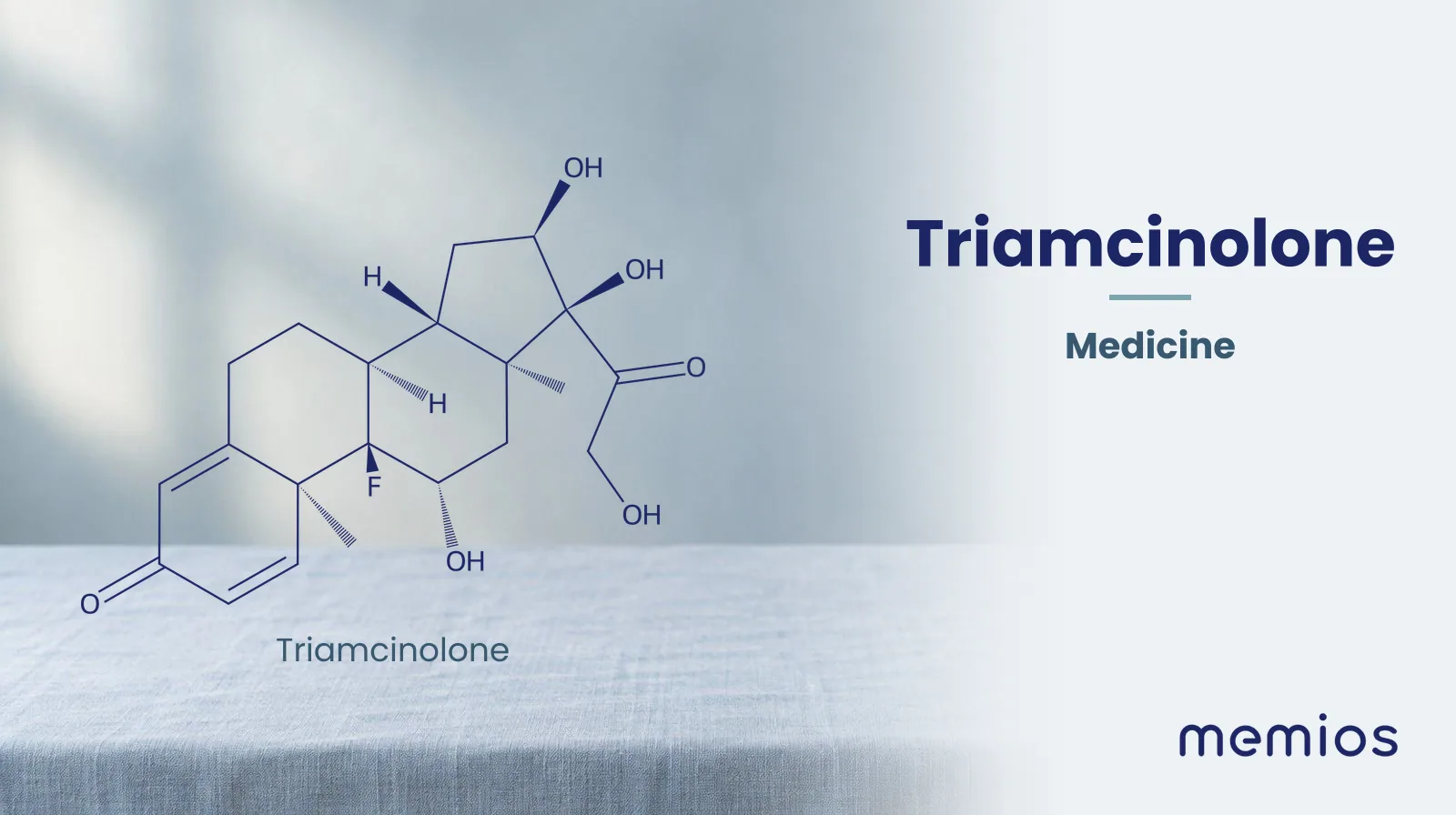
- What it is: Triamcinolone is a synthetic corticosteroid, most often supplied as the acetonide ester.
- Main use: Knee osteoarthritis, intra-articular injection (disputed).
- Other approved uses: Eczema and other inflammatory skin disease, topical (well supported); Moderate-to-severe allergic rhinitis, intranasal spray (well supported); Systemic allergic, rheumatic, dermatologic and other inflammatory conditions, intramuscular injection (limited evidence).
- Uses NOT supported by research: Diabetic macular oedema, intravitreal injection.
- Recommended dose (official position): There is no reference intake for a prescription corticosteroid; the dose and route are set by the prescriber. As a position, the Kenalog-40 label (revised 29 September 2010) states an initial dose that may vary from 2.5 mg to 100 mg per day depending on the condition being treated.
- Studied dose (a trial dose, not a recommendation): The abstracts we reached do not state the exact triamcinolone dose used in the two-year knee trial or in the nasal spray trials. No finding here cites that trial.
- Upper limit: As a position, the Kenalog-40 label states the initial dose range up to 100 mg per day and restricts the route: for intramuscular or intra-articular use, not for intravenous, intradermal or intraocular use.
- What goes wrong: 5 findings on harm. In that same trial, triamcinolone caused significantly greater loss of knee cartilage than saline.
- Interactions: 4 recorded, including Aspirin and other non-steroidal anti-inflammatory drugs, Ketoconazole (and, by the same route, other strong inhibitors of corticosteroid metabolism), Live and live attenuated vaccines, Aminoglutethimide.
- Common myth: A steroid injection into an arthritic knee is a harmless way to keep it going, and repeating it is fine.
What it is
Triamcinolone is a synthetic corticosteroid, most often supplied as the acetonide ester. It is given by very different routes that behave like different medicines: injected into a joint, rubbed on the skin, sprayed into the nose, injected into a muscle, or injected into the eye. The injectable suspension label describes it as a synthetic analog used mainly for anti-inflammatory effects across many organ systems, with an effect that can last weeks.
What the research says
The evidence differs sharply by route, so the routes have to be judged separately. Nasal and topical use have consistent randomised support. Intra-articular use in knee osteoarthritis has only low-certainty short-term benefit, and a two-year randomised trial found no pain advantage over saline and more cartilage loss. Intravitreal use for diabetic macular oedema came out behind laser in the DRCR trial. Across every route, absorbed steroid can suppress the adrenal glands.
Evidence grade: Disputed.
How it works
Drug class: Synthetic glucocorticoid (corticosteroid), supplied mainly as triamcinolone acetonide
Triamcinolone is a manufactured copy of the body's own steroid hormones. It binds glucocorticoid receptors inside cells and changes which genes are switched on, damping down the immune and inflammatory response wherever it reaches. The acetonide ester is poorly soluble, which is why an injected depot keeps working for weeks. (Source 1)
What it is used for
- A Cochrane review found a short-term benefit over placebo at one month, about 13 more responders per 100, but graded the evidence low for every finding. A two-year randomised trial of triamcinolone against saline found no pain difference and more cartilage loss. Evidence: disputed. (Source 2)
- Cochrane's network meta-analysis ranks potent topical corticosteroids among the most effective topical anti-inflammatory treatments for eczema, and least likely of the topicals to cause application-site reactions. Skin thinning is a longer-term risk, not a short-term one. Evidence: established. (Source 3)
- In a network meta-analysis of licensed-dose intranasal corticosteroids, triamcinolone acetonide was among the more effective agents in both seasonal and perennial allergic rhinitis, with acceptability no worse than placebo and moderate quality of evidence. Evidence: established. (Source 4)
- The injectable label lists intramuscular use where oral therapy is not feasible, across a long list of conditions. We did not find outcome trials of intramuscular triamcinolone for those conditions in this search, so the approval rests largely on older evidence and class effects. Evidence: limited. (Source 1)
- The DRCR network's randomised comparison found laser photocoagulation gave generally more favourable anatomic and visual outcomes than intravitreal triamcinolone at two and three years. Intravitreal triamcinolone also raises intraocular pressure and accelerates cataract. Evidence: not-supported. (Source 5)
Interactions
- Aspirin and other non-steroidal anti-inflammatory drugs (label): Taking an NSAID with a corticosteroid raises the risk of gastrointestinal side effects such as ulceration and bleeding. (Source 6)
- Ketoconazole (and, by the same route, other strong inhibitors of corticosteroid metabolism) (pharmacokinetic study): Ketoconazole slows the breakdown of corticosteroids by as much as 60%, so more steroid stays in the body and steroid side effects become more likely. (Source 6)
- Live and live attenuated vaccines (label): At immunosuppressive doses, live vaccines are contraindicated because the weakened organism in the vaccine may not be controlled. (Source 6)
- Aminoglutethimide (label): Aminoglutethimide can undo the adrenal suppression that corticosteroids cause, which changes how the adrenal glands behave on and after treatment. (Source 6)
Stopping it
- After long-term treatment the injectable label states the drug should be withdrawn gradually rather than abruptly, because steroid treatment suppresses the body's own cortisol production. (Source 6)
- The resulting secondary adrenal insufficiency can outlast the treatment by months, and tapering reduces but does not remove it. (Source 6)
- A meta-analysis of 73 studies found adrenal insufficiency after stopping glucocorticoids is common and cannot be ruled out for any route, dose or duration, and argued the threshold for testing should be low, especially when vague symptoms follow stopping. (Source 7)
What goes wrong
In that same trial, triamcinolone caused significantly greater loss of knee cartilage than saline. (Source 8)
- Randomized trial, Moderate certainty.
- Size: 140 randomised.
- Who: As above.
- How long: 2 years.
- Result: Index compartment cartilage thickness change -0.21 mm versus -0.10 mm; between-group difference -0.11 mm (95% CI -0.20 to -0.03 mm). Five treatment-related adverse events on triamcinolone versus three on saline.
- Funding: not stated on the page we read.
Intra-articular triamcinolone resulted in significantly greater cartilage volume loss than did saline for a mean change in index compartment cartilage thickness of −0.21 mm vs −0.10 mm
Longer-term topical corticosteroid use may thin the skin, at a rate of roughly 1 in 300 people; short-term use showed no such signal. (Source 3)
- Systematic review, Low certainty.
- Size: As above.
- Who: People using mild, moderate or potent topical corticosteroids.
- How long: Six months to five years for the thinning estimate; 16 weeks or fewer for the short-term comparison.
- Result: Skin thinning in about 1 in 300 people (roughly 0.3%) over six months to five years; no evidence of increased thinning with 16 weeks or fewer of use, including once or twice daily potent corticosteroids.
- Funding: independent (Cochrane)
Skin thinning occurred in about 1 in 300 people who used mild, moderate or potent corticosteroids for six months to five years.
Corticosteroid use suppresses the adrenal glands often, and intra-articular injection carried the highest rate of any route in a meta-analysis. (Source 7)
- Meta-analysis, Moderate certainty.
- Size: 73 studies, 3,753 participants.
- Who: People treated with corticosteroids by any route.
- How long: Assessed after stopping; risk rose from 1.4% at 28 days to 27.4% at 1 year in asthma patients.
- Result: Adrenal insufficiency in 4.2% after nasal administration (95% CI 0.5-28.9) up to 52.2% after intra-articular administration (95% CI 40.5-63.6); 2.4% low dose to 21.5% high dose.
- Funding: not stated.
Stratified by administration form, percentages of patients with adrenal insufficiency ranged from 4.2% for nasal administration (95% CI: 0.5–28.9) to 52.2% for intra-articular administration (95% CI: 40.5– 63.6).
Corticosteroids increase susceptibility to infection and can hide the signs of an infection already present. (Source 6)
- Official position, Certainty not rated.
- Size: not stated.
- Who: Patients on corticosteroids.
- How long: not stated.
- Result: The label states increased susceptibility to infection and masking of signs of current infection; live vaccines are contraindicated at immunosuppressive doses.
- Funding: not applicable (regulatory document)
Patients who are on corticosteroids are more susceptible to infections than are healthy individuals.
Documented adverse reactions include raised eye pressure, cataract, osteoporosis with fractures, a cushingoid state and post-injection flare. (Source 6)
- Official position, Certainty not rated.
- Size: not stated.
- Who: Patients receiving triamcinolone acetonide injection.
- How long: not stated.
- Result: The label lists exophthalmos, glaucoma, increased intraocular pressure, posterior subcapsular cataracts, osteoporosis, pathologic fracture of long bones and post injection flare after intra-articular use. No frequencies are given.
- Funding: not applicable (regulatory document)
Exophthalmos, glaucoma, increased intraocular pressure, posterior subcapsular cataracts, rare osteoporosis, pathologic fracture of long bones, post injection flare (following intra-articular use)
What the evidence supports
Intra-articular corticosteroid injection gives a small short-term benefit over placebo in knee osteoarthritis, on low-certainty evidence. (Source 2)
- Systematic review, Low certainty.
- Size: 27 trials, 1,767 participants in the Cochrane review.
- Who: Adults with knee osteoarthritis.
- How long: Benefit measured at 1 month.
- Result: 44 responders per 100 on corticosteroid versus 31 per 100 on placebo: 13 more responders per 100, an absolute difference of 13 percentage points, about 8 people injected per extra responder. Pain improvement about 3 versus about 2 points on a 0-10 scale. Side effects were reported by 13 per 100 on corticosteroid and 15 per 100 on placebo.
- Funding: independent (Cochrane)
13 more people respond to treatment with intra-articular corticosteroids than with placebo (difference of 13%). Note that these numbers may considerably overestimate the true benefit due to the low quality of the evidence.
Potent corticosteroids, JAK inhibitors and tacrolimus 0.1% are consistently effective at reducing eczema signs and symptoms, and side effects such as burning and stinging are less likely with corticosteroids than with tacrolimus, pimecrolimus or crisaborole. (Source 3)
- Systematic review, Moderate certainty.
- Size: 291 trials, 45,846 participants in the Cochrane network meta-analysis.
- Who: Adults and children with eczema.
- How long: Mostly up to 16 weeks.
- Result: Potent corticosteroids, JAK inhibitors such as ruxolitinib 1.5% and tacrolimus 0.1% consistently effective; PDE-4 inhibitors such as crisaborole 2% among the least effective. Burning and stinging more likely with tacrolimus, pimecrolimus and crisaborole and less likely with corticosteroids.
- Funding: independent (Cochrane)
Potent corticosteroids, Janus kinase inhibitors such as ruxolitinib 1.5%, and tacrolimus 0.1% were consistently effective at reducing signs and symptoms of eczema. Phosphodiesterase-4 inhibitors such as crisaborole 2% were amongst the least effective. Side effects such as burning and stinging were more likely with tacrolimus, pimecrolimus and crisaborole and less likely with corticosteroids.
Intranasal triamcinolone acetonide is among the more effective licensed-dose nasal steroids for moderate-to-severe allergic rhinitis, with acceptability no worse than placebo. (Source 4)
- Meta-analysis, Moderate certainty.
- Size: Network meta-analysis of randomised trials of licensed-dose intranasal corticosteroids.
- Who: Adults and adolescents with moderate-to-severe seasonal or perennial allergic rhinitis.
- How long: Typical trial durations of 2 to 6 weeks.
- Result: Perennial allergic rhinitis: triamcinolone acetonide standardised mean difference -0.32 (95% CI -0.54 to -0.10) versus placebo, third-ranked. Seasonal allergic rhinitis: -0.41 (95% CI -0.81 to -0.00). Moderate quality of evidence in most placebo-controlled studies.
- Funding: not stated.
In perennial AR, budesonide was ranked the highest efficacy, followed by FF, TAA, CIC, and MF (SMD −0.43, 95% CI: −0.75 to −0.11; −0.36, 95% CI: −0.53 to −0.19; −0.32, 95% CI: −0.54 to −0.10;
What the evidence does not support
Over two years, intra-articular triamcinolone was no better than saline for knee pain. (Source 8)
- Randomized trial, Moderate certainty.
- Size: 140 randomised, 119 (85%) completed.
- Who: Adults with symptomatic knee osteoarthritis, mean age 58, 54% women.
- How long: 2 years, injections every 12 weeks.
- Result: Pain change -1.2 versus -1.9; between-group difference -0.6 (95% CI -1.6 to 0.3), not significant.
- Funding: not stated on the page we read.
no significant difference in pain (−1.2 vs −1.9; between-group difference, −0.6; 95% CI, −1.6 to 0.3)
The trial's own authors concluded their findings do not support intra-articular triamcinolone for symptomatic knee osteoarthritis. (Source 8)
- Randomized trial, Moderate certainty.
- Size: 140.
- Who: As above.
- How long: 2 years.
- Result: Stated conclusion against the treatment.
- Funding: not stated on the page we read.
These findings do not support this treatment for patients with symptomatic knee osteoarthritis.
For diabetic macular oedema, laser photocoagulation outperformed intravitreal triamcinolone in the DRCR randomised comparison at two and three years. (Source 5)
- Expert review, not systematic, Low certainty.
- Size: 840 eyes in the DRCR trial, as described in this review.
- Who: Adults with diabetic macular oedema.
- How long: 2 and 3 years.
- Result: Photocoagulation associated with generally more favourable anatomic and visual outcomes at both time points; triamcinolone described as remaining useful only for selected patients.
- Funding: not stated.
The DRCR reported that photocoagulation was associated with generally more favorable anatomic and visual outcomes at 2 years and 3 years follow-up.
Where the evidence is mixed
Cochrane graded all of its knee injection findings as low quality, meaning the benefit may be overstated. (Source 2)
- Systematic review, Low certainty.
- Size: As above.
- Who: Adults with knee osteoarthritis.
- How long: Short term.
- Result: Quality graded low for every outcome.
- Funding: independent (Cochrane)
We graded the quality of the evidence as low for all of our findings, which means that we have little confidence in these results.
Where the research disagrees
Whether corticosteroid injection helps knee osteoarthritis
- Cochrane review of intra-articular corticosteroid for knee osteoarthritis (Juni and colleagues, 2015), systematic review of randomised trials, graded low quality: 13 more people respond to treatment with intra-articular corticosteroids than with placebo (difference of 13%). (Source 2)
- McAlindon and colleagues, two-year randomised trial (JAMA, 2017), randomised controlled trial with MRI cartilage endpoint: These findings do not support this treatment for patients with symptomatic knee osteoarthritis. (Source 8)
How much
- Reference intake: There is no reference intake for a prescription corticosteroid; the dose and route are set by the prescriber. As a position, the Kenalog-40 label (revised 29 September 2010) states an initial dose that may vary from 2.5 mg to 100 mg per day depending on the condition being treated. (Source 1)
- Upper limit: As a position, the Kenalog-40 label states the initial dose range up to 100 mg per day and restricts the route: for intramuscular or intra-articular use, not for intravenous, intradermal or intraocular use. (Source 1)
- Studied: The abstracts we reached do not state the exact triamcinolone dose used in the two-year knee trial or in the nasal spray trials. The label dose range we could quote verbatim is 2.5 mg to 100 mg per day for the intramuscular and intra-articular injectable suspension. (Source 1)
A common belief, and what the research shows
The belief: A steroid injection into an arthritic knee is a harmless way to keep it going, and repeating it is fine.
What the research shows: The randomised evidence for benefit is short-term and graded low certainty, with Cochrane warning that "these numbers may considerably overestimate the true benefit due to the low quality of the evidence." Repeated injection over two years produced no pain advantage over saline and measurable harm: "Intra-articular triamcinolone resulted in significantly greater cartilage volume loss than did saline for a mean change in index compartment cartilage thickness of −0.21 mm vs −0.10 mm". Intra-articular injection also had the highest rate of adrenal insufficiency of any route in a meta-analysis, at "52.2% for intra-articular administration".
Questions and answers
What is it?
Triamcinolone is a manufactured corticosteroid, usually supplied as triamcinolone acetonide. It comes as a joint or muscle injection, a skin cream or ointment, a nasal spray and an eye injection. The injectable label describes it as a synthetic analog used mainly for its anti-inflammatory effects across many organ systems. (Source 1)
What does it do in the body?
It acts like the body's own steroid hormones, damping down inflammation and the immune response wherever the drug reaches. Because the acetonide form is poorly soluble, an injected depot keeps releasing drug, so a single injection can go on working for several weeks. (Source 1)
Is it good or bad for you?
It depends on the route and how long it is used. Short courses on the skin and sprays in the nose have good randomised support with few problems. Repeated injection into an arthritic knee did not beat saline for pain over two years and was associated with more cartilage loss. Steroid reaching the bloodstream by any route can suppress the adrenal glands, and the rate was highest with intra-articular injection. (Source 7)
How do you get more of it?
Triamcinolone is prescription-only in its injectable and stronger topical forms, so more of it means a prescriber changing dose or route. The injectable label's stated initial dose ranges from 2.5 mg to 100 mg a day depending on the condition, and the route is restricted to intramuscular or intra-articular for that product. (Source 1)
If it is harmful, what reduces it?
You cannot flush out a depot injection; it wears off over weeks. What the literature addresses is how to come off steroid treatment safely: after long-term use the label says to withdraw gradually rather than abruptly, because the body's own cortisol production has been suppressed. (Source 6)
Why might someone be low in it or missing it?
Nobody is naturally low in triamcinolone; the body does not make it. People are not given it, or have it stopped, for documented reasons including infection risk, the need for live vaccination, and the accumulating harms of repeated use such as cartilage loss, raised eye pressure, cataract and bone thinning. (Source 6)
Which whole foods contain it or feed it?
Does not apply. Triamcinolone is not present in any whole food and is not made by the body; it exists only as a manufactured medicine given by injection, on the skin, into the nose or into the eye. The label describes it only as a synthetic analog of the body's steroid hormones. (Source 1)
What happens if you do not have it?
Not having triamcinolone is the normal state. What trials show you forgo depends on the route: about 13 fewer responders per 100 at one month for knee injection on low-certainty evidence, and less symptom relief in allergic rhinitis and eczema. For knee osteoarthritis over two years, the saline group did as well on pain and lost less cartilage. (Source 2)
How can you test for it?
There is no routine blood level test for triamcinolone itself. What is tested is its main systemic effect: adrenal function after steroid exposure. A meta-analysis of 73 studies concluded that adrenal insufficiency cannot be excluded for any route, dose or duration, and that the threshold for testing corticosteroid users should be low, particularly when vague symptoms follow stopping. (Source 7)
References
- DailyMed, US National Library of Medicine. KENALOG-40 (triamcinolone acetonide injectable suspension, USP) - US prescribing information, description, indications and dosage (label revised 29 September 2010). 2010. Read the source
- Cochrane Database of Systematic Reviews (Cochrane). Joint corticosteroid injection for knee osteoarthritis (plain language summary of the Cochrane Review 'Intra-articular corticosteroid for knee osteoarthritis'). 2015. PMID 26490760, DOI 10.1002/14651858.CD005328.pub3. Read the source
- Cochrane Database of Systematic Reviews (Cochrane). Comparing skin treatments for eczema (plain language summary of 'Topical anti-inflammatory treatments for eczema: network meta-analysis'). 2024. PMID 39158322, DOI 10.1002/14651858.CD015064.pub2. Read the source
- Frontiers in Pharmacology. Comparative efficacy and acceptability of licensed dose intranasal corticosteroids for moderate-to-severe allergic rhinitis: a systematic review and network meta-analysis. 2023. PMID 37324459, DOI 10.3389/fphar.2023.1184552. Read the source
- Current Ophthalmology Reports (PubMed Central). Intravitreal Corticosteroids in the Management of Diabetic Macular Edema. 2013. PMID 24319649, DOI 10.1007/s40135-013-0025-1. Read the source
- DailyMed, US National Library of Medicine. KENALOG-40 (triamcinolone acetonide injectable suspension, USP) - US prescribing information, warnings, precautions, drug interactions and adverse reactions. 2010. Read the source
- The Journal of Clinical Endocrinology & Metabolism. Adrenal insufficiency in corticosteroids use: systematic review and meta-analysis. 2015. PMID 25844620, DOI 10.1210/jc.2015-1218. Read the source
- JAMA. Effect of Intra-articular Triamcinolone vs Saline on Knee Cartilage Volume and Pain in Patients With Knee Osteoarthritis: A Randomized Clinical Trial. 2017. PMID 28510679, DOI 10.1001/jama.2017.5283. Read the source