Medications · September 29, 2026 · Memios · 12 min read
Tamsulosin
In the two pivotal 13-week US placebo-controlled trials (1,486 men) urinary symptom scores improved more on tamsulosin than placebo, though placebo groups also improved substantially.
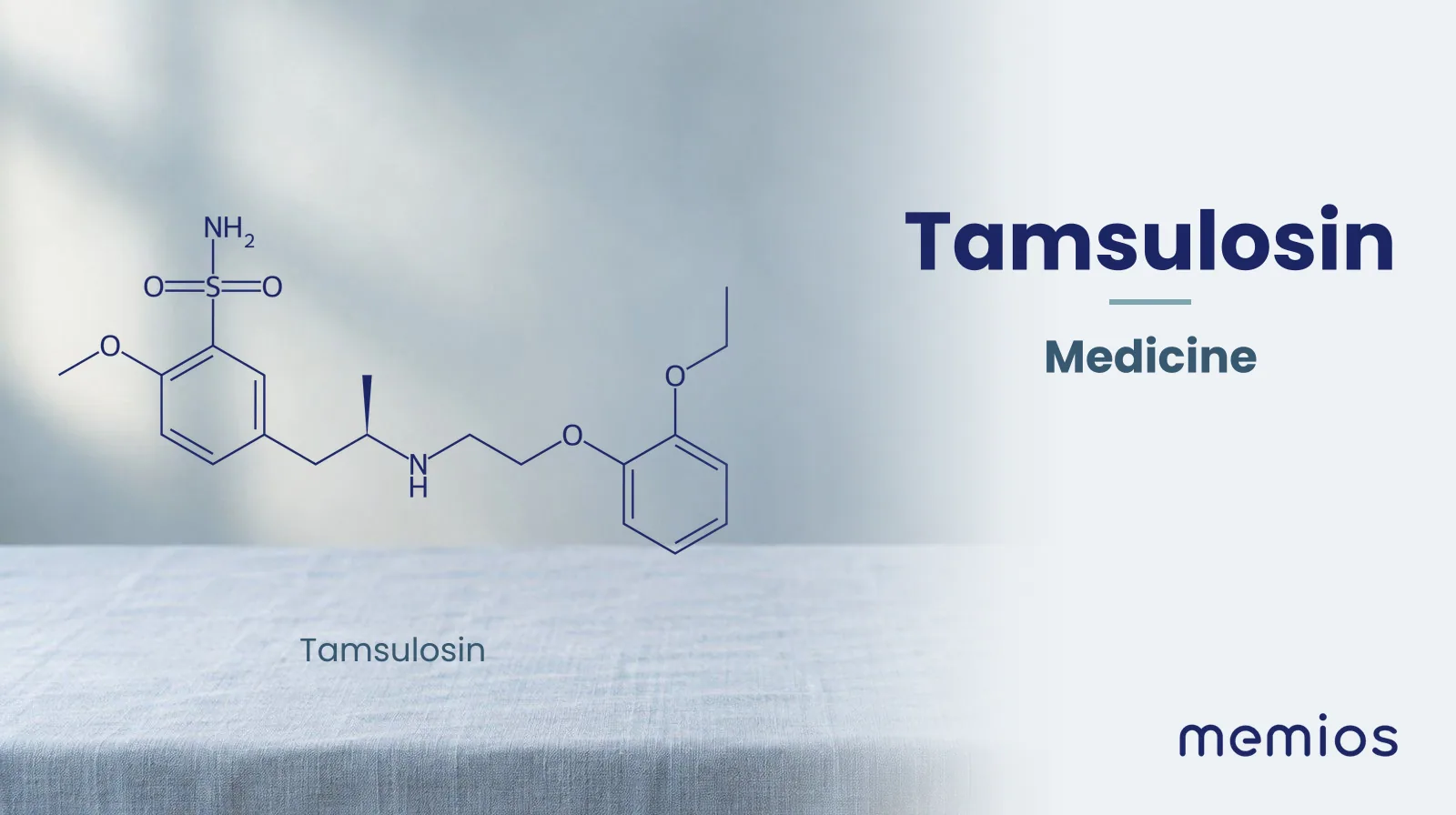
TLDR
- Well established. In the two pivotal 13-week US placebo-controlled trials (1,486 men) urinary symptom scores improved more on tamsulosin than placebo, though placebo groups also improved substantially.
- What it is: Tamsulosin is a prescription capsule approved in the US for the signs and symptoms of an enlarged prostate (benign prostatic hyperplasia).
- Main use: Lower urinary tract symptoms of benign prostatic hyperplasia (well supported).
- Off-label uses (not on the FDA label): Medical expulsive therapy for ureteric (kidney) stones (disputed); Lower urinary tract symptoms in women (limited evidence).
- Recommended dose (official position): Dosing is set by the prescriber. As a position, the US label (2024) gives 0.4 mg once daily for BPH, taken about half an hour after the same meal each day.
- Studied dose (a trial dose, not a recommendation): Pivotal BPH trials: 0.4 mg and 0.8 mg daily versus placebo for 13 weeks. Findings citing that trial: 1 for, 2 on harm.
- Upper limit: Label position (2024): the dose can be increased to 0.8 mg once daily in those who do not respond to 0.4 mg after 2 to 4 weeks.
- What goes wrong: 5 findings on harm. Abnormal ejaculation led 1.6% of men on 0.8 mg to stop in the pivotal trials, and orthostatic symptoms were more frequent than on placebo.
- Interactions: 6 recorded, including Strong CYP3A4 inhibitors (e.g. ketoconazole), CYP2D6 inhibitors (e.g. paroxetine, terbinafine), PDE5 inhibitors (sildenafil, tadalafil, vardenafil), Cimetidine.
- Common myth: Tamsulosin reliably helps you pass a kidney stone.
What it is
Tamsulosin is a prescription capsule approved in the US for the signs and symptoms of an enlarged prostate (benign prostatic hyperplasia). It blocks alpha-1 adrenoceptors, which are abundant in the prostate and bladder neck.
What the research says
In the two pivotal 13-week US placebo-controlled trials (1,486 men) urinary symptom scores improved more on tamsulosin than placebo, though placebo groups also improved substantially. It is widely used off-label to help pass kidney stones: the large SUSPEND trial found no benefit, while a meta-analysis found benefit mainly for larger stones. Harms include dizziness, ejaculation problems and floppy iris syndrome during cataract surgery. A reported dementia association has not been confirmed.
Evidence grade: Well established.
How it works
Drug class: Alpha-1 adrenoceptor antagonist (alpha blocker), alpha-1A selective
Tamsulosin relaxes the smooth muscle of the prostate and bladder neck by blocking alpha-1 receptors, which eases urine flow. The same receptor type sits in the iris muscle of the eye, which explains its effect on cataract surgery. (Source 1)
What it is used for
- Pivotal 13-week placebo-controlled trials (1,486 men) showed larger symptom-score improvements than placebo (for example -8.3 vs -5.5 AUA points at 0.4 mg in Study 1, per the label). We could not reach the Cochrane review in this run. Evidence: established. (Source 2)
- The 1,167-patient SUSPEND RCT found no increase in stone passage (81% vs 80%). A 55-trial meta-analysis found benefit overall, driven by larger stones, with no benefit for smaller stones. Evidence: disputed. (Source 3)
- A meta-analysis of 6 RCTs (764 women) found symptom relief versus placebo, but safety remains unknown and long-term trials are lacking. Evidence: limited. (Source 4)
Interactions
- Strong CYP3A4 inhibitors (e.g. ketoconazole) (label): These raise tamsulosin levels; the label says not to combine them with tamsulosin. (Source 2)
- CYP2D6 inhibitors (e.g. paroxetine, terbinafine) (label): These can raise tamsulosin levels; caution is advised. (Source 2)
- PDE5 inhibitors (sildenafil, tadalafil, vardenafil) (label): Both lower blood pressure, so combining them can cause low blood pressure and dizziness. (Source 2)
- Cimetidine (label): Caution advised, particularly at doses above 0.4 mg. (Source 2)
- Warfarin (label): The label advises caution; it does not describe a specific effect in the text read. (Source 2)
- Meals (timing) (label): The label directs taking it about half an hour after the same meal each day. (Source 2)
Stopping it
- Stopping tamsulosin before cataract surgery does not appear to prevent floppy iris syndrome; the iris effect may be permanent, so the eye surgeon needs to know about past use. (Source 1)
- The label says floppy iris syndrome has been seen in people currently or previously treated with alpha blockers. No dependence or withdrawal syndrome was described in the sources read. (Source 2)
What goes wrong
Abnormal ejaculation led 1.6% of men on 0.8 mg to stop in the pivotal trials, and orthostatic symptoms were more frequent than on placebo. (Source 2)
- Randomized trial, Moderate certainty.
- Size: 1,487 men in the pooled pivotal trials.
- Who: Men with BPH.
- How long: 13 weeks.
- Result: Abnormal ejaculation withdrawal 8/492 (1.6%) at 0.8 mg, none at 0.4 mg or placebo; label table: abnormal ejaculation 18.1% at 0.8 mg vs 0.2% placebo; dizziness 17.1% vs 10.1%.
- Funding: Industry (label data)
Withdrawal from these clinical studies of FLOMAX capsules because of abnormal ejaculation was also dose-dependent, with 8 of 492 patients (1.6%) in the 0.8 mg group and no patients in the 0.4 mg or placebo groups discontinuing treatment due to abnormal ejaculation.
Floppy iris syndrome during cataract surgery shows at least one classic sign in 57-100% of tamsulosin users, and the odds are about 40 times higher than with alfuzosin. (Source 1)
- Expert review, not systematic, Low certainty.
- Size: Narrative review of published studies.
- Who: People having cataract surgery while taking or after taking tamsulosin.
- How long: n/a.
- Result: IFIS signs in 57-100% of tamsulosin users; OR about 40-fold vs alfuzosin.
- Funding: Not stated in the text read.
57–100% of patients taking tamsulosin show at least one classic sign of IFIS during cataract surgery
In a prospective series of 1,274 cataract operations, floppy iris syndrome occurred in 4.9% overall and current tamsulosin use was independently associated with it. (Source 5)
- Cohort study, Low certainty.
- Size: 1,274 patients.
- Who: Consecutive patients having phacoemulsification in Greece.
- How long: Single operation.
- Result: IFIS 63/1274 eyes (4.9%, 95% CI 3.9-6.7%)
- Funding: Authors declared no conflict of interest.
Current use of tamsulosin, alfuzosin, terazosin, benzodiazepines, quetiapine, and finasteride, as well as hypertension, were all independently associated with IFIS.
A Medicare cohort reported higher dementia incidence in tamsulosin users than men on no BPH medication; this is an association, not proof of cause. (Source 6)
- Cohort study, Very low certainty.
- Size: 253,136 tamsulosin users plus comparison cohorts (as summarised)
- Who: US Medicare men aged 65+ with BPH, 2006-2012.
- How long: Median 19.8 months.
- Result: 31.3 vs 25.9 per 1,000 person-years; HRs 1.11-1.26 vs comparators (as summarised)
- Funding: Not stated in the text read.
31.3/1000 person-years compared with only 25.9/1000 person-years in the no-BPH-medication cohort
The label reports priapism as rare, probably under 1 in 50,000 patients. (Source 2)
- Official position, Certainty not rated.
- Size: n/a.
- Who: Label position (2024)
- How long: n/a.
- Result: <1 in 50,000 (estimate)
- Funding: Manufacturer label.
Rarely (probably less than 1 in 50,000 patients), tamsulosin, like other alpha 1 antagonists, has been associated with priapism (persistent painful penile erection unrelated to sexual activity).
What the evidence supports
In two 13-week placebo-controlled US trials in men with BPH, tamsulosin improved urinary symptom scores more than placebo (Study 1: -8.3 at 0.4 mg vs -5.5 placebo; Study 2: -5.1 vs -3.6). (Source 2)
- Randomized trial, Moderate certainty.
- Size: 1,486 men across two trials.
- Who: Men with signs and symptoms of BPH.
- How long: 13 weeks.
- Result: AUA symptom score change: Study 1 placebo -5.5, 0.4 mg -8.3, 0.8 mg -9.6; Study 2 placebo -3.6, 0.4 mg -5.1, 0.8 mg -5.8 (table values from label)
- Funding: Industry (manufacturer registration trials, as reported in the label)
In the two U.S. placebo-controlled, double-blind, 13-week, multicenter studies (Study 1 [US92-03A] and Study 2 [US93-01]), 1486 men with the signs and symptoms of BPH were enrolled.
What the evidence does not support
In the SUSPEND trial, tamsulosin did not increase spontaneous passage of kidney stones compared with placebo. (Source 3)
- Randomized trial, High certainty.
- Size: 1,167 adults.
- Who: Adults with renal colic in 24 UK NHS hospitals.
- How long: Up to 4 weeks of tamsulosin 400 micrograms daily.
- Result: No further intervention needed: 81% tamsulosin vs 80% placebo; adjusted risk difference 1.3% (95% CI -5.7 to 8.3)
- Funding: Independent (NIHR HTA programme)
Further intervention was not needed by 80% of the placebo group compared with 81% of the tamsulosin group (adjusted risk difference 1.3%, 95% confidence interval -5.7 to 8.3)
A 2024 systematic review of 7 studies found no convincing causal link between alpha blockers, including tamsulosin, and cognitive decline. (Source 7)
- Systematic review, Low certainty.
- Size: 7 studies (3 RCTs, 4 non-randomised)
- Who: Alpha-blocker users.
- How long: Varied.
- Result: No convincing causal association.
- Funding: Not stated in the text read.
Our systematic review did not show a convincing causal association between α1-AR antagonists, including tamsulosin, and cognitive dysfunction.
Where the evidence is mixed
A Pfizer-sponsored network meta-analysis found doxazosin GITS 4 mg more effective than most tamsulosin formulations for male urinary symptoms, with similar tolerability. (Source 8)
- Meta-analysis, Low certainty.
- Size: 40 publications, 12,201 participants.
- Who: Men with LUTS/BPH.
- How long: Varied.
- Result: Doxazosin GITS 4 mg IPSS improvement -10.07 (95% CrI -11.96 to -8.25)
- Funding: Industry-funded (Pfizer, maker of doxazosin)
This network meta-analysis found a statistically significantly greater clinical efficacy (IPSS-T, IPSS-S, QoL improvement) for doxazosin GITS 4mg versus most tamsulosin formulations and a similar overall tolerability profile.
A meta-analysis of 55 RCTs found alpha blockers helped stones pass overall, but not for smaller stones; the benefit was for larger stones. (Source 9)
- Meta-analysis, Moderate certainty.
- Size: 55 RCTs.
- Who: Patients with ureteric stones amenable to conservative management.
- How long: Varied.
- Result: Overall RR 1.49 (1.39-1.61); small stones RR 1.19 (1.00-1.48); larger stones RR 1.57 (1.17-2.27)
- Funding: Not stated in the abstract read.
Based on a priori subgroup analysis, there seemed to be no benefit to treatment with alpha blocker among patients with smaller ureteric stones (1.19, 1.00 to 1.48).
Tamsulosin relieved urinary symptoms in women versus placebo in a meta-analysis of six trials, but its safety in this use remains unknown. (Source 4)
- Meta-analysis, Low certainty.
- Size: 6 RCTs, 764 women.
- Who: Women with lower urinary tract symptoms.
- How long: Varied, short-term.
- Result: Improvement vs placebo (numbers not in the text read)
- Funding: Independent (Chinese government science grants); authors declared no conflict.
tamsulosin is an effective treatment for the relief of LUTS in women when compared with placebo.
Where the research disagrees
Whether tamsulosin helps kidney stones pass
- SUSPEND trial investigators (NIHR summary), large multicentre placebo-controlled RCT: Neither drug had significant effect on the likelihood of spontaneous stone passage compared with placebo. (Source 3)
- Hollingsworth et al. (BMJ 2016), meta-analysis of 55 RCTs: Alpha blockers seem efficacious in the treatment of patients with ureteric stones who are amenable to conservative management. The greatest benefit might be among those with larger stones. (Source 9)
Whether tamsulosin raises dementia risk
- Duan et al. (2018), Medicare cohort (observational): Tamsulosin may increase the risk of dementia in older men with BPH (Source 6)
- Kingsley et al. (2024), systematic review of 7 studies: Considering the existing literature, it is appropriate to use α1-AR antagonists without concern for cognitive dysfunction. (Source 7)
How much
- Reference intake: Dosing is set by the prescriber. As a position, the US label (2024) gives 0.4 mg once daily for BPH, taken about half an hour after the same meal each day. (Source 2)
- Upper limit: Label position (2024): the dose can be increased to 0.8 mg once daily in those who do not respond to 0.4 mg after 2 to 4 weeks. (Source 2)
- Studied: Pivotal BPH trials: 0.4 mg and 0.8 mg daily versus placebo for 13 weeks. (Source 2)
- Studied: SUSPEND: tamsulosin 400 micrograms daily for up to 4 weeks for ureteric stones. (Source 3)
A common belief, and what the research shows
The belief: Tamsulosin reliably helps you pass a kidney stone.
What the research shows: The largest placebo-controlled trial found no difference: 'Further intervention was not needed by 80% of the placebo group compared with 81% of the tamsulosin group (adjusted risk difference 1.3%, 95% confidence interval -5.7 to 8.3)'. A meta-analysis found benefit only for larger stones.
Questions and answers
What is it?
Tamsulosin is a prescription alpha blocker capsule approved for urinary symptoms from an enlarged prostate. (Source 2)
What does it do in the body?
It relaxes smooth muscle in the prostate and bladder neck, improving urine flow. The same receptor is in the iris muscle of the eye. (Source 1)
Is it good or bad for you?
For prostate symptoms it beat placebo in trials, though placebo also helped. For kidney stones the evidence is disputed. Harms include dizziness, ejaculation problems and floppy iris during cataract surgery. (Source 2)
How do you get more of it?
Does not apply in the usual sense; the dose is set by a prescriber. The label position allows an increase from 0.4 mg to 0.8 mg if there is no response. (Source 2)
If it is harmful, what reduces it?
Drugs that block its breakdown (strong CYP3A4 or CYP2D6 inhibitors) raise its levels. Stopping it before cataract surgery does not seem to undo the iris effect. (Source 1)
Why might someone be low in it or missing it?
Does not apply. Tamsulosin is a medicine, not something the body makes or needs. (Source 2)
We searched: Label and reviews read; not applicable to a synthetic drug.
Which whole foods contain it or feed it?
No food contains tamsulosin. The label ties dosing to a meal: about half an hour after the same meal each day. No supplement interaction was documented in the sources read. (Source 2)
What happens if you do not have it?
Without it, many men's prostate symptoms still improve somewhat (placebo groups improved in the pivotal trials), and about 80% of people with a kidney stone in SUSPEND passed it without intervention on placebo. (Source 3)
How can you test for it?
There is no routine blood test for tamsulosin. Response is judged by symptom scores such as the AUA/IPSS questionnaire, as used in the trials. (Source 2)
We searched: Label clinical studies section and reviews read; none described a test for the drug itself.
References
- Annals of Translational Medicine. A narrative review of intraoperative floppy iris syndrome: an update 2020 (Yang X, Liu Z, Fan Z, Grzybowski A, Wang N). 2020. DOI 10.21037/atm-20-3214. Read the source
- US National Library of Medicine DailyMed (FDA-approved labeling). FLOMAX (tamsulosin hydrochloride) capsule label (RedPharm Drug repackager), DailyMed. 2024. Read the source
- NIHR Evidence (NIHR Dissemination Centre). Two common drugs do not help more people pass kidney stones (NIHR summary of Pickard R et al., Medical expulsive therapy in adults with ureteric colic: a multicentre, randomised, placebo-controlled trial, Lancet 2015). 2015. Read the source
- International Journal of Impotence Research. Tamsulosin for treatment of lower urinary tract symptoms in women: a systematic review and meta-analysis (Zhang HL et al.). 2017. DOI 10.1038/ijir.2017.12. Read the source
- Eye. Risk factors for intraoperative floppy iris syndrome: a prospective study (Chatziralli IP et al.). 2016. DOI 10.1038/eye.2016.122. Read the source
- UroToday (abstract of Pharmacoepidemiology and Drug Safety article). Tamsulosin and the risk of dementia in older men with benign prostatic hyperplasia (Duan Y, Grady JJ, Albertsen PC, Wu ZH), Pharmacoepidemiology and Drug Safety - abstract as reproduced by UroToday. 2018. PMID 29316005, DOI 10.1002/pds.4361. Read the source
- International Neurourology Journal. Association Between Alpha-1 Adrenoreceptor Antagonist Use and Cognitive Impairment: A Systematic Review (Kingsley et al.). 2024. DOI 10.5213/inj.2448266.133. Read the source
- World Journal of Urology. Doxazosin versus tamsulosin for the treatment of male lower urinary tract symptoms associated with benign prostatic hyperplasia (LUTS/BPH): systematic literature review and network meta-analysis (Oelke M et al.). 2026. DOI 10.1007/s00345-025-06122-1. Read the source
- BMJ. Alpha blockers for treatment of ureteric stones: systematic review and meta-analysis (Hollingsworth JM et al.). 2016. DOI 10.1136/bmj.i6112. Read the source