Supplements · September 29, 2026 · Memios · 14 min read
Sulforaphane and broccoli sprout
Limited evidence. The evidence is best described as promising but mostly unconfirmed.
TLDR
- Limited evidence. The evidence is best described as promising but mostly unconfirmed.
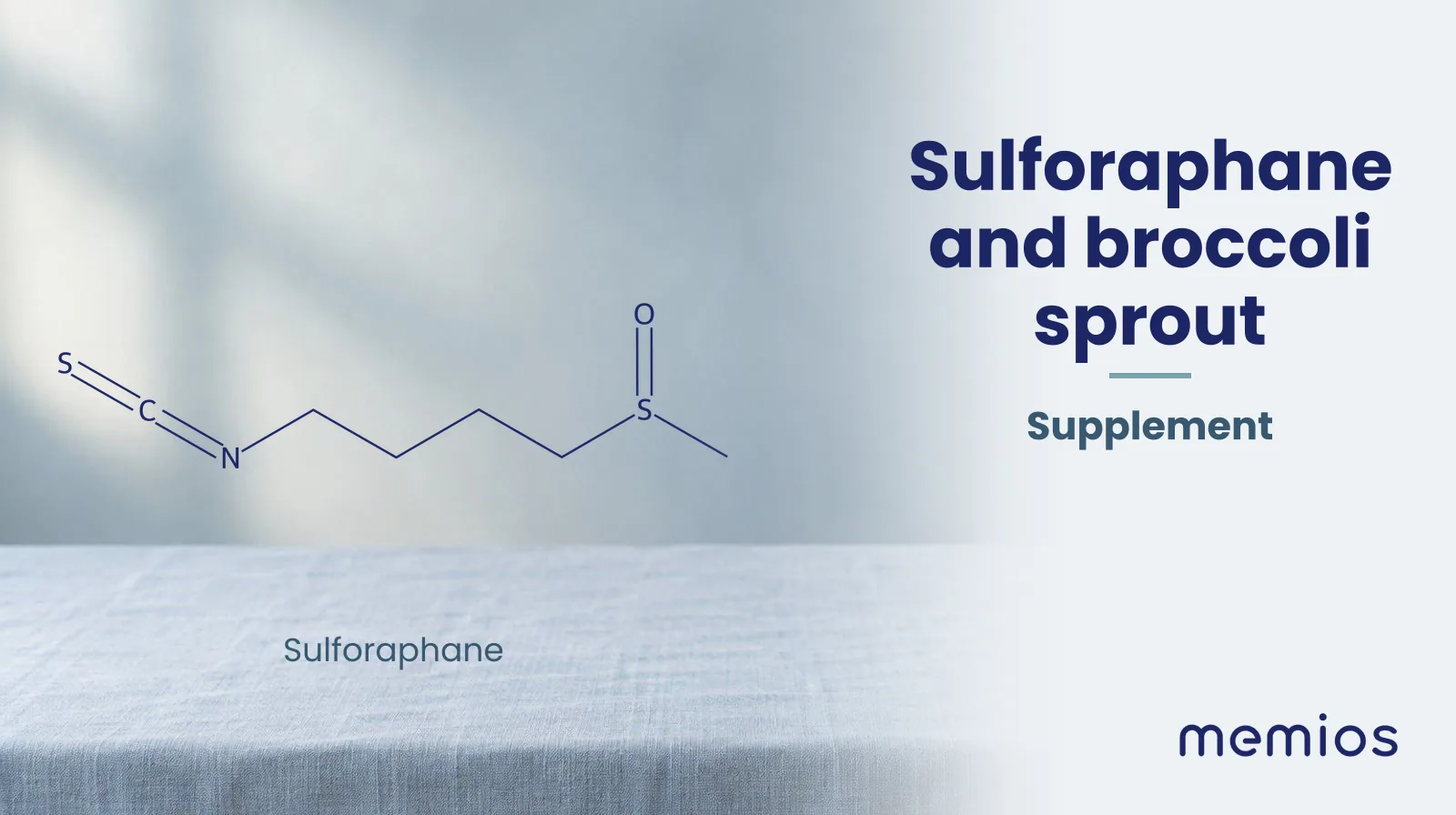
- What it is: Sulforaphane is an isothiocyanate.
- Main use, supported: How much sulforaphane a person absorbs depends heavily on whether the preparation still contains active plant myrosinase. (moderate certainty)
- Other use, supported: In a meta-analysis of randomised trials in schizophrenia, sulforaphane produced a small improvement in negative symptoms at 12 weeks that was not sustained. (low certainty)
- Claim NOT supported by research: A 12-week randomised trial of broccoli sprout extract in prediabetes did not meet its pre-specified primary glucose endpoint. (moderate certainty)
- Another claim NOT supported: A four-week randomised trial in COPD found sulforaphane did not switch on the Nrf2 target genes it was designed to activate, and did not change inflammation or lung function. (moderate certainty)
- Recommended dose: not established. No recommended dietary allowance or adequate intake exists for sulforaphane or glucoraphanin from any national body. They are not essential nutrients; sulforaphane is formed when the glucosinolate glucoraphanin in broccoli and its sprouts and seeds is hydrolysed by myrosinase.
- Studied dose (a trial dose, not a recommendation): 25 micromoles or 150 micromoles of sulforaphane daily by mouth for four weeks in patients with COPD. Findings citing that trial: 1 against.
- Upper limit: No tolerable upper intake level or acceptable daily intake has been set.
- What goes wrong: 5 findings on harm. In the COPD trial, bad taste was significantly more common with sulforaphane than placebo, and two serious adverse events occurred in a sulforaphane arm.
- Common myth: Eating broccoli gives you a reliable dose of sulforaphane.
What it is
Sulforaphane is an isothiocyanate. It does not exist in intact broccoli; the plant stores an inert water-soluble precursor called glucoraphanin, which the plant enzyme myrosinase converts to sulforaphane when the tissue is chewed, chopped or crushed. Broccoli sprouts and broccoli seeds are much richer in glucoraphanin than mature broccoli. Supplements vary widely: some supply glucoraphanin alone, some add active myrosinase, and the amount of sulforaphane a person actually absorbs differs several-fold between these forms.
What the research says
The evidence is best described as promising but mostly unconfirmed. A 12-week randomised trial in prediabetes missed its primary blood-glucose endpoint. A four-week randomised trial in COPD found no effect on the gene pathway it was designed to switch on. A 2023 systematic review of eight cancer trials could not pool any result because the trials were too different and three-quarters were at high risk of bias. A 2025 meta-analysis in schizophrenia found no improvement in total or positive symptoms and only a small, short-lived change in negative symptoms. Gastrointestinal side effects are the commonest complaint, and raw sprouts carry a separate and well-documented risk of bacterial contamination.
Evidence grade: Limited evidence.
What goes wrong
Gastrointestinal side effects are the commonest adverse effect of sulforaphane in cancer trials. (Source 1)
- Systematic review, Low certainty.
- Size: 8 randomised controlled trials.
- Who: people with cancer taking sulforaphane or broccoli sprout preparations.
- How long: 14 days to several months depending on trial.
- Result: Nausea, vomiting, diarrhoea, bloating, flatulence, constipation, taste alteration and headache; one participant across all trials dropped out of the sulforaphane arm because of bowel discomfort; in one ductal carcinoma in situ trial gastrointestinal side effects occurred in 9 of 15 (60%) patients in both groups.
- Funding: not stated in the text retrieved.
Concerning the safety outcomes, although few, the main reported side effects were gastrointestinal, including nausea, vomiting, diarrhea, bloating, flatulence, and constipation.
In the COPD trial, bad taste was significantly more common with sulforaphane than placebo, and two serious adverse events occurred in a sulforaphane arm. (Source 2)
- Randomized trial, Moderate certainty.
- Size: 89 patients.
- Who: patients with COPD.
- How long: 4 weeks.
- Result: Bad taste reported by 24% and 31% in the 25 and 150 micromole groups versus 7% on placebo (P = 0.05); heartburn, nausea and abdominal discomfort more common but not significant (P < 0.10); two serious adverse events, both in the low-dose sulforaphane group, judged unrelated to treatment.
- Funding: not stated in the text retrieved.
participants assigned to sulforaphane were more likely to report a bad taste (24% and 31% in the 25 and 150 μmoles dose groups respectively compared to 7% in the placebo group, P = 0.05)
In the prediabetes trial, gastrointestinal side effects occurred with broccoli sprout extract but no severe adverse events were seen. (Source 3)
- Randomized trial, Moderate certainty.
- Size: 74 participants.
- Who: adults with prediabetes.
- How long: 12 weeks.
- Result: Gastrointestinal side effects observed in response to treatment; no severe adverse events.
- Funding: not stated in the abstract retrieved.
Gastro-intestinal side effects but no severe adverse events were observed in response to treatment.
Raw broccoli sprouts have caused bacterial foodborne illness outbreaks, a contamination risk separate from the sulforaphane itself. (Source 4)
- Case series, Moderate certainty.
- Size: 22 illnesses, 2 hospitalisations, 0 deaths across 4 US states (ID, MT, UT, WA)
- Who: US consumers of recalled broccoli sprouts.
- How long: illness onsets 7 July 2026 to 26 August 2026; page last updated 9 September 2026.
- Result: 22 Salmonella illnesses and 2 hospitalisations linked to recalled broccoli sprouts from one grower; recall initiated 4 September 2026.
- Funding: government investigation (US FDA)
Consumers, restaurants, and retailers should not eat, serve, or sell recalled broccoli sprouts grown by Evergreen Fresh Sprouts, LLC.
The US Food and Drug Administration's September 2026 position was that recalled broccoli sprouts should not be eaten, served or sold. (Source 4)
- Official position, Certainty not rated.
- Size: not applicable.
- Who: US consumers, restaurants and retailers.
- How long: position stated on a page last updated 9 September 2026.
- Result: Advice to discard and to clean and sanitise contact surfaces; investigation ongoing.
- Funding: government agency (US FDA)
Consumers, restaurants, and retailers should not eat, serve, or sell recalled broccoli sprouts grown by Evergreen Fresh Sprouts, LLC.
What the evidence supports
In a meta-analysis of randomised trials in schizophrenia, sulforaphane produced a small improvement in negative symptoms at 12 weeks that was not sustained. (Source 5)
- Meta-analysis, Low certainty.
- Size: 369 patients across the included randomised controlled trials.
- Who: people with schizophrenia, mostly in China plus one US trial.
- How long: trials ran from 12 weeks to 24 weeks.
- Result: Negative symptoms at 12 weeks MD = -1.06 (95% CI -1.95 to -0.16; p = 0.02); general psychopathology MD = -1.5 (95% CI -2.78 to -0.23; p = 0.02); discontinuation RR = 0.68 (95% CI 0.49 to 0.95; p = 0.02)
- Funding: not stated in the text retrieved.
a modest improvement in negative symptoms was found at 12 week- time point (MD= -1.06; 95% CI: -1.95 to -0.16; p = 0.02), which was not maintained at the latest follow-up
How much sulforaphane a person absorbs depends heavily on whether the preparation still contains active plant myrosinase. (Source 6)
- Blood level study, Moderate certainty.
- Size: small numbers of human volunteers across several crossover comparisons.
- Who: healthy adult volunteers.
- How long: single doses with 24-hour urine collection.
- Result: Sprouts or seeds with active endogenous myrosinase delivered 3- to 4-fold more bioavailable sulforaphane than glucoraphanin given without active myrosinase.
- Funding: not stated in the abstract retrieved.
the sulforaphane in those preparations is 3- to 4-fold more bioavailable than sulforaphane from glucoraphanin delivered without active plant myrosinase
What the evidence does not support
The same meta-analysis found no improvement in total or positive psychotic symptoms and no cognitive benefit. (Source 5)
- Meta-analysis, Low certainty.
- Size: 369 patients.
- Who: people with schizophrenia.
- How long: 12 to 24 weeks.
- Result: No significant improvement in PANSS total or positive symptom scores at 12 weeks or at latest follow-up; no cognitive benefits observed.
- Funding: not stated in the text retrieved.
Sulforaphane did not significantly improve PANSS total or positive symptom scores at the latest follow-up (ranging from 24 weeks to 18 weeks) or at a consistent 12-week time point.
A 12-week randomised trial of broccoli sprout extract in prediabetes did not meet its pre-specified primary glucose endpoint. (Source 3)
- Randomized trial, Moderate certainty.
- Size: 74 participants (35 broccoli sprout extract, 39 placebo)
- Who: drug-naive adults with prediabetes.
- How long: 12 weeks, once daily.
- Result: Primary outcome was a 0.3 mmol/l reduction in fasting blood glucose versus placebo; the observed overall effect was a 0.2 mmol/l reduction (95% CI -0.44 to -0.01; P = 0.04), which did not meet the pre-specified target.
- Funding: not stated in the abstract retrieved.
BSE did not meet the prespecified primary outcome, and the overall effect in individuals with prediabetes was a 0.2 mmol l−1 reduction in fasting blood glucose (95% confidence interval −0.44 to −0.01; P = 0.04)
A four-week randomised trial in COPD found sulforaphane did not switch on the Nrf2 target genes it was designed to activate, and did not change inflammation or lung function. (Source 7)
- Randomized trial, Moderate certainty.
- Size: 89 patients enrolled and randomised at three US academic medical centres.
- Who: patients meeting GOLD criteria for COPD.
- How long: 4 weeks.
- Result: Changes in Nrf2 target gene expression relative to baseline ranged from 0.79 to 1.45 with no consistent pattern and no statistically significant difference from baseline; inflammation markers and pulmonary function tests did not differ between groups.
- Funding: not stated in the text retrieved; conducted at US academic medical centres.
Changes in measures of inflammation and pulmonary function tests were not different among the groups.
Three-quarters of the randomised sulforaphane cancer trials were judged to be at high risk of bias. (Source 8)
- Systematic review, Very low certainty.
- Size: 8 randomised controlled trials.
- Who: people with cancer.
- How long: not applicable.
- Result: 75% high risk of bias overall; two trials rated 'some concern', six rated high risk, driven by missing outcome data and deviations from intended interventions.
- Funding: not stated in the text retrieved.
Limit of this finding: The review's own sentence is loosely worded. "a 75% high risk of bias in all the included clinical trials" does not mean every trial was 75% biased; it means 75% of the eight trials - six of them - were rated high risk, and the other two were rated "some concern". Read it as: six of eight trials were judged high risk of bias.
Overall, there was a 75% high risk of bias in all the included clinical trials.
Where the evidence is mixed
A systematic review of eight randomised cancer trials found inconsistent PSA results and could not pool any outcome. (Source 9)
- Systematic review, Very low certainty.
- Size: 8 randomised controlled trials in prostate, breast and pancreatic cancer and melanoma.
- Who: people with cancer.
- How long: varied and inconsistent across trials.
- Result: Statistically significant changes in some genes and histological biomarkers; no impact on other key genes; PSA results inconsistent in prostate cancer; survival improvement in pancreatic cancer was not statistically significant.
- Funding: not stated in the text retrieved.
The results on prostate-specific antigen (PSA) were inconsistent in PCa.
Where the research disagrees
Whether sulforaphane is ready to be described as a therapeutic agent
- Authors of the 2023 systematic review of cancer trials, systematic review of eight randomised trials, no meta-analysis possible: SFN has emerged as a promising and safe therapeutic agent for diverse cancer types. (Source 10)
- The same review's own risk-of-bias assessment, Cochrane RoB2 assessment of the same eight trials: Overall, there was a 75% high risk of bias in all the included clinical trials. (Source 8)
How much
- Reference intake: No recommended dietary allowance or adequate intake exists for sulforaphane or glucoraphanin from any national body. They are not essential nutrients; sulforaphane is formed when the glucosinolate glucoraphanin in broccoli and its sprouts and seeds is hydrolysed by myrosinase. (Source 6)
- Upper limit: No tolerable upper intake level or acceptable daily intake has been set. The practical ceiling reported in trials is tolerability: gastrointestinal effects and taste disturbance are the commonest dose-limiting complaints, and one participant across eight cancer trials withdrew because of bowel discomfort. (Source 1)
- Studied: 25 micromoles or 150 micromoles of sulforaphane daily by mouth for four weeks in patients with COPD (Source 7)
- Studied: Broccoli sprout extract once daily for 12 weeks in adults with prediabetes (Source 3)
- Studied: Dosing regimens in cancer trials were variable and inconsistent across the eight randomised trials reviewed (Source 9)
A common belief, and what the research shows
The belief: Eating broccoli gives you a reliable dose of sulforaphane.
What the research shows: Broccoli contains almost no sulforaphane. It contains glucoraphanin, described in the literature as "a water soluble and relatively inert precursor of sulforaphane", which only becomes sulforaphane when the plant enzyme myrosinase acts on it. That is why preparations that keep myrosinase active matter: "the sulforaphane in those preparations is 3- to 4-fold more bioavailable than sulforaphane from glucoraphanin delivered without active plant myrosinase". A second misconception is that broccoli sprouts are a risk-free food; US FDA outbreak investigations in 2026 linked recalled broccoli sprouts to 22 Salmonella illnesses and 2 hospitalisations.
Questions and answers
What is it?
Sulforaphane is a sulphur-containing compound called an isothiocyanate. Broccoli, and especially its sprouts and seeds, store an inactive precursor called glucoraphanin. Sulforaphane is created from that precursor when plant tissue is damaged, or in supplements when myrosinase is added. (Source 6)
What does it do in the body?
In laboratory work sulforaphane activates the Nrf2 antioxidant pathway and in people with type 2 diabetes it has been reported to reduce the liver's production of glucose. When tested directly in a randomised COPD trial, however, it did not measurably switch on the Nrf2 target genes. So its cellular mechanism is better established than its effects on outcomes people notice. (Source 3)
Is it good or bad for you?
Broccoli and broccoli sprouts as food are widely eaten and well tolerated. As a concentrated supplement, sulforaphane looks safe in short trials but the benefit claims outrun the evidence: the trials are small, heterogeneous and mostly at high risk of bias, and the reviewers could not combine them. Gastrointestinal upset is the commonest adverse effect, and raw sprouts carry a separate contamination risk. (Source 10)
How do you get more of it?
Studies have used fresh broccoli sprouts and seeds, and supplements containing glucoraphanin with or without added myrosinase. Preparations that keep the plant enzyme active deliver several times more sulforaphane than glucoraphanin given alone. Trials have used 25 to 150 micromoles a day. (Source 6)
If it is harmful, what reduces it?
There is no recognised need to lower sulforaphane, and no toxicity syndrome from it has been described in the trials searched. Where people do have trouble it is dose-related gastrointestinal upset and taste disturbance, which stop when the supplement stops. The separate hazard of raw sprouts is bacterial contamination, addressed by recall and by cooking, not by reducing sulforaphane. (Source 1)
Why might someone be low in it or missing it?
The main reason is preparation rather than diet alone. Extracting or heating broccoli inactivates myrosinase, so the glucoraphanin passes through largely unconverted. Studies show that when the enzyme is inactivated, the amount of sulforaphane absorbed falls several-fold, and earlier work also documented large differences between individuals. (Source 6)
Which whole foods contain it or feed it?
Broccoli, broccoli sprouts and broccoli seeds are the studied sources, with sprouts and seeds far richer in the glucoraphanin precursor than mature broccoli. Other cruciferous vegetables contain related glucosinolates. Eating the food raw or lightly crushed preserves the myrosinase needed for conversion. (Source 6)
What happens if you do not have it?
Nothing is known to happen, because sulforaphane is not an essential nutrient and no deficiency state has been described. There is no trial of withholding it. The available trials test whether adding it helps in specific diseases, and those results have been inconsistent enough that the reviewers could not pool them. (Source 10)
We searched: Searched for sulforaphane deficiency, glucoraphanin requirement and cruciferous intake deficiency states via WebSearch and the systematic review literature; no deficiency syndrome is described.
How can you test for it?
There is no routine clinical test. In research, sulforaphane exposure is measured by collecting urine and quantifying the total dithiocarbamate metabolites using a chemical method called the cyclocondensation reaction. That measures recent intake and conversion, not any health status, and it is not offered as a consumer test. (Source 11)
References
- Frontiers in Oncology. Efficacy and tolerability of sulforaphane in the therapeutic management of cancers: a systematic review of randomized controlled trials (side effects passage). 2023. DOI 10.3389/fonc.2023.1251895. Read the source
- PLOS ONE. Lack of Effect of Oral Sulforaphane Administration on Nrf2 Expression in COPD: A Randomized, Double-Blind, Placebo Controlled Trial (adverse events passage). 2016. DOI 10.1371/journal.pone.0163716. Read the source
- Nature Microbiology. Effect of broccoli sprout extract and baseline gut microbiota on fasting blood glucose in prediabetes: a randomized, placebo-controlled trial. 2025. DOI 10.1038/s41564-025-01932-w. Read the source
- US Food and Drug Administration. Outbreak Investigation of Salmonella: Sprouts (September 2026). 2026. Read the source
- BMC Psychiatry. Efficacy and safety of sulforaphane in schizophrenia: a systematic review and meta-analysis of randomized controlled trials (abstract results). 2025. PMID 41184790, DOI 10.1186/s12888-025-07515-7. Read the source
- PLOS ONE. Sulforaphane Bioavailability from Glucoraphanin-Rich Broccoli: Control by Active Endogenous Myrosinase (abstract). 2015. DOI 10.1371/journal.pone.0140963. Read the source
- PLOS ONE. Lack of Effect of Oral Sulforaphane Administration on Nrf2 Expression in COPD: A Randomized, Double-Blind, Placebo Controlled Trial (abstract Results). 2016. DOI 10.1371/journal.pone.0163716. Read the source
- Frontiers in Oncology. Efficacy and tolerability of sulforaphane in the therapeutic management of cancers: a systematic review of randomized controlled trials (risk of bias statement). 2023. DOI 10.3389/fonc.2023.1251895. Read the source
- Frontiers in Oncology. Efficacy and tolerability of sulforaphane in the therapeutic management of cancers: a systematic review of randomized controlled trials (abstract Results). 2023. DOI 10.3389/fonc.2023.1251895. Read the source
- Frontiers in Oncology. Efficacy and tolerability of sulforaphane in the therapeutic management of cancers: a systematic review of randomized controlled trials (abstract Conclusion). 2023. DOI 10.3389/fonc.2023.1251895. Read the source
- PLOS ONE. Sulforaphane Bioavailability from Glucoraphanin-Rich Broccoli: Control by Active Endogenous Myrosinase (urinary measurement method). 2015. DOI 10.1371/journal.pone.0140963. Read the source