Supplements · September 29, 2026 · Memios · 13 min read
Spermidine
Limited evidence. Observational data look favourable and interventional data do not.
TLDR
- Limited evidence. Observational data look favourable and interventional data do not.
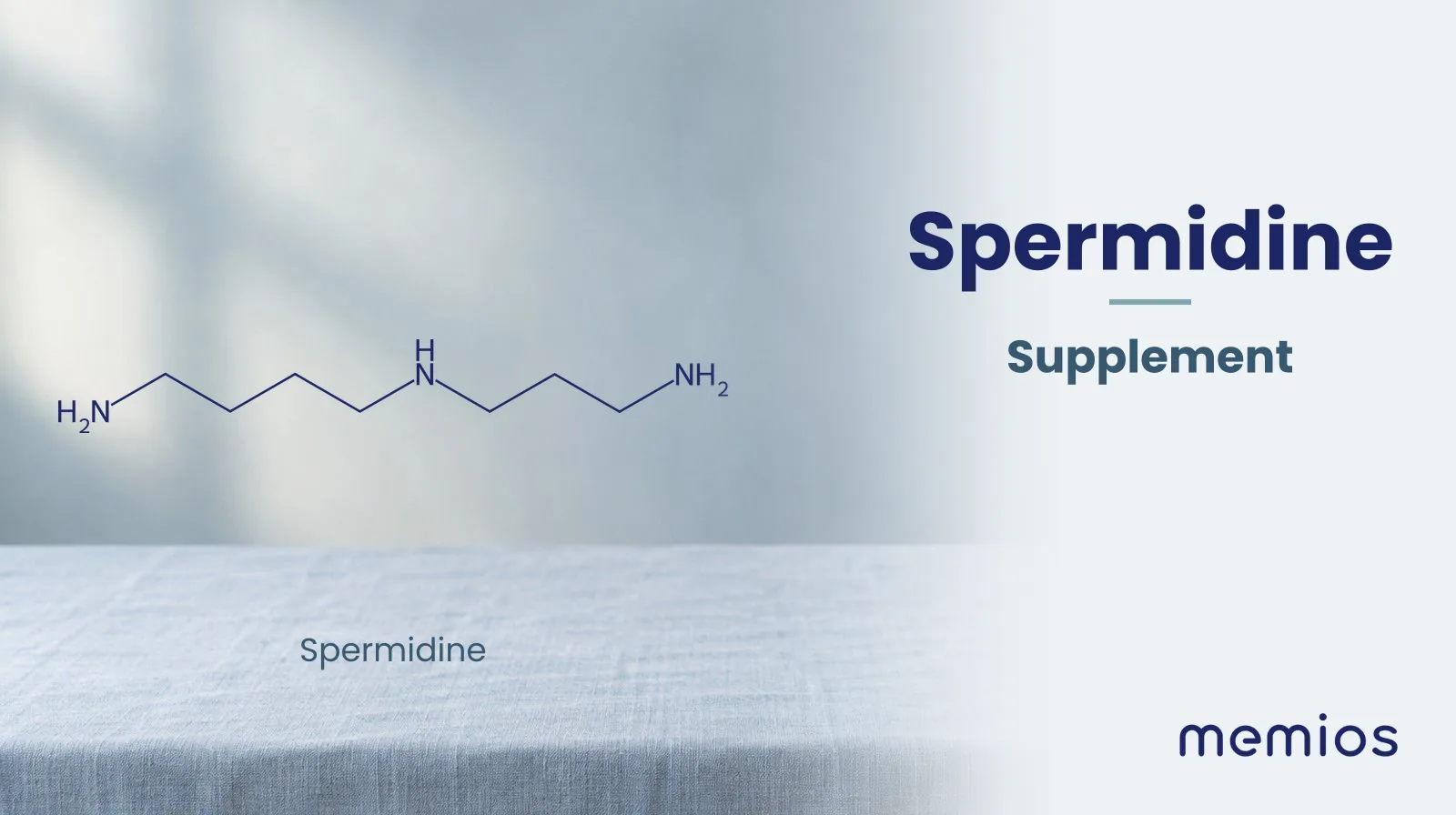
- What it is: Spermidine is a biogenic polyamine, a small positively charged molecule present in all living cells and involved in cell growth and autophagy.
- Main use, supported: In a prospective population cohort, people whose diets were richer in spermidine had lower total mortality over twenty years; this is an association the study measured, not a demonstrated effect of spermidine. (low certainty)
- Other use, supported: A large case-control study found higher dietary spermidine intake associated with lower odds of colorectal cancer, while higher intake of the related polyamine spermine was associated with higher odds. (very low certainty)
- Claim NOT supported by research: The largest and longest randomised trial of spermidine supplementation found no effect on memory or biomarkers over twelve months. (moderate certainty)
- Another claim NOT supported: A crossover pharmacokinetic trial found that 15 mg/day of oral spermidine did not raise plasma or salivary spermidine at all; only spermine rose, suggesting presystemic conversion. (low certainty)
- Recommended dose: not established. No reference intake or recommended amount exists for spermidine; it is not an essential nutrient. Reported habitual dietary intakes range from about 5 to 25 mg per day, with an EU average of 12.6 mg per day.
- Studied dose (a trial dose, not a recommendation): The SmartAge trial gave a spermidine-rich wheat germ supplement providing 0.9 mg spermidine/d for 12 months. No finding here cites that trial.
- Upper limit: We found no tolerable upper intake level or acceptable daily intake set for spermidine by any body we could reach.
- What goes wrong: 4 findings on harm. In the twelve-month spermidine trial, musculoskeletal and connective tissue adverse events were substantially more common in the spermidine group than in placebo.
- Common myth: Taking a spermidine supplement raises your spermidine levels and switches on autophagy.
What it is
Spermidine is a biogenic polyamine, a small positively charged molecule present in all living cells and involved in cell growth and autophagy. Humans obtain it three ways: the body synthesises it, food supplies it, and gut bacteria in the large intestine produce more. Wheat germ and soybeans are the richest dietary sources measured, at 2,437 and 1,425 nmol/g respectively. Commercial supplements are usually wheat germ extracts, and their measured spermidine content varies roughly tenfold between products.
What the research says
Observational data look favourable and interventional data do not. In an Italian population cohort, each standard deviation of higher dietary spermidine was associated with a 26% lower rate of death over twenty years, and a case-control study found lower colorectal cancer odds with higher intake, but both are associations. When spermidine was actually given to older adults in a twelve-month randomised trial, memory and biomarkers were unchanged. A pharmacokinetic study helps explain why: oral spermidine at 15 mg/day did not raise plasma spermidine at all, apparently because it is converted to spermine before entering the circulation. Safety signals are modest but real: more musculoskeletal adverse events in the trial's spermidine arm, and preclinical evidence that spermidine can help tumours evade immune attack.
Evidence grade: Limited evidence.
What goes wrong
In the twelve-month spermidine trial, musculoskeletal and connective tissue adverse events were substantially more common in the spermidine group than in placebo. (Source 1)
- Randomized trial, Low certainty.
- Size: 100 participants; 129 adverse events in total (58 spermidine, 71 placebo)
- Who: Adults aged 60 to 90 with subjective cognitive decline.
- How long: 12 months.
- Result: Musculoskeletal and connective tissue adverse events in 11 spermidine participants versus 4 placebo participants; 19 serious adverse events overall (7 spermidine, 12 placebo), all rated unrelated to the intervention.
- Funding: not stated in the abstract.
Noticeably, musculoskeletal and connective tissue was the only system organ class with substantially more AEs in the spermidine group (11 participants) compared with the placebo group (4 participants).
In mouse models of glioblastoma, giving spermidine made tumours more aggressive by reducing CD8+ T cell numbers and cytotoxic function; this is animal and cell work, not a human finding. (Source 2)
- Animal study, Certainty not rated.
- Size: Preclinical mouse models plus human glioblastoma tumour samples.
- Who: Mice bearing glioblastoma tumours; human tumour samples for the correlative analysis.
- How long: Not stated.
- Result: Exogenous spermidine drove tumour aggressiveness in an immune-dependent manner; patients with more favourable outcome had significantly lower tumour spermidine.
- Funding: not stated.
Exogenous administration of SPD drove tumor aggressiveness in an immune-dependent manner in preclinical mouse models via reduction of CD8+ T cell frequency and reduced cytotoxic function.
Spermidine content of commercial supplements varies by roughly an order of magnitude between products, so the dose a buyer receives is not standardised. (Source 3)
- Survey study, Very low certainty.
- Size: A comparison of commercially available spermidine supplements.
- Who: Retail spermidine supplements, mostly wheat-germ based.
- How long: Single-timepoint product analysis.
- Result: One wheat-germ product contained 9,83 mg of spermidine per gram, almost ten times more than competing supplements.
- Funding: not stated.
Limit of this finding: The tenfold figure comes from a product comparison reported by the authors, not an independent laboratory assay, and the source writes the amount in continental style as "9,83 mg", which means 9.83 mg in English notation.
Tec sperm is also based on wheat germ, but it contains 9,83 mg of spermidine per gram, which is almost 10 times more than competing supplements.
Polyamines including spermidine are raised in cancer cells and associated with tumour growth, which is why polyamine synthesis has been explored as a target to block rather than boost. (Source 4)
- Expert review, not systematic, Very low certainty.
- Size: Not applicable; a review of polyamines in food and physiology.
- Who: Cancer patients and cancer cell biology.
- How long: Not applicable.
- Result: No effect estimate given; the review describes deregulated ODC activity raising intracellular polyamine content in cancer cells.
- Funding: not stated.
Elevated levels of polyamines in cancer patients are associated with tumor growth.
What the evidence supports
In a prospective population cohort, people whose diets were richer in spermidine had lower total mortality over twenty years; this is an association the study measured, not a demonstrated effect of spermidine. (Source 5)
- Cohort study, Low certainty.
- Size: 829 participants aged 45–84 y, 2540 dietary assessments, 341 deaths.
- Who: Community-dwelling adults in Bruneck, Italy, with independent validation in the SAPHIR study.
- How long: Follow-up between 1995 and 2015.
- Result: HR for all-cause death per 1-SD higher spermidine intake 0.74 (95% CI: 0.66, 0.83; P <0.001); after full adjustment 0.76 (95% CI: 0.67, 0.86; P <0.001)
- Funding: not stated.
The age-, sex- and caloric ratio–adjusted HR for all-cause death per 1-SD higher spermidine intake was 0.74 (95% CI: 0.66, 0.83; P <0.001).
A large case-control study found higher dietary spermidine intake associated with lower odds of colorectal cancer, while higher intake of the related polyamine spermine was associated with higher odds. (Source 6)
- Case-control study, Very low certainty.
- Size: 2502 colorectal cancer cases and 2538 matched controls.
- Who: Adults recruited July 2010 to April 2019.
- How long: Dietary intake assessed at a single timepoint relative to diagnosis.
- Result: Highest versus lowest quartile adjusted ORs: total polyamines 0.60 (95% CI 0.50, 0.72; Ptrend < 0.001); putrescine 0.35 (95% CI 0.29, 0.43; Ptrend < 0.001); spermidine 0.79 (95% CI 0.66, 0.95; Ptrend = 0.001); spermine 1.58 (95% CI 1.29, 1.93; Ptrend < 0.001)
- Funding: not stated.
Limit of this finding: Polyamines did not all point the same way. Spermidine and putrescine went with lower odds of colorectal cancer, but spermine went the other way, with an odds ratio of 1.58 for the highest intake group. This is also a case-control study, which compares people who already have the disease with people who do not and asks about past diet, so it can show an association but cannot show that diet caused anything.
This data indicate that higher intake of total polyamines, putrescine and spermidine, as well as lower intake of spermine, is associated with a decreased risk of colorectal cancer.
What the evidence does not support
The largest and longest randomised trial of spermidine supplementation found no effect on memory or biomarkers over twelve months. (Source 7)
- Randomized trial, Moderate certainty.
- Size: 100 participants (51 spermidine, 49 placebo), 89% completed.
- Who: Adults aged 60 to 90 with subjective cognitive decline, at a German academic research centre.
- How long: 12 months.
- Result: Mnemonic discrimination performance between-group difference −0.03; 95% CI, −0.11 to 0.05; P = .47, and no effect on secondary outcomes.
- Funding: not stated in the abstract; the wheat-germ supplement was supplied for the trial.
In this randomized clinical trial, longer-term spermidine supplementation in participants with subjective cognitive decline did not modify memory and biomarkers compared with placebo.
A crossover pharmacokinetic trial found that 15 mg/day of oral spermidine did not raise plasma or salivary spermidine at all; only spermine rose, suggesting presystemic conversion. (Source 8)
- Blood level study, Low certainty.
- Size: 12 healthy volunteers.
- Who: Healthy adult volunteers.
- How long: Two 5-day intervention phases separated by a 9-day washout.
- Result: Spermine in plasma increased significantly versus placebo; spermidine and putrescine levels unaffected; no effect on salivary polyamines.
- Funding: not stated.
Compared with a placebo, spermidine supplementation significantly increased spermine levels in the plasma, but it did not affect spermidine or putrescine levels.
Where the research disagrees
Whether dietary spermidine intake is actually doing the work attributed to it
- Kiechl et al., American Journal of Clinical Nutrition 2018, prospective cohort of 829 adults with 341 deaths, plus an independent validation cohort: Our findings lend epidemiologic support to the concept that nutrition rich in spermidine is linked to increased survival in humans. (Source 9)
- Schwarz et al., SmartAge randomized clinical trial, JAMA Network Open 2022, 12-month double-masked placebo-controlled phase 2b randomised trial, 100 participants: In this randomized clinical trial, longer-term spermidine supplementation in participants with subjective cognitive decline did not modify memory and biomarkers compared with placebo. (Source 7)
- Schwarz et al., pharmacokinetic crossover study, Nutrients 2023, randomised placebo-controlled crossover pharmacokinetic study in 12 healthy volunteers: It is rather unlikely that spermidine supplements with doses <15 mg/d exert any short-term effects. (Source 8)
How much
- Reference intake: No reference intake or recommended amount exists for spermidine; it is not an essential nutrient. Reported habitual dietary intakes range from about 5 to 25 mg per day, with an EU average of 12.6 mg per day. (Source 10)
- Upper limit: We found no tolerable upper intake level or acceptable daily intake set for spermidine by any body we could reach. The only quantitative anchor we located is the reported habitual intake range of about 5 to 25 mg per day; the EFSA novel food opinion on spermidine-rich wheat germ extract could not be retrieved in this run. (Source 10)
- Studied: The SmartAge trial gave a spermidine-rich wheat germ supplement providing 0.9 mg spermidine/d for 12 months. (Source 11)
- Studied: A crossover pharmacokinetic trial gave 12 healthy volunteers 15 mg/d of spermidine orally for two 5-day phases. (Source 8)
A common belief, and what the research shows
The belief: Taking a spermidine supplement raises your spermidine levels and switches on autophagy.
What the research shows: A randomised crossover pharmacokinetic study measured exactly this and found the opposite of what is assumed: "Compared with a placebo, spermidine supplementation significantly increased spermine levels in the plasma, but it did not affect spermidine or putrescine levels." The authors concluded that "It is rather unlikely that spermidine supplements with doses <15 mg/d exert any short-term effects." Most marketed products supply well under 15 mg.
Questions and answers
What is it?
Spermidine is a biogenic polyamine, a small positively charged molecule found in every living cell. The body makes its own, and more comes from food and from gut bacteria. Supplements are usually wheat germ extracts standardised for spermidine. (Source 8)
What does it do in the body?
Polyamines are involved in cell growth and in autophagy, the cellular recycling process, and this is the basis of the anti-ageing claims. In humans, though, a pharmacokinetic trial showed that swallowing 15 mg a day did not raise plasma spermidine; what rose was spermine, suggesting the gut converts it before it reaches the bloodstream. (Source 8)
Is it good or bad for you?
Diets higher in spermidine have been linked to lower mortality and lower colorectal cancer odds in observational studies, which cannot show cause. The best interventional test so far, a twelve-month randomised trial in older adults, found no effect on memory or biomarkers. Against that, spermidine drove tumour growth in mouse glioblastoma models, and polyamines are elevated in cancer cells. (Source 7)
How do you get more of it?
Diet is the main external source. The estimated human intake range is about 5 to 25 mg a day depending on dietary habits, and the source notes it can be higher still in some cases; the EU average is put at 12.6 mg a day. Supplement trials have used far less in one case (0.9 mg/day of wheat germ extract over twelve months) and 15 mg/day in a pharmacokinetic study. (Source 10)
If it is harmful, what reduces it?
Reducing polyamines is studied in oncology rather than in healthy people: the rationale is that cancer cells accumulate polyamines through raised ornithine decarboxylase activity, so blocking that enzyme has been explored as antineoplastic therapy. There is no established reason for a healthy adult to lower spermidine, and the body makes its own regardless of diet. (Source 4)
Why might someone be low in it or missing it?
Tissue spermidine falls with age, which is the premise behind supplementation. Beyond age, intake is what varies: dietary spermidine ranges roughly fivefold between individuals depending on how much wheat germ, soy, mushrooms and aged cheese the diet contains, and gut bacteria contribute a further variable amount. (Source 8)
Which whole foods contain it or feed it?
Wheat germ and soybeans are the standout sources, measured at 2,437 and 1,425 nmol/g of spermidine respectively. Mushrooms, aged cheese, legumes and whole grains also contribute, and gut bacteria in the large intestine produce polyamines too. (Source 12)
What happens if you do not have it?
There is no spermidine deficiency state, because the body synthesises polyamines itself and gut bacteria add more. No trial has tested what happens when dietary spermidine is withheld; the observational link between lower intake and higher mortality is an association across populations, not a demonstrated consequence. (Source 13)
We searched: Searched for a described spermidine deficiency syndrome or reference intake in the Frontiers in Nutrition polyamines review, the 2018 AJCN cohort, the SmartAge trial and the 2023 pharmacokinetic study; none defines one.
How can you test for it?
Spermidine can be measured in plasma and saliva by liquid chromatography-mass spectrometry, but the result tells you little about supplementation: in a controlled crossover study, 15 mg/day for five days did not change plasma or salivary spermidine. There is no clinically validated spermidine status test or reference range. (Source 8)
References
- JAMA Network Open. Effects of Spermidine Supplementation on Cognition and Biomarkers in Older Adults With Subjective Cognitive Decline: A Randomized Clinical Trial. 2022. PMID 35616942, DOI 10.1001/jamanetworkopen.2022.13875. Read the source
- Journal of Clinical Investigation. Tumor cell-derived spermidine promotes a protumorigenic immune microenvironment in glioblastoma via CD8+ T cell inhibition. 2025. DOI 10.1172/JCI177824. Read the source
- Functional Foods in Health and Disease. Spermidine content of selected dietary supplements: potential for improvement?. 2023. DOI 10.31989/ffhd.v13i5.1102. Read the source
- Frontiers in Nutrition. Polyamines in Food. 2019. DOI 10.3389/fnut.2019.00108. Read the source
- The American Journal of Clinical Nutrition. Higher spermidine intake is linked to lower mortality: a prospective population-based study. 2018. PMID 29955838, DOI 10.1093/ajcn/nqy102. Read the source
- Nutrients. Dietary Polyamines Intake and Risk of Colorectal Cancer: A Case-Control Study. 2020. DOI 10.3390/nu12113575. Read the source
- JAMA Network Open. Effects of Spermidine Supplementation on Cognition and Biomarkers in Older Adults With Subjective Cognitive Decline: A Randomized Clinical Trial. 2022. PMID 35616942, DOI 10.1001/jamanetworkopen.2022.13875. Read the source
- Nutrients. High-Dose Spermidine Supplementation Does Not Increase Spermidine Levels in Blood Plasma and Saliva of Healthy Adults: A Randomized Placebo-Controlled Pharmacokinetic and Metabolomic Study. 2023. PMID 37111071, DOI 10.3390/nu15081852. Read the source
- The American Journal of Clinical Nutrition. Higher spermidine intake is linked to lower mortality: a prospective population-based study. 2018. PMID 29955838, DOI 10.1093/ajcn/nqy102. Read the source
- Functional Foods in Health and Disease. Spermidine content of selected dietary supplements: potential for improvement?. 2023. DOI 10.31989/ffhd.v13i5.1102. Read the source
- JAMA Network Open. Effects of Spermidine Supplementation on Cognition and Biomarkers in Older Adults With Subjective Cognitive Decline: A Randomized Clinical Trial. 2022. PMID 35616942, DOI 10.1001/jamanetworkopen.2022.13875. Read the source
- Frontiers in Nutrition. Polyamines in Food. 2019. DOI 10.3389/fnut.2019.00108. Read the source
- Frontiers in Nutrition. Polyamines in Food. 2019. DOI 10.3389/fnut.2019.00108. Read the source