Medications · September 29, 2026 · Memios · 12 min read
Simvastatin
In people with heart disease, simvastatin reduced death: in 4S all-cause mortality fell from 11.5% to 8.2% over about 5.4 years, and in HPS from 14.7% to 12.9% over 5 years.
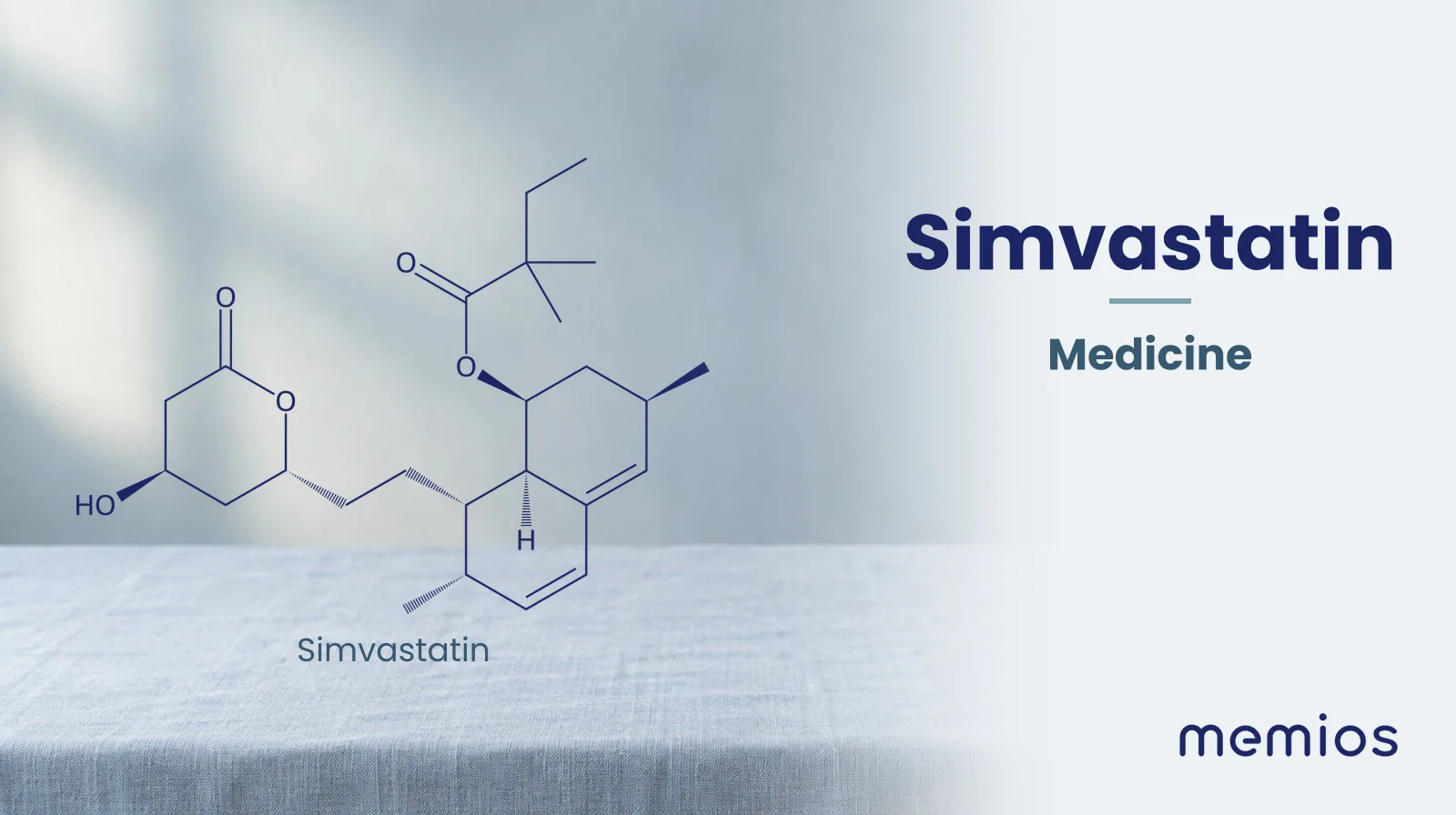
TLDR
- Well established. In people with heart disease, simvastatin reduced death: in 4S all-cause mortality fell from 11.5% to 8.2% over about 5.4 years, and in HPS from 14.7% to 12.9% over 5 years.
- What it is: Simvastatin is a prescription statin tablet.
- Main use: Reducing death and cardiovascular events in people with established coronary heart disease (secondary prevention) (well supported).
- Other approved uses: High-risk people with vascular disease, diabetes or other risk (HPS population) (well supported); Primary prevention in adults without cardiovascular disease (statins as a class) (well supported).
- Uses NOT supported by research: Secondary progressive multiple sclerosis.
- Recommended dose (official position): Dosing is set by the prescriber. As a position, the US label (revised 8/2023) gives a usual range of 20 mg to 40 mg once daily.
- Studied dose (a trial dose, not a recommendation): MS-STAT2 gave 80 mg simvastatin daily or placebo for up to 4.5 years. Findings citing that trial: 1 against.
- Upper limit: Label position (8/2023): 80 mg daily is restricted to people who have already taken it for about 12 months or more without muscle toxicity, because of myopathy risk.
- What goes wrong: 4 findings on harm. Across 19 double-blind statin trials, muscle pain or weakness was reported almost as often on placebo as on statin; the statin caused a small excess, mostly in year one.
- Interactions: 3 recorded, including Grapefruit juice, Strong CYP3A4 inhibitors (some azole antifungals, macrolide antibiotics, antivirals, nefazodone), Cyclosporine, danazol, gemfibrozil.
- Common myth: Statins commonly cause muscle pain.
What it is
Simvastatin is a prescription statin tablet. The US label (revised 8/2023) describes it as an HMG-CoA reductase inhibitor used to lower cholesterol and to reduce death, heart attack, stroke and revascularisation in people with established vascular disease or diabetes at high risk.
What the research says
In people with heart disease, simvastatin reduced death: in 4S all-cause mortality fell from 11.5% to 8.2% over about 5.4 years, and in HPS from 14.7% to 12.9% over 5 years. A Cochrane review of statins for primary prevention found fewer deaths and cardiovascular events. Harms include a small excess of mild muscle pain in the first year, rare myopathy and rhabdomyolysis, and a small rise in new diabetes (about 1 extra case per 255 people treated for 4 years). It did not slow progressive multiple sclerosis in a phase 3 trial.
Evidence grade: Well established.
How it works
Drug class: HMG-CoA reductase inhibitor (statin)
Simvastatin's active form blocks HMG-CoA reductase, the enzyme that controls the first committed step in the liver's production of cholesterol. (Source 1)
What it is used for
- In 4S (4,444 people with prior heart attack or angina), all-cause death was 8.2% on simvastatin versus 11.5% on placebo over a median 5.4 years (NNT about 30). Merck funded the trial. Evidence: established. (Source 2)
- In HPS (20,536 people), death was 12.9% versus 14.7% (NNT 55) and major vascular events 19.8% versus 25.2% (NNT 18) over 5 years. Evidence: established. (Source 3)
- The 2013 Cochrane review of 18 trials found lower all-cause mortality (OR 0.86) and fewer cardiovascular events; it estimated that of 1,000 people treated for five years, 18 would avoid a major event. This is class evidence, not simvastatin alone, and the label limits the indication to people at high risk. Evidence: established. (Source 4)
- The phase 3 MS-STAT2 trial (964 people, 80 mg daily vs placebo up to 4.5 years) found no slowing of disability progression. Evidence: not-supported. (Source 5)
Interactions
- Grapefruit juice (label): Grapefruit juice blocks the gut enzyme CYP3A4 and raises simvastatin blood levels, which may raise the risk of muscle damage. (Source 1)
- Strong CYP3A4 inhibitors (some azole antifungals, macrolide antibiotics, antivirals, nefazodone) (label): These are contraindicated with simvastatin because they sharply raise its levels. (Source 1)
- Cyclosporine, danazol, gemfibrozil (label): Contraindicated with simvastatin on the label because of myopathy risk. (Source 1)
Stopping it
- In a French national cohort of 120,173 previously adherent 75-year-olds taking statins for primary prevention, stopping was associated with a 33% higher risk of admission for a cardiovascular event. This is observational and the authors call for randomised trials. (Source 6)
- The same study reported hazard ratios by event type after stopping. (Source 6)
What goes wrong
In HPS, myopathy with rhabdomyolysis was rare but slightly more frequent on simvastatin. (Source 3)
- Randomized trial, Moderate certainty.
- Size: 20,536.
- Who: Adults at high risk of cardiovascular disease.
- How long: Mean 5 years.
- Result: Myopathy with rhabdomyolysis 0.05% vs 0.03%; without rhabdomyolysis 0.05% vs 0.01%.
- Funding: UK Medical Research Council and British Heart Foundation, with Merck.
Myopathy with rhabdomyolysis: 0.05% vs. 0.03%
Across 19 double-blind statin trials, muscle pain or weakness was reported almost as often on placebo as on statin; the statin caused a small excess, mostly in year one. (Source 7)
- Meta-analysis, High certainty.
- Size: 123,940 participants in 19 placebo-controlled trials.
- Who: Adults in large long-term statin trials.
- How long: Median 4.3 years.
- Result: 27.1% vs 26.6% reported muscle pain or weakness; RR 1.03 (95% CI 1.01-1.06); year 1 excess 11 (6-16) per 1,000 person-years.
- Funding: independent (British Heart Foundation, Medical Research Council, Australian NHMRC)
16 835 (27·1%) allocated statin versus 16 446 (26·6%) allocated placebo reported muscle pain or weakness (rate ratio [RR] 1·03; 95% CI 1·01–1·06)
Statins slightly increase the risk of developing diabetes: about one extra case per 255 people treated for four years. (Source 8)
- Meta-analysis, Moderate certainty.
- Size: 13 trials, 91,140 participants.
- Who: Participants in statin endpoint trials.
- How long: Mean 4 years.
- Result: OR 1.09 (95% CI 1.02-1.17); NNH 255 (95% CI 150-852) over 4 years.
- Funding: None (as stated by the authors)
Treatment of 255 (95% CI 150-852) patients with statins for 4 years resulted in one extra case of diabetes.
The label records rare immune-mediated necrotizing myopathy, an autoimmune muscle disease, with statins. (Source 1)
- Official position, Certainty not rated.
- Size: Postmarketing reports.
- Who: Statin users.
- How long: Not applicable.
- Result: Rare; no rate given.
- Funding: Label (FDA-approved manufacturer text, revised 8/2023)
There have been rare reports of immune-mediated necrotizing myopathy (IMNM), an autoimmune myopathy, associated with statin use
What the evidence supports
In 4S, simvastatin reduced all-cause mortality in people with prior heart attack or angina and high cholesterol. (Source 2)
- Randomized trial, High certainty.
- Size: 4,444 (2,221 simvastatin, 2,223 placebo)
- Who: Adults with prior myocardial infarction or angina and hyperlipidaemia.
- How long: Median 5.4 years (stopped after interim analysis)
- Result: Death 11.5% placebo vs 8.2% simvastatin; RR 0.70 (95% CI 0.58-0.85); NNT 30.
- Funding: industry-funded (Merck)
11.5% vs. 8.2% (RR 0.70; 95% CI 0.58-0.85; P=0.0003; NNT 30)
In 4S, coronary deaths were lower with simvastatin. (Source 2)
- Randomized trial, High certainty.
- Size: 4,444.
- Who: Adults with coronary heart disease and hyperlipidaemia.
- How long: Median 5.4 years.
- Result: 8.5% vs 5.0%; RR 0.58 (95% CI 0.46-0.73); NNT 42.
- Funding: industry-funded (Merck)
8.5% vs. 5.0% (RR 0.58; 95% CI 0.46-0.73; NNT 42)
In HPS, simvastatin reduced all-cause mortality in high-risk people. (Source 3)
- Randomized trial, High certainty.
- Size: 20,536.
- Who: Adults at high risk of cardiovascular disease.
- How long: Mean 5 years.
- Result: 12.9% vs 14.7%; RR 0.87 (95% CI 0.81-0.94); NNT 55.
- Funding: UK Medical Research Council and British Heart Foundation, with Merck.
12.9% vs. 14.7% (RR 0.87; 95% CI 0.81-0.94; P=0.0003; NNT 55)
In HPS, major vascular events were reduced by about a quarter. (Source 3)
- Randomized trial, High certainty.
- Size: 20,536.
- Who: Adults at high risk of cardiovascular disease.
- How long: Mean 5 years.
- Result: 19.8% vs 25.2%; RR 0.76 (95% CI 0.72-0.81); NNT 18.
- Funding: UK Medical Research Council and British Heart Foundation, with Merck.
19.8% vs. 25.2% patients (RR 0.76; 95% CI 0.72-0.81; P<0.0001; NNT 18)
A Cochrane review of statins for primary prevention found reduced all-cause mortality and cardiovascular events. (Source 4)
- Systematic review, Moderate certainty.
- Size: 18 trials, 56,934 participants.
- Who: Adults without prior cardiovascular disease.
- How long: Trials of 1 year or more.
- Result: All-cause mortality OR 0.86 (95% CI 0.79 to 0.94); fatal and non-fatal CVD RR 0.75 (0.70 to 0.81)
- Funding: not stated in the fetched text; some included trials were industry funded.
All-cause mortality was reduced by statins (OR 0.86, 95% CI 0.79 to 0.94)
The Cochrane review's absolute estimate for primary prevention was that 18 of 1,000 people treated for five years would avoid a major cardiovascular event. (Source 9)
- Systematic review, Moderate certainty.
- Size: 18 trials, 56,934 participants.
- Who: Adults without prior cardiovascular disease.
- How long: Five years.
- Result: 18 per 1,000 over five years (NNT about 56)
- Funding: not stated in the fetched text.
Of 1000 people treated with a statin for five years, 18 would avoid a major CVD event
What the evidence does not support
After the first year, statins caused no significant excess of new muscle symptoms, and over 90% of muscle reports on statins were not due to the statin. (Source 7)
- Meta-analysis, High certainty.
- Size: 123,940 participants.
- Who: Adults in large long-term statin trials.
- How long: Median 4.3 years.
- Result: After year 1: RR 0.99 (0.96-1.02)
- Funding: independent (British Heart Foundation, Medical Research Council, Australian NHMRC)
After year 1, there was no significant excess in first reports of muscle pain or weakness (0·99; 0·96–1·02).
In MS-STAT2, simvastatin 80 mg did not slow disability progression in secondary progressive multiple sclerosis. (Source 5)
- Randomized trial, High certainty.
- Size: 964 participants.
- Who: Adults aged 18-65 with secondary progressive multiple sclerosis.
- How long: Up to 4.5 years.
- Result: 6-month confirmed disability progression 40% (192/482) simvastatin vs 36% (173/482) placebo; adjusted HR 1.13 (95% CI 0.91 to 1.39), p=0.26 (no significant difference)
- Funding: independent (NIHR HTA, UK MS Society, US National MS Society)
The MS-STAT2 trial did not show a treatment effect of simvastatin in slowing disability progression in SPMS.
Where the research disagrees
Whether statins carry meaningful harms beyond muscle symptoms
- Cochrane review of statins for primary prevention (2013), systematic review of 18 RCTs: There was no evidence of any serious harm caused by statin prescription. (Source 4)
- Sattar et al. collaborative meta-analysis (2010), meta-analysis of 13 RCTs: Statin therapy is associated with a slightly increased risk of development of diabetes, but the risk is low both in absolute terms and when compared with the reduction in coronary events. (Source 8)
How much
- Reference intake: Dosing is set by the prescriber. As a position, the US label (revised 8/2023) gives a usual range of 20 mg to 40 mg once daily. (Source 1)
- Upper limit: Label position (8/2023): 80 mg daily is restricted to people who have already taken it for about 12 months or more without muscle toxicity, because of myopathy risk. (Source 1)
- Studied: MS-STAT2 gave 80 mg simvastatin daily or placebo for up to 4.5 years. (Source 5)
A common belief, and what the research shows
The belief: Statins commonly cause muscle pain.
What the research shows: In blinded trials muscle symptoms were reported almost as often on placebo; the CTT analysis concluded "Most (>90%) of all reports of muscle symptoms by participants allocated statin therapy were not due to the statin." Rare serious myopathy does occur.
Questions and answers
What is it?
Simvastatin is a prescription cholesterol-lowering tablet from the statin class. Its active form blocks HMG-CoA reductase, a liver enzyme. (Source 1)
What does it do in the body?
By blocking the enzyme that makes mevalonate, an early building block of cholesterol, it lowers the body's own cholesterol production, which lowers LDL cholesterol in the blood. (Source 1)
Is it good or bad for you?
In people at high cardiovascular risk, trials show fewer deaths and vascular events. Harms include a small excess of mild muscle pain, rare serious muscle damage, and a small rise in diabetes risk. (Source 3)
How do you get more of it?
Does not apply as a nutrient: simvastatin is a prescription drug and the dose is set by the prescriber. The label range is recorded here as a position, not advice. (Source 1)
If it is harmful, what reduces it?
Does not apply in the usual sense. When muscle symptoms occur on a statin, blinded trial data show most are not caused by the statin; any change is for the prescriber to decide. (Source 7)
Why might someone be low in it or missing it?
The body does not make simvastatin. People often stop taking statins over concerns about muscle side effects, which the CTT analysis set out to test. (Source 7)
Which whole foods contain it or feed it?
No food contains simvastatin. Grapefruit juice raises its blood levels and may increase the risk of muscle damage, according to the label. (Source 1)
What happens if you do not have it?
In an observational study of 75-year-olds taking a statin for primary prevention, stopping was associated with more cardiovascular admissions. This is an association, not proof of cause. (Source 6)
How can you test for it?
Simvastatin levels are not routinely measured; its effect is seen in blood cholesterol tests. In the Cochrane trials, cholesterol fell in all trials but by varying amounts. (Source 4)
References
- Organon / US FDA (Drugs@FDA). ZOCOR (simvastatin) tablets - Prescribing Information. 2023. Read the source
- Wiki Journal Club. 4S (Scandinavian Simvastatin Survival Study Group. Randomised trial of cholesterol lowering in 4444 patients with coronary heart disease. Lancet 1994) - trial summary. 1994. PMID 7968073, DOI 10.1016/S0140-6736(94)90566-5. Read the source
- Wiki Journal Club. HPS Statin (Heart Protection Study Collaborative Group. MRC/BHF Heart Protection Study of cholesterol lowering with simvastatin in 20,536 high-risk individuals. Lancet 2002) - trial summary. 2002. PMID 12114036, DOI 10.1016/S0140-6736(02)09327-3. Read the source
- Cochrane Database of Systematic Reviews (repository PDF, Universidad de Navarra). Statins for the primary prevention of cardiovascular disease (Review). Taylor F et al. Cochrane Database Syst Rev 2013, CD004816. 2013. PMID 23440795, DOI 10.1002/14651858.CD004816.pub5. Read the source
- The Lancet (ScienceDirect). Effect of repurposed simvastatin on disability progression in secondary progressive multiple sclerosis (MS-STAT2): a phase 3, randomised, double-blind, placebo-controlled trial. 2025. PMID 41045938, DOI 10.1016/S0140-6736(25)01039-6. Read the source
- European Heart Journal (Oxford Academic). Cardiovascular effect of discontinuing statins for primary prevention at the age of 75 years: a nationwide population-based cohort study in France. 2019. PMID 31362307, DOI 10.1093/eurheartj/ehz458. Read the source
- The Lancet (abstract via Houston Methodist Scholars). Effect of statin therapy on muscle symptoms: an individual participant data meta-analysis of large-scale, randomised, double-blind trials. 2022. PMID 36049498, DOI 10.1016/S0140-6736(22)01545-8. Read the source
- The Lancet (abstract via Houston Methodist Scholars). Statins and risk of incident diabetes: a collaborative meta-analysis of randomised statin trials. 2010. PMID 20167359, DOI 10.1016/S0140-6736(09)61965-6. Read the source
- Cochrane. Statins for the primary prevention of cardiovascular disease (plain language summary). 2013. PMID 23440795, DOI 10.1002/14651858.CD004816.pub5. Read the source