Medications · September 29, 2026 · Memios · 13 min read
Sertraline
In the largest network meta-analysis (522 trials), all antidepressants beat placebo for acute depression in adults, and sertraline was among the better tolerated.
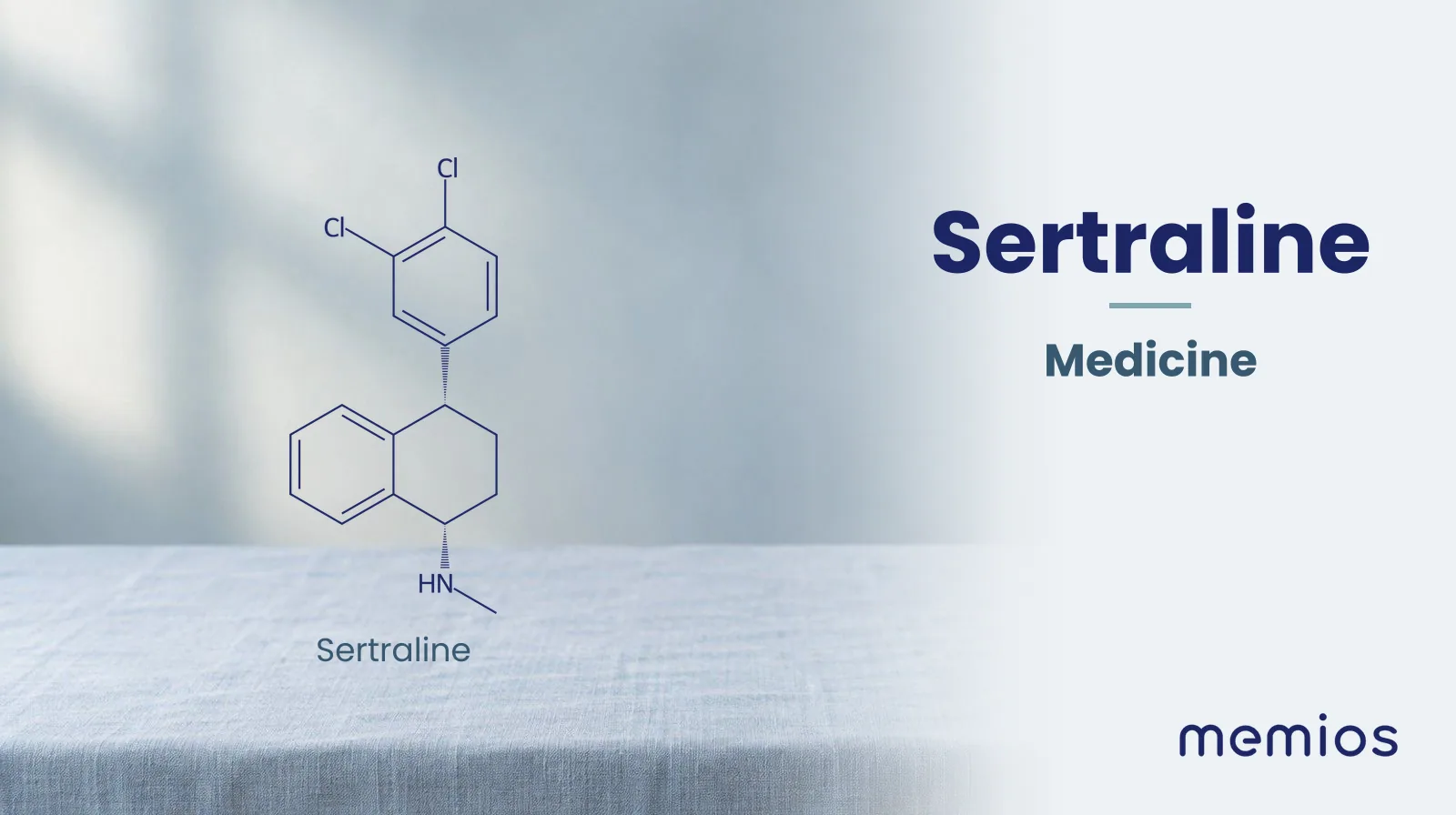
TLDR
- Boxed warning: Antidepressants increased the risk of suicidal thoughts and behavior in pediatric and young adult patients in short-term studies.
- Well established. In the largest network meta-analysis (522 trials), all antidepressants beat placebo for acute depression in adults, and sertraline was among the better tolerated.
- What it is: Sertraline is a prescription antidepressant of the SSRI class.
- Main use: Major depressive disorder (adults) (well supported).
- Other approved uses: Obsessive-compulsive disorder, panic disorder, PTSD and other labelled anxiety disorders (evidence not rated).
- Recommended dose (official position): Dosing is set by the prescriber. As a position, the Zoloft label (revised 1/2023) gives a starting dose of 50 mg per day for MDD in adults.
- Studied dose (a trial dose, not a recommendation): The ANTLER discontinuation trial included people maintained on sertraline 100 mg. Findings citing that trial: 1 on harm.
- Upper limit: The label's maximum is 200 mg per day (from the dosage table, not quoted here).
- What goes wrong: 6 findings on harm. In FDA trial data on adults, the risk of suicidality with antidepressants depended strongly on age: raised under 25, neutral to protective at older ages.
- Interactions: 3 recorded, including St John's wort, NSAIDs (ibuprofen, naproxen), aspirin, other antiplatelet drugs, warfarin and other anticoagulants, Other serotonergic drugs and supplements (triptans, tramadol, tryptophan, lithium, fentanyl).
- Common myth: Antidepressant withdrawal is always mild, or always severe.
What it is
Sertraline is a prescription antidepressant of the SSRI class. Its label lists major depressive disorder, obsessive-compulsive disorder, panic disorder and PTSD, among other uses.
What the research says
In the largest network meta-analysis (522 trials), all antidepressants beat placebo for acute depression in adults, and sertraline was among the better tolerated. The average benefit over placebo is modest, and how much it matters clinically is debated. Unpublished negative trials once inflated the apparent effect, and some analyses find the benefit is clearest in severe depression. In a UK primary-care trial, sertraline did not clearly reduce depressive symptoms at 6 weeks but did improve anxiety. The label carries a boxed warning on suicidal thinking in young people. Sexual side effects are common, and a persistent form after stopping is recognised but its frequency is unknown. Discontinuation symptoms, bleeding risk with NSAIDs, and serotonin syndrome with St John's wort are documented.
Evidence grade: Well established.
How it works
Drug class: Selective serotonin reuptake inhibitor (SSRI) antidepressant
Sertraline blocks the recycling (reuptake) of serotonin into nerve cells, which leaves more serotonin active in the brain. (Source 1)
Boxed warning
Antidepressants increased the risk of suicidal thoughts and behavior in pediatric and young adult patients in short-term studies.
(Source 1)
What it is used for
- In a network meta-analysis of 522 trials, all antidepressants beat placebo, and sertraline was among the better tolerated. The average benefit over placebo is modest and the trials were short. One pragmatic primary-care trial found no clear effect on depressive symptoms at 6 weeks. Evidence: established. (Source 2)
- Approved on the label. The trial evidence for these uses was not reviewed in this batch. Evidence: unknown. (Source 1)
Interactions
- St John's wort (case reports): Combining with St John's wort can cause serotonin syndrome (agitation, fever, muscle twitching). The evidence is case reports and the label. (Source 3)
- NSAIDs (ibuprofen, naproxen), aspirin, other antiplatelet drugs, warfarin and other anticoagulants (label): Adds to bleeding risk, especially upper gastrointestinal bleeding; the label lists warfarin and other anticoagulants as well as NSAIDs and antiplatelet drugs. An observational meta-analysis (Alam 2022) found OR 1.75 for SSRI plus NSAID versus NSAID alone. (Source 1)
- Other serotonergic drugs and supplements (triptans, tramadol, tryptophan, lithium, fentanyl) (label): Raises the risk of serotonin syndrome. (Source 1)
Stopping it
- Stopping, especially abruptly, can cause discontinuation symptoms; the label recommends gradual dose reduction. (Source 1)
- In the ANTLER trial, people who stopped had more withdrawal symptoms, peaking around 12 weeks, and relapsed more often. (Source 4)
- A meta-analysis of RCTs found on average about one extra symptom at week 1 after stopping and no worsening of mood attributable to discontinuation itself; later low mood was interpreted as relapse. (Source 5)
What goes wrong
In FDA trial data on adults, the risk of suicidality with antidepressants depended strongly on age: raised under 25, neutral to protective at older ages. (Source 6)
- Meta-analysis, Moderate certainty.
- Size: 372 RCTs, 99,231 adults.
- Who: Adults in placebo-controlled antidepressant trials.
- How long: Short-term trials.
- Result: Under 25: OR 2.30 (1.04 to 5.09) for suicidal behaviour; 65+: OR 0.06 for suicidal behaviour.
- Funding: No specific grant (authors were FDA staff)
Compared with placebo, the increased risk for suicidality and suicidal behaviour among adults under 25 approaches that seen in children and adolescents.
After maintenance treatment in primary care, stopping antidepressants (including sertraline) roughly doubled the hazard of relapse compared with staying on them, and brought more withdrawal symptoms. (Source 4)
- Randomized trial, Moderate certainty.
- Size: 478 participants.
- Who: UK primary-care adults well enough to consider stopping, on citalopram, sertraline, fluoxetine or mirtazapine.
- How long: 52 weeks.
- Result: HR 2.06 (95% CI 1.56 to 2.70); relapse 56% vs 39% by 52 weeks.
- Funding: NIHR (public)
The time to relapse was shorter in participants who discontinued antidepressants than in those who stayed on maintenance treatment [hazard ratio (HR) 2.06, 95% CI 1.56 to 2.70; p < 0.0001]
Sexual dysfunction is a common adverse effect of second-generation antidepressants, and it is under-reported in efficacy trials. Comparative estimates between drugs rest on low-strength evidence. (Source 7)
- Systematic review, Low certainty.
- Size: 63 studies, more than 26,000 patients.
- Who: Adults with major depressive disorder.
- How long: Trials of 6 weeks or more.
- Result: Comparative network estimates; strength of evidence low.
- Funding: not stated in the text read.
clinicians need to be aware of SD as a common adverse event and should discuss patients' preferences before initiating antidepressant therapy.
Sexual dysfunction that persists after stopping SSRIs (PSSD) is recognised by regulators, but how often it happens is unknown. (Source 8)
- Official position, Very low certainty.
- Size: Not applicable (commentary)
- Who: People who have taken SSRIs.
- How long: Not applicable.
- Result: No reliable incidence estimate.
- Funding: not stated.
A gap in our knowledge of PSSD is understanding the prevalence of this condition and the incidence in people starting on SSRIs
In observational studies, adding an SSRI to an NSAID was associated with a higher risk of upper gastrointestinal bleeding than an NSAID alone. (Source 9)
- Meta-analysis, Low certainty.
- Size: 10 studies (1 cohort, 9 case-control), 66,419 patients.
- Who: Adults taking NSAIDs.
- How long: Varied.
- Result: OR 1.75 (95% CI 1.32–2.33)
- Funding: not stated in the text read.
an additional increased risk of upper GI bleeding in patients on NSAIDs with concomitant SSRI use (OR 1.75, 95% CI = 1.32–2.33)
A case series described serotonin syndrome in older people who combined prescription antidepressants with St John's wort. (Source 3)
- Case series, Very low certainty.
- Size: 5 cases.
- Who: Elderly patients.
- How long: Not applicable.
- Result: Clinically diagnosed central serotonergic syndrome.
- Funding: not stated.
We report a series of five cases of clinically diagnosed central serotonergic syndrome among elderly patients who combined prescription antidepressants with St. John's wort.
What the evidence supports
Across 522 trials of 21 antidepressants in adults with major depression, all beat placebo in the short term, and sertraline was among the more effective and better-tolerated drugs in head-to-head trials. (Source 2)
- Meta-analysis, Low certainty.
- Size: 522 trials, 116,477 participants.
- Who: Adults with major depressive disorder.
- How long: Acute treatment (about 8 weeks)
- Result: ORs for response vs placebo 1.38-2.13 across drugs; certainty moderate to very low.
- Funding: Not recorded in the text read (NIHR-supported; some authors had industry links, check full paper)
In head-to-head studies, agomelatine, amitriptyline, escitalopram, mirtazapine, paroxetine, sertraline, venlafaxine and vortioxetine were more effective than other antidepressants (OR range: 1.12-2.00)
What the evidence does not support
In a pragmatic UK primary-care trial, sertraline did not clearly reduce depressive symptoms at 6 weeks compared with placebo, though anxiety, quality of life and self-rated mental health improved. (Source 10)
- Randomized trial, Moderate certainty.
- Size: 655 participants.
- Who: Adults in UK primary care with depressive symptoms, including mild ones.
- How long: 6 weeks (primary), 12 weeks follow-up.
- Result: PHQ-9 adjusted proportional difference 0·95 (95% CI 0·85–1·07; p=0·41)
- Funding: NIHR (public)
The mean 6-week PHQ-9 score was 7·98 (SD 5·63) in the sertraline group and 8·76 (5·86) in the placebo group (adjusted proportional difference 0·95, 95% CI 0·85–1·07; p=0·41).
An analysis of FDA trial data found the drug-placebo difference is small except in very severe depression, mainly because placebo response falls in severe cases. The four drugs analysed did not include sertraline, so this is class evidence. (Source 11)
- Meta-analysis, Moderate certainty.
- Size: All FDA-submitted trials for four new-generation antidepressants.
- Who: Adults with depression in licensing trials.
- How long: Acute.
- Result: Clinical significance reached only at the upper end of the very severe category.
- Funding: No specific funding.
Drug–placebo differences in antidepressant efficacy increase as a function of baseline severity, but are relatively small even for severely depressed patients.
Where the evidence is mixed
The certainty of that network meta-analysis evidence was rated moderate to very low. (Source 2)
- Meta-analysis, Low certainty.
- Size: 522 trials.
- Who: Adults with major depressive disorder.
- How long: Acute.
- Result: Quality rating.
- Funding: see above.
The certainty of evidence was moderate to very low.
Comparing FDA reviews with journal publications shows that selective publication inflated the apparent efficacy of antidepressants (the 2008 study covered 12 older antidepressants). The bias was smaller for newer drugs. (Source 12)
- Meta-analysis, Moderate certainty.
- Size: 74 trials of 12 older and 30 trials of 4 newer antidepressants.
- Who: Antidepressant licensing trials.
- How long: Acute.
- Result: Effect-size inflation 0.10 (older) vs 0.05 (newer)
- Funding: No specific funding.
Compared to trial results in FDA review documents, results published in journals inflated the apparent efficacy of antidepressants over placebo both in terms of proportion of positive trials and effect size (ES).
A meta-analysis of randomised trials found stopping antidepressants led, on average, to about one extra discontinuation symptom at week 1, with dizziness the most common. The average fell below the threshold for a clinically significant syndrome. (Source 5)
- Meta-analysis, Moderate certainty.
- Size: 50 studies, 17,828 participants.
- Who: People stopping antidepressants in RCTs.
- How long: 1 day to 52 weeks.
- Result: SMD 0.31 (0.23-0.39); dizziness OR 5.52 (3.81-8.01), risk difference 6.24%.
- Funding: not stated in the text read.
Discontinuation of antidepressants was associated with increased odds of dizziness (OR, 5.52; 95%CI, 3.81-8.01)
Where the research disagrees
How much do antidepressants like sertraline help depression beyond placebo?
- Cipriani et al. 2018 (network meta-analysis), meta-analysis: In terms of efficacy, all antidepressants were more effective than placebo, with OR ranging between 2.13 for amitriptyline and 1.38 for reboxetine. (Source 2)
- Kirsch et al. 2008 (FDA dataset; sertraline not included), meta-analysis: Drug–placebo differences in antidepressant efficacy increase as a function of baseline severity, but are relatively small even for severely depressed patients. (Source 11)
How much
- Reference intake: Dosing is set by the prescriber. As a position, the Zoloft label (revised 1/2023) gives a starting dose of 50 mg per day for MDD in adults. That figure is from the label's dosage table and is not quoted here. (Source 1)
- Upper limit: The label's maximum is 200 mg per day (from the dosage table, not quoted here). (Source 1)
- Studied: The ANTLER discontinuation trial included people maintained on sertraline 100 mg. (Source 4)
A common belief, and what the research shows
The belief: Antidepressant withdrawal is always mild, or always severe.
What the research shows: Trial data point to a middle ground. A meta-analysis found on average one extra symptom at week 1: "the mean number of discontinuation symptoms at week 1 after stopping antidepressants was below the threshold for clinically significant discontinuation syndrome". The label lists symptoms including "electric shock sensations", and the ANTLER trial found withdrawal symptoms stayed higher for months.
Questions and answers
What is it?
Sertraline is a prescription antidepressant from the SSRI family, sold as Zoloft. It is used for depression and several anxiety disorders. (Source 1)
What does it do in the body?
It blocks the reabsorption of the chemical messenger serotonin by nerve cells, so more serotonin stays active. How this relieves depression is not fully understood. (Source 1)
Is it good or bad for you?
For adults with depression, trials show a modest average benefit over placebo, and sertraline is among the better tolerated antidepressants. In a primary-care trial it did not clearly lift depressive symptoms at 6 weeks but did improve anxiety. Harms include sexual side effects, discontinuation symptoms, bleeding with NSAIDs, and raised suicidality risk under age 25. (Source 10)
How do you get more of it?
Does not apply in the usual sense. Sertraline is a prescription drug whose dose is set by the prescriber. Supplements that raise serotonin, such as St John's wort, are a risk to combine with it, not a way to get more. (Source 1)
If it is harmful, what reduces it?
Stopping should be planned with a prescriber. The label recommends reducing the dose gradually, and trials show relapse is more likely after stopping than when staying on treatment. (Source 1)
Why might someone be low in it or missing it?
Does not apply. Sertraline is not a nutrient or a substance the body makes. The literature we read does not describe any deficiency of it. (Source 1)
Which whole foods contain it or feed it?
Does not apply. No food contains sertraline. The documented supplement interaction is with St John's wort, where case reports describe serotonin syndrome. (Source 3)
What happens if you do not have it?
Not taking it causes no deficiency. For someone who has been on it long-term, stopping raises the chance of depression returning and can bring withdrawal symptoms. (Source 4)
How can you test for it?
Routine blood testing of sertraline levels is not part of standard care in the sources we read. We found no source in this search on the reliability of such testing. (Source 1)
We searched: Zoloft label (DailyMed); Cipriani 2018; PANDA trial
References
- US FDA label via DailyMed (Viatris). ZOLOFT (sertraline hydrochloride) prescribing information (Revised 1/2023). 2023. Read the source
- The Lancet (abstract as held on University of Bristol research portal). Comparative efficacy and acceptability of 21 antidepressant drugs for the acute treatment of adults with major depressive disorder: a systematic review and network meta-analysis. 2018. PMID 29477251, DOI 10.1016/S0140-6736(17)32802-7. Read the source
- Journal of Geriatric Psychiatry and Neurology. St. John's Wort and Antidepressant Drug Interactions in the Elderly. 1999. DOI 10.1177/089198879901200103. Read the source
- Health Technology Assessment (NIHR Journals Library). Antidepressant medication to prevent depression relapse in primary care: the ANTLER RCT. 2021. DOI 10.3310/hta25690. Read the source
- JAMA Psychiatry. Incidence and nature of antidepressant discontinuation symptoms: A systematic review and meta-analysis (accepted manuscript). 2025. Read the source
- BMJ. Risk of suicidality in clinical trials of antidepressants in adults: analysis of proprietary data submitted to US Food and Drug Administration. 2009. PMID 19671933, DOI 10.1136/bmj.b2880. Read the source
- Drug Safety. Sexual Dysfunction associated with Second-Generation Antidepressants in Patients with Major Depressive Disorder: Results from a Systematic Review with Network Meta-Analysis. 2014. DOI 10.1007/s40264-013-0129-4. Read the source
- Epidemiology and Psychiatric Sciences. Post-SSRI sexual dysfunction: barriers to quantifying incidence and prevalence. 2024. PMID 39289881. Read the source
- Scientific Reports. Selective serotonin reuptake inhibitors increase risk of upper gastrointestinal bleeding when used with NSAIDs: a systemic review and meta-analysis. 2022. DOI 10.1038/s41598-022-18654-2. Read the source
- The Lancet Psychiatry (UCL Discovery record). The clinical effectiveness of sertraline in primary care and the role of depression severity and duration (PANDA): a pragmatic, double-blind, placebo-controlled randomised trial. 2019. PMID 31543474, DOI 10.1016/S2215-0366(19)30366-9. Read the source
- PLOS Medicine. Initial Severity and Antidepressant Benefits: A Meta-Analysis of Data Submitted to the Food and Drug Administration. 2008. DOI 10.1371/journal.pmed.0050045. Read the source
- PLOS Medicine. Selective publication of antidepressant trials and its influence on apparent efficacy: Updated comparisons and meta-analyses of newer versus older trials. 2022. DOI 10.1371/journal.pmed.1003886. Read the source