Supplements · September 29, 2026 · Memios · 17 min read
Reishi
Limited evidence. Reishi is sold for immunity, cancer support, sleep, blood sugar and cholesterol.
TLDR
- Limited evidence. Reishi is sold for immunity, cancer support, sleep, blood sugar and cholesterol.
- What it is: Reishi is a hard, shiny bracket fungus used in East Asian medicine for centuries.
- Main use, supported: In controlled trials of reishi, liver enzymes did not change and no jaundice or clinically apparent liver injury was reported. (low certainty)
- Other use, supported: Pooled immune-cell percentages rose by around 2 to 4 percentage points in reishi groups compared with controls, which is a laboratory marker rather than a health outcome. (very low certainty)
- Claim NOT supported by research: In an 84-person, 16-week randomised trial in type 2 diabetes and metabolic syndrome, 3 g a day of reishi had no effect on any primary or secondary outcome. (moderate certainty)
- Another claim NOT supported: The authors of that trial stated their results do not support using reishi for cardiovascular risk factors in people with diabetes or metabolic syndrome. (moderate certainty)
- Recommended dose: not established. No dietary reference intake exists for reishi. It is a fungus used as a supplement, not a nutrient, and the Cochrane review describes it as a natural medicine widely used and recommended by Asian physicians and naturopaths rather than a substance with an established requirement.
- Studied dose (a trial dose, not a recommendation): The 84-person metabolic syndrome trial gave 3 g a day of Ganoderma lucidum, with or without Cordyceps sinensis, for 16 weeks. Findings citing that trial: 2 against.
- Upper limit: No tolerable upper intake level or acceptable daily intake was located from any regulator.
- What goes wrong: 4 findings on harm. In that cardiovascular review, people taking reishi were 1.67 times more likely to report an adverse event than those on placebo, although the events were not serious.
- Common myth: Reishi is a well-studied immune tonic, and the product on the shelf is Ganoderma lucidum.
What it is
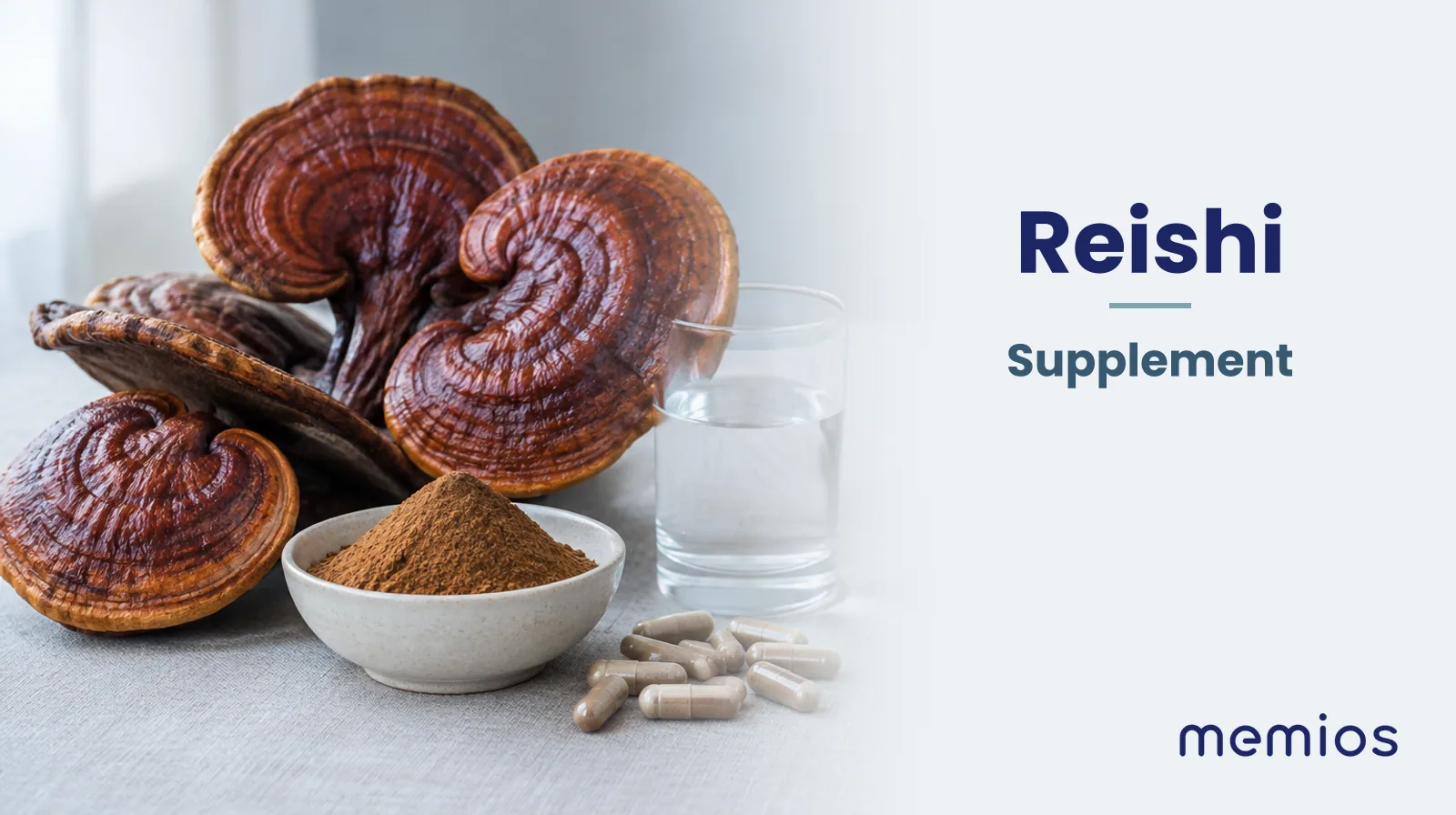
Reishi is a hard, shiny bracket fungus used in East Asian medicine for centuries. The name is taxonomically unreliable: DNA sequencing of commercial products found that none of twenty manufactured reishi products actually contained Ganoderma lucidum in the strict sense, most contained the related Asian species Ganoderma lingzhi, and other Ganoderma species were present as well. Microscopy of those same products showed they were made from different tissues, some from mature fruiting bodies, some from immature fruiting bodies, some from culture mycelium and some from spores alone.
What the research says
Reishi is sold for immunity, cancer support, sleep, blood sugar and cholesterol. A Cochrane review of reishi in cancer found five randomised trials, judged their methodological quality unsatisfying, and concluded there was not enough evidence to justify reishi as a first-line cancer treatment, although some immune-cell percentages rose modestly. A separate Cochrane review on cardiovascular risk factors concluded reishi was not effective for blood glucose, blood pressure or cholesterol, and the largest single trial in type 2 diabetes and metabolic syndrome found no effect on any outcome. On safety, most trials show no liver enzyme change, but published case reports from several countries describe hepatitis attributed to reishi including a fatal case, and the NIH LiverTox monograph classifies it as a possible rare cause of clinically apparent liver injury.
Evidence grade: Limited evidence.
What goes wrong
In that cardiovascular review, people taking reishi were 1.67 times more likely to report an adverse event than those on placebo, although the events were not serious. (Source 1)
- Systematic review, Low certainty.
- Size: one study within the review; 398 participants across 5 trials.
- Who: adults taking reishi for four months.
- How long: four months.
- Result: 1.67 times more likely to experience an adverse event than placebo; nausea, diarrhoea or constipation.
- Funding: Cochrane review.
Participants who took G lucidum for four months were 1.67 times more likely to experience an adverse event than those who took placebo but these were not serious side effects.
Clinically apparent liver injury attributed to reishi has been reported from China, Japan, Thailand and India, ranging from mild enzyme rises to hepatic failure. (Source 2)
- Case series, Low certainty.
- Size: a small number of published case reports across four countries.
- Who: people taking lingzhi or reishi or their extracts.
- How long: latency typically 1 to 2 months, ranging from a few days to 6 months.
- Result: hepatocellular injury; severity from asymptomatic aminotransferase elevations to severe hepatitis with hepatic failure; recovery usually complete within 1 to 3 months after stopping.
- Funding: government body (NIH LiverTox), last updated 5 October 2024.
Nevertheless, there have been a small number of reports from China, Japan, Thailand, and India of clinically apparent liver injury attributed to Lingzhi or Reishi or their extracts. The latency to onset was typically 1 to 2 months, but ranged from a few days to as long as 6 months, presenting with symptoms of fatigue, nausea, abdominal pain, poor appetite, dark urine, and jaundice.
LiverTox rates reishi as a possible rare cause of clinically apparent liver injury, while noting many of the published cases were poorly documented. (Source 2)
- Official position, Low certainty.
- Size: not applicable.
- Who: people taking Ganoderma products worldwide.
- How long: not applicable.
- Result: likelihood score D; in some cases other causes of liver injury such as gallstones, paracetamol overdose, other herbal products or contaminants were not excluded.
- Funding: government body (NIH)
Many of the cases were poorly documented and the attribution to Ganoderma species somewhat weak. In some cases, other common causes of liver injury were not excluded (such as gallstones, acetaminophen overdose, exposure to other herbal products, contaminants of the herbal product). In view of the extensive worldwide use of Ganoderma lucidum and Lingzhi, clinically apparent liver injury from its use must be extremely rare.
DNA sequencing of commercial reishi products found that 86% of products labelled Ganoderma lucidum contained a substituted species. (Source 3)
- Survey study, Low certainty.
- Size: 20 manufactured products and 17 grow-your-own kits, 36 of which were labelled as containing G. lucidum.
- Who: commercially available reishi products.
- How long: not applicable.
- Result: 86% included a product substitution; no manufactured product contained Ganoderma lucidum in the strict sense; other species detected included G. applanatum, G. australe, G. gibbosum, G. sessile and G. sinense.
- Funding: not stated.
we found that 86% of them included a product substitution.
What the evidence supports
Pooled immune-cell percentages rose by around 2 to 4 percentage points in reishi groups compared with controls, which is a laboratory marker rather than a health outcome. (Source 4)
- Meta-analysis, Very low certainty.
- Size: 5 randomised trials, participant total not stated in the abstract.
- Who: cancer patients receiving reishi, in several cases alongside chemotherapy or radiotherapy.
- How long: not stated.
- Result: CD3 +3.91% (95% CI 1.92% to 5.90%, P < 0.01), CD4 +3.05% (95% CI 1.00% to 5.11%, P < 0.01), CD8 +2.02% (95% CI 0.21% to 3.84%, P = 0.03)
- Funding: not stated.
The results for host immune function indicators suggested that G. lucidum simultaneously increases the percentage of CD3, CD4 and CD8 by 3.91% (95% CI 1.92% to 5.90%, P < 0.01), 3.05% (95% CI 1.00% to 5.11%, P < 0.01) and 2.02% (95% CI 0.21% to 3.84%, P = 0.03), respectively.
In controlled trials of reishi, liver enzymes did not change and no jaundice or clinically apparent liver injury was reported. (Source 2)
- Official position, Low certainty.
- Size: multiple small short-term placebo-controlled trials.
- Who: trial participants.
- How long: short term.
- Result: serum aminotransferase levels did not change during treatment; no reported instances of clinically apparent liver injury or jaundice.
- Funding: government body (NIH)
In multiple small, short term placebo-controlled trials of Lingzhi or Reishi, serum aminotransferase levels did not change during treatment, and there were no reported instances of clinically apparent liver injury or jaundice.
In the Cochrane cancer review the only trial that recorded side effects reported nausea and insomnia, with no significant blood or liver toxicity. (Source 4)
- Systematic review, Very low certainty.
- Size: one of five included trials recorded adverse events.
- Who: cancer patients.
- How long: not stated.
- Result: minimal side effects including nausea and insomnia; no significant haematological or hepatological toxicity reported.
- Funding: Cochrane review.
One study recorded minimal side effects, including nausea and insomnia. No significant haematological or hepatological toxicity was reported.
What the evidence does not support
The Cochrane review concluded there is not enough evidence to justify reishi as a first-line cancer treatment. (Source 4)
- Systematic review, Very low certainty.
- Size: 5 randomised controlled trials.
- Who: cancer patients.
- How long: not stated.
- Result: uncertain whether reishi prolongs long-term cancer survival.
- Funding: Cochrane review.
Our review did not find sufficient evidence to justify the use of G. lucidum as a first-line treatment for cancer.
A separate Cochrane review concluded that reishi was not an effective treatment for blood glucose, blood pressure or cholesterol. (Source 1)
- Systematic review, Low certainty.
- Size: 5 trials with 398 participants, of which 3 trials with 157 participants provided usable data.
- Who: adults with cardiovascular risk factors.
- How long: up to four months in the trial reporting adverse events.
- Result: no statistically significant differences between groups for blood pressure or triglycerides.
- Funding: Cochrane review, 2015.
G lucidum was not an effective treatment for reducing blood glucose, blood pressure, or cholesterol.
In an 84-person, 16-week randomised trial in type 2 diabetes and metabolic syndrome, 3 g a day of reishi had no effect on any primary or secondary outcome. (Source 5)
- Randomized trial, Moderate certainty.
- Size: 84 participants randomised to three groups.
- Who: adults with type 2 diabetes mellitus and metabolic syndrome.
- How long: 16 weeks.
- Result: HbA1c difference 0.13%, 95% CI [-0.35, 0.60], p = 0.60; fasting plasma glucose 0.03 mmol/L, 95% CI [-0.90, 0.96], p = 0.95; no overall increased risk of adverse events.
- Funding: not stated in the abstract.
The combined intervention had no effect on any of the primary (baseline-adjusted difference in means: HbA1c = 0.13%, 95% CI [−0.35, 0.60], p = 0.60; FPG = 0.03 mmol/L, 95% CI [−0.90, 0.96], p = 0.95) or secondary outcome measures over the course of the 16-week trial, and no overall increased risk of adverse events with either active treatment.
The authors of that trial stated their results do not support using reishi for cardiovascular risk factors in people with diabetes or metabolic syndrome. (Source 5)
- Randomized trial, Moderate certainty.
- Size: 84 participants.
- Who: adults with type 2 diabetes and metabolic syndrome.
- How long: 16 weeks.
- Result: null across primary and secondary outcomes.
- Funding: not stated in the abstract.
Evidence from this randomised clinical trial does not support the use of Ganoderma lucidum for treatment of cardiovascular risk factors in people with diabetes mellitus or metabolic syndrome.
Where the evidence is mixed
A Cochrane review found only five randomised trials of reishi in cancer and judged their methodological quality unsatisfying. (Source 4)
- Systematic review, Very low certainty.
- Size: 5 randomised controlled trials.
- Who: patients with pathologically diagnosed cancer of any type and stage.
- How long: varied; no trial recorded long-term survival.
- Result: no trial had recorded long-term survival rates; additional information was not available from the primary trialists.
- Funding: Cochrane review; trial funding not stated in the abstract.
The methodological quality of primary studies was generally unsatisfying and the results were reported inadequately in many aspects.
The Cochrane cancer review reported a tumour response estimate for reishi added to chemotherapy or radiotherapy whose printed confidence interval includes no effect, so it does not establish a benefit. (Source 4)
- Meta-analysis, Very low certainty.
- Size: 5 randomised trials.
- Who: cancer patients given reishi alongside chemotherapy or radiotherapy.
- How long: not stated.
- Result: RR 1.50; 95% CI 0.90 to 2.51, P = 0.02 as printed in the review.
- Funding: not stated.
Limit of this finding: As printed, this result contradicts itself. The confidence interval (0.90 to 2.51) includes 1.0, which means no difference, and an interval like that cannot go with P = 0.02. One of the numbers is likely a typo in the review. Do not read this as proof that reishi improves how tumours respond to treatment. The honest reading is that the result is uncertain, and it comes from five small trials the reviewers themselves rated as poor quality.
The meta-analysis results showed that patients who had been given G. lucidum alongside with chemo/radiotherapy were more likely to respond positively compared to chemo/radiotherapy alone (RR 1.50; 95% CI 0.90 to 2.51, P = 0.02).
Only one of the five trials in the cardiovascular review was judged at low risk of bias. (Source 1)
- Systematic review, Low certainty.
- Size: 5 trials.
- Who: adults with cardiovascular risk factors.
- How long: not stated.
- Result: risk of bias low for one study and unclear for the remaining four.
- Funding: Cochrane review.
Of the five included studies, risk of bias was low for one study and unclear for the remaining four.
Microscopy of the same reishi products showed manufacturers use several different tissues, including culture mycelium and spores, not only fruiting bodies. (Source 3)
- Survey study, Low certainty.
- Size: 20 manufactured reishi products.
- Who: commercial reishi supplements.
- How long: not applicable.
- Result: 35% putatively mature fruiting bodies, 25% immature fruiting bodies, 20% cultures with generative hyphae only, 10% spores only.
- Funding: not stated.
Our microscopic analyses indicated that in addition to species variability, companies are making manufactured reishi products out of various tissue types (e.g., basidiomata, mycelium, spores, etc.).
One in five of the reishi products analysed appeared to be made from culture mycelium rather than mushroom tissue. (Source 3)
- Survey study, Low certainty.
- Size: 20 manufactured products.
- Who: commercial reishi supplements.
- How long: not applicable.
- Result: twenty percent were putatively made with cultures identified by generative hyphae only; ten percent with basidiospores only.
- Funding: not stated.
were putatively made with cultures (generative hyphae only), and ten percent
Where the research disagrees
Whether reishi is worth using alongside cancer treatment
- Jin and colleagues, Cochrane Database of Systematic Reviews, 2016, meta-analysis of five randomised trials the same authors describe as methodologically unsatisfying; the tumour-response estimate behind 'enhancing tumour response' is printed as RR 1.50 with a 95% CI of 0.90 to 2.51, which includes no effect: However, G. lucidum could be administered as an alternative adjunct to conventional treatment in consideration of its potential of enhancing tumour response and stimulating host immunity. (Source 4)
- Jin and colleagues in the same review, on first-line use, same meta-analysis: Our review did not find sufficient evidence to justify the use of G. lucidum as a first-line treatment for cancer. (Source 4)
Whether reishi affects blood sugar and cardiovascular risk
- Klupp and colleagues, Cochrane review, 2015, systematic review of five trials, four at unclear risk of bias: G lucidum was not an effective treatment for reducing blood glucose, blood pressure, or cholesterol. (Source 1)
- Klupp and colleagues, randomised trial, 2016, 84-person double-blind placebo-controlled randomised trial: Evidence from this randomised clinical trial does not support the use of Ganoderma lucidum for treatment of cardiovascular risk factors in people with diabetes mellitus or metabolic syndrome. (Source 5)
How much
- Reference intake: No dietary reference intake exists for reishi. It is a fungus used as a supplement, not a nutrient, and the Cochrane review describes it as a natural medicine widely used and recommended by Asian physicians and naturopaths rather than a substance with an established requirement. (Source 4)
- Upper limit: No tolerable upper intake level or acceptable daily intake was located from any regulator. The NIH LiverTox monograph advises only that clinically apparent liver injury from Ganoderma appears extremely rare, while assigning a likelihood score of D. (Source 2)
- Studied: The 84-person metabolic syndrome trial gave 3 g a day of Ganoderma lucidum, with or without Cordyceps sinensis, for 16 weeks. (Source 5)
- Studied: The Cochrane cardiovascular review pooled trials of up to four months' duration; five trials with 398 participants were included and three trials with 157 participants provided usable data. (Source 1)
A common belief, and what the research shows
The belief: Reishi is a well-studied immune tonic, and the product on the shelf is Ganoderma lucidum.
What the research shows: DNA testing of commercial products found "we found that 86% of them included a product substitution." and microscopy found that "Our microscopic analyses indicated that in addition to species variability, companies are making manufactured reishi products out of various tissue types (e.g., basidiomata, mycelium, spores, etc.)." On the evidence, Cochrane reported that "The methodological quality of primary studies was generally unsatisfying and the results were reported inadequately in many aspects." and the largest cardiovascular trial found "Evidence from this randomised clinical trial does not support the use of Ganoderma lucidum for treatment of cardiovascular risk factors in people with diabetes mellitus or metabolic syndrome."
Questions and answers
What is it?
Reishi (lingzhi) is a hard, woody bracket fungus that has been used in East Asian traditional medicine for a very long time. It is not something the body makes or needs; it is taken as a supplement. (Source 6)
What does it do in the body?
The compounds researchers focus on are its polysaccharides (including beta-glucans) and triterpenes, which a 2024 review describes as its main active ingredients. How much these do in people is uncertain (see goodOrBad). (Source 7)
Is it good or bad for you?
The evidence does not show a clear benefit. A 2025 meta-analysis of 17 randomised trials (971 people) found small changes in a few markers, such as body mass index and heart rate. It found no effect on body fat, blood pressure, blood sugar, cholesterol, inflammation or liver enzymes, and it rated the certainty of the evidence as very low for every outcome. There are also case reports of liver injury (see getRidOf). (Source 8)
How do you get more of it?
Reishi is sold as tea, powder and dietary supplements. These products are made from different parts of the mushroom, mostly the fruit body (the cap). (Source 9)
If it is harmful, what reduces it?
Reishi is not something the body carries or builds up, so there is nothing to reduce. The harm on record is liver injury described in case reports. In one published case, a 47-year-old man developed acute hepatitis after taking reishi powder with alcohol, and his symptoms and blood tests had returned to normal at a two-week follow-up after treatment. (Source 10)
Why might someone be low in it or missing it?
Does not apply. Reishi is not a nutrient or a normal part of the body or the gut, so no one is 'low' in it. It is an optional product people choose to take. (Source 7)
Which whole foods contain it or feed it?
Reishi is not an everyday food. It is a woody mushroom, and it is sold as tea, powder and dietary supplements rather than eaten as a cooked mushroom. (Source 9)
What happens if you do not have it?
Nothing is known to happen. There is no deficiency state, and the trial evidence for benefit in people who do take it is rated very low certainty. (Source 8)
How can you test for it?
No blood or body test for reishi exists, and none would make sense, because it is not a body component. What can be tested is the product: DNA barcoding of the ITS region, checked with a family-tree (phylogenetic) analysis, can confirm which Ganoderma species a supplement contains. (Source 11)
References
- Cochrane Database of Systematic Reviews / cochrane.org evidence summary. Ganoderma lucidum mushroom for the treatment of cardiovascular risk factors. 2015. PMID 25686270, DOI 10.1002/14651858.CD007259.pub2. Read the source
- National Institute of Diabetes and Digestive and Kidney Diseases, National Institutes of Health. Lingzhi, Reishi - LiverTox: Clinical and Research Information on Drug-Induced Liver Injury. 2024. Read the source
- Frontiers in Microbiology. Identifying the "Mushroom of Immortality": Assessing the Ganoderma Species Composition in Commercial Reishi Products. 2018. PMID 30061872, DOI 10.3389/fmicb.2018.01557. Read the source
- Cochrane Database of Systematic Reviews. Ganoderma lucidum (Reishi mushroom) for cancer treatment. 2016. PMID 27045603, DOI 10.1002/14651858.CD007731.pub3. Read the source
- Scientific Reports. A double-blind, randomised, placebo-controlled trial of Ganoderma lucidum for the treatment of cardiovascular risk factors of metabolic syndrome. 2016. PMID 27511742, DOI 10.1038/srep29540. Read the source
- British Journal of Nutrition. Ganoderma lucidum ('Lingzhi'), a Chinese medicinal mushroom: biomarker responses in a controlled human supplementation study. 2004. DOI 10.1079/BJN20041039. Read the source
- Heliyon. Bioactivities and industrial standardization status of Ganoderma lucidum: A comprehensive review. 2024. PMID 39435114, DOI 10.1016/j.heliyon.2024.e36987. Read the source
- Food Science & Nutrition. The Nutritional Significance of Ganoderma lucidum on Human Health: A GRADE-Assessed Systematic Review and Meta-Analysis of Clinical Trials. 2025. PMID 40510787, DOI 10.1002/fsn3.70423. Read the source
- British Journal of Nutrition. Ganoderma lucidum ('Lingzhi'), a Chinese medicinal mushroom: biomarker responses in a controlled human supplementation study. 2004. DOI 10.1079/BJN20041039. Read the source
- Cureus. Ganoderma lingzhi (Reishi Mushroom)-Induced Acute Liver Injury in the Setting of Alcohol Use: A Case Report and Review of the Literature. 2023. DOI 10.7759/cureus.45953. Read the source
- PLOS One. The ITS region provides a reliable DNA barcode for identifying reishi/lingzhi (Ganoderma) from herbal supplements. 2020. DOI 10.1371/journal.pone.0236774. Read the source