Medications · September 30, 2026 · Memios · 21 min read
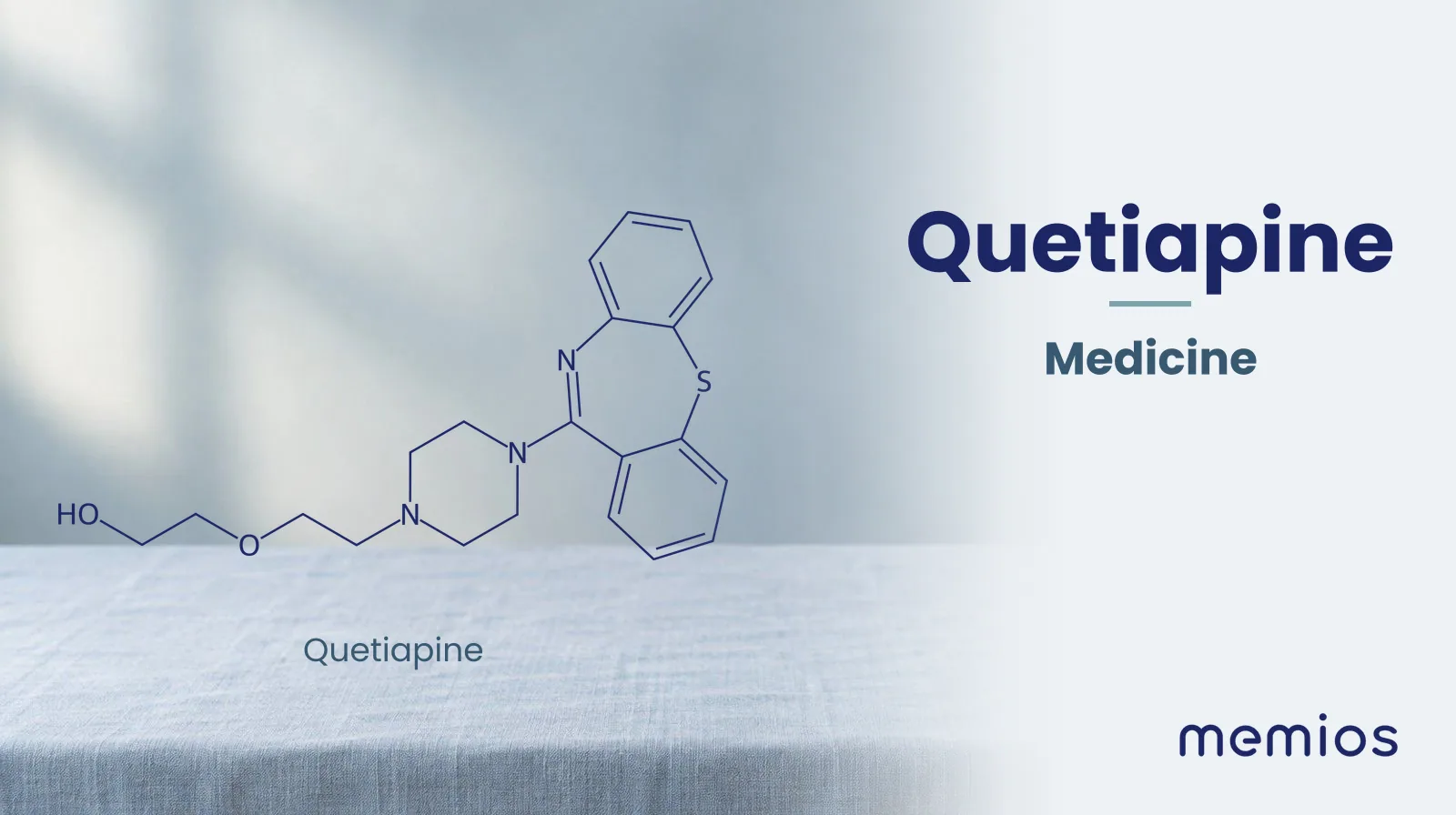
Quetiapine
For the conditions it is approved for, the evidence is real but narrower than the prescribing suggests.
TLDR
- Boxed warning: Quetiapine tablets are not approved for use in pediatric patients under ten years of age [see Use in Specific Populations (8.4)].
- Well established. For the conditions it is approved for, the evidence is real but narrower than the prescribing suggests.
- What it is: Quetiapine is a prescription medicine classed as an atypical, or second-generation, antipsychotic.
- Main use: Schizophrenia (well supported).
- Other approved uses: Depressive episodes of bipolar disorder (well supported); Adjunctive treatment of major depressive disorder (limited evidence); Manic episodes of bipolar I disorder (evidence not rated).
- Off-label uses (not on the FDA label): Other off-label uses documented in practice (agitation, delirium, post-traumatic stress disorder, anxiety) (evidence not rated).
- Uses NOT supported by research: Insomnia.
- Recommended dose (official position): There is no reference intake for quetiapine.
- Studied dose (a trial dose, not a recommendation): The BOLDER bipolar depression trial gave 600 mg/day or 300 mg/day for 8 weeks. Findings citing that trial: 1 for.
- Upper limit: The US label's stated maximum daily doses (revision 1/2024) are 750 mg/day for schizophrenia in adults, 800 mg/day for adolescents with schizophrenia and for adults in bipolar mania, 600 mg/day for children and adolescents in bipolar mania.
- What goes wrong: 5 findings on harm. Almost all antipsychotics, quetiapine among them, produce weight gain with prolonged use, and more so in people who have never taken them before.
- Interactions: 2 recorded, including St John's wort (Hypericum perforatum), Potent CYP3A4 inhibitors (ketoconazole, itraconazole, indinavir, ritonavir, nefazodone).
- Common myth: Low-dose quetiapine is a mild, safe sleeping tablet.
What it is
Quetiapine is a prescription medicine classed as an atypical, or second-generation, antipsychotic. It is a manufactured small molecule taken as immediate-release or extended-release tablets. In the United States the immediate-release tablet label lists approval for schizophrenia, manic episodes of bipolar I disorder, and depressive episodes of bipolar disorder; the extended-release form is also used as an add-on in major depressive disorder. It is very widely prescribed off-label at low doses for sleep and for agitation.
What the research says
For the conditions it is approved for, the evidence is real but narrower than the prescribing suggests. Against older antipsychotic drugs in schizophrenia, a Cochrane review of 43 trials found no significant difference for positive symptoms or global state, with fewer movement side effects. In bipolar depression a large placebo-controlled trial found remission in 52.9% on quetiapine versus 28.4% on placebo. As an add-on in treatment-resistant depression the pooled odds ratio for remission was 1.79 with a number needed to treat of nine, and no meaningful gain in quality of life. For insomnia, the use most people encounter, a 2025 CADTH review found no eligible comparative trials and two guidelines that recommend against it. The harms are not trivial: weight gain, blood pressure and fasting glucose rise on low doses, and stopping abruptly produces discontinuation symptoms in about twice as many people as placebo.
Evidence grade: Well established.
How it works
Drug class: Atypical (second-generation) antipsychotic; dibenzothiazepine
Quetiapine is an atypical, or second-generation, antipsychotic, a class that acts on dopamine and serotonin signalling in the brain. How much drug reaches the bloodstream is controlled by the liver enzyme CYP3A4: the US label instructs that the dose be cut to one sixth when a potent CYP3A4 inhibitor is added, and raised up to five-fold when a potent inducer such as St John's wort is taken for more than a week or two. Its sedating effect is the reason it is used off-label for sleep, and the same drug produces weight gain and rises in glucose and blood pressure. (Source 1)
Boxed warning
WARNING: INCREASED MORTALITY IN ELDERLY PATIENTS WITH DEMENTIA-RELATED PSYCHOSIS; and SUICIDAL THOUGHTS AND BEHAVIORS Increased Mortality in Elderly Patients with Dementia-Related Psychosis Elderly patients with dementia-related psychosis treated with antipsychotic drugs are at an increased risk of death [see Warnings and Precautions (5.1)]. Quetiapine tablets are not approved for the treatment of patients with dementia-related psychosis [see Warnings and Precautions (5.1)]. Suicidal Thoughts and Behaviors Antidepressants increased the risk of suicidal thoughts and behavior in children, adolescents, and young adults in short-term studies. These studies did not show an increase in the risk of suicidal thoughts and behavior with antidepressant use in patients over age 24; there was a reduction in risk with antidepressant use in patients aged 65 and older [see Warnings and Precautions (5.2)]. In patients of all ages who are started on antidepressant therapy, monitor closely for worsening, and for emergence of suicidal thoughts and behaviors. Advise families and caregivers of the need for close observation and communication with the prescriber [see Warnings and Precautions (5.2)]. Quetiapine tablets are not approved for use in pediatric patients under ten years of age [see Use in Specific Populations (8.4)].
(Source 2)
What it is used for
- Quetiapine is an established treatment, but a Cochrane review of 43 trials in 7,217 people found it no better than older (typical) antipsychotics for positive symptoms or global state. Its advantage over the older drugs is fewer movement side effects, less prolactin rise and less weight gain than some of them. Evidence: established. (Source 3)
- In an 8-week placebo-controlled trial of 542 outpatients, 57.6-58.2% of those on quetiapine met response criteria versus 36.1% on placebo, and 52.9% met remission criteria versus 28.4% on placebo. Evidence: established. (Source 4)
- A meta-analysis of 14 short-term placebo-controlled trials of add-on antipsychotics found quetiapine improved remission (odds ratio 1.79, number needed to treat nine) but produced no meaningful improvement in functioning or quality of life, alongside sedation and abnormal metabolic laboratory results. Evidence: limited. (Source 5)
- This is an approved indication on the US label, but this research batch did not retrieve the mania trials, so no effect size is stated here. The approval is recorded as a regulatory position dated 1/2024, not as evidence. Evidence: unknown. (Source 2)
- A 2025 CADTH review found no studies comparing quetiapine with other drugs for insomnia that met its inclusion criteria, and two guidelines (the 2023 European Insomnia Guideline and the 2025 VA/DoD guideline) recommend against antipsychotics for insomnia. The only randomised trial found by an earlier review was in 13 people and showed nonsignificant trends. Evidence: not-supported. (Source 6)
- The CADTH review records that off-label use of quetiapine has been documented for several conditions including agitation, delirium and post-traumatic stress disorder. This batch did not research those uses, so no effect is stated for them. Evidence: unknown. (Source 6)
Interactions
- St John's wort (Hypericum perforatum) (label): St John's wort is a potent inducer of the liver enzyme CYP3A4, which breaks quetiapine down. Taken together for more than a week or two it can push quetiapine blood levels down far enough that the label instructs prescribers to raise the dose up to five-fold, and stopping the St John's wort then leaves the dose too high. (Source 1)
- Potent CYP3A4 inhibitors (ketoconazole, itraconazole, indinavir, ritonavir, nefazodone) (label): These drugs block the enzyme that clears quetiapine, so blood levels rise sharply. The label instructs that the quetiapine dose be cut to one sixth while they are taken, and raised six-fold again when they are stopped. (Source 1)
Stopping it
- Abrupt stopping produces a measurable discontinuation syndrome. In pooled short-term trials with a discontinuation phase, 12.1% of people stopping quetiapine extended-release abruptly had one or more discontinuation symptoms (insomnia, nausea, headache, diarrhoea, vomiting, dizziness, irritability) versus 6.7% on placebo. No single symptom exceeded 5.3% and symptoms usually settled within a week. The label advises gradual withdrawal. (Source 7)
- For antipsychotics as a class, a 2021 Schizophrenia Bulletin paper argues that the act of stopping can itself bring on relapse through adaptations that persist after the drug is gone, and proposes tapering over months or years in ever-smaller steps rather than fixed decrements. The authors state explicitly that the proposal has not yet been tested in randomised trials. (Source 8)
What goes wrong
Low-dose quetiapine used long term was followed by significant rises in weight, blood pressure, BMI and fasting glucose. (Source 9)
- Cohort study, Low certainty.
- Size: 403 veterans.
- Who: Veterans taking low-dose quetiapine, average daily dose 116.8 mg.
- How long: Average 44 months.
- Result: Systolic BP +1.95 mm Hg (P = .036), diastolic BP +1.97 mm Hg (P = .001), BMI +0.52 kg/m2 (P = .001), weight +1.88 kg (P = .002), fasting glucose +6.71 mg/dL (P = .002). This is an observational before-and-after comparison, so it shows association, not proof of cause.
- Funding: not stated.
Statistically significant increases were found in systolic blood pressure (1.95 mm Hg, P = .036), diastolic blood pressure (1.97 mm Hg, P = .001), BMI (0.52 kg/m2, P = .001), weight (1.88 kg, P = .002), and fasting blood glucose (6.71 mg/dL, P = .002).
Almost all antipsychotics, quetiapine among them, produce weight gain with prolonged use, and more so in people who have never taken them before. (Source 10)
- Meta-analysis, Moderate certainty.
- Size: 307 articles met inclusion criteria.
- Who: Patients in clinical trials of antipsychotics, stratified by duration of use.
- How long: Stratified: up to 6 weeks, 6-16 weeks, 16-38 weeks, over 38 weeks.
- Result: Weight gain for almost all antipsychotics after prolonged use, with amisulpride, aripiprazole and ziprasidone the exceptions; weight gain much more pronounced in antipsychotic-naive patients.
- Funding: not stated.
Almost all AP showed a degree of weight gain after prolonged use, except for amisulpride, aripiprazole and ziprasidone, for which prolonged exposure resulted in negligible weight change.
Abrupt cessation of quetiapine extended-release produced discontinuation symptoms in about twice as many people as placebo. (Source 7)
- Official position, Moderate certainty.
- Size: 1,993 on quetiapine extended-release and 1,065 on placebo, pooled across short-term monotherapy trials.
- Who: Participants in short-term placebo-controlled monotherapy trials with a discontinuation phase.
- How long: Symptoms usually resolved within about a week of stopping.
- Result: One or more discontinuation symptoms in 12.1% (241/1993) on quetiapine extended-release versus 6.7% (71/1065) on placebo, an absolute difference of 5.4 percentage points; no individual symptom exceeded 5.3% in any group.
- Funding: not stated (data pooled by the manufacturer and reported in the FDA label, revision 1/2024)
the aggregated incidence of patients experiencing one or more discontinuation symptoms after abrupt cessation was 12.1% (241/1993) for quetiapine extended-release tablets and 6.7% (71/1065) for placebo
Quetiapine is misused as a drug of abuse, with tolerance, withdrawal and self-dosing described in the literature. (Source 11)
- Expert review, not systematic, Very low certainty.
- Size: 254 inmate patients prescribed quetiapine in one correctional system; case reports from the wider literature.
- Who: Prisoners and psychiatric patients.
- How long: Not applicable.
- Result: No rates are given; the report describes feigning of symptoms, diversion, theft, sale, and intranasal and intravenous misuse.
- Funding: not stated.
tolerance, withdrawal, and self-dosing in users; combination with illicit substances to achieve a hallucinatory effect
The US label carries a boxed warning that antipsychotics increase the risk of death in elderly people with dementia-related psychosis. (Source 2)
- Official position, Certainty not rated.
- Size: Not stated in this label's boxed warning.
- Who: Elderly patients with dementia-related psychosis.
- How long: Not stated.
- Result: The warning states an increased risk of death without giving numbers; quetiapine is not approved for this population.
- Funding: Not applicable (regulatory position, label revision 1/2024)
Elderly patients with dementia-related psychosis treated with antipsychotic drugs are at an increased risk of death
What the evidence supports
Quetiapine caused fewer extrapyramidal (movement) effects than older antipsychotic drugs. (Source 12)
- Systematic review, Moderate certainty.
- Size: 1,095 participants across 8 randomised controlled trials.
- Who: People with schizophrenia.
- How long: Short-term trials.
- Result: Overall extrapyramidal effects RR 0.17 (CI 0.09 to 0.32); prolactin MD -16.20 (CI -23.34 to -9.07); weight gain RR 0.52 (CI 0.34 to 0.80)
- Funding: not stated.
fewer overall extrapyramidal effects (8 RCTs, n = 1,095, RR 0.17 CI 0.09 to 0.32, NNTH 3, CI 3 to 3, moderate quality evidence)
In bipolar I or II depression, quetiapine produced remission in about half of patients versus about a quarter on placebo. (Source 4)
- Randomized trial, Moderate certainty.
- Size: 542 outpatients.
- Who: Outpatients with bipolar I or II depression.
- How long: 8 weeks.
- Result: Remission (MADRS <=12) 52.9% on quetiapine 600 and 300 mg/day versus 28.4% on placebo, an absolute difference of about 24.5 percentage points (about 4 people treated for one extra remission); response 58.2% and 57.6% versus 36.1%. Treatment-emergent mania is reported twice in the paper and the two figures are different statements: the abstract gives 3.2% for the quetiapine groups versus 3.9% for placebo, while the Safety and Tolerability section separately reports 2.2% for the 600 mg/day dose. The 3.2% is the figure quoted here.
- Funding: not stated in the passage we recorded; the BOLDER programme was run by the drug's manufacturer.
Limit of this finding: Two different mania percentages appear in this paper and they are easy to confuse. The 3.2% quoted here is the abstract’s figure for the quetiapine groups against 3.9% on placebo; a separate 2.2% appears later in the paper as the rate for the 600 mg/day dose specifically. The paper does not reconcile the two, so a reader should conclude that mania was uncommon over these 8 weeks and no more common than on placebo, and should not treat 3.2% and 2.2% as the same measure. Eight weeks is also too short to say anything about mania risk over longer treatment.
The proportions of patients meeting remission criteria (Montgomery-Åsberg Depression Rating Scale ≤12) were 52.9% in the groups taking 600 and 300 mg/day of quetiapine versus 28.4% for placebo.
As an add-on to antidepressants in treatment-resistant depression, quetiapine improved remission with a number needed to treat of nine. (Source 5)
- Meta-analysis, Moderate certainty.
- Size: 14 short-term trials of four drugs.
- Who: Adults with major depressive disorder not responding to antidepressant monotherapy.
- How long: 4 to 12 weeks.
- Result: Remission odds ratio 1.79 (95% CI 1.33-2.42), number needed to treat nine; response odds ratio 1.53 (95% CI 1.17-2.0), NNT 10.
- Funding: independent (academic review using manufacturers' registries and FDA New Drug Applications)
All four drugs had statistically significant effects on remission, as follows: aripiprazole (odds ratio [OR], 2.01; 95% CI, 1.48–2.73), OFC (OR, 1.42; 95% CI, 1.01–2.0), quetiapine (OR, 1.79; 95% CI, 1.33–2.42), and risperidone (OR, 2.37; 95% CI, 1.31–4.30). The number needed to treat (NNT) was 19 for OFC and nine for each other drug.
What the evidence does not support
Against older antipsychotic drugs in schizophrenia, quetiapine showed no significant difference in positive symptoms or global state. (Source 3)
- Systematic review, Moderate certainty.
- Size: 7,217 participants across 43 randomised controlled trials (positive symptoms: 22 RCTs, n = 1,934)
- Who: People with schizophrenia, most studies from China.
- How long: Mostly short-term trials; attrition around 36% in both arms.
- Result: PANSS positive subscore MD 0.02 (CI -0.39 to 0.43); global state no clinically significant response RR 0.96 (CI 0.75 to 1.23); leaving early for any reason RR 0.91 (CI 0.81 to 1.01)
- Funding: not stated.
there was no significant difference in positive symptoms (PANSS positive subscore: 22 RCTs, n = 1934, MD 0.02 CI -0.39 to 0.43, moderate quality evidence)
Add-on antipsychotics including quetiapine produced no benefit or a very small benefit on functioning and quality of life. (Source 13)
- Meta-analysis, Moderate certainty.
- Size: 14 short-term trials.
- Who: Adults with treatment-resistant major depressive disorder.
- How long: 4 to 12 weeks.
- Result: Clinician-rated severity Hedges' g 0.26 to 0.48 (mean difference 2.69 MADRS points); functioning and quality of life no benefit or a very small benefit except risperidone (g = 0.49)
- Funding: independent.
On measures of functioning and quality of life, these medications produced either no benefit or a very small benefit, except for risperidone, which had a small-to-moderate effect on quality of life (g = 0.49).
For insomnia, a 2025 evidence review found no eligible comparative trials and two guidelines that recommend against antipsychotics including quetiapine. (Source 6)
- Official position, Low certainty.
- Size: No eligible comparative studies identified; two guidelines reviewed.
- Who: Adults with insomnia.
- How long: Not applicable.
- Result: No pooled effect could be calculated because no eligible comparative study was found.
- Funding: independent (Canadian Agency for Drugs and Technologies in Health)
Both the 2023 European Insomnia Guideline and the 2025 VA/DoD guideline for chronic insomnia disorder recommend against using antipsychotic drugs, including quetiapine, for the treatment of insomnia due to concerns about safety and lack of evidence on clinical benefit.
The only randomised trial of quetiapine in primary insomnia that met an AHRQ review's criteria enrolled 13 people and found nonsignificant trends. (Source 14)
- Expert review, not systematic, Very low certainty.
- Size: 13 patients in the single eligible trial.
- Who: Adults with primary insomnia, Thailand.
- How long: 2 weeks.
- Result: Nonsignificant trends for longer total sleep time and shorter sleep latency on quetiapine 25 mg at night versus placebo.
- Funding: not stated.
Only 1 relevant study met the authors' inclusion criteria: a 2010 study in just 13 patients with primary insomnia conducted in Thailand. In this randomized, double-blinded, placebo-controlled trial, participants received either quetiapine 25 mg or placebo each night for 2 weeks. There were nonsignificant trends for longer total sleep time and shorter sleep latency in the quetiapine group.
Where the research disagrees
Whether quetiapine is better than older antipsychotics for the negative symptoms of schizophrenia
- The pooled result of the Cochrane review, Meta-analysis of 22 randomised trials: quetiapine was statistically significantly more efficacious for negative symptoms (PANSS negative subscore: 22 RCTs, n = 1934, MD -0.82 CI -1.59 to -0.04, moderate quality evidence) (Source 12)
- The same review's own sensitivity analysis, Sensitivity analysis removing two small outlier trials: Without these two studies, there was no heterogeneity and no statistically significant difference between quetiapine and typical antipsychotics. (Source 12)
How much
- Reference intake: There is no reference intake for quetiapine. It is a prescription medicine and the dose is set by the prescriber for the specific condition. The US label (quetiapine fumarate tablets, Camber Pharmaceuticals, revision 1/2024) sets a different range for each approved indication. This is recorded as a regulatory position with its date, not as a recommendation. (Source 2)
- Upper limit: The US label's stated maximum daily doses (revision 1/2024) are 750 mg/day for schizophrenia in adults, 800 mg/day for adolescents with schizophrenia and for adults in bipolar mania, 600 mg/day for children and adolescents in bipolar mania, and 300 mg/day for bipolar depression in adults. This is a regulatory position dated 1/2024, not advice. (Source 2)
- Studied: The BOLDER bipolar depression trial gave 600 mg/day or 300 mg/day for 8 weeks. (Source 4)
- Studied: The only randomised trial in primary insomnia identified by an AHRQ review gave quetiapine 25 mg each night for 2 weeks to 13 people. (Source 14)
- Studied: A cohort of 403 veterans on low-dose quetiapine took an average daily dose of 116.8 mg for an average of 44 months. (Source 9)
A common belief, and what the research shows
The belief: Low-dose quetiapine is a mild, safe sleeping tablet.
What the research shows: The evidence for sleep is close to absent and the harms are documented. A 2025 review found no eligible comparative trials and two guidelines that recommend against it: "Both the 2023 European Insomnia Guideline and the 2025 VA/DoD guideline for chronic insomnia disorder recommend against using antipsychotic drugs, including quetiapine, for the treatment of insomnia due to concerns about safety and lack of evidence on clinical benefit." In 403 veterans on an average of 116.8 mg a day, "Statistically significant increases were found in systolic blood pressure (1.95 mm Hg, P = .036), diastolic blood pressure (1.97 mm Hg, P = .001), BMI (0.52 kg/m2, P = .001), weight (1.88 kg, P = .002), and fasting blood glucose (6.71 mg/dL, P = .002)."
Questions and answers
What is it?
Quetiapine is a prescription antipsychotic medicine, one of the group known as atypical or second-generation antipsychotics. It is taken as a tablet, in immediate-release or extended-release form. Its licensed uses are schizophrenia and the manic and depressive phases of bipolar disorder, with the extended-release form also used as an add-on in major depression. (Source 15)
What does it do in the body?
It dampens dopamine and serotonin signalling in the brain, which is how it reduces psychotic symptoms and lifts depressed mood in bipolar disorder. In a trial of 542 people with bipolar depression, scores on a depression rating scale improved more than placebo from the first week onward. It is also strongly sedating, which is why it makes people sleepy, and it changes appetite and metabolism. (Source 4)
Is it good or bad for you?
It depends entirely on what it is being used for. For schizophrenia and bipolar depression the benefit is measurable and the trials are placebo-controlled. For insomnia, the use it is most often reached for outside its licence, a 2025 review found no eligible comparative trials and concluded against it. So the same drug can be a reasonable treatment in one setting and an unjustified risk in another. (Source 6)
How do you get more of it?
Quetiapine is available only on prescription and the dose is set by a prescriber for a named condition. There is no food or supplement that provides it. Blood levels are not adjusted by the person taking it: the label itself instructs prescribers to change the dose sharply when interacting medicines are added or removed. (Source 1)
If it is harmful, what reduces it?
Stopping is a medical decision, and stopping abruptly carries a documented cost. In pooled trials, 12.1% of people who stopped quetiapine extended-release suddenly had one or more discontinuation symptoms against 6.7% on placebo. The label advises gradual withdrawal, and for antipsychotics generally a 2021 paper argues for tapering over months in ever-smaller steps. (Source 7)
Why might someone be low in it or missing it?
Someone can have a much lower quetiapine level than expected if they are taking something that speeds up its breakdown by the liver enzyme CYP3A4. St John's wort, carbamazepine, phenytoin and rifampin all do this, and the label says the dose may need to be up to five times higher when a potent inducer is taken for more than a week or two. Missed doses and stopping without telling the prescriber are the other common reasons. (Source 1)
Which whole foods contain it or feed it?
None. Quetiapine is a manufactured medicine, not a nutrient, and no whole food contains it or raises it. The question does not apply in the way it does to a vitamin or a gut organism. (Source 15)
What happens if you do not have it?
For someone taking it for schizophrenia or bipolar disorder, coming off it raises the risk that the illness returns. A 2021 review of antipsychotic tapering argues that the act of stopping can itself contribute to relapse, through changes in the brain that persist after the drug has gone. That is a hypothesis the authors say still needs randomised testing, not a settled fact. (Source 8)
How can you test for it?
There is no blood test in routine use that tells you whether a quetiapine dose is right. What is measured instead is the damage it can do: weight, blood pressure, BMI and fasting glucose, all of which rose significantly in a cohort of 403 veterans on low doses. The sources we read do not describe a validated blood-level test used to guide dosing. (Source 9)
References
- DailyMed, US National Library of Medicine (labeler: Camber Pharmaceuticals, Inc.). QUETIAPINE FUMARATE tablet, film coated - CYP3A4 inhibitors and inducers dose adjustment. 2024. Read the source
- DailyMed, US National Library of Medicine (labeler: Camber Pharmaceuticals, Inc.). QUETIAPINE FUMARATE tablet, film coated - boxed warning. 2024. Read the source
- Cochrane Database of Systematic Reviews. Quetiapine versus typical antipsychotic medications for schizophrenia (Cochrane Review) - Main results, efficacy. 2013. DOI 10.1002/14651858.CD007815.pub2. Read the source
- American Journal of Psychiatry. A Randomized, Double-Blind, Placebo-Controlled Trial of Quetiapine in the Treatment of Bipolar I or II Depression (BOLDER study). 2005. PMID 15994719, DOI 10.1176/appi.ajp.162.7.1351. Read the source
- PLOS Medicine. Adjunctive Atypical Antipsychotic Treatment for Major Depressive Disorder: A Meta-Analysis of Depression, Quality of Life, and Safety Outcomes - remission results. 2013. DOI 10.1371/journal.pmed.1001403. Read the source
- Canadian Agency for Drugs and Technologies in Health (CADTH), NCBI Bookshelf. Quetiapine for Insomnia - Conclusions and Implications for Decision- or Policy-Making. 2025. Read the source
- DailyMed, US National Library of Medicine (labeler: Camber Pharmaceuticals, Inc.). QUETIAPINE FUMARATE tablet, film coated - discontinuation syndrome. 2024. Read the source
- Schizophrenia Bulletin. A Method for Tapering Antipsychotic Treatment That May Minimize the Risk of Relapse. 2021. DOI 10.1093/schbul/sbab017. Read the source
- Cleveland Clinic Journal of Medicine. Quetiapine for primary insomnia: Consider the risks - metabolic outcomes on low-dose quetiapine. 2021. DOI 10.3949/ccjm.88a.20031. Read the source
- PLOS ONE. Almost All Antipsychotics Result in Weight Gain: A Meta-Analysis. 2014. DOI 10.1371/journal.pone.0094112. Read the source
- Journal of the American Academy of Psychiatry and the Law. Successful Removal of Quetiapine From a Correctional Formulary. 2012. Read the source
- Cochrane Database of Systematic Reviews. Quetiapine versus typical antipsychotic medications for schizophrenia (Cochrane Review) - Main results, negative symptoms and adverse effects. 2013. DOI 10.1002/14651858.CD007815.pub2. Read the source
- PLOS Medicine. Adjunctive Atypical Antipsychotic Treatment for Major Depressive Disorder: A Meta-Analysis of Depression, Quality of Life, and Safety Outcomes - severity, quality of life and adverse events. 2013. DOI 10.1371/journal.pmed.1001403. Read the source
- Cleveland Clinic Journal of Medicine. Quetiapine for primary insomnia: Consider the risks - randomised evidence. 2021. DOI 10.3949/ccjm.88a.20031. Read the source
- Canadian Agency for Drugs and Technologies in Health (CADTH), NCBI Bookshelf. Quetiapine for Insomnia - Key Messages, what is the issue. 2025. Read the source