Supplements · September 30, 2026 · Memios · 14 min read
Pterostilbene
The most reliable human finding about pterostilbene is an unwanted one: in the only substantial randomised trial of metabolic effects, LDL cholesterol rose by about 17 mg/dL with pterostilbene taken alone.
TLDR
- Limited evidence. The most reliable human finding about pterostilbene is an unwanted one: in the only substantial randomised trial of metabolic effects, LDL cholesterol rose by about 17 mg/dL with pterostilbene taken alone.
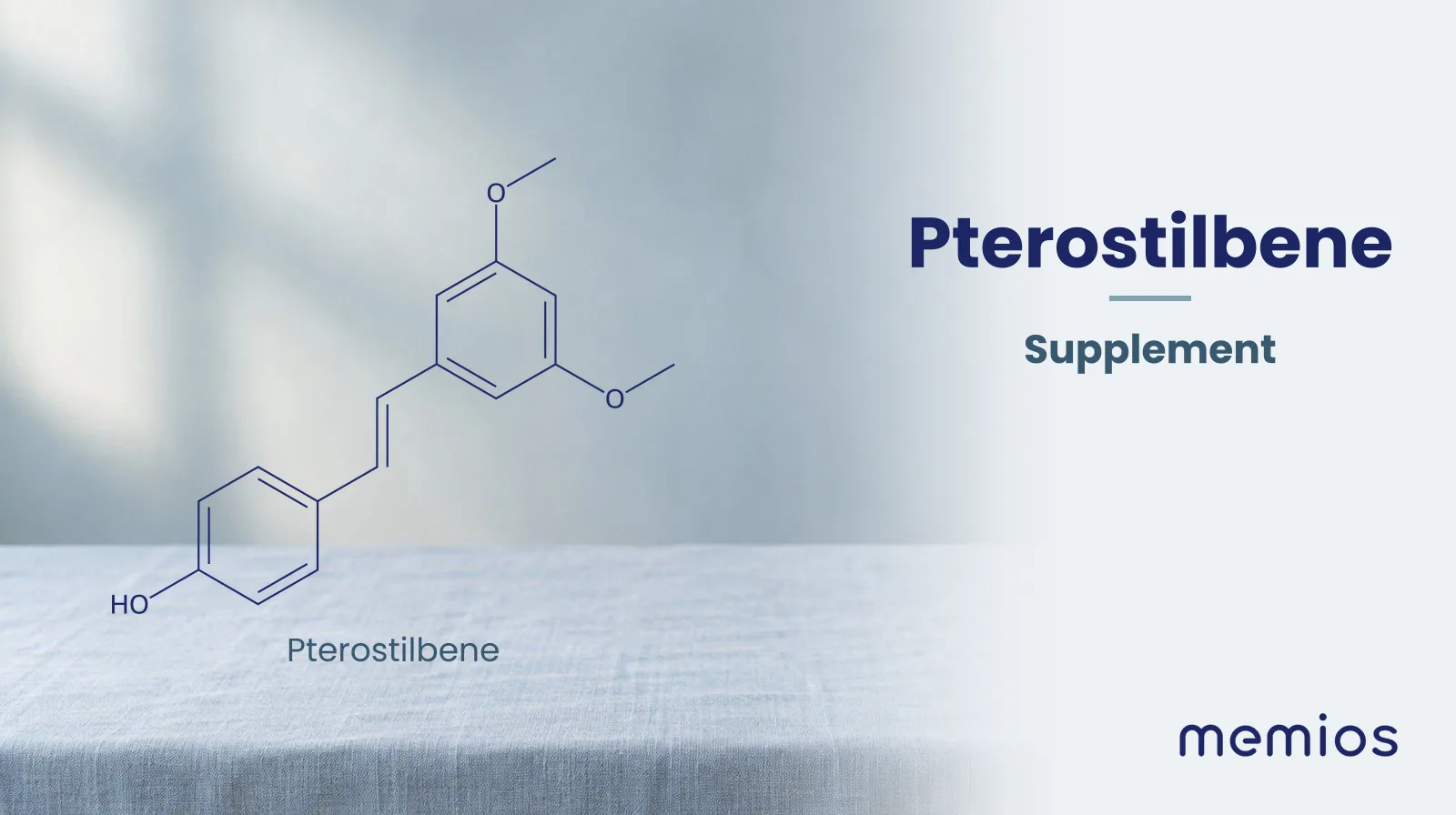
- What it is: Pterostilbene is a stilbene, closely related to resveratrol but with two methoxy groups in place of two hydroxyls.
- Main use, supported: In a randomised placebo-controlled trial, high-dose pterostilbene lowered both systolic and diastolic blood pressure. (low certainty)
- Other use, supported: A formal safety analysis of the same trial found no adverse drug reactions on liver, kidney or glucose markers at up to 250 mg a day. (low certainty)
- Claim NOT supported by research: A six-month randomised trial of nicotinamide riboside plus pterostilbene in fatty liver disease did not change liver fat, its primary endpoint. (moderate certainty)
- Another claim NOT supported: Doubling the nicotinamide riboside and pterostilbene dose in that trial produced no dose-dependent effect on any of the liver markers that improved at the single dose. (moderate certainty)
- Recommended dose: not established. No recommended dietary allowance or adequate intake exists for pterostilbene from any national body. It is not an essential nutrient; it is a plant stilbene found in small amounts in blueberries and grapes and in the heartwood of Pterocarpus marsupium.
- Studied dose (a trial dose, not a recommendation): Pterostilbene 125 mg twice daily, 50 mg twice daily, or 50 mg twice daily with 100 mg grape extract, for 6 to 8 weeks. Findings citing that trial: 1 for, 1 mixed, 1 on harm.
- Upper limit: No tolerable upper intake level or acceptable daily intake has been set by a food safety body.
- What goes wrong: 4 findings on harm. The same trial found that pterostilbene taken on its own raised LDL cholesterol.
- Common myth: Pterostilbene is simply a better-absorbed resveratrol, so it carries the same benefits with none of the drawbacks.
What it is
Pterostilbene is a stilbene, closely related to resveratrol but with two methoxy groups in place of two hydroxyls. It occurs naturally in blueberries, in grapes and in the heartwood of Pterocarpus marsupium. The two methoxy groups make it more lipid-soluble and more slowly metabolised than resveratrol, which is why reviews describe it as having higher oral bioavailability. Supplements use synthetic or extracted pterostilbene, often combined with grape extract or with nicotinamide riboside.
What the research says
The most reliable human finding about pterostilbene is an unwanted one: in the only substantial randomised trial of metabolic effects, LDL cholesterol rose by about 17 mg/dL with pterostilbene taken alone. The same trial found blood pressure fell by roughly 7 to 8 mmHg. A separate safety analysis of that trial found no signal of liver, kidney or glucose toxicity at up to 250 mg a day over six to eight weeks. When combined with nicotinamide riboside in a six-month trial in fatty liver disease, the combination did not change liver fat. There is no meta-analysis of pterostilbene outcome trials, and the trial evidence is industry-funded.
Evidence grade: Limited evidence.
What goes wrong
The same trial found that pterostilbene taken on its own raised LDL cholesterol. (Source 1)
- Randomized trial, Low certainty.
- Size: 80 patients enrolled; 51 not taking cholesterol medication.
- Who: adults with raised cholesterol.
- How long: 6 to 8 weeks.
- Result: LDL rose 17.1 mg/dL with pterostilbene monotherapy (P = 0.001); no rise when combined with grape extract (P = 0.47); being on a cholesterol medication at baseline appeared to attenuate the LDL effect.
- Funding: industry-funded (grant through ChromaDex, Inc.)
LDL increased with pterostilbene monotherapy (17.1 mg/dL; P = 0.001) which was not seen with GE combination (P = 0.47).
No hospitalisations, new-onset disease, infections or deaths were attributed to pterostilbene in that safety analysis. (Source 2)
- Randomized trial, Low certainty.
- Size: 80 subjects.
- Who: adults with hypercholesterolaemia.
- How long: 6 to 8 weeks.
- Result: No major adverse drug reactions and no statistically significant self-reported adverse drug reactions versus placebo; separately, a 3.6% reduction in bicarbonate in the high-dose group versus placebo (P = 0.02), and a 7.1% fall in blood urea nitrogen from baseline in the grape-extract plus low-dose pterostilbene group (P = 0.01) that was not significant against placebo (P = 0.20)
- Funding: industry-funded (ChromaDex, Inc.)
There were no statistically significant self-reported ADRs versus placebo (see Table 2). There were no major ADRs (e.g., hospitalization, new-onset disease, infection, or death).
The same safety analysis did record two blood-chemistry changes: a small fall in bicarbonate on high-dose pterostilbene, and a fall in blood urea nitrogen on the grape-extract combination that was not significant against placebo. (Source 2)
- Randomized trial, Low certainty.
- Size: 80 subjects.
- Who: adults with hypercholesterolaemia.
- How long: 6 to 8 weeks.
- Result: Bicarbonate fell 3.6% in the high-dose group versus placebo (P = 0.02), with a similar trend in both low-dose groups; blood urea nitrogen fell 7.1% from baseline in the grape extract plus low-dose pterostilbene group (P = 0.01) but was not significant versus placebo (P = 0.20); no other significant effects on electrolyte markers.
- Funding: industry-funded (ChromaDex, Inc.)
Limit of this finding: Both of these are small changes in routine blood chemistry, not symptoms, and the bicarbonate fall was measured against placebo while the blood urea nitrogen fall was measured only against each person's own starting value. Against placebo the blood urea nitrogen change was not significant. Neither finding shows organ damage, and neither should be read as one.
There was a significant 3.6% reduction in bicarbonate in the high-dose group versus placebo (P = 0.02) with a similar trend in both low-dose groups. The combination of grape extract and low-dose pterostilbene decreased BUN by 7.1% from baseline (P = 0.01), but this reduction was not significant when compared to placebo (P = 0.20).
In that trial adverse events were reported by a substantial minority of participants, with no excess in the treatment groups. (Source 3)
- Randomized trial, Low certainty.
- Size: 66 adverse events reported by 45 participants.
- Who: healthy older adults.
- How long: 8 weeks.
- Result: 66 adverse events reported by 45 participants: 18 by 13 participants on placebo, 25 by 15 participants at the recommended dose and 23 by 17 participants at the double dose; there were no significant differences in the incidence of adverse events among groups.
- Funding: industry-linked (Elysium Health supplied product and placebo)
A total of 66 adverse events (AEs) were reported by 45 participants (Table S2).
What the evidence supports
In a randomised placebo-controlled trial, high-dose pterostilbene lowered both systolic and diastolic blood pressure. (Source 1)
- Randomized trial, Low certainty.
- Size: 80 patients enrolled across four arms.
- Who: adults with total cholesterol at or above 200 mg/dL and/or LDL at or above 100 mg/dL; mean age 54 years, 71% female, 70% Caucasian.
- How long: 6 to 8 weeks.
- Result: Systolic blood pressure -7.8 mmHg (P < 0.01) and diastolic blood pressure -7.3 mmHg (P < 0.001) with high dose pterostilbene (125 mg twice daily)
- Funding: industry-funded (grant through ChromaDex, Inc.)
Both systolic (-7.8 mmHg; P < 0.01) and diastolic blood pressure (-7.3 mmHg; P < 0.001) were reduced with high dose pterostilbene.
A formal safety analysis of the same trial found no adverse drug reactions on liver, kidney or glucose markers at up to 250 mg a day. (Source 4)
- Randomized trial, Low certainty.
- Size: 80 subjects, 91.3% completed.
- Who: adults with hypercholesterolaemia, average age 54, 71% female, 70% Caucasian.
- How long: 6 to 8 weeks.
- Result: No biochemical adverse drug reactions on hepatic, renal or glucose markers; no statistically significant self-reported adverse drug reactions versus placebo; a significant 3.6% reduction in bicarbonate in the high-dose group versus placebo.
- Funding: industry-funded (This trial was supported by a grant through ChromaDex, Inc.)
There were no adverse drug reactions (ADRs) on hepatic, renal, or glucose markers based on biochemical analysis.
In healthy adults, nicotinamide riboside combined with pterostilbene raised blood NAD+ levels dose-dependently. (Source 5)
- Randomized trial, Low certainty.
- Size: 120 participants reported in the trial.
- Who: healthy adults aged 60 to 80.
- How long: 8 weeks.
- Result: NAD+ rose by approximately 40% at the recommended dose (250 mg nicotinamide riboside plus 50 mg pterostilbene) and approximately 90% at double dose after 4 weeks versus placebo and baseline.
- Funding: industry-linked: the investigational product and matched placebo were provided by Elysium Health.
Analysis of NAD+ in whole blood demonstrated that NRPT significantly increases the concentration of NAD+ in a dose-dependent manner. NAD+ levels increased by approximately 40% in the NRPT 1X group and approximately 90% in the NRPT 2X group after 4 weeks as compared to placebo and baseline.
What the evidence does not support
A six-month randomised trial of nicotinamide riboside plus pterostilbene in fatty liver disease did not change liver fat, its primary endpoint, and the doubled dose produced no dose-dependent benefit on any of the secondary liver markers. (Source 6)
- Randomized trial, Moderate certainty.
- Size: 111 adults with NAFLD across three arms.
- Who: adults with non-alcoholic fatty liver disease.
- How long: 6 months.
- Result: No significant change in hepatic fat fraction versus placebo. Among prespecified secondary outcomes ALT and GGT fell significantly versus placebo in the single-dose group only, and a dose-dependent effect was not observed for ALT, GGT or ceramide 14:0 in the double-dose group.
- Funding: product supplied by the commercial sponsor of the NRPT combination.
At the end of the study, no significant change was seen in the primary endpoint of hepatic fat fraction with respect to placebo.
Doubling the nicotinamide riboside and pterostilbene dose in that trial produced no dose-dependent effect on any of the liver markers that improved at the single dose. (Source 6)
- Randomized trial, Moderate certainty.
- Size: 111 adults with NAFLD across three arms.
- Who: adults with non-alcoholic fatty liver disease.
- How long: 6 months.
- Result: No dose-dependent effect on alanine aminotransferase, gamma-glutamyltransferase or ceramide 14:0 in the double-dose (NRPT 2x) group.
- Funding: product supplied by the commercial sponsor of the NRPT combination.
A dose-dependent effect was not observed with respect to ALT, GGT, or ceramide 14:0 in the NRPT 2× group.
A 2024 review concluded that pterostilbene's safety and efficacy are not yet established in clinical populations. (Source 7)
- Expert review, not systematic, Very low certainty.
- Size: not applicable; narrative review of laboratory, animal and early clinical work.
- Who: not applicable.
- How long: not applicable.
- Result: The review reports anti-inflammatory, antioxidant and antitumour activity in laboratory studies and favourable pharmacokinetics, but states larger clinical trials are still needed.
- Funding: not stated in the text retrieved.
However, more extensive clinical trials are imperative to establish its safety and efficacy in diverse patient populations.
Where the evidence is mixed
The trial investigators' own conclusion was that pterostilbene both raises LDL and lowers blood pressure. (Source 1)
- Randomized trial, Low certainty.
- Size: 80 patients.
- Who: adults with hypercholesterolaemia.
- How long: 6 to 8 weeks.
- Result: LDL +17.1 mg/dL with monotherapy; systolic -7.8 mmHg and diastolic -7.3 mmHg at the high dose; minor weight change of -0.62 kg/m2 (P = 0.012) in those not on cholesterol medication.
- Funding: industry-funded (grant through ChromaDex, Inc.)
Pterostilbene increases LDL and reduces blood pressure in adults.
Where the research disagrees
Whether pterostilbene is good for cardiovascular risk
- The randomised metabolic trial's authors, on blood pressure, randomised, double-blind, placebo-controlled trial, 80 patients, 6 to 8 weeks, industry-funded: Both systolic (-7.8 mmHg; P < 0.01) and diastolic blood pressure (-7.3 mmHg; P < 0.001) were reduced with high dose pterostilbene. (Source 1)
- The same trial, on LDL cholesterol, same randomised trial, same participants: LDL increased with pterostilbene monotherapy (17.1 mg/dL; P = 0.001) which was not seen with GE combination (P = 0.47). (Source 1)
How much
- Reference intake: No recommended dietary allowance or adequate intake exists for pterostilbene from any national body. It is not an essential nutrient; it is a plant stilbene found in small amounts in blueberries and grapes and in the heartwood of Pterocarpus marsupium. (Source 8)
- Upper limit: No tolerable upper intake level or acceptable daily intake has been set by a food safety body. The only quantitative human ceiling in the literature is the trial investigators' own statement that pterostilbene is generally safe for use in humans up to 250 mg a day over six to eight weeks, and that trial also recorded a rise in LDL cholesterol at that dose. (Source 4)
- Studied: Pterostilbene 125 mg twice daily, 50 mg twice daily, or 50 mg twice daily with 100 mg grape extract, for 6 to 8 weeks (Source 1)
- Studied: 50 mg or 100 mg pterostilbene daily combined with 250 mg or 500 mg nicotinamide riboside for 8 weeks (Source 5)
- Studied: Nicotinamide riboside plus pterostilbene at recommended and double daily dose for 6 months in adults with fatty liver disease (Source 6)
A common belief, and what the research shows
The belief: Pterostilbene is simply a better-absorbed resveratrol, so it carries the same benefits with none of the drawbacks.
What the research shows: Better absorption is documented: reviews describe that "Compared to other stilbene compounds, pterostilbene boasts higher bioavailability, potentially amplifying its nutritional advantages". But the best human outcome data show a specific drawback that resveratrol is not known for: "LDL increased with pterostilbene monotherapy (17.1 mg/dL; P = 0.001) which was not seen with GE combination (P = 0.47)." The trial investigators summarised it as "Pterostilbene increases LDL and reduces blood pressure in adults." There is no meta-analysis of pterostilbene outcome trials, and a review published in 2024 still said "more extensive clinical trials are imperative to establish its safety and efficacy in diverse patient populations."
Questions and answers
What is it?
Pterostilbene is a plant compound in the stilbene family and a close chemical relative of resveratrol. Two of resveratrol's hydroxyl groups are replaced by methoxy groups, which makes pterostilbene more fat-soluble and slower to be cleared. It is sold as a synthetic or extracted supplement ingredient. (Source 7)
What does it do in the body?
In laboratory studies pterostilbene has anti-inflammatory, antioxidant and antitumour activity, acting on signalling pathways such as NF-kB and PI3K/Akt. In people, what has actually been measured is narrower: a fall in blood pressure, a rise in LDL cholesterol, a rise in blood NAD+ when combined with nicotinamide riboside, and no change in liver fat in fatty liver disease. (Source 7)
Is it good or bad for you?
It is both, in the same trial. At 250 mg a day for six to eight weeks pterostilbene lowered blood pressure by around 7 to 8 mmHg but raised LDL cholesterol by about 17 mg/dL when taken on its own. Liver, kidney and glucose markers were unaffected. That mix means the net effect on cardiovascular risk is genuinely unresolved. (Source 1)
How do you get more of it?
Small amounts come from blueberries and grapes. Trials have used supplements rather than food: 125 mg twice daily, 50 mg twice daily, or 50 mg twice daily combined with 100 mg grape extract, for six to eight weeks. Other trials combined 50 to 100 mg daily with nicotinamide riboside. (Source 1)
If it is harmful, what reduces it?
The identified harm is the rise in LDL cholesterol, and the trial itself showed this was specific to pterostilbene taken alone: it did not occur when pterostilbene was combined with grape extract, and it appeared to be blunted in people already on a cholesterol medicine. Pterostilbene is cleared from the body, so stopping the supplement removes the exposure. (Source 1)
Why might someone be low in it or missing it?
Pterostilbene is not something the body needs or makes, so nobody is deficient in it. Ordinary dietary intake is low because it occurs in only a few foods and in small quantities, mainly blueberries, with grapes and the heartwood of Pterocarpus marsupium as the other described sources. (Source 8)
Which whole foods contain it or feed it?
Blueberries are the main food source, with grapes also described. The compound was first identified in the heartwood of sandalwood and in Pterocarpus marsupium, which is not a food. Food amounts are far below the doses used in trials. (Source 8)
What happens if you do not have it?
Nothing is known to happen. Pterostilbene is not an essential nutrient, no deficiency state has been described, and no trial has studied withholding it. Reviews still call for larger clinical trials before even its benefits and safety can be characterised, let alone any consequence of absence. (Source 7)
We searched: Searched for pterostilbene deficiency, requirement and absence outcomes via WebSearch and Europe PMC; the human literature is limited to short supplementation trials and no deficiency state is described.
How can you test for it?
There is no clinical test for pterostilbene status and none would be meaningful, since it is not an essential nutrient. Pharmacokinetic studies measure pterostilbene and its metabolites in plasma after a dose; reviews report rapid absorption and high oral bioavailability. That is a research measurement of a recent dose, not a test of anything about you. (Source 9)
We searched: Searched for pterostilbene blood test, biomarker and clinical assay via WebSearch and the review literature; only pharmacokinetic plasma measurement in research settings was found.
References
- Evidence-Based Complementary and Alternative Medicine. Pterostilbene on metabolic parameters: a randomized, double-blind, and placebo-controlled trial. 2014. PMID 25057276, DOI 10.1155/2014/459165. Read the source
- Journal of Toxicology. Analysis of Safety from a Human Clinical Trial with Pterostilbene (adverse drug reactions passage). 2013. PMID 23431291, DOI 10.1155/2013/463595. Read the source
- npj Aging and Mechanisms of Disease. Repeat dose NRPT (nicotinamide riboside and pterostilbene) increases NAD+ levels in humans safely and sustainably: a randomized, double-blind, placebo-controlled study (adverse events). 2017. DOI 10.1038/s41514-017-0016-9. Read the source
- Journal of Toxicology. Analysis of Safety from a Human Clinical Trial with Pterostilbene (abstract). 2013. PMID 23431291, DOI 10.1155/2013/463595. Read the source
- npj Aging and Mechanisms of Disease. Repeat dose NRPT (nicotinamide riboside and pterostilbene) increases NAD+ levels in humans safely and sustainably: a randomized, double-blind, placebo-controlled study (results). 2017. DOI 10.1038/s41514-017-0016-9. Read the source
- Hepatology. Nicotinamide riboside and pterostilbene reduces markers of hepatic inflammation in NAFLD: A double-blind, placebo-controlled clinical trial. 2023. PMID 36082508, DOI 10.1002/hep.32778. Read the source
- Frontiers in Pharmacology. Pterostilbene in the treatment of inflammatory and oncological diseases (abstract). 2024. DOI 10.3389/fphar.2023.1323377. Read the source
- Frontiers in Pharmacology. Pterostilbene in the treatment of inflammatory and oncological diseases (chemical identity and natural sources). 2024. DOI 10.3389/fphar.2023.1323377. Read the source
- Frontiers in Pharmacology. Pterostilbene in the treatment of inflammatory and oncological diseases (section 'Absorption of pterostilbene'). 2024. DOI 10.3389/fphar.2023.1323377. Read the source