Medications · September 30, 2026 · Memios · 17 min read
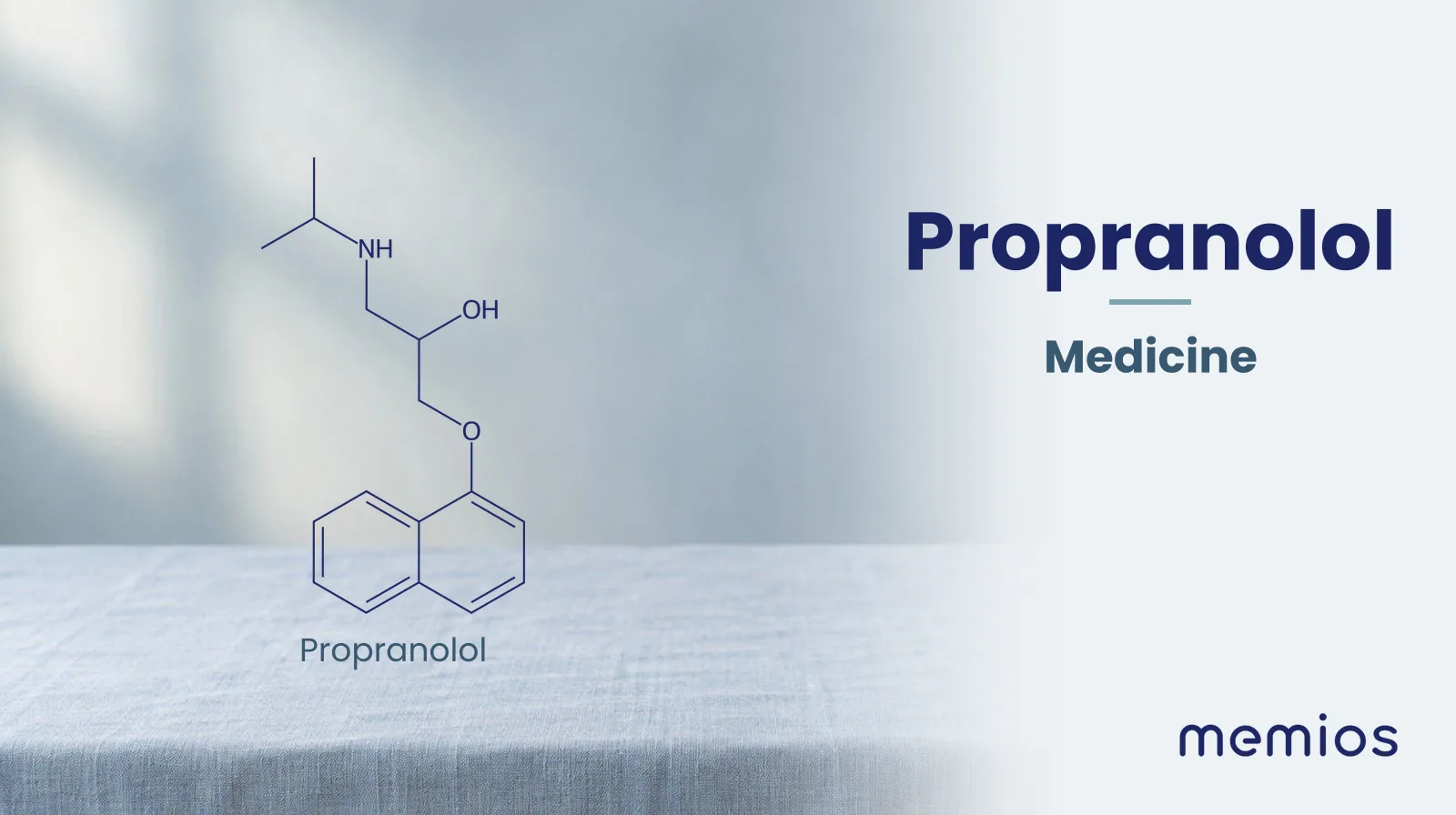
Propranolol
Well established. The strongest outcome evidence is in two places.
TLDR
- Well established. The strongest outcome evidence is in two places.
- What it is: Propranolol is a non-selective beta-blocker: it competes with adrenaline and noradrenaline for beta-adrenergic receptors throughout the body, including in the heart and the airways.
- Main use: Reducing cardiovascular mortality after a myocardial infarction (well supported).
- Other approved uses: Prophylaxis of common migraine headache (well supported); Management of hypertension (disputed); Familial or hereditary essential tremor, atrial fibrillation rate control, angina, hypertrophic subaortic stenosis and adjunctive use in pheochromocytoma (limited evidence).
- Uses NOT supported by research: Anxiety disorders, including performance and situational anxiety.
- Recommended dose (official position): There is no reference intake for a prescription beta-blocker; the dose is set by the prescriber.
- Studied dose (a trial dose, not a recommendation): In the Beta-Blocker Heart Attack Trial, propranolol was administered at either 60 or 80 mg three times a day, based on blood levels achieved during an initial trial of 40 mg three times a day. Findings citing that trial: 1 for.
- Upper limit: The tablet label's stated ceiling for hypertension is a position rather than a recommendation: it says that in some instances a dosage of 640 mg a day may be required.
- What goes wrong: 5 findings on harm. People taking beta-blockers for headache prevention report more side effects than those on placebo, though not enough to make them stop more often.
- Interactions: 4 recorded, including Alcohol, Protein-rich food, Aluminium hydroxide antacid, Insulin and other diabetes treatment.
- Common myth: Propranolol is a proven treatment for anxiety - it is the standard beta-blocker for nerves.
What it is
Propranolol is a non-selective beta-blocker: it competes with adrenaline and noradrenaline for beta-adrenergic receptors throughout the body, including in the heart and the airways. It was the first widely used drug of its class and is available as immediate-release tablets, extended-release capsules, an oral solution and an injection. Because it blocks beta-2 receptors as well as beta-1, it affects the lungs and blood-vessel responses as well as the heart.
What the research says
The strongest outcome evidence is in two places. After a heart attack, long-term beta-blockade cut the odds of death by 23% in a meta-analysis of 54,234 randomised patients, with a number needed to treat of 42 over two years. For preventing episodic migraine, a 2019 systematic review graded the propranolol-versus-placebo evidence high quality: propranolol cut episodic migraine by about 1.5 headaches a month versus placebo; that rating is for episodic migraine only. Its use as a first-line blood-pressure drug is the weaker claim - Cochrane found beta-blockers reduce cardiovascular disease modestly, with little or no effect on mortality, and inferior to other classes. Its very common off-label use for anxiety is not well supported. Harms include bradycardia, fatigue, vivid dreams and depression-like symptoms, bronchospasm in people with asthma, and masking of hypoglycaemia in people on insulin. It should not be stopped abruptly in angina.
Evidence grade: Well established.
How it works
Drug class: Non-selective beta-adrenergic receptor blocking agent (beta-blocker)
Propranolol sits on beta-adrenergic receptors and blocks adrenaline and noradrenaline from reaching them. The heart then beats more slowly and less forcefully, and blood vessels respond less to adrenaline. Because the block is non-selective it also reaches beta-2 receptors in the airways, which is why it can trigger bronchospasm in people with asthma. (Source 1)
What it is used for
- Approved for clinically stable survivors of the acute phase of a heart attack. A BMJ meta-regression of 54,234 randomised patients found a 23% reduction in the odds of death in long-term trials, with a number needed to treat of 42 over two years. Propranolol's own pivotal trial, BHAT, reduced total mortality 26% over an average of 25 months. Evidence: established. (Source 2)
- Approved for preventing migraine, not for treating an attack that has already started. A 2019 systematic review and meta-analysis graded the evidence for propranolol versus placebo in episodic migraine specifically as high quality: propranolol reduced episodic migraine by 1.5 headaches a month at 8 weeks versus placebo and was more likely to halve headache frequency (RR 1.4). The review rates its other comparisons lower, and this rating does not extend to chronic migraine or to beta-blockers as a class. Evidence: established. (Source 3)
- Approved, alone or with a thiazide diuretic, but not for hypertensive emergencies. Cochrane's review of beta-blockers as initial therapy found modest cardiovascular reductions - driven by stroke, with no difference in coronary heart disease (RR 0.93, 95% CI 0.81 to 1.07) - little or no effect on mortality, and effects inferior to other antihypertensive classes, with the caveat that atenolol, not propranolol, was the beta-blocker most used in those trials. Evidence: disputed. (Source 4)
- Off-label and very common in practice. A systematic review and meta-analysis of eight randomised trials found no significant difference from benzodiazepines in panic disorder, no effect on PTSD symptom severity through memory reconsolidation, and concluded the quality of evidence is insufficient to support routine use in any anxiety disorder. Evidence: not-supported. (Source 5)
- All are listed indications on the tablet label. We did not retrieve outcome trials or systematic reviews for these uses in this run, so they are recorded here as approved positions with their evidence unassessed rather than as established outcome findings. Evidence: limited. (Source 6)
Interactions
- Alcohol (label): Drinking alcohol while taking propranolol raises propranolol blood levels, which can add to its blood-pressure-lowering and heart-slowing effects. (Source 7)
- Protein-rich food (pharmacokinetic study): Eating protein-rich food with propranolol raises how much of the drug reaches the bloodstream, by about half, without changing how fast it peaks or how long it lasts. Taking it consistently with or without food therefore matters more than the absolute dose number. (Source 8)
- Aluminium hydroxide antacid (pharmacokinetic study): An aluminium hydroxide antacid gel taken with propranolol lowers propranolol concentrations, so the antacid can weaken the drug's effect. (Source 9)
- Insulin and other diabetes treatment (label): Propranolol hides the racing pulse and blood-pressure changes that normally warn of a hypoglycaemic episode, and the label says it can make insulin dosing harder to adjust. This is the interaction that matters most for anyone taking both propranolol and insulin lispro. (Source 10)
Stopping it
- Propranolol should not be stopped abruptly in people with angina. The label records reports of worsening angina and, in some cases, myocardial infarction after abrupt discontinuation, and instructs that the dose be reduced gradually over at least a few weeks. (Source 6)
- The label's stated taper is a gradual reduction over at least a few weeks, with the patient warned not to interrupt or stop treatment on their own. (Source 6)
What goes wrong
People taking beta-blockers for headache prevention report more side effects than those on placebo, though not enough to make them stop more often. (Source 11)
- Systematic review, Moderate certainty.
- Size: Beta-blocker headache prevention trials pooled in the 2019 review.
- Who: Adults taking beta-blockers for headache prevention.
- How long: 8 to 12 weeks in most trials.
- Result: Side effects RR 1.2 (95% CI 1.0-1.4) versus placebo; withdrawal RR 0.99 (95% CI 0.83 to 1.2)
- Funding: not stated.
Participants on beta-blockers were more likely to experience side effects than those on placebo (RR: 1.2, 95% CI: 1.0–1.4), though they were not more likely to withdraw
Propranolol can provoke bronchospasm and should generally not be given to people with bronchospastic lung disease. (Source 12)
- Official position, Moderate certainty.
- Size: not stated.
- Who: People with asthma or other bronchospastic lung disease.
- How long: Any time during treatment.
- Result: Rate not quantified in the label; the mechanism given is blockade of catecholamine-driven bronchodilation.
- Funding: not stated (FDA-approved label)
In general, patients with bronchospastic lung disease should not receive beta-blockers. Propranolol should be administered with caution in this setting since it may provoke a bronchial asthmatic attack
Central nervous system adverse reactions listed for propranolol include depression, insomnia, fatigue, vivid dreams, hallucinations and a reversible confusional syndrome with short-term memory loss. (Source 13)
- Official position, Low certainty.
- Size: not stated.
- Who: People taking propranolol.
- How long: Not stated; the confusional syndrome is described as acute and reversible.
- Result: No frequencies are given in this label section, and there is no placebo comparison - this is a spontaneous-report style list, not trial incidence.
- Funding: not stated (FDA-approved label)
Lightheadedness, mental depression manifested by insomnia, lassitude, weakness, fatigue; catatonia; visual disturbances; hallucinations; vivid dreams
Propranolol blunts the warning signs of low blood sugar and has itself been associated with hypoglycaemia, particularly in children and during fasting. (Source 10)
- Official position, Moderate certainty.
- Size: not stated.
- Who: People with insulin-treated diabetes, infants and children, people fasting or with renal insufficiency.
- How long: Any time during treatment.
- Result: Rate not quantified; the label describes blunted pulse and blood-pressure warning signs and reported hypoglycaemia after prolonged exertion and in renal insufficiency.
- Funding: not stated (FDA-approved label)
Beta-adrenergic blockade may prevent the appearance of certain premonitory signs and symptoms (pulse rate and pressure changes) of acute hypoglycemia, especially in labile insulin-dependent diabetics.
Cardiovascular adverse reactions listed include bradycardia, congestive heart failure, worsening AV block, hypotension and Raynaud-type arterial insufficiency. (Source 14)
- Official position, Low certainty.
- Size: not stated.
- Who: People taking propranolol.
- How long: Not stated.
- Result: No frequencies given in the label passage and no placebo comparison.
- Funding: not stated (FDA-approved label)
Bradycardia; congestive heart failure; intensification of AV block; hypotension; paresthesia of hands; thrombocytopenic purpura
What the evidence supports
Long-term beta-blockade after myocardial infarction reduces death, with a number needed to treat of 42 over two years. (Source 15)
- Meta-analysis, High certainty.
- Size: 5,477 deaths among 54,234 randomised patients.
- Who: Patients after myocardial infarction, randomised to beta-blocker or control.
- How long: Long-term trials; NNT expressed over 2 years.
- Result: 23% reduction in the odds of death in long term trials (95% CI 15% to 31%); only a 4% reduction in short term trials (−8% to 15%), an interval that crosses zero; number needed to treat in long term trials 42 over 2 years to avoid a death.
- Funding: not stated.
We identified a 23% reduction in the odds of death in long term trials (95% confidence interval 15% to 31%), but only a 4% reduction in the odds of death in short term trials (−8% to 15%).
In propranolol's own post-infarction trial, BHAT, total mortality fell 26% over an average 25 months of follow-up. (Source 16)
- Randomized trial, High certainty.
- Size: 3,837 persons.
- Who: Survivors of the acute phase of myocardial infarction without severe heart failure or certain conduction defects.
- How long: Up to 39 months, average follow-up 25 months.
- Result: Total mortality reduced 39% at 12 months and 26% over an average follow-up period of 25 months. These are relative reductions; the label passage does not give absolute event counts.
- Funding: independent (National Heart, Lung and Blood Institute sponsored)
Compared with placebo, total mortality was reduced 39% at 12 months and 26% over an average follow-up period of 25 months.
Propranolol prevents episodic migraine better than placebo, on high quality evidence. (Source 17)
- Systematic review, High certainty.
- Size: Systematic review and meta-analysis of beta-blocker headache prevention trials.
- Who: Adults with episodic migraine.
- How long: Outcomes at 8 and 12 weeks.
- Result: 1.5 fewer headaches per month at 8 weeks (95% CI -2.3 to -0.65); RR 1.4 (95% CI 1.1-1.7) for halving headache frequency.
- Funding: not stated.
Compared to placebo, propranolol reduced episodic migraine headaches by 1.5 headaches/month at 8 weeks (95% CI: -2.3 to -0.65)
What the evidence does not support
The evidence is insufficient to support routine use of propranolol for any anxiety disorder. (Source 5)
- Systematic review, Very low certainty.
- Size: 8 studies; panic disorder n=130, specific phobia n=37, social phobia n=16, PTSD n=19.
- Who: Patients with panic disorder, specific phobia, social phobia or PTSD.
- How long: Short-term treatment in the pooled panic disorder trials.
- Result: No statistically significant difference between propranolol and benzodiazepines for short-term treatment of panic disorder; no effect on PTSD symptom severity through inhibition of memory reconsolidation.
- Funding: not stated.
the quality of evidence for the efficacy of propranolol at present is insufficient to support the routine use of propranolol in the treatment of any of the anxiety disorders
As initial therapy for hypertension, beta-blockers produce little or no mortality benefit and are inferior to other antihypertensive classes. (Source 18)
- Systematic review, Moderate certainty.
- Size: Outcome randomised trials of beta-blockers as initial therapy for hypertension.
- Who: Adults with primary hypertension, mostly treated with atenolol rather than propranolol.
- How long: Trial follow-up as reported in the included studies.
- Result: All-cause mortality versus placebo RR 0.99 (95% CI 0.88 to 1.11); versus calcium channel blockers RR 1.07 (1.00 to 1.14); stroke higher versus CCBs RR 1.24 (1.11 to 1.40) and versus RAS inhibitors RR 1.30 (1.11 to 1.53)
- Funding: independent (Cochrane)
Current evidence suggests that initiating treatment of hypertension with beta-blockers leads to modest CVD reductions and little or no effects on mortality. These beta-blocker effects are inferior to those of other antihypertensive drugs.
Where the research disagrees
Whether beta-blockers belong as a first-line treatment for high blood pressure
- The FDA-approved propranolol tablet label, position (regulatory approval): Propranolol hydrochloride tablets are indicated in the management of hypertension. They may be used alone or used in combination with other antihypertensive agents, particularly a thiazide diuretic. (Source 4)
- Wiysonge and colleagues, Cochrane Database of Systematic Reviews, systematic review of randomised outcome trials: Current evidence suggests that initiating treatment of hypertension with beta-blockers leads to modest CVD reductions and little or no effects on mortality. These beta-blocker effects are inferior to those of other antihypertensive drugs. (Source 18)
How much
- Reference intake: There is no reference intake for a prescription beta-blocker; the dose is set by the prescriber. The FDA-approved tablet label (as posted on DailyMed) states as a position that for hypertension the usual initial dosage is 40 mg twice daily and the usual maintenance dosage is 120 mg to 240 mg per day. (Source 19)
- Upper limit: The tablet label's stated ceiling for hypertension is a position rather than a recommendation: it says that in some instances a dosage of 640 mg a day may be required. No separate toxicological upper limit exists for a prescription medicine of this kind. (Source 19)
- Studied: In the Beta-Blocker Heart Attack Trial, propranolol was administered at either 60 or 80 mg three times a day, based on blood levels achieved during an initial trial of 40 mg three times a day, starting 5 to 21 days after infarction. (Source 16)
- Studied: In the Norwegian Multicenter Trial, propranolol was administered at 40 mg four times a day. (Source 16)
A common belief, and what the research shows
The belief: Propranolol is a proven treatment for anxiety - it is the standard beta-blocker for nerves.
What the research shows: It is prescribed that way constantly, but the trial evidence does not carry the claim. A systematic review of eight randomised trials found no significant difference between propranolol and benzodiazepines for panic disorder and "no evidence was found for effects of propranolol on PTSD symptom severity through inhibition of memory reconsolidation", concluding that the quality of evidence is insufficient to support routine use in any anxiety disorder. The trials were also very small - 16 to 130 participants per condition.
Questions and answers
What is it?
Propranolol is a beta-blocker - the original one - available as tablets, extended-release capsules, a liquid and an injection. It is non-selective, meaning it blocks beta receptors everywhere rather than only in the heart. It is licensed for high blood pressure, angina, rate control in atrial fibrillation, survival after a heart attack, migraine prevention, essential tremor, hypertrophic subaortic stenosis and as an add-on in pheochromocytoma. (Source 1)
What does it do in the body?
It competes with adrenaline for beta receptors and wins, so the heart's rate, force and the vessel responses to adrenaline all fall together. That lowers blood pressure and reduces the work the heart does. The same blockade in the airways is why it can be dangerous for people with asthma. (Source 1)
Is it good or bad for you?
It depends entirely on why it is being taken. After a heart attack, long-term beta-blockade prevents deaths: in the long term trials of the BMJ meta-analysis, 42 people treated for two years to avoid one death. For preventing episodic migraine the evidence is graded high quality. As a first-line blood-pressure drug the same class looks weaker than the alternatives, and for anxiety the evidence does not support routine use. For someone with asthma it can be actively harmful. (Source 20)
How do you get more of it?
Propranolol is a prescription medicine and there is no dietary or supplement route to it. What is taken alongside it changes how much reaches the blood: protein-rich food raises its bioavailability by about half, and an aluminium hydroxide antacid lowers its concentrations. Dose is decided by a prescriber, and the label describes titration upward until blood pressure is controlled. (Source 8)
If it is harmful, what reduces it?
If propranolol needs to come off, the label is explicit that it must not be stopped suddenly in angina: abrupt discontinuation has been followed by worsening angina and, in some cases, heart attack. The stated approach is to reduce the dose gradually over at least a few weeks under medical supervision. (Source 6)
Why might someone be low in it or missing it?
Propranolol is not something the body makes, so nobody is naturally low in it. People end up without it for two kinds of reason: it is contraindicated or risky for them - the label says patients with bronchospastic lung disease should in general not receive beta-blockers - or its blood levels are pushed down by what else they take, such as an aluminium hydroxide antacid. (Source 12)
Which whole foods contain it or feed it?
No food contains propranolol. Food does change it: protein-rich meals increase how much of a dose gets into the bloodstream by about 50%, without changing the time to peak level, the plasma binding or the half-life. Alcohol is the other dietary factor named on the label, and it raises propranolol levels. (Source 7)
What happens if you do not have it?
For most people, nothing - it is a treatment, not a nutrient. For someone taking it after a heart attack, not having it means losing the mortality benefit that long-term beta-blockade provides. For someone with angina, stopping it abruptly is worse than never starting: the label records worsening angina and, in some cases, myocardial infarction after abrupt discontinuation. (Source 6)
How can you test for it?
There is no routine blood test for propranolol levels in ordinary care. What gets measured is the effect: for hypertension the label describes increasing the dose gradually until adequate blood pressure control is achieved, and pulse rate is the other standard check because bradycardia is a listed adverse reaction. In diabetes this monitoring is less reliable, because the drug blunts the pulse and blood-pressure changes that normally signal a low blood sugar. (Source 19)
References
- DailyMed (US National Library of Medicine), FDA-approved prescribing information. Propranolol hydrochloride tablet - Clinical Pharmacology. 2026. Read the source
- DailyMed (US National Library of Medicine), FDA-approved prescribing information. Propranolol hydrochloride tablet - Indications and Usage: Myocardial Infarction. 2026. Read the source
- DailyMed (US National Library of Medicine), FDA-approved prescribing information. Propranolol hydrochloride tablet - Indications and Usage: Migraine. 2026. Read the source
- DailyMed (US National Library of Medicine), FDA-approved prescribing information. Propranolol hydrochloride tablet - Indications and Usage: Hypertension. 2026. Read the source
- Journal of Psychopharmacology. Propranolol for the treatment of anxiety disorders: Systematic review and meta-analysis. 2016. PMID 26487439, DOI 10.1177/0269881115612236. Read the source
- DailyMed (US National Library of Medicine), FDA-approved prescribing information. Propranolol hydrochloride tablet - Warnings: Angina Pectoris, abrupt discontinuance. 2026. Read the source
- DailyMed (US National Library of Medicine), FDA-approved prescribing information. Propranolol hydrochloride tablet - Drug Interactions: alcohol. 2026. Read the source
- DailyMed (US National Library of Medicine), FDA-approved prescribing information. Propranolol hydrochloride tablet - Clinical Pharmacology: effect of protein-rich food on bioavailability. 2026. Read the source
- DailyMed (US National Library of Medicine), FDA-approved prescribing information. Propranolol hydrochloride tablet - Drug Interactions: aluminum hydroxide gel. 2026. Read the source
- DailyMed (US National Library of Medicine), FDA-approved prescribing information. Propranolol hydrochloride tablet - Warnings: Diabetes and Hypoglycemia. 2026. Read the source
- PLOS ONE. Beta-blockers for the prevention of headache in adults, a systematic review and meta-analysis - adverse events. 2019. DOI 10.1371/journal.pone.0212785. Read the source
- DailyMed (US National Library of Medicine), FDA-approved prescribing information. Propranolol hydrochloride tablet - Warnings: Nonallergic Bronchospasm. 2026. Read the source
- DailyMed (US National Library of Medicine), FDA-approved prescribing information. Propranolol hydrochloride tablet - Adverse Reactions: Central Nervous System. 2026. Read the source
- DailyMed (US National Library of Medicine), FDA-approved prescribing information. Propranolol hydrochloride tablet - Adverse Reactions: Cardiovascular. 2026. Read the source
- The BMJ. β Blockade after myocardial infarction: systematic review and meta regression analysis - Results. 1999. DOI 10.1136/bmj.318.7200.1730. Read the source
- DailyMed (US National Library of Medicine), FDA-approved prescribing information. Propranolol hydrochloride tablet - Clinical Pharmacology: the Beta-Blocker Heart Attack Trial (BHAT). 2026. Read the source
- PLOS ONE. Beta-blockers for the prevention of headache in adults, a systematic review and meta-analysis - propranolol versus placebo. 2019. DOI 10.1371/journal.pone.0212785. Read the source
- Cochrane Database of Systematic Reviews (scientific abstract as displayed on cochrane.org, not the plain language summary). Beta-blockers for hypertension - Authors' conclusions. 2017. DOI 10.1002/14651858.CD002003.pub5. Read the source
- DailyMed (US National Library of Medicine), FDA-approved prescribing information. Propranolol hydrochloride tablet - Dosage and Administration: Hypertension. 2026. Read the source
- The BMJ. β Blockade after myocardial infarction: systematic review and meta regression analysis - number needed to treat in long term trials. 1999. DOI 10.1136/bmj.318.7200.1730. Read the source