Medications · September 30, 2026 · Memios · 26 min read
Pregabalin
Limited evidence. Pregabalin's benefit is real but narrow and condition-specific.
TLDR
- Limited evidence. Pregabalin's benefit is real but narrow and condition-specific.
- What it is: Pregabalin is a prescription capsule, oral solution or extended-release tablet.
- Main use: Postherpetic neuralgia (nerve pain after shingles) (well supported).
- Other approved uses: Painful diabetic peripheral neuropathy (limited evidence); Fibromyalgia (limited evidence); Adjunctive therapy for partial-onset seizures in adults (evidence not rated).
- Off-label uses (not on the FDA label): Generalised anxiety disorder (limited evidence).
- Uses NOT supported by research: HIV-associated neuropathy; Sciatica (acute or chronic leg pain of nerve-root origin).
- Recommended dose: not established. There is no reference intake for a drug: the dose is set by the prescriber and adjusted for kidney function. As a position, the US LYRICA label (revised 10/2011.
- Studied dose (a trial dose, not a recommendation): Cochrane's neuropathic pain review pooled trials of pregabalin 300 mg and 600 mg daily against placebo, typically over 8 to 13 weeks. Findings citing that trial: 1 for, 1 on harm.
- Upper limit: As a position, the US LYRICA label states that the maximum recommended dose for neuropathic pain associated with diabetic peripheral neuropathy is 100 mg three times a day (300 mg/day).
- What goes wrong: 8 findings on harm. In that sciatica trial adverse events were nearly twice as frequent on pregabalin as on placebo.
- Interactions: 2 recorded, including Alcohol (ethanol), Oxycodone and lorazepam.
- Common myth: Pregabalin is a non-opioid painkiller, so it is a safe general-purpose option for any bad pain and has no dependence risk.
What it is
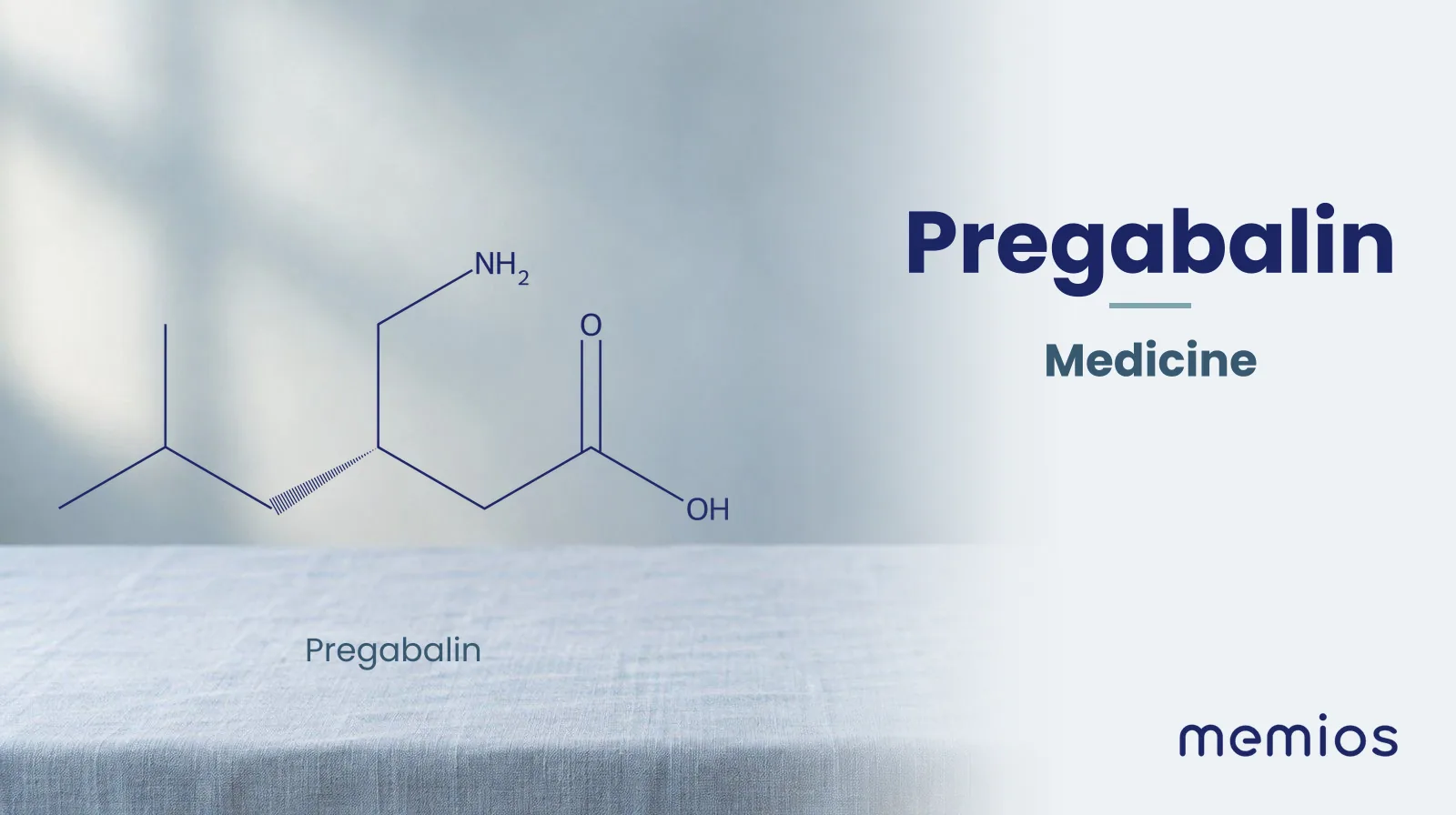
Pregabalin is a prescription capsule, oral solution or extended-release tablet. It is a structural derivative of the inhibitory neurotransmitter GABA but does not act on GABA receptors. In the United States it is a Schedule CV controlled substance, reflecting recognised abuse potential. Its US label lists four approved indications: neuropathic pain from diabetic peripheral neuropathy, postherpetic neuralgia, adjunctive treatment of partial-onset seizures, and fibromyalgia.
What the research says
Pregabalin's benefit is real but narrow and condition-specific. Cochrane's review of 45 studies found good evidence in postherpetic neuralgia, where 300 mg gave at least 30% pain relief to 50% versus 25% on placebo (number needed to treat 3.9), weaker evidence in painful diabetic neuropathy, where 300 mg gave 47% versus 42% and a number needed to treat of 22, and an absence of efficacy in HIV neuropathy. In fibromyalgia about 10% more people than on placebo get substantial relief. For sciatica, a condition it is widely used off-label for, a randomised trial of 209 people found no benefit at 8 or 52 weeks and nearly twice as many adverse events. Dizziness and somnolence are common and dose-related, and a systematic review found abuse prevalence of 1.6% in the general population and 3% to 68% among people who abuse opioids.
Evidence grade: Limited evidence.
How it works
Drug class: Gabapentinoid: alpha-2-delta ligand of voltage-gated calcium channels (anticonvulsant and analgesic)
Pregabalin sticks tightly to a helper part of the calcium channels on nerve endings called the alpha2-delta subunit. In animal models this reduces the calcium-driven release of pain-signalling chemicals in the spinal cord. The label is explicit that the full mechanism has not been worked out, and that despite looking like GABA the drug does not act on GABA receptors, sodium channels or opioid receptors. (Source 1)
What it is used for
- Cochrane found moderate-quality evidence of benefit: at 300 mg, 50% of people had at least 30% pain reduction versus 25% on placebo, a number needed to treat of 3.9; at 600 mg, 62% versus 24%, number needed to treat 2.7. Evidence: established. (Source 2)
- Benefit is real but much smaller than in postherpetic neuralgia. At 300 mg, 47% had at least 30% pain reduction versus 42% on placebo, a number needed to treat of 22 (95% CI 12 to 200) across 8 studies and 2,320 participants. Evidence: limited. (Source 3)
- Cochrane concluded that pregabalin 300 to 600 mg gives a major reduction in pain intensity to a small proportion of people, about 10% more than placebo, over 12 to 26 weeks, while withdrawals for adverse events were about 10% higher than placebo. Evidence: limited. (Source 4)
- This is an approved indication on the US label, but this research run did not retrieve the pivotal epilepsy trials or a systematic review of them, so no evidence grade is asserted here. Treat the approval as a regulatory position, not as the evidence. Evidence: unknown. (Source 5)
- Cochrane's authors' conclusions state an absence of efficacy in HIV neuropathy, in contrast to their positive findings in postherpetic neuralgia and diabetic neuropathy. Evidence: not-supported. (Source 6)
- A 209-person randomised, double-blind, placebo-controlled trial found no reduction in leg-pain intensity at week 8 or week 52 and no benefit on any secondary outcome, with significantly more adverse events on pregabalin. Evidence: not-supported. (Source 7)
- A meta-analysis of seven randomised trials in 2,413 patients reported a small to moderate effect over placebo, but the appraisers who summarised it judged that limitations in the review process and uncertain trial quality mean the conclusion may not be reliable. Pregabalin is licensed for this use in Europe but not in the United States. Evidence: limited. (Source 8)
Interactions
- Alcohol (ethanol) (pharmacokinetic study): Pregabalin taken with alcohol produces additive impairment of thinking and of gross movement, even though neither drug changes the other's blood levels. (Source 9)
- Oxycodone and lorazepam (pharmacokinetic study): In the manufacturer's interaction studies pregabalin was given with oxycodone, lorazepam or ethanol; blood levels did not change but the combined effect on thinking and movement was additive. (Source 9)
Stopping it
- Stopping pregabalin abruptly can produce withdrawal symptoms. The extended-release label states that following abrupt or rapid discontinuation some patients reported insomnia, nausea, headache, anxiety and diarrhoea. (Source 10)
- Dependence and misuse are documented rather than theoretical. A systematic review of 59 studies found gabapentinoid abuse in 1.6% of the general population and in 3% to 68% of people who abuse opioids, and concluded that prior substance abuse history is a risk factor. Pregabalin is a Schedule CV controlled substance in the United States. (Source 11)
What goes wrong
In that sciatica trial adverse events were nearly twice as frequent on pregabalin as on placebo. (Source 7)
- Randomized trial, High certainty.
- Size: 209 randomised.
- Who: Adults with acute or chronic sciatica, pregabalin 150-600 mg/day.
- How long: Up to 8 weeks of treatment, follow-up to 52 weeks.
- Result: 227 adverse events in the pregabalin group versus 124 in the placebo group; dizziness more common on pregabalin.
- Funding: National Health and Medical Research Council of Australia.
A total of 227 adverse events were reported in the pregabalin group and 124 in the placebo group. Dizziness was more common in the pregabalin group than in the placebo group.
Dizziness and somnolence are several times more common on pregabalin than placebo and rise with dose. (Source 2)
- Systematic review, Moderate certainty.
- Size: Postherpetic neuralgia trials within a 45-study, 11,906-participant review.
- Who: Adults with postherpetic neuralgia.
- How long: Typically 8 to 13 weeks.
- Result: Somnolence 300 mg 16% versus 5.5%, 600 mg 25% versus 5.8%; dizziness 300 mg 29% versus 8.1%, 600 mg 35% versus 8.8%.
- Funding: Cochrane review; most included trials manufacturer-sponsored.
Somnolence and dizziness were more common with pregabalin than with placebo (moderate-quality evidence): somnolence 300 mg 16% versus 5.5%, 600 mg 25% versus 5.8%; dizziness 300 mg 29% versus 8.1%, 600 mg 35% versus 8.8%.
In fibromyalgia trials, withdrawals because of adverse events were about 10% higher on pregabalin than placebo. (Source 12)
- Systematic review, High certainty.
- Size: 8 studies in adults with fibromyalgia.
- Who: Adults with fibromyalgia on pregabalin 150-600 mg/day.
- How long: 12 to 26 weeks.
- Result: Withdrawals for adverse events about 10% higher with pregabalin (high quality evidence); withdrawals for lack of efficacy about 6% lower.
- Funding: Cochrane review.
Withdrawals due to adverse events were about 10% higher with pregabalin than placebo, but withdrawals due to lack of efficacy were about 6% lower (high quality evidence).
In fibromyalgia trials dizziness, somnolence, weight gain and peripheral oedema were each more common on pregabalin than placebo, and the review gives a number needed to harm for each. (Source 13)
- Systematic review, High certainty.
- Size: 8 studies in adults with fibromyalgia, all doses combined.
- Who: Adults with moderate or severe pain due to fibromyalgia.
- How long: 12 to 26 weeks.
- Result: Numbers needed to harm, all doses combined: dizziness 3.7, somnolence 7.4, weight gain 18, peripheral oedema 19 (high quality evidence). A number needed to harm of 3.7 means roughly one extra person in every four treated gets dizziness that they would not have had on placebo. Serious adverse events did not differ from placebo, on very low quality evidence.
- Funding: Cochrane review; the fibromyalgia trial base is largely manufacturer-sponsored.
Specific adverse events were more common with pregabalin than placebo, in particular dizziness, somnolence, weight gain, and peripheral oedema, with number needed to harm of 3.7, 7.4, 18, and 19 respectively for all doses combined (high quality evidence). Serious adverse events did not differ between active treatment groups and placebo (very low quality evidence).
A systematic review of 59 studies found gabapentinoid abuse in 1.6% of the general population and in 3% to 68% of people who abuse opioids. (Source 14)
- Systematic review, Low certainty.
- Size: 59 studies (24 epidemiological, 3 clinical abuse-liability, 16 abuse or dependence case reports or series, 17 overdose case reports)
- Who: General population samples and populations with substance use disorders.
- How long: Literature to 28 July 2016; an adverse event database covering 2004-2015.
- Result: 1.6% prevalence in the general population; 3% to 68% among opioid abusers; 11,940 abuse reports in an international adverse event database 2004-2015, over 75% of them after 2012.
- Funding: not stated in the abstract.
In the general population, a 1.6% prevalence of gabapentinoid abuse was observed, whereas prevalence ranged from 3% to 68% among opioid abusers. An international adverse event database identified 11,940 reports of gabapentinoid abuse from 2004–2015, with >75% reported since 2012.
The reviewers concluded gabapentinoids including pregabalin have abuse potential, particularly in people with a history of opioid abuse. (Source 11)
- Systematic review, Low certainty.
- Size: 59 studies.
- Who: Mixed general and substance-using populations.
- How long: Literature to 28 July 2016.
- Result: High-dose effects were usually non-lethal, but gabapentinoids increasingly appeared in post-mortem toxicology; risk factors included prior substance abuse and psychiatric conditions.
- Funding: not stated in the abstract.
Evidence suggests gabapentinoids possess potential for abuse, particularly in individuals with a history of opioid abuse, and reports of such abuse are increasingly being documented.
The manufacturer's controlled trials recorded euphoria as an adverse reaction in 4% of pregabalin-treated patients versus 1% on placebo, and in up to 12% in some study populations. (Source 15)
- Official position, Certainty not rated.
- Size: Pooled controlled clinical studies summarised in the label.
- Who: Patients in the manufacturer's controlled trials across indications.
- How long: Controlled trial durations.
- Result: 4% pregabalin versus 1% placebo overall across controlled studies in over 5500 patients; in some patient populations the reporting rate ranged from 1 to 12%.
- Funding: Manufacturer data submitted to the FDA.
Limit of this finding: This wording is from the extended-release LYRICA CR label, but the data in it were carried over from immediate-release LYRICA and the text refers to "LYRICA". The mechanism paragraph also mentions antiseizure effects in animals even though LYRICA CR is not approved for seizures, so do not read that as an approved use of the extended-release product.
In controlled clinical studies in over 5500 patients, 4% of LYRICA-treated patients and 1% of placebo-treated patients overall reported euphoria as an adverse reaction, though in some patient populations studied, this reporting rate was higher and ranged from 1 to 12%.
The label warns that pregabalin can cause angioedema with life-threatening airway compromise. (Source 16)
- Official position, Certainty not rated.
- Size: Postmarketing and trial reports summarised in the label.
- Who: Patients taking pregabalin.
- How long: Can occur at any point in treatment.
- Result: Swelling of the throat, head and neck, which may involve life-threatening respiratory compromise; the label directs that LYRICA be discontinued immediately in these cases.
- Funding: Manufacturer data submitted to the FDA.
Angioedema (e.g. swelling of the throat, head and neck) can occur, and may be associated with life-threatening respiratory compromise requiring emergency treatment. Discontinue LYRICA immediately in these cases.
What the evidence supports
In postherpetic neuralgia, pregabalin 300 mg gave at least 30% pain relief to twice as many people as placebo, with a number needed to treat of about 4. (Source 2)
- Systematic review, Moderate certainty.
- Size: 3 studies, 589 participants for the 300 mg 30%-relief outcome (45 studies overall in the review)
- Who: Adults with postherpetic neuralgia.
- How long: Typically 8 to 13 week trials.
- Result: 50% vs 25%; RR 2.1 (95% CI 1.6 to 2.6); NNTB 3.9 (3.0 to 5.6). At 600 mg, 62% vs 24%; RR 2.5 (95% CI 2.0 to 3.2); NNTB 2.7 (2.2 to 3.7)
- Funding: Cochrane review; most included trials were manufacturer-sponsored.
More participants had at least 30% pain intensity reduction with pregabalin 300 mg than with placebo (50% vs 25%; RR 2.1 (95% confidence interval (CI) 1.6 to 2.6); NNTB 3.9 (3.0 to 5.6); 3 studies, 589 participants, moderate-quality evidence)
In fibromyalgia, pregabalin 300 to 600 mg produced a major pain reduction in about 10% more people than placebo over 12 to 26 weeks. (Source 4)
- Systematic review, Moderate certainty.
- Size: 8 studies; 5 classic-design studies with 3,283 participants randomised.
- Who: Adults with moderate or severe pain due to fibromyalgia.
- How long: 12 to 26 weeks.
- Result: About 10% more people than placebo achieved substantial pain relief; adverse events affected roughly 70-90% of all participants in both arms.
- Funding: Cochrane review; the fibromyalgia trial base is largely manufacturer-sponsored.
Pregabalin 300 to 600 mg produces a major reduction in pain intensity over 12 to 26 weeks with tolerable adverse events for a small proportion of people (about 10% more than placebo) with moderate or severe pain due to fibromyalgia.
The structured write-up of that meta-analysis records its conclusion that pregabalin was an effective treatment for generalised anxiety disorder compared with placebo, with effect sizes that were small to moderate. (Source 8)
- Meta-analysis, Very low certainty.
- Size: 7 randomised controlled trials, 2,413 patients.
- Who: Adults with generalised anxiety disorder.
- How long: Acute treatment trials.
- Result: Pooled effect size 0.364 (95% CI 0.256-0.471) on the Hamilton Anxiety Rating Scale total score.
- Funding: Review funding not stated in the structured abstract; Pfizer-affiliated authors on many included trials.
Limit of this finding: This is the appraisers' rendering of the review's conclusion on a third-party summary page, not a verbatim sentence from the Canadian Journal of Psychiatry paper, which was not reachable.
Pregabalin was an effective treatment for generalised anxiety disorder compared to placebo although effect sizes to date were small to moderate.
What the evidence does not support
Cochrane found an absence of efficacy for pregabalin in HIV neuropathy and inadequate evidence in central neuropathic pain. (Source 6)
- Systematic review, Moderate certainty.
- Size: 45 studies, 11,906 participants in the full review.
- Who: Adults with chronic neuropathic pain of various causes.
- How long: 2 weeks or longer.
- Result: No efficacy demonstrated in HIV neuropathy; evidence in central neuropathic pain judged inadequate.
- Funding: Cochrane review; most included trials were manufacturer-sponsored.
Limit of this finding: The review's own text is inconsistent between its sections: the results call the condition "painful diabetic neuropathy" while the authors' conclusions call it "painful diabetic neuralgia". They mean the same condition. The wording is quoted as printed and has not been tidied.
Evidence shows efficacy of pregabalin in postherpetic neuralgia, painful diabetic neuralgia, and mixed or unclassified post-traumatic neuropathic pain, and absence of efficacy in HIV neuropathy; evidence of efficacy in central neuropathic pain is inadequate.
In a randomised placebo-controlled trial, pregabalin did not reduce leg pain in acute or chronic sciatica at 8 weeks or at 52 weeks. (Source 17)
- Randomized trial, High certainty.
- Size: 209 randomised (108 pregabalin, 101 placebo); 2 pregabalin patients later excluded as ineligible.
- Who: Adults with acute or chronic sciatica.
- How long: Up to 8 weeks of treatment, follow-up to 52 weeks.
- Result: Week 8 leg-pain intensity 3.7 pregabalin vs 3.1 placebo (adjusted mean difference 0.5; 95% CI -0.2 to 1.2; P=0.19); week 52 3.4 vs 3.0 (adjusted mean difference 0.3; 95% CI -0.5 to 1.0; P=0.46)
- Funding: National Health and Medical Research Council of Australia (independent of industry)
Treatment with pregabalin did not significantly reduce the intensity of leg pain associated with sciatica and did not significantly improve other outcomes, as compared with placebo, over the course of 8 weeks.
Where the evidence is mixed
In painful diabetic neuropathy the same review found a much smaller absolute benefit at 300 mg than in postherpetic neuralgia: 22 people had to be treated for one extra person to get at least 30% pain relief. (Source 3)
- Systematic review, Moderate certainty.
- Size: 8 studies, 2,320 participants.
- Who: Adults with painful diabetic peripheral neuropathy.
- How long: Typically 5 to 13 week trials.
- Result: 47% vs 42%; RR 1.1 (95% CI 1.01 to 1.2); NNTB 22 (12 to 200); 8 studies, 2320 participants, moderate-quality evidence. These are the painful diabetic neuropathy figures; the postherpetic neuralgia figures at the same dose are 50% vs 25% with RR 2.1.
- Funding: Cochrane review; most included trials were manufacturer-sponsored.
Painful diabetic neuropathy: More participants had at least 30% pain intensity reduction with pregabalin 300 mg than with placebo (47% vs 42%; RR 1.1 (95% CI 1.01 to 1.2); NNTB 22 (12 to 200); 8 studies, 2320 participants, moderate-quality evidence)
The same review notes that many people treated with pregabalin get no benefit at all or stop the drug. (Source 6)
- Systematic review, Moderate certainty.
- Size: 45 studies, 11,906 participants.
- Who: Adults with chronic neuropathic pain.
- How long: 2 weeks or longer.
- Result: A minority derive substantial benefit; more derive moderate benefit; many derive none or discontinue.
- Funding: Cochrane review.
Limit of this finding: The review's own text is inconsistent between its sections: the results call the condition "painful diabetic neuropathy" while the authors' conclusions call it "painful diabetic neuralgia". They mean the same condition. The wording is quoted as printed and has not been tidied.
Some people will derive substantial benefit with pregabalin; more will have moderate benefit, but many will have no benefit or will discontinue treatment.
A meta-analysis of seven trials reported a small to moderate effect of pregabalin over placebo in generalised anxiety disorder, but the appraisers who wrote that record up judged that limitations in the review process and uncertain trial quality mean the conclusion may not be reliable. (Source 18)
- Meta-analysis, Very low certainty.
- Size: 7 randomised controlled trials, 2,413 patients (1,352 for the primary pooled outcome)
- Who: Adults with generalised anxiety disorder.
- How long: Acute treatment trials.
- Result: Primary outcome (HARS total) effect size 0.364 (95% CI 0.256-0.471); 0.325 (95% CI 0.226-0.424) after adjustment for publication bias; psychic anxiety 0.349, somatic anxiety 0.239 (95% CI 0.107-0.370)
- Funding: Review funding not stated in the structured abstract; the appraisers' commentary notes that many included trials shared authors with Pfizer affiliations or positions.
Limit of this finding: This sentence is the appraiser's verdict on the review, not the review author's own view, and what was read was the Centre for Reviews and Dissemination's write-up rather than the journal article, which was not reachable. The source's grammar, including "the authors conclusion", is reproduced as printed.
Given the limitations in the review process as well as uncertain quality of the included trials the authors conclusion may not be reliable.
Where the research disagrees
Whether pregabalin's benefit in nerve pain generalises to other painful conditions it is widely prescribed for
- Derry and colleagues, Cochrane review of pregabalin for neuropathic pain, 2019, Systematic review of 45 randomised studies, moderate-quality evidence, in postherpetic neuralgia specifically: More participants had at least 30% pain intensity reduction with pregabalin 300 mg than with placebo (50% vs 25%; RR 2.1 (95% confidence interval (CI) 1.6 to 2.6); NNTB 3.9 (3.0 to 5.6); 3 studies, 589 participants, moderate-quality evidence) (Source 2)
- Mathieson and colleagues, randomised trial of pregabalin for sciatica, New England Journal of Medicine 2017, Independently funded randomised, double-blind, placebo-controlled trial in 209 people with follow-up to 52 weeks: Treatment with pregabalin did not significantly reduce the intensity of leg pain associated with sciatica and did not significantly improve other outcomes, as compared with placebo, over the course of 8 weeks. (Source 17)
How much
- Reference intake: There is no reference intake for a drug: the dose is set by the prescriber and adjusted for kidney function. As a position, the US LYRICA label (revised 10/2011, DEA Schedule CV per the label's own header) lists the approved indications as neuropathic pain associated with diabetic peripheral neuropathy, post herpetic neuralgia, adjunctive therapy for adult patients with partial onset seizures, and fibromyalgia. (Source 5)
- Upper limit: As a position, the US LYRICA label states that the maximum recommended dose for neuropathic pain associated with diabetic peripheral neuropathy is 100 mg three times a day (300 mg/day), and for fibromyalgia that treatment with doses above 450 mg/day is not recommended. The label's 600 mg/day ceiling for postherpetic neuralgia and for adjunctive seizure therapy appears in the label only as a bare dosing line, so it is reported here without a quotation. None of this is a dose for a reader. (Source 19)
- Studied: Cochrane's neuropathic pain review pooled trials of pregabalin 300 mg and 600 mg daily against placebo, typically over 8 to 13 weeks. (Source 2)
- Studied: The sciatica trial titrated pregabalin from 150 mg to a maximum of 600 mg per day for up to 8 weeks. (Source 7)
- Studied: The fibromyalgia review pooled trials randomising 3,283 participants to pregabalin 150 to 600 mg daily or placebo for 12 to 26 weeks. (Source 4)
A common belief, and what the research shows
The belief: Pregabalin is a non-opioid painkiller, so it is a safe general-purpose option for any bad pain and has no dependence risk.
What the research shows: Its benefit is condition-specific and its risks are not trivial. Cochrane found "absence of efficacy in HIV neuropathy", the diabetic neuropathy number needed to treat at 300 mg was 22 (12 to 200), and in sciatica a randomised trial found no benefit while "A total of 227 adverse events were reported in the pregabalin group and 124 in the placebo group." On dependence, a systematic review found "In the general population, a 1.6% prevalence of gabapentinoid abuse was observed, whereas prevalence ranged from 3% to 68% among opioid abusers." The drug is a Schedule CV controlled substance and the label lists withdrawal symptoms after abrupt stopping.
Questions and answers
What is it?
Pregabalin is a prescription capsule, solution or extended-release tablet used for certain kinds of nerve pain, for fibromyalgia and as an add-on for partial-onset seizures. Chemically it is a derivative of the brain's own inhibitory messenger GABA, but it does not act on GABA receptors. In the United States it is a Schedule CV controlled substance. (Source 1)
What does it do in the body?
Pregabalin binds tightly to the alpha2-delta helper subunit of voltage-gated calcium channels in the brain and spinal cord. In animal models of nerve injury this reduces the calcium-dependent release of pain-signalling chemicals in the spinal cord. The label states the mechanism has not been fully worked out. (Source 1)
Is it good or bad for you?
It depends heavily on the condition. In postherpetic neuralgia the absolute benefit is substantial, with about four people needing treatment for one extra person to get 30% pain relief. In diabetic neuropathy the number is about 22. In sciatica a randomised trial found no benefit and nearly twice as many adverse events. Dizziness and somnolence are common, and abuse and withdrawal are documented. (Source 6)
How do you get more of it?
Pregabalin is prescription-only and there is no food or behaviour that provides it. The doses studied in trials were 300 mg and 600 mg daily for nerve pain, 150 to 600 mg daily in fibromyalgia and sciatica. The label caps daily doses by indication, and dosing is reduced for impaired kidney function. Only a prescriber can set a dose. (Source 2)
If it is harmful, what reduces it?
If pregabalin is causing harm, it is reduced by tapering under a prescriber's direction rather than stopping suddenly, because abrupt or rapid discontinuation produces withdrawal symptoms. The extended-release label lists insomnia, nausea, headache, anxiety and diarrhoea among the symptoms patients reported after stopping abruptly. (Source 10)
Why might someone be low in it or missing it?
Does not apply in the nutrient sense: nobody is naturally low in pregabalin. What changes the amount in the body is kidney clearance, since pregabalin is cleared unchanged by the kidneys and doses are reduced in renal impairment. Some people also stop it because it is not working: in fibromyalgia trials, withdrawals for lack of efficacy were about 6% lower on pregabalin than placebo, so the majority on placebo who left did so for that reason. (Source 12)
Which whole foods contain it or feed it?
No food contains pregabalin; it is a synthetic prescription drug. The relevant food and drink point is alcohol: taken together, pregabalin and alcohol have additive effects on thinking and movement, even though neither changes the other's blood levels. (Source 9)
What happens if you do not have it?
There is no deficiency state for a drug. Without it, the trial placebo groups show what happens: in postherpetic neuralgia 25% of people on placebo still got at least 30% pain relief, and in sciatica placebo and pregabalin groups ended at essentially the same leg-pain score at both 8 and 52 weeks. (Source 7)
How can you test for it?
No blood test for pregabalin levels is used in routine care, and this research run found no validated monitoring test in the literature we reached. What is monitored clinically is kidney function, because dosing depends on it, and signs of misuse or of withdrawal on stopping. The systematic review of misuse describes behavioural monitoring rather than a laboratory test. (Source 11)
We searched: Searched for pregabalin therapeutic drug monitoring, plasma level targets, and validated monitoring tests alongside the Cochrane reviews, the Lyrica labels and a systematic review of gabapentinoid misuse; none described a validated test used to guide treatment.
References
- DailyMed, US National Library of Medicine; labeler Viatris Specialty LLC; label revised 3/2026. Label: LYRICA CR- pregabalin tablet, film coated, extended release (US prescribing information) - section 12.1 MECHANISM OF ACTION, first two paragraphs. 2026. Read the source
- Cochrane Database of Systematic Reviews; read on cochrane.org, where the full review abstract is printed below the plain-language summary. All recorded text is from the abstract's Main results and Authors' conclusions, not from the plain-language summary. Pregabalin for neuropathic pain in adults (Cochrane Database of Systematic Reviews, CD007076) - abstract, Main results: the Postherpetic neuralgia block. 2019. PMID 30673120, DOI 10.1002/14651858.CD007076.pub3. Read the source
- Cochrane Database of Systematic Reviews; read on cochrane.org, where the full review abstract is printed below the plain-language summary. All recorded text is from the abstract's Main results and Authors' conclusions, not from the plain-language summary. Pregabalin for neuropathic pain in adults (CD007076) - abstract, Main results: the opening sentence of the Painful diabetic neuropathy block. 2019. PMID 30673120, DOI 10.1002/14651858.CD007076.pub3. Read the source
- Cochrane Database of Systematic Reviews; read on cochrane.org, where the full review abstract is printed below the plain-language summary. All recorded text is from the abstract's Main results and Authors' conclusions, not from the plain-language summary. Pregabalin for pain in fibromyalgia in adults (CD011790) - abstract, Authors' conclusions. 2016. PMID 27684492, DOI 10.1002/14651858.CD011790.pub2. Read the source
- DailyMed, US National Library of Medicine; labeler H.J. Harkins Company, Inc.; label revised 10/2011; DEA Schedule CV. Label: LYRICA- pregabalin capsule - Highlights INDICATIONS AND USAGE list. 2011. Read the source
- Cochrane Database of Systematic Reviews; read on cochrane.org, where the full review abstract is printed below the plain-language summary. All recorded text is from the abstract's Main results and Authors' conclusions, not from the plain-language summary. Pregabalin for neuropathic pain in adults (CD007076) - abstract, Authors' conclusions. 2019. PMID 30673120, DOI 10.1002/14651858.CD007076.pub3. Read the source
- New England Journal of Medicine (PubMed record). Trial of Pregabalin for Acute and Chronic Sciatica - structured abstract, RESULTS section. 2017. PMID 28328324, DOI 10.1056/NEJMoa1614292. Read the source
- Centre for Reviews and Dissemination (Database of Abstracts of Reviews of Effects), NCBI Bookshelf - a third-party structured abstract with CRD commentary on Boschen MJ, Canadian Journal of Psychiatry 2011;56(9):558-566; the journal article itself was not reachable. A meta-analysis of the efficacy of pregabalin in the treatment of generalized anxiety disorder - DARE structured abstract, the "Authors' conclusions" field as written by CRD. 2011. PMID 21959031, DOI 10.1177/070674371105600907. Read the source
- DailyMed, US National Library of Medicine; labeler H.J. Harkins Company, Inc.; label revised 10/2011; DEA Schedule CV. Label: LYRICA- pregabalin capsule (US prescribing information) - section 7 DRUG INTERACTIONS. 2011. Read the source
- DailyMed, US National Library of Medicine; labeler Viatris Specialty LLC; label revised 3/2026. Label: LYRICA CR - section 5.4, symptoms after abrupt or rapid discontinuation. 2026. Read the source
- Drugs (Springer). Abuse and Misuse of Pregabalin and Gabapentin - abstract, Conclusion section. 2017. PMID 28144823, DOI 10.1007/s40265-017-0700-x. Read the source
- Cochrane Database of Systematic Reviews; read on cochrane.org, where the full review abstract is printed below the plain-language summary. All recorded text is from the abstract's Main results and Authors' conclusions, not from the plain-language summary. Pregabalin for pain in fibromyalgia in adults (CD011790) - abstract, Main results: the withdrawals sentence. 2016. PMID 27684492, DOI 10.1002/14651858.CD011790.pub2. Read the source
- Cochrane Database of Systematic Reviews; read on cochrane.org, where the full review abstract is printed below the plain-language summary. All recorded text is from the abstract's Main results and Authors' conclusions, not from the plain-language summary. Pregabalin for pain in fibromyalgia in adults (Cochrane Database of Systematic Reviews, CD011790) - abstract, Main results: the adverse-event sentences. 2016. PMID 27684492, DOI 10.1002/14651858.CD011790.pub2. Read the source
- Drugs (Springer). Abuse and Misuse of Pregabalin and Gabapentin - abstract, Results section. 2017. PMID 28144823, DOI 10.1007/s40265-017-0700-x. Read the source
- DailyMed, US National Library of Medicine; labeler Viatris Specialty LLC; label revised 3/2026. Label: LYRICA CR - section 9.2 ABUSE, euphoria reporting rates. 2026. Read the source
- DailyMed, US National Library of Medicine; labeler H.J. Harkins Company, Inc.; label revised 10/2011; DEA Schedule CV. Label: LYRICA- pregabalin capsule - Highlights WARNINGS AND PRECAUTIONS, angioedema. 2011. Read the source
- New England Journal of Medicine (PubMed record). Trial of Pregabalin for Acute and Chronic Sciatica - structured abstract, CONCLUSIONS section. 2017. PMID 28328324, DOI 10.1056/NEJMoa1614292. Read the source
- Centre for Reviews and Dissemination (Database of Abstracts of Reviews of Effects), NCBI Bookshelf - a third-party structured abstract with CRD commentary on Boschen MJ, Canadian Journal of Psychiatry 2011;56(9):558-566; the journal article itself was not reachable. A meta-analysis of the efficacy of pregabalin in the treatment of generalized anxiety disorder - the CRD commentary, i.e. the Centre for Reviews and Dissemination's own appraisal, not the review author's words. 2011. PMID 21959031, DOI 10.1177/070674371105600907. Read the source
- DailyMed, US National Library of Medicine; labeler H.J. Harkins Company, Inc.; label revised 10/2011; DEA Schedule CV. Label: LYRICA- pregabalin capsule - dosing ceiling for neuropathic pain associated with diabetic peripheral neuropathy. 2011. Read the source