Medications · September 29, 2026 · Memios · 13 min read
Prednisone
It enters cells and switches specific genes on and off, which damps inflammation and the immune response.
TLDR
- Well established. It enters cells and switches specific genes on and off, which damps inflammation and the immune response.
- What it is: Prednisone is a synthetic glucocorticoid steroid taken as tablets.
- Main use: Wide range of inflammatory and autoimmune conditions (label indications) (evidence not rated).
- Off-label uses (not on the FDA label): Acute exacerbation of COPD (well supported); Bell's palsy (well supported); Acute sciatica from a herniated disc (limited evidence).
- Uses NOT supported by research: Acute lower respiratory tract infection (chest infection) in adults without asthma.
- Recommended dose (official position): Dosing is set by the prescriber. The US label (prednisone tablets USP, revised Aug 2025) is a regulator position: it gives a starting range of 5 mg to 60 mg a day depending on the condition.
- Studied dose (a trial dose, not a recommendation): Sciatica trial: a 15-day tapering course of 5 days each at 60 mg, 40 mg and 20 mg (600 mg in total). Findings citing that trial: 1 for, 1 against, 1 on harm.
- Upper limit: The label sets no single maximum; its stated starting range is 5 to 60 mg a day, and it notes doses vary by disease.
- What goes wrong: 5 findings on harm. In the sciatica trial, about half of prednisone patients had an adverse event by 3 weeks, against about a quarter on placebo.
- Interactions: 7 recorded, including Aspirin and other NSAIDs, CYP3A4 inducers (for example phenytoin, rifampin), CYP3A4 inhibitors (for example ketoconazole), Warfarin.
- Common myth: A short course of steroid tablets is harmless.
What it is
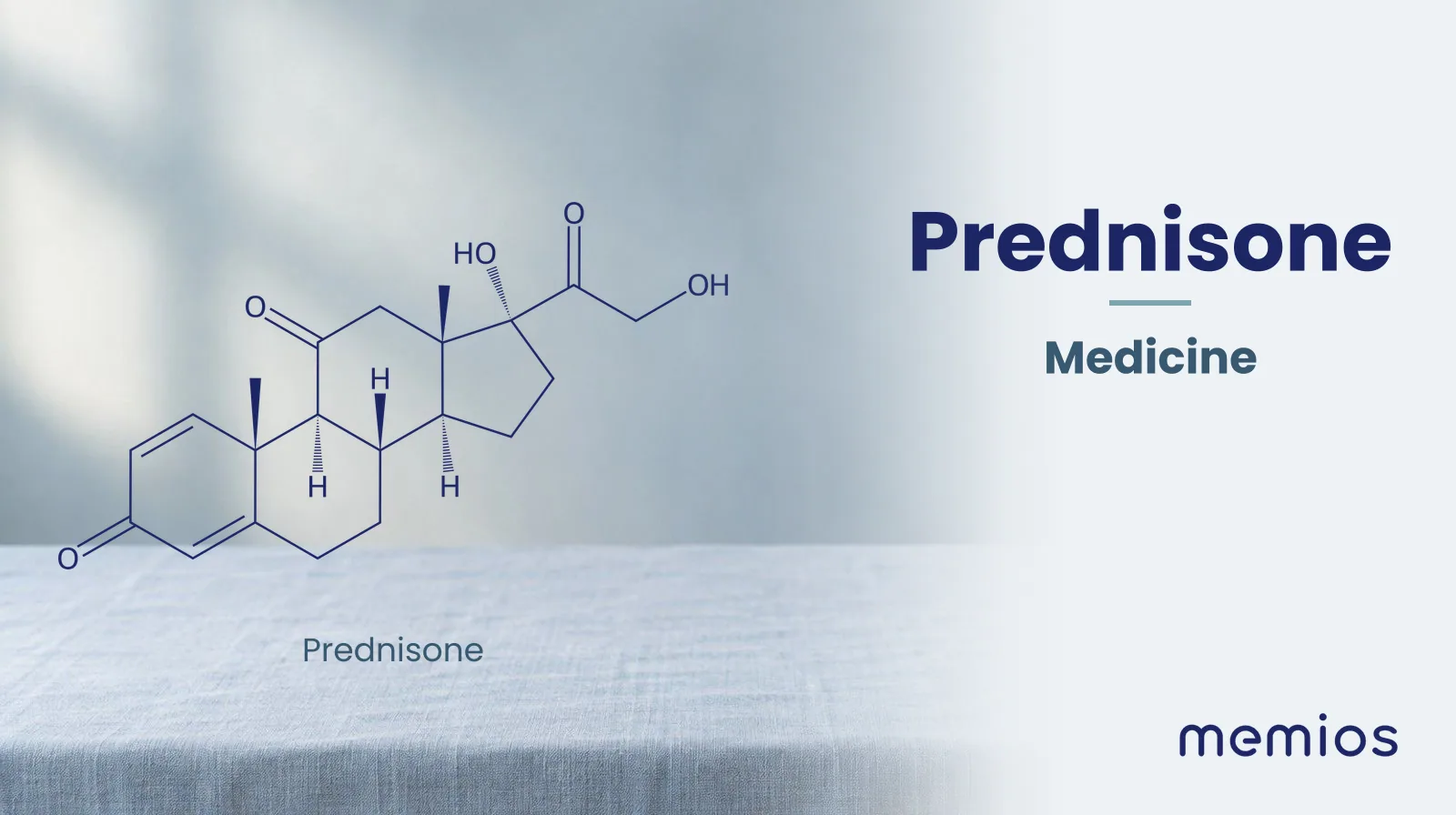
Prednisone is a synthetic glucocorticoid steroid taken as tablets. It is a prodrug: the liver converts it to prednisolone, which does the work.
What the research says
It enters cells and switches specific genes on and off, which damps inflammation and the immune response. Trials support short courses for COPD flare-ups (fewer treatment failures, but no fewer deaths) and for Bell's palsy (1 fewer incomplete recovery for every 10 treated). For sciatica it improved function modestly but not pain, and for chest infections in people without asthma it did not help. Even short courses carry measurable harms. In a large US cohort, sepsis, blood clots and fractures were more frequent in the month after starting. After longer use, stopping abruptly risks adrenal insufficiency.
Evidence grade: Well established.
How it works
Drug class: Oral glucocorticoid (corticosteroid)
Prednisone is converted to prednisolone, which enters cells, binds glucocorticoid receptors in the nucleus and changes which genes are active, reducing inflammation and immune activity. (Source 1)
What it is used for
- A Cochrane review found systemic steroids more than halved treatment failure (OR 0.48) with high-quality evidence. Deaths within 30 days did not fall, and adverse events and high blood sugar rose. Evidence: established. (Source 2)
- A Cochrane review of 7 trials found fewer people with incomplete recovery at 6 months (17% vs 28%; NNTB 10), with no excess of adverse effects over placebo. Evidence: established. (Source 3)
- In a JAMA trial of 269 adults, a 15-day prednisone course improved a disability score modestly at 3 weeks and 1 year but did not reduce leg pain. Adverse events were twice as common. Evidence: limited. (Source 4)
- In a UK trial of 401 adults, prednisolone did not shorten cough or reduce symptom severity. The authors concluded it should not be used for this. Evidence: not-supported. (Source 5)
- The label covers many conditions at doses from 5 to 60 mg a day. We did not research each labelled indication separately in this run; see notes. Evidence: unknown. (Source 6)
Interactions
- Aspirin and other NSAIDs (label): The combination raises the risk of stomach ulcers or bleeding. (Source 1)
- CYP3A4 inducers (for example phenytoin, rifampin) (label): Drugs that speed up the liver enzyme CYP3A4 can make prednisone less effective. (Source 1)
- CYP3A4 inhibitors (for example ketoconazole) (label): Drugs that block CYP3A4 may raise steroid levels and side-effect risk. (Source 1)
- Warfarin (label): Warfarin's blood-thinning effect can become inconsistent. (Source 1)
- Potassium-lowering drugs (for example amphotericin B, some diuretics) (label): Combined use may cause low potassium. (Source 1)
- Calcium and vitamin D (theoretical): Not a harmful interaction. Because long-term use causes bone loss, the StatPearls review advises calcium and vitamin D alongside it. (Source 1)
- Live vaccines (label): Live or live-attenuated vaccines are contraindicated during immunosuppressive prednisone therapy. (Source 1)
Stopping it
- The label says tapering the dose gradually can reduce adrenal insufficiency, which may last for months after stopping. (Source 6)
- A meta-analysis found no dose, route, duration or disease for which adrenal insufficiency after stopping could be ruled out, and advised a low threshold for testing. (Source 7)
- Stopping abruptly after long-term use can trigger adrenal insufficiency, so doses are tapered. (Source 1)
What goes wrong
In COPD flare-up trials, adverse events and high blood sugar were more common with corticosteroids. (Source 2)
- Systematic review, Certainty not rated.
- Size: number of trials not stated in the text we read.
- Who: Adults with COPD exacerbations.
- How long: short courses.
- Result: Adverse events OR 2.33 (95% CI 1.59 to 3.43); hyperglycaemia OR 2.79 (95% CI 1.86 to 4.19)
- Funding: not stated in text read.
The likelihood of adverse events increased with corticosteroid treatment (OR 2.33; 95% CI 1.59 to 3.43).
In the sciatica trial, about half of prednisone patients had an adverse event by 3 weeks, against about a quarter on placebo. (Source 4)
- Randomized trial, Moderate certainty.
- Size: 269 adults.
- Who: Adults with acute sciatica.
- How long: 3 weeks.
- Result: 49.2% vs 23.9% had 1 or more adverse events at 3 weeks (P < .001)
- Funding: not stated in text read.
Having 1 or more adverse events at 3-week follow-up was more common in the prednisone group than in the placebo group (49.2% vs 23.9%; P < .001).
In a nationwide US insurance cohort, rates of sepsis, blood clots and fractures were higher in the 30 days after starting a short course of oral corticosteroids. This is an association, not proof of cause. (Source 8)
- Cohort study, Low certainty.
- Size: 1,548,945 adults, of whom 327,452 used short courses.
- Who: Privately insured US adults aged 18 to 64.
- How long: 2012 to 2014; 30-day and 31-90 day risk windows.
- Result: Incidence rate ratios within 30 days: sepsis 5.30 (3.80 to 7.41), venous thromboembolism 3.33 (2.78 to 3.99), fracture 1.87 (1.69 to 2.07); increased risk persisted below 20 mg/day.
- Funding: independent (US Department of Veterans Affairs, University of Michigan and foundations; funders had no role)
Within 30 days of drug initiation, there was an increase in rates of sepsis (incidence rate ratio 5.30, 95% confidence interval 3.80 to 7.41), venous thromboembolism (3.33, 2.78 to 3.99), and fracture (1.87, 1.69 to 2.07), which diminished over the subsequent 31-90 days.
Adrenal insufficiency after stopping glucocorticoids was common in pooled studies: 21.5% of people on high doses, against 2.4% on low doses, and 27.4% of asthma patients treated for more than a year. (Source 7)
- Meta-analysis, Certainty not rated.
- Size: 3,753 participants in 74 articles.
- Who: Adult corticosteroid users tested for adrenal insufficiency.
- How long: varied.
- Result: By dose: 2.4% (95% CI 0.6-9.3) low dose to 21.5% (95% CI 12.0-35.5) high dose. By duration, in asthma patients only: 1.4% (95% CI 0.3-7.4) under 28 days to 27.4% (95% CI 17.7-39.8) over 1 year. No figure for the oral route appears in the text we read; by route the reported range was 4.2% nasal to 52.2% intra-articular.
- Funding: not stated in text read.
The risk also varied according to dose from 2.4% (95% CI: 0.6-9.3) (low dose) to 21.5% (95% CI: 12.0-35.5) (high dose)
Mood and psychiatric effects are listed on the label, ranging from insomnia and mood swings to psychosis. (Source 6)
- Official position, Certainty not rated.
- Size: not applicable.
- Who: People taking corticosteroids.
- How long: not applicable.
- Result: No rate given on label.
- Funding: label.
Psychic derangements may appear when corticosteroids are used, ranging from euphoria, insomnia, mood swings, personality changes, and severe depression, to frank psychotic manifestations.
What the evidence supports
In COPD flare-ups, systemic corticosteroids cut treatment failure by more than half compared with placebo. (Source 2)
- Systematic review, High certainty.
- Size: 917 participants across nine studies.
- Who: Adults with acute exacerbations of COPD.
- How long: median treatment duration 14 days.
- Result: Treatment failure OR 0.48 (95% CI 0.35 to 0.67) in nine studies (n = 917)
- Funding: not stated in text read.
Systemic corticosteroids reduced the risk of treatment failure by over half compared with placebo in nine studies (n = 917) with median treatment duration 14 days, odds ratio (OR) 0.48 (95% confidence interval (CI) 0.35 to 0.67).
In Bell's palsy, corticosteroids reduced incomplete recovery of facial movement at 6 months from 28% to 17%. (Source 3)
- Systematic review, Moderate certainty.
- Size: 895 participants in 7 trials.
- Who: People with Bell's palsy (idiopathic facial paralysis)
- How long: 6 months or more follow-up.
- Result: RR 0.63 (95% CI 0.50 to 0.80); NNTB 10 (95% CI 6 to 20)
- Funding: not stated in text read.
The number of people who need to be treated with corticosteroids to avoid one incomplete recovery was 10 (95% CI 6 to 20).
In the sciatica trial, function scores improved modestly on prednisone at 3 weeks and at 1 year. (Source 4)
- Randomized trial, Moderate certainty.
- Size: 269 adults.
- Who: Adults with acute sciatica.
- How long: 52 weeks.
- Result: ODI 6.4 points (95% CI 1.9-10.9) better at 3 weeks; 7.4 points (95% CI 2.2-12.5) at 52 weeks.
- Funding: not stated in text read.
The prednisone-treated group showed an adjusted mean 6.4-point (95% CI, 1.9-10.9; P = .006) greater improvement in ODI scores at 3 weeks than the placebo group
What the evidence does not support
The same review found that corticosteroids did not reduce deaths within 30 days. (Source 2)
- Systematic review, Certainty not rated.
- Size: 1,319 participants in 12 studies.
- Who: Adults with acute exacerbations of COPD.
- How long: up to 30 days.
- Result: OR 1.00 (95% CI 0.60 to 1.66)
- Funding: not stated in text read.
Mortality up to 30 days was not reduced by treatment with systemic corticosteroid compared with control in 12 studies (n = 1319; OR 1.00; 95% CI 0.60 to 1.66).
Corticosteroids made no clear difference to cosmetically disabling after-effects of Bell's palsy. (Source 3)
- Systematic review, Low certainty.
- Size: 75 participants in 2 trials.
- Who: People with Bell's palsy.
- How long: 6 months.
- Result: RR 0.96 (95% CI 0.40 to 2.29)
- Funding: not stated in text read.
The reduction in the proportion of participants with cosmetically disabling sequelae six months after randomisation was very similar in the corticosteroid and placebo groups (RR 0.96, 95% CI 0.40 to 2.29, two trials, n = 75, low-quality evidence).
For sciatica from a herniated disc, a 15-day prednisone course modestly improved function but did not significantly reduce pain. (Source 4)
- Randomized trial, Moderate certainty.
- Size: 269 adults.
- Who: Adults with radicular pain of 3 months or less and an MRI-confirmed herniated disc.
- How long: 15-day course, follow-up to 52 weeks.
- Result: Pain 0.3 points greater reduction at 3 weeks (95% CI -0.4 to 1.0; P = .34); ODI function 6.4 points better at 3 weeks (P = .006)
- Funding: not stated in text read.
Compared with the placebo group, the prednisone group showed an adjusted mean 0.3-point (95% CI, -0.4 to 1.0; P = .34) greater reduction in pain at 3 weeks
For chest infections in adults without asthma, prednisolone (the active form of prednisone) did not shorten cough or reduce symptom severity. (Source 5)
- Randomized trial, Moderate certainty.
- Size: 401 adults in 54 English family practices.
- Who: Adults with acute cough and lower respiratory tract symptoms, no asthma or chronic lung disease.
- How long: 5-day course, 28-day follow-up.
- Result: Median cough duration 5 days in both groups; adjusted HR 1.11 (95% CI 0.89-1.39; P = .36)
- Funding: not stated in text read.
Oral corticosteroids should not be used for acute lower respiratory tract infection symptoms in adults without asthma because they do not reduce symptom duration or severity.
How much
- Reference intake: Dosing is set by the prescriber. The US label (prednisone tablets USP, revised Aug 2025) is a regulator position: it gives a starting range of 5 mg to 60 mg a day depending on the condition. (Source 6)
- Upper limit: The label sets no single maximum; its stated starting range is 5 to 60 mg a day, and it notes doses vary by disease. (Source 6)
- Studied: Sciatica trial: a 15-day tapering course of 5 days each at 60 mg, 40 mg and 20 mg (600 mg in total). (Source 4)
- Studied: Chest infection trial: prednisolone 40 mg (two 20-mg tablets) once daily for 5 days. (Source 5)
A common belief, and what the research shows
The belief: A short course of steroid tablets is harmless.
What the research shows: In a US cohort of 1.5 million adults, rates of sepsis, venous thromboembolism and fracture rose within 30 days of starting a short course, and 'The increased risk persisted at prednisone equivalent doses of less than 20 mg/day'. This is observational data, so it shows an association rather than proof of cause.
Questions and answers
What is it?
Prednisone is a man-made steroid (glucocorticoid) taken as tablets. It is a prodrug: the body turns it into prednisolone, which produces the effects. (Source 1)
What does it do in the body?
Once inside cells, it binds receptors in the cell nucleus and changes which genes are active, which reduces production of inflammatory signalling molecules and calms the immune system. (Source 1)
Is it good or bad for you?
Both. It clearly helps some conditions, such as COPD flare-ups and Bell's palsy, and does not help others, such as chest infections in people without asthma. Even short courses were linked with higher rates of sepsis, blood clots and fractures in the following month in a large cohort. (Source 8)
How do you get more of it?
Prednisone is available only on prescription, and the prescriber sets the dose. The label's starting range is wide and depends on the condition. (Source 6)
If it is harmful, what reduces it?
After more than a short course, prednisone is tapered off rather than stopped suddenly, because the body's own steroid production (the adrenal glands) may be suppressed for months. This is done with the prescriber. (Source 6)
Why might someone be low in it or missing it?
Prednisone itself is a medicine, not a body substance. The body does make its own glucocorticoid (cortisol), and long or high-dose prednisone use can suppress that production, leaving someone short of cortisol after stopping. (Source 7)
Which whole foods contain it or feed it?
Does not apply. No food contains prednisone, and no whole food substitutes for it in the sources we read. (Source 1)
We searched: DailyMed prednisone label (Aug 2025), StatPearls prednisone (2025), Waljee 2017, Broersen 2015
What happens if you do not have it?
For people who have taken it for a while, suddenly going without it can cause adrenal insufficiency, because their own adrenal glands have been suppressed. (Source 1)
How can you test for it?
No routine test measures prednisone itself. The relevant test is adrenal function testing after stopping, and a meta-analysis advised doctors to have a low threshold for it, especially when people have vague symptoms after stopping. (Source 7)
References
- StatPearls Publishing, NCBI Bookshelf. Prednisone (StatPearls). Puckett Y, Patel P, Bokhari AA. Updated April 26, 2025. 2025. Read the source
- McMaster Optimal Aging Portal (abstract of Cochrane Database of Systematic Reviews). Systemic corticosteroids for acute exacerbations of chronic obstructive pulmonary disease (Walters JAE et al., Cochrane 2014, CD001288.pub4), summary page. 2014. DOI 10.1002/14651858.CD001288.pub4. Read the source
- McMaster Optimal Aging Portal (abstract of Cochrane Database of Systematic Reviews). Corticosteroids for Bell's palsy (idiopathic facial paralysis) (Madhok VB et al., Cochrane 2016, CD001942.pub5), summary page. 2016. PMID 27428352, DOI 10.1002/14651858.CD001942.pub5. Read the source
- JAMA (abstract read via Europe PMC REST API). Oral steroids for acute radiculopathy due to a herniated lumbar disk: a randomized clinical trial (Goldberg H et al., JAMA 2015;313(19):1915-23). 2015. PMID 25988461, DOI 10.1001/jama.2015.4468. Read the source
- JAMA, via University of Bristol research information portal. Effect of oral prednisolone on symptom duration and severity in nonasthmatic adults with acute lower respiratory tract infection: a randomized clinical trial (OSAC). 2017. DOI 10.1001/jama.2017.10572. Read the source
- DailyMed, US National Library of Medicine (FDA label). PredniSONE Tablets USP 5 mg, 10 mg, 20 mg, prescribing information (Granulation Technology, Inc.). Revised Aug 2025. 2025. Read the source
- Journal of Clinical Endocrinology and Metabolism, via Aarhus University research portal. Adrenal insufficiency in corticosteroids use: systematic review and meta-analysis. 2015. PMID 25844620. Read the source
- BMJ. Short term use of oral corticosteroids and related harms among adults in the United States: population based cohort study. 2017. PMID 28404617, DOI 10.1136/bmj.j1415. Read the source