Supplements · September 30, 2026 · Memios · 14 min read
Plant sterols and plant stanols
This is the best-evidenced of the three ingredients in this group for its stated effect, and the most clearly bounded.
TLDR
- Well established. This is the best-evidenced of the three ingredients in this group for its stated effect, and the most clearly bounded.
- What it is: Plant sterols and plant stanols, collectively phytosterols, are plant compounds with a chemical structure close to that of cholesterol.
- Main use, supported: Across 124 randomised studies, plant sterols and stanols lowered LDL-cholesterol in a dose-dependent way up to about 3 g/day. (high certainty)
- Other use, supported: POSITION: the EFSA Panel on Dietetic Products, Nutrition and Allergies concluded in 2012 that plant sterols and stanol esters at about 3 g/day in approved food matrices lower LDL-cholesterol by 11.3 per cent.
- Claim NOT supported by research: A systematic review and meta-analysis of 17 observational studies found no association between blood concentrations of plant sterols and cardiovascular disease risk. (low certainty)
- Recommended dose (official position): There is no RDA, because phytosterols are not essential nutrients. The EFSA Panel's 2012 opinion frames the intake in terms of the effect instead: daily intakes ranging from 1.5 to 3.0 g in approved matrices have similar efficacy on LDL-cholesterol lowering.
- Studied dose (a trial dose, not a recommendation): Average intake across 124 randomised studies was 2.1 g/day, range 0.2 to 9.0 g/day. Findings citing that trial: 1 for.
- Upper limit: No tolerable upper intake level has been set.
- What goes wrong: 4 findings on harm. Plant sterol and stanol consumption lowered blood concentrations of beta-carotene and several other carotenoids, though the paper states the concentrations stayed within normal ranges.
- Common myth: Because plant sterol spreads lower your cholesterol, they lower your risk of a heart attack.
What it is
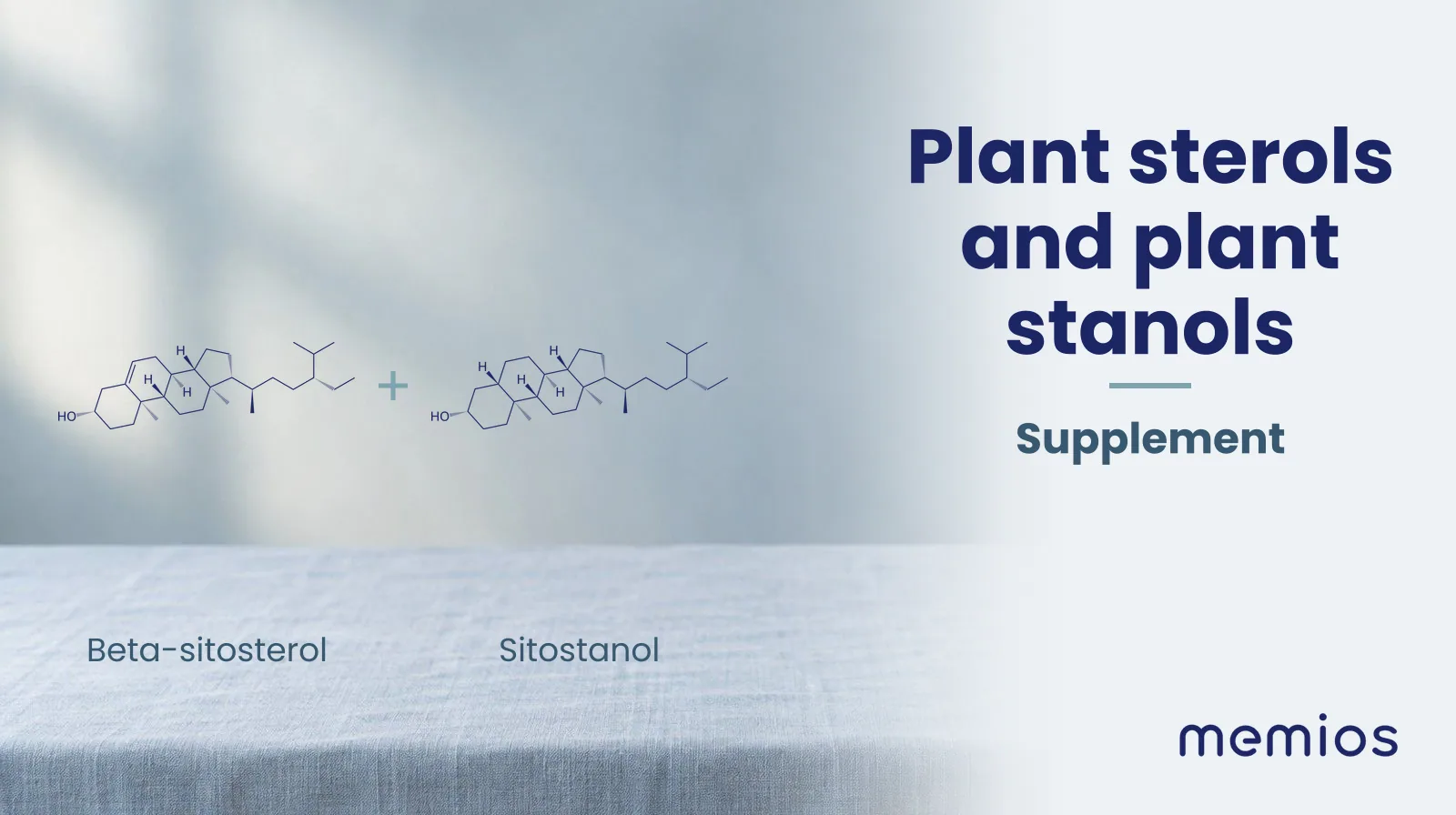
Plant sterols and plant stanols, collectively phytosterols, are plant compounds with a chemical structure close to that of cholesterol. That resemblance is the point: in the gut they compete with cholesterol for incorporation into micelles and so reduce how much dietary and biliary cholesterol is absorbed. They occur naturally in all plant foods, most concentrated in unrefined plant oils, and are added in ester form to spreads, yoghurt drinks and similar products. Stanols are the saturated form of sterols.
What the research says
This is the best-evidenced of the three ingredients in this group for its stated effect, and the most clearly bounded. Across 124 randomised studies, intakes of roughly 0.6 to 3.3 g/day lowered LDL-cholesterol by about 6 to 12 per cent, with the effect flattening above about 3 g/day. Added on top of a statin they lower LDL by a further 0.30 mmol/L on average. What has never been shown is that this LDL reduction translates into fewer heart attacks or strokes: no outcome trial exists, a meta-analysis of 17 observational studies found no association between blood plant sterol levels and cardiovascular disease, and a genetic (Mendelian randomisation) analysis actually points the other way for sitosterol. They also modestly lower blood carotenoids.
Evidence grade: Well established.
What goes wrong
Plant sterol and stanol consumption lowered blood concentrations of beta-carotene and several other carotenoids, though the paper states the concentrations stayed within normal ranges. (Source 1)
- Meta-analysis, Moderate certainty.
- Size: 3,306 subjects across 41 randomised controlled trials.
- Who: participants in randomised controlled trials of plant sterol or stanol consumption; average intake 2.5 g/d.
- How long: trials both at or below and above 4 weeks.
- Result: Beta-carotene fell -16.3% (95% CI -18.3 to -14.3) unstandardised and -10.1% (-12.3 to -8.0) standardised for total cholesterol; alpha-carotene -7.8% (-11.3 to -4.3) and lycopene -6.3% (-8.6 to -4.0) standardised; tocopherols, retinol and vitamin D unaffected after standardisation.
- Funding: two authors are affiliated with Unilever R&D (Ras and Trautwein), a manufacturer of plant sterol enriched foods.
Limit of this finding: The passage this is drawn from contains a misprint in the published paper. The non-standardised fall in alpha-carotene is printed as '−14.4 % (−17.5; 11.3)', with the minus sign missing from the second figure: the interval runs from −17.5 % to −11.3 %, entirely below zero. A reader must not take 11.3 as a positive upper bound, which would wrongly suggest alpha-carotene might have risen. The quotation reproduces the publisher's text as printed rather than silently correcting it. The beta-carotene figures quoted in this finding are not affected.
Relative non-standardized and TC-standardized concentrations of β-carotene decreased by, respectively, −16.3 % (95 % CI −18.3; −14.3) and −10.1 % (−12.3; −8.0)
A genome-wide meta-analysis with Mendelian randomisation found evidence of a risk-increasing causal relationship between serum sitosterol concentration and coronary artery disease. (Source 2)
- Meta-analysis, Low certainty.
- Size: up to 9,758 subjects across six studies, 32 phytosterol traits.
- Who: participants of six population studies with genotype and serum phytosterol measurements.
- How long: not applicable (genetic analysis)
- Result: Ten independent genome-wide significant SNPs at seven loci; Mendelian randomisation indicated both direct and indirect causal effects of sitosterol on CAD, partly mediated by cholesterol.
- Funding: not stated in the abstract.
Limit of this finding: This paper carries an Author Correction (Nature Communications, 25 February 2022, doi 10.1038/s41467-022-28863-y), which the original citation did not mention. The correction changes one author's listed affiliation and nothing else: no result, number or sentence quoted here is affected. Separately, a Mendelian randomisation result is an inference from genetic variants, not an experiment: it is stronger than an ordinary observational association but it is not a trial of taking plant sterols.
Based on these results, we perform Mendelian Randomization analyses (MR) revealing a risk-increasing causal relationship of sitosterol serum concentrations and CAD, which is partly mediated by cholesterol.
People with sitosterolemia, a very rare inherited disease of the ABCG5 or ABCG8 transporters, are advised to avoid foods and supplements with added plant sterols; in the two published studies of heterozygous carriers, serum phytosterols did not become abnormally elevated. (Source 3)
- Expert review, not systematic, Certainty not rated.
- Size: not applicable.
- Who: people with sitosterolemia, and heterozygous carriers of a sitosterolemia mutation.
- How long: four weeks in two carriers; 6 to 12 weeks in 12 carriers.
- Result: no quantitative effect estimate given; a stated contraindication in a rare inherited disorder, alongside two small studies in heterozygous carriers (3 g/day for four weeks in two carriers, 2.2 g/day for 6 to 12 weeks in 12 carriers) that did not find abnormally elevated serum phytosterols.
- Funding: Linus Pauling Institute, Oregon State University; page reviewed by an academic reviewer.
People with sitosterolemia should avoid foods or supplements with added plant sterols. Two studies have examined the effect of plant sterol consumption in heterozygous carriers of sitosterolemia, a more common condition. Consumption of 3 g/day of plant sterols for four weeks by two heterozygous carriers and consumption of 2.2 g/day of plant sterols for 6 to 12 weeks by 12 heterozygous carriers did not result in abnormally elevated serum phytosterols.
The Linus Pauling Institute's review states that phytosterols are usually well tolerated but that nausea, indigestion, diarrhoea and constipation have occasionally been reported. (Source 4)
- Expert review, not systematic, Certainty not rated.
- Size: not applicable.
- Who: people consuming plant sterols or stanols.
- How long: not stated.
- Result: no frequency or rate given; occasional reports of nausea, indigestion, diarrhea and constipation against a background the review describes as usually well tolerated.
- Funding: Linus Pauling Institute, Oregon State University; page reviewed by an academic reviewer.
Although phytosterols are usually well tolerated, nausea, indigestion, diarrhea, and constipation have occasionally been reported.
What the evidence supports
Across 124 randomised studies, plant sterols and stanols lowered LDL-cholesterol in a dose-dependent way up to about 3 g/day. (Source 5)
- Meta-analysis, High certainty.
- Size: 124 studies (201 strata)
- Who: participants in randomised controlled studies of plant sterol or stanol intake.
- How long: varied across the included studies.
- Result: Average dose 2.1 g/d (range 0.2-9.0); intakes of 0.6-3.3 g/d reduced LDL-cholesterol by about 6-12%; effect continues to increase up to about 3 g/d to an average of 12%.
- Funding: two of the three authors are affiliated with Unilever R&D, a manufacturer of plant sterol enriched foods (Ras and Trautwein)
PS intakes of 0·6–3·3 g/d were found to gradually reduce LDL-cholesterol concentrations by, on average, 6–12 %.
POSITION: the EFSA Panel on Dietetic Products, Nutrition and Allergies concluded in 2012 that plant sterols and stanol esters at about 3 g/day in approved food matrices lower LDL-cholesterol by 11.3 per cent, with two to three weeks needed for the maximum effect. (Source 6)
- Official position, Certainty not rated.
- Size: not applicable.
- Who: general adult population consuming approved plant sterol enriched foods in the EU.
- How long: opinion adopted 2012; minimum two to three weeks for maximum effect.
- Result: LDL-cholesterol lowered by 11.3% (95% CI: 10.0 - 12.5) at 3 g/day (range 2.6-3.4 g)
- Funding: EU regulatory agency.
plant sterols and stanol esters at a daily intake of 3 g (range 2.6 g to 3.4 g) plant sterols/stanols in matrices approved by Regulation (EC) No 376/2010 lower LDL-cholesterol by 11.3 % (95 % CI: 10.0 - 12.5)
What the evidence does not support
A systematic review and meta-analysis of 17 observational studies found no association between blood concentrations of plant sterols and cardiovascular disease risk. (Source 7)
- Systematic review, Low certainty.
- Size: 11,182 participants across 17 studies (4 case-control, 5 nested case-control, 3 cohort, 5 cross-sectional)
- Who: adults in observational studies measuring serum sitosterol and campesterol.
- How long: studies published January 1950 to April 2010.
- Result: No evidence of an association between serum plant sterol concentrations and CVD risk.
- Funding: not stated in the abstract.
Our systematic review and meta-analysis did not reveal any evidence of an association between serum concentrations of plant sterols and risk of CVD.
Where the evidence is mixed
Added to statin therapy, plant stanol or sterol enriched diets lowered total and LDL-cholesterol further, but did not change HDL-cholesterol or triglycerides. (Source 8)
- Meta-analysis, Moderate certainty.
- Size: 500 participants across 15 randomised controlled trials.
- Who: patients already treated with a statin.
- How long: varied across the included trials.
- Result: Total cholesterol -0.30 mmol/L (95% CI -0.36 to -0.25) and LDL-cholesterol -0.30 mmol/L (95% CI -0.35 to -0.25); no significant change in HDL-cholesterol or triglycerides.
- Funding: industry-funded: supported by Nestec Limited (Nestle R&D (China) Limited)
Stanol- or sterol-enriched diets in combination with statins, compared with statins alone, produced significant reductions in total cholesterol of 0.30 mmol/L (95% CI −0.36 to −0.25) and low-density lipoprotein (LDL) cholesterol of 0.30 mmol/L (95% CI −0.35 to −0.25), but not in high-density lipoprotein cholesterol or triglycerides.
Where the research disagrees
Whether raised blood plant sterol concentrations are themselves atherogenic
- Genser and colleagues, European Heart Journal (2012), systematic review and meta-analysis of 17 observational studies, 11,182 participants: Our systematic review and meta-analysis did not reveal any evidence of an association between serum concentrations of plant sterols and risk of CVD. (Source 7)
- Scholz and colleagues, Nature Communications (2022), genome-wide meta-analysis with Mendelian randomisation, up to 9,758 subjects: Based on these results, we perform Mendelian Randomization analyses (MR) revealing a risk-increasing causal relationship of sitosterol serum concentrations and CAD, which is partly mediated by cholesterol. (Source 2)
How much
- Reference intake: There is no RDA, because phytosterols are not essential nutrients. The EFSA Panel's 2012 opinion frames the intake in terms of the effect instead: daily intakes ranging from 1.5 to 3.0 g in approved matrices have similar efficacy on LDL-cholesterol lowering. (Source 6)
- Upper limit: No tolerable upper intake level has been set. EFSA's 2012 opinion works up to a daily intake of 3 g (range 2.6 to 3.4 g) in EU-approved food matrices, and the Ras 2014 meta-analysis found the LDL effect flattens above roughly 3 g/day, with doses above 4 g/day too scarce and scattered to pool. (Source 5)
- Studied: Average intake across 124 randomised studies was 2.1 g/day, range 0.2 to 9.0 g/day (Source 5)
- Studied: Average plant sterol or stanol intake across 41 trials measuring carotenoids was 2.5 g/day (Source 1)
A common belief, and what the research shows
The belief: Because plant sterol spreads lower your cholesterol, they lower your risk of a heart attack.
What the research shows: The cholesterol lowering is real and well quantified - EFSA's panel put it at "lower LDL-cholesterol by 11.3 % (95 % CI: 10.0 - 12.5)" at about 3 g/day. The step from there to fewer cardiovascular events has not been tested in any outcome trial. The observational evidence on blood plant sterol levels is null: "Our systematic review and meta-analysis did not reveal any evidence of an association between serum concentrations of plant sterols and risk of CVD." And a 2022 genetic analysis points the opposite way for one sterol, reporting "a risk-increasing causal relationship of sitosterol serum concentrations and CAD".
Questions and answers
What is it?
Plant sterols and plant stanols, together called phytosterols, are compounds made by plants whose molecular structure closely resembles cholesterol. Stanols are the saturated version of sterols. Common individual ones are beta-sitosterol, campesterol and sitostanol. (Source 9)
What does it do in the body?
Because they look like cholesterol, they compete with it in the gut and reduce how much cholesterol is absorbed, which lowers LDL-cholesterol in the blood. EFSA's expert panel quantified the effect at about 11 per cent at around 3 g a day, with the maximum effect reached after two to three weeks. The effect stops growing much above 3 g/day. (Source 6)
Is it good or bad for you?
Good for the narrow job of lowering LDL-cholesterol, and unproven for anything beyond that. Few adverse effects have been reported over up to a year of regular use, and the main measured downside is a modest fall in blood carotenoids. Whether the LDL reduction prevents heart attacks has never been tested, and one rare inherited condition makes them actively unwanted. (Source 4)
How do you get more of it?
They come from plant foods, and in larger amounts from foods deliberately enriched with sterol or stanol esters, such as spreads, yoghurt drinks and milk drinks. Across the 124 randomised studies pooled in 2014 the average intake given was about 2 g a day, spanning 0.2 to 9 g a day. (Source 5)
If it is harmful, what reduces it?
For most people there is nothing to remove; the compounds are poorly absorbed and blood levels stay low. The exception is sitosterolemia, a rare inherited condition in which plant sterols accumulate, and there the literature is explicit that enriched foods and supplements should be avoided. (Source 3)
Why might someone be low in it or missing it?
Phytosterol intake tracks what you eat. Diets low in unrefined plant oils, nuts, seeds, whole grains and legumes deliver less, and refining removes much of what plant oils naturally carry. There is no deficiency disease, so being low simply means missing the cholesterol-lowering effect rather than developing a disorder. (Source 10)
Which whole foods contain it or feed it?
All plant foods contain some. The richest natural sources are unrefined plant oils including vegetable, nut and olive oils, followed by nuts, seeds, whole grains and legumes. Ordinary diets supply well below the 1.5 to 3 g a day used in trials, which is why enriched spreads and drinks exist. (Source 10)
What happens if you do not have it?
No deficiency disease exists, because phytosterols are not essential nutrients. The consequence of low intake is simply the absence of the LDL-lowering effect: the effect described by regulators and meta-analyses requires intakes of roughly 1.5 to 3 g a day, far above what an ordinary diet supplies, and it appears within two to three weeks of starting and disappears when intake stops. (Source 5)
We searched: Searched for a phytosterol deficiency state or essential requirement alongside the EFSA 2012 opinion, the 2014 British Journal of Nutrition dose-range meta-analysis and the Linus Pauling Institute phytosterols review; none describes phytosterols as essential or defines a deficiency.
How can you test for it?
Serum sitosterol and campesterol can be measured in a laboratory, and research has used those measurements extensively - 17 observational studies covering more than 11,000 people pooled them. But these are research and specialist diagnostic assays, used mainly to investigate sitosterolemia or cholesterol absorption, not a routine test of status, and the pooled data showed no link with cardiovascular disease, so a result has no established meaning for an individual. (Source 11)
References
- European Journal of Nutrition. Plasma fat-soluble vitamin and carotenoid concentrations after plant sterol and plant stanol consumption: a meta-analysis of randomized controlled trials. 2017. PMID 27591863, DOI 10.1007/s00394-016-1289-7. Read the source
- Nature Communications. Genome-wide meta-analysis of phytosterols reveals five novel loci and a detrimental effect on coronary atherosclerosis. 2022. PMID 35013273, DOI 10.1038/s41467-021-27706-6. Read the source
- Linus Pauling Institute, Oregon State University. Phytosterols (safety, sitosterolemia) - Micronutrient Information Center. 2026. Read the source
- Linus Pauling Institute, Oregon State University. Phytosterols (safety, adverse effects) - Micronutrient Information Center. 2026. Read the source
- British Journal of Nutrition. LDL-cholesterol-lowering effect of plant sterols and stanols across different dose ranges: a meta-analysis of randomised controlled studies. 2014. DOI 10.1017/S0007114514000750. Read the source
- EFSA Journal (EFSA Panel on Dietetic Products, Nutrition and Allergies). Scientific Opinion on the substantiation of a health claim related to 3 g/day plant sterols/stanols and lowering blood LDL-cholesterol and reduced risk of (coronary) heart disease pursuant to Article 19 of Regulation (EC) No 1924/2006. 2012. DOI 10.2903/j.efsa.2012.2693. Read the source
- European Heart Journal. Plant sterols and cardiovascular disease: a systematic review and meta-analysis (conclusion). 2012. PMID 22334625, DOI 10.1093/eurheartj/ehr441. Read the source
- Scientific Reports. Effects of plant stanol or sterol-enriched diets on lipid profiles in patients treated with statins: systematic review and meta-analysis. 2016. DOI 10.1038/srep31337. Read the source
- Linus Pauling Institute, Oregon State University. Phytosterols (definition) - Micronutrient Information Center. 2026. Read the source
- Linus Pauling Institute, Oregon State University. Phytosterols (food sources) - Micronutrient Information Center. 2026. Read the source
- European Heart Journal. Plant sterols and cardiovascular disease: a systematic review and meta-analysis. 2012. PMID 22334625, DOI 10.1093/eurheartj/ehr441. Read the source