Medications · September 30, 2026 · Memios · 18 min read
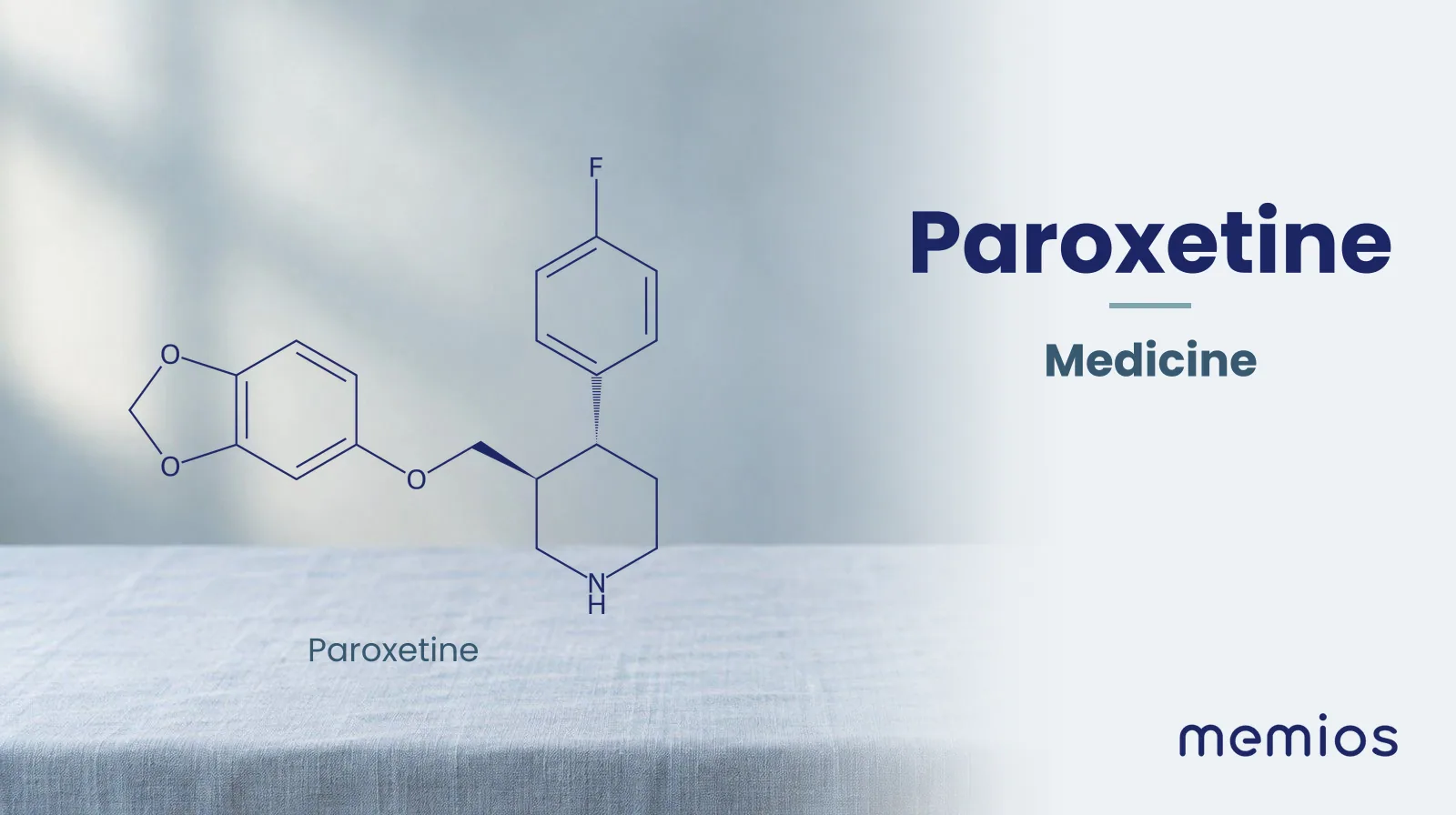
Paroxetine
The literature supports paroxetine as modestly more effective than placebo for adult depression, in line with other antidepressants, on evidence the largest network meta-analysis rated moderate to very low certainty.
TLDR
- Boxed warning: WARNING: SUICIDAL THOUGHTS AND BEHAVIORS.
- Well established. The literature supports paroxetine as modestly more effective than placebo for adult depression, in line with other antidepressants, on evidence the largest network meta-analysis rated moderate to very low certainty.
- What it is: Paroxetine is a prescription antidepressant of the selective serotonin reuptake inhibitor (SSRI) class, taken by mouth as a tablet, capsule, extended-release tablet or suspension. In the United States it is approved in adults for major depressive disorder, obsessive compulsive disorder, panic disorder.
- Main use: Major depressive disorder in adults (well supported).
- Other approved uses: Obsessive compulsive disorder, panic disorder, social anxiety disorder, generalised anxiety disorder and post-traumatic stress disorder in adults (limited evidence).
- Off-label uses (not on the FDA label): Premature ejaculation (limited evidence).
- Uses NOT supported by research: Depression in children and adolescents.
- Recommended dose: not established. There is no reference intake for a prescription drug; dosing is set by the prescriber. As a position, the US label (revised August 2024) gives a starting daily dose of 20 mg for major depressive disorder.
- Studied dose (a trial dose, not a recommendation): The abstracts we reached for Cipriani 2018, the restored Study 329 and the premature ejaculation meta-analysis do not state the paroxetine doses used, so we do not report them. No finding here cites that trial.
- Upper limit: As a position, the US label (revised August 2024) gives a maximum daily dose of 50 mg for major depressive disorder.
- What goes wrong: 7 findings on harm. That reanalysis also found clinically significant increases in harm on paroxetine, including suicidal ideation and behaviour.
- Interactions: 5 recorded, including Monoamine oxidase inhibitors, including linezolid and intravenous methylene blue, Tamoxifen, St John's wort, Tryptophan and 5-HTP-type serotonin precursor supplements.
- Common myth: Paroxetine was shown to be safe and effective in depressed teenagers, and any withdrawal on stopping is mild and brief.
What it is
Paroxetine is a prescription antidepressant of the selective serotonin reuptake inhibitor (SSRI) class, taken by mouth as a tablet, capsule, extended-release tablet or suspension. In the United States it is approved in adults for major depressive disorder, obsessive compulsive disorder, panic disorder, social anxiety disorder, generalised anxiety disorder and post-traumatic stress disorder. It carries a boxed warning about suicidal thoughts and behaviours and is not approved for use in children.
What the research says
The literature supports paroxetine as modestly more effective than placebo for adult depression, in line with other antidepressants, on evidence the largest network meta-analysis rated moderate to very low certainty. It failed in adolescents: the restored Study 329 found no efficacy advantage over placebo and more harm. Its distinguishing problems are a higher rate of sexual dysfunction and weight gain than most other second-generation antidepressants, and a discontinuation syndrome that is more common and more severe than with other SSRIs.
Evidence grade: Well established.
How it works
Drug class: Selective serotonin reuptake inhibitor (SSRI) antidepressant; potent irreversible inhibitor of CYP2D6
Paroxetine blocks the serotonin transporter, the pump that takes serotonin back into nerve endings after it has been released. Serotonin therefore stays in the synapse longer. The prevailing account is that this then leads, over weeks, to a downregulation of serotonin receptors, which is why the clinical effect lags behind the pharmacological one. (Source 1)
Boxed warning
WARNING: SUICIDAL THOUGHTS AND BEHAVIORS
(Source 2)
What it is used for
- In the largest network meta-analysis of antidepressants, all 21 drugs including paroxetine beat placebo, and paroxetine was among those more effective than other antidepressants in head-to-head trials. The authors rated the certainty of evidence moderate to very low. Evidence: established. (Source 3)
- These are approved adult indications on the US label. We did not reach condition-specific systematic reviews for each of them in this search, so the strength of evidence for each anxiety indication separately is not established here. Evidence: limited. (Source 2)
- The independent reanalysis of the original adolescent trial found no efficacy advantage over placebo on any prespecified outcome, and clinically significant increases in harms including suicidal ideation and behaviour. The US label states paroxetine is not approved for paediatric use. Evidence: not-supported. (Source 4)
- A systematic review and meta-analysis found paroxetine lengthened intravaginal ejaculatory latency time more than placebo, fluoxetine and escitalopram, but with high heterogeneity and no significant difference against several active comparators. Evidence: limited. (Source 5)
Interactions
- Monoamine oxidase inhibitors, including linezolid and intravenous methylene blue (label): Combining paroxetine with an MAOI is contraindicated because of the risk of serotonin syndrome. (Source 6)
- Tamoxifen (clinical trial): Paroxetine irreversibly blocks the CYP2D6 enzyme that converts tamoxifen into its active form, so tamoxifen may work less well. This is one of the better-documented antidepressant interactions. (Source 6)
- St John's wort (label): St John's wort is serotonergic. Taken with paroxetine it adds to the risk of serotonin syndrome, which the label describes as potentially life-threatening. (Source 6)
- Tryptophan and 5-HTP-type serotonin precursor supplements (label): Tryptophan is named in the label's list of serotonergic agents that raise the risk of serotonin syndrome when combined with paroxetine. (Source 6)
- Aspirin, NSAIDs, warfarin and other anticoagulants or antiplatelet drugs (including fish oil and other supplements taken for blood thinning, by the same mechanism) (label): Paroxetine reduces platelet serotonin and increases bleeding risk on its own; adding an antiplatelet or anticoagulant adds to that risk. The label names aspirin, NSAIDs and warfarin explicitly; it does not name fish oil or turmeric. (Source 6)
Stopping it
- The label instructs that the dose be reduced gradually rather than stopped abruptly whenever possible, because adverse reactions occur on discontinuation. (Source 7)
- The label lists what discontinuation can feel like, including the electric-shock sensations people often describe, and notes seizures among the reactions reported. (Source 7)
- Pharmacology reviews single paroxetine out: its discontinuation syndrome is described as more common and more severe than with other SSRIs, partly because it inhibits its own metabolism so blood levels fall steeply. (Source 1)
- Cochrane's review of stopping long-term antidepressants found a higher relapse risk after discontinuation, whether abrupt or tapered, but warned that the trials did not properly separate relapse from withdrawal and that the certainty was low to very low. (Source 8)
- A survey of people who had tried to stop an antidepressant found long duration of use was strongly associated with being unable to stop, which is a signal about stopping after years rather than months. It is self-report without a control group, so it cannot establish rates in the general population. (Source 9)
What goes wrong
That reanalysis also found clinically significant increases in harm on paroxetine, including suicidal ideation and behaviour. (Source 4)
- Randomized trial, Moderate certainty.
- Size: 275 adolescents.
- Who: Adolescents with major depression.
- How long: 8 weeks acute phase plus continuation.
- Result: Clinically significant increases in harms, including suicidal ideation and behaviour and other serious adverse events in the paroxetine group. The abstract does not give the event counts.
- Funding: independent (as above)
There were clinically significant increases in harms, including suicidal ideation and behaviour and other serious adverse events in the paroxetine group
Compared with other second-generation antidepressants, paroxetine caused more sexual dysfunction and more weight gain. (Source 10)
- Systematic review, Low certainty.
- Size: Systematic review and meta-analysis of comparative harms trials.
- Who: Adults taking second-generation antidepressants.
- How long: Varied.
- Result: Paroxetine associated with a higher incidence of sexual dysfunction and, with mirtazapine, higher weight gain. The review also states there was insufficient evidence to draw firm conclusions about serious adverse events such as suicidality, hyponatraemia and seizures, and that publication bias assessment was not reported.
- Funding: not stated.
mirtazapine and paroxetine were associated with higher weight gains. Paroxetine was associated with a higher incidence of sexual dysfunction and bupropion with a lower incidence.
In the label's pooled depression trials, nausea, drowsiness and ejaculatory problems were markedly commoner on paroxetine than placebo. (Source 11)
- Official position, Certainty not rated.
- Size: Pooled placebo-controlled trials underlying the US label.
- Who: Adults with major depressive disorder.
- How long: Short-term trials.
- Result: As rendered from the label's adverse reaction table (paroxetine % versus placebo %): nausea 26 versus 9, somnolence 23 versus 9, ejaculatory disturbance 13 versus 0. The qualifying criterion was an incidence of 5% or greater and at least twice that for placebo.
- Funding: not applicable (regulatory document)
Nausea | 26 | 9 Somnolence | 23 | 9 Ejaculatory Disturbance | 13 | 0
The label concedes that its own figures probably understate sexual side effects. (Source 11)
- Official position, Certainty not rated.
- Size: not stated.
- Who: Adults taking paroxetine.
- How long: not stated.
- Result: The label states estimates cited in labelling may underestimate the actual incidence of sexual problems, because patients and clinicians may be reluctant to raise them.
- Funding: not applicable (regulatory document)
Accordingly, estimates of the incidence of untoward sexual experience and performance cited in labeling may underestimate their actual incidence.
Paroxetine can cause low blood sodium, occasionally to a dangerous degree. (Source 11)
- Official position, Certainty not rated.
- Size: not stated.
- Who: Adults taking SSRIs including paroxetine; older people are noted elsewhere in the label as higher risk.
- How long: not stated.
- Result: Cases with serum sodium below 110 mmol/L reported. No rate is given in the section we read.
- Funding: not applicable (regulatory document)
Hyponatremia may occur as a result of treatment with SSRIs, including paroxetine. Cases with serum sodium lower than 110 mmol/L have been reported.
Discontinuation syndrome is more common and more severe with paroxetine than with other SSRIs. (Source 1)
- Expert review, not systematic, Low certainty.
- Size: not stated.
- Who: People stopping paroxetine.
- How long: Onset after dose reduction or stopping.
- Result: Described as more common and more severe than with other SSRIs, attributed partly to paroxetine inhibiting its own metabolism. Symptoms listed include dizziness, lethargy, nausea, vomiting, headache, fever, chills, vivid dreams and electric shock-like sensations.
- Funding: not stated.
Discontinuation syndrome is more common and more severe with paroxetine than with other SSRIs; this may be due in part to the fact that it inhibits its own metabolism.
In a survey of primary care psychotherapy patients, withdrawal symptoms on stopping antidepressants were common and often severe or prolonged. (Source 9)
- Survey study, Very low certainty.
- Size: Survey respondents enrolled in primary care psychotherapy services (self-report, not paroxetine-specific)
- Who: People who had tried to stop an antidepressant.
- How long: Recalled experience; 20% reported symptoms lasting more than three months.
- Result: 79% reported withdrawal symptoms of some degree, 45% severe or moderately severe, 43% met the most stringent withdrawal-syndrome definition, 38% were unable to stop, 20% had symptoms lasting more than three months and 10% for more than a year. Use for over 24 months was associated with a withdrawal syndrome (OR 10.41, 95% CI 2.88 to 37.67) versus use under six months. This is a self-selected survey with no control group.
- Funding: not stated.
Withdrawal symptoms of some degree were reported by 79 %. 45 % reported severe or moderately severe symptoms.
What the evidence supports
Across 522 randomised trials, every antidepressant studied including paroxetine was more effective than placebo for acute adult depression, on evidence rated moderate to very low certainty. (Source 3)
- Meta-analysis, Moderate certainty.
- Size: 522 trials, 116,477 participants.
- Who: Adults with major depressive disorder.
- How long: Acute treatment, typically 8 weeks.
- Result: Odds ratios versus placebo ranged from 2.13 (amitriptyline) to 1.38 (reboxetine). In head-to-head trials paroxetine was among the drugs more effective than other antidepressants (OR range 1.12-2.00). The abstract reports odds ratios only, not absolute response rates or NNTs.
- Funding: independent (the published trial was funded by the UK National Institute for Health Research and others; this repository record does not state funding)
In terms of efficacy, all antidepressants were more effective than placebo, with OR ranging between 2.13 for amitriptyline and 1.38 for reboxetine.
Paroxetine ranked among the more effective antidepressants in direct comparisons, though confidence intervals on most comparisons were wide. (Source 3)
- Meta-analysis, Low certainty.
- Size: Head-to-head subset of the 522 trials.
- Who: Adults with major depressive disorder.
- How long: Acute treatment.
- Result: Paroxetine named among drugs more effective than other antidepressants, OR range 1.12-2.00; differences between antidepressants ranged 1.15 to 1.55 for efficacy with wide confidence intervals on most comparative analyses.
- Funding: independent (as above)
In head-to-head studies, agomelatine, amitriptyline, escitalopram, mirtazapine, paroxetine, sertraline, venlafaxine and vortioxetine were more effective than other antidepressants (OR range: 1.12-2.00)
What the evidence does not support
In the independent reanalysis of the original adolescent trial, paroxetine did not beat placebo on any prespecified efficacy outcome. (Source 4)
- Randomized trial, Moderate certainty.
- Size: 275 adolescents randomised to paroxetine, imipramine or placebo.
- Who: Adolescents with major depression.
- How long: 8 weeks acute phase.
- Result: HAM-D scores fell 10.7 points (95% CI 9.1 to 12.3) on paroxetine, 9.0 (7.4 to 10.5) on imipramine and 9.1 (7.5 to 10.7) on placebo, P=0.20.
- Funding: independent - this research received no specific grant from any funding agency (the original trial was sponsored by SmithKline Beecham)
The efficacy of paroxetine and imipramine was not statistically or clinically significantly different from placebo for any prespecified primary or secondary efficacy outcome.
Where the evidence is mixed
The same network meta-analysis rated its own evidence base as moderate to very low certainty. (Source 3)
- Meta-analysis, Low certainty.
- Size: 522 trials, 116,477 participants.
- Who: Adults with major depressive disorder.
- How long: Acute treatment.
- Result: Certainty of evidence rated moderate to very low; wide confidence intervals on most comparative analyses.
- Funding: independent (as above)
We included 522 trials with 116,477 participants. The certainty of evidence was moderate to very low.
Cochrane found that stopping long-term antidepressants raised the risk of relapse, but the trials did not measure withdrawal symptoms properly, and the certainty was very low. (Source 8)
- Systematic review, Very low certainty.
- Size: 33 studies, 4,995 participants; relapse analyses of 1,373 and 1,546 participants.
- Who: Adults on long-term antidepressants for depressive or anxiety disorders.
- How long: Varied.
- Result: Abrupt discontinuation without psychological support: relapse HR 2.09 (95% CI 1.59 to 2.74); adverse events OR 1.11 (95% CI 0.62 to 1.99). Tapered discontinuation: relapse HR 2.97 (95% CI 2.24 to 3.93); adverse events OR 1.06 (95% CI 0.82 to 1.38). Certainty low to very low throughout.
- Funding: independent (Cochrane)
Overall, the certainty of evidence was low to very low. This means we have limited or little confidence in the results, and new research is likely to change our conclusions.
For premature ejaculation, paroxetine beat placebo on ejaculatory latency but did not beat several active comparators, and the pooling was heterogeneous. (Source 5)
- Meta-analysis, Low certainty.
- Size: Randomised trials pooled in the systematic review.
- Who: Men with premature ejaculation.
- How long: Varied.
- Result: Greater increase in intravaginal ejaculatory latency time than placebo, fluoxetine and escitalopram (all p < 0.05), with a high level of heterogeneity in the paroxetine versus placebo comparison. No significant difference against tramadol, sertraline, PDE5 inhibitors, lidocaine gel, behaviour therapy or dapoxetine.
- Funding: not stated.
Comparing paroxetine with tramadol, sertraline, phosphodiesterase 5 inhibitors (PDE5Is), local lidocaine gel, behaviour therapy or dapoxetine, we found that the increase in IELT was not statistically significant between groups.
Where the research disagrees
How severe and how common antidepressant withdrawal is
- Cochrane review of discontinuation approaches (Van Leeuwen and colleagues, 2021), systematic review of randomised discontinuation trials, certainty low to very low: Evidence about the effects of abrupt discontinuation on withdrawal symptoms (1 study) is very uncertain. (Source 8)
- Survey of primary care psychotherapy patients (Psychiatry Research, 2025), cross-sectional self-report survey, no control group: Withdrawal symptoms of some degree were reported by 79 %. 45 % reported severe or moderately severe symptoms. (Source 9)
How much
- Reference intake: There is no reference intake for a prescription drug; dosing is set by the prescriber. As a position, the US label (revised August 2024) gives a starting daily dose of 20 mg for major depressive disorder. (Source 2)
- Upper limit: As a position, the US label (revised August 2024) gives a maximum daily dose of 50 mg for major depressive disorder. (Source 2)
- Studied: The abstracts we reached for Cipriani 2018, the restored Study 329 and the premature ejaculation meta-analysis do not state the paroxetine doses used, so we do not report them. The label range we could quote verbatim for major depressive disorder is a 20 mg starting dose and a 50 mg maximum daily dose. (Source 2)
A common belief, and what the research shows
The belief: Paroxetine was shown to be safe and effective in depressed teenagers, and any withdrawal on stopping is mild and brief.
What the research shows: The independent reanalysis of the original adolescent trial found the opposite on both counts: "The efficacy of paroxetine and imipramine was not statistically or clinically significantly different from placebo for any prespecified primary or secondary efficacy outcome." and "There were clinically significant increases in harms, including suicidal ideation and behaviour and other serious adverse events in the paroxetine group". On stopping, pharmacology reviews record that "Discontinuation syndrome is more common and more severe with paroxetine than with other SSRIs; this may be due in part to the fact that it inhibits its own metabolism." The randomised evidence on withdrawal itself remains weak: Cochrane rated it low to very low certainty.
Questions and answers
What is it?
Paroxetine is a prescription antidepressant in the SSRI class, taken by mouth. In adults it is approved for major depressive disorder, obsessive compulsive disorder, panic disorder, social anxiety disorder, generalised anxiety disorder and post-traumatic stress disorder. It is not approved for children. (Source 2)
What does it do in the body?
It blocks the serotonin transporter, the pump that pulls serotonin back into nerve endings, so serotonin stays in the synapse longer. The standard account is that this leads over weeks to downregulation of serotonin receptors, which fits the delay before people feel a change. (Source 1)
Is it good or bad for you?
For adult depression it works better than placebo, in line with other antidepressants, on evidence the biggest review rated moderate to very low certainty. In adolescents the reanalysed trial found no benefit and more harm, and the drug carries a boxed warning about suicidal thoughts in young people. It also causes more sexual dysfunction and weight gain than most other modern antidepressants, and the worst discontinuation syndrome of the SSRIs. (Source 2)
How do you get more of it?
Paroxetine is prescription-only, so the amount is set by a prescriber. As a position, the US label gives a starting dose of 20 mg daily and a maximum of 50 mg daily for major depressive disorder. No food, drink or supplement contains it. (Source 2)
If it is harmful, what reduces it?
Coming off paroxetine is the part the literature treats carefully. The label says to reduce the dose gradually rather than stop abruptly. Pharmacology reviews note that paroxetine's discontinuation syndrome is worse than other SSRIs because it inhibits its own metabolism, so levels drop sharply when doses are missed. (Source 7)
Why might someone be low in it or missing it?
Nobody is naturally low in paroxetine; the body does not make it. People come off it or never start it for documented reasons: it is contraindicated with MAOIs, it can reduce the effect of tamoxifen through CYP2D6 inhibition, it increases bleeding risk with aspirin, NSAIDs or anticoagulants, and side effects such as sexual dysfunction and weight gain lead people to stop. (Source 6)
Which whole foods contain it or feed it?
Does not apply: no whole food contains paroxetine. What matters on the food and supplement side is the opposite direction. Serotonergic supplements such as St John's wort and tryptophan are named in the label as raising the risk of serotonin syndrome when combined with paroxetine. (Source 6)
What happens if you do not have it?
Most people never take it and are fine. For someone already on it long term, the evidence on stopping shows a higher relapse rate than staying on, both after abrupt and after tapered discontinuation, though Cochrane warned the trials could not separate true relapse from withdrawal and rated the certainty low to very low. (Source 8)
How can you test for it?
There is no routine blood test to measure paroxetine or to decide whether it is working; response is judged on symptom scales such as the HAM-D used in trials. What is sometimes tested is a specific harm, low blood sodium, which the label records can fall below 110 mmol/L in reported cases. (Source 11)
References
- StatPearls Publishing, NCBI Bookshelf. Paroxetine - StatPearls. 2023. PMID 29939650. Read the source
- DailyMed, US National Library of Medicine. PAROXETINE HYDROCHLORIDE tablet, film coated - US prescribing information, boxed warning, indications and dosage (label revised August 2024). 2024. Read the source
- The Lancet (abstract as held in the University of Bristol research repository). Comparative efficacy and acceptability of 21 antidepressant drugs for the acute treatment of adults with major depressive disorder: a systematic review and network meta-analysis. 2018. PMID 29477251, DOI 10.1016/S0140-6736(17)32802-7. Read the source
- The BMJ. Restoring Study 329: efficacy and harms of paroxetine and imipramine in treatment of major depression in adolescence. 2015. PMID 26376805, DOI 10.1136/bmj.h4320. Read the source
- BMC Urology. Paroxetine in the treatment of premature ejaculation: a systematic review and meta-analysis. 2019. PMID 30606186, DOI 10.1186/s12894-018-0431-7. Read the source
- DailyMed, US National Library of Medicine. PAROXETINE HYDROCHLORIDE tablet, film coated - US prescribing information, contraindications, warnings and drug interactions. 2024. Read the source
- DailyMed, US National Library of Medicine. PAROXETINE HYDROCHLORIDE tablet, film coated - US prescribing information, discontinuation of treatment sections. 2024. Read the source
- Cochrane Database of Systematic Reviews (Cochrane). Stopping long-term antidepressants in people with depression or anxiety (plain language summary of 'Approaches for discontinuation versus continuation of long-term antidepressant use for depressive and anxiety disorders in adults'). 2021. PMID 33886130, DOI 10.1002/14651858.CD013495.pub2. Read the source
- Psychiatry Research (version of record, UCL Discovery). Antidepressants withdrawal effects and duration of use: a survey of patients enrolled in primary care psychotherapy services. 2025. Read the source
- Centre for Reviews and Dissemination, Database of Abstracts of Reviews of Effects (DARE), NCBI Bookshelf. Comparative risk for harms of second-generation antidepressants: a systematic review and meta-analysis (CRD/DARE structured abstract of Gartlehner G, Thieda P, Hansen RA, et al., Drug Safety 2008). 2008. PMID 18759509, DOI 10.2165/00002018-200831100-00004. Read the source
- DailyMed, US National Library of Medicine. PAROXETINE HYDROCHLORIDE tablet, film coated - US prescribing information, adverse reactions and hyponatremia sections. 2024. Read the source