Supplements · September 29, 2026 · Memios · 16 min read
Paraxanthine
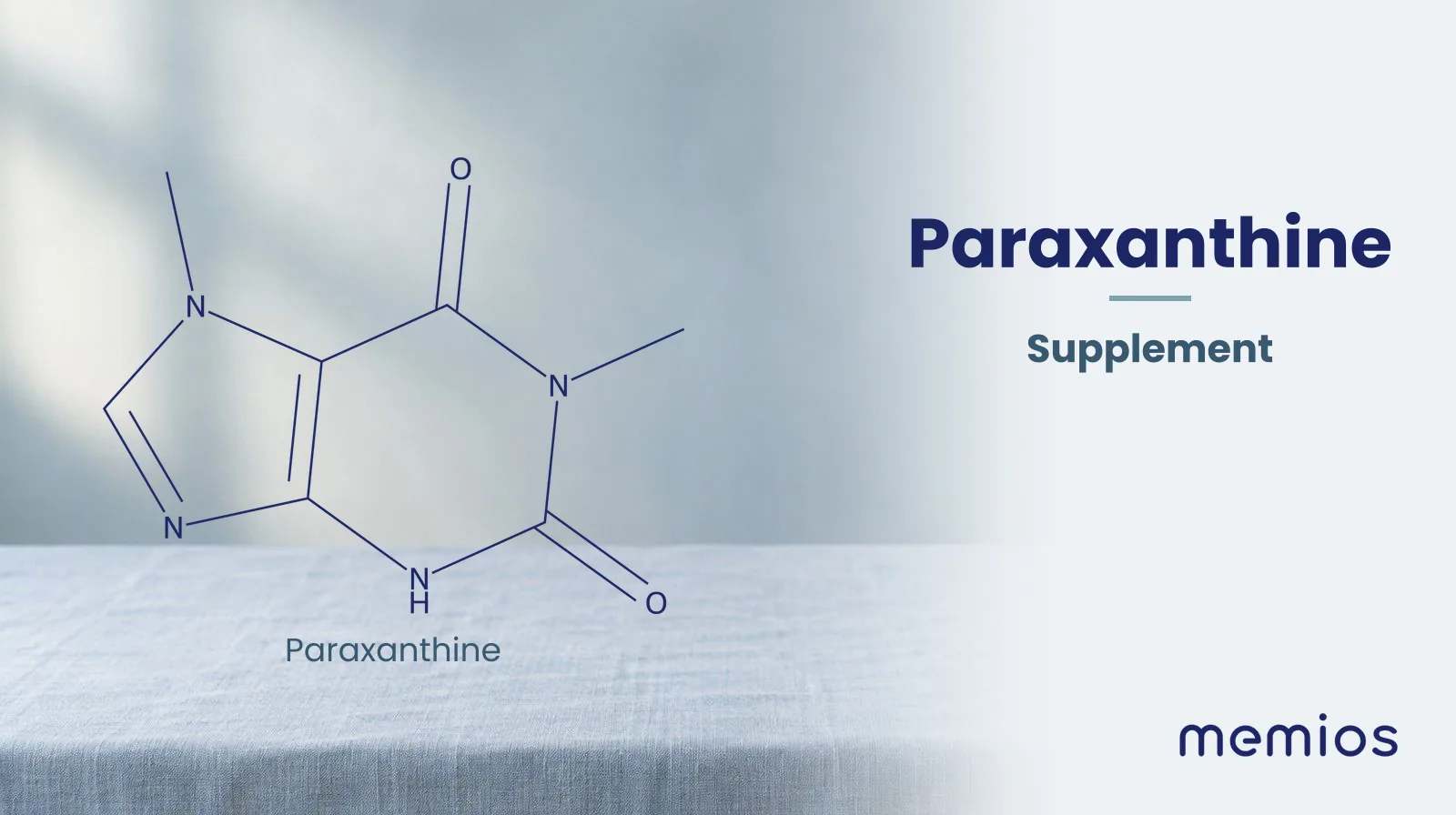
Paraxanthine is a stimulant with pharmacology similar to caffeine, which is unsurprising since it is what most caffeine turns into.
TLDR
- Limited evidence. Paraxanthine is a stimulant with pharmacology similar to caffeine, which is unsurprising since it is what most caffeine turns into.
- What it is: Paraxanthine is a dimethylxanthine and the main product the human body makes when it breaks caffeine down. N-3 demethylation of caffeine by the liver enzyme CYP1A2 accounts for around 80 to 90 per cent of caffeine demethylation, and that reaction produces paraxanthine.
- Main use, supported: A manufacturer-funded acute crossover trial in 13 volunteers reported that 200 mg of paraxanthine improved some measures of short-term memory, reasoning and response time compared with placebo. (low certainty)
- Other use, supported: A dose-response crossover trial in 12 volunteers, funded by the ingredient manufacturer, reported acute and short-term cognitive benefits at every dose from 50 to 200 mg, with more consistent effects at 100 and 200 mg. (low certainty)
- Claim NOT supported by research: In the same 13-person acute trial, the pre-specified statistical model for the Sternberg short-term memory task found no significant treatment-by-time effects on reaction time. (low certainty)
- Another claim NOT supported: In the dose-response trial, no significant differences were found between doses after seven days of daily supplementation, and response time in the 100 mg arm was actually higher than at baseline. (low certainty)
- Recommended dose: not established. No reference intake exists. Paraxanthine is not an essential nutrient; in almost everyone it is present only because the body made it from caffeine, with N-3 demethylation of caffeine accounting for around 80 to 90 per cent of caffeine demethylation.
- Studied dose (a trial dose, not a recommendation): A crossover trial in 13 healthy volunteers gave a single 200 mg capsule of paraxanthine or placebo. Findings citing that trial: 1 for.
- Upper limit: No government body has set a tolerable upper intake or acceptable daily intake for paraxanthine that we could find.
- What goes wrong: 2 findings on harm. Paraxanthine is acutely toxic to rats at high doses, with an oral LD50 of 829 mg/kg body weight, and its 90-day no-observed-adverse-effect level was 185 mg/kg body weight.
- Common myth: Paraxanthine is a proven, cleaner caffeine - all the focus, none of the jitters or crash.
What it is
Paraxanthine is a dimethylxanthine and the main product the human body makes when it breaks caffeine down. N-3 demethylation of caffeine by the liver enzyme CYP1A2 accounts for around 80 to 90 per cent of caffeine demethylation, and that reaction produces paraxanthine. Since about 2021 it has also been sold as a purified ingredient in its own right, mostly under the trade name enfinity, marketed as a caffeine alternative.
What the research says
Paraxanthine is a stimulant with pharmacology similar to caffeine, which is unsurprising since it is what most caffeine turns into. The human evidence for taking it as a supplement is thin: the trials we could reach are acute crossover studies in 12 and 13 healthy volunteers, funded by the ingredient's manufacturer and co-authored by its principals, testing 50 to 200 mg over six hours and a seven-day period. They reported scattered improvements on some cognitive tests and, in the same papers, no significant differences on many of the other measures they took. The toxicology is animal work: a rat acute oral LD50 of 829 mg/kg and a 90-day no-observed-adverse-effect level of 185 mg/kg, and the toxicologists themselves state that human toxicity studies are scarce.
Evidence grade: Limited evidence.
What goes wrong
Paraxanthine is acutely toxic to rats at high doses, with an oral LD50 of 829 mg/kg body weight, and its 90-day no-observed-adverse-effect level was 185 mg/kg body weight. (Source 1)
- Animal study, Low certainty.
- Size: Sprague Dawley rats, 5 per sex per group in the 14-day study and 10 animals per sex per group in the 90-day study.
- Who: rats, both sexes.
- How long: acute, 14-day and 90-day repeat-dose studies.
- Result: Acute oral LD50 829.20 mg/kg bw; no mortality or treatment-related adverse effects at 50, 100 or 150 mg/kg bw over 14 days, or at 100, 150 or 185 mg/kg bw over 90 days; 90-day NOAEL 185 mg/kg bw for paraxanthine versus 150 mg/kg bw for caffeine, with mortality in two animals in the high-dose caffeine group.
- Funding: industry-linked: the test article was paraxanthine from Rarebird, Inc.
An acute oral LD50 of 829.20 mg/kg body weight (bw) was established.
The toxicologists who ran that animal programme state plainly that human toxicity studies on paraxanthine are scarce, so its human safety profile is not yet characterised. (Source 2)
- Expert review, not systematic, Very low certainty.
- Size: not applicable - narrative appraisal of the existing literature within a toxicology paper.
- Who: humans.
- How long: not applicable.
- Result: No quantitative estimate: the authors describe the available human toxicity literature as scarce and say thorough characterisation is required before widespread incorporation into foods and beverages.
- Funding: industry-linked: study test article supplied by Rarebird, Inc.
Although human toxicity studies on paraxanthine are scarce, the few studies that have been conducted in humans demonstrate a lack of adverse events.
What the evidence supports
A manufacturer-funded acute crossover trial in 13 volunteers reported that 200 mg of paraxanthine improved some measures of short-term memory, reasoning and response time compared with placebo. (Source 3)
- Randomized trial, Low certainty.
- Size: 13 participants.
- Who: healthy male and female adults.
- How long: single dose, tested hourly to 6 hours, with a 7-day washout between treatments.
- Result: Berg Wisconsin Card Sorting errors reduced by 4.7 (95% CI -0.2 to -9.20), p = 0.04, and perseverative errors by 2.2 (-4.2 to -0.2), p = 0.03, at hour 6; six-letter Sternberg absent reaction time 86.5 ms faster (-165 to -7.2), p = 0.03, at 2 hours.
- Funding: industry-linked: the supplement was ENFINITY, supplied by Ingenious Ingredients, L.P., and the companion dose-response paper from the same group states that company funded the work.
crossover, and counterbalanced manner, 13 healthy male and female participants were randomly assigned to consume a placebo (PLA) or 200 mg of PXN (ENFINITY™, Ingenious Ingredients, L.P.).
A dose-response crossover trial in 12 volunteers, funded by the ingredient manufacturer, reported acute and short-term cognitive benefits at every dose from 50 to 200 mg, with more consistent effects at 100 and 200 mg. (Source 4)
- Randomized trial, Low certainty.
- Size: 12 participants.
- Who: healthy male and female volunteers, mean age 22.7 years.
- How long: single dose tested to 6 hours, then daily dosing for 6 days with retesting on day 7; at least 7-day washout between treatments.
- Result: Doses compared were placebo, 50 mg, 100 mg and 200 mg paraxanthine; the authors report several significant differences from baseline on card-sorting and Sternberg measures but the Sternberg 4-letter present reaction time only tended to differ among groups (p = 0.06)
- Funding: industry-funded: Ingenious Ingredients, L.P. funded the study as a fee-for-service project, and the paper's Conflicts of Interest statement records that three authors are researchers and principals for the sponsor and inventors on paraxanthine patent applications.
Ingenious Ingredients, L.P. (Lewisville, TX, USA) funded this study as a fee for service project awarded to the Human Clinical Research Facility at Texas A&M University.
In the 13-person acute trial no participant reported any subjective side effect or adverse event after a single 200 mg dose, which is short-term tolerability in a very small sample rather than evidence of safety. (Source 5)
- Randomized trial, Low certainty.
- Size: 13 participants.
- Who: healthy male and female adults.
- How long: single dose, followed for 6 hours.
- Funding: industry-linked: supplement supplied by Ingenious Ingredients, L.P.
No subjective side effects or adverse events were reported by participants in response to the acute ingestion of PXN.
What the evidence does not support
In the same 13-person acute trial, the pre-specified statistical model for the Sternberg short-term memory task found no significant treatment-by-time effects on reaction time. (Source 6)
- Randomized trial, Low certainty.
- Size: 13 participants.
- Who: healthy male and female adults.
- How long: single dose, tested hourly to 6 hours.
- Result: No significant overall or univariate treatment-by-time interaction effects in the Sternberg reaction time data (Results section 4.2.3). The paper's positive claims rested on changes-from-baseline with confidence intervals rather than on these interaction models.
- Funding: industry-linked: supplement supplied by Ingenious Ingredients, L.P.
No significant overall or univariate treatment × time interaction effects were observed from GLM analysis using weight as a covariate in reaction time data.
In the dose-response trial, no significant differences were found between doses after seven days of daily supplementation, and response time in the 100 mg arm was actually higher than at baseline. (Source 7)
- Randomized trial, Low certainty.
- Size: 12 participants.
- Who: healthy male and female volunteers.
- How long: acute to 6 hours plus 7 days of daily dosing.
- Result: No significant differences among treatments after 7 days of supplementation; response time was higher than baseline in the 100 mg paraxanthine arm (Results section 4.2.2)
- Funding: industry-funded: Ingenious Ingredients, L.P.
No significant differences were observed among treatments after 7 days of supplementation although response time was higher than baseline in the PX 100 treatment.
The same trial's card-sorting task showed the same pattern: no significant treatment-by-time effects on correct responses, errors or perseverative errors. (Source 8)
- Randomized trial, Low certainty.
- Size: 13 participants.
- Who: healthy male and female adults.
- How long: single dose, tested hourly to 6 hours.
- Funding: industry-linked: supplement supplied by Ingenious Ingredients, L.P.
No significant overall or univariate treatment × time interaction effects were observed from GLM analysis using weight as a covariate in correct responses, errors, perseverative errors (PEBL), or perseverative errors (PAR rules).
The dose-response trial reported no significant overall or treatment-by-time effects on any of the go/no-go variables, with the results placed in a supplementary table. (Source 9)
- Randomized trial, Low certainty.
- Size: 12 participants.
- Who: healthy male and female volunteers, mean age 22.7 years.
- How long: acute to 6 hours plus 7 days of daily dosing.
- Funding: industry-funded: Ingenious Ingredients, L.P.
As shown in Table S3, no significant overall or treatment x time effects were observed among GNG related variables.
In the dose-response trial there were no significant differences between doses in the frequency or severity of the stimulant side effects the investigators asked about, including tachycardia, heart palpitations and nervousness. (Source 10)
- Randomized trial, Low certainty.
- Size: 12 participants.
- Who: healthy male and female volunteers.
- How long: acute to 6 hours plus 7 days of daily dosing.
- Funding: industry-funded: Ingenious Ingredients, L.P.; three authors are principals for the sponsor and inventors on paraxanthine patent applications.
Likewise, no significant differences among treatments were observed in the frequency or severity of dizziness, headache, tachycardia, heart palpitations, shortness of breath, nervousness, or blurred vision.
Where the evidence is mixed
The regulatory basis for selling paraxanthine in food is a self-affirmed GRAS determination made by the manufacturer in 2021, not an FDA review. (Source 11)
- Official position, Certainty not rated.
- Size: not applicable - company regulatory position.
- Who: United States food and supplement market.
- How long: position announced 23 November 2021.
- Result: Self-affirmed generally-recognised-as-safe status for use in energy beverages, decaffeinated coffee beverages and powders, and nutrition and cereal bars at levels up to 300 mg. The report contains no indication that the FDA reviewed the determination.
- Funding: company position (Ingenious Ingredients), reported in trade press.
The GRAS status was determined using established scientific procedures, and confirmed the safety of the ingredient for use in energy beverages, decaffeinated coffee beverages and powders, and nutrition and cereal bars in levels up to 300 mg.
Where the research disagrees
Whether paraxanthine is a safer alternative to caffeine
- Toxicology group behind the rat programme (Frontiers in Toxicology, 2023), acute, 14-day and 90-day oral toxicity studies in rats plus in-vitro genotoxicity: These findings may suggest that paraxanthine could be a safer alternative to caffeine in humans. (Source 1)
- The same paper on the human evidence, narrative appraisal of the existing human literature: The few toxicity studies that are available for paraxanthine suggest that the molecule is relatively safe, although thorough characterization of its safety is required prior to widespread incorporation into foods/beverages. (Source 12)
- Ingenious Ingredients (2021), company self-affirmed GRAS determination, not an FDA review: Ingenious Ingredients (Ing2) has announced it has achieved self-affirmed GRAS (generally recognized as safe) status for its Enfinity-branded paraxanthine ingredient for use in food and beverages. (Source 11)
How much
- Reference intake: No reference intake exists. Paraxanthine is not an essential nutrient; in almost everyone it is present only because the body made it from caffeine, with N-3 demethylation of caffeine accounting for around 80 to 90 per cent of caffeine demethylation. (Source 13)
- Upper limit: No government body has set a tolerable upper intake or acceptable daily intake for paraxanthine that we could find. The only ceiling on record is the manufacturer's own 2021 self-affirmed GRAS determination, which covers use at levels up to 300 mg in named food categories and was not reviewed by the FDA. (Source 11)
- Studied: A crossover trial in 13 healthy volunteers gave a single 200 mg capsule of paraxanthine or placebo. (Source 3)
- Studied: A dose-response crossover trial in 12 healthy volunteers compared placebo with 50 mg, 100 mg and 200 mg of paraxanthine, acutely and then daily for seven days. (Source 14)
- Studied: Rat toxicology used 50, 100 and 150 mg/kg body weight over 14 days and 100, 150 and 185 mg/kg body weight over 90 days. (Source 12)
A common belief, and what the research shows
The belief: Paraxanthine is a proven, cleaner caffeine - all the focus, none of the jitters or crash.
What the research shows: The human trials behind that marketing are two crossover studies in 12 and 13 volunteers, paid for by the ingredient's maker and co-authored by its principals: “Ingenious Ingredients, L.P. (Lewisville, TX, USA) funded this study as a fee for service project awarded to the Human Clinical Research Facility at Texas A&M University.” The dose-response paper's own Conflicts of Interest statement adds that “R.J., M.P. and S.D.W. are researchers and principals for the sponsor of the study, and inventors of numerous patent application for the use of paraxanthine”. The same papers report a long list of measures that did not move, including “As shown in Table S3, no significant overall or treatment x time effects were observed among GNG related variables.” The favourable safety comparison with caffeine comes from rats, not people, and the toxicologists who did that work note that “Although human toxicity studies on paraxanthine are scarce, the few studies that have been conducted in humans demonstrate a lack of adverse events.”
Questions and answers
What is it?
Paraxanthine, or 1,7-dimethylxanthine, is the substance your body turns most of your caffeine into. The liver enzyme CYP1A2 removes a methyl group from caffeine, and that single reaction accounts for around 80 to 90 per cent of caffeine breakdown. Since 2021 it has also been sold as a purified supplement ingredient. (Source 13)
What does it do in the body?
It acts as a stimulant with pharmacology described as similar to caffeine's. What it does when taken on its own has only been tested in small acute trials in healthy volunteers, which found scattered changes on some cognitive tests and no change on many others. (Source 12)
Is it good or bad for you?
Everyone who drinks coffee already makes it, and at those levels it is simply part of normal caffeine handling. As a supplement the honest answer is that nobody yet knows: the animal toxicology is reassuring up to 185 mg/kg body weight over 90 days in rats, but the toxicologists who produced it say the human safety literature is scarce. (Source 2)
How do you get more of it?
The ordinary route is caffeine: anything containing caffeine produces paraxanthine as it is metabolised. It is also sold directly as a purified ingredient, and the trials that exist gave single capsules of 50, 100 or 200 mg. That is a description of what was studied, not a suggestion about what to take. (Source 14)
If it is harmful, what reduces it?
We found nothing in the literature on deliberately lowering paraxanthine, and no condition in which that is a goal. It is a normal caffeine metabolite that is cleared along with caffeine, so the only lever described anywhere is consuming less caffeine or less paraxanthine. The closest thing to a safety ceiling on record is a manufacturer's self-affirmed GRAS determination, not a limit set by a health body. (Source 12)
We searched: Searched for paraxanthine elimination, clearance, detoxification, reduction and antidote alongside toxicity and adverse-event terms; searched the toxicology programme and the two human crossover trials; searched for a government upper limit or acceptable daily intake. Nothing addressed reducing paraxanthine in the body.
Why might someone be low in it or missing it?
Because it comes from caffeine, someone will have little or no paraxanthine if they consume little or no caffeine. Beyond that, how much a given caffeine intake produces varies a great deal between people, and identifying the causes of that variability is still an open research problem. (Source 15)
Which whole foods contain it or feed it?
No whole food is a meaningful direct source. You get paraxanthine by consuming caffeine-containing foods and drinks - coffee, tea, cocoa, energy drinks - and letting your liver convert it, since that conversion accounts for around 80 to 90 per cent of caffeine breakdown. (Source 15)
What happens if you do not have it?
There is no described deficiency state. Paraxanthine is not an essential nutrient and no paper we reached reports any consequence of having none of it; people who consume no caffeine make none, and no harm is attributed to that. The literature on paraxanthine consists of animal toxicology and small acute human trials of taking more, not of lacking it. (Source 12)
We searched: Searched for paraxanthine deficiency, low paraxanthine, paraxanthine requirement and essentiality; reviewed the Frontiers in Toxicology safety paper and both human crossover trials; none describes a deficiency syndrome or any consequence of absence.
How can you test for it?
There is no routine clinical test. In research, paraxanthine is measured in blood or saliva alongside caffeine after a measured caffeine dose, and the ratio between the two is used to phenotype the CYP1A2 enzyme and to assess liver function. That is a test of enzyme activity, not of a paraxanthine deficiency, and no reference range for paraxanthine status exists. (Source 16)
References
- Frontiers in Toxicology. Paraxanthine safety and comparison to caffeine (methods and toxicology results passages). 2023. DOI 10.3389/ftox.2023.1117729. Read the source
- Frontiers in Toxicology. Paraxanthine safety and comparison to caffeine (Introduction, the two consecutive sentences on the human evidence base). 2023. DOI 10.3389/ftox.2023.1117729. Read the source
- Nutrients. Acute Paraxanthine Ingestion Improves Cognition and Short-Term Memory and Helps Sustain Attention in a Double-Blind, Placebo-Controlled, Crossover Trial. 2021. PMID 34836235, DOI 10.3390/nu13113980. Read the source
- Nutrients. Xing et al. – Dose-Response of Paraxanthine on Cognitive Function: A Double Blind, Placebo Controlled, Crossover Trial (Funding statement). 2021. DOI 10.3390/nu13124478. Read the source
- Nutrients. Acute Paraxanthine Ingestion Improves Cognition and Short-Term Memory and Helps Sustain Attention in a Double-Blind, Placebo-Controlled, Crossover Trial (Results section 4.3, Safety Assessment). 2021. PMID 34836235, DOI 10.3390/nu13113980. Read the source
- Nutrients. Acute Paraxanthine Ingestion Improves Cognition and Short-Term Memory and Helps Sustain Attention in a Double-Blind, Placebo-Controlled, Crossover Trial (Results section 4.2.3, Sternberg Task Test). 2021. PMID 34836235, DOI 10.3390/nu13113980. Read the source
- Nutrients. Xing et al. – Dose-Response of Paraxanthine on Cognitive Function: A Double Blind, Placebo Controlled, Crossover Trial (Results section 4.2.2, after 7 days of supplementation). 2021. DOI 10.3390/nu13124478. Read the source
- Nutrients. Acute Paraxanthine Ingestion Improves Cognition and Short-Term Memory and Helps Sustain Attention in a Double-Blind, Placebo-Controlled, Crossover Trial (Results section 4.2.1, Berg Wisconsin Card Sorting Test). 2021. PMID 34836235, DOI 10.3390/nu13113980. Read the source
- Nutrients. Xing et al. – Dose-Response of Paraxanthine on Cognitive Function: A Double Blind, Placebo Controlled, Crossover Trial (Results section 4.2.2, Go/No-Go summary sentence). 2021. DOI 10.3390/nu13124478. Read the source
- Nutrients. Xing et al. – Dose-Response of Paraxanthine on Cognitive Function: A Double Blind, Placebo Controlled, Crossover Trial (Discussion, side effect and adverse event comparison). 2021. DOI 10.3390/nu13124478. Read the source
- NutraIngredients-USA. Ingenious Ingredients self-affirms GRAS status for paraxanthine ingredient. 2021. Read the source
- Frontiers in Toxicology. Paraxanthine safety and comparison to caffeine. 2023. DOI 10.3389/ftox.2023.1117729. Read the source
- Frontiers in Pharmacology. Pharmacokinetics of Caffeine: A Systematic Analysis of Reported Data for Application in Metabolic Phenotyping and Liver Function Testing (Introduction, three consecutive sentences on caffeine demethylation). 2022. DOI 10.3389/fphar.2021.752826. Read the source
- Nutrients. Xing et al. – Dose-Response of Paraxanthine on Cognitive Function: A Double Blind, Placebo Controlled, Crossover Trial (Methods, participants and treatments). 2021. DOI 10.3390/nu13124478. Read the source
- Frontiers in Pharmacology. Pharmacokinetics of Caffeine: A Systematic Analysis of Reported Data for Application in Metabolic Phenotyping and Liver Function Testing (abstract). 2022. DOI 10.3389/fphar.2021.752826. Read the source
- Frontiers in Pharmacology. Pharmacokinetics of Caffeine: A Systematic Analysis of Reported Data for Application in Metabolic Phenotyping and Liver Function Testing (Introduction, first paragraph on the applications of caffeine). 2022. DOI 10.3389/fphar.2021.752826. Read the source