Medications · September 29, 2026 · Memios · 12 min read
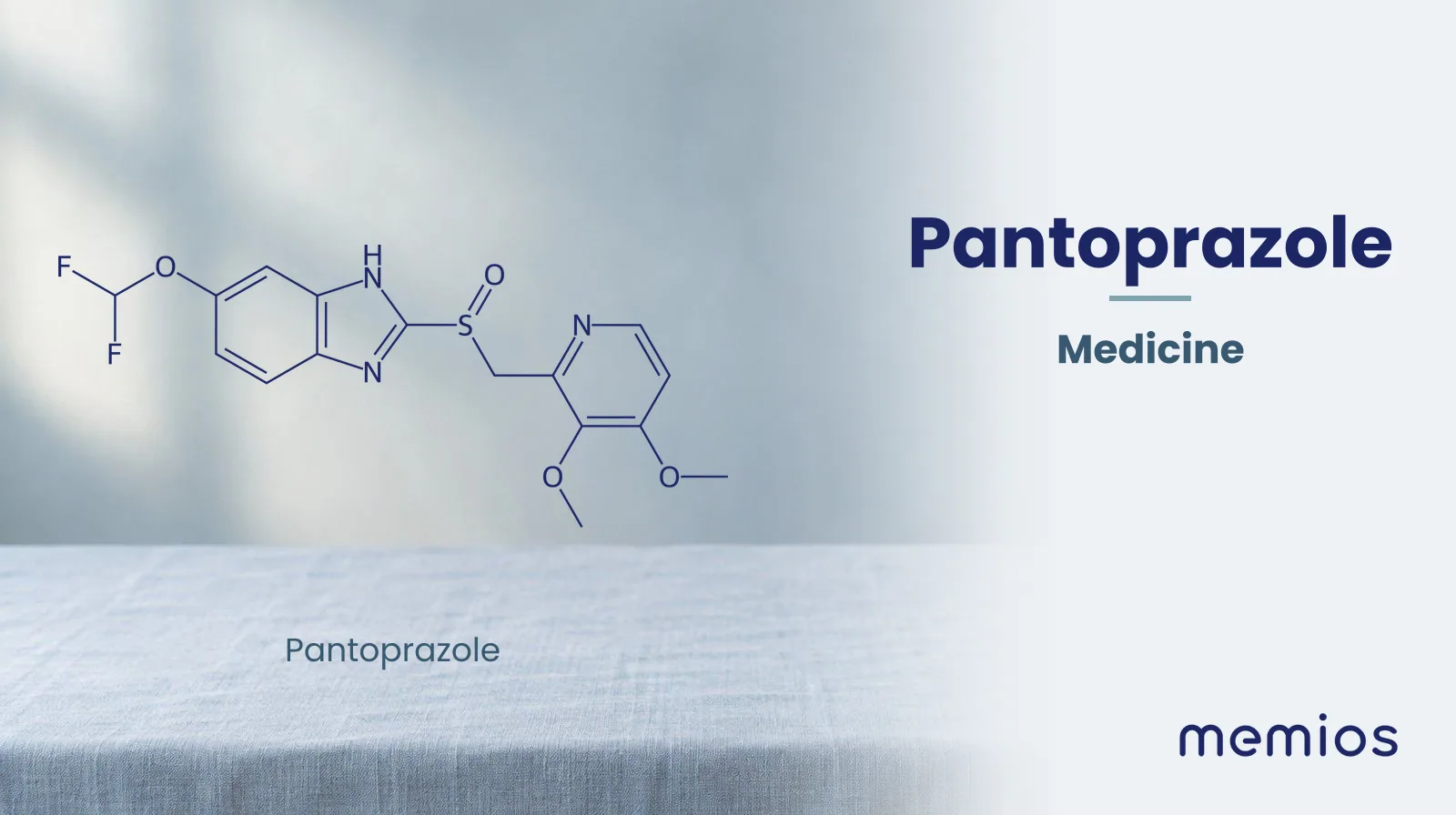
Pantoprazole
The best evidence is for healing erosive oesophagitis (acid damage to the gullet): in a Wyeth-funded placebo-controlled trial, 88% of people on 40 mg had healed at 8 weeks versus 33% on placebo.
TLDR
- Well established. The best evidence is for healing erosive oesophagitis (acid damage to the gullet): in a Wyeth-funded placebo-controlled trial, 88% of people on 40 mg had healed at 8 weeks versus 33% on placebo.
- What it is: Pantoprazole is a prescription (and in some countries over-the-counter) proton pump inhibitor taken as a delayed-release tablet or given intravenously.
- Main use: Healing of erosive oesophagitis caused by GERD (well supported).
- Other approved uses: Maintenance of healed erosive oesophagitis (limited evidence); Zollinger-Ellison syndrome and other hypersecretory conditions (evidence not rated).
- Off-label uses (not on the FDA label): Preventing upper-gut bleeding and ulcers in people on aspirin or low-dose rivaroxaban (disputed).
- Recommended dose (official position): Dosing is set by the prescriber. As a position, the Protonix label (revised 6/2023) lists 40 mg once daily for erosive oesophagitis and its maintenance, and 40 mg twice daily for Zollinger-Ellison syndrome as starting points.
- Studied dose (a trial dose, not a recommendation): COMPASS gave 40 mg pantoprazole once daily versus placebo for a median of about 3 years. Findings citing that trial: 1 against, 1 mixed, 1 on harm.
- Upper limit: The label's text we captured gives 40 mg twice daily as the starting dose for hypersecretory conditions; we did not capture the label's stated maximum for those conditions.
- What goes wrong: 5 findings on harm. COMPASS found more enteric (gut) infections with pantoprazole than placebo.
- Interactions: 4 recorded, including Clopidogrel, Methotrexate (mainly high dose), Vitamin B12 (from food and supplements), Magnesium.
- Common myth: All PPIs dangerously block clopidogrel.
What it is
Pantoprazole is a prescription (and in some countries over-the-counter) proton pump inhibitor taken as a delayed-release tablet or given intravenously. It lowers stomach acid by blocking the acid pump in the stomach lining.
What the research says
The best evidence is for healing erosive oesophagitis (acid damage to the gullet): in a Wyeth-funded placebo-controlled trial, 88% of people on 40 mg had healed at 8 weeks versus 33% on placebo. For long-term safety, pantoprazole is unusual among PPIs because it was tested for about 3 years against placebo in 17,598 people in the COMPASS trial: no harm was clearly increased except enteric (gut) infections, 1.4% versus 1.0%. The same trial found routine pantoprazole did not reduce overall upper-gut events in people taking aspirin or low-dose rivaroxaban, though it may reduce bleeding from ulcers and erosions. Observational studies link long-term acid suppression with low vitamin B12 and low magnesium. Stopping after 8 weeks of a PPI can cause rebound acid symptoms in people who never had them. Unlike omeprazole, pantoprazole was not linked to loss of clopidogrel's benefit in a large population study.
Evidence grade: Well established.
How it works
Drug class: Proton pump inhibitor (PPI)
Pantoprazole binds permanently to the proton pump (the H+/K+-ATPase enzyme) on the acid-making parietal cells of the stomach, switching off the last step of acid production until the cell makes new pumps. (Source 1)
What it is used for
- In a 603-person placebo-controlled trial, healing at 8 weeks was 88% on 40 mg versus 33% on placebo. The trial was funded by the manufacturer. Evidence: established. (Source 2)
- Approved as a position on the label; we did not reach a maintenance trial in this run, so the evidence here rests on the label only. Evidence: limited. (Source 1)
- Approved on the label; we did not reach trials for this rare use in this run. Evidence: unknown. (Source 1)
- COMPASS found no reduction in the overall composite of upper-gut events (hazard ratio 0.88, not significant), but fewer bleeding gastroduodenal lesions (hazard ratio 0.52), with a high number needed to treat of 982. Evidence: disputed. (Source 3)
Interactions
- Clopidogrel (pharmacokinetic study): A population study found no link between pantoprazole and repeat heart attacks in clopidogrel users, unlike other PPIs; a healthy-volunteer study cited on the label found no meaningful effect on clopidogrel's active metabolite. (Source 1)
- Methotrexate (mainly high dose) (label): PPIs may raise and prolong methotrexate levels, risking toxicity. (Source 1)
- Vitamin B12 (from food and supplements) (label): Long-term acid suppression may reduce absorption of vitamin B12 from food. (Source 1)
- Magnesium (case reports): PPI use is associated with low blood magnesium, usually after months to a year of use. (Source 1)
Stopping it
- After 8 weeks of a PPI (esomeprazole in this trial), stopping produced acid symptoms in 44% of healthy volunteers versus 15% on placebo, suggesting rebound can mimic the original problem and create dependence. No pantoprazole-specific withdrawal trial was reached in this run. (Source 4)
What goes wrong
COMPASS found more enteric (gut) infections with pantoprazole than placebo. (Source 5)
- Randomized trial, Moderate certainty.
- Size: 17,598 participants.
- Who: Adults with stable cardiovascular or peripheral artery disease.
- How long: Median 3.01 years.
- Result: 1.4% vs 1.0%; odds ratio 1.33 (95% CI 1.01-1.75)
- Funding: not stated in the abstract we read.
enteric infections (1.4% vs 1.0% in the placebo group; odds ratio, 1.33; 95% confidence interval, 1.01-1.75)
Two or more years of PPI use was associated with a higher chance of a vitamin B12 deficiency diagnosis, more so at higher doses (association, not proof of cause; PPIs as a class, not pantoprazole alone). (Source 6)
- Case-control study, Low certainty.
- Size: 25,956 cases and 184,199 controls.
- Who: Kaiser Permanente Northern California members.
- How long: 1997-2011.
- Result: OR 1.65 (95% CI 1.58-1.73) for 2+ years of PPI; OR 1.95 for more than 1.5 pills/day.
- Funding: not stated in the abstract we read.
Both a 2 or more years' supply of PPIs (OR, 1.65 [95% CI, 1.58-1.73])
A meta-analysis of observational studies found PPI use associated with low magnesium, but the studies disagreed so much that the authors could not reach a firm conclusion. (Source 7)
- Meta-analysis, Very low certainty.
- Size: 9 studies, 115,455 patients.
- Who: Mixed PPI users, observational studies.
- How long: Various.
- Result: Pooled OR 1.775 (95% CI 1.077-2.924); I2 = 98.0%.
- Funding: not stated in the abstract we read.
On meta-analysis, pooled odds ratio for PPI use was found to be 1.775 (95% confidence interval 1.077–2.924)
Stopping 8 weeks of a PPI caused new acid symptoms in healthy volunteers who had none before (rebound acid hypersecretion). This trial used esomeprazole, not pantoprazole; it is a class effect assumption. (Source 4)
- Randomized trial, Moderate certainty.
- Size: 120 healthy volunteers.
- Who: Healthy adults without reflux symptoms.
- How long: 8 weeks of PPI then 4 weeks placebo.
- Result: 44% (26/59) vs 15% (9/59) had acid-related symptoms in weeks 9-12, P < .001.
- Funding: not stated in the abstract we read.
Forty-four percent (26/59) of those randomized to PPI reported ≥1 relevant, acid-related symptom in weeks 9–12 compared with 15% (9/59; P < .001) in the placebo group
The FDA label, as a position (revised June 2023), warns that observational studies link PPIs to C. difficile diarrhoea, especially in hospital, and to fractures. (Source 1)
- Official position, Certainty not rated.
- Size: n/a.
- Who: n/a.
- How long: n/a.
- Result: n/a.
- Funding: n/a.
Published observational studies suggest that PPI therapy like PROTONIX may be associated with an increased risk of Clostridium difficile associated diarrhea, especially in hospitalized patients.
What the evidence supports
Pantoprazole 40 mg healed erosive oesophagitis far more often than placebo at 4 and 8 weeks. (Source 2)
- Randomized trial, Moderate certainty.
- Size: 603 patients.
- Who: Adults with endoscopically confirmed erosive oesophagitis.
- How long: 4 to 8 weeks.
- Result: 8-week healing: placebo 33%, pantoprazole 10 mg 59%, 20 mg 78%, 40 mg 88% (p < 0.001 for all doses)
- Funding: industry-funded (Wyeth-Ayerst)
Cumulative healing rates after 8 wk for placebo and pantoprazole 10 mg, 20 mg, and 40 mg/day were 33%, 59%, 78%, and 88%, respectively
Pantoprazole reduced bleeding from gastroduodenal lesions (ulcers and erosions), but a large number of people had to be treated to prevent one bleed. (Source 3)
- Randomized trial, Moderate certainty.
- Size: 17,598 participants.
- Who: Adults with stable cardiovascular or peripheral artery disease.
- How long: Median about 3 years.
- Result: Hazard ratio 0.52 (95% CI 0.28-0.94); post-hoc NNT 982.
- Funding: not stated in the abstract we read.
Pantoprazole significantly reduced bleeding of gastroduodenal lesions (hazard ratio, 0.52; 95% confidence interval, 0.28–0.94; P = .03)
In older people taking clopidogrel after a heart attack, PPIs other than pantoprazole were linked with more repeat heart attacks, while pantoprazole was not. (Source 8)
- Case-control study, Low certainty.
- Size: 734 cases, 2057 controls from 13,636 patients.
- Who: Ontario adults aged 66+ on clopidogrel after myocardial infarction.
- How long: 2002-2007, 90-day follow-up.
- Result: Pantoprazole adjusted OR 1.02 (95% CI 0.70-1.47); PPIs overall OR 1.27 (1.03-1.57)
- Funding: not stated in the abstract we read.
pantoprazole, which does not inhibit cytochrome P450 2C19, had no association with readmission for myocardial infarction (adjusted OR 1.02, 95% CI 0.70–1.47)
What the evidence does not support
In COMPASS, about 3 years of pantoprazole showed no statistically significant increase in pneumonia, fractures, kidney disease, dementia, cancer, death or other safety outcomes, apart from enteric infections. (Source 5)
- Randomized trial, High certainty.
- Size: 17,598 participants; 53,152 patient-years.
- Who: Adults with stable cardiovascular or peripheral artery disease on aspirin and/or rivaroxaban.
- How long: Median 3.01 years.
- Result: No significant difference in safety events except enteric infections.
- Funding: industry-sponsored: the Europe PMC grant record for this paper lists Bayer (maker of rivaroxaban) as funding agency.
There was no statistically significant difference between the pantoprazole and placebo groups in safety events except for enteric infections
Routine pantoprazole did not reduce the overall rate of upper gastrointestinal events in people taking aspirin and/or low-dose rivaroxaban. (Source 3)
- Randomized trial, High certainty.
- Size: 17,598 participants.
- Who: Adults with stable cardiovascular or peripheral artery disease.
- How long: Median about 3 years.
- Result: 102 vs 116 events; hazard ratio 0.88 (95% CI 0.67-1.15)
- Funding: not stated in the abstract we read.
There was no significant difference in upper gastrointestinal events between the pantoprazole group (102 of 8791 events) and the placebo group (116 of 8807 events)
Where the evidence is mixed
C. difficile infection was about twice as common on pantoprazole in COMPASS, but there were only 13 events and the difference was not statistically significant. (Source 5)
- Randomized trial, Low certainty.
- Size: 17,598 participants; 13 C. difficile events.
- Who: Adults with stable cardiovascular or peripheral artery disease.
- How long: Median 3.01 years.
- Result: About 2-fold, not statistically significant.
- Funding: not stated in the abstract we read.
C difficile infection, which was approximately twice as common in the pantoprazole vs the placebo group, although there were only 13 events
Where the research disagrees
Whether long-term PPIs cause the harms seen in observational studies
- Observational studies (e.g. Lam 2013; Park 2014 meta-analysis), case-control / meta-analysis of observational studies: Previous and current gastric acid inhibitor use was significantly associated with the presence of vitamin B12 deficiency. (Source 6)
- COMPASS investigators (Moayyedi 2019), placebo-controlled RCT, 17,598 participants: we found that pantoprazole is not associated with any adverse event when used for 3 years, with the possible exception of an increased risk of enteric infections (Source 5)
How much
- Reference intake: Dosing is set by the prescriber. As a position, the Protonix label (revised 6/2023) lists 40 mg once daily for erosive oesophagitis and its maintenance, and 40 mg twice daily for Zollinger-Ellison syndrome as starting points. (Source 1)
- Upper limit: The label's text we captured gives 40 mg twice daily as the starting dose for hypersecretory conditions; we did not capture the label's stated maximum for those conditions. Reviewer to check the full label. (Source 1)
- Studied: COMPASS gave 40 mg pantoprazole once daily versus placebo for a median of about 3 years. (Source 5)
- Studied: The erosive oesophagitis trial compared 10, 20 and 40 mg once daily with placebo for 4 to 8 weeks. (Source 2)
A common belief, and what the research shows
The belief: All PPIs dangerously block clopidogrel.
What the research shows: The concern comes mostly from omeprazole-type PPIs that inhibit CYP2C19. In a population study, 'pantoprazole, which does not inhibit cytochrome P450 2C19, had no association with readmission for myocardial infarction (adjusted OR 1.02, 95% CI 0.70–1.47)'.
Questions and answers
What is it?
Pantoprazole is a medicine in the proton pump inhibitor family, used to lower stomach acid. It is sold as Protonix and as generics. (Source 1)
What does it do in the body?
It permanently switches off the acid pumps in the stomach lining, so the stomach makes much less acid until new pumps are made. Less acid lets acid damage in the gullet heal. (Source 1)
Is it good or bad for you?
For healing acid damage to the gullet it works well in trials. Over 3 years in a large placebo-controlled trial it showed no clear harm except more gut infections (1.4% vs 1.0%). Observational studies link long-term use with low B12 and low magnesium, and stopping can bring rebound acid symptoms. (Source 5)
How do you get more of it?
Does not apply as a nutrient. Pantoprazole is a medicine obtained on prescription (or over the counter in some countries), and the dose is set by a prescriber; the label lists its approved uses. (Source 1)
If it is harmful, what reduces it?
Pantoprazole leaves the body when it is stopped, but acid output can rebound. In a trial with another PPI, 44% of healthy volunteers had acid symptoms after stopping versus 15% on placebo, so stopping is usually discussed with a prescriber. (Source 4)
Why might someone be low in it or missing it?
Does not apply: pantoprazole is not something the body makes or needs. People are prescribed it for acid-related conditions listed on the label. (Source 1)
Which whole foods contain it or feed it?
No foods contain pantoprazole. Long-term acid suppression may reduce absorption of vitamin B12 from food, which is relevant to diet. (Source 1)
What happens if you do not have it?
For people with erosive oesophagitis, going without treatment meant much lower healing: in the placebo arm of a trial only 33% had healed at 8 weeks versus 88% on 40 mg pantoprazole. (Source 2)
How can you test for it?
There is no routine blood test for pantoprazole itself. Studies of long-term users measure the effects instead, such as vitamin B12 deficiency diagnoses from laboratory records and blood magnesium; we did not find a validated study of how often these should be checked. (Source 6)
We searched: Searched for monitoring guidance for long-term PPI users (B12, magnesium) in PubMed-indexed studies and the Protonix label; found association studies but no trial of screening.
References
- DailyMed, US National Library of Medicine (FDA-approved label). PROTONIX (pantoprazole sodium) delayed-release tablets, prescribing information (Revised: 6/2023). 2023. Read the source
- American Journal of Gastroenterology. Oral pantoprazole for erosive esophagitis: a placebo-controlled, randomized clinical trial. 2000. PMID 11095320, DOI 10.1016/S0002-9270(00)02047-5. Read the source
- Gastroenterology. Pantoprazole to Prevent Gastroduodenal Events in Patients Receiving Rivaroxaban and/or Aspirin in a Randomized, Double-Blind, Placebo-Controlled Trial. 2019. PMID 31054846, DOI 10.1053/j.gastro.2019.04.041. Read the source
- Gastroenterology. Proton-Pump Inhibitor Therapy Induces Acid-Related Symptoms in Healthy Volunteers After Withdrawal of Therapy. 2009. PMID 19362552, DOI 10.1053/j.gastro.2009.03.058. Read the source
- Gastroenterology. Safety of Proton Pump Inhibitors Based on a Large, Multi-Year, Randomized Trial of Patients Receiving Rivaroxaban or Aspirin. 2019. PMID 31152740, DOI 10.1053/j.gastro.2019.05.056. Read the source
- JAMA. Proton pump inhibitor and histamine 2 receptor antagonist use and vitamin B12 deficiency. 2013. PMID 24327038, DOI 10.1001/jama.2013.280490. Read the source
- PLOS ONE. The Association between the Use of Proton Pump Inhibitors and the Risk of Hypomagnesemia: A Systematic Review and Meta-Analysis. 2014. DOI 10.1371/journal.pone.0112558. Read the source
- CMAJ. A population-based study of the drug interaction between proton pump inhibitors and clopidogrel. 2009. PMID 19176635, DOI 10.1503/cmaj.082001. Read the source