Medications · September 29, 2026 · Memios · 26 min read
Oxycodone
It relieves pain by acting on opioid receptors in the brain and spinal cord, with no ceiling to the dose-response for analgesia.
TLDR
- Boxed warning: Limit dosages and durations to the minimum required.
- Limited evidence. It relieves pain by acting on opioid receptors in the brain and spinal cord, with no ceiling to the dose-response for analgesia.
- What it is: Oxycodone is a semi-synthetic opioid painkiller taken by mouth, sold as immediate-release tablets and liquids and as extended-release tablets.
- Main use: Pain severe enough to require an opioid analgesic, where alternative treatments are inadequate (the labelled indication) (limited evidence).
- Other approved uses: Cancer-related pain (limited evidence).
- Uses NOT supported by research: Chronic non-cancer pain managed over months (chronic back pain, hip or knee osteoarthritis); Neuropathic pain (painful diabetic neuropathy, postherpetic neuralgia).
- Recommended dose: not established. There is no reference intake for an opioid analgesic; dose is set and titrated by the prescriber.
- Studied dose (a trial dose, not a recommendation): The trial and review abstracts we recorded (96-trial meta-analysis, SPACE, Cochrane neuropathic and cancer pain reviews) did not state the oxycodone doses used in the passages available to us. No finding here cites that trial.
- Upper limit: The label states there is no ceiling effect for analgesia with oxycodone, so no maximum dose is defined by effectiveness.
- What goes wrong: 6 findings on harm. In that trial adverse medication symptoms were about twice as common on opioids as on non-opioid medicines.
- Interactions: 5 recorded, including Benzodiazepines, other CNS depressants and alcohol, Cytochrome P450 3A4 inhibitors (for example some antifungals, macrolide antibiotics, protease inhibitors), Grapefruit juice, St John's wort (Hypericum perforatum).
- Common myth: Physical dependence on oxycodone is the same thing as addiction, so anyone who gets withdrawal symptoms is addicted; and an opioid is the strongest option so it must work best for long-term pain.
What it is
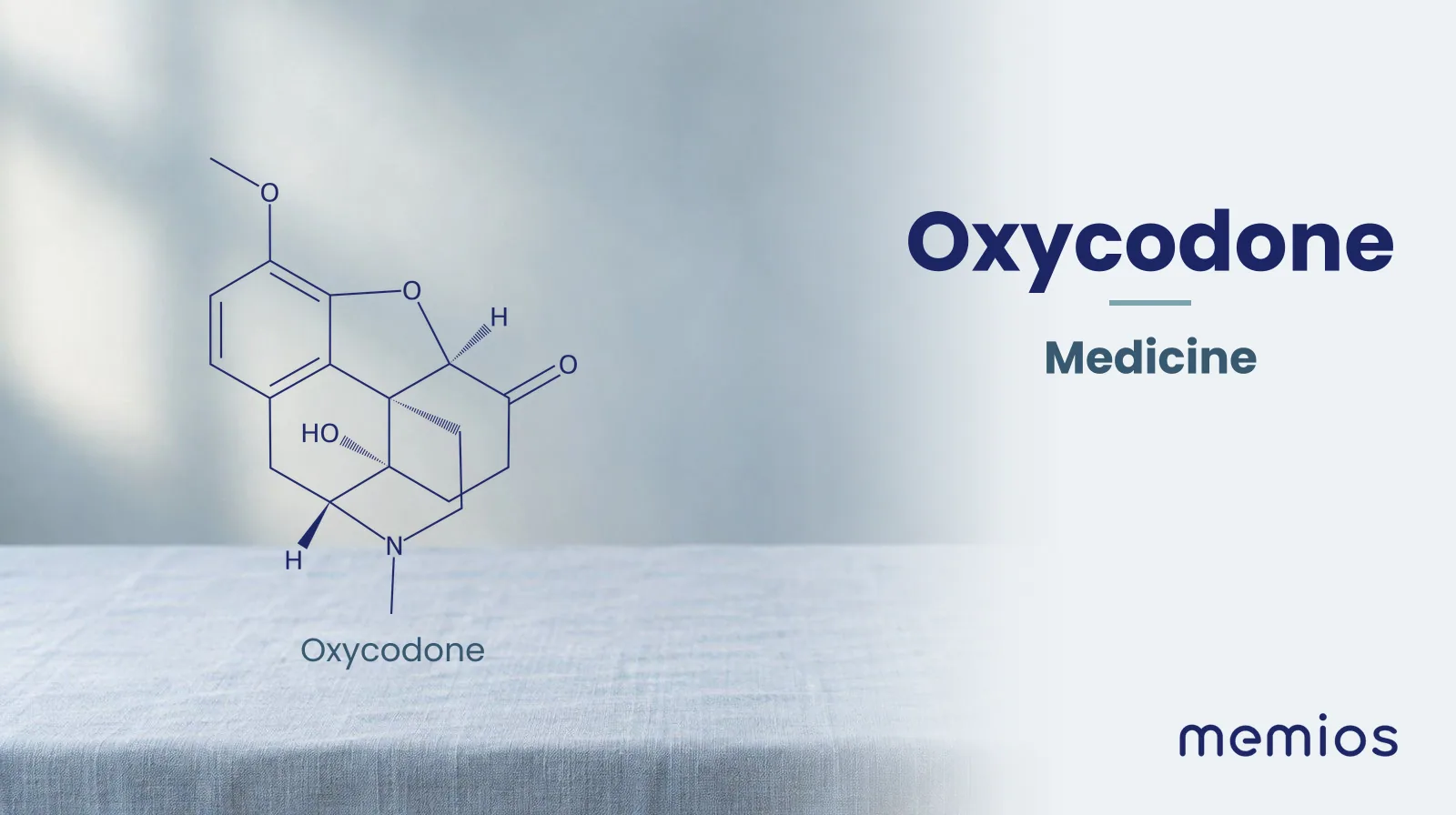
Oxycodone is a semi-synthetic opioid painkiller taken by mouth, sold as immediate-release tablets and liquids and as extended-release tablets. It is a full agonist at the mu-opioid receptor, meaning it switches that receptor on completely rather than partly, and it is a Schedule II controlled substance in the United States. Its US label is indicated only for pain severe enough to require an opioid where other treatments are inadequate, and it carries a boxed warning covering addiction, respiratory depression, accidental ingestion, neonatal withdrawal, a cytochrome P450 3A4 interaction and the risks of combining it with benzodiazepines or other depressants.
What the research says
It relieves pain by acting on opioid receptors in the brain and spinal cord, with no ceiling to the dose-response for analgesia. In chronic non-cancer pain the largest meta-analysis (96 trials, 26,169 patients) found the average benefit small: 0.69 cm on a 10 cm pain scale, with about 12% more people reaching a meaningful improvement than on placebo, and vomiting in 5.9% versus 2.3%. The SPACE randomised trial found opioids no better than non-opioid medicines for pain-related function over 12 months, with worse pain intensity and more adverse symptoms. For cancer pain Cochrane found no meaningful difference from morphine, on low to very low certainty evidence; for neuropathic pain the certainty was very low. Across chronic pain studies, misuse was estimated at 21% to 29% and addiction at 8% to 12%.
Evidence grade: Limited evidence.
How it works
Drug class: Opioid analgesic; full mu-opioid receptor agonist; Schedule II controlled substance (CII)
Oxycodone switches on opioid receptors, mainly the mu receptor, which are found throughout the brain and spinal cord and normally respond to the body's own opioid-like chemicals. Turning them on dampens the transmission and perception of pain. Because it is a full agonist there is no ceiling to its analgesic effect, so the dose is limited by side effects, particularly slowed breathing and sedation, rather than by any maximum useful dose. (Source 1)
Boxed warning
WARNING: ADDICTION, ABUSE, AND MISUSE; LIFE-THREATENING RESPIRATORY DEPRESSION; ACCIDENTAL INGESTION; NEONATAL OPIOID WITHDRAWAL SYNDROME; CYTOCHROME P450 3A4 INTERACTION; and RISKS FROM CONCOMITANT USE WITH BENZODIAZEPINES OR OTHER CNS DEPRESSANTS
(Source 2)
What it is used for
- The label restricts it to patients for whom other options have failed or are not expected to work. Pooled placebo-controlled trials in chronic non-cancer pain show a small average benefit (0.69 cm on a 10 cm scale; about 12% more people reaching a meaningful improvement) with more vomiting. Evidence: limited. (Source 3)
- In the SPACE randomised trial opioids were not superior to non-opioid medicines for pain-related function over 12 months, pain intensity was significantly better in the non-opioid group, and adverse medication symptoms were significantly more common on opioids. Evidence: not-supported. (Source 4)
- Cochrane found no meaningful difference between oxycodone and other strong opioids such as morphine, and none between immediate- and controlled-release forms, on evidence from small trials with substantial dropout. Hallucinations were less likely with oxycodone than morphine. Evidence: limited. (Source 5)
- Cochrane rated the evidence very low quality for both benefit and harm, found no evidence at all for neuropathic pain conditions other than diabetic neuropathy and postherpetic neuralgia, and noted opioid-typical adverse events appeared common. Evidence: not-supported. (Source 6)
Interactions
- Benzodiazepines, other CNS depressants and alcohol (label): Combining oxycodone with alcohol, benzodiazepines or other sedating drugs can cause profound sedation, slowed or stopped breathing, coma and death. This appears in the label's boxed warning, not merely in a precautions section. (Source 2)
- Cytochrome P450 3A4 inhibitors (for example some antifungals, macrolide antibiotics, protease inhibitors) (label): These slow the breakdown of oxycodone, raising its blood level, which can prolong side effects and cause potentially fatal slowing of breathing. (Source 2)
- Grapefruit juice (pharmacokinetic study): Grapefruit juice inhibits CYP3A4 in the gut and liver, so oxycodone exposure rises: in a randomised study in healthy volunteers total exposure went up 1.7-fold, peak level 1.5-fold and half-life 1.2-fold, and self-rated performance impairment increased. (Source 7)
- St John's wort (Hypericum perforatum) (pharmacokinetic study): St John's wort induces CYP3A4 and cut oxycodone exposure by half in a randomised study in healthy volunteers, shortening its half-life and reducing the self-reported drug effect. That means less pain relief on the same dose, and a risk of exposure rising sharply if the supplement is stopped. (Source 8)
- Serotonergic medicines (SSRIs, SNRIs, tricyclic antidepressants, triptans, MAOIs and others) (label): Using opioids with drugs acting on serotonin has caused serotonin syndrome; the label says to observe carefully during initiation and dose changes and to stop oxycodone if it is suspected. (Source 9)
Stopping it
- The label says not to stop oxycodone abruptly in someone who has become physically dependent, and gives a taper: reduce by 25% to 50% every 2 to 4 days while watching for withdrawal, going back up and slowing down if withdrawal appears. (Source 10)
- The label lists what opioid withdrawal looks like, so it can be recognised rather than mistaken for something else: restlessness, watering eyes, runny nose, yawning, sweating, chills, muscle aches and dilated pupils, and later irritability, anxiety, back and joint pain, cramps, insomnia, nausea, vomiting, diarrhoea and rises in blood pressure, breathing rate and heart rate. (Source 11)
- A systematic review of 67 studies of reducing or stopping long-term opioid therapy found that pain, function and quality of life may improve after dose reduction, but rated the evidence very low quality: 51 of the 67 studies were of poor quality. (Source 12)
- Stopping is not only a matter of the patient's own dependence: prolonged use in pregnancy can leave the newborn with an opioid withdrawal syndrome that can be life-threatening if not anticipated and treated. (Source 2)
What goes wrong
In that trial adverse medication symptoms were about twice as common on opioids as on non-opioid medicines. (Source 13)
- Randomized trial, Moderate certainty.
- Size: 240 patients.
- Who: patients with chronic back pain or hip or knee osteoarthritis pain.
- How long: 12 months.
- Result: mean medication-related symptoms at 12 months 1.8 opioid versus 0.9 non-opioid (difference 0.9, 95% CI 0.3 to 1.5; overall p=0.03)
- Funding: publicly funded (US Department of Veterans Affairs)
Adverse medication-related symptoms were significantly more common in the opioid group over 12 months (overall P = .03); mean medication-related symptoms at 12 months were 1.8 in the opioid group and 0.9 in the nonopioid group (difference, 0.9 [95% CI, 0.3 to 1.5]).
All strong opioids including oxycodone commonly cause vomiting, constipation and drowsiness, with no advantage for oxycodone over the alternatives. (Source 5)
- Systematic review, Low certainty.
- Size: 42 studies, 4,485 participants.
- Who: adults with cancer-related pain.
- How long: not stated.
- Result: unwanted effects did not differ between oxycodone and other strong painkillers.
- Funding: Cochrane review.
All the strong painkillers examined in the studies also have a number of unwanted effects, such as vomiting, constipation, and drowsiness. Overall, these do not differ between oxycodone and the other strong painkillers.
The label's boxed warning states that oxycodone exposes patients and others to addiction, abuse and misuse that can lead to overdose and death, and that respiratory depression may be fatal. (Source 2)
- Official position, Certainty not rated.
- Size: regulatory labelling, not a trial.
- Who: all patients prescribed oxycodone and others who may take it.
- How long: not applicable.
- Result: no rates given in the warning; risks stated as addiction, abuse, misuse, overdose, death, fatal respiratory depression, fatal overdose from a single dose in a child, neonatal opioid withdrawal syndrome.
- Funding: manufacturer's FDA-approved labelling.
Oxycodone hydrochloride tablets exposes patients and other users to the risks of opioid addiction, abuse, and misuse, which can lead to overdose and death.
The label states that even one dose taken accidentally, especially by a child, can be a fatal overdose. (Source 2)
- Official position, Certainty not rated.
- Size: regulatory labelling.
- Who: children and others who take it accidentally.
- How long: not applicable.
- Result: fatal overdose possible from a single dose.
- Funding: manufacturer's FDA-approved labelling.
Accidental ingestion of even one dose of oxycodone hydrochloride tablets, especially by children, can result in a fatal overdose of oxycodone
In the pooled oxycodone neuropathic pain trials adverse events were substantially more common on oxycodone than on placebo, with a number needed to harm of 4.3. (Source 14)
- Systematic review, Very low certainty.
- Size: five studies, 687 participants.
- Who: adults with painful diabetic neuropathy or postherpetic neuralgia.
- How long: studies of two weeks or longer.
- Result: adverse events 86% with modified-release oxycodone alone versus 63% with placebo, NNH 4.3; serious adverse events 3.4% versus 7.0% and adverse event withdrawals 11% versus 6.4%, neither significantly different.
- Funding: Cochrane review; funding of the included trials is not stated in the abstract we read.
More participants experienced adverse events with oxycodone MR alone (86%) than with placebo (63%); the number needed to treat for an additional harmful outcome (NNH) was 4.3.
A systematic review and data synthesis of 38 studies of people taking opioids for chronic pain found average misuse rates of 21% to 29% and average addiction rates of 8% to 12%. (Source 15)
- Systematic review, Low certainty.
- Size: data from 38 studies.
- Who: people prescribed opioids for chronic pain.
- How long: not stated in the abstract we read.
- Result: rates of problematic use ranged from < 1% to 81% across studies; misuse averaged 21% to 29% (range of 95% CIs 13%-38%); addiction averaged 8% to 12% (range of 95% CI 3%-17%); abuse was reported in only a single study.
- Funding: not stated on the record we read.
Across most calculations, rates of misuse averaged between 21% and 29% (range, 95% confidence interval [CI]: 13%-38%). Rates of addiction averaged between 8% and 12% (range, 95% CI: 3%-17%).
What the evidence supports
Across 96 placebo-controlled trials, opioids gave a small average reduction in chronic non-cancer pain and a small improvement in physical functioning, with more vomiting. (Source 16)
- Meta-analysis, Moderate certainty.
- Size: 96 RCTs including 26,169 participants.
- Who: adults with chronic non-cancer pain (61% female; median age 58 years), across neuropathic, nociceptive, central sensitisation and mixed pain.
- How long: not stated in the abstract passage we recorded.
- Result: pain weighted mean difference -0.69 cm (95% CI -0.82 to -0.56) on a 10 cm visual analogue scale, modelled risk difference for reaching the minimally important difference 11.9% (95% CI 9.7% to 14.1%); physical functioning WMD 2.04 points (1.41 to 2.68) on the 100-point SF-36 PCS, modelled risk difference 8.5% (5.9% to 11.2%); vomiting 5.9% with opioids versus 2.3% with placebo.
- Funding: not stated in the passage we recorded.
Compared with placebo, opioid use was associated with reduced pain (weighted mean difference [WMD], −0.69 cm [95% CI, −0.82 to −0.56 cm] on a 10-cm visual analog scale for pain; modeled risk difference for achieving the MID, 11.9% [95% CI, 9.7% to 14.1%]), improved physical functioning (WMD, 2.04 points [95% CI, 1.41 to 2.68 points] on the 100-point SF-36 PCS; modeled risk difference for achieving the MID, 8.5% [95% CI, 5.9% to 11.2%]), and increased vomiting (5.9% with opioids vs 2.3% with placebo for trials that excluded patients with adverse events during a run-in period).
What the evidence does not support
In the same meta-analysis, opioids were no better than NSAIDs, tricyclic antidepressants or anticonvulsants for pain or physical functioning. (Source 16)
- Meta-analysis, Low certainty.
- Size: 96 RCTs, 26,169 participants.
- Who: adults with chronic non-cancer pain.
- How long: not stated in the passage we recorded.
- Result: versus NSAIDs, pain WMD -0.60 cm (95% CI -1.54 to 0.34); versus tricyclic antidepressants, pain WMD -0.13 cm (-0.99 to 0.74); versus anticonvulsants, pain WMD -0.90 cm (-1.65 to -0.14) with physical functioning 0.45 points (-5.77 to 6.66)
- Funding: not stated in the passage we recorded.
Low- to moderate-quality evidence suggested similar associations of opioids with improvements in pain and physical functioning compared with nonsteroidal anti-inflammatory drugs (pain: WMD, −0.60 cm [95% CI, −1.54 to 0.34 cm]; physical functioning: WMD, −0.90 points [95% CI, −2.69 to 0.89 points])
In a 12-month randomised trial, opioids did not significantly differ from non-opioid medicines on pain-related function. (Source 4)
- Randomized trial, Moderate certainty.
- Size: 240 patients randomised (SPACE trial)
- Who: US veterans with moderate to severe chronic back pain or hip or knee osteoarthritis pain.
- How long: 12 months.
- Result: 12-month BPI interference 3.4 opioid versus 3.3 non-opioid (difference 0.1, 95% CI -0.5 to 0.7; overall p=0.58); 12-month BPI severity 4.0 versus 3.5 (difference 0.5, 95% CI 0.0 to 1.0; overall p=0.03, favouring non-opioids)
- Funding: publicly funded (US Department of Veterans Affairs), per the published trial.
Groups did not significantly differ on pain-related function over 12 months (overall P = .58); mean 12-month BPI interference was 3.4 for the opioid group and 3.3 for the nonopioid group (difference, 0.1 [95% CI, −0.5 to 0.7]).
In that same 12-month trial pain intensity ran worse on opioids than on non-opioid medicines. (Source 17)
- Randomized trial, Moderate certainty.
- Size: 240 patients randomised (SPACE trial)
- Who: US veterans with moderate to severe chronic back pain or hip or knee osteoarthritis pain.
- How long: 12 months.
- Result: mean 12-month BPI severity 4.0 opioid versus 3.5 non-opioid (difference 0.5, 95% CI 0.0 to 1.0; overall p=0.03 favouring non-opioids)
- Funding: publicly funded (US Department of Veterans Affairs), per the published trial.
Limit of this finding: The p value of .03 comes from the trial's overall test across all twelve months, not from the twelve-month measurement on its own. At twelve months the difference was 0.5 points with a confidence interval running from 0.0 to 1.0, which just touches zero, so the gap at that single time point is not firmly established. What the trial does show is that pain intensity did not come out better on opioids.
Pain intensity was significantly better in the nonopioid group over 12 months (overall P = .03); mean 12-month BPI severity was 4.0 for the opioid group and 3.5 for the nonopioid group (difference, 0.5 [95% CI, 0.0 to 1.0]).
The cancer-pain evidence base is small studies with substantial dropout, by the reviewers' own description. (Source 5)
- Systematic review, Low certainty.
- Size: 42 studies, 4,485 participants.
- Who: adults with cancer-related pain.
- How long: not stated.
- Result: 12.2% of participants did not finish the studies; the reviewers judged further research unlikely to be undertaken.
- Funding: Cochrane review.
Overall, we found that the current evidence is comprised of studies that contained small numbers of people, of which many (12.2%) did not finish the studies.
In Cochrane's 2016 review of oxycodone for neuropathic pain the reviewers downgraded every outcome to very low quality because of limitations in study methods, heterogeneity and sparse data. (Source 14)
- Systematic review, Very low certainty.
- Size: five studies, 687 participants (637 painful diabetic neuropathy, 50 postherpetic neuralgia)
- Who: adults with chronic neuropathic pain; only painful diabetic neuropathy and postherpetic neuralgia were represented in the included trials.
- How long: randomised, double-blind studies of two weeks' duration or longer.
- Result: all outcomes downgraded to very low quality; in the three diabetic neuropathy studies (537 participants) 44% on oxycodone versus 27% on placebo reached at least moderate benefit, NNT 5.7.
- Funding: Cochrane review; funding of the included trials is not stated in the abstract we read.
We downgraded the quality of the evidence to very low for all outcomes, due to limitations in the study methods, heterogeneity in the pain condition and study methods, and sparse data.
Every one of the five oxycodone trials Cochrane included for neuropathic pain carried at least one source of potential major bias, and all of them were in diabetic neuropathy or postherpetic neuralgia. (Source 18)
- Systematic review, Very low certainty.
- Size: five studies, 687 participants (637 painful diabetic neuropathy, 50 postherpetic neuralgia)
- Who: adults with chronic neuropathic pain.
- How long: studies of two weeks or longer; two cross-over and three parallel group designs.
- Result: all included studies had one or more sources of potential major bias; one study used an active placebo (benztropine) and two added oxycodone to ongoing pregabalin or gabapentin.
- Funding: Cochrane review; funding of the included trials is not stated in the abstract we read.
All studies had one or more sources of potential major bias.
Where the evidence is mixed
In cancer pain, Cochrane found no difference between oxycodone and other strong opioids such as morphine, and hallucinations were less likely with oxycodone. (Source 5)
- Systematic review, Low certainty.
- Size: 42 studies with 4,485 participants across the review.
- Who: adults with cancer-related pain.
- How long: not stated in the plain language summary.
- Result: no difference between oxycodone and morphine or between immediate- and controlled-release oxycodone; unwanted effects such as vomiting, constipation and drowsiness did not differ between oxycodone and other strong opioids; hallucinations less likely with oxycodone than morphine; 12.2% of participants did not finish the studies.
- Funding: Cochrane review; funding of included trials not stated in the summary.
In general, the studies also showed no difference between oxycodone and other strong pain killers such as morphine.
A systematic review of 67 studies of reducing or stopping long-term opioid therapy reported improvement in pain severity, function and quality of life after dose reduction, but graded the overall evidence very low. (Source 19)
- Systematic review, Very low certainty.
- Size: 67 studies (11 randomised trials and 56 observational studies); 40 studies examined patient outcomes after dose reduction.
- Who: adults prescribed long-term opioid therapy for chronic pain who reduced or discontinued it.
- How long: varied across studies; literature searched from inception through April 2017.
- Result: study quality good for 3, fair for 13 and poor for 51 studies; improvement reported in pain severity (8 of 8 fair-quality studies), function (5 of 5) and quality of life (3 of 3), at very low overall quality of evidence.
- Funding: not stated on the record we read.
Among 40 studies examining patient outcomes after dose reduction (very low overall quality of evidence), improvement was reported in pain severity (8 of 8 fair-quality studies), function (5 of 5 fair-quality studies), and quality of life (3 of 3 fair-quality studies).
Where the research disagrees
Whether opioids such as oxycodone are worth using for chronic non-cancer pain
- Busse and colleagues, meta-analysis of 96 placebo-controlled trials, meta-analysis of 96 RCTs, 26,169 participants: Compared with placebo, opioid use was associated with reduced pain (weighted mean difference [WMD], −0.69 cm [95% CI, −0.82 to −0.56 cm] on a 10-cm visual analog scale for pain; modeled risk difference for achieving the MID, 11.9% [95% CI, 9.7% to 14.1%]) (Source 16)
- Krebs and colleagues, SPACE randomised trial, 12-month pragmatic randomised trial, 240 patients, opioids versus non-opioid medicines: Groups did not significantly differ on pain-related function over 12 months (overall P = .58); mean 12-month BPI interference was 3.4 for the opioid group and 3.3 for the nonopioid group (difference, 0.1 [95% CI, −0.5 to 0.7]). (Source 4)
How much
- Reference intake: There is no reference intake for an opioid analgesic; dose is set and titrated by the prescriber. As a position, the US label (DailyMed, oxycodone hydrochloride tablets USP, read 22 September 2026) states in its Mechanism of Action section that dosage is titrated to provide adequate analgesia and may be limited by adverse reactions, including respiratory and CNS depression. Its indication, recorded separately as oxy-label-b, restricts use to patients for whom alternative treatment options are inadequate. (Source 1)
- Upper limit: The label states there is no ceiling effect for analgesia with oxycodone, so no maximum dose is defined by effectiveness; the limit in practice is adverse reactions, particularly respiratory and central nervous system depression. We did not record the numeric starting-dose table from the label verbatim in this run. (Source 1)
- Studied: The trial and review abstracts we recorded (96-trial meta-analysis, SPACE, Cochrane neuropathic and cancer pain reviews) did not state the oxycodone doses used in the passages available to us. The Cochrane neuropathic pain review specifies the formulation studied as oxycodone MR (modified release). (Source 20)
- Studied: The grapefruit juice pharmacokinetic study gave healthy volunteers a single oral dose of oxycodone 10 mg. (Source 7)
- Studied: The St John's wort pharmacokinetic study gave healthy participants a single oral dose of oxycodone hydrochloride 15 mg. (Source 8)
A common belief, and what the research shows
The belief: Physical dependence on oxycodone is the same thing as addiction, so anyone who gets withdrawal symptoms is addicted; and an opioid is the strongest option so it must work best for long-term pain.
What the research shows: The label treats dependence as an expected pharmacological consequence to be managed by tapering, separate from addiction: it instructs prescribers to "taper the dose gradually, by 25% to 50% every 2 to 4 days, while monitoring carefully for signs and symptoms of withdrawal." It also separately warns that oxycodone "exposes patients and other users to the risks of opioid addiction, abuse, and misuse, which can lead to overdose and death." On effectiveness, the SPACE trial found "Groups did not significantly differ on pain-related function over 12 months (overall P = .58)" and pain intensity was better in the non-opioid group.
Questions and answers
What is it?
Oxycodone is a prescription opioid painkiller and a Schedule II controlled substance, taken as immediate-release or extended-release tablets or liquid. It is a full agonist at the mu-opioid receptor. Its label limits it to pain severe enough to need an opioid where other treatments are inadequate. (Source 1)
What does it do in the body?
It switches on opioid receptors in the brain and spinal cord, which dampens the transmission and perception of pain. Because it is a full agonist there is no ceiling to the analgesic effect, so what limits the dose is side effects, especially slowed breathing and sedation, rather than a maximum useful amount. (Source 1)
Is it good or bad for you?
For severe short-term or cancer pain it works about as well as other strong opioids. For chronic non-cancer pain the average benefit is small, about 0.69 cm on a 10 cm pain scale, and a 12-month randomised trial found it no better than non-opioid medicines while causing more side effects. Against any benefit sit addiction, misuse in an estimated 21% to 29%, and a boxed warning about fatal respiratory depression. (Source 2)
How do you get more of it?
Oxycodone is available only on prescription and, in the United States, as a Schedule II controlled substance; no food, supplement or behaviour supplies it. The label directs that it be reserved for patients whose other options have failed or are not expected to work, and the dose is titrated by the prescriber. (Source 3)
If it is harmful, what reduces it?
The documented way to come off it is a gradual taper, not an abrupt stop: the label specifies reducing by 25% to 50% every 2 to 4 days with monitoring, and going back to the previous dose and tapering more slowly if withdrawal appears. A systematic review of 67 tapering studies found pain and function may improve after dose reduction, on very low quality evidence. (Source 10)
Why might someone be low in it or missing it?
Someone in pain may not be prescribed oxycodone precisely because of its risks: the label instructs that it be reserved for people whose alternatives have failed, and randomised evidence shows non-opioid medicines did at least as well over 12 months. Others stop it because of side effects, which were about twice as frequent on opioids as on non-opioids in that trial. (Source 13)
Which whole foods contain it or feed it?
No whole food contains oxycodone. Food matters in the other direction: grapefruit juice blocks the enzyme that clears oxycodone, and in a randomised study in healthy volunteers it raised total exposure 1.7-fold and the peak level 1.5-fold. Alcohol is the other dietary item of concern, because the combination can stop breathing. (Source 7)
What happens if you do not have it?
Oxycodone is not something the body needs, so there is no deficiency state. What happens in its absence depends on whether the body has adapted to it: someone who has taken it regularly and become physically dependent will get a withdrawal syndrome if it stops suddenly, with restlessness, watering eyes, sweating, chills, muscle aches, cramps, insomnia, nausea and diarrhoea. In a newborn exposed in pregnancy, withdrawal can be life-threatening. (Source 11)
How can you test for it?
Urine drug testing is used to check whether someone is taking what was prescribed, but a standard opiate immunoassay is unreliable for oxycodone: those screens are built around morphine and codeine, while oxycodone follows a different metabolic route, so it can be missed. A dedicated oxycodone assay, or confirmatory testing such as mass spectrometry, is needed. There is no blood level used to guide oxycodone dosing in ordinary practice. One caution about this source: the same paragraph also states that hydrocodone and hydromorphone are metabolites of codeine, which is not correct - hydromorphone is a metabolite of hydrocodone and of morphine, not of codeine - so that sentence is not quoted or relied on here, and this trade-publication article should not be treated as a primary toxicology reference. (Source 21)
References
- DailyMed, US National Library of Medicine (manufacturer's FDA-approved label). Oxycodone Hydrochloride Tablets USP, for oral use, CII - FDA-approved prescribing information (read 22 September 2026). Passages recorded from the BOXED WARNING, section 1 INDICATIONS AND USAGE, section 5 WARNINGS AND PRECAUTIONS (dependence/tapering, withdrawal, serotonin syndrome) and section 12.1 MECHANISM OF ACTION. not dated in the text we read; initial US approval 1950; accessed 2026-09-22. Read the source
- DailyMed, US National Library of Medicine (manufacturer's FDA-approved label). Oxycodone Hydrochloride Tablets USP, for oral use, CII - FDA-approved prescribing information (read 22 September 2026). Passages recorded from the BOXED WARNING, section 1 INDICATIONS AND USAGE, section 5 WARNINGS AND PRECAUTIONS (dependence/tapering, withdrawal, serotonin syndrome) and section 12.1 MECHANISM OF ACTION. not dated in the text we read; initial US approval 1950; accessed 2026-09-22. Read the source
- DailyMed, US National Library of Medicine (manufacturer's FDA-approved label). Oxycodone Hydrochloride Tablets USP, for oral use, CII - FDA-approved prescribing information (read 22 September 2026). Passages recorded from the BOXED WARNING, section 1 INDICATIONS AND USAGE, section 5 WARNINGS AND PRECAUTIONS (dependence/tapering, withdrawal, serotonin syndrome) and section 12.1 MECHANISM OF ACTION. not dated in the text we read; initial US approval 1950; accessed 2026-09-22. Read the source
- JAMA (copy hosted by CDC Stacks). Effect of Opioid vs Nonopioid Medications on Pain-Related Function in Patients With Chronic Back Pain or Hip or Knee Osteoarthritis Pain: The SPACE Randomized Clinical Trial. 2018. PMID 29509867, DOI 10.1001/jama.2018.0899. Read the source
- Cochrane Database of Systematic Reviews / cochrane.org. Oxycodone for cancer-related pain in adults (Cochrane review, plain language summary). 2022. DOI 10.1002/14651858.CD003870.pub7. Read the source
- Cochrane Database of Systematic Reviews / cochrane.org. Oxycodone for neuropathic pain in adults (Cochrane review, plain language summary). 2016. DOI 10.1002/14651858.CD010692.pub3. Read the source
- Journal of Pain Research (Dove Medical Press). Opioid analgesics-related pharmacokinetic drug interactions: from the perspectives of evidence based on randomized controlled trials and clinical risk management. 2019. Read the source
- Journal of Pain Research (Dove Medical Press). Opioid analgesics-related pharmacokinetic drug interactions: from the perspectives of evidence based on randomized controlled trials and clinical risk management. 2019. Read the source
- DailyMed, US National Library of Medicine (manufacturer's FDA-approved label). Oxycodone Hydrochloride Tablets USP, for oral use, CII - FDA-approved prescribing information (read 22 September 2026). Passages recorded from the BOXED WARNING, section 1 INDICATIONS AND USAGE, section 5 WARNINGS AND PRECAUTIONS (dependence/tapering, withdrawal, serotonin syndrome) and section 12.1 MECHANISM OF ACTION. not dated in the text we read; initial US approval 1950; accessed 2026-09-22. Read the source
- DailyMed, US National Library of Medicine (manufacturer's FDA-approved label). Oxycodone Hydrochloride Tablets USP, for oral use, CII - FDA-approved prescribing information (read 22 September 2026). Passages recorded from the BOXED WARNING, section 1 INDICATIONS AND USAGE, section 5 WARNINGS AND PRECAUTIONS (dependence/tapering, withdrawal, serotonin syndrome) and section 12.1 MECHANISM OF ACTION. not dated in the text we read; initial US approval 1950; accessed 2026-09-22. Read the source
- DailyMed, US National Library of Medicine (manufacturer's FDA-approved label). Oxycodone Hydrochloride Tablets USP, for oral use, CII - FDA-approved prescribing information (read 22 September 2026). Passages recorded from the BOXED WARNING, section 1 INDICATIONS AND USAGE, section 5 WARNINGS AND PRECAUTIONS (dependence/tapering, withdrawal, serotonin syndrome) and section 12.1 MECHANISM OF ACTION. not dated in the text we read; initial US approval 1950; accessed 2026-09-22. Read the source
- Annals of Internal Medicine (copy hosted by the Connecticut Hospital Association). Patient Outcomes in Dose Reduction or Discontinuation of Long-Term Opioid Therapy: A Systematic Review. 2017. DOI 10.7326/M17-0598. Read the source
- JAMA (copy hosted by CDC Stacks). Effect of Opioid vs Nonopioid Medications on Pain-Related Function in Patients With Chronic Back Pain or Hip or Knee Osteoarthritis Pain: The SPACE Randomized Clinical Trial. 2018. PMID 29509867, DOI 10.1001/jama.2018.0899. Read the source
- The Cochrane database of systematic reviews (bibliographic record and abstract served by the Europe PMC REST API). Oxycodone for neuropathic pain in adults.. 2016. PMID 27465317, DOI 10.1002/14651858.CD010692.pub3. Read the source
- Pain 156(4):569-576 (record on the Queen's University Belfast Pure research portal). Rates of opioid misuse, abuse, and addiction in chronic pain: A systematic review and data synthesis. 2015. DOI 10.1097/01.j.pain.0000460357.01998.f1. Read the source
- JAMA (copy hosted by Partnership HealthPlan of California). Opioids for Chronic Noncancer Pain: A Systematic Review and Meta-analysis. 2018. PMID 30561481, DOI 10.1001/jama.2018.18472. Read the source
- JAMA (copy hosted by CDC Stacks). Effect of Opioid vs Nonopioid Medications on Pain-Related Function in Patients With Chronic Back Pain or Hip or Knee Osteoarthritis Pain: The SPACE Randomized Clinical Trial. 2018. PMID 29509867, DOI 10.1001/jama.2018.0899. Read the source
- The Cochrane database of systematic reviews (bibliographic record and abstract served by the Europe PMC REST API). Oxycodone for neuropathic pain in adults.. 2016. PMID 27465317, DOI 10.1002/14651858.CD010692.pub3. Read the source
- Annals of Internal Medicine 167(3):181-191 (record on the Experts@Minnesota research portal). Patient outcomes in dose reduction or discontinuation of long-term opioid therapy: A systematic review. 2017. DOI 10.7326/M17-0598. Read the source
- Cochrane Database of Systematic Reviews / cochrane.org. Oxycodone for neuropathic pain in adults (Cochrane review, plain language summary). 2016. DOI 10.1002/14651858.CD010692.pub3. Read the source
- U.S. Pharmacist. Urine Drug Screening: Minimizing False-Positives and False-Negatives to Optimize Patient Care. 2016. Read the source