Medications · September 29, 2026 · Memios · 15 min read
Omeprazole
The trial evidence that PPIs relieve heartburn and help heal and prevent ulcers (with antibiotics when H. pylori is present) is solid, though Cochrane rates much of the ulcer evidence low quality.
TLDR
- Well established. The trial evidence that PPIs relieve heartburn and help heal and prevent ulcers (with antibiotics when H. pylori is present) is solid, though Cochrane rates much of the ulcer evidence low quality.
- What it is: Omeprazole is a prescription and over-the-counter acid-suppressing drug of the proton pump inhibitor class.
- Main use: Heartburn / gastro-oesophageal reflux disease (GERD) symptoms (well supported).
- Other approved uses: Duodenal and gastric ulcer, with H. pylori eradication (well supported); Erosive oesophagitis, maintenance of healing, pathological hypersecretory conditions (evidence not rated).
- Recommended dose (official position): Dosing is set by the prescriber. As a position, the FDA label (revised 3/2024) lists 20 mg once daily for 4 weeks for active duodenal ulcer and 20 mg once daily for up to 4 weeks for symptomatic GERD.
- Studied dose (a trial dose, not a recommendation): COMPASS gave pantoprazole (a related PPI) 40 mg daily versus placebo for a median of about 3 years. Findings citing that trial: 1 against, 1 on harm.
- Upper limit: The label passages we recorded do not state a single maximum daily dose; higher doses are used under specialist care for pathological hypersecretory conditions.
- What goes wrong: 6 findings on harm. The same trial found more enteric (gut) infections with the PPI than with placebo, and C. difficile infection was about twice as common but based on only 13 events.
- Interactions: 4 recorded, including St John's wort, Clopidogrel, Vitamin B12 (nutrient status), Magnesium (nutrient status).
- Common myth: Long-term omeprazole causes dementia and kidney failure.
What it is
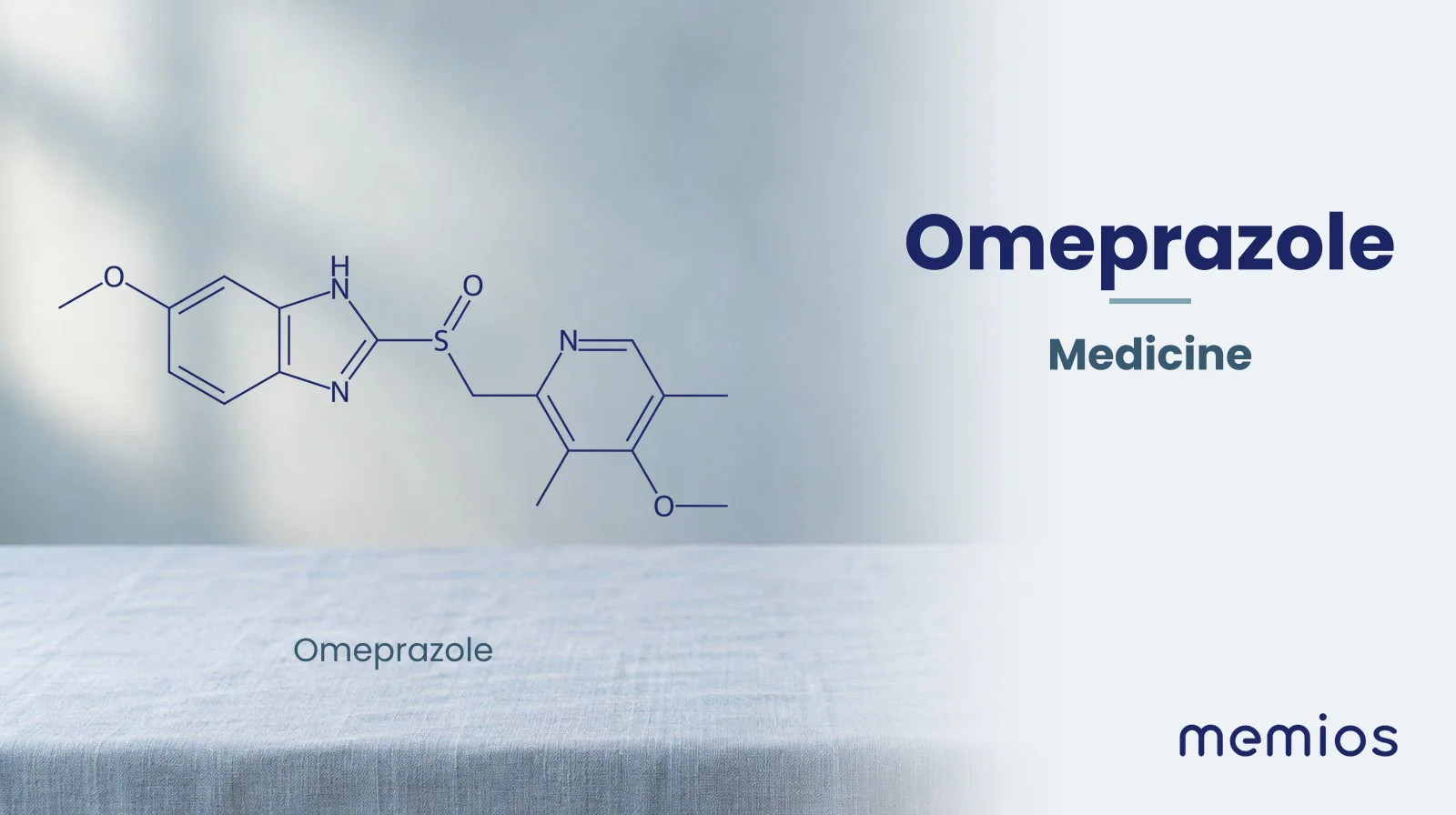
Omeprazole is a prescription and over-the-counter acid-suppressing drug of the proton pump inhibitor class. Its label describes it as a substituted benzimidazole that blocks the acid pump (H+/K+ ATPase) of the stomach's parietal cells.
What the research says
The trial evidence that PPIs relieve heartburn and help heal and prevent ulcers (with antibiotics when H. pylori is present) is solid, though Cochrane rates much of the ulcer evidence low quality. On long-term harms, the one large placebo-controlled trial (COMPASS, 17,598 people, pantoprazole for about 3 years) found no excess of dementia, kidney disease, fractures or death, with the exception of more enteric infections. Many of the alarming signals (dementia, kidney disease) come from observational studies, which cannot separate the drug from the reasons people take it. Rebound acid symptoms after stopping are documented in a trial of healthy volunteers.
Evidence grade: Well established.
How it works
Drug class: Proton pump inhibitor (PPI), substituted benzimidazole
Omeprazole switches off the final step of acid production in the stomach by blocking the proton pump (H+/K+ ATPase) in the acid-making parietal cells, so the stomach makes much less acid. (Source 1)
What it is used for
- In placebo-controlled trials pooled by Cochrane, PPIs made it far less likely that heartburn persisted (risk ratio 0.37 in empirical treatment; 0.71 in endoscopy-negative reflux disease). PPIs outperformed H2 blockers. Evidence: established. (Source 2)
- Cochrane found that H. pylori eradication therapy (which includes a PPI plus antibiotics) healed duodenal ulcers better than acid-suppressing drug alone, but rated the evidence low or very low quality. Evidence: established. (Source 3)
- Approved uses on the label; the trial evidence for these specific uses was not separately reviewed in this batch. Evidence: unknown. (Source 1)
Interactions
- St John's wort (label): St John's wort speeds up the breakdown of omeprazole and can reduce its effect; the label says to avoid the combination. (Source 1)
- Clopidogrel (label): Omeprazole can reduce activation of the antiplatelet drug clopidogrel; the label says to avoid the combination. (Source 1)
- Vitamin B12 (nutrient status) (label): Long-term acid suppression is associated with lower vitamin B12 absorption and more B12 deficiency diagnoses (case-control data, Lam 2013); the label gives more than 3 years of daily use as an example of long-term. (Source 1)
- Magnesium (nutrient status) (label): PPI use is associated with low blood magnesium in observational studies (meta-analysis, Cheungpasitporn 2015). (Source 1)
Stopping it
- Stopping after 8 weeks produced acid symptoms in healthy volunteers who had never had reflux (44% vs 15%), so symptoms right after stopping can be rebound rather than the original disease. (Source 4)
- A deprescribing guideline based on a systematic review says rebound is hard to tell apart from returning GERD and its clinical significance is unknown. (Source 5)
- In deprescribing trials, stepping down the dose held symptoms better than on-demand use or switching to an H2 blocker. (Source 5)
What goes wrong
The same trial found more enteric (gut) infections with the PPI than with placebo, and C. difficile infection was about twice as common but based on only 13 events. (Source 6)
- Randomized trial, Moderate certainty.
- Size: 17,598 participants.
- Who: Adults with stable cardiovascular or peripheral artery disease.
- How long: Median 3.01 years.
- Result: Enteric infections 1.4% vs 1.0%; OR 1.33 (95% CI 1.01-1.75); absolute difference about 0.4 percentage points.
- Funding: not stated.
enteric infections (1.4% vs 1.0% in the placebo group; odds ratio, 1.33; 95% confidence interval, 1.01-1.75)
Observational studies pooled together associate PPI use with about twice the odds of C. difficile infection, but the studies disagreed strongly and showed publication bias. (Source 7)
- Meta-analysis, Low certainty.
- Size: 56 observational studies, 356,683 patients.
- Who: Adults in case-control and cohort studies.
- How long: Varied.
- Result: Pooled OR about 1.99; heterogeneity I2 85.4%; funnel-plot asymmetry P = 0.002.
- Funding: not stated.
This meta-analysis provides further evidence that PPI use is associated with an increased risk for development of CDI.
In a large US cohort, PPI use was associated with a higher risk of chronic kidney disease; this is an association, not proof of cause. (Source 8)
- Cohort study, Low certainty.
- Size: 10,482 ARIC participants; replicated in 248,751 Geisinger patients.
- Who: Adults with normal kidney function at baseline.
- How long: Baseline 1996-1999, followed to December 2011.
- Result: Adjusted HR 1.50 (95% CI 1.14-1.96); time-varying adjusted HR 1.35 (95% CI 1.17-1.55)
- Funding: NIH grants.
Proton pump inhibitor use was associated with incident CKD in unadjusted analysis (hazard ratio [HR], 1.45; 95% CI, 1.11-1.90); in analysis adjusted for demographic, socioeconomic, and clinical variables (HR, 1.50; 95% CI, 1.14-1.96)
In a large case-control study, people prescribed PPIs for 2+ years were more often diagnosed with vitamin B12 deficiency. (Source 9)
- Case-control study, Low certainty.
- Size: 25,956 cases; 184,199 controls.
- Who: Kaiser Permanente members.
- How long: 1997-2011.
- Result: OR 1.65 (95% CI 1.58-1.73); higher doses OR 1.95.
- Funding: not stated in the source read.
deficiency diagnoses were 65% more common among case patients prescribed PPIs compared with patients not taking PPIs (odds ratio [OR] 1.65; 95% confidence interval [CI], 1.58-1.73)
A meta-analysis of observational studies linked PPI use with low blood magnesium. (Source 10)
- Meta-analysis, Low certainty.
- Size: 9 observational studies, 109,798 patients.
- Who: Adults in cohort, cross-sectional and case-control studies.
- How long: Varied.
- Result: Pooled RR 1.43 (1.63 in high-quality studies)
- Funding: not stated.
CONCLUSIONS: Our study demonstrates a statistically significant increased risk of hypomagnesemia in patients with PPI use.
In a randomised trial of healthy volunteers with no reflux, 8 weeks of a PPI (esomeprazole) led to acid symptoms after stopping in 44% versus 15% on placebo, pointing to rebound acid. (Source 4)
- Randomized trial, Moderate certainty.
- Size: 120 healthy volunteers.
- Who: Healthy adults without reflux.
- How long: 8 weeks PPI then 4 weeks placebo.
- Result: 44% (26/59) vs 15% (9/59), P < .001.
- Funding: not stated in abstract.
Forty-four percent (26/59) of those randomized to PPI reported > or = 1 relevant, acid-related symptom in weeks 9-12 compared with 15% (9/59; P < .001) in the placebo group.
What the evidence supports
In placebo-controlled trials, PPIs made persistent heartburn much less likely than placebo in people treated for reflux symptoms. (Source 2)
- Systematic review, Certainty not rated.
- Size: Two trials (empirical GORD); ten trials (ENRD)
- Who: Adults with reflux-type heartburn.
- How long: Short-term (up to about 8 weeks)
- Result: Risk ratio for heartburn remaining: 0.37 (two trials, 95% CI 0.32 to 0.44; empirical GORD); 0.71 (ten trials, 95% CI 0.65 to 0.78; ENRD) versus placebo.
- Funding: not stated.
Limit of this finding: The review labels this a risk ratio for 'heartburn remission', but a value below 1 in favour of the PPI means the chance of heartburn still being present was lower with the PPI (roughly 63% lower in empirically treated reflux and 29% lower in endoscopy-negative reflux). The review also notes the benefit is larger in people treated empirically than in those with endoscopy-negative reflux.
In empirical treatment of GORD the risk ratio (RR) for heartburn remission (the primary efficacy variable) in placebo-controlled trials for PPI was 0.37 (two trials, 95% confidence interval (CI) 0.32 to 0.44)
H. pylori eradication therapy (a PPI plus antibiotics) healed duodenal ulcers better than acid-suppressing drug alone, but the evidence is low quality. (Source 3)
- Systematic review, Low certainty.
- Size: 34 trials, 3,910 participants.
- Who: People with H. pylori-positive peptic ulcer.
- How long: Trial durations varied.
- Result: RR of ulcer persisting 0.66 (95% CI 0.58 to 0.76) versus ulcer-healing drug.
- Funding: not stated.
In duodenal ulcer healing, eradication therapy was superior to ulcer healing drug (UHD) (34 trials, 3910 participants, RR of ulcer persisting = 0.66
What the evidence does not support
In the COMPASS randomised trial, about 3 years of a PPI (pantoprazole) did not raise the risk of pneumonia, fractures, kidney disease, dementia, cancer or death compared with placebo. (Source 6)
- Randomized trial, High certainty.
- Size: 17,598 participants.
- Who: Adults with stable cardiovascular or peripheral artery disease.
- How long: Median 3.01 years (53,152 patient-years)
- Result: No statistically significant difference in any safety outcome except enteric infections.
- Funding: Not stated in abstract (COMPASS was run alongside a rivaroxaban trial)
There was no statistically significant difference between the pantoprazole and placebo groups in safety events except for enteric infections
A meta-analysis restricted to randomised trials found no increase in C. difficile infection with PPIs versus placebo or other acid suppressants. (Source 11)
- Meta-analysis, Certainty not rated.
- Size: 7 RCTs, 25,118 participants.
- Who: Adults in randomised trials of PPIs.
- How long: Varied.
- Result: RR 0.94 (95% CI 0.55; 1.59) vs non-users; RR 0.72 (0.49; 1.07) vs H2 blockers.
- Funding: No funding (declared)
We observed no significant difference in the risk of CDI between the two groups (RR=0.94, 95% CI: 0.55; 1.59)
A meta-analysis of ten observational studies found no link between PPI use and dementia or Alzheimer's disease, though the studies disagreed a lot. (Source 12)
- Meta-analysis, Low certainty.
- Size: 10 studies, 642,305 participants.
- Who: Adults in observational studies.
- How long: Varied.
- Result: Dementia HR 1.04 (95% CI 0.92–1.15), I2 95.6%.
- Funding: No specific funding.
PPI users were unassociated with dementia (HR = 1.04, 95% CI 0.92–1.15; I2 = 95.6%, p < 0.001)
A Welsh national cohort could not confirm a link between PPIs and dementia and suggested earlier links reflect confounding (the illnesses and medicines of people who take PPIs). (Source 13)
- Cohort study, Low certainty.
- Size: 315,078 people aged 55+.
- Who: Adults aged 55 and over in Wales.
- How long: 1999-2015.
- Result: The abstract reports HR 0.67 for dementia in PPI-exposed people, but its confidence interval (0.65 to 0.67) appears to contain a printing error, so treat that number as unreliable.
- Funding: Affiliated with HDRUK (public funders); no specific funding.
Limit of this finding: The paper's abstract gives a hazard ratio of 0.67 with a 95% confidence interval of 0.65 to 0.67. A point estimate should sit inside its interval, not on the upper edge, so at least one of these numbers is probably misprinted. Do not read this study as showing that PPIs lower dementia risk. What it supports is the authors' own conclusion: it did not find the increased dementia risk reported by some earlier studies. It is observational and cannot prove cause either way.
was unable to confirm an association between PPI use and increased dementia risk
Where the evidence is mixed
Cochrane rated the H. pylori ulcer evidence low or very low quality because of flaws in trial design. (Source 3)
- Systematic review, Low certainty.
- Size: 34+ trials.
- Who: People with H. pylori-positive peptic ulcer.
- How long: Varied.
- Result: Quality rating only.
- Funding: not stated.
The quality of evidence was low or very low because most of the studies had errors in study design.
A systematic review of deprescribing trials behind a Canadian guideline found that lowering the PPI dose in people without ongoing symptoms did not significantly increase relapse, while on-demand use or switching to an H2 blocker did raise relapse more. (Source 5)
- Systematic review, Certainty not rated.
- Size: Deprescribing trials (number not recorded in the text read)
- Who: Adults with mild to moderate GERD whose symptoms had resolved.
- How long: Varied.
- Result: Qualitative summary.
- Funding: not stated in the text read.
lowering the dose of a PPI does not lead to significantly greater relapse compared with continuing at a standard dose
Where the research disagrees
Do long-term PPIs cause dementia, kidney disease and other harms?
- Lazarus et al. 2016 (observational), cohort: Proton pump inhibitor use is associated with a higher risk of incident CKD. (Source 8)
- Moayyedi et al. 2019 (COMPASS RCT), rct: we found that pantoprazole is not associated with any adverse event when used for 3 years, with the possible exception of an increased risk of enteric infections. (Source 6)
How much
- Reference intake: Dosing is set by the prescriber. As a position, the FDA label (revised 3/2024) lists 20 mg once daily for 4 weeks for active duodenal ulcer and 20 mg once daily for up to 4 weeks for symptomatic GERD. (Source 1)
- Upper limit: The label passages we recorded do not state a single maximum daily dose; higher doses are used under specialist care for pathological hypersecretory conditions. Check the full label. (Source 1)
- Studied: COMPASS gave pantoprazole (a related PPI) 40 mg daily versus placebo for a median of about 3 years. (Source 6)
- Studied: The rebound trial gave esomeprazole (a related PPI) 40 mg/day for 8 weeks to healthy volunteers. (Source 4)
A common belief, and what the research shows
The belief: Long-term omeprazole causes dementia and kidney failure.
What the research shows: Those links come from observational studies. The large COMPASS randomised trial found no excess dementia or kidney disease over about 3 years: "There was no statistically significant difference between the pantoprazole and placebo groups in safety events except for enteric infections". A pooled analysis of ten studies also found "PPI users were unassociated with dementia".
Questions and answers
What is it?
Omeprazole is a medicine that lowers stomach acid. It belongs to the proton pump inhibitor (PPI) family and is sold on prescription and over the counter. (Source 1)
What does it do in the body?
It blocks the acid pump in the stomach lining cells that make acid, so much less acid is produced. That lets reflux symptoms settle and ulcers heal. (Source 1)
Is it good or bad for you?
For heartburn, reflux and ulcers, trials show clear benefit. Over about 3 years, the one large placebo-controlled trial found no rise in dementia, kidney disease, fractures or death, but it did find more gut infections. Observational studies link long-term use to low B12 and magnesium, though they cannot prove the drug causes it. It depends on having a reason to take it. (Source 6)
How do you get more of it?
Does not apply in the usual sense. Omeprazole is a medicine whose dose and length of treatment are set by a prescriber or by the over-the-counter label. A deprescribing guideline suggests reviewing the dose once symptoms have resolved after at least 4 weeks. (Source 5)
If it is harmful, what reduces it?
When someone and their prescriber decide to stop, trials suggest stepping the dose down works better than switching to on-demand use or to an H2 blocker. Rebound acid can appear for a few weeks after stopping. (Source 5)
Why might someone be low in it or missing it?
Does not apply. Omeprazole is not a nutrient the body needs. It lowers stomach acid, and long-term use is associated with low vitamin B12 and low magnesium. (Source 1)
Which whole foods contain it or feed it?
Does not apply. No food contains omeprazole. Food matters for the drug only through interactions. For example, the label says to avoid the herbal supplement St John's wort with it. (Source 1)
What happens if you do not have it?
Not taking omeprazole is harmful only if there is a condition that needs it. After people stop, symptoms may come back, and some are rebound acid rather than the original disease. (Source 4)
How can you test for it?
There is no routine blood test for omeprazole itself. The literature we read links long-term use to low B12 and low magnesium, which are measured with ordinary blood tests. We did not find a source in this search that sets out a monitoring schedule. (Source 10)
We searched: Prilosec label (DailyMed), magnesium meta-analysis (Cheungpasitporn 2015), B12 case-control study (Lam 2013 via Medscape)
References
- US FDA label via DailyMed. PRILOSEC (omeprazole magnesium) for delayed-release oral suspension, prescribing information (Revised 3/2024). 2024. Read the source
- Cochrane. Short-term treatment with proton pump inhibitors, H2-receptor antagonists and prokinetics for gastro-oesophageal reflux disease-like symptoms and endoscopy negative reflux disease (Cochrane review CD002095). 2013. Read the source
- Cochrane. Eradication therapy for peptic ulcer disease in Helicobacter pylori-positive people (Cochrane review CD003840). 2016. DOI 10.1002/14651858.CD003840.pub5. Read the source
- Gastroenterology. Proton-pump inhibitor therapy induces acid-related symptoms in healthy volunteers after withdrawal of therapy. 2009. PMID 19362552. Read the source
- Canadian Family Physician. Deprescribing proton pump inhibitors: Evidence-based clinical practice guideline. 2017. Read the source
- Gastroenterology. Safety of Proton Pump Inhibitors Based on a Large, Multi-Year, Randomized Trial of Patients Receiving Rivaroxaban or Aspirin. 2019. PMID 31152740, DOI 10.1053/j.gastro.2019.05.056. Read the source
- World Journal of Gastroenterology. Proton pump inhibitors therapy and risk of Clostridium difficile infection: Systematic review and meta-analysis. 2017. PMID 29085200. Read the source
- JAMA Internal Medicine. Proton Pump Inhibitor Use and the Risk of Chronic Kidney Disease. 2016. PMID 26752337, DOI 10.1001/jamainternmed.2015.7193. Read the source
- Medscape. Taking Acid Inhibitors Long-term May Lead to B12 Deficiency (news report of Lam JR et al., JAMA 2013;310:2435-2442). 2013. Read the source
- Renal Failure. Proton pump inhibitors linked to hypomagnesemia: a systematic review and meta-analysis of observational studies. 2015. PMID 26108134, DOI 10.3109/0886022X.2015.1057800. Read the source
- SSRN preprint. Proton Pump Inhibitors are Not Associated with an Increased Risk of Clostridioides Difficile Infection: A Systematic Review and Meta-Analysis of Randomized Controlled Trials (preprint; later published in Gut Microbes 2025). 2024. DOI 10.1080/19490976.2025.2562341. Read the source
- PLOS One. Proton pump inhibitor use does not increase dementia and Alzheimer's disease risk: An updated meta-analysis of published studies involving 642305 patients. 2019. DOI 10.1371/journal.pone.0219213. Read the source
- PLOS One. Proton pump inhibitors and dementia risk: Evidence from a cohort study using linked routinely collected national health data in Wales, UK. 2020. DOI 10.1371/journal.pone.0237676. Read the source