Medications · September 29, 2026 · Memios · 19 min read
Olmesartan
For lowering blood pressure the class evidence is solid and olmesartan is not distinguishable from other ARBs.
TLDR
- Boxed warning: When pregnancy is detected, discontinue amlodipine and olmesartan medoxomil tablets as soon as possible (5.1, 8.1).
- Well established. For lowering blood pressure the class evidence is solid and olmesartan is not distinguishable from other ARBs.
- What it is: Olmesartan is an angiotensin II receptor blocker, one of the ARB family that also includes losartan, valsartan and candesartan. It is given by mouth as olmesartan medoxomil, a prodrug that is converted to olmesartan in the body.
- Main use: High blood pressure (hypertension) (well supported).
- Off-label uses (not on the FDA label): Preventing or delaying microalbuminuria in type 2 diabetes (disputed).
- Recommended dose: not established. No dietary reference intake exists; this is a prescription medicine and the dose is set by the prescriber. As a position, the US label for the amlodipine/olmesartan combination (DailyMed, revised 03/2025) gives a usual starting dose.
- Studied dose (a trial dose, not a recommendation): Cochrane's ARB review pooled trials that used doses from one eighth of the manufacturer's maximum recommended daily dose up to above that maximum. Findings citing that trial: 1 for, 1 against, 1 mixed.
- Upper limit: As a position, that same label (revised 03/2025) sets the maximum at one 10 mg/40 mg tablet once daily.
- What goes wrong: 5 findings on harm. Olmesartan can cause a severe coeliac-like bowel disease with chronic diarrhoea, weight loss and flattening of the gut lining, which can appear months or years after starting it.
- Interactions: 4 recorded, including Lithium, Potassium supplements and potassium-based salt substitutes, NSAIDs plus a diuretic (the 'triple whammy'), Liquorice (glycyrrhizin) in confectionery, teas and herbal medicines.
- Common myth: Olmesartan is a stronger or better blood-pressure drug than the older ARBs.
What it is
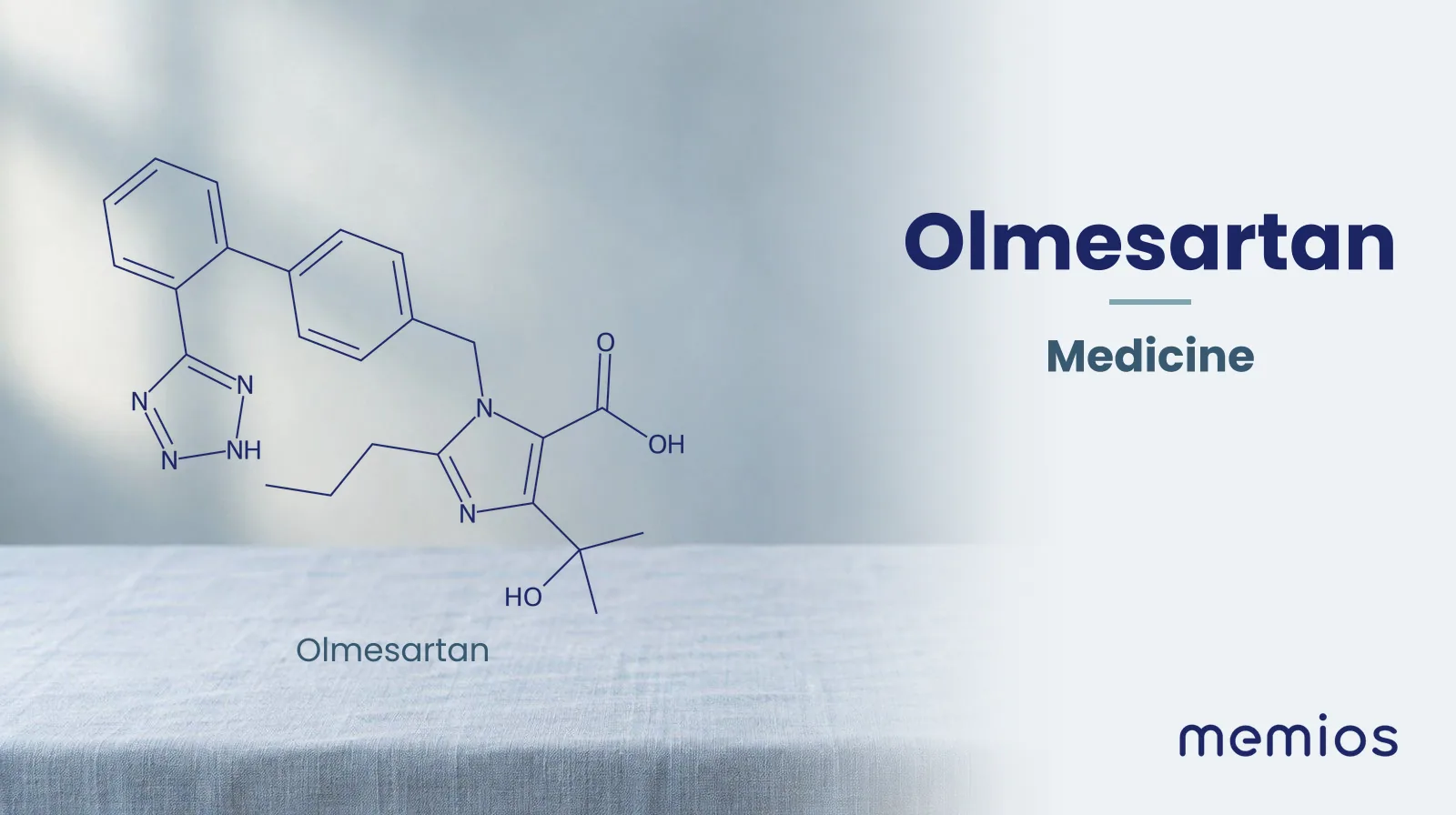
Olmesartan is an angiotensin II receptor blocker, one of the ARB family that also includes losartan, valsartan and candesartan. It is given by mouth as olmesartan medoxomil, a prodrug that is converted to olmesartan in the body. It is sold alone and in fixed combinations with amlodipine and with hydrochlorothiazide. It is licensed for high blood pressure.
What the research says
For lowering blood pressure the class evidence is solid and olmesartan is not distinguishable from other ARBs. Beyond blood pressure the picture is more mixed than for some other ARBs: the authors of a 2012 letter to the editor report that the ROADMAP trial in type 2 diabetes delayed the onset of microalbuminuria but recorded more cardiovascular deaths on olmesartan than on placebo, a finding that has never been fully resolved. Olmesartan is also the one ARB with a distinctive and well-documented harm of its own, a coeliac-like bowel disease that resolves when the drug is stopped.
Evidence grade: Well established.
How it works
Drug class: Angiotensin II receptor blocker (ARB), given as the prodrug olmesartan medoxomil
Angiotensin II is the hormone that tightens blood vessels in the renin-angiotensin system. Olmesartan sits on the AT1 receptor in the muscle of blood vessel walls and stops angiotensin II binding there, so the vessels stay relaxed and pressure falls. Because it blocks the receptor rather than the enzyme that makes the hormone, it works no matter which route the body used to make angiotensin II. (Source 1)
Boxed warning
When pregnancy is detected, discontinue amlodipine and olmesartan medoxomil tablets as soon as possible (5.1, 8.1).
(Source 1)
What it is used for
- Olmesartan lowers blood pressure like the rest of its class. Cochrane's review of 46 trials in 13,451 people found the class lowers trough blood pressure by about 8/5 mmHg and that no ARB out-performs another. The label indication is to lower blood pressure, which is a surrogate rather than an outcome. Evidence: established. (Source 2)
- The authors of a 2012 letter to the editor report that the ROADMAP trial reduced the incidence of microalbuminuria by 23% in relative terms, but that in the same trial there were more cardiovascular deaths on olmesartan than on placebo (15 vs 3). These figures are quoted from that letter, not from the trial report, which could not be reached. This is not an approved indication and the safety signal has kept it controversial. Evidence: disputed. (Source 3)
Interactions
- Lithium (case reports): Taking lithium with an ARB has been followed by higher lithium blood levels and lithium toxicity. (Source 1)
- Potassium supplements and potassium-based salt substitutes (label): Blocking the angiotensin system holds potassium back in the body, so extra potassium from supplements or salt substitutes can push blood potassium into a dangerous range. (Source 1)
- NSAIDs plus a diuretic (the 'triple whammy') (clinical trial): An observational study of this combination found a measurable rate of hospital admission for acute kidney injury: about 8.8 admissions per 1000 users per year for the full triple combination, and 6.9 for an ACE inhibitor or ARB with a diuretic. (Source 4)
- Liquorice (glycyrrhizin) in confectionery, teas and herbal medicines (case reports): Liquorice raises blood pressure and lowers potassium by mimicking a mineralocorticoid effect in the kidney, which pushes against what an ARB is being taken to do. (Source 5)
Stopping it
- Where olmesartan has caused the sprue-like enteropathy, stopping the drug is the treatment: the label instructs prescribers to consider discontinuation once other causes have been excluded. (Source 1)
- A 2025 single case report states that the prognosis of this bowel disease is usually good once the drug is withdrawn; in that one patient the illness came back when olmesartan was restarted. One case cannot show how often either happens. (Source 6)
- The boxed warning makes pregnancy an immediate stopping trigger. (Source 1)
- For planned withdrawal of blood-pressure medicines in older adults generally, a 2026 systematic review of 17 studies concluded the effects remain uncertain. (Source 7)
What goes wrong
The same letter's authors report that the trial recorded significantly more cardiovascular deaths on olmesartan than on placebo. (Source 3)
- Expert review, not systematic, Low certainty.
- Size: ROADMAP trial, reported second-hand in this editorial letter.
- Who: People with type 2 diabetes.
- How long: Median about 3.2 years.
- Result: Cardiovascular death 15 olmesartan vs 3 placebo, P=.01, driven by sudden cardiac death (7 vs 1) and fatal myocardial infarction (5 vs 0); all-cause death 26 vs 15, not significant.
- Funding: ROADMAP was sponsored by Daiichi Sankyo; the letter does not state its own funding.
However, it also showed increased incidence of cardiovascular death with olmesartan (15 vs 3 patients; P=.01), mainly due to sudden cardiac death (7 patients vs 1) and death from myocardial infarction (5 patients vs 0).
Olmesartan can cause a severe coeliac-like bowel disease with chronic diarrhoea, weight loss and flattening of the gut lining, which can appear months or years after starting it. (Source 1)
- Official position, Moderate certainty.
- Size: not quantified in the label.
- Who: People taking olmesartan.
- How long: Onset months to years after starting.
- Result: No rate is given; the label describes the syndrome and tells prescribers to consider stopping the drug when no other cause is found.
- Funding: FDA-approved labelling.
Severe, chronic diarrhea with substantial weight loss has been reported in patients taking olmesartan months to years after drug initiation. Intestinal biopsies of patients often demonstrated villous atrophy.
A published case shows the enteropathy can be severe enough to cause acute kidney injury and can recur on rechallenge, and that it can occur without the classic biopsy findings. (Source 6)
- Case report, Very low certainty.
- Size: 1 patient.
- Who: A 76-year-old woman taking olmesartan.
- How long: Six months of follow-up after stopping.
- Result: Severe enteropathy with acute kidney injury; symptoms recurred when olmesartan was restarted and did not return in six months after definite cessation; she was left with stage G3b chronic kidney disease. One case cannot give a rate.
- Funding: not stated.
we report the case of a 76-year-old woman who developed a severe form of Olmesartan-induced enteropathy complicated by acute kidney injury and acute recurrence after drug rechallenge
Liquorice preparations whose main component is glycyrrhizic acid raise blood pressure in humans, an effect in the opposite direction to a blood pressure medicine such as olmesartan; the pooled trials gave liquorice on its own and none of them studied people taking olmesartan. (Source 8)
- Meta-analysis, Low certainty.
- Size: 541 participants across 8 randomised controlled trials.
- Who: participants in randomised trials of licorice functional components; the review does not restrict to people on antihypertensive drugs.
- How long: not stated in the abstract.
- Result: SBP: WMD [95% CI] = 3.48 [2.74, 4.21], p < 0.001; DBP: WMD [95% CI] = 1.27 [0.76, 1.78], p < 0.001. Licorice flavonoid interventions: SBP WMD 0.58 (-1.15, 2.31), p = 0.511; DBP WMD 0.17 (-1.53, 1.88), p = 0.843.
- Funding: not stated.
Limit of this finding: This is evidence about liquorice itself, not about liquorice taken with olmesartan. The eight pooled trials gave liquorice preparations to people and measured blood pressure; no trial of the combination was found, so nothing here is a measured drug interaction. The review also separates two different things sold as liquorice: preparations dominated by glycyrrhizic acid raised blood pressure, while preparations dominated by liquorice flavonoids did not.
Eight RCTs (541 participants) were included in the meta-analysis, which indicated interventions containing glycyrrhizic acid (GA) as the main component increased systolic blood pressure (SBP) and diastolic blood pressure (DBP) (SBP: WMD [95% CI] = 3.48 [2.74, 4.21], p < 0.001; DBP: WMD [95% CI] = 1.27 [0.76, 1.78], p < 0.001).
A single published case describes life-threatening hyperkalaemia in a woman with normal kidney function who used large amounts of a potassium-chloride salt substitute while taking quinapril, an ACE inhibitor, which blocks the same hormone system as olmesartan but is a different drug. (Source 9)
- Case report, Very low certainty.
- Size: 1 patient.
- Who: 72-year-old woman with hypertension, type 2 diabetes and normal renal function taking quinapril (an ACE inhibitor, not olmesartan)
- How long: chronic salt substitute use; presented acutely.
- Result: Plasma potassium 9.8 mmol/L; sodium 134 mmol/L.
- Funding: not stated.
Limit of this finding: This is one patient, written up as a case report. It shows that this can happen; it says nothing about how often it happens, and no rate, percentage or risk can be read from it. The patient was taking quinapril, an ACE inhibitor, not olmesartan: the two act on the same renin-angiotensin system, but this case is not evidence about olmesartan itself.
We report the case of an elderly female with chronically high salt substitute intake, normal renal function, diabetes, hypertension treated with angiotensin-converting enzyme inhibitor and beta blockade, who developed life-threatening hyperkalemia after a minimally invasive outpatient procedure.
What the evidence supports
Olmesartan, like other ARBs, lowers blood pressure by a modest and well-quantified amount. (Source 2)
- Systematic review, Moderate certainty.
- Size: 13,451 participants across 46 randomised trials of 9 ARBs.
- Who: Adults with primary hypertension, baseline blood pressure 156/101 mmHg.
- How long: Short-term dose-ranging trials.
- Result: Best estimate of trough effect for the class: -8 mmHg systolic and -5 mmHg diastolic; 60-70% of that occurs at recommended starting doses.
- Funding: independent (Cochrane review)
Due to evidence of publication bias, the largest trials provide the best estimate of the trough BP lowering efficacy for ARBs as a class of drugs: -8 mm Hg for SBP and -5 mm Hg for DBP.
The authors of a 2012 letter to the editor, commenting on the ROADMAP trial, report that olmesartan significantly reduced the onset of microalbuminuria in people with type 2 diabetes. (Source 3)
- Expert review, not systematic, Low certainty.
- Size: ROADMAP randomised 4,447 people with type 2 diabetes; this source is a letter reporting the trial, not the trial report.
- Who: People with type 2 diabetes and normal urinary albumin at entry.
- How long: Median follow-up about 3.2 years.
- Result: As reported by the letter's authors: a 23% relative reduction in the incidence of microalbuminuria. The absolute event numbers are not given in this source, and the figure is second-hand rather than from the trial report.
- Funding: ROADMAP was sponsored by Daiichi Sankyo; the letter does not state its own funding.
it found that the use of olmesartan vs placebo to be associated with a significantly reduced incidence of microalbuminuria (23% relative reduction)
Olmesartan is not obtained from food: it is given as the manufactured prodrug olmesartan medoxomil, which is converted to olmesartan during absorption from the gut. (Source 10)
- Expert review, not systematic, Moderate certainty.
- Size: not applicable - pharmacology overview.
- Who: not applicable.
- How long: not applicable.
- Result: Peak plasma concentrations 1-3 h after administration; elimination half-life 10-15 h; absolute bioavailability 28.6%.
- Funding: not stated.
Orally administered olmesartan medoxomil is rapidly absorbed from the gastrointestinal tract and converted during absorption to olmesartan, which is subsequently excreted without further metabolism.
What the evidence does not support
There is no evidence that olmesartan lowers blood pressure better than any other ARB. (Source 2)
- Systematic review, Moderate certainty.
- Size: 46 trials, 13,451 participants.
- Who: Adults with primary hypertension.
- How long: Short-term.
- Result: No clinically meaningful differences between available ARBs.
- Funding: independent (Cochrane review)
The evidence from this review suggests that there are no clinically meaningful BP lowering differences between available ARBs.
In one small controlled trial, 20 people with normal kidney function taking an ACE inhibitor or an angiotensin receptor blocker ate more potassium from fruit and vegetables for four weeks and their serum potassium did not rise; the trial covered the drug class as a whole, not olmesartan. (Source 11)
- Randomized trial, Very low certainty.
- Size: 20 hypertensive subjects.
- Who: hypertensive adults with normal renal function treated with an ACEi or ARB.
- How long: 4 weeks.
- Result: High-potassium diet group: dietary potassium 3775 +/- 1189 mg/d at baseline vs 5212 +/- 1295 mg/d at 4 wk (P = 0.02); serum potassium 4.1 +/- 0.6, 4.3 +/- 0.3 and 4.2 +/- 0.4 mmol/L at baseline, midpoint and end.
- Funding: not stated.
Limit of this finding: This is a single small trial: 20 people in total, four weeks long, and everyone in it had normal kidney function. It is not a general statement that potassium is safe with these medicines. It cannot tell you what happens over longer periods, in people whose kidneys are not working normally, or with potassium supplements and salt substitutes rather than food. It also mixed ACE inhibitors and angiotensin receptor blockers together, so it says nothing about olmesartan specifically.
Despite increased potassium intake in the HKD group, serum potassium concentrations did not significantly increase from baseline at midpoint or end of study
Where the evidence is mixed
The same Cochrane review states it could not estimate how often ARBs cause harm, because the trials were short and under-reported adverse effects. (Source 2)
- Systematic review, Low certainty.
- Size: 46 trials, 13,451 participants.
- Who: Adults with primary hypertension.
- How long: Short-term.
- Result: No usable incidence estimate for harms.
- Funding: independent (Cochrane review)
The review did not provide a good estimate of the incidence of harms associated with ARBs because of the short duration of the trials and the lack of reporting of adverse effects in many of the trials.
The letter's authors also report that all-cause mortality in the trial numerically favoured placebo, but that this difference was not statistically significant. (Source 3)
- Expert review, not systematic, Very low certainty.
- Size: ROADMAP trial, reported second-hand in this 2012 editorial letter.
- Who: People with type 2 diabetes.
- How long: Median about 3.2 years.
- Result: 26 deaths on olmesartan vs 15 on placebo, not significant.
- Funding: ROADMAP was sponsored by Daiichi Sankyo.
Any-cause mortality was unfavorable, but non-significant, for olmesartan (26 vs 15 patients).
Where the research disagrees
Whether the extra cardiovascular deaths seen with olmesartan in ROADMAP are a real drug effect or a chance finding
- Authors of the 2012 Revista Espanola de Cardiologia letter, editorial letter reporting a randomised trial's secondary outcome: However, it also showed increased incidence of cardiovascular death with olmesartan (15 vs 3 patients; P=.01), mainly due to sudden cardiac death (7 patients vs 1) and death from myocardial infarction (5 patients vs 0). (Source 3)
- The same letter, on the counter-argument, the same trial's all-cause mortality, which did not reach significance: Any-cause mortality was unfavorable, but non-significant, for olmesartan (26 vs 15 patients). (Source 3)
How much
- Reference intake: No dietary reference intake exists; this is a prescription medicine and the dose is set by the prescriber. As a position, the US label for the amlodipine/olmesartan combination (DailyMed, revised 03/2025) gives a usual starting dose. (Source 1)
- Upper limit: As a position, that same label (revised 03/2025) sets the maximum at one 10 mg/40 mg tablet once daily. (Source 1)
- Studied: Cochrane's ARB review pooled trials that used doses from one eighth of the manufacturer's maximum recommended daily dose up to above that maximum. (Source 2)
A common belief, and what the research shows
The belief: Olmesartan is a stronger or better blood-pressure drug than the older ARBs.
What the research shows: Cochrane's review of 46 trials in 13,451 people is blunt about this: "The data do not suggest that any one ARB is better or worse at lowering BP." What does set olmesartan apart is a harm, not a benefit - it is the ARB associated with a coeliac-like bowel disease, and the label records that "Severe, chronic diarrhea with substantial weight loss has been reported in patients taking olmesartan months to years after drug initiation."
Questions and answers
What is it?
Olmesartan is a prescription blood-pressure medicine in the angiotensin receptor blocker family. It is swallowed as olmesartan medoxomil and converted to the active drug in the body. It is sold on its own and combined with amlodipine or with hydrochlorothiazide. (Source 1)
What does it do in the body?
It blocks the receptor that angiotensin II uses to squeeze blood vessels, so the vessels relax and blood pressure falls. Because it blocks the receptor rather than the enzyme that makes angiotensin II, it works regardless of how the body produced the hormone. (Source 1)
Is it good or bad for you?
For lowering blood pressure it works about as well as any ARB, roughly 8/5 mmHg at trough. Against that, it is the one ARB linked to a severe coeliac-like bowel disease, and the authors of a 2012 letter to the editor report that the ROADMAP diabetes trial recorded more cardiovascular deaths on olmesartan than on placebo. Those numbers are quoted from the letter, not from the trial report, and whether the mortality signal is real has never been settled. (Source 3)
How do you get more of it?
There is nothing to get more of. It is a prescription-only medicine with no food or supplement source, and the amount is set by a prescriber. The label records a usual starting dose and a maximum as the manufacturer's position. (Source 1)
If it is harmful, what reduces it?
When olmesartan is causing harm the answer in the literature is to stop it, under medical supervision. A 2025 case report says the bowel disease generally settles after withdrawal, and the label tells prescribers to consider stopping once other causes have been excluded. A single case report cannot show how often the problem occurs or how often it settles. (Source 6)
Why might someone be low in it or missing it?
Does not apply as a deficiency. People come off olmesartan because of adverse effects, because pregnancy is detected, or because a prescriber deliberately reduces treatment. The distinctive olmesartan reason is the sprue-like enteropathy, which can start months or years after the drug was begun and is easy to mistake for coeliac disease. (Source 1)
Which whole foods contain it or feed it?
Olmesartan is a manufactured medicine, not a nutrient, so no whole food contains it: it is swallowed as the prodrug olmesartan medoxomil and converted to olmesartan as it is absorbed from the gut. Foods matter instead because a few push against the drug class olmesartan belongs to, and none of the evidence below comes from a trial in people taking olmesartan. Liquorice is the clearest example: a 2024 systematic review pooling eight randomised trials in 541 people found that preparations dominated by glycyrrhizic acid raised systolic blood pressure by about 3.5 mmHg and diastolic by about 1.3 mmHg, the opposite direction to a blood pressure drug, while liquorice flavonoid preparations did not; those trials gave liquorice on its own, not alongside olmesartan. Potassium is the other, because drugs of olmesartan's class reduce potassium excretion: a small trial in 20 people with normal kidney function taking an ACE inhibitor or an angiotensin receptor blocker saw no rise in serum potassium over four weeks on a high fruit-and-vegetable potassium diet. One published case describes a woman taking quinapril, an ACE inhibitor, who reached a potassium of 9.8 mmol/L after heavy use of a potassium-chloride salt substitute, which shows what can happen in one person rather than how often it happens. (Source 8)
What happens if you do not have it?
Not taking it is not a deficiency state. Untreated high blood pressure is what treatment is aimed at, and the authors of a 2012 letter to the editor report that in people with type 2 diabetes the ROADMAP trial found olmesartan reduced the incidence of microalbuminuria, an early marker of kidney damage, by 23% in relative terms. The same letter reports the trial's death signal, so the balance is not one-sided. (Source 3)
How can you test for it?
There is no routine blood test for the drug. Blood pressure is the measure of effect, and kidney function and potassium are checked because the drug acts on the renin-angiotensin system. If the sprue-like enteropathy is suspected, the investigation is an intestinal biopsy looking for villous atrophy, though one published case had the illness without those biopsy findings; that is a single report, not a measure of how often biopsies are negative. (Source 6)
References
- DailyMed, US National Library of Medicine. AMLODIPINE AND OLMESARTAN MEDOXOMIL tablet, film coated - US prescribing information (DailyMed). 2025. Read the source
- Cochrane Database of Systematic Reviews (Cochrane evidence page). Blood pressure lowering efficacy of angiotensin receptor blockers for primary hypertension. 2008. PMID 18843650, DOI 10.1002/14651858.CD003822.pub2. Read the source
- Revista Española de Cardiología (English Edition). Increased Mortality in Patients With Diabetes Associated With Olmesartan for the Prevention/Delay of Microalbuminuria Onset, a Matter of Concern?. 2012. DOI 10.1016/j.rec.2011.05.028. Read the source
- Nefrología (English Edition). Acute kidney injury secondary to a combination of renin-angiotensin system inhibitors, diuretics and NSAIDS: "The Triple Whammy". 2015. DOI 10.1016/j.nefroe.2015.05.010. Read the source
- Frontiers in Nutrition. Clinical Risk Factors of Licorice-Induced Pseudoaldosteronism Based on Glycyrrhizin-Metabolite Concentrations: A Narrative Review. 2021. PMID 34434958, DOI 10.3389/fnut.2021.719197. Read the source
- Diseases (MDPI). Atypical Rapid Onset of Olmesartan-Induced Enteropathy with Recurrence After Rechallenging. 2025. DOI 10.3390/diseases13070223. Read the source
- BMC Geriatrics (record read via the DOAJ article API). Deprescribing antihypertensive medications in older people: a systematic review and a meta-analysis. 2026. PMID 41491674, DOI 10.1186/s12877-025-06941-2. Read the source
- Nutrients. Effects of Licorice Functional Components Intakes on Blood Pressure: A Systematic Review with Meta-Analysis and NETWORK Toxicology. 2024. PMID 39519602, DOI 10.3390/nu16213768. Read the source
- Clinical Kidney Journal. Life-threatening hyperkalemia in a patient with normal renal function. 2014. PMID 25859350, DOI 10.1093/ckj/sft151. Read the source
- Journal of Human Hypertension. The new oral angiotensin II antagonist olmesartan medoxomil: a concise overview. 2002. PMID 11967728, DOI 10.1038/sj.jhh.1001391. Read the source
- The American Journal of Clinical Nutrition. Adequate intake of potassium does not cause hyperkalemia in hypertensive individuals taking medications that antagonize the renin angiotensin aldosterone system. 2016. PMID 27581475, DOI 10.3945/ajcn.115.129635. Read the source