Supplements · September 29, 2026 · Memios · 11 min read
Niacin
Not supported by the research. The strongest evidence is against the main claim made for high-dose nicotinic acid.
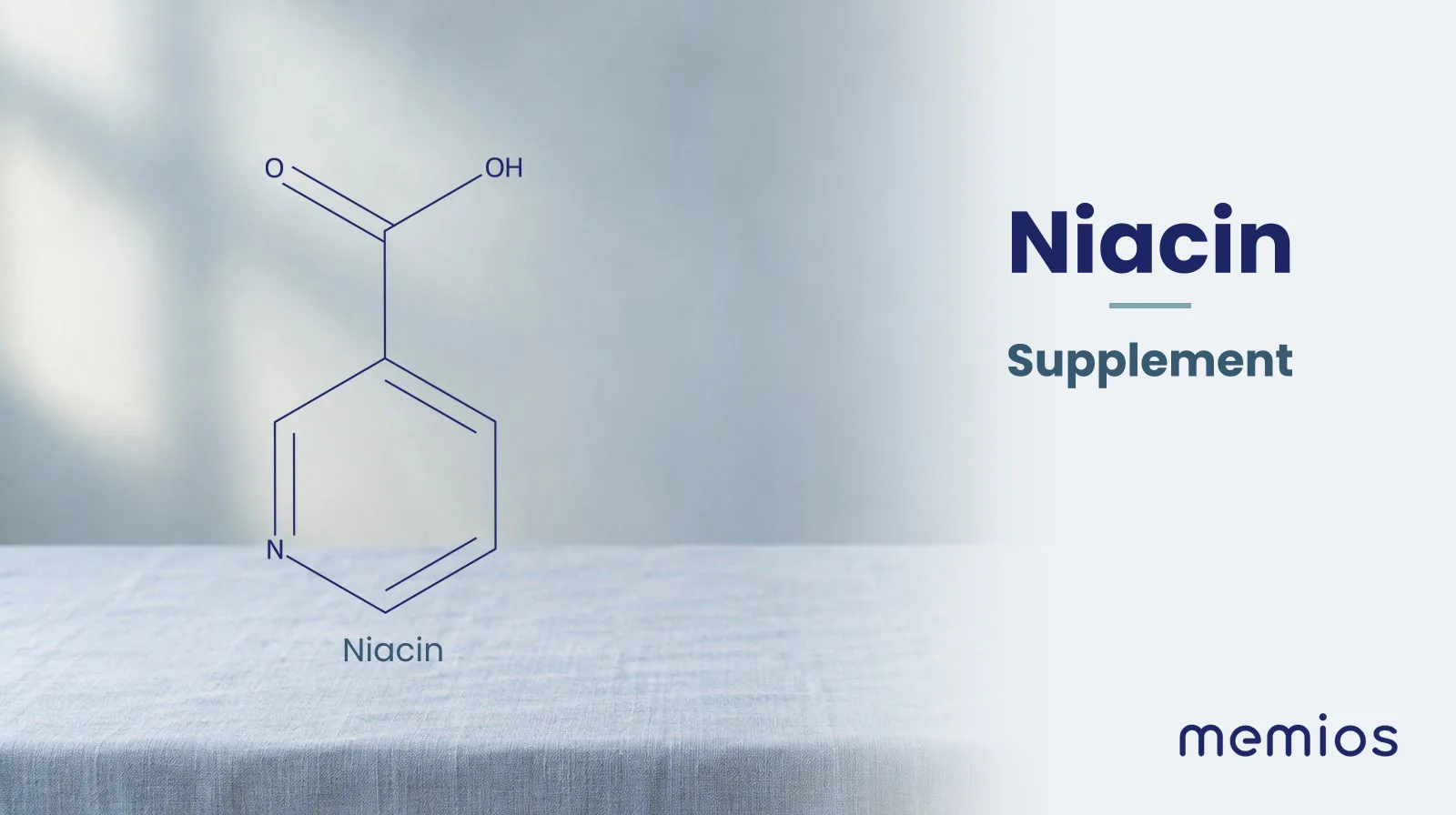
TLDR
- Not supported by the research. The strongest evidence is against the main claim made for high-dose nicotinic acid.
- What it is: Niacin is the umbrella name for nicotinic acid, nicotinamide (also called niacinamide) and related compounds.
- Main use, supported: In the ONTRAC phase 3 trial, as reported in a 2026 review, oral nicotinamide reduced new non-melanoma skin cancers by 23% over 12 months in high-risk patients. (moderate certainty)
- Other use, supported: In a large US veterans cohort, people who took nicotinamide had a 14% lower rate of new skin cancer than people who did not. (low certainty)
- Claim NOT supported by research: In a Cochrane review of 23 randomised trials, niacin did not reduce deaths, heart attacks or strokes, whether or not people were also taking a statin. (moderate certainty)
- Another claim NOT supported: The Cochrane authors rated the evidence moderate to high quality and concluded that benefits of niacin for preventing cardiovascular events are unlikely; most included trials were manufacturer-funded. (moderate certainty)
- Recommended dose (official position): RDA (Food and Nutrition Board, as reported by NIH ODS, fact sheet updated 2022): 16 mg niacin equivalents (NE) a day for adult men and 14 mg NE for adult women; 18 mg NE in pregnancy and 17 mg NE in lactation.
- Studied dose (a trial dose, not a recommendation): Cochrane-pooled trials of prescription nicotinic acid, typically gram doses; HPS2-THRIVE gave 2 g/day extended-release nicotinic acid and AIM-HIGH gave 1,500 to 2,000 mg/day extended-release niacin (per NIH ODS). Findings citing that trial: 2 on harm.
- Upper limit: UL (Food and Nutrition Board, as reported by NIH ODS, 2022): 35 mg a day for adults 19 and over from supplements and fortified foods, set on the basis of skin flushing.
- What goes wrong: 7 findings on harm. Niacin raised the risk of flushing, itching, rash and gastrointestinal symptoms in the pooled Cochrane trials.
- Common myth: Taking niacin to raise HDL ('good') cholesterol protects the heart.
What it is
Niacin is the umbrella name for nicotinic acid, nicotinamide (also called niacinamide) and related compounds. The body turns them into NAD, a coenzyme that more than 400 enzymes need. The body can also make some niacin from the amino acid tryptophan.
What the research says
The strongest evidence is against the main claim made for high-dose nicotinic acid. A 2017 Cochrane review of 23 trials (39,195 people) found it did not reduce deaths, heart attacks or strokes. It did raise the rates of flushing, itching, rash, stomach upset and diabetes, and 18% of people stopped taking it because of side effects. High doses can also injure the liver. Nicotinamide, the non-flushing form, cut new non-melanoma skin cancers by 23% in one 12-month trial of high-risk patients. A later trial in organ transplant recipients did not show this benefit. Niacin at normal dietary amounts is essential: severe lack of it causes pellagra.
Evidence grade: Not supported by the research.
What goes wrong
Niacin raised the risk of flushing, itching, rash and gastrointestinal symptoms in the pooled Cochrane trials. (Source 1)
- Systematic review, Moderate certainty.
- Size: 39,195 participants across 23 trials.
- Who: adults with or without cardiovascular disease.
- How long: not stated.
- Result: flushing RR 7.69 (95% CI 4.14 to 14.28; NNH 3.5); pruritus RR 5.26 (95% CI 2.68 to 10.32); rash RR 3.15 (95% CI 1.94 to 5.13); gastrointestinal symptoms RR 1.69 (95% CI 1.37 to 2.07)
- Funding: 17 of 23 trials manufacturer-funded.
Niacin did appear to increase the risk of several adverse effects, including flushing (relative risk [RR] = 7.69; 95% confidence interval [CI], 4.14 to 14.28; number needed to harm [NNH] = 3.5)
People taking niacin in the pooled trials had a higher risk of developing diabetes. (Source 1)
- Systematic review, Moderate certainty.
- Size: 39,195 participants across 23 trials.
- Who: adults with or without cardiovascular disease.
- How long: not stated.
- Result: diabetes RR 1.32 (95% CI 1.16 to 1.51; NNH 143)
- Funding: 17 of 23 trials manufacturer-funded.
There was also an apparent increased risk of developing diabetes mellitus in patients who used niacin (RR = 1.32; 95% CI, 1.16 to 1.51; NNH = 143).
People on niacin were about twice as likely to stop treatment because of side effects; 18% stopped. (Source 1)
- Systematic review, Moderate certainty.
- Size: 39,195 participants across 23 trials.
- Who: adults with or without cardiovascular disease.
- How long: not stated.
- Result: discontinuation due to adverse effects RR 2.17 (95% CI 1.70 to 2.77; NNH 8)
- Funding: 17 of 23 trials manufacturer-funded.
Niacin users were at risk of discontinuing the medication because of these adverse effects (RR = 2.17; 95% CI, 1.70 to 2.77; NNH = 8 [95% CI, 5 to 14]).
In the HPS2-THRIVE trial, as summarised by NIH ODS, 2 g a day of extended-release nicotinic acid increased diabetes, gut problems, bleeding in the gut and brain, and skin rashes and ulcerations. (Source 2)
- Official position, Certainty not rated.
- Size: 25,673 adults (per ODS summary)
- Who: adults with cardiovascular disease taking statins.
- How long: median about 4 years.
- Result: significantly greater risk of diabetes, dyspepsia, diarrhoea, ulceration, gut and brain bleeding, and skin rashes and ulcerations; rates not given in the ODS text.
- Funding: not stated in the fetched summary.
the nicotinic acid group had a significantly greater risk of diabetes, gastrointestinal dyspepsia, diarrhea, ulceration, bleeding events in the gut and brain, and skin rashes and ulcerations.
In a separate, earlier randomised trial of 3,414 patients (AIM-HIGH, per the ODS reference list), which was stopped after 3 years, patients given extended-release niacin on top of cholesterol treatment had a higher risk of ischaemic stroke. This is a different trial from HPS2-THRIVE. (Source 2)
- Official position, Certainty not rated.
- Size: 3,414 patients (per ODS summary)
- Who: patients with cardiovascular disease on cholesterol-lowering treatment.
- How long: stopped after 3 years.
- Result: increased risk of ischaemic stroke; no cardiovascular benefit.
- Funding: not stated in the fetched summary.
The results also showed that patients taking niacin had an increased risk of ischemic stroke.
LiverTox rates niacin a well-known cause of clinically apparent liver injury at high doses; above 500 mg a day it raises liver enzymes in up to 20% of people, and injury can be severe or fatal. (Source 3)
- Official position, Certainty not rated.
- Size: not applicable.
- Who: people taking pharmacological doses.
- How long: not applicable.
- Result: transient aminotransferase elevations in up to 20% at doses above 500 mg daily; severe injury more common with sustained-release forms.
- Funding: government (NIDDK)
Niacin in doses above 500 mg daily causes transient, asymptomatic elevations in serum aminotransferase levels in up to 20% of people.
Sustained-release niacin carries a particular risk of serious liver injury compared with crystalline or extended-release forms. (Source 3)
- Official position, Certainty not rated.
- Size: not applicable.
- Who: people taking high-dose niacin.
- How long: not applicable.
- Result: not quantified.
- Funding: government (NIDDK)
Significant hepatotoxicity is particularly common with high doses of sustained release niacin
What the evidence supports
In the ONTRAC phase 3 trial, as reported in a 2026 review, oral nicotinamide reduced new non-melanoma skin cancers by 23% over 12 months in high-risk patients. (Source 4)
- Randomized trial, Moderate certainty.
- Size: not stated in the fetched review.
- Who: people at high risk of non-melanoma skin cancer.
- How long: 12 months.
- Result: 23% relative reduction in number of new non-melanoma skin cancers versus placebo.
- Funding: not stated in the fetched review.
During the 12-month intervention period, there was a 23% reduction in the number of NMSCs in the nicotinamide group compared with placebo.
In a large US veterans cohort, people who took nicotinamide had a 14% lower rate of new skin cancer than people who did not. This is an observational comparison of exposed and unexposed patients, not a placebo-controlled result. (Source 4)
- Cohort study, Low certainty.
- Size: more than 33,000 veterans, about 12,000 of whom took nicotinamide for at least 30 days.
- Who: US veterans with at least one prior skin cancer.
- How long: not stated.
- Result: 14% reduction in rate of new skin cancer versus unexposed patients (observational association)
- Funding: not stated.
In this study, there was an overall 14% reduction in the rate of new skin cancer development among patients receiving nicotinamide compared with unexposed patients.
What the evidence does not support
In a Cochrane review of 23 randomised trials, niacin did not reduce deaths, heart attacks or strokes, whether or not people were also taking a statin. (Source 5)
- Systematic review, Moderate certainty.
- Size: 39,195 participants across 23 randomised trials.
- Who: adults with or without established cardiovascular disease.
- How long: trials to August 2016.
- Result: no reduction in overall mortality, cardiovascular mortality, heart attack or stroke.
- Funding: Review independent; 17 of 23 included trials fully or partially funded by the drug manufacturer.
Niacin did not reduce the number of deaths, heart attack or stroke
The Cochrane authors rated the evidence moderate to high quality and concluded that benefits of niacin for preventing cardiovascular events are unlikely; most included trials were manufacturer-funded. (Source 5)
- Systematic review, Moderate certainty.
- Size: 23 randomised trials.
- Who: adults with or without cardiovascular disease.
- How long: not stated.
- Result: not applicable (conclusion)
- Funding: 17 of 23 trials fully or partially funded by the drug manufacturer.
Seventeen out of 23 studies were fully or partially funded by the drug manufacturer with a commercial interest in the results of the studies.
The ONTRANS trial in solid-organ transplant recipients did not show that nicotinamide prevents skin cancer. (Source 4)
- Randomized trial, Low certainty.
- Size: not stated in the fetched review.
- Who: solid organ transplant recipients.
- How long: not stated.
- Result: no demonstrated efficacy; the reviewers note limitations.
- Funding: not stated.
The ONTRANS trial did not demonstrate efficacy of nicotinamide in SOTRs, though several limitations have been discussed.
Where the research disagrees
Whether the niacin metabolite 4PY signals that niacin intake harms the heart
- Ferrell, Hazen and colleagues (Cleveland Clinic), 2024, two clinical cohorts plus cell and mouse experiments (the VCAM-1 finding is from mice): Lastly, treatment with physiological levels of 4PY, but not its structural isomer 2PY, induced expression of VCAM-1 and leukocyte adherence to vascular endothelium in mice. (Source 6)
- Schreiber and colleagues, 2024 Matters Arising, commentary drawing on prior trials and pharmacovigilance: Strikingly, the exact mechanism identified as a potential adverse outcome by Ferrell et al. has been noted to be suppressed with niacin supplementation (Source 7)
How much
- Reference intake: RDA (Food and Nutrition Board, as reported by NIH ODS, fact sheet updated 2022): 16 mg niacin equivalents (NE) a day for adult men and 14 mg NE for adult women; 18 mg NE in pregnancy and 17 mg NE in lactation. (Source 2)
- Upper limit: UL (Food and Nutrition Board, as reported by NIH ODS, 2022): 35 mg a day for adults 19 and over from supplements and fortified foods, set on the basis of skin flushing. (Source 2)
- Studied: Cochrane-pooled trials of prescription nicotinic acid, typically gram doses; HPS2-THRIVE gave 2 g/day extended-release nicotinic acid and AIM-HIGH gave 1,500 to 2,000 mg/day extended-release niacin (per NIH ODS). (Source 2)
- Studied: ONTRAC gave oral nicotinamide for 12 months to people at high risk of skin cancer. (Source 4)
A common belief, and what the research shows
The belief: Taking niacin to raise HDL ('good') cholesterol protects the heart.
What the research shows: Niacin raises HDL but the large trials pooled by Cochrane showed no fewer deaths, heart attacks or strokes: "Benefits from niacin therapy in the prevention of cardiovascular disease events are unlikely."
Questions and answers
What is it?
Niacin, or vitamin B3, is a group of compounds: nicotinic acid, nicotinamide (niacinamide) and related forms. They are found in food and sold as supplements and prescription drugs. (Source 2)
What does it do in the body?
The body turns niacin into NAD, a helper molecule that hundreds of enzymes need to release energy from food and to maintain cells. (Source 2)
Is it good or bad for you?
Enough niacin from food is essential. High-dose nicotinic acid, used as a cholesterol drug, did not prevent heart attacks, strokes or deaths in trials and caused side effects such as flushing and diabetes. At high doses and in some slow-release forms it can seriously damage the liver. (Source 3)
How do you get more of it?
Niacin comes from food, supplements, and from the body's own conversion of the amino acid tryptophan found in protein. The usual estimate is 1 mg of niacin from every 60 mg of tryptophan. (Source 2)
If it is harmful, what reduces it?
Niacin is not harmful at dietary amounts. The only source in this write-up that described what happens after stopping high-dose niacin was a case series whose recorded identifiers turn out to belong to a different paper, so it has been held and is not quoted here. (Source 2)
We searched: The case series that addressed this (recorded as Mittal et al., Annals of Emergency Medicine 2007) is held by the 2026-09-22 identifier audit because its pmid and doi both resolve to Hoot et al. on crowding in emergency departments. No replacement source was sought, because an identifier audit adds no new research and no new quotations.
Why might someone be low in it or missing it?
Low niacin is linked with undernutrition from poverty or anorexia, alcohol use disorder, AIDS, inflammatory bowel disease and liver cirrhosis. The tuberculosis drugs isoniazid and pyrazinamide can block the body making niacin from tryptophan. (Source 2)
Which whole foods contain it or feed it?
Poultry, beef and fish are rich sources, at about 5 to 10 mg per serving. Plant foods such as nuts, legumes and grains provide smaller amounts. (Source 2)
What happens if you do not have it?
Severe deficiency causes pellagra. Its signs include a dark rash on skin exposed to sunlight, changes to the tongue and mouth, digestive problems and, in advanced cases, depression and confusion. (Source 2)
How can you test for it?
NIH ODS describes measuring two niacin breakdown products in urine as the most sensitive and reliable way to assess niacin status. This is a specialist test, not a routine blood test. (Source 2)
References
- American Family Physician. Use of Niacin for Primary or Secondary Prevention of Cardiovascular or Cerebrovascular Events (Cochrane for Clinicians). 2018. PMID 29671561. Read the source
- NIH Office of Dietary Supplements. Niacin: Fact Sheet for Health Professionals (updated November 18, 2022). 2022. Read the source
- NIDDK, NCBI Bookshelf. LiverTox: Niacin (last updated July 9, 2020). 2020. Read the source
- Practical Dermatology. Update on the Safety and Efficacy of Nicotinamide for Skin Cancer Chemoprevention (Jelousi S, Wheless L). 2026. Read the source
- Cochrane. Niacin for people with or without established cardiovascular disease (plain language summary of Schandelmaier et al., Niacin for primary and secondary prevention of cardiovascular events, CD009744.pub2). 2017. PMID 28616955, DOI 10.1002/14651858.CD009744.pub2. Read the source
- Nature Medicine. A terminal metabolite of niacin promotes vascular inflammation and contributes to cardiovascular disease risk. 2024. PMID 38374343, DOI 10.1038/s41591-023-02793-8. Read the source
- Nature Medicine. Cardiovascular safety of vitamin B3 administration (Matters Arising). 2024. DOI 10.1038/s41591-024-03219-9. Read the source