Supplements · September 29, 2026 · Memios · 14 min read
N-acetylcysteine
Limited evidence. The best-graded evidence is narrow.
TLDR
- Limited evidence. The best-graded evidence is narrow.
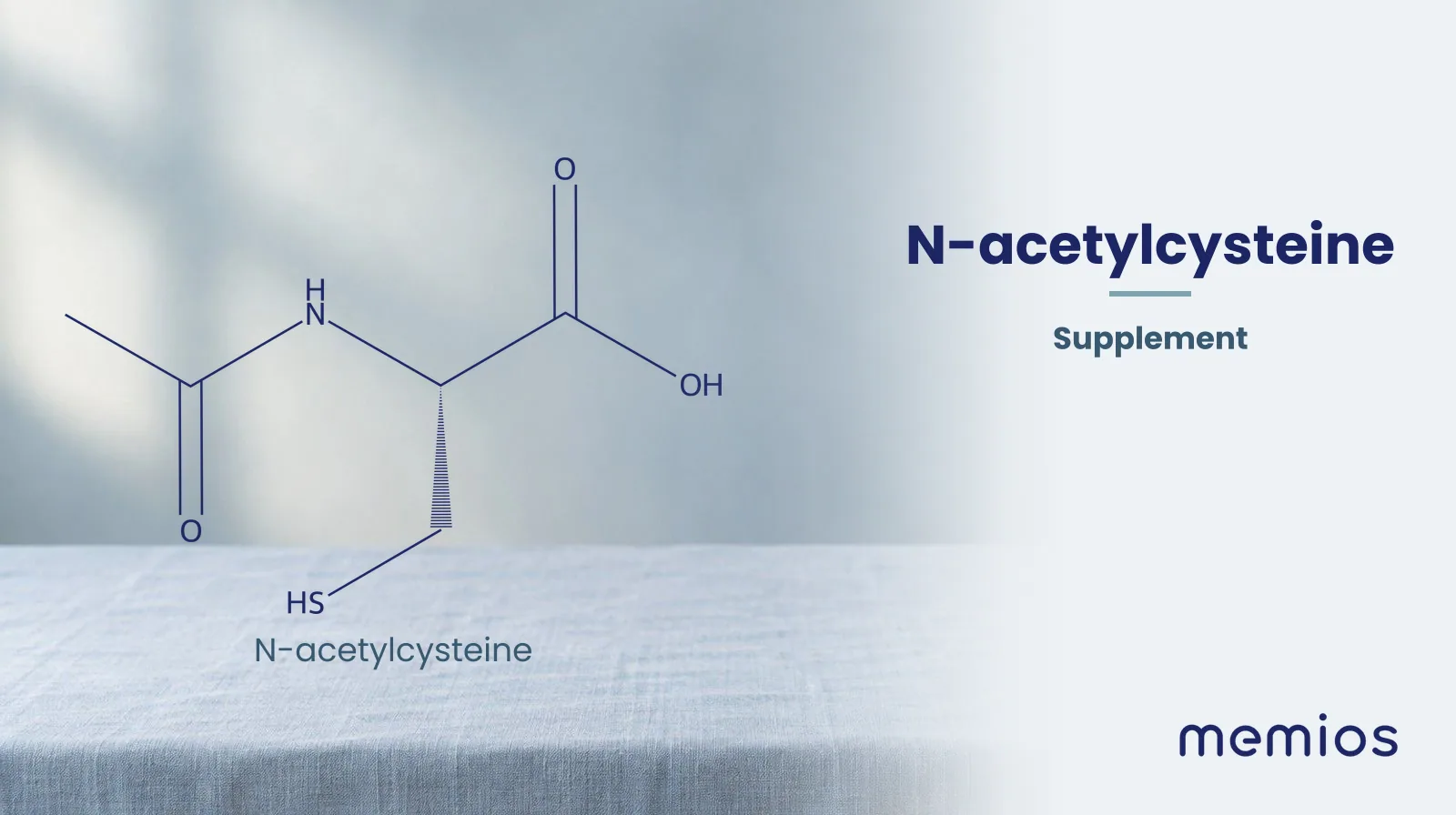
- What it is: N-acetylcysteine is an acetylated form of the amino acid cysteine, described in the NIH LiverTox record as a modified amino acid whose thiol side chain gives it redox activity.
- Main use, supported: An umbrella review of meta-analyses of randomised trials found moderate-quality evidence that NAC reduces contrast-induced nephropathy. (moderate certainty)
- Other use, supported: NIH LiverTox records that acetylcysteine has not been linked to clinically apparent liver injury. (low certainty)
- Claim NOT supported by research: The same umbrella review found no association between NAC and the outcomes that matter most, dialysis and death. (moderate certainty)
- Another claim NOT supported: A meta-analysis of double-blind randomised placebo-controlled trials found NAC did not improve depressive symptoms. (low certainty)
- Recommended dose: not established. No reference intake exists. NAC is not an essential nutrient; the US FDA states that NAC is excluded from the statutory definition of a dietary supplement and it regulates NAC-labelled products only under an enforcement discretion policy that finalises an April 2022 draft guidance.
- Studied dose (a trial dose, not a recommendation): The 72-hour oral poisoning protocol gives a 140 mg/kg loading dose, then 70 mg/kg every 4 hours for 17 further doses (total 1330 mg/kg). No finding here cites that trial.
- Upper limit: No tolerable upper intake level has been set by a nutrition body.
- What goes wrong: 4 findings on harm. Pooled trial data show NAC causes more gastrointestinal adverse events than placebo.
- Common myth: NAC is a general-purpose antioxidant that protects the kidneys, liver and mood.
What it is
N-acetylcysteine is an acetylated form of the amino acid cysteine, described in the NIH LiverTox record as a modified amino acid whose thiol side chain gives it redox activity. Cysteine is the rate-limiting building block for glutathione, the main intracellular antioxidant, which is why NAC is studied as a way to raise glutathione. In hospital medicine it is a licensed drug given orally or intravenously for paracetamol (acetaminophen) poisoning and as a mucolytic; in shops it is sold as a capsule. NAC itself is a manufactured compound rather than a constituent of food.
What the research says
The best-graded evidence is narrow. An umbrella review of meta-analyses of randomised trials found moderate-quality evidence that NAC lowers the rate of contrast-induced nephropathy, but the same review found no association with dialysis or death, so the benefit is on a surrogate measure rather than on outcomes that matter to patients. In psychiatry, a meta-analysis of seven double-blind randomised trials found no improvement in depressive symptoms versus placebo, and a meta-analysis in obsessive-compulsive disorder found no difference on the obsession and compulsion subscales. Its established role is as a hospital antidote and mucolytic, not as a general supplement.
Evidence grade: Limited evidence.
What goes wrong
Pooled trial data show NAC causes more gastrointestinal adverse events than placebo. (Source 1)
- Meta-analysis, Moderate certainty.
- Size: 4 trials, 537 participants.
- Who: adults with bipolar depression or major depressive disorder.
- How long: 8 to 24 weeks.
- Result: risk ratio 1.79, 95% CI 1.37 to 2.32, p < 0.01, I2 = 0.00%, number needed to treat to harm = 7.
- Funding: not stated.
N-acetylcysteine was associated with a higher incidence of gastrointestinal adverse events compared with placebo (N = 4, n = 537, risk ratio = 1.79, 95% CI = 1.37, 2.32, p < 0.01, I2 = 0.00%, number needed to treat to harm = 7)
Anaphylactoid reactions were recorded in 8.2% of intravenous NAC treatment courses in a large multicentre record review. (Source 2)
- Cohort study, Moderate certainty.
- Size: 6,455 treatment courses across 34 Canadian hospitals.
- Who: patients treated with the 21-hour IV NAC protocol for acetaminophen poisoning.
- How long: February 1980 to November 2005.
- Result: 528 of 6455 courses (8.2%); 398 (75.4%) cutaneous; 504 (95.4%) within the first 5 hours; female sex adjusted OR 1.24 (95%CI 1.08, 1.42) for more severe reactions.
- Funding: not stated.
An anaphylactoid reaction was documented in 528 (8.2%) of 6455 treatment courses, of which 398 (75.4%) were cutaneous.
A reported case of massive accidental NAC infusion resulted in permanent brain injury. (Source 3)
- Case report, Very low certainty.
- Size: 1 patient (described within a reference review)
- Who: a patient being treated for acetaminophen overdose.
- How long: acute.
- Result: 100 mg/kg/hr infusion followed by cerebral edema, seizures, uncal herniation and permanent brain injury.
- Funding: not stated.
Massive accidental NAC administration of 100 mg/kg/hr had resulted in cerebral edema, seizures, uncal herniation, and permanent brain injury in a patient with an APAP overdose.
Oral NAC commonly causes gastrointestinal symptoms, and intravenous NAC causes rate-related anaphylactoid reactions in up to 18% of patients. (Source 4)
- Expert review, not systematic, Low certainty.
- Size: not stated; reference-text summary.
- Who: patients given oral or intravenous NAC.
- How long: not stated.
- Result: anaphylactoid reactions mild in 6%, moderate in 10%, severe (bronchospasm, hypotension) rare at 1%.
- Funding: not stated.
Limit of this finding: The source's own percentages do not add up: it says anaphylactoid reactions occur in up to 18% of people given NAC into a vein, then describes them as mild in 6%, moderate in 10% and severe in 1%, which totals 17%. Read these as rough figures, not an exact breakdown of the 18%. They also apply to the intravenous hospital drug, not to capsules taken by mouth.
Oral NAC may cause nausea, vomiting, diarrhea, flatus, and gastroesophageal reflux. IV NAC can cause rate-related anaphylactoid reactions in up to 18% of patients, which is not an issue with the oral route.
What the evidence supports
An umbrella review of meta-analyses of randomised trials found moderate-quality evidence that NAC reduces contrast-induced nephropathy. (Source 5)
- Review of reviews, Moderate certainty.
- Size: 12 meta-analyses selected from 493 records screened and 46 full texts assessed.
- Who: patients receiving iodinated contrast media in randomised clinical trials.
- How long: peri-procedural, with creatinine measured in the days after contrast.
- Result: OR 0.72, 95% CI 0.65 to 0.79, P < 0.00001 for contrast-induced nephropathy; serum creatinine MD -0.09, 95% CI -0.17 to -0.01, P = 0.03.
- Funding: not stated.
Based on the pooled data, which was graded as moderate-quality evidence, it can be concluded that NAC can decrease CIN
NIH LiverTox records that acetylcysteine has not been linked to clinically apparent liver injury. (Source 6)
- Official position, Low certainty.
- Size: not applicable.
- Who: patients treated with acetylcysteine for acetaminophen overdose and other conditions.
- How long: not applicable.
- Result: no serum enzyme elevations or clinically apparent liver injury reported.
- Funding: US National Institutes of Health (NIDDK)
it has not been associated with serum enzyme elevations during therapy or with episodes of clinically apparent liver injury
The US FDA has announced enforcement discretion for certain NAC-labelled supplements, finalising an April 2022 draft policy, and says its initial review has not revealed safety concerns while its full safety review remains ongoing. (Source 7)
- Official position, Certainty not rated.
- Size: not applicable.
- Who: US market for NAC-labelled supplements.
- How long: final guidance announced in a constituent update dated November 29, 2023, finalising the April 2022 draft policy.
- Result: enforcement discretion for certain NAC-containing products labelled as dietary supplements; the full safety review is stated to be ongoing.
- Funding: US government.
Limit of this finding: This is an absence of findings so far under a policy of not enforcing the exclusion, not an FDA statement that NAC is safe. The agency says its own safety review is still running.
While our full safety review of NAC remains ongoing, our initial review has not revealed safety concerns with respect to the use of this ingredient in or as a dietary supplement.
What the evidence does not support
The same umbrella review found no association between NAC and the outcomes that matter most, dialysis and death. (Source 5)
- Review of reviews, Moderate certainty.
- Size: 12 meta-analyses of randomised clinical trials.
- Who: patients receiving iodinated contrast media.
- How long: in-hospital and short-term follow-up as reported by the included meta-analyses.
- Result: no association reported for dialysis requirement or mortality.
- Funding: not stated.
there were no associations between NAC and dialysis requirement or mortality in these studies
A meta-analysis of double-blind randomised placebo-controlled trials found NAC did not improve depressive symptoms. (Source 1)
- Meta-analysis, Low certainty.
- Size: 7 studies, 728 participants (579 in the depressive-symptom analysis)
- Who: adults with bipolar depression or major depressive disorder, mean age 46.81, 58.45% female.
- How long: 8 to 24 weeks.
- Result: SMD = -0.12, 95% CI -0.38 to 0.14, p = 0.38, I2 = 52.74%.
- Funding: not stated.
N-acetylcysteine did not improve depressive symptoms compared with placebo
A systematic review of 41 studies using NAC at 600 to 3000 mg/day in chronic respiratory disease found no excess of adverse events over control. (Source 8)
- Systematic review, Low certainty.
- Size: 41 articles reporting safety.
- Who: mostly patients with COPD, idiopathic pulmonary fibrosis, bronchiectasis, chronic bronchitis and cystic fibrosis.
- How long: varied; chronic use studies.
- Result: safety profile similar at high and standard oral doses; gastrointestinal symptoms no more common than control.
- Funding: not stated.
In general, the safety profile was similar at both the high and standard doses with the oral formulation; gastrointestinal symptoms were reported but they were no more common than in the control group.
Where the evidence is mixed
In obsessive-compulsive disorder, NAC augmentation showed no difference on the obsession and compulsion subscales despite a borderline total-score result. (Source 9)
- Meta-analysis, Low certainty.
- Size: 6 randomised controlled trials, 195 patients.
- Who: adults with moderate to severe OCD taking SSRIs.
- How long: trials from under 5 weeks to over 12 weeks.
- Result: total Y-BOCS favoured NAC at 5 to 8 weeks (p-Value = 0.05); no significant difference for shorter or longer durations, and none on obsession or compulsion subscales or adverse events.
- Funding: not stated.
no significant difference was found between the two groups in terms of the obsession and compulsion Y-BOCS scores
Where the research disagrees
Whether NAC helps psychiatric symptoms
- Eghdami and colleagues, Frontiers in Psychiatry 2024, meta-analysis of 6 RCTs, 195 patients, with no difference on the obsession and compulsion subscales: The results of our study indicated a positive outcome for the experimental group in terms of the total Y-BOCS score when using the medication for a period of five to eight weeks (p-Value = 0.05). (Source 9)
- Sakurai and colleagues, Psychopharmacology 2020, meta-analysis of 7 double-blind randomised placebo-controlled trials, 728 participants: N-acetylcysteine did not improve depressive symptoms compared with placebo (Source 1)
How much
- Reference intake: No reference intake exists. NAC is not an essential nutrient; the US FDA states that NAC is excluded from the statutory definition of a dietary supplement and it regulates NAC-labelled products only under an enforcement discretion policy that finalises an April 2022 draft guidance. (Source 7)
- Upper limit: No tolerable upper intake level has been set by a nutrition body. The closest published boundary is a Drug Safety systematic review that examined oral doses from 600 mg/day up to 3000 mg/day in chronic respiratory disease and reported no excess of adverse events over control. (Source 8)
- Studied: The 72-hour oral poisoning protocol gives a 140 mg/kg loading dose, then 70 mg/kg every 4 hours for 17 further doses (total 1330 mg/kg). (Source 10)
- Studied: Chronic respiratory disease studies used NAC at 600 mg/day and above, up to 3000 mg/day. (Source 8)
A common belief, and what the research shows
The belief: NAC is a general-purpose antioxidant that protects the kidneys, liver and mood.
What the research shows: The strongest synthesis found only a surrogate benefit. The umbrella review states that "there were no associations between NAC and dialysis requirement or mortality in these studies", and the depression meta-analysis found "N-acetylcysteine did not improve depressive symptoms compared with placebo". Its clearly established use is as a hospital antidote, where LiverTox records that "it has not been associated with serum enzyme elevations during therapy or with episodes of clinically apparent liver injury".
Questions and answers
What is it?
NAC is an acetylated form of the amino acid cysteine. Cysteine carries a sulfur-containing thiol group that can take part in oxidation and reduction reactions, which is the basis of its antioxidant chemistry. Cysteine is also one of the three amino acids the body joins together to make glutathione. NAC is manufactured rather than extracted from food. (Source 11)
What does it do in the body?
In the body NAC is deacetylated to cysteine, and cysteine is the limiting ingredient for making glutathione. In paracetamol poisoning this matters directly: the overdose depletes liver glutathione, and NAC restores it so the toxic metabolite can be neutralised. Outside that setting, whether topping up glutathione changes health outcomes is much less certain. (Source 12)
Is it good or bad for you?
It depends entirely on the setting. As a hospital antidote it is standard care. As a long-term supplement, reviews of chronic respiratory disease trials found the oral safety profile similar at high and standard doses, while a pooled analysis of mood-disorder trials found more gastrointestinal upset on NAC than placebo (risk ratio 1.79, number needed to harm 7) and no improvement in depressive symptoms. Intravenous NAC carries a documented risk of anaphylactoid reactions. (Source 8)
How do you get more of it?
In clinical use NAC is given as a weight-based oral or intravenous protocol for poisoning, and in respiratory trials as fixed oral doses of 600 mg/day and above. Supplement capsules are sold in the United States under an FDA enforcement discretion policy. This is a description of what has been studied and marketed, not a recommendation. (Source 10)
If it is harmful, what reduces it?
NAC leaves the body quickly once stopped, so the practical step described in the literature is to stop the dose and treat the reaction. Reference texts warn that the weight-based hospital regimen is error-prone and that overdose has caused hemolysis, acidosis, renal failure and, in one reported case, permanent brain injury. (Source 3)
Why might someone be low in it or missing it?
You cannot be deficient in NAC itself, because it is a manufactured compound rather than a nutrient. What can be limiting is cysteine, the amino acid NAC supplies, which reviews identify as the rate-limiting step in making glutathione. Low protein intake, illness and oxidative stress are the situations in which cysteine supply is discussed as limiting. (Source 13)
Which whole foods contain it or feed it?
No whole food is a source of NAC itself; it is a synthetic derivative. Foods supply the underlying amino acid cysteine, mainly through protein, and a dietary review notes that whey protein raised lymphocyte glutathione in a dose-dependent way. Sulfur-rich plant foods are discussed in the same review as supporting glutathione. (Source 14)
What happens if you do not have it?
Nothing happens from not taking NAC, because it is not a required nutrient and there is no NAC deficiency state. The body makes glutathione from dietary amino acids. The interest in NAC comes from the fact that cysteine supply limits glutathione synthesis, not from any established requirement for NAC. (Source 13)
How can you test for it?
No validated clinical test of NAC status exists in the literature we searched, and because NAC is not a nutrient there is nothing to be low in. Hospital monitoring during NAC treatment watches for reactions and, in poisoning, measures the paracetamol concentration and liver function rather than NAC itself. (Source 15)
We searched: Searched PubMed-indexed reviews and reference texts (LiverTox, StatPearls) and the NAC respiratory-safety and psychiatric meta-analyses for any validated assay of NAC status; only treatment-monitoring parameters were described.
References
- Psychopharmacology. N-acetylcysteine as an adjunctive treatment for bipolar depression and major depressive disorder: a systematic review and meta-analysis of double-blind, randomized placebo-controlled trials. 2020. DOI 10.1007/s00213-020-05629-2. Read the source
- Journal of Medical Toxicology. Anaphylactoid Reactions to Intravenous N-Acetylcysteine during Treatment for Acetaminophen Poisoning. 2018. PMID 29423816, DOI 10.1007/s13181-018-0653-9. Read the source
- StatPearls Publishing. N-Acetylcysteine - StatPearls (Toxicity). 2024. Read the source
- StatPearls Publishing. N-Acetylcysteine - StatPearls (Adverse Effects). 2024. Read the source
- Frontiers in Medicine. Association of N-acetylcysteine use with contrast-induced nephropathy: an umbrella review of meta-analyses of randomized clinical trials. 2023. DOI 10.3389/fmed.2023.1235023. Read the source
- National Institute of Diabetes and Digestive and Kidney Diseases (NIH), Bethesda. Acetylcysteine - LiverTox: Clinical and Research Information on Drug-Induced Liver Injury (Hepatotoxicity section). 2016. Read the source
- US Food and Drug Administration. FDA Releases Final Guidance on Enforcement Discretion for Certain NAC Products. 2023. Read the source
- Drug Safety. Safety of N-Acetylcysteine at High Doses in Chronic Respiratory Diseases: A Review. 2021. DOI 10.1007/s40264-020-01026-y. Read the source
- Frontiers in Psychiatry. The safety and efficacy of N-acetylcysteine as an augmentation in the treatment of obsessive-compulsive disorder in adults: a systematic review and meta-analysis of randomized clinical trials. 2024. DOI 10.3389/fpsyt.2024.1421150. Read the source
- StatPearls Publishing. N-Acetylcysteine - StatPearls (Administration). 2024. Read the source
- National Institute of Diabetes and Digestive and Kidney Diseases (NIH), Bethesda. Acetylcysteine - LiverTox: Clinical and Research Information on Drug-Induced Liver Injury. 2016. Read the source
- StatPearls Publishing. N-Acetylcysteine - StatPearls (Mechanism of Action). 2024. Read the source
- Nutrients. A Review of Dietary (Phyto)Nutrients for Glutathione Support (N-acetylcysteine passage). 2019. DOI 10.3390/nu11092073. Read the source
- Nutrients. A Review of Dietary (Phyto)Nutrients for Glutathione Support (whey protein passage). 2019. DOI 10.3390/nu11092073. Read the source
- StatPearls Publishing. N-Acetylcysteine - StatPearls (Monitoring). 2024. Read the source