Medications · September 29, 2026 · Memios · 10 min read
Meloxicam
Well established. In 12-week placebo-controlled trials it improved arthritis symptoms at 7.5 and 15 mg.
TLDR
- Boxed warning: Gastrointestinal Bleeding, Ulceration, and Perforation.
- Well established. In 12-week placebo-controlled trials it improved arthritis symptoms at 7.5 and 15 mg.
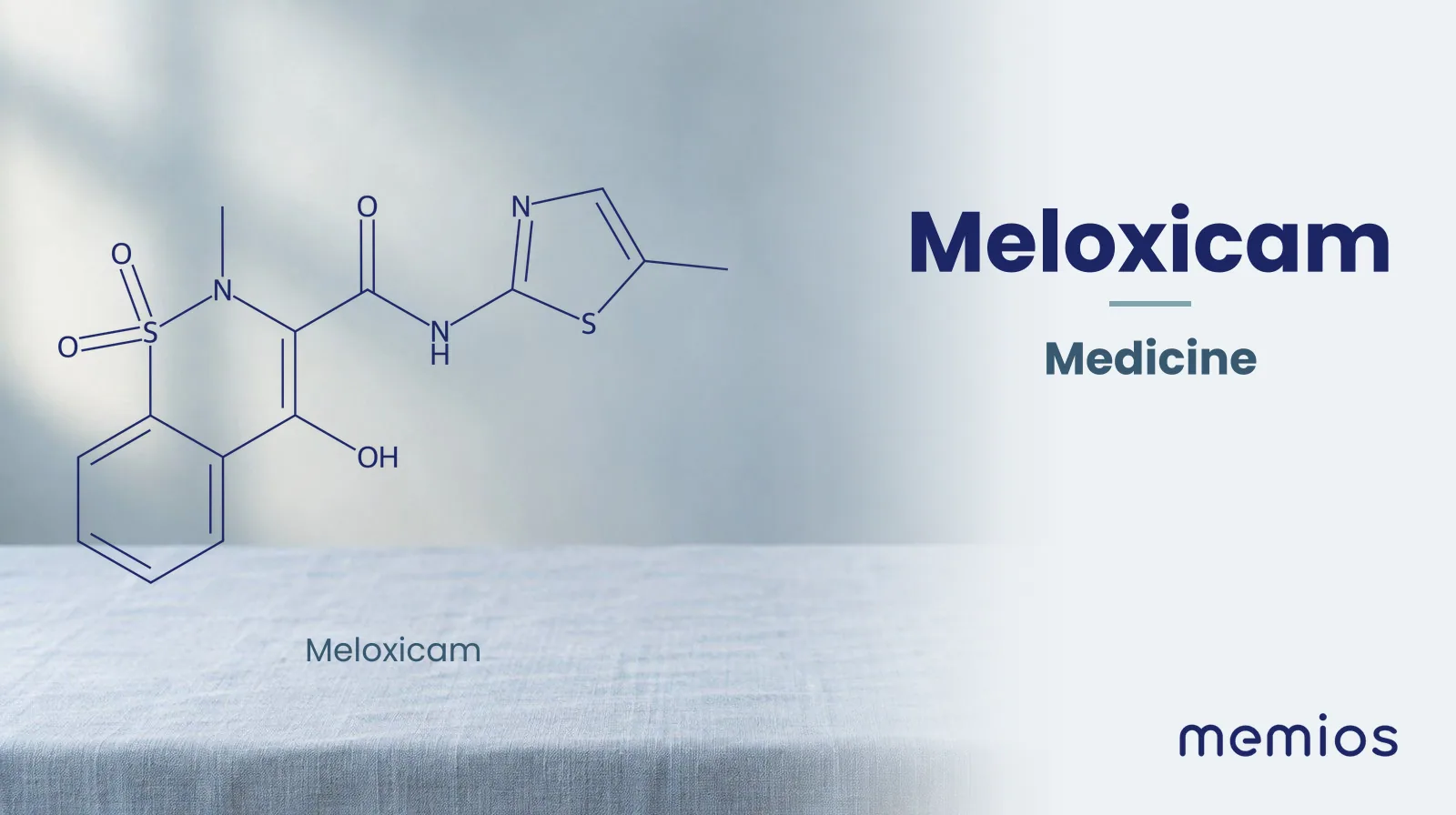
- What it is: Meloxicam is a prescription NSAID in the oxicam class, similar to piroxicam.
- Main use: Osteoarthritis (well supported).
- Other approved uses: Rheumatoid arthritis (well supported); Juvenile rheumatoid arthritis (patients weighing 60 kg or more) (evidence not rated).
- Recommended dose (official position): Dosing is set by the prescriber. As a position, the generic label (revised 2/2017) gives a starting dose of 7.5 mg once daily, which may be raised to 15 mg once daily.
- Studied dose (a trial dose, not a recommendation): The label's osteoarthritis trial compared 3.75 mg, 7.5 mg and 15 mg daily with placebo over 12 weeks; the rheumatoid arthritis trial compared 7.5, 15 and 22.5 mg daily. Findings citing that trial: 1 for, 1 on harm.
- Upper limit: The label's maximum daily dose is 15 mg (generic label, revised 2/2017).
- What goes wrong: 5 findings on harm. In pooled population-based observational studies, meloxicam's cardiovascular risk profile resembled that of ibuprofen and celecoxib, though the authors note meloxicam was not widely investigated.
- Interactions: 3 recorded, including Alcohol, SSRIs and SNRIs (antidepressants), Aspirin, anticoagulants and oral corticosteroids.
- Common myth: Meloxicam is a 'safer' NSAID for the heart.
What it is
Meloxicam is a prescription NSAID in the oxicam class, similar to piroxicam. The generic US label read (revised 2/2017) approves it for osteoarthritis, rheumatoid arthritis and juvenile rheumatoid arthritis in patients weighing at least 60 kg.
What the research says
In 12-week placebo-controlled trials it improved arthritis symptoms at 7.5 and 15 mg. Compared with older NSAIDs it was of equal or lower efficacy, with fewer clinical stomach events in some analyses but no clear difference in complicated ulcers. Like all NSAIDs it carries a boxed warning for heart attack, stroke and stomach bleeding; observational data put its heart risk similar to ibuprofen and celecoxib.
Evidence grade: Well established.
How it works
Drug class: Nonsteroidal anti-inflammatory drug (NSAID), oxicam class, relatively COX-2 preferential
Meloxicam blocks cyclooxygenase enzymes (COX-1 and COX-2), which make prostaglandins that drive pain, inflammation and fever. It is in the oxicam family, like piroxicam. (Source 1)
Boxed warning
WARNING: RISK OF SERIOUS CARDIOVASCULAR AND GASTROINTESTINAL EVENTS
(Source 2)
What it is used for
- The label reports a 12-week placebo-controlled trial in knee and hip osteoarthritis. A 2008 HTA review found meloxicam of inferior or equivalent efficacy to non-selective NSAIDs. Evidence: established. (Source 2)
- A 12-week placebo-controlled multinational trial described in the label; the 2008 HTA review covered rheumatoid arthritis alongside osteoarthritis. Evidence: established. (Source 2)
- Approved by label position; pediatric trials were not retrieved in this run. Evidence: unknown. (Source 2)
Interactions
- Alcohol (label): Alcohol use is listed among risk factors for NSAID stomach and gut bleeding. (Source 2)
- SSRIs and SNRIs (antidepressants) (label): Combining them with an NSAID raises bleeding risk more than the NSAID alone, per case-control and cohort studies cited in the label. (Source 2)
- Aspirin, anticoagulants and oral corticosteroids (label): Each is listed as a risk factor for GI bleeding when taken with an NSAID. (Source 2)
Stopping it
- No dependence or withdrawal syndrome was found in the sources read. For drug-induced liver injury, LiverTox reports that recovery is usually rapid after meloxicam is stopped. (Source 1)
What goes wrong
Class-wide, NSAID upper GI ulcers, gross bleeding or perforation occur in about 1% of people treated for 3-6 months and 2-4% treated for one year. (Source 2)
- Official position, Certainty not rated.
- Size: label.
- Who: People on NSAIDs.
- How long: 3 months to 1 year.
- Result: About 1% at 3-6 months; 2-4% at one year.
- Funding: label.
Upper GI ulcers, gross bleeding, or perforation caused by NSAIDs occurred in approximately 1% of patients treated for 3-6 months, and in about 2-4% of patients treated for one year.
In pooled population-based observational studies, meloxicam's cardiovascular risk profile resembled that of ibuprofen and celecoxib, though the authors note meloxicam was not widely investigated. (Source 3)
- Systematic review, Low certainty.
- Size: 30 case-control and 21 cohort studies (all NSAIDs)
- Who: Community populations using NSAIDs.
- How long: observational.
- Result: Risk profile similar to ibuprofen and celecoxib (pooled observational estimates)
- Funding: independent (no specific funding)
In the pooled analyses, meloxicam had a risk profile similar to that of ibuprofen and celecoxib, while piroxicam appeared similar to naproxen.
In head-to-head comparisons within the same studies, meloxicam's cardiovascular risk was about 10% higher than naproxen's; the difference (p = 0.012) did not reach the review's multiple-comparison threshold, so it is not statistically established. (Source 4)
- Systematic review, Low certainty.
- Size: 30 case-control and 21 cohort studies (all NSAIDs)
- Who: Community populations using NSAIDs.
- How long: observational.
- Result: Relative risk about 10% higher than naproxen; p = 0.012, not significant after Bonferroni adjustment.
- Funding: independent (no specific funding)
The RR with meloxicam was about 10% higher than with naproxen. The p-value for this comparison (0.012) did not reach the Bonferroni-adjusted threshold
Because meloxicam's excess risk over naproxen came close to significance and meloxicam is partly COX-2 selective, the review authors recommend avoiding it in people at high cardiovascular risk. This is the authors' judgement from sparse observational data, not a trial result. (Source 5)
- Systematic review, Low certainty.
- Size: 30 case-control and 21 cohort studies (all NSAIDs)
- Who: Community populations using NSAIDs.
- How long: observational.
- Result: Authors' recommendation; no additional effect estimate.
- Funding: independent (no specific funding)
However, taking account of its relative Cox-2 selectivity and the data presented here, we believe that it should be avoided in patients at high risk of cardiovascular events.
Up to 7% of patients on meloxicam had transient liver enzyme rises; clinically apparent liver injury is rare, with only case reports. (Source 1)
- Case series, Low certainty.
- Size: prospective studies and case reports.
- Who: People taking meloxicam.
- How long: varied.
- Result: Up to 7% transient aminotransferase elevations; >3x ULN in 1%.
- Funding: NIH (LiverTox)
Clinically apparent liver injury with jaundice from meloxicam is rare and only individual case reports have been published.
What the evidence supports
The label describes a 12-week double-blind trial in knee and hip osteoarthritis comparing meloxicam 3.75, 7.5 and 15 mg with placebo, in which 7.5 and 15 mg improved the primary endpoints. (Source 2)
- Official position, Moderate certainty.
- Size: about 467 across placebo, 7.5 mg and 15 mg arms (label)
- Who: Adults with knee or hip osteoarthritis.
- How long: 12 weeks.
- Result: Significant improvement vs placebo at 7.5 and 15 mg (numbers not given in the text read)
- Funding: manufacturer trial (label)
The use of meloxicam for the treatment of the signs and symptoms of osteoarthritis of the knee and hip was evaluated in a 12-week, double-blind, controlled trial.
What the evidence does not support
Pooled trials did not show that meloxicam reduces complicated upper GI events (bleeds, perforations) compared with non-selective NSAIDs. (Source 6)
- Systematic review, Moderate certainty.
- Size: not stated in the summary read.
- Who: Adults with arthritis.
- How long: varied.
- Result: Complicated UGI events RR 0.56 (95% CI 0.27 to 1.15); clinical UGI events RR 0.53 (95% CI 0.29 to 0.97)
- Funding: independent (UK NIHR HTA programme)
Pooled analysis did not show a difference in complicated UGI events (RR 0.56, 95% CI 0.27 to 1.15).
Where the evidence is mixed
Against non-selective NSAIDs, meloxicam was of inferior or equivalent efficacy. (Source 6)
- Systematic review, Moderate certainty.
- Size: not stated in the summary read.
- Who: Adults with osteoarthritis or rheumatoid arthritis.
- How long: varied.
- Result: Inferior or equivalent efficacy vs naproxen, diclofenac, nabumetone or piroxicam.
- Funding: independent (UK NIHR HTA programme)
Compared with non-selective NSAIDs (naproxen, diclofenac, nabumetone or piroxicam), meloxicam (7.5–22.5 mg/day) was of inferior or equivalent efficacy
An earlier meta-analysis reported fewer GI adverse events than non-selective NSAIDs, but an independent appraisal flagged a single-database search and single-reviewer data extraction. (Source 7)
- Meta-analysis, Low certainty.
- Size: not stated in the summary read.
- Who: Adults in randomised trials of meloxicam.
- How long: varied.
- Result: GI adverse events OR 0.64 (95% CI 0.59, 0.69) vs non-selective NSAIDs.
- Funding: not stated.
Patients using meloxicam had fewer GI adverse events compared with non-COX-2-selective NSAIDs (OR 0.64, 95% CI: 0.59, 0.69).
The HTA review found too few events to comment on meloxicam's heart attack risk from trials. (Source 6)
- Systematic review, Very low certainty.
- Size: trial events insufficient.
- Who: Adults with arthritis.
- How long: varied.
- Result: Insufficient MI events.
- Funding: independent (UK NIHR HTA programme)
There were insufficient events to comment on MI risk.
Where the research disagrees
Whether meloxicam is easier on the stomach than older NSAIDs
- Schoenfeld 1999 meta-analysis, meta-analysis (single-database search, single reviewer per CRD appraisal): Meloxicam, a COX-2-selective NSAID, appears to cause fewer adverse GI events than standard, non-COX-2-selective NSAIDs. (Source 7)
- Chen et al. 2008 NIHR HTA review, systematic review: Pooled analysis did not show a difference in complicated UGI events (RR 0.56, 95% CI 0.27 to 1.15). (Source 6)
How much
- Reference intake: Dosing is set by the prescriber. As a position, the generic label (revised 2/2017) gives a starting dose of 7.5 mg once daily, which may be raised to 15 mg once daily. (Source 2)
- Upper limit: The label's maximum daily dose is 15 mg (generic label, revised 2/2017). (Source 2)
- Studied: The label's osteoarthritis trial compared 3.75 mg, 7.5 mg and 15 mg daily with placebo over 12 weeks; the rheumatoid arthritis trial compared 7.5, 15 and 22.5 mg daily. (Source 2)
- Studied: Comparator trials in the HTA review used 7.5 to 22.5 mg/day. (Source 6)
A common belief, and what the research shows
The belief: Meloxicam is a 'safer' NSAID for the heart.
What the research shows: Pooled observational data found "meloxicam had a risk profile similar to that of ibuprofen and celecoxib", and the authors wrote "we believe that it should be avoided in patients at high risk of cardiovascular events."
Questions and answers
What is it?
Meloxicam is a prescription anti-inflammatory painkiller (an NSAID) in the oxicam family, similar to piroxicam. It is approved for osteoarthritis and rheumatoid arthritis. (Source 1)
What does it do in the body?
It blocks the COX enzymes that make prostaglandins, the chemicals that drive pain, swelling and fever. (Source 1)
Is it good or bad for you?
It eases arthritis symptoms about as well as, or slightly less well than, older NSAIDs. Like all NSAIDs it raises the risk of heart attack, stroke and stomach bleeding, with risk rising with longer use. (Source 2)
How do you get more of it?
Does not apply as a nutrient. It is a prescription medicine; the label contraindicates it around heart bypass surgery. (Source 2)
If it is harmful, what reduces it?
It is stopped by the prescriber. For liver injury, LiverTox reports recovery is usually rapid once meloxicam is stopped; no withdrawal syndrome was described in the sources read. (Source 1)
Why might someone be low in it or missing it?
Does not apply. Meloxicam is a medicine, not something the body needs or makes. (Source 1)
We searched: Label and LiverTox; deficiency does not apply to a synthetic drug
Which whole foods contain it or feed it?
No food contains meloxicam. The documented lifestyle interactions are alcohol and smoking, both listed as risk factors for NSAID stomach bleeding. (Source 2)
What happens if you do not have it?
Without it, people with arthritis in trials had less symptom relief than those on 7.5 or 15 mg, but other NSAIDs gave similar or better relief. (Source 6)
How can you test for it?
Drug levels are not routinely measured in the sources we read. Liver enzymes can rise on NSAIDs, which blood tests can detect. (Source 1)
References
- NIDDK / NCBI Bookshelf. Meloxicam (LiverTox: Clinical and Research Information on Drug-Induced Liver Injury). 2025. Read the source
- US FDA label via DailyMed. MELOXICAM tablets, prescribing information (DailyMed), Revised 2/2017 (DailyMed version effective January 20, 2022). 2017. Read the source
- PLOS Medicine. Cardiovascular Risk with Non-Steroidal Anti-Inflammatory Drugs: Systematic Review of Population-Based Controlled Observational Studies (Results: less extensively studied drugs). 2011. DOI 10.1371/journal.pmed.1001098. Read the source
- PLOS Medicine. Cardiovascular Risk with Non-Steroidal Anti-Inflammatory Drugs: Systematic Review of Population-Based Controlled Observational Studies (Results: pair-wise comparisons). 2011. DOI 10.1371/journal.pmed.1001098. Read the source
- PLOS Medicine. Cardiovascular Risk with Non-Steroidal Anti-Inflammatory Drugs: Systematic Review of Population-Based Controlled Observational Studies (Discussion: meloxicam paragraph). 2011. DOI 10.1371/journal.pmed.1001098. Read the source
- NIHR Health Technology Assessment, NCBI Bookshelf. Cyclooxygenase-2 selective non-steroidal anti-inflammatory drugs (etodolac, meloxicam, celecoxib, rofecoxib, etoricoxib, valdecoxib and lumiracoxib) for osteoarthritis and rheumatoid arthritis: a systematic review and economic evaluation (executive summary). 2008. PMID 18405470. Read the source
- Database of Abstracts of Reviews of Effects (CRD), NCBI Bookshelf. Gastrointestinal safety profile of meloxicam: a meta-analysis and systematic review of randomized controlled trials (Schoenfeld P, Am J Med 1999;107(6A):48S-54S), DARE structured abstract. 1999. Read the source