Supplements · September 29, 2026 · Memios · 15 min read
Lycopene
Limited evidence. Less is established than the marketing suggests.
TLDR
- Limited evidence. Less is established than the marketing suggests.
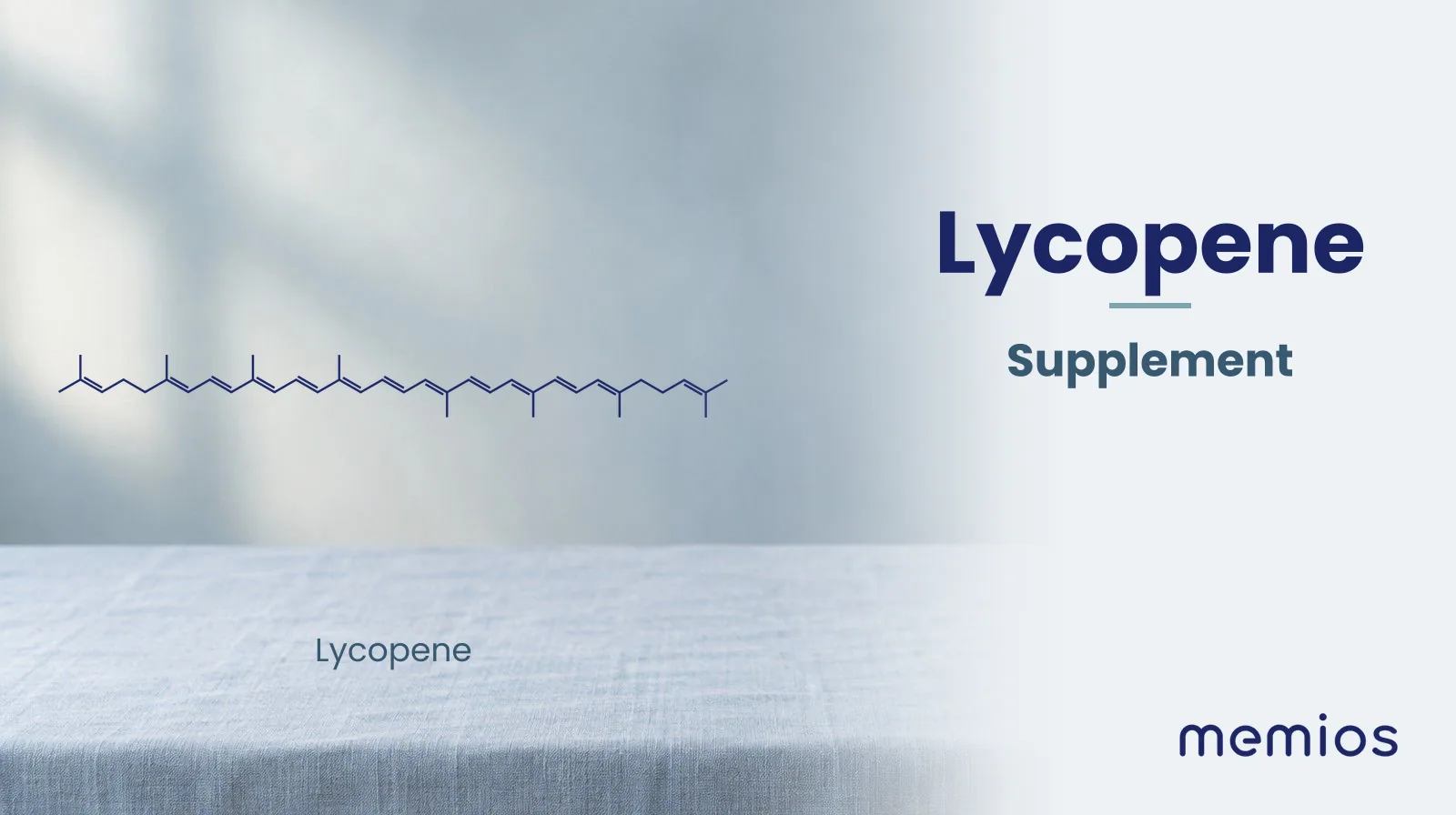
- What it is: Lycopene is a tetraterpene carotenoid, an open-chain hydrocarbon with thirteen double bonds and no ring at either end, which gives tomatoes and watermelon their red colour.
- Main use, supported: A meta-analysis of intervention trials found a significant cholesterol-lowering effect only in the subgroup of trials using 25 mg a day or more, with no significant effect at lower doses. (low certainty)
- Other use, supported: A cross-sectional analysis found that plasma lycopene tracks plasma cholesterol, dietary lycopene intake and social factors, and that these together explained only about a quarter of the variation. (low certainty)
- Claim NOT supported by research: A 2022 meta-analysis of randomised trials found no significant effect of lycopene or tomato extract on PSA. (low certainty)
- Another claim NOT supported: The same meta-analysis found that trials using lower lycopene doses showed no significant lipid effect. (low certainty)
- Recommended dose: not established. No recommended dietary allowance or adequate intake exists for lycopene in the documents we read. It is not converted to vitamin A and is not classed as an essential nutrient, so bodies set an Acceptable Daily Intake rather than a requirement.
- Studied dose (a trial dose, not a recommendation): The meta-analysis of lipid trials found effects only in the subgroup of trials that used 25 mg daily or more. Findings citing that trial: 1 for, 1 against.
- Upper limit: EFSA's AFC Panel set an Acceptable Daily Intake of 0.5 mg per kilogram of body weight per day from all sources in 2008 - about 35 mg a day for a 70 kg adult - and noted that high-consuming children may exceed it.
- What goes wrong: 5 findings on harm. Laboratory analysis of commercial lycopene supplements found measured lycopene up to 70% above the label claim and a pesticide not approved in the EU in one product.
- Common myth: Eating tomatoes or taking lycopene protects against prostate cancer.
What it is
Lycopene is a tetraterpene carotenoid, an open-chain hydrocarbon with thirteen double bonds and no ring at either end, which gives tomatoes and watermelon their red colour. Unlike beta-carotene it is not converted to vitamin A, so it is described as a non-provitamin A carotenoid. Most dietary lycopene comes from tomatoes and tomato products; it is also authorised in Europe as the food colour E 160d. Supplements use either tomato oleoresin or chemically synthesised lycopene formulated into beadlets.
What the research says
Less is established than the marketing suggests. The Cochrane review of lycopene for preventing prostate cancer found only three small randomised trials and concluded there was insufficient evidence to support or refute it, and a later meta-analysis found no effect on PSA. For heart-related markers the picture is more positive but still shaky: meta-analyses of small intervention trials report lower LDL cholesterol at doses of 25 mg a day or more and lower systolic blood pressure, with substantial heterogeneity between studies and no effect on diastolic pressure.
Evidence grade: Limited evidence.
What goes wrong
Laboratory analysis of commercial lycopene supplements found measured lycopene up to 70% above the label claim and a pesticide not approved in the EU in one product. (Source 1)
- Survey study, Low certainty.
- Size: a set of commercially available lycopene supplements (preliminary evaluation)
- Who: Marketed lycopene dietary supplements.
- How long: not applicable.
- Result: HPLC concentrations up to 70% above label claims; methomyl detected at 0.059 mg/kg in one supplement; heavy metals within regulatory limits; no pathogens, yeasts or moulds.
- Funding: not stated in the abstract.
Marked inconsistencies were found between the declared and measured lycopene content, with HPLC revealing concentrations up to 70% above label claims. Methomyl (0.059 mg/kg), a pesticide not approved in the EU, was detected in one supplement
EFSA concluded in 2008 that some high consumers, particularly pre-school and school children, may exceed the Acceptable Daily Intake for lycopene. (Source 2)
- Official position, Certainty not rated.
- Size: EU population intake modelling.
- Who: All population groups, with children singled out.
- How long: lifetime intake.
- Result: ADI 0.5 mg per kilogram of body weight per day; exceeded by high consumers in some groups.
- Funding: public body (EFSA)
However, the Panel noted that in some cases, the ADI may be exceeded by high consumers of foods containing lycopene in certain groups of the population, such as pre-school and school children.
A safety review reported that improperly stored crystalline lycopene can degrade into mutagenic products, and that lycopene produces reversible pigment deposits in the livers of rats. (Source 3)
- Animal study, Low certainty.
- Size: rodent toxicology studies plus genotoxicity test batteries.
- Who: Rats; plus in-vitro genotoxicity systems.
- How long: up to 14 weeks in the repeat-dose studies.
- Result: No significant toxicity at up to 500 mg/kg bw/day for 14 weeks; hepatocyte pigment deposits, reversible after about 13 weeks of depletion; formulated lycopene not genotoxic, but unformulated crystalline material can degrade to mutagenic products on exposure to light and air.
- Funding: industry - the paper summarises safety studies on a commercial synthetic lycopene beadlet formulation.
Unformulated pure crystalline lycopene and lycopene as a 10% beadlet formulation are not genotoxic as determined in a comprehensive battery of tests, however, improperly stored, unformulated crystalline lycopene can degrade to mutagenic products if exposed to light and air.
EFSA's AFC Panel set an Acceptable Daily Intake for lycopene of 0.5 mg per kilogram of body weight per day covering all sources, including tomatoes. (Source 2)
- Official position, Certainty not rated.
- Size: not applicable.
- Who: General EU population.
- How long: lifetime intake.
- Result: ADI 0.5 mg/kg bodyweight per day; most consumers were within it.
- Funding: public body (EFSA)
For the majority of consumers, intakes of lycopene from all sources were within the ADI of 0.5 mg per kilo of bodyweight per day (including consumption of naturally-occurring lycopene from sources such as tomatoes).
A published risk assessment identified 75 mg a day as the highest lycopene intake with strong evidence of safety. (Source 4)
- Expert review, not systematic, Low certainty.
- Size: not applicable - a review of human and animal safety data.
- Who: General adult population.
- How long: not applicable.
- Result: Observed Safe Level 75 mg/day for lycopene.
- Funding: the authors were affiliated with the Council for Responsible Nutrition, a supplement industry body.
The OSL risk assessment method indicates that the evidence of safety is strong at intakes up to 20 mg/d for lutein, and 75 mg/d for lycopene, and these levels are identified as the respective OSL.
What the evidence supports
A meta-analysis of intervention trials found a significant cholesterol-lowering effect only in the subgroup of trials using 25 mg a day or more, with no significant effect at lower doses. (Source 5)
- Meta-analysis, Low certainty.
- Size: 12 studies (13 trial arms) for lipids; 4 studies for blood pressure.
- Who: Mixed adult populations in short intervention trials.
- How long: minimum duration 2 weeks.
- Result: Total cholesterol mean change -7.55 mg/dl (SE 6.15), p = 0.02; LDL cholesterol -10.35 mg/dl (SE 5.64), p = 0.0003, in trials using 25 mg daily or more; systolic blood pressure -5.60 mm Hg (SE 5.26), p = 0.04.
- Funding: not stated in the abstract.
Meta-analysis on serum lipids revealed a significant cholesterol-lowering effect of lycopene for total serum cholesterol
A cross-sectional analysis found that plasma lycopene tracks plasma cholesterol, dietary lycopene intake and social factors, and that these together explained only about a quarter of the variation. (Source 6)
- Survey study, Low certainty.
- Size: 111 participants.
- Who: Adults enrolled in a two-centre cancer prevention trial.
- How long: single cross-sectional measurement.
- Result: Median plasma lycopene 0.59 micromol/L (range 0.07-1.79); correlations with dietary lycopene r = 0.29, P = 0.002 and plasma cholesterol r = 0.43, P = 0.0001; three variables explained 26% of the variance; no difference between smokers and nonsmokers.
- Funding: not stated in the abstract.
Low plasma concentrations of lycopene were associated with the following variables in univariate analyses
What the evidence does not support
A Cochrane review of randomised trials concluded there was insufficient evidence to support or refute lycopene for preventing prostate cancer, and that two of the three included trials were at high risk of bias. (Source 7)
- Systematic review, Very low certainty.
- Size: 3 RCTs, 154 participants in total.
- Who: Men, in trials of lycopene for prostate cancer prevention.
- How long: not stated in the abstract.
- Result: No trial reported prostate cancer mortality; PSA mean difference -0.34, 95% CI -2.01 to 1.32.
- Funding: not stated in the abstract.
Given that only three RCTs were included in this systematic review, and the high risk of bias in two of the three studies, there is insufficient evidence to either support, or refute, the use of lycopene for the prevention of prostate cancer.
Pooling the Cochrane trials showed no statistically significant difference in PSA between men given lycopene and controls. (Source 8)
- Meta-analysis, Very low certainty.
- Size: 3 RCTs, 154 participants.
- Who: Men in prostate cancer prevention trials.
- How long: not stated in the abstract.
- Result: Mean difference -0.34, 95% CI -2.01 to 1.32.
- Funding: not stated in the abstract.
Meta-analysis indicated no statistical difference in PSA levels between men randomised to receive lycopene and the comparison group (MD (mean difference) -0.34, 95% CI (confidence interval) -2.01, 1.32).
A 2022 meta-analysis of randomised trials found no significant effect of lycopene or tomato extract on PSA. (Source 9)
- Meta-analysis, Low certainty.
- Size: 6 trials in the meta-analysis, drawn from 9 studies in the systematic review.
- Who: Men, including men with non-metastatic prostate disease.
- How long: not stated in the abstract.
- Result: WMD -0.12 ng/ml; 95% CI -0.62 to 0.38 ng/ml; P = 0.64.
- Funding: not stated in the abstract.
The pooled analysis of the 6 studies showed no significant differences in PSA levels in subjects treated with lycopene or tomato extract containing lycopene
The same meta-analysis found that trials using lower lycopene doses showed no significant lipid effect. (Source 5)
- Meta-analysis, Low certainty.
- Size: 12 studies (13 trial arms)
- Who: Mixed adult populations.
- How long: minimum duration 2 weeks.
- Result: Subgroup meta-analysis of trials below 25 mg daily was not statistically significant.
- Funding: not stated in the abstract.
whereas subgroup meta-analysis of trials using lower lycopene dosages was not significant
Where the evidence is mixed
An updated meta-analysis found a significant reduction in systolic blood pressure with lycopene but no significant effect on diastolic blood pressure, with substantial heterogeneity between trials. (Source 10)
- Meta-analysis, Low certainty.
- Size: 6 studies.
- Who: Adults in intervention trials, including some with raised baseline blood pressure.
- How long: not stated in the abstract.
- Result: Systolic -4.953 mmHg (95% CI -8.820 to -1.086), p = 0.012, heterogeneity p = 0.034, I2 = 58.5%; diastolic -3.809 mmHg (95% CI -8.177 to 0.560), p = 0.087, I2 = 53.1%.
- Funding: the review explicitly stratified its subgroup analysis by 'the funding support of the paper'
lycopene intervention had no statistical effect on diastolic blood pressure (DBP)
Where the research disagrees
Whether lycopene supplements lower blood pressure, and at what dose
- Ried and Fakler (Maturitas, 2011), meta-analysis of 4 intervention trials for blood pressure: "Meta-analysis of the effect of lycopene on systolic blood pressure of all trials suggested a significant blood pressure reducing effect" (Source 5)
- Li and Xu (Nutrients, 2013), on systolic blood pressure, updated meta-analysis of 6 intervention trials with subgroup analysis; the pooled systolic result carried obvious heterogeneity (p = 0.034, I2 = 58.5%): “Our present study suggests that lycopene supplement >12 mg/day might effectively decrease SBP, particularly among Asians or population with higher baseline SBP.” (Source 10)
- Li and Xu (Nutrients, 2013), on diastolic blood pressure, the same updated meta-analysis of 6 intervention trials: “lycopene intervention had no statistical effect on diastolic blood pressure (DBP) (mean DBP = −3.809 [−8.177, 0.560], p = 0.087), and obvious heterogeneity was also observed (p = 0.074, I2 = 53.1%)” (Source 10)
How much
- Reference intake: No recommended dietary allowance or adequate intake exists for lycopene in the documents we read. It is not converted to vitamin A and is not classed as an essential nutrient, so bodies set an Acceptable Daily Intake rather than a requirement. Quote: "It is fundamentally recognized as a potent antioxidant and a non-pro-vitamin A carotenoid." (Source 11)
- Upper limit: EFSA's AFC Panel set an Acceptable Daily Intake of 0.5 mg per kilogram of body weight per day from all sources in 2008 - about 35 mg a day for a 70 kg adult - and noted that high-consuming children may exceed it. A 2006 risk assessment identified 75 mg a day as the Observed Safe Level. There is no US Tolerable Upper Intake Level. (Source 2)
- Studied: The meta-analysis of lipid trials found effects only in the subgroup of trials that used 25 mg daily or more. (Source 5)
- Studied: The blood pressure meta-analysis found larger systolic effects in trials using more than 12 mg/day. (Source 10)
- Studied: The Cochrane review pooled only three randomised trials of lycopene, with 154 participants between them. (Source 8)
A common belief, and what the research shows
The belief: Eating tomatoes or taking lycopene protects against prostate cancer.
What the research shows: The Cochrane review found the randomised evidence too thin to judge: "Given that only three RCTs were included in this systematic review, and the high risk of bias in two of the three studies, there is insufficient evidence to either support, or refute, the use of lycopene for the prevention of prostate cancer." A later meta-analysis of randomised trials concluded that "The pooled analysis of the 6 studies showed no significant differences in PSA levels in subjects treated with lycopene or tomato extract containing lycopene". The observational association between tomato intake and prostate cancer has not translated into a demonstrated effect in trials.
Questions and answers
What is it?
Lycopene is the red carotenoid pigment of tomatoes, watermelon and pink grapefruit. Chemically it is a tetraterpene with a long chain of double bonds and no ring at either end. Unlike beta-carotene, the body does not convert it into vitamin A. (Source 11)
What does it do in the body?
In the laboratory it behaves as an antioxidant, and in the body it is absorbed with dietary fat, accumulates in the liver, and is cleaved by carotene oxygenase enzymes. What it does clinically is much less certain: trial evidence for prostate cancer prevention is insufficient, while meta-analyses of small trials suggest modest reductions in LDL cholesterol at higher doses and in systolic blood pressure. (Source 12)
Is it good or bad for you?
Mostly neutral, in context. As a component of tomatoes in a normal diet it is not considered a problem. As a supplement it has not been shown to prevent prostate cancer, and supplement quality is variable. EFSA has flagged that high-consuming children can exceed the Acceptable Daily Intake, mainly through flavoured soft drinks coloured with lycopene. (Source 2)
How do you get more of it?
Tomatoes and tomato products are the dominant dietary source. Absorption depends on dietary fat and on genetics, so lycopene from a cooked, oily tomato dish is taken up better than from a raw tomato eaten alone. Trials that reported lipid effects used 25 mg a day or more, well above typical dietary intakes. (Source 12)
If it is harmful, what reduces it?
There is no medical procedure for lowering lycopene, and no reason described in the literature to do so at dietary levels. Intake is the only lever: plasma lycopene tracks how much is eaten. A published risk assessment treats 75 mg a day as the highest intake with strong evidence of safety, and says the data above that level are not sufficient for a confident conclusion of long-term safety. (Source 4)
Why might someone be low in it or missing it?
Low blood lycopene mostly reflects eating few tomato products. A cross-sectional study of 111 adults found lower plasma lycopene associated with lower dietary intake, lower plasma cholesterol and triglycerides (lycopene travels in lipoproteins), lower income and not being married; smoking made no difference in that sample. Those factors together explained only 26% of the variation, so a single blood value is a noisy signal. (Source 6)
Which whole foods contain it or feed it?
Tomatoes and tomato products such as ketchup and puree, plus watermelon, pink grapefruit and papaya. In Europe it is also added as the colour E 160d, and EFSA found non-alcoholic flavoured drinks to be the largest single source of added lycopene. (Source 13)
What happens if you do not have it?
Nothing specific is described. Lycopene is not converted to vitamin A and there is no recognised lycopene deficiency disease in the literature we searched. The claim that going without it causes disease is not supported: the randomised evidence was judged insufficient even to say whether supplementing it prevents prostate cancer. (Source 7)
How can you test for it?
Plasma or serum lycopene can be measured by HPLC, and this is the standard research biomarker. It is a reasonable but imperfect marker of intake: in one study the median was 0.59 micromol per litre with a wide range, and intake, plasma cholesterol and social factors together explained only about a quarter of the variation between people. There is no clinical reference range that defines lycopene deficiency. (Source 6)
References
- Foods. Preliminary Quality and Safety Evaluation of Lycopene-Based Dietary Supplements: Analysis of Active Compound Content, Microbiological Purity, and Chemical Contaminants. 2026. DOI 10.3390/foods15091583. Read the source
- European Food Safety Authority (EFSA), AFC Panel. EFSA assesses safety of lycopene in foods. 2008. Read the source
- Regulatory Toxicology and Pharmacology. Summary of safety studies conducted with synthetic lycopene. 2003. DOI 10.1016/S0273-2300(03)00004-7. Read the source
- Regulatory Toxicology and Pharmacology. Risk assessment for the carotenoids lutein and lycopene. 2006. DOI 10.1016/j.yrtph.2006.05.007. Read the source
- Maturitas. Protective effect of lycopene on serum cholesterol and blood pressure: Meta-analyses of intervention trials. 2011. PMID 21163596, DOI 10.1016/j.maturitas.2010.11.018. Read the source
- The Journal of Nutrition. Plasma Lycopene Concentrations in Humans Are Determined by Lycopene Intake, Plasma Cholesterol Concentrations and Selected Demographic Factors. 1999. DOI 10.1093/jn/129.4.849. Read the source
- Cochrane Database of Systematic Reviews. Lycopene for the prevention of prostate cancer.. 2011. PMID 22071840, DOI 10.1002/14651858.CD008007.pub2. Read the source
- Cochrane Database of Systematic Reviews. Lycopene for the prevention of prostate cancer.. 2011. PMID 22071840, DOI 10.1002/14651858.CD008007.pub2. Read the source
- Complementary Therapies in Medicine. The effect of lycopene supplement from different sources on prostate specific antigen (PSA): A systematic review and meta-analysis of randomized controlled trials. 2022. PMID 35031434, DOI 10.1016/j.ctim.2022.102801. Read the source
- Nutrients. Lycopene Supplement and Blood Pressure: An Updated Meta-Analysis of Intervention Trials. 2013. PMID 24051501, DOI 10.3390/nu5093696. Read the source
- Antioxidants. Lycopene as a Natural Antioxidant Used to Prevent Human Health Disorders. 2020. DOI 10.3390/antiox9080706. Read the source
- Antioxidants. Lycopene: A Critical Review of Digestion, Absorption, Metabolism, and Excretion. 2021. DOI 10.3390/antiox10030342. Read the source
- European Food Safety Authority (EFSA), AFC Panel. EFSA assesses safety of lycopene in foods (natural occurrence section). 2008. Read the source