Medications · September 29, 2026 · Memios · 11 min read
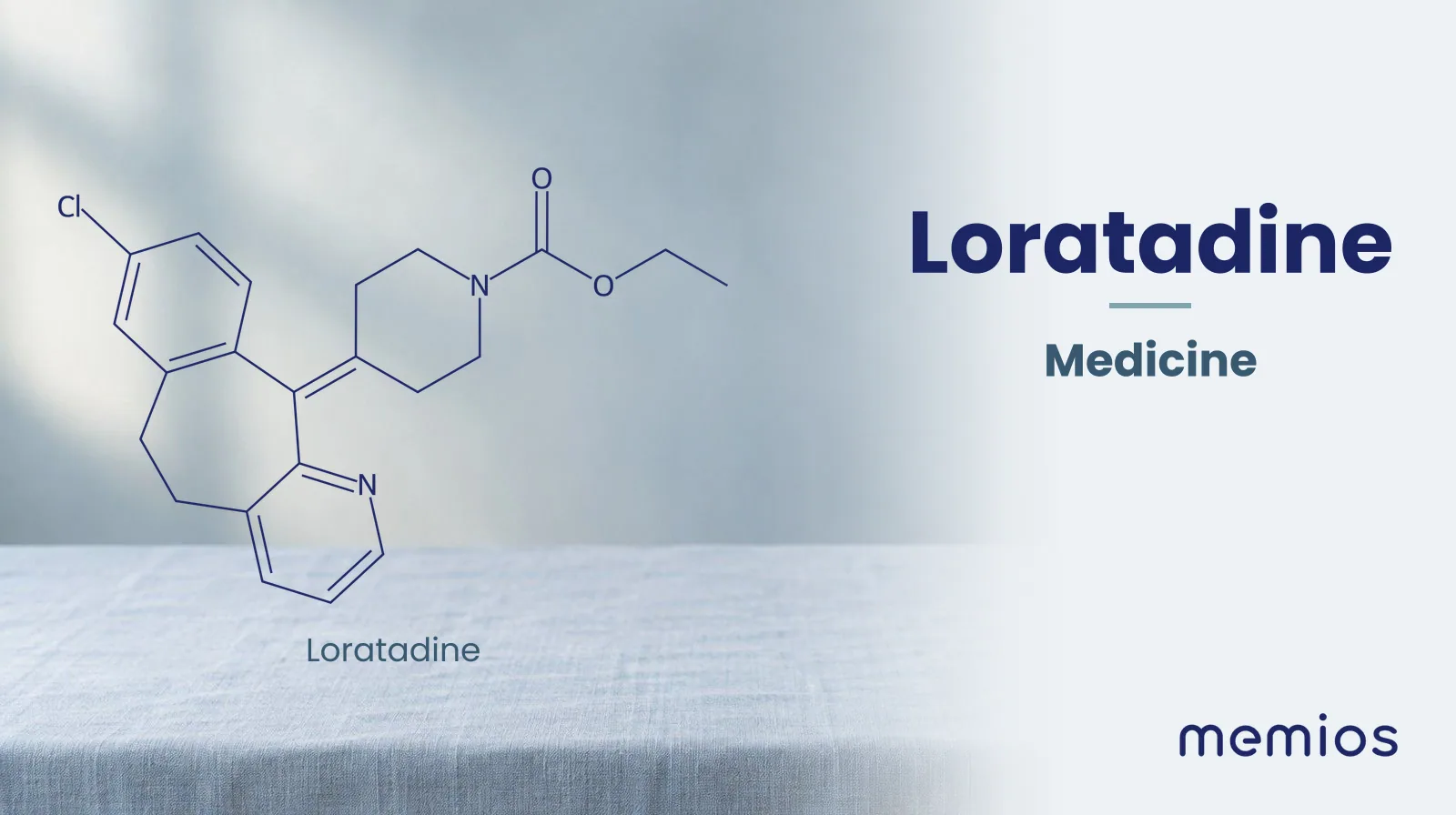
Loratadine
Loratadine blocks peripheral H1 histamine receptors, reducing the sneezing, itching and runny nose of allergic reactions, while penetrating the brain only minimally so it is comparatively non-sedating.
TLDR
- Well established. Loratadine blocks peripheral H1 histamine receptors, reducing the sneezing, itching and runny nose of allergic reactions, while penetrating the brain only minimally so it is comparatively non-sedating.
- What it is: Loratadine is a second-generation antihistamine sold over the counter (e.g., Claritin) for allergy symptoms. It was designed to block histamine H1 receptors mainly outside the brain, which is why it causes far less drowsiness than first-generation antihistamines like diphenhydramine.
- Main use: Allergic rhinitis (seasonal and perennial) symptom relief (well supported).
- Other approved uses: Chronic idiopathic (spontaneous) urticaria (limited evidence).
- Off-label uses (not on the FDA label): Mosquito-bite hypersensitivity/itch reduction in children (limited evidence); Control of histamine-mediated flushing in vancomycin-induced red-man syndrome (evidence not rated).
- Uses NOT supported by research: Itch in atopic dermatitis/eczema.
- Recommended dose (official position): The OTC Drug Facts label directs adults and children 6 years and older to 1 tablet (10 mg) daily, not more than 1 tablet in 24 hours; this is a labeled dosing instruction, not a nutrient reference intake.
- Studied dose (a trial dose, not a recommendation): The pivotal efficacy/safety trials underlying the label used a 10 mg once-daily adult dose. Findings citing that trial: 1 against, 1 on harm.
- Upper limit: The OTC label caps use at 1 tablet (10 mg) per 24 hours for the standard product.
- What goes wrong: 1 finding on harm. Across its clinical trial program, loratadine caused measurable excess somnolence and headache versus placebo, though at a low absolute rate consistent with its non-sedating design.
- Interactions: 3 recorded, including Alcohol, CYP3A4/CYP2D6 inhibitors (e.g. ketoconazole, erythromycin, cimetidine), Grapefruit juice.
- Common myth: Because loratadine is labeled 'non-drowsy,' it must be free of side effects and interactions.
What it is
Loratadine is a second-generation antihistamine sold over the counter (e.g., Claritin) for allergy symptoms. It was designed to block histamine H1 receptors mainly outside the brain, which is why it causes far less drowsiness than first-generation antihistamines like diphenhydramine.
What the research says
Loratadine blocks peripheral H1 histamine receptors, reducing the sneezing, itching and runny nose of allergic reactions, while penetrating the brain only minimally so it is comparatively non-sedating. Its own label-cited trial data still record measurable excess adverse effects compared with placebo, and evidence for its label uses varies by condition, being stronger for allergic rhinitis than for chronic urticaria in the most recent network meta-analysis.
Evidence grade: Well established.
How it works
Drug class: Second-generation (non-sedating) H1-antihistamine, piperidine derivative
What it is used for
- This is loratadine's core approved use; a 2023 meta-analysis (mainly of loratadine plus montelukast) found benefit over placebo on nasal symptom scores, though study quality in the pooled trials was flagged as not high. Evidence: established. (Source 1)
- Loratadine is FDA-labeled for chronic urticaria, but a recent network meta-analysis found its itch-score reduction did not reach statistical significance versus placebo, while some comparator antihistamines performed better; older label-era trials had supported efficacy, so the current picture is mixed. Evidence: limited. (Source 2)
- A small pediatric trial found reduced wheal size and itch with loratadine versus control, but the trial was small and this is not an FDA-labeled use. Evidence: limited. (Source 3)
- A systematic review cited by a pharmacology reference found no evidence that loratadine or other second-generation antihistamines relieve itching associated with atopic dermatitis; the reference notes this itch is predominantly non-histaminergic. Evidence: not-supported. (Source 4)
- A pharmacology reference describes this off-label use on the basis of a single case report; no trial quantifying its effectiveness was retrieved in this research session. Evidence: unknown. (Source 4)
Interactions
- Alcohol (clinical trial): In a controlled psychomotor-performance study cited on the label, alcohol taken with loratadine did not add measurable sedative/psychomotor impairment, unlike the pattern seen with older sedating antihistamines. (Source 5)
- CYP3A4/CYP2D6 inhibitors (e.g. ketoconazole, erythromycin, cimetidine) (clinical trial): These inhibitors raise loratadine blood levels by blocking the enzymes that clear it, but controlled clinical trials found no clinically significant change in effect at these elevated levels. (Source 5)
- Grapefruit juice (pharmacokinetic study): A pharmacokinetic study of the related antihistamine desloratadine (loratadine's active metabolite) found grapefruit juice did not reduce its bioavailability, unlike fexofenadine, which lost 30% of its absorption; this argues against a clinically important loratadine-grapefruit interaction, though the study was not conducted on loratadine's parent compound itself. (Source 6)
Stopping it
- No dependence or classic withdrawal syndrome is documented for loratadine. The FDA's 2025 safety communication about rare, severe rebound itching after stopping long-term antihistamine use names cetirizine and levocetirizine specifically; it does not name loratadine, so this particular rebound phenomenon has not been established for loratadine in the same way. (Source 7)
What goes wrong
Across its clinical trial program, loratadine caused measurable excess somnolence and headache versus placebo, though at a low absolute rate consistent with its non-sedating design. (Source 5)
- Randomized trial, Moderate certainty.
- Size: pooled label trial population (exact n not given in excerpt)
- Who: adults and children with allergic conditions.
- How long: standard trial durations underlying the OTC/label safety data.
- Result: 2% overall excess adverse events vs placebo; somnolence 1.2%, headache 0.6%, increased appetite 0.5%, insomnia 0.1% excess vs placebo.
- Funding: manufacturer-sponsored label trials (typical for approval data; not independently confirmed this session)
adverse reactions with loratadine were reported in 2% of patients in excess of those treated with placebo.
What the evidence supports
Loratadine combined with montelukast reduces total nasal symptom scores in allergic rhinitis more than loratadine alone, montelukast alone, or placebo. (Source 1)
- Meta-analysis, Low certainty.
- Size: 4,902 participants across 23 RCTs (7 trials in the placebo comparison)
- Who: patients with allergic rhinitis.
- How long: varied across included trials.
- Result: combo vs placebo: SMD -0.93 (95% CI -1.37 to -0.49, p<0.00001); combo vs loratadine alone: SMD -1.00 (95% CI -1.35 to -0.65, p<0.00001); combo vs montelukast alone: SMD -0.46 (95% CI -0.68 to -0.25, p<0.0001)
- Funding: not stated; the review's own Limitations section reports that the quality of the included articles was not high (recorded separately as frontiers-loratadine-montelukast-ar-2023-b)
For the primary outcome, pooled results showed that loratadine-montelukast can significantly reduce total nasal symptom scores (TNSS), when compared with loratadine (SMD, −1.00; 95% CI, −1.35 to −0.65, p < 0.00001), montelukast (SMD, −0.46; 95% CI, −0.68 to −0.25, p < 0.0001), or placebo (SMD, −0.93; 95% CI, −1.37 to −0.49, p < 0.00001).
In children sensitive to mosquito bites, loratadine reduced bite-induced wheal size and pruritus versus baseline/control in a small trial. (Source 3)
- Randomized trial, Low certainty.
- Size: 25 children (wheal outcome), 12 children (pruritus outcome)
- Who: mosquito-bite-sensitive children.
- How long: not specified in the excerpt reviewed.
- Result: wheal size reduced 45% (P<0.001); pruritus reduced 78% (P=0.011)
- Funding: not stated.
Loratadine (0.3 mg/kg) in children likewise significantly decreased wheal size by 45% (P < 0.001, 25 children) and pruritus by 78% (P = 0.011, 12 children).
What the evidence does not support
In a recent network meta-analysis of chronic urticaria treatments, loratadine's reduction in itch score was not statistically distinguishable from placebo. (Source 2)
- Meta-analysis, Certainty not rated.
- Size: part of a pool of 54 studies across multiple antihistamines.
- Who: patients with chronic urticaria.
- How long: not specified in the excerpt reviewed.
- Result: loratadine among 8 drugs whose itch-score reduction versus placebo did not reach statistical significance in this analysis.
- Funding: not stated.
While the remaining eight drugs showed numerically greater reductions in itch scores compared to placebo, these differences were not statistically significant.
A systematic review cited by a pharmacology reference found no evidence that second-generation antihistamines, including loratadine, cetirizine and fexofenadine, relieve itching associated with atopic dermatitis — an off-label use; the same reference notes itch in atopic dermatitis is predominantly non-histaminergic. (Source 4)
- Systematic review, Certainty not rated.
- Size: not specified in the excerpt reviewed.
- Who: patients with atopic dermatitis.
- How long: not specified.
- Result: no supporting evidence found for effectiveness against itching associated with atopic dermatitis specifically; the reference adds that antihistamines can still be a valuable option where allergic rhinitis coexists with eczema.
- Funding: not stated.
Nonetheless, the pathophysiology of itch in atopic dermatitis is predominantly non-histaminergic, indicating that antihistaminergic agents may have limited efficacy. Furthermore, a systematic review of second-generation antihistamines, such as fexofenadine, cetirizine, and loratadine, found no evidence supporting their effectiveness in alleviating itching associated with atopic dermatitis.
In a controlled psychomotor-performance study, co-administering alcohol with loratadine did not add to any sedative/psychomotor impairment. (Source 5)
- Randomized trial, Moderate certainty.
- Size: not specified in the excerpt reviewed.
- Who: healthy adult volunteers.
- How long: not specified.
- Result: no potentiating effect of alcohol on loratadine's psychomotor performance measures.
- Funding: not stated (label-cited study)
When administered concomitantly with alcohol, loratadine has no potentiating effects as measured by psychomotor performance studies.
Where the evidence is mixed
The same meta-analysis states in its own Limitations that the quality of the included trials was not high, that blinding and allocation concealment were often unreported, and that heterogeneity in the primary outcome stayed moderate to high after subgroup analysis. (Source 8)
- Meta-analysis, Low certainty.
- Size: 23 studies, 4,902 participants.
- Who: patients with allergic rhinitis.
- How long: varied across included trials.
- Result: authors report unreported blinding and allocation concealment in some included trials, and moderate to high heterogeneity in the primary outcome that subgroup analysis did not significantly reduce.
- Funding: not stated.
Second, the quality of the included articles was not high, and some articles did not mention blinding method and allocation concealment, especially in the Chinese articles. Third, moderate to high heterogeneity were found in the primary outcome.
How much
- Reference intake: The OTC Drug Facts label directs adults and children 6 years and older to 1 tablet (10 mg) daily, not more than 1 tablet in 24 hours; this is a labeled dosing instruction, not a nutrient reference intake. (Source 9)
- Upper limit: The OTC label caps use at 1 tablet (10 mg) per 24 hours for the standard product. (Source 9)
- Studied: The pivotal efficacy/safety trials underlying the label used a 10 mg once-daily adult dose. (Source 5)
- Studied: The pediatric mosquito-bite trial used a weight-based dose of 0.3 mg/kg. (Source 3)
A common belief, and what the research shows
The belief: Because loratadine is labeled 'non-drowsy,' it must be free of side effects and interactions.
What the research shows: Its own label-cited trial data record a real, if small, excess of adverse effects versus placebo, and drugs that inhibit CYP3A4/CYP2D6 (such as ketoconazole or erythromycin) measurably raise loratadine blood levels, even though that specific rise was not tied to clinically significant symptoms in the cited trials.
Questions and answers
What is it?
Loratadine is an over-the-counter, second-generation antihistamine sold as Claritin and other brands, used to relieve allergy symptoms. It was designed to act mainly outside the brain, which distinguishes it from older, sedating antihistamines. (Source 5)
What does it do in the body?
Loratadine blocks histamine H1 receptors on cells in the nose, skin and eyes, which are involved in allergic sneezing, itching and hives, while penetrating the brain only minimally, which is why it causes comparatively little drowsiness compared with older antihistamines. (Source 5)
Is it good or bad for you?
For its main approved use, allergic rhinitis, evidence supports real symptom benefit with a good safety margin; for chronic urticaria the most recent network meta-analysis found its itch benefit was not statistically distinguishable from placebo. It is not harm-free: label trials record a small but measurable excess of somnolence, headache and other effects compared with placebo, and levels can rise with certain other drugs. (Source 5)
How do you get more of it?
Loratadine is sold over the counter without a prescription; the OTC label itself sets the adult and pediatric (6+) dose at one 10 mg tablet daily, not more than one tablet in 24 hours. Because it is self-selected OTC, 'getting more' is a matter of purchase and following the label, not prescriber titration as with warfarin. (Source 9)
If it is harmful, what reduces it?
In a documented pediatric overdose case, treatment was supportive: the child was given activated charcoal and admitted for observation, with symptoms (elevated blood pressure, fast heart rate, dry flushed skin) resolving with monitoring rather than a specific antidote. (Source 10)
Why might someone be low in it or missing it?
Does not apply in the literal sense: loratadine is a manufactured drug, not something the body produces or can be deficient in. People take it because they have allergy symptoms (hay fever, hives) they want relief from, not because of a missing substance. (Source 9)
Which whole foods contain it or feed it?
Does not apply. Loratadine is a synthetic pharmaceutical and is not present in or obtained from any food. (Source 5)
What happens if you do not have it?
If someone with allergic rhinitis does not take loratadine, they keep their baseline allergy symptoms. In the pooled trial data, loratadine combined with montelukast lowered total nasal symptom scores compared with placebo, which implies worse symptom control without treatment. Untreated allergic rhinitis is generally uncomfortable rather than dangerous, unlike the conditions warfarin or ferrous sulfate address. (Source 1)
How can you test for it?
No validated routine clinical test for loratadine exposure or level exists; the assays that measure loratadine in blood (LC-MS/MS methods) are research and bioequivalence tools, not something ordered in ordinary clinical care. (Source 4)
We searched: searched for loratadine plasma level testing and clinical monitoring; only found bioanalytical/pharmacokinetic research assays, no clinical diagnostic or monitoring test
References
- Frontiers in Pharmacology. A systematic review and meta-analysis of loratadine combined with montelukast for the treatment of allergic rhinitis — abstract, Results. 2023. DOI 10.3389/fphar.2023.1287320. Read the source
- Frontiers in Medicine. Second-generation H1 antihistamines for the treatment of chronic urticaria: a network meta-analysis. 2026. DOI 10.3389/fmed.2026.1880701. Read the source
- Frontiers in Immunology. Update on mosquito bite reaction: Itch and hypersensitivity, pathophysiology, prevention, and treatment. 2022. DOI 10.3389/fimmu.2022.1024559. Read the source
- StatPearls / NCBI Bookshelf. Loratadine — Off-Label Uses. 2025. Read the source
- Medsafe (New Zealand Medicines and Medical Devices Safety Authority). New Zealand Data Sheet — LORA-TABS Allergy & Hayfever (loratadine). not stated on page. Read the source
- Clinical Pharmacokinetics. Grapefruit Juice Reduces the Oral Bioavailability of Fexofenadine But Not Desloratadine. 2002. PMID 11978146. Read the source
- U.S. Food and Drug Administration. FDA requires warning about rare but severe itching after stopping long-term use of oral allergy medicines cetirizine or levocetirizine. 2025. Read the source
- Frontiers in Pharmacology. A systematic review and meta-analysis of loratadine combined with montelukast for the treatment of allergic rhinitis — full text, Limitations. 2023. DOI 10.3389/fphar.2023.1287320. Read the source
- DailyMed (U.S. National Library of Medicine). Loratadine Tablet — OTC Drug Facts label. 2026. Read the source
- National Capital Poison Center (Poison Control). Loratadine (Claritin): Uses, dosage, and safety info. not stated on page. Read the source