Medications · September 29, 2026 · Memios · 20 min read
Lisdexamfetamine
It raises brain dopamine and noradrenaline signalling through the dextroamphetamine released from it.
TLDR
- Boxed warning: Before prescribing VYVANSE, assess each patient's risk for abuse, misuse, and addiction.
- Well established. It raises brain dopamine and noradrenaline signalling through the dextroamphetamine released from it.
- What it is: Lisdexamfetamine is a prescription central nervous system stimulant and a controlled substance.
- Main use: Attention deficit hyperactivity disorder (ADHD) in adults and children aged 6 and over (limited evidence).
- Other approved uses: Moderate to severe binge eating disorder in adults (well supported).
- Uses NOT supported by research: Add-on treatment for major depressive disorder with inadequate antidepressant response.
- Recommended dose: not established. There is no reference intake; dosing is set by the prescriber. As a position, the Vyvanse label states a starting dosage of 30 mg once daily in the morning for adults and children aged 6 and over with ADHD.
- Studied dose (a trial dose, not a recommendation): The binge eating disorder pivotal trials used 50 and 70 mg a day. No finding here cites that trial.
- Upper limit: As a position, the label's maximum recommended dosage is 70 mg once daily, reached by increments of 10 mg or 20 mg at about weekly intervals.
- What goes wrong: 6 findings on harm. Lisdexamfetamine carries an FDA boxed warning for abuse, misuse and addiction.
- Interactions: 6 recorded, including Monoamine oxidase inhibitors (MAOIs), including the antidepressants phenelzine and tranylcypromine and the antibiotic linezolid, Serotonergic drugs (SSRIs, SNRIs, triptans, tramadol, St John's wort), Vitamin C (ascorbic acid) and other acidifying agents, Sodium bicarbonate and other alkalinizing agents.
- Common myth: Because lisdexamfetamine is a prodrug that has to be activated by the body, it cannot be abused or become addictive.
What it is
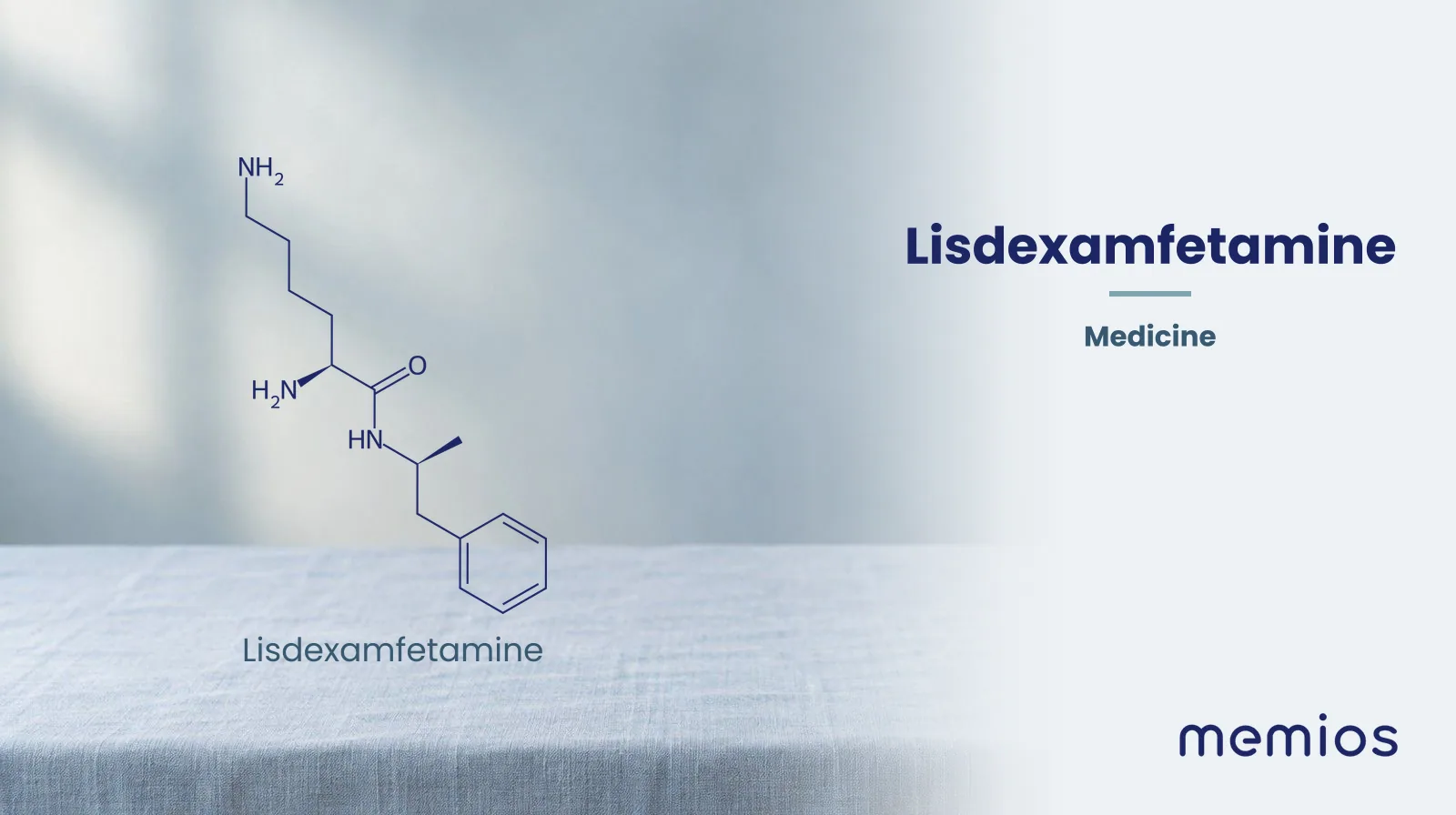
Lisdexamfetamine is a prescription central nervous system stimulant and a controlled substance. The molecule is dextroamphetamine bonded to the amino acid l-lysine, and it is inactive until red blood cells split it and release dextroamphetamine into the circulation. Because that conversion happens in blood, the drug is not metabolised by cytochrome P450 enzymes.
What the research says
It raises brain dopamine and noradrenaline signalling through the dextroamphetamine released from it. Two pivotal randomised trials show it reduces binge eating days in adults with binge eating disorder. For ADHD, a Cochrane review of amphetamines found short-term symptom reduction but rated most evidence low to very low and judged most trials at high risk of bias. Two phase 3 trials of it as an add-on for depression found no benefit over placebo. It carries an FDA boxed warning for abuse, misuse and addiction.
Evidence grade: Well established.
How it works
Drug class: Central nervous system stimulant; amphetamine prodrug (Schedule II controlled substance in the US)
Lisdexamfetamine is a prodrug: it does nothing until red blood cells cleave it into dextroamphetamine and l-lysine. The dextroamphetamine then increases release of dopamine and noradrenaline in the brain, which is what produces the effects on attention, appetite and arousal. (Source 1)
Boxed warning
VYVANSE has a high potential for abuse and misuse, which can lead to the development of a substance use disorder, including addiction. Misuse and abuse of CNS stimulants, including VYVANSE, can result in overdose and death [see Overdosage (10)], and this risk is increased with higher doses or unapproved methods of administration, such as snorting or injection.
(Source 2)
What it is used for
- Amphetamines reduce core ADHD symptoms in the short term, but the Cochrane review of 23 trials in 2,675 children and adolescents rated the evidence low to very low, found most trials at high risk of bias, and found no amphetamine derivative or formulation better than another. Long-term outcome evidence is what the reviewers say is missing. Evidence: limited. (Source 3)
- Two pivotal randomised placebo-controlled trials (n=383 and n=390) found reductions of 1.35 and 1.66 binge eating days per week versus placebo at weeks 11-12, both P<0.001. The programme was manufacturer-funded. Evidence: established. (Source 4)
- Two phase 3 randomised placebo-controlled trials in 826 adults found no significant difference from placebo on the MADRS depression scale (P=0.883 and P=0.583). The authors wrote that the result was contrary to expectations. It is not approved for depression. Evidence: not-supported. (Source 5)
Interactions
- Monoamine oxidase inhibitors (MAOIs), including the antidepressants phenelzine and tranylcypromine and the antibiotic linezolid (label): MAOIs slow the breakdown of amphetamine and the combination can cause a hypertensive crisis; the label requires a 14-day gap. (Source 6)
- Serotonergic drugs (SSRIs, SNRIs, triptans, tramadol, St John's wort) (label): Combining lisdexamfetamine with drugs that raise serotonin increases the risk of serotonin syndrome. St John's wort is a herbal product with serotonergic activity and belongs in this group. (Source 7)
- Vitamin C (ascorbic acid) and other acidifying agents (label): Acidifying agents lower blood levels of amphetamines and can reduce the effect. The amphetamine class label names ascorbic acid explicitly among gastrointestinal acidifying agents. (Source 8)
- Sodium bicarbonate and other alkalinizing agents (label): Alkalinizing agents raise amphetamine blood levels and potentiate its action; the class label says co-administration with gastrointestinal alkalinizing agents should be avoided. (Source 9)
- Urinary acidity, which diet and supplements can shift (label): The lisdexamfetamine label itself puts the same point in general terms: making the urine more acidic lowers blood levels and efficacy. (Source 10)
- Urinary alkalinity (label): Conversely, making the urine more alkaline raises blood levels and strengthens the drug's action. (Source 11)
Stopping it
- Physical dependence can develop, and withdrawal follows abrupt stopping or a big dose cut after prolonged use. (Source 12)
- The withdrawal picture the label describes is a low, flat, oversleeping and overeating state rather than a physically dangerous one. (Source 12)
- Tolerance is also described, so a dose that once worked may stop working, which is itself a reason people escalate. (Source 12)
- In children, treatment interruption is described in the label as a response to faltering growth rather than something to avoid. (Source 13)
What goes wrong
Lisdexamfetamine carries an FDA boxed warning for abuse, misuse and addiction. (Source 2)
- Official position, Certainty not rated.
- Size: not applicable.
- Who: everyone prescribed lisdexamfetamine.
- How long: throughout treatment.
- Result: The warning states a high potential for abuse and misuse that can lead to a substance use disorder including addiction, and that misuse and abuse of CNS stimulants can result in overdose and death.
- Funding: manufacturer label (Takeda)
VYVANSE has a high potential for abuse and misuse, which can lead to the development of a substance use disorder, including addiction.
Side effects in the licensing trials were common and clearly above placebo. (Source 14)
- Official position, Certainty not rated.
- Size: controlled trials in adults with ADHD (Study 7) and in adults with binge eating disorder (Studies 11 and 12); participant numbers not given in this passage.
- Who: adults with ADHD.
- How long: trial durations not given in this passage.
- Result: In adults with ADHD: decreased appetite 27% versus 2% placebo, insomnia 27% versus 8%, dry mouth 26% versus 3%, anxiety 6% versus 0%, increased blood pressure 3% versus 0%, increased heart rate 2% versus 0%.
- Funding: manufacturer label (Takeda)
Adverse reactions reported in the controlled trials in pediatric patients ages, 6 to 12 years (Study 1), pediatric patients ages 13 to 17 years (Study 4), and adult patients (Study 7) treated with VYVANSE or placebo are presented in Tables 1, 2 and 3 below.
In the binge eating disorder trials the pattern of side effects was similar, led by dry mouth and insomnia. (Source 15)
- Official position, Certainty not rated.
- Size: pooled controlled trials in adults with binge eating disorder (Studies 11 and 12)
- Who: adults with moderate to severe binge eating disorder.
- How long: trial durations not given in this passage.
- Result: Dry mouth 36% versus 7% placebo, insomnia 20% versus 8%, increased heart rate 7% versus 1%, decreased appetite 8% versus 2%, anxiety 5% versus 1%.
- Funding: manufacturer label (Takeda)
Adverse reactions reported in the pooled controlled trials in adult patients (Study 11 and 12) treated with VYVANSE or placebo are presented in Table 4 below.
Stimulants including lisdexamfetamine can cause psychotic or manic symptoms at ordinary prescribed doses in people with no previous psychiatric history. (Source 16)
- Official position, Certainty not rated.
- Size: not stated.
- Who: people taking CNS stimulants at recommended doses.
- How long: not stated.
- Result: The label describes hallucinations, delusional thinking or mania occurring at the recommended dosage in people without a prior history of psychotic illness or mania.
- Funding: manufacturer label (Takeda)
CNS stimulants, at the recommended dosage, may cause psychotic or manic symptoms (e.g., hallucinations, delusional thinking, or mania) in patients without a prior history of psychotic illness or mania.
In children, stimulant treatment is associated with weight loss and slowed growth. (Source 13)
- Official position, Certainty not rated.
- Size: a 4-week placebo-controlled trial in children aged 6 to 12 (numbers not given in this passage)
- Who: children aged 6 to 12 with ADHD.
- How long: 4 weeks for the weight finding; height data come from studies of another stimulant.
- Result: Dose-related decrease in weight in the lisdexamfetamine groups against weight gain on placebo; slowing of the increase in height seen with another stimulant.
- Funding: manufacturer label (Takeda)
In a 4-week, placebo-controlled trial of VYVANSE in pediatric patients ages 6 to 12 years old with ADHD, there was a dose-related decrease in weight in the VYVANSE groups compared to weight gain in the placebo group.
Stopping after prolonged use produces a recognised withdrawal pattern, and the drug can produce physical dependence and tolerance. (Source 12)
- Official position, Certainty not rated.
- Size: not stated.
- Who: people who have taken CNS stimulants including lisdexamfetamine for a prolonged period.
- How long: on abrupt discontinuation or significant dose reduction.
- Result: Withdrawal signs listed are dysphoric mood, depression, fatigue, vivid unpleasant dreams, insomnia or hypersomnia, increased appetite, and psychomotor retardation or agitation.
- Funding: manufacturer label (Takeda)
Withdrawal signs and symptoms after abrupt discontinuation or dose reduction following prolonged use of CNS stimulants including VYVANSE include dysphoric mood; depression; fatigue; vivid, unpleasant dreams; insomnia or hypersomnia; increased appetite; and psychomotor retardation or agitation.
What the evidence supports
In two pivotal randomised trials, lisdexamfetamine reduced binge eating days per week more than placebo in adults with moderate to severe binge eating disorder. (Source 4)
- Randomized trial, Moderate certainty.
- Size: study 1 n=383; study 2 n=390.
- Who: adults with moderate to severe binge eating disorder.
- How long: 11-12 weeks.
- Result: Least squares mean treatment differences in binge eating days per week: study 1 –1.35 (95% CI –1.70, –1.01); study 2 –1.66 (–2.04, –1.28); both P<0.001.
- Funding: industry-funded (Shire pivotal phase 3 programme)
Least squares mean (95% CI) treatment differences for change from baseline binge eating days/week at weeks 11–12 significantly favored LDX (study 1: –1.35 [–1.70, –1.01]; study 2: –1.66 [–2.04, –1.28]; both P<0.001).
A large cohort study of young and middle-aged adults did not find an increased rate of serious cardiovascular events with ADHD medicines, and its authors say the apparently lower rate among users is likely healthy user bias rather than protection. (Source 17)
- Cohort study, Moderate certainty.
- Size: 806,182 person-years of follow-up; 1,357 myocardial infarctions, 296 sudden cardiac deaths, 575 strokes.
- Who: young and middle-aged adults in four US health plans.
- How long: median 1.3 years per person.
- Result: Adjusted rate ratio for serious cardiovascular events, current use versus non-use, 0.83 (95% CI 0.72 to 0.96); current versus remote use 1.03 (0.86 to 1.24). The authors write that apparent protective associations likely represent healthy user bias. This is observational, so confounding by indication and by healthy-user effects cannot be excluded, and it cannot show absence of rare risks.
- Funding: not stated.
The multivariable adjusted rate ratio (RR) of serious cardiovascular events for current use vs non-use of ADHD medications was 0.83 (95% CI, 0.72–0.96).
What the evidence does not support
Two phase 3 trials of lisdexamfetamine added to an antidepressant in major depressive disorder failed: it was no better than placebo. (Source 5)
- Randomized trial, High certainty.
- Size: study 1 n=402 (placebo 201, LDX 201); study 2 n=424 (placebo 213, LDX 211)
- Who: adults aged 18 to 65 with DSM-IV-TR major depressive disorder and an inadequate response to 8 weeks of antidepressant monotherapy.
- How long: 8 weeks of randomised augmentation after an 8-week antidepressant lead-in.
- Result: MADRS total score difference (LDX minus placebo) at week 16: study 1 0.1 (95% CI –1.7, 2.0), P=0.883; study 2 –0.5 (–2.3, 1.3), P=0.583.
- Funding: industry-funded (Shire)
Least squares mean (95% CI) treatment differences (LDX–placebo) for MADRS total score changes from augmentation baseline to week 16 were not statistically significant in study 1 (0.1 [–1.7, 2.0], P =0.883) or study 2 (–0.5 [–2.3, 1.3], P =0.583).
The authors of those depression trials state the result plainly against their own expectation. (Source 18)
- Randomized trial, High certainty.
- Size: 826 randomised across the two studies.
- Who: adults with major depressive disorder and inadequate antidepressant response.
- How long: 8 weeks of randomised augmentation.
- Result: No statistically significant benefit on the primary depression rating scale in either study.
- Funding: industry-funded (Shire)
Contrary to expectations, LDX augmentation was not superior to placebo in reducing depressive symptoms in individuals with MDD exhibiting inadequate responses to antidepressant monotherapy.
Where the evidence is mixed
A Cochrane review of amphetamines for ADHD in children and adolescents found short-term symptom improvement but rated the evidence low to very low and found no amphetamine preparation better than another. (Source 3)
- Systematic review, Very low certainty.
- Size: 23 trials, 2,675 children and adolescents.
- Who: children and adolescents aged 3 to 17 with ADHD.
- How long: short-term; the reviewers call for future trials longer than 12 months.
- Result: The review reports short-term reduction in core ADHD symptoms alongside a number of adverse events, and finds no difference between long-acting and short-acting preparations or between amphetamine derivatives.
- Funding: not stated.
Most of the included studies were at high risk of bias and the overall quality of the evidence ranged from low to very low on most outcomes.
Where the research disagrees
How strong the evidence for stimulants in ADHD actually is
- Vyvanse label (FDA-approved labelling, 2024), regulatory position: VYVANSE® is indicated for the treatment of: Attention Deficit Hyperactivity Disorder (ADHD) in adults and pediatric patients 6 years and older. (Source 19)
- Cochrane review of amphetamines for ADHD in children and adolescents (2016), systematic review of 23 trials, 2,675 children and adolescents: Most of the included studies were at high risk of bias and the overall quality of the evidence ranged from low to very low on most outcomes. (Source 3)
Whether stimulants raise the risk of serious cardiovascular events
- Vyvanse label, Warnings and Precautions 5.6 Peripheral Vasculopathy, including Raynaud's Phenomenon, regulatory position; the label also lists increased blood pressure among adult ADHD trial adverse reactions, and the side effect tables behind it are in section 6.1: CNS stimulants, including VYVANSE, used to treat ADHD are associated with peripheral vasculopathy, including Raynaud's phenomenon. (Source 20)
- Habel and colleagues, JAMA 2011 cohort study, retrospective cohort, 806,182 person-years, median 1.3 years per person: Among young and middle-aged adults, current or new use of ADHD medications, compared with non-use or remote use, was not associated with an increased risk of serious cardiovascular events. Apparent protective associations likely represent healthy user bias. (Source 21)
How much
- Reference intake: There is no reference intake; dosing is set by the prescriber. As a position, the Vyvanse label states a starting dosage of 30 mg once daily in the morning for adults and children aged 6 and over with ADHD. (Source 22)
- Upper limit: As a position, the label's maximum recommended dosage is 70 mg once daily, reached by increments of 10 mg or 20 mg at about weekly intervals. (Source 23)
- Studied: The binge eating disorder pivotal trials used 50 and 70 mg a day. (Source 24)
- Studied: The two depression augmentation trials used dose-optimised lisdexamfetamine in a 20 to 70 mg range. (Source 18)
- Studied: For binge eating disorder the label describes titrating to a target dose of 50 mg to 70 mg once daily. (Source 25)
A common belief, and what the research shows
The belief: Because lisdexamfetamine is a prodrug that has to be activated by the body, it cannot be abused or become addictive.
What the research shows: The FDA boxed warning says the opposite: 'VYVANSE has a high potential for abuse and misuse, which can lead to the development of a substance use disorder, including addiction.' The label adds that misuse and abuse of CNS stimulants can result in overdose and death, and that the risk rises with higher doses or with snorting or injection.
Questions and answers
What is it?
Lisdexamfetamine is a prescription stimulant capsule or chewable tablet, best known as Vyvanse. It is a prodrug: the molecule itself is inactive and is dextroamphetamine chemically joined to the amino acid l-lysine. It is a controlled substance in the United States and most other countries. (Source 1)
What does it do in the body?
Once swallowed, red blood cells split the molecule and release dextroamphetamine, which increases the release of dopamine and noradrenaline in the brain. That is what produces the effects on attention, appetite, sleep, heart rate and blood pressure. Because the conversion happens in the blood rather than the liver, it is not handled by cytochrome P450 enzymes. (Source 26)
Is it good or bad for you?
Both, depending on the use and the person. It has a clear randomised benefit in binge eating disorder and short-term benefit for ADHD symptoms on evidence the Cochrane reviewers rate low to very low. It failed outright as an add-on for depression. It carries a boxed warning for abuse, misuse and addiction, causes appetite loss and insomnia in around a quarter of adults in trials, can trigger psychosis at ordinary doses, and slows growth in children. (Source 2)
How do you get more of it?
It is a prescription-only controlled substance; there is no food or supplement route. The label's starting dose is 30 mg once daily in the morning, with a maximum of 70 mg daily. Taking more than prescribed, or by snorting or injecting, is precisely what the boxed warning is about. (Source 27)
If it is harmful, what reduces it?
If it is doing harm, stopping is a prescriber's decision, and the label describes what to expect: physical dependence can develop, and abrupt discontinuation or a large dose reduction after prolonged use brings low mood, depression, fatigue, vivid unpleasant dreams, disturbed sleep, increased appetite and either slowing or agitation. Tolerance can also develop, meaning a higher dose is needed for the same effect. (Source 12)
Why might someone be low in it or missing it?
Nobody is naturally low in lisdexamfetamine. Someone with ADHD may not be taking it because it was never prescribed, because a different stimulant or a non-stimulant was chosen, or because they stopped it. The Cochrane review found no evidence that any one amphetamine derivative is better than another, and no difference between long-acting and short-acting preparations. (Source 3)
Which whole foods contain it or feed it?
No food contains it. Food chemistry does affect it, though: the amphetamine class label lists ascorbic acid (vitamin C) among gastrointestinal acidifying agents that lower blood levels and efficacy of amphetamines, while sodium bicarbonate is listed among alkalinizing agents that raise them. Lisdexamfetamine's own label carries the same acidifying and alkalinizing warnings in general terms. (Source 8)
What happens if you do not have it?
This is not a deficiency state. What the literature describes is what happens without treatment for the conditions it is licensed for: the Cochrane review found amphetamines reduce core ADHD symptoms in the short term, so not taking one means those symptoms are not pharmacologically reduced, while also avoiding the adverse events the same review attaches to them. Many people manage ADHD without stimulants. (Source 3)
How can you test for it?
There is no blood test used to decide whether someone needs it; ADHD and binge eating disorder are diagnosed clinically. Lisdexamfetamine is detected indirectly, as its metabolite dextroamphetamine, on amphetamine urine immunoassays, and those screens are imperfect in both directions, so a pharmacy review of urine drug screening advises confirming unexpected results with a more accurate method. (Source 28)
References
- DailyMed label text (fda.report mirror); SPL effective 2026-04-30, version 81, Takeda Pharmaceuticals America, Inc.. VYVANSE (lisdexamfetamine dimesylate) label, 12.3 Pharmacokinetics (conversion). 2026. Read the source
- DailyMed, US National Library of Medicine (SPL effective 2026-04-30, version 81; Takeda Pharmaceuticals America, Inc.). VYVANSE (lisdexamfetamine dimesylate) label, BOXED WARNING: ABUSE, MISUSE, AND ADDICTION (complete, both paragraphs). 2026. Read the source
- Cochrane Database of Systematic Reviews. Amphetamines for attention deficit hyperactivity disorder (ADHD) in children and adolescents (Authors' conclusions). 2016. PMID 26844979, DOI 10.1002/14651858.CD009996.pub2. Read the source
- Neuropsychopharmacology. Lisdexamfetamine Dimesylate for Adults with Moderate to Severe Binge Eating Disorder: Results of Two Pivotal Phase 3 Randomized Controlled Trials (Results). 2016. DOI 10.1038/npp.2015.275. Read the source
- Journal of Affective Disorders. Lisdexamfetamine dimesylate augmentation for adults with major depressive disorder and inadequate response to antidepressant monotherapy: Results from 2 phase 3, multicenter, randomized, double-blind, placebo-controlled studies (Results). 2016. PMID 27474961, DOI 10.1016/j.jad.2016.07.006. Read the source
- DailyMed label text (fda.report mirror); SPL effective 2026-04-30, version 81, Takeda Pharmaceuticals America, Inc.. VYVANSE (lisdexamfetamine dimesylate) label, 7 DRUG INTERACTIONS: MAO Inhibitors. 2026. Read the source
- DailyMed label text (fda.report mirror); SPL effective 2026-04-30, version 81, Takeda Pharmaceuticals America, Inc.. VYVANSE (lisdexamfetamine dimesylate) label, 7 DRUG INTERACTIONS: Serotonergic Drugs. 2026. Read the source
- US Food and Drug Administration (Drugs@FDA); label revised December 2016, posted in the 2017 Drugs@FDA archive. ADDERALL (dextroamphetamine saccharate, amphetamine aspartate, dextroamphetamine sulfate and amphetamine sulfate) label, DRUG INTERACTIONS: acidifying agents. 2016. Read the source
- US Food and Drug Administration (Drugs@FDA); label revised December 2016, posted in the 2017 Drugs@FDA archive. ADDERALL label, DRUG INTERACTIONS: alkalinizing agents. 2016. Read the source
- DailyMed label text (fda.report mirror); SPL effective 2026-04-30, version 81, Takeda Pharmaceuticals America, Inc.. VYVANSE (lisdexamfetamine dimesylate) label, 7 DRUG INTERACTIONS: Acidifying Agents. 2026. Read the source
- DailyMed label text (fda.report mirror); SPL effective 2026-04-30, version 81, Takeda Pharmaceuticals America, Inc.. VYVANSE (lisdexamfetamine dimesylate) label, 7 DRUG INTERACTIONS: Alkalinizing Agents. 2026. Read the source
- DailyMed label text (fda.report mirror); SPL effective 2026-04-30, version 81, Takeda Pharmaceuticals America, Inc.. VYVANSE (lisdexamfetamine dimesylate) label, 9.3 Dependence. 2026. Read the source
- DailyMed label text (fda.report mirror); SPL effective 2026-04-30, version 81, Takeda Pharmaceuticals America, Inc.. VYVANSE (lisdexamfetamine dimesylate) label, Warnings and Precautions 5.5 Long-Term Suppression of Growth. 2026. Read the source
- DailyMed label text (fda.report mirror); SPL effective 2026-04-30, version 81, Takeda Pharmaceuticals America, Inc.. VYVANSE (lisdexamfetamine dimesylate) label, 6.1 Clinical Trials Experience (ADHD tables). 2026. Read the source
- DailyMed label text (fda.report mirror); SPL effective 2026-04-30, version 81, Takeda Pharmaceuticals America, Inc.. VYVANSE (lisdexamfetamine dimesylate) label, 6.1 Clinical Trials Experience (BED table). 2026. Read the source
- DailyMed label text (fda.report mirror); SPL effective 2026-04-30, version 81, Takeda Pharmaceuticals America, Inc.. VYVANSE (lisdexamfetamine dimesylate) label, Warnings and Precautions: Psychiatric Adverse Reactions. 2026. Read the source
- JAMA - quoted from the NIH author accepted manuscript in PubMed Central (PMC3350308). ADHD Medications and Risk of Serious Cardiovascular Events in Young and Middle-aged Adults (Results). 2011. PMID 22161946, DOI 10.1001/jama.2011.1830. Read the source
- Journal of Affective Disorders. Lisdexamfetamine dimesylate augmentation for adults with major depressive disorder (Conclusion). 2016. PMID 27474961, DOI 10.1016/j.jad.2016.07.006. Read the source
- DailyMed label text (fda.report mirror); SPL effective 2026-04-30, version 81, Takeda Pharmaceuticals America, Inc.. VYVANSE (lisdexamfetamine dimesylate) label, 1 INDICATIONS AND USAGE (ADHD). 2026. Read the source
- DailyMed label text (fda.report mirror); SPL effective 2026-04-30, version 81, Takeda Pharmaceuticals America, Inc.. VYVANSE (lisdexamfetamine dimesylate) label, Warnings and Precautions: Peripheral Vasculopathy. 2026. Read the source
- JAMA - quoted from the NIH author accepted manuscript in PubMed Central (PMC3350308). ADHD Medications and Risk of Serious Cardiovascular Events in Young and Middle-aged Adults (Conclusion). 2011. PMID 22161946, DOI 10.1001/jama.2011.1830. Read the source
- DailyMed label text (fda.report mirror); SPL effective 2026-04-30, version 81, Takeda Pharmaceuticals America, Inc.. VYVANSE (lisdexamfetamine dimesylate) label, 2.3 Dosage for Treatment of ADHD (starting dosage). 2026. Read the source
- DailyMed label text (fda.report mirror); SPL effective 2026-04-30, version 81, Takeda Pharmaceuticals America, Inc.. VYVANSE (lisdexamfetamine dimesylate) label, 2.3 Dosage for Treatment of ADHD (maximum dosage). 2026. Read the source
- Neuropsychopharmacology. Lisdexamfetamine Dimesylate for Adults with Moderate to Severe Binge Eating Disorder (Conclusion). 2016. DOI 10.1038/npp.2015.275. Read the source
- DailyMed label text (fda.report mirror); SPL effective 2026-04-30, version 81, Takeda Pharmaceuticals America, Inc.. VYVANSE (lisdexamfetamine dimesylate) label, 2.4 Dosage for Treatment of Moderate to Severe BED in Adults (target dose). 2026. Read the source
- DailyMed label text (fda.report mirror); SPL effective 2026-04-30, version 81, Takeda Pharmaceuticals America, Inc.. VYVANSE (lisdexamfetamine dimesylate) label, 12.1 Mechanism of Action. 2026. Read the source
- DailyMed label text (fda.report mirror); SPL effective 2026-04-30, version 81, Takeda Pharmaceuticals America, Inc.. VYVANSE (lisdexamfetamine dimesylate) label, BOXED WARNING (overdose and death, complete sentence). 2026. Read the source
- US Pharmacist. Urine Drug Screening: Minimizing False-Positives and False-Negatives to Optimize Patient Care. 2016. Read the source