Medications · September 29, 2026 · Memios · 13 min read
Latanoprost
The evidence is that latanoprost reliably lowers pressure inside the eye, and that in one placebo-controlled trial this slowed the loss of visual field in newly diagnosed open-angle glaucoma over two years.
TLDR
- Well established. The evidence is that latanoprost reliably lowers pressure inside the eye, and that in one placebo-controlled trial this slowed the loss of visual field in newly diagnosed open-angle glaucoma over two years.
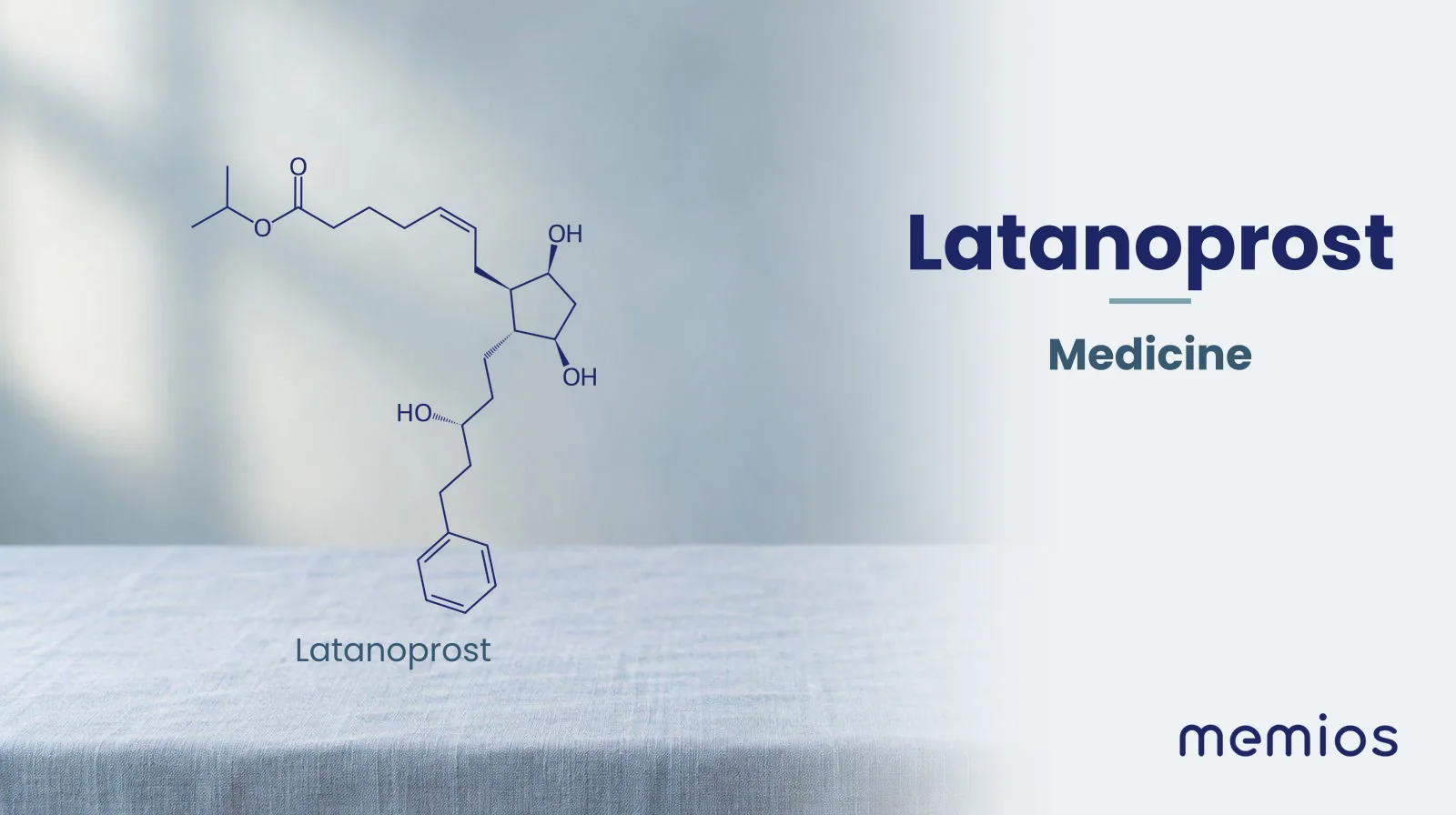
- What it is: Latanoprost is a synthetic analogue of prostaglandin F2-alpha, supplied as a 0.005% eye drop. It is a selective agonist at the prostanoid FP receptor in the eye.
- Main use: Open-angle glaucoma (well supported).
- Other approved uses: Ocular hypertension (raised eye pressure without established glaucoma) (limited evidence).
- Off-label uses (not on the FDA label): Hair loss (scalp, eyebrow and eyelash hypotrichosis) (limited evidence).
- Recommended dose: not established. There is no reference intake: the dose is set by the prescriber. As a position, the manufacturer's label (DailyMed, Xalatan) states one drop (1.5 micrograms) in the affected eye once daily in the evening.
- Studied dose (a trial dose, not a recommendation): The UK Glaucoma Treatment Study randomised people to latanoprost 0.005% or placebo eye drops once daily to both eyes. Findings citing that trial: 1 for.
- Upper limit: As a position, the label's ceiling is once-daily dosing; it states the dose should not exceed once daily and that combining prostaglandins is not recommended.
- What goes wrong: 3 findings on harm. A small photographic study found changes to the tissue around the eye (prostaglandin-associated periorbitopathy) in a minority of long-term latanoprost users.
- Interactions: 3 recorded, including Thimerosal-preserved eye drops, Other prostaglandin eye drops (for example bimatoprost, travoprost), Other topical eye medicines generally.
- Common myth: Latanoprost improves your eyesight, and the eye colour change it causes will fade once you stop.
What it is
Latanoprost is a synthetic analogue of prostaglandin F2-alpha, supplied as a 0.005% eye drop. It is a selective agonist at the prostanoid FP receptor in the eye. It is a prescription medicine, not a nutrient or a supplement, and it is applied to the surface of the eye rather than swallowed.
What the research says
The evidence is that latanoprost reliably lowers pressure inside the eye, and that in one placebo-controlled trial this slowed the loss of visual field in newly diagnosed open-angle glaucoma over two years. It does not restore sight already lost. A Cochrane review found that pressure-lowering drugs as a class reduce the onset of field defects in ocular hypertension, but that no individual drug, prostaglandins included, had been shown to do so against placebo at the time of that review.
Evidence grade: Well established.
How it works
Drug class: Prostaglandin F2-alpha analogue (prostanoid selective FP receptor agonist)
It acts on FP prostanoid receptors in the eye and increases the drainage of aqueous humour, mainly by the uveoscleral route, which lowers the pressure inside the eye. (Source 1)
What it is used for
- One placebo-controlled trial in newly diagnosed open-angle glaucoma found visual field deterioration in 15.0% on latanoprost versus 24.8% on placebo at 24 months. The trial was funded by the manufacturer and was stopped early. Evidence: established. (Source 2)
- Pressure-lowering drug treatment as a class reduced the onset of visual field defects in a Cochrane meta-analysis (OR 0.62, 95% CI 0.47 to 0.81), but no single drug, including prostaglandins, was shown to do so on its own and no direct prostaglandin-versus-placebo comparison existed. Evidence: limited. (Source 3)
- A meta-analysis of six small placebo-controlled trials of topical prostaglandin analogues, pooling latanoprost with other drugs in the class, reported improved hair length and density. The trials are few and small and the pooling across different drugs makes this weak evidence for latanoprost specifically. Evidence: limited. (Source 4)
Interactions
- Thimerosal-preserved eye drops (pharmacokinetic study): Mixing latanoprost with eye drops preserved with thimerosal makes a precipitate form, so the label says to separate them by at least five minutes. (Source 5)
- Other prostaglandin eye drops (for example bimatoprost, travoprost) (label): Using two prostaglandin drops, or dosing latanoprost more than once a day, can reduce the pressure-lowering effect or paradoxically raise the pressure. (Source 6)
- Other topical eye medicines generally (label): Latanoprost can be used alongside other pressure-lowering eye drops, but the label asks for at least five minutes between drops so each is not washed out. (Source 6)
Stopping it
- Stopping does not undo the iris colour change. The label states iris pigmentation is likely to be permanent after the drug is discontinued, while pigmentation of the eyelid skin and eyelash changes have reversed in some people. (Source 7)
- There is no described withdrawal syndrome; what the literature describes instead is loss of the pressure-lowering effect, which begins within hours of a dose and is therefore dependent on continued daily use. (Source 6)
What goes wrong
Latanoprost causes permanent darkening of the iris and other changes to pigmented tissue around the eye. (Source 7)
- Official position, Certainty not rated.
- Size: not stated in this section of the label.
- Who: people using latanoprost eye drops.
- How long: pigmentation increases for as long as the drug is used; effects beyond 5 years unknown.
- Result: The label states pigmentation is expected to increase while treatment continues and that iris pigmentation is likely to be permanent after stopping, while eyelid and eyelash changes may reverse in some people.
- Funding: manufacturer label (Pfizer)
After discontinuation of XALATAN, pigmentation of the iris is likely to be permanent while pigmentation of the periorbital tissue and eyelash changes have been reported to be reversible in some patients.
Common eye side effects in the manufacturer's controlled trials occurred in 5 to 15% of people using latanoprost. (Source 8)
- Official position, Certainty not rated.
- Size: three 6-month multi-centre double-masked active-controlled trials (participant numbers not given in this passage)
- Who: people with open-angle glaucoma or ocular hypertension.
- How long: 6 months.
- Result: Blurred vision, burning and stinging, conjunctival hyperemia, foreign body sensation, itching, increased iris pigmentation and punctate epithelial keratopathy each in 5 to 15%; fewer than 1% stopped because of redness. No placebo comparator is given: the comparators were active drugs.
- Funding: manufacturer label (Pfizer)
The ocular adverse events and ocular signs and symptoms reported in 5 to 15% of the patients on XALATAN Sterile Ophthalmic Solution in the three 6-month, multi-center, double-masked, active-controlled trials were blurred vision, burning and stinging, conjunctival hyperemia, foreign body sensation, itching, increased pigmentation of the iris, and punctate epithelial keratopathy.
A small photographic study found changes to the tissue around the eye (prostaglandin-associated periorbitopathy) in a minority of long-term latanoprost users. (Source 9)
- Survey study, Very low certainty.
- Size: 22 subjects, one eye each.
- Who: people with glaucoma who had used latanoprost for more than 1 year and had not previously used a prostaglandin analogue.
- How long: 12 to 45 months of use (mean 26.0 months)
- Result: 12 of 22 (54.5%) had no apparent sign; deepening of the upper eyelid sulcus in 3 (13.6%); flattening of the lower eyelid bags and eyelid pigmentation in 2 each (9.0%); other signs in 1 each (4.5%).
- Funding: not stated.
Twelve subjects (54.5%) had no apparent signs. Three subjects were judged to have DUES (13.6%), and two subjects each were judged to have flattening of the lower eyelid bags and eyelid pigmentation (9.0%).
What the evidence supports
In the only placebo-controlled trial of an eye-pressure-lowering drug with a vision outcome, latanoprost reduced the proportion of people with newly diagnosed open-angle glaucoma whose visual field deteriorated within 24 months. (Source 2)
- Randomized trial, Moderate certainty.
- Size: 516 randomised; 461 with post-allocation data analysed.
- Who: adults with newly diagnosed open-angle glaucoma at 10 UK centres.
- How long: 24 months (trial stopped early in July 2011 on data monitoring committee advice)
- Result: Visual field deterioration by 24 months 15·0% (95% CI 10·8, 20·0) with latanoprost vs 24·8% (19·5, 30·7) with placebo, P=0·007; that is an absolute difference of about 9·8 percentage points, roughly 10 people treated for 2 years per additional person spared measurable field loss. Adjusted hazard ratio 0·44 (0·28, 0·69). IOP fell 3·8 mmHg vs 0·9 mmHg.
- Funding: industry-funded (Pfizer Inc.; plus UK NIHR Biomedical Research Centre)
Incident VF deterioration (95% CI) by 24 months was 15·0% (10·8, 20·0) in the latanoprost group and 24·8% (19·5, 30·7) in the placebo group (P=0·007).
What the evidence does not support
A Cochrane review of medical treatment in ocular hypertension found that pressure-lowering drugs as a class reduced the onset of visual field defects, but no individual drug, including the prostaglandins, was shown to do so on its own. (Source 3)
- Systematic review, Low certainty.
- Size: 26 trials, 4979 participants (10 trials in the visual field meta-analysis)
- Who: people with ocular hypertension or primary open-angle glaucoma.
- How long: varied by trial.
- Result: Class effect on onset of visual field defects OR 0.62 (95% CI 0.47 to 0.81); no single drug reached significance against placebo or no treatment; beta-blockers borderline OR 0.67 (95% CI 0.45 to 1.00).
- Funding: not stated.
No single drug showed a significant VF protection compared to placebo or untreated controls.
The same Cochrane review states plainly that at the time of the review no direct placebo-controlled comparison of prostaglandins existed, and that failure to prove effectiveness is not the same as proof of no effect. (Source 10)
- Systematic review, Low certainty.
- Size: 26 trials, 4979 participants.
- Who: people with ocular hypertension or primary open-angle glaucoma.
- How long: varied by trial.
- Result: No pooled estimate for prostaglandins versus placebo could be produced.
- Funding: not stated.
Direct comparisons of prostaglandins or brimonidine to placebo are not available and the comparison of dorzolamide to placebo failed to demonstrate a protective effect.
Where the evidence is mixed
A meta-analysis of topical prostaglandin analogues for hair loss, an off-label use of latanoprost, pooled six small placebo-controlled trials and reported improved hair length and density. (Source 4)
- Meta-analysis, Very low certainty.
- Size: six randomised controlled trials (one contributing two datasets); total participants not stated in the abstract.
- Who: people with hair loss including androgenetic alopecia and alopecia areata; both latanoprost and bimatoprost trials included.
- How long: trial durations varied; the largest latanoprost trial ran 24 weeks.
- Result: Hair length and density improved significantly (P<0.001) with no significant difference in adverse events between groups. The review pools different drugs and very small trials, so this is not evidence for latanoprost specifically.
- Funding: not stated.
The results showed that prostaglandin analogs could significantly improve the hair length and density (P<0.001). As far as adverse events are concerned, there was no significant difference between the experimental group and the control group.
Where the research disagrees
Whether latanoprost specifically has been shown to protect vision, as opposed to lowering a number
- UK Glaucoma Treatment Study investigators (2015), randomised, triple-masked, placebo-controlled trial, 516 randomised, stopped early: This is the first placebo-controlled trial to demonstrate VF preservation with an IOP-lowering agent in OAG. (Source 2)
- Cochrane review of medical interventions for open angle glaucoma and ocular hypertension (2007, pre-dating UKGTS), systematic review and meta-analysis of 26 trials, 4979 participants: No single drug showed a significant VF protection compared to placebo or untreated controls. (Source 3)
How much
- Reference intake: There is no reference intake: the dose is set by the prescriber. As a position, the manufacturer's label (DailyMed, Xalatan) states one drop (1.5 micrograms) in the affected eye once daily in the evening. (Source 6)
- Upper limit: As a position, the label's ceiling is once-daily dosing; it states the dose should not exceed once daily and that combining prostaglandins is not recommended. (Source 6)
- Studied: The UK Glaucoma Treatment Study randomised people to latanoprost 0.005% or placebo eye drops once daily to both eyes. (Source 2)
- Studied: The periorbitopathy study looked at people who had used latanoprost for 12 to 45 months, mean 26.0 months. (Source 11)
A common belief, and what the research shows
The belief: Latanoprost improves your eyesight, and the eye colour change it causes will fade once you stop.
What the research shows: It lowers eye pressure and, in the one placebo-controlled trial, slowed further loss of visual field; it does not restore vision. The manufacturer's label says of the colour change that 'pigmentation of the iris is likely to be permanent while pigmentation of the periorbital tissue and eyelash changes have been reported to be reversible in some patients'.
Questions and answers
What is it?
Latanoprost is a prescription eye drop. It is a synthetic copy of a natural prostaglandin (prostaglandin F2-alpha) that acts on the FP receptor in the eye. It is sold as a 0.005% solution, most familiar under the brand name Xalatan, and is licensed to lower raised pressure inside the eye. (Source 1)
What does it do in the body?
It lowers the pressure inside the eye by helping fluid (aqueous humour) drain out, mainly through the uveoscleral route. Lower eye pressure is the only way any glaucoma drug is thought to protect the optic nerve; latanoprost does not act on the nerve directly and does not improve sight that has already been lost. (Source 12)
Is it good or bad for you?
For people with newly diagnosed open-angle glaucoma the balance of the one placebo-controlled trial is favourable: fewer people lost visual field over two years. The benefit is a slowing of loss, not a cure, the absolute difference was about 10 percentage points over two years, and the trial was funded by the manufacturer and stopped early. Against that sit permanent iris darkening, redness and changes to the eyelids. (Source 2)
How do you get more of it?
This is not a substance the body makes or that you can obtain from diet; it is a prescription-only medicine and the amount used is set by the prescriber. The label describes one drop in the affected eye once daily in the evening and says the dose should not be exceeded, because more frequent dosing can lower the pressure-lowering effect or push pressure up. (Source 6)
If it is harmful, what reduces it?
Stopping the drops ends the pressure-lowering effect and eye pressure returns towards its untreated level. Some of the cosmetic changes reverse and some do not: the label states that iris darkening is likely to be permanent, while eyelid pigmentation and eyelash changes have reversed in some people. Any decision to stop is a prescriber's, since untreated raised pressure is what the drug is there to control. (Source 7)
Why might someone be low in it or missing it?
The question of being 'low' in latanoprost does not arise; nobody has a natural level of it. People are not on it either because their eye pressure and optic nerve do not warrant treatment, or because a clinician chose a different drug or laser or surgery. The Cochrane reviewers say the decision to treat at all, and with what, should be individualised. (Source 10)
Which whole foods contain it or feed it?
No food contains latanoprost and no food-based route of getting it exists. It is a drop placed on the eye, not something swallowed, and the label's only administration cautions concern other eye drops rather than food or drink. (Source 6)
What happens if you do not have it?
For someone with raised eye pressure, no pressure-lowering treatment means a higher rate of developing visual field defects: the Cochrane meta-analysis of treated versus untreated ocular hypertension reported an odds ratio of 0.62 in favour of treatment. In the placebo arm of the UK trial, about a quarter of people with newly diagnosed glaucoma had measurable field deterioration within two years. (Source 3)
How can you test for it?
There is no test for latanoprost itself. What is measured is what it is meant to change: eye pressure by tonometry, and the visual field by perimetry. The UK trial defined deterioration on repeated automated visual field tests, requiring the same change to appear on consecutive tests precisely because single field tests are noisy. (Source 2)
References
- DailyMed, US National Library of Medicine. XALATAN- latanoprost solution (prescribing information), CLINICAL PHARMACOLOGY. 2024. Read the source
- Author accepted manuscript in UCL Discovery; published as Lancet 2015;385(9975):1295-1304. Latanoprost treatment for open angle glaucoma. The United Kingdom Glaucoma Treatment Study: a multicentre, randomised, placebo-controlled clinical trial (author accepted manuscript). 2015. PMID 25533656, DOI 10.1016/S0140-6736(14)62111-5. Read the source
- Cochrane Database of Systematic Reviews. Medical interventions for primary open angle glaucoma and ocular hypertension (Main results). 2007. DOI 10.1002/14651858.CD003167.pub3. Read the source
- Frontiers in Medicine. The efficacy of topical prostaglandin analogs for hair loss: A systematic review and meta-analysis. 2023. DOI 10.3389/fmed.2023.1130623. Read the source
- DailyMed, US National Library of Medicine. XALATAN- latanoprost solution (prescribing information), PRECAUTIONS: Drug Interactions. 2024. Read the source
- DailyMed, US National Library of Medicine. XALATAN- latanoprost solution (prescribing information), DOSAGE AND ADMINISTRATION. 2024. Read the source
- DailyMed, US National Library of Medicine. XALATAN- latanoprost solution (prescribing information). 2024. Read the source
- DailyMed, US National Library of Medicine. XALATAN- latanoprost solution (prescribing information), ADVERSE REACTIONS. 2024. Read the source
- Clinical Ophthalmology (Dove Medical Press). Prostaglandin-associated periorbitopathy in latanoprost users (Results). 2015. Read the source
- Cochrane Database of Systematic Reviews. Medical interventions for primary open angle glaucoma and ocular hypertension (Authors' conclusions). 2007. DOI 10.1002/14651858.CD003167.pub3. Read the source
- Clinical Ophthalmology (Dove Medical Press). Prostaglandin-associated periorbitopathy in latanoprost users (Subjects and Methods). 2015. Read the source
- DailyMed, US National Library of Medicine. XALATAN- latanoprost solution (prescribing information), CLINICAL PHARMACOLOGY (uveoscleral outflow). 2024. Read the source