Supplements · September 29, 2026 · Memios · 18 min read
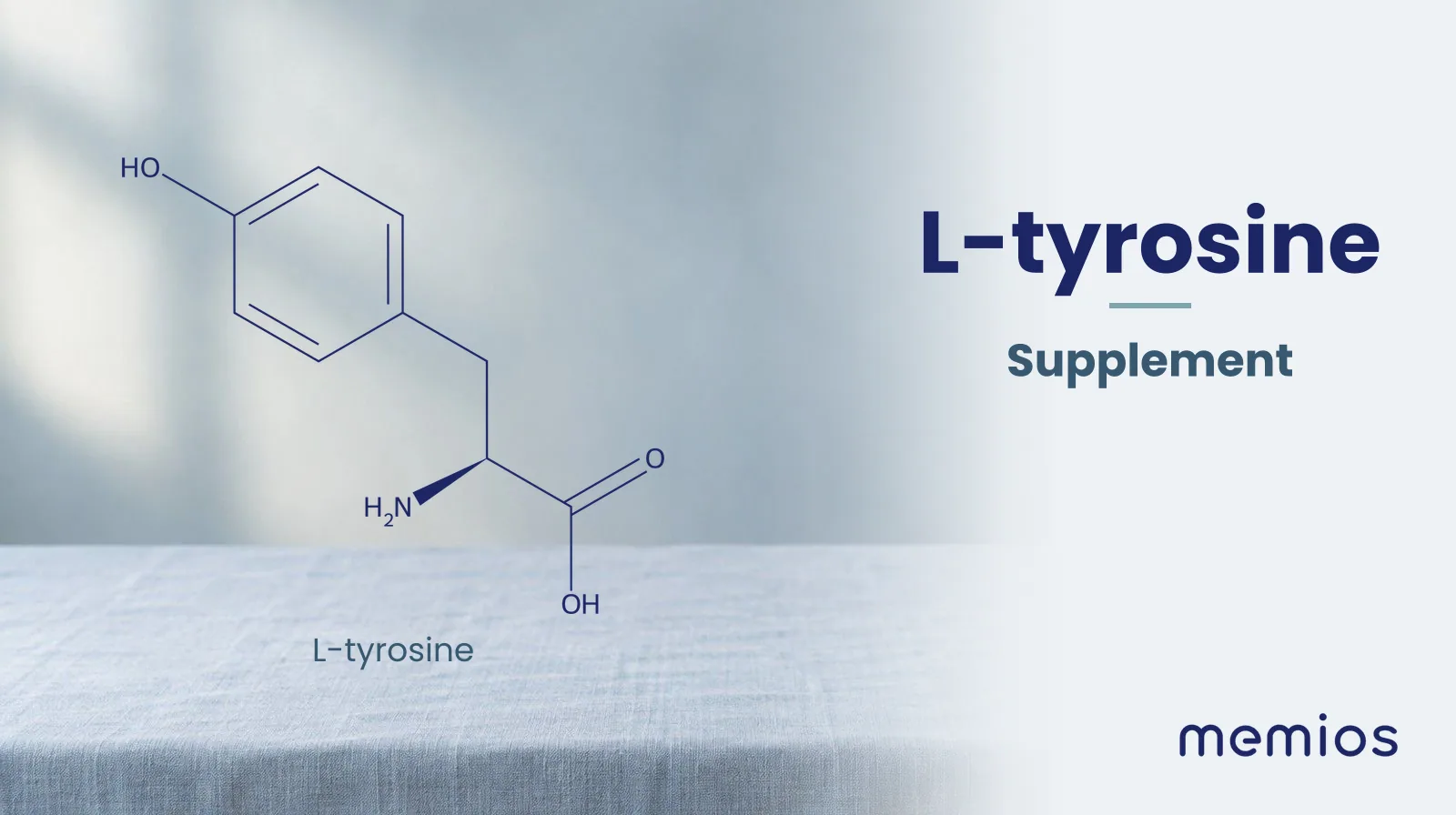
L-tyrosine
The claim is that extra tyrosine supports thinking under pressure, and the review literature partly backs that while narrowing it sharply.
TLDR
- Limited evidence. The claim is that extra tyrosine supports thinking under pressure, and the review literature partly backs that while narrowing it sharply.
- What it is: L-tyrosine is an aromatic amino acid used to build protein. It is dispensable rather than essential: it comes from dietary protein and from recycled body protein, and the liver can also make it from the essential amino acid phenylalanine.
- Main use, supported: A review of tyrosine and cognition concluded tyrosine can enhance cognitive performance, but only in short-term stressful or demanding situations and only when the underlying neurotransmitter systems are intact. (low certainty)
- Other use, supported: A four-week randomised crossover safety trial in healthy men found no dose-related laboratory abnormalities and no serious adverse events up to 4 g a day, in an industry-funded study. (low certainty)
- Claim NOT supported by research: The review judged tyrosine's potential for treating clinical disorders to be limited and its potential for improving physical exercise performance to be minimal. (low certainty)
- Another claim NOT supported: A Cochrane review of tyrosine supplementation in phenylketonuria found it raised blood tyrosine but changed no clinical outcome. (low certainty)
- Recommended dose: not established. No separate reference intake for tyrosine was found; it is a dispensable amino acid obtained from protein and made from phenylalanine. Habitual intake in healthy adults has been estimated at a mean of 39.9 mg/kg/day, about 2.79 g/day for a 70 kg person.
- Studied dose (a trial dose, not a recommendation): A cross-over trial gave single doses of 100, 150 or 200 mg per kg body weight to older adults and 150 mg/kg to young adults. Findings citing that trial: 2 on harm.
- Upper limit: No tolerable upper intake level has been established.
- What goes wrong: 6 findings on harm. In a randomised cross-over trial, working memory performance in older adults declined as the tyrosine dose rose, and the decline was greatest in those whose plasma tyrosine rose most.
- Common myth: Tyrosine is a dopamine booster, so more of it means sharper focus.
What it is
L-tyrosine is an aromatic amino acid used to build protein. It is dispensable rather than essential: it comes from dietary protein and from recycled body protein, and the liver can also make it from the essential amino acid phenylalanine. It is the precursor the body uses to make dopamine and noradrenaline, and it is present in ordinary protein foods including dairy, soy products and meat.
What the research says
The claim is that extra tyrosine supports thinking under pressure, and the review literature partly backs that while narrowing it sharply. A review of the cognitive and behavioural studies concluded tyrosine enhances cognition "only when neurotransmitter function is intact and DA and/or NE is temporarily depleted", judged its potential for clinical disorders limited and for exercise performance minimal, and noted that findings vary considerably between studies. A Cochrane review of tyrosine in phenylketonuria found it raised blood tyrosine and changed nothing else. There is also a clear signal that more is not better: in a randomised cross-over trial, higher single doses worsened working memory in older adults, and Norway's food safety committee judged supplement doses from 1250 mg a day upward as possibly risky, while a four-week industry-funded trial reported 4 g a day well tolerated in healthy adult men.
Evidence grade: Limited evidence.
What goes wrong
In a randomised cross-over trial, working memory performance in older adults declined as the tyrosine dose rose, and the decline was greatest in those whose plasma tyrosine rose most. (Source 1)
- Randomized trial, Low certainty.
- Size: 17 older adults aged 60 to 75 years, plus 17 young adults aged 18 to 35 for comparison.
- Who: Healthy older and younger adults.
- How long: Single administration, cognition tested 90 minutes later.
- Result: Load-dependent working memory performance decreased with higher doses (p = 0.048); 3-back accuracy fell on 150 and 200 mg/kg versus 100 mg/kg (F(1,15) = 4.98, p = 0.041; F(1,16) = 6.89, p = 0.018)
- Funding: independent - European Fund for Regional Development and Dutch provincial funding; authors declared no conflicts of interest.
Load-dependent working memory performance decreased with higher doses of tyrosine (p = 0.048), especially in older adults with greater dose-dependent plasma tyrosine responses (p = 0.035).
The authors of that trial concluded that the age-related rise in plasma tyrosine was associated with a dose-dependent decline in cognitive functioning in older adults. (Source 1)
- Randomized trial, Low certainty.
- Size: 17 older adults and 17 young adults.
- Who: Healthy older and younger adults.
- How long: Single dose.
- Result: Dose-dependent decline in cognition in older adults; doses were 100, 150 and 200 mg/kg body weight.
- Funding: independent - EFRO and Dutch provinces Gelderland and Overijssel; no conflicts declared.
Our results show an age-related increase in plasma tyrosine response, which was associated with a dose-dependent decline in cognitive functioning in older adults.
That safety trial recorded 18 adverse events split evenly between mild and moderate, with none serious. (Source 2)
- Randomized trial, Low certainty.
- Size: 30 healthy adult men.
- Who: Healthy adult men.
- How long: 4 weeks per dose period.
- Result: 18 adverse events; 9 (50.0%) mild and 9 (50.0%) moderate; no serious adverse events.
- Funding: industry-funded - Ajinomoto Co., Inc.
A total of 18 AEs were reported, of which 9 (50.0%) were classified as mild and 9 (50.0%) as moderate. No serious AEs were observed.
The Norwegian Scientific Committee for Food Safety concluded in 2016 that tyrosine supplement doses from 1250 to 2000 mg a day may represent a risk of adverse health effects. (Source 3)
- Official position, Certainty not rated.
- Size: Not applicable.
- Who: Adults, adolescents 14 to under 18, and children 10 to under 14.
- How long: Position dated 12 December 2016.
- Result: All four assessed doses (1250, 1500, 1750 and 2000 mg/day) judged to possibly represent a risk of adverse health effects.
- Funding: government committee.
Limit of this finding: This wording was read from the plain summary on the online record where the committee's report is deposited, not from the report itself. The doses and age groups match that summary, but the evidence and reasoning behind the judgement sit in the full report, which we could not read.
the specified doses of 1250, 1500, 1750, and 2000 mg/day L-tyrosine in food supplements may represent a risk of adverse health effects.
In animal studies read by the Norwegian committee, a dose of 2000 mg per kilogram of body weight per day increased liver and kidney weights, raised plasma lipids and enlarged centrilobular liver cells in both sexes. (Source 4)
- Animal study, Certainty not rated.
- Size: Not stated in the text we could read.
- Who: Laboratory animals of both sexes in the toxicity studies the committee reviewed, not people.
- How long: Not stated.
- Result: At 2000 mg/kg body weight per day: significant increases in liver and kidney weights, increased plasma lipids and hypertrophy of centrilobular hepatocytes in both sexes.
- Funding: government committee.
Limit of this finding: The liver and blood-fat changes described here were seen in animals given 2000 mg per kilogram of body weight per day, which is far more, weight for weight, than the 1250 to 2000 mg per day human supplement doses the committee was assessing. The text we could read does not set out the reasoning that connects the two, so this is not liver damage observed in people taking supplements.
At 2000 mg/kg bw per day, significant increases, were found in weights of livers and kidneys in addition to increased plasma lipids and hypertrophy of centrilobular hepatocytes in both sexes.
Relative to the lowest dose, higher tyrosine doses were accompanied by worse working memory at the hardest task level in older adults. (Source 5)
- Randomized trial, Low certainty.
- Size: 17 older adults aged 60 to 75 years.
- Who: Healthy older adults.
- How long: Single administration, cognition tested 90 minutes later.
- Result: 3-back performance decreased on the 150 and 200 mg/kg doses relative to 100 mg/kg (150 vs 100 mg/kg: F(1,15) = 4.98, p = 0.041; 200 vs 100 mg/kg: F(1,16) = 6.89, p = 0.018)
- Funding: independent - European Fund for Regional Development and Dutch provincial funding; authors declared no conflicts of interest.
Limit of this finding: The authors write that the higher doses were “accompanied by” the poorer scores rather than that they caused them. This was a single-dose crossover in 17 older adults tested once, so it shows a dose-related pattern on one task, not a lasting effect on thinking.
relative to the lowest dose, higher doses of tyrosine were accompanied by negative effects on working memory performance in older adults in the most difficult N-back level.
What the evidence supports
A review of tyrosine and cognition concluded tyrosine can enhance cognitive performance, but only in short-term stressful or demanding situations and only when the underlying neurotransmitter systems are intact. (Source 6)
- Expert review, not systematic, Low certainty.
- Size: Number of included studies not stated in the abstract.
- Who: Healthy adults under stress or cognitive load, plus clinical populations.
- How long: Mostly single-dose, short-term studies.
- Result: No pooled effect size reported; a qualitative conclusion about when benefit appears.
- Funding: not stated.
In contrast, TYR does seem to effectively enhance cognitive performance, particularly in short-term stressful and/or cognitively demanding situations.
A four-week randomised crossover safety trial in healthy men found no dose-related laboratory abnormalities and no serious adverse events up to 4 g a day, in an industry-funded study. (Source 7)
- Randomized trial, Low certainty.
- Size: 30 healthy adult men.
- Who: Healthy adult men.
- How long: 4 weeks per dose period, with 2-week washouts.
- Result: 18 adverse events, 9 mild and 9 moderate, none serious; no dose-related abnormalities in haematology, biochemistry or electrolytes; NOAEL stated as 4 g/day under these conditions.
- Funding: industry-funded - Ajinomoto Co., Inc. provided the L-tyrosine and funded the study.
No serious adverse events occurred, and the incidence of mild-to-moderate adverse events was comparable to that observed with placebo.
What the evidence does not support
The review judged tyrosine's potential for treating clinical disorders to be limited and its potential for improving physical exercise performance to be minimal. (Source 6)
- Expert review, not systematic, Low certainty.
- Size: Not stated.
- Who: Clinical populations and exercising adults.
- How long: Varied.
- Result: No pooled estimate; the authors describe the potential as limited and minimal respectively.
- Funding: not stated.
Likewise, the potential of TYR supplementation for enhancing physical exercise seems minimal as well, perhaps because the link between physical exercise and catecholamine function is mediated by many other factors.
A Cochrane review of tyrosine supplementation in phenylketonuria found it raised blood tyrosine but changed no clinical outcome. (Source 8)
- Systematic review, Low certainty.
- Size: 3 trials with results, 56 participants, out of 6 trials found.
- Who: People treated for phenylketonuria, aged 6 to 28 years.
- How long: Short treatment periods.
- Result: Blood tyrosine mean difference 23.46 (95% confidence interval 12.87 to 34.05); no significant differences in any other outcome.
- Funding: not stated.
Although the amount of tyrosine measured in the blood of those taking the supplement was higher, there were no differences noted in any other outcome measures.
The Cochrane reviewers concluded there is no evidence that tyrosine should be routinely added to the diet in phenylketonuria. (Source 8)
- Systematic review, Low certainty.
- Size: 3 trials, 56 participants.
- Who: People with phenylketonuria.
- How long: Short treatment periods.
- Result: No quantitative estimate; trials judged good quality but small.
- Funding: not stated.
There is no evidence to suggest that tyrosine should be routinely added to the diet of people with phenylketonuria. Further randomised controlled trials are needed to provide more evidence.
The Cochrane reviewers rated the three included trials as good quality but noted they contained only a small number of participants. (Source 9)
- Systematic review, Low certainty.
- Size: 3 trials, 56 participants.
- Who: People with phenylketonuria.
- How long: Short treatment periods.
- Result: No quantitative estimate; a judgement on trial quality and size.
- Funding: not stated.
The three trials considered in this review were of a good quality, but only included a small number of participants.
The Cochrane authors' conclusions state that no recommendation can be made about introducing tyrosine supplementation into routine clinical practice, and that they have no plans to update the review. (Source 10)
- Systematic review, Low certainty.
- Size: 3 included trials, 56 participants, from 6 trials found.
- Who: People with phenylketonuria.
- How long: Review search updated to 7 December 2020.
- Result: No quantitative estimate; an explicit refusal to make a recommendation, plus a statement that the review will not be updated.
- Funding: not stated.
From the available evidence no recommendations can be made about whether tyrosine supplementation should be introduced into routine clinical practice. Further randomised controlled studies are required to provide more evidence. However, given this is not an active area of research, we have no plans to update this review in the future.
Where the evidence is mixed
The same review reported that results across tyrosine studies vary considerably, with some finding benefit and others none. (Source 6)
- Expert review, not systematic, Low certainty.
- Size: Not stated.
- Who: Healthy and clinical populations.
- How long: Varied.
- Result: No pooled estimate; inconsistent direction of findings across studies.
- Funding: not stated.
However, reports on the effectiveness of TYR supplementation vary considerably, with some studies finding beneficial effects, whereas others do not.
Where the research disagrees
Whether supplemental tyrosine helps or harms thinking
- Jongkees and colleagues, Journal of Psychiatric Research 2015, review of cognitive and behavioural studies, no stated systematic method: In contrast, TYR does seem to effectively enhance cognitive performance, particularly in short-term stressful and/or cognitively demanding situations. (Source 6)
- van de Rest and colleagues, Nutrients 2017, double-blind randomised cross-over trial in 17 older and 17 young adults: Our results show an age-related increase in plasma tyrosine response, which was associated with a dose-dependent decline in cognitive functioning in older adults. (Source 1)
Whether supplement-level tyrosine doses are a safety concern
- Norwegian Scientific Committee for Food Safety, 2016, position, drawing on animal toxicity data: the specified doses of 1250, 1500, 1750, and 2000 mg/day L-tyrosine in food supplements may represent a risk of adverse health effects. (Source 3)
- Matsumoto and colleagues, Nutrients 2026 (funded by Ajinomoto Co., Inc.), randomised, double-blind, placebo-controlled crossover trial in 30 healthy men: Four-week supplementation with L-tyrosine at doses up to 4 g/day was well tolerated in healthy adult men and was not associated with biochemical and clinically relevant adverse effects under the conditions of this study. (Source 7)
How much
- Reference intake: No separate reference intake for tyrosine was found; it is a dispensable amino acid obtained from protein and made from phenylalanine. Habitual intake in healthy adults has been estimated at a mean of 39.9 mg/kg/day, about 2.79 g/day for a 70 kg person. (Source 11)
- Upper limit: No tolerable upper intake level has been established. Norway's VKM concluded in December 2016 that supplement doses of 1250, 1500, 1750 and 2000 mg/day may represent a risk of adverse health effects in adults, adolescents and children aged 10 to under 14. A 2026 four-week trial proposed 4 g/day as the highest tested intake without observable adverse effects in healthy adult men. (Source 3)
- Studied: A cross-over trial gave single doses of 100, 150 or 200 mg per kg body weight to older adults and 150 mg/kg to young adults. (Source 1)
- Studied: A safety trial gave 30 healthy adult men graded daily doses of 0, 1, 2, 3 or 4 g/day for 4 weeks each with 2-week washouts. (Source 7)
A common belief, and what the research shows
The belief: Tyrosine is a dopamine booster, so more of it means sharper focus.
What the research shows: The review that is most often cited for the benefit sets a strict condition: “We conclude that TYR is an effective enhancer of cognition, but only when neurotransmitter function is intact and DA and/or NE is temporarily depleted.” In older adults the dose went the wrong way: “Load-dependent working memory performance decreased with higher doses of tyrosine (p = 0.048), especially in older adults with greater dose-dependent plasma tyrosine responses (p = 0.035).” And where a genuine tyrosine shortfall was suspected, in phenylketonuria, supplementation raised blood levels without helping: “Although the amount of tyrosine measured in the blood of those taking the supplement was higher, there were no differences noted in any other outcome measures.”
Questions and answers
What is it?
L-tyrosine is an amino acid used to build protein. It is classed as dispensable, meaning the body can make it as well as absorb it from food: the liver converts the essential amino acid phenylalanine into tyrosine. It is also the starting material for the catecholamine signalling chemicals. (Source 12)
What does it do in the body?
Besides being a protein building block, tyrosine is the precursor the body uses to make dopamine and noradrenaline. That is the reason it has been tested as a way of supporting thinking under stress, when those chemicals are thought to be temporarily run down. (Source 6)
Is it good or bad for you?
It depends heavily on who and how much. The cognitive review concluded tyrosine only helps when the neurotransmitter systems are working normally and are temporarily depleted, not as a general enhancer. In older adults, higher single doses made working memory worse, and Norway's food safety committee judged supplement doses from 1250 mg a day upward as possibly risky, while a four-week industry-funded trial found 4 g a day well tolerated in young healthy men. (Source 6)
How do you get more of it?
It comes from protein in ordinary meals, and from phenylalanine the liver converts. Reported habitual intake in healthy adults averages about 39.9 mg per kilogram of body weight a day, roughly 2.79 g a day for someone of 70 kg. Trials have given supplemental amounts on top of that; we report what they used rather than suggesting any amount. (Source 11)
If it is harmful, what reduces it?
We found no study of any intervention that lowers body tyrosine. The closest relevant evidence is that harm in the studies we read was dose-related, so it followed the amount taken rather than something that had to be cleared. (Source 3)
We searched: Searched for tyrosine adverse effects, safety and tolerability reviews, the VKM risk assessment of L-tyrosine, the Cochrane review of tyrosine in phenylketonuria, and the dose-response trial in older adults; none described a treatment to reduce tyrosine levels.
Why might someone be low in it or missing it?
Low tyrosine is unusual in people eating enough protein, because the body also makes it from phenylalanine in the liver. The recognised exception is when that route or the diet is restricted, as in phenylketonuria, where the phenylalanine-restricted diet can leave tyrosine short. (Source 12)
Which whole foods contain it or feed it?
Everyday protein foods contain it. The safety trial's authors list dairy products, soy products and meat among commonly consumed foods that supply L-tyrosine. (Source 13)
What happens if you do not have it?
A shortage of tyrosine has been proposed as one explanation for some of the thinking and behaviour problems seen in phenylketonuria, which is why supplementing it was trialled. When it was tested, though, adding tyrosine raised blood levels without improving any of those outcomes, so the deficiency explanation is not settled. (Source 14)
How can you test for it?
Tyrosine is measured as a blood or plasma concentration, and trials use it to confirm that a supplement was absorbed. It is a reliable measure of the level itself, but the Cochrane review showed the limitation: blood tyrosine rose clearly on supplements while no clinical outcome changed, so the number does not tell you whether a person will benefit. (Source 8)
References
- Nutrients (MDPI). Dose-Dependent Effects of Oral Tyrosine Administration on Plasma Tyrosine Levels and Cognition in Aging (abstract). 2017. DOI 10.3390/nu9121279. Read the source
- Nutrients (MDPI). Evaluation of the Safety and Tolerability of L-Tyrosine Supplementation in Healthy Adult Men: A Randomized Crossover Trial (adverse events, Results section). 2026. DOI 10.3390/nu18122020. Read the source
- Norwegian Scientific Committee for Food Safety (VKM); text read from the summary description field of the Zenodo record where the opinion is deposited, not from the opinion document itself. Risk assessment of "other substances" - L-tyrosine: summary description on the Zenodo record of the opinion of the Panel on Nutrition, dietetic products, Novel Food and Allergy of the Norwegian Scientific Committee for Food Safety. 2016. Read the source
- European Journal of Nutrition & Food Safety (published version of the VKM opinion). Risk Assessment of "Other Substances" - L-Tyrosine (animal toxicity findings at 2000 mg/kg bw per day). 2020. DOI 10.9734/ejnfs/2020/v12i830269. Read the source
- Nutrients (MDPI). Dose-Dependent Effects of Oral Tyrosine Administration on Plasma Tyrosine Levels and Cognition in Aging (dose-response effect on working memory, Discussion). 2017. DOI 10.3390/nu9121279. Read the source
- Journal of Psychiatric Research. Effect of tyrosine supplementation on clinical and healthy populations under stress or cognitive demands-A review. 2015. PMID 26424423, DOI 10.1016/j.jpsychires.2015.08.014. Read the source
- Nutrients (MDPI). Evaluation of the Safety and Tolerability of L-Tyrosine Supplementation in Healthy Adult Men: A Randomized Crossover Trial (abstract). 2026. DOI 10.3390/nu18122020. Read the source
- Cochrane (cochrane.org). Adding the amino acid tyrosine to the diet of people with phenylketonuria (plain language summary of Cochrane Review CD001507, Key results section). 2021. PMID 33427303, DOI 10.1002/14651858.CD001507.pub4. Read the source
- Cochrane (cochrane.org). Adding the amino acid tyrosine to the diet of people with phenylketonuria (plain language summary of Cochrane Review CD001507, Quality of the evidence section). 2021. PMID 33427303, DOI 10.1002/14651858.CD001507.pub4. Read the source
- Cochrane Database of Systematic Reviews; structured abstract read on cochrane.org. Tyrosine supplementation for phenylketonuria (Authors' conclusions section of the structured abstract). 2021. PMID 33427303, DOI 10.1002/14651858.CD001507.pub4. Read the source
- Nutrients (MDPI). Evaluation of the Safety and Tolerability of L-Tyrosine Supplementation in Healthy Adult Men: A Randomized Crossover Trial (Introduction, usual consumption estimate). 2026. DOI 10.3390/nu18122020. Read the source
- Nutrients (MDPI). Evaluation of the Safety and Tolerability of L-Tyrosine Supplementation in Healthy Adult Men: A Randomized Crossover Trial (Introduction, what L-tyrosine is). 2026. DOI 10.3390/nu18122020. Read the source
- Nutrients (MDPI). Evaluation of the Safety and Tolerability of L-Tyrosine Supplementation in Healthy Adult Men: A Randomized Crossover Trial (Introduction, food sources). 2026. DOI 10.3390/nu18122020. Read the source
- Cochrane Database of Systematic Reviews; structured abstract read on cochrane.org. Tyrosine supplementation for phenylketonuria (Background section of the structured abstract). 2021. PMID 33427303, DOI 10.1002/14651858.CD001507.pub4. Read the source