Supplements · September 29, 2026 · Memios · 18 min read
L-tryptophan
As a nutrient it is not optional; as a supplement the evidence is modest and the safety history is serious.
TLDR
- Limited evidence. As a nutrient it is not optional; as a supplement the evidence is modest and the safety history is serious.
- What it is: L-tryptophan is one of the amino acids that make up dietary protein, and one of the eight classed as essential because the human body cannot synthesise them.
- Main use, supported: A meta-analysis of tryptophan supplementation trials found it shortened time awake after falling asleep, but changed no other measure of sleep. (low certainty)
- Claim NOT supported by research: The same meta-analysis found no effect of tryptophan on sleep measures other than wake after sleep onset, and rested on only four analysable studies. (low certainty)
- Another claim NOT supported: For depression, a Cochrane review found only two usable trials out of 108 located and judged the evidence insufficient to be conclusive. (very low certainty)
- Recommended dose (official position): A 2009 review reports typical intakes of approximately 900 to 1000 mg daily and gives the estimated adult recommended daily allowance as between 250 mg/day and 425 mg/day.
- Studied dose (a trial dose, not a recommendation): Sleep trials pooled in a 2022 meta-analysis compared daily doses below 1 g with doses of 1 g or more; the group on 1 g or more had shorter wake after sleep onset (56.55 vs 28.91 min; P = 0.001). Findings citing that trial: 1 for, 1 against.
- Upper limit: No formal tolerable upper intake level was found.
- What goes wrong: 4 findings on harm. CDC surveillance recorded 730 eosinophilia-myalgia syndrome cases reported from 48 states, the District of Columbia and Puerto Rico as of 6 December 1989.
- Common myth: Tryptophan is just the sleepy ingredient in turkey, and a proven natural sleep aid.
What it is
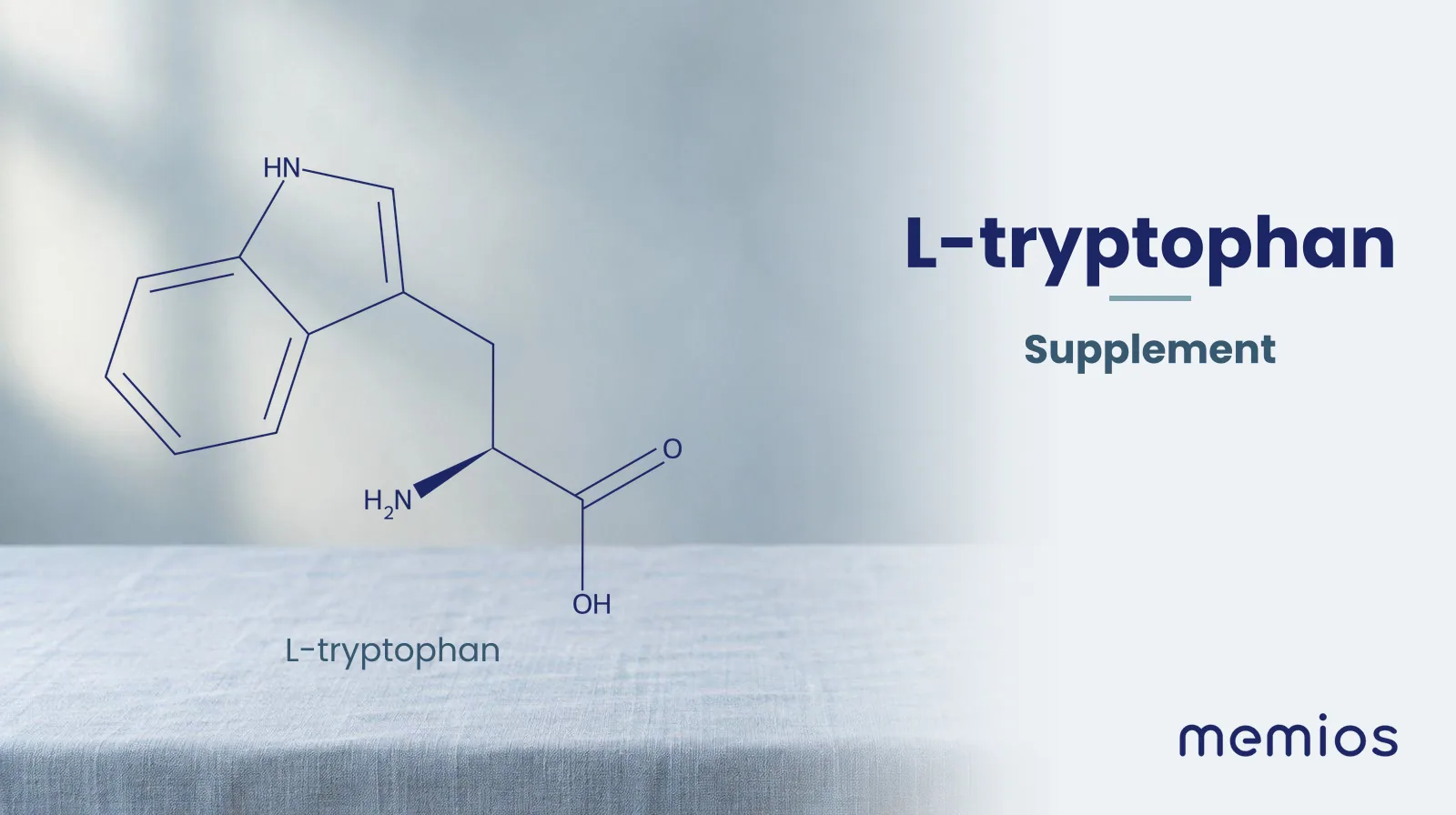
L-tryptophan is one of the amino acids that make up dietary protein, and one of the eight classed as essential because the human body cannot synthesise them. It is the precursor from which the body makes 5-HTP, then serotonin, then melatonin, and it also feeds the kynurenine pathway that yields a small amount of niacin. It is present in most protein foods and has also been sold as a purified supplement and prescribed as a medicine.
What the research says
As a nutrient it is not optional; as a supplement the evidence is modest and the safety history is serious. A meta-analysis of four analysable trials found tryptophan supplementation shortened time spent awake after falling asleep but changed no other sleep measure. For depression, a Cochrane review could use only two of 108 located trials and judged the evidence insufficient to be conclusive. The dominant safety event is the 1989 eosinophilia-myalgia syndrome epidemic: within weeks of CDC alerting state health departments, 730 cases had been reported from 48 states, and four deaths were reported in people who met the case definition and had used L-tryptophan. Whether the cause was the amino acid itself, an impurity, a combination of the two, or those together with other unknown external factors has still not been resolved: the FDA said exactly that in 2001, and a 2023 review of the impurity work reached the same conclusion. Cases became rare once the supplement was withdrawn.
Evidence grade: Limited evidence.
What goes wrong
CDC surveillance recorded 730 eosinophilia-myalgia syndrome cases reported from 48 states, the District of Columbia and Puerto Rico as of 6 December 1989. (Source 1)
- Survey study, Moderate certainty.
- Size: 730 reported cases as of 6 December 1989.
- Who: US residents reported to CDC with eosinophilia-myalgia syndrome.
- How long: Surveillance begun 9 November 1989; count as of 6 December 1989.
- Result: 730 cases reported from 48 states, the District of Columbia and Puerto Rico within about four weeks of the national alert.
- Funding: government agency.
As of December 6, 730 EMS cases have been reported to CDC from 48 states, the District of Columbia, and Puerto Rico.
Four deaths were reported in patients who met the surveillance case definition and had used L-tryptophan, one of them confirmed as directly attributable to eosinophilia-myalgia syndrome. (Source 2)
- Survey study, Moderate certainty.
- Size: 4 reported deaths among the 730 reported cases.
- Who: US residents reported to CDC with eosinophilia-myalgia syndrome.
- How long: Surveillance begun 9 November 1989.
- Result: Four deaths reported; one confirmed as directly attributable to EMS, the others under investigation at the time of the report.
- Funding: government agency.
Four deaths have been reported in patients who met the surveillance case definition and who used LT; one death has been confirmed as directly attributable to EMS, and the others are under investigation.
A 2011 report describes a new case of L-tryptophan-associated eosinophilia-myalgia syndrome after the epidemic, an illness in which muscle pain and raised eosinophils are followed by chronic nerve damage and hardening of the skin. (Source 3)
- Case report, Very low certainty.
- Size: 1 patient.
- Who: A person with L-tryptophan-associated eosinophilia-myalgia syndrome after the 1989 epidemic.
- How long: Not stated in the abstract.
- Result: No rate; a clinical, histopathologic and immunogenetic description of one new case, with activated transforming growth factor beta and interleukin-4 signalling in the lesional skin.
- Funding: not stated.
Limit of this finding: The paper contradicts itself on one point. Its abstract states that no new cases have been described since the FDA ban was lifted in 2005, and the same paper then reports a new case. Read the “no new cases” statement as a description of how rare the illness became after the supplement was withdrawn, not as evidence that it stopped happening.
Eosinophilia-myalgia syndrome (EMS) is characterized by subacute onset of myalgias and peripheral eosinophilia, followed by chronic neuropathy and skin induration.
The Norwegian Scientific Committee for Food Safety concluded in 2016 that tryptophan supplement doses of 250 to 450 mg a day may represent a risk of adverse health effects in adults, adolescents and children. (Source 4)
- Official position, Certainty not rated.
- Size: Not applicable.
- Who: Adults 18 years and over, adolescents 14 to under 18, children 10 to under 14.
- How long: Position dated 2016.
- Result: Doses of 250, 300 and 450 mg per day judged to possibly represent a risk of adverse health effects.
- Funding: government committee.
Limit of this finding: This wording was read from the plain summary on the online record where the committee's report is deposited, not from the report itself. The doses and age groups match that summary, but the evidence and reasoning behind the judgement sit in the full report, which we could not read.
VKM concludes that the specified doses 250 mg/day, 300 mg/day, and 450 mg/day tryptophan may represent a risk of adverse health effects in adults (≥18 years), adolescents (14 to <18 years), and children (10 to <14 years).
What the evidence supports
A meta-analysis of tryptophan supplementation trials found it shortened time awake after falling asleep, but changed no other measure of sleep. (Source 5)
- Meta-analysis, Low certainty.
- Size: 4 articles analysed out of 18 collected.
- Who: Participants in tryptophan supplementation trials reporting sleep outcomes.
- How long: Not stated in the abstract.
- Result: Wake after sleep onset −81.03 min/g, P = 0.017; SMD −1.08 min [95%CI, −1.89 to −0.28]; no effect on other sleep components.
- Funding: not stated.
Limit of this finding: One number in the paper is inconsistent with itself: it labels the standardised mean difference as “−1.08 min”, but a standardised mean difference is a unitless measure, so the “min” cannot be right. Read that result as a direction and a rough size, not as 1.08 minutes. The estimate also comes from only four analysable trials.
Results from the study suggested that Trp supplementation can shorten wake after sleep onset (−81.03 min/g, P = 0.017; SMD, −1.08 min [95%CI, −1.89 to −0.28]).
What the evidence does not support
The same meta-analysis found no effect of tryptophan on sleep measures other than wake after sleep onset, and rested on only four analysable studies. (Source 5)
- Meta-analysis, Low certainty.
- Size: 4 articles analysed.
- Who: Participants in tryptophan supplementation trials.
- How long: Not stated.
- Result: No effect on other sleep components; only 4 of 18 retrieved articles could be analysed.
- Funding: not stated.
Limit of this finding: One number in the paper is inconsistent with itself: it labels the standardised mean difference as “−1.08 min”, but a standardised mean difference is a unitless measure, so the “min” cannot be right. Read that result as a direction and a rough size, not as 1.08 minutes. The estimate also comes from only four analysable trials.
However, Trp supplementation did not affect other sleep components.
For depression, a Cochrane review found only two usable trials out of 108 located and judged the evidence insufficient to be conclusive. (Source 6)
- Systematic review, Very low certainty.
- Size: 2 trials, 64 patients.
- Who: Adults with unipolar depression or dysthymia.
- How long: Not stated.
- Result: Peto Odds Ratio 4.10; 95% confidence interval 1.28-13.15; RD 0.36; NNT 2.78, described as insufficient quality to be conclusive.
- Funding: not stated.
Limit of this finding: The review says two different things in two places. Its results section calls the evidence “of insufficient quality to be conclusive”, while its conclusions say the available evidence “does suggest these substances are better than placebo”. Both statements rest on the same two small trials in 64 patients, so the positive-sounding sentence should not be read as a reliable finding. The review is also from 2002 and has not been updated here.
A large number of studies appear to address the research questions, but few are of sufficient quality to be reliable.
Where the evidence is mixed
The same report states that the incidence of the syndrome fell rapidly after the FDA banned the sale of L-tryptophan, and that no new cases had been described since that ban was lifted in 2005. (Source 3)
- Case report, Very low certainty.
- Size: 1 patient, set against the authors’ reading of the published record.
- Who: People with L-tryptophan-associated eosinophilia-myalgia syndrome.
- How long: From the 1989 epidemic to 2011.
- Result: No rate given; a statement that incidence declined rapidly after the ban and that no new cases had been described since the ban was lifted in 2005.
- Funding: not stated.
Limit of this finding: The paper contradicts itself on one point. Its abstract states that no new cases have been described since the FDA ban was lifted in 2005, and the same paper then reports a new case. Read the “no new cases” statement as a description of how rare the illness became after the supplement was withdrawn, not as evidence that it stopped happening.
Following the ban by the Food and Drug Administration (FDA) on the sale of L-tryptophan, the incidence of EMS declined rapidly. Moreover, no new cases have been described since the FDA ban was lifted in 2005.
A 2023 review of the impurity hypothesis concluded that despite many laboratory and animal studies, no clear conclusion has been reached on whether impurities in L-tryptophan caused eosinophilia-myalgia syndrome. (Source 7)
- Expert review, not systematic, Very low certainty.
- Size: Narrative synthesis, number of studies not stated in the abstract.
- Who: Laboratory and animal studies of L-tryptophan impurities.
- How long: Not applicable.
- Result: Six components generated during L-tryptophan synthesis are suspected; no clear and convincing conclusions drawn.
- Funding: industry-funded - four authors employed by CJ CheilJedang, an amino acid manufacturer.
Many in vitro and in vivo studies have been conducted to assess the putative correlation between impurities in L-tryptophan preparations and EMS, but no clear and convincing conclusions have been drawn so far.
What official bodies say
The UK Committee on Toxicity concluded in June 2004 that prescription tryptophan had not produced a detectable increase in eosinophilia-myalgia risk, and derived a supplemental figure by applying a tenfold uncertainty factor. (Source 8)
- Official position, Certainty not rated.
- Size: Not applicable.
- Who: UK users of prescription tryptophan and of supplements.
- How long: Position dated June 2004.
- Result: Mean therapeutic dose 2228 mg per day; a tenfold uncertainty factor gives 220 mg per day as a supplement figure, conditional on European Pharmacopoeia purity criteria.
- Funding: government committee.
We conclude that the new data offer reassurance that as a prescription medicine, tryptophan has not resulted in a detectable increase in risk of EMS.
The US Food and Drug Administration stated in 2001 that it could not determine whether eosinophilia-myalgia syndrome in susceptible people came from L-tryptophan itself, an impurity in it, a combination of the two, or those together with other external factors not yet known. (Source 9)
- Official position, Certainty not rated.
- Size: Not applicable.
- Who: US consumers of L-tryptophan supplements.
- How long: Position dated February 2001.
- Result: No effect size; a statement that causation was unresolved, expressly leaving open a role for other, as yet unknown, external factors.
- Funding: government agency.
we cannot determine with certainty that the occurrence of EMS in susceptible persons consuming L-Tryptophan supplements derives from the content of L-Tryptophan, an impurity contained in the L-Tryptophan, or a combination of the two in association with other, as yet unknown, external factors.
Where the research disagrees
Whether the 1989 eosinophilia-myalgia epidemic was caused by impurities, by tryptophan itself, or by something not yet identified
- Maffei, International Journal of Molecular Sciences 2021, narrative review of 5-HTP and tryptophan toxicology: occurrence in both synthetic tryptophan and 5-HTP of toxic impurities has caused eosinophilia myalgia syndrome cases (Source 10)
- US Food and Drug Administration, February 2001, agency position: we cannot determine with certainty that the occurrence of EMS in susceptible persons consuming L-Tryptophan supplements derives from the content of L-Tryptophan, an impurity contained in the L-Tryptophan, or a combination of the two in association with other, as yet unknown, external factors. (Source 9)
- Ko and colleagues, Food and Chemical Toxicology 2023 (four authors employed by an amino acid manufacturer), narrative review: Many in vitro and in vivo studies have been conducted to assess the putative correlation between impurities in L-tryptophan preparations and EMS, but no clear and convincing conclusions have been drawn so far. (Source 7)
What supplemental amount, if any, is acceptable
- UK Committee on Toxicity, June 2004, position, from review of prescription monitoring data: We conclude that the new data offer reassurance that as a prescription medicine, tryptophan has not resulted in a detectable increase in risk of EMS. (Source 8)
- Norwegian Scientific Committee for Food Safety, 2016, position: VKM concludes that the specified doses 250 mg/day, 300 mg/day, and 450 mg/day tryptophan may represent a risk of adverse health effects in adults (≥18 years), adolescents (14 to <18 years), and children (10 to <14 years). (Source 4)
How much
- Reference intake: A 2009 review reports typical intakes of approximately 900 to 1000 mg daily and gives the estimated adult recommended daily allowance as between 250 mg/day and 425 mg/day. (Source 11)
- Upper limit: No formal tolerable upper intake level was found. The UK Committee on Toxicity in June 2004 applied a tenfold uncertainty factor to a mean therapeutic dose of 2228 mg/day and identified 220 mg/day as a supplemental amount not presenting an appreciable risk, conditional on European Pharmacopoeia purity criteria. Norway's VKM concluded in 2016 that 250, 300 and 450 mg/day may represent a risk of adverse health effects. (Source 8)
- Studied: Sleep trials pooled in a 2022 meta-analysis compared daily doses below 1 g with doses of 1 g or more; the group on 1 g or more had shorter wake after sleep onset (56.55 vs 28.91 min; P = 0.001). (Source 5)
- Studied: The Cochrane review's two included depression trials involved a total of 64 patients; doses are not given in the abstract. (Source 12)
A common belief, and what the research shows
The belief: Tryptophan is just the sleepy ingredient in turkey, and a proven natural sleep aid.
What the research shows: The sleep evidence rests on four analysable trials, and only one measure moved. The meta-analysis reported that “Trp supplementation can shorten wake after sleep onset (−81.03 min/g, P = 0.017; SMD, −1.08 min [95%CI, −1.89 to −0.28])” but also that “However, Trp supplementation did not affect other sleep components.” Turkey is on the list of common dietary sources – “Some common sources of tryptophan are oats, bananas, dried prunes, milk, tuna fish, cheese, bread, chicken, turkey, peanuts, and chocolate.” – but supplemental tryptophan is a different matter, and the 1989 epidemic is why: “Four deaths have been reported in patients who met the surveillance case definition and who used LT; one death has been confirmed as directly attributable to EMS, and the others are under investigation.”
Questions and answers
What is it?
L-tryptophan is one of the amino acids that make up protein in food. It is classed as essential, meaning the human body cannot build it and has to take it in from the diet. It is also the raw material for serotonin, melatonin and part of the body's niacin supply. (Source 13)
What does it do in the body?
Most dietary tryptophan is used to build proteins. A small fraction is converted by the enzyme tryptophan hydroxylase into 5-HTP, which becomes serotonin and then melatonin. Another route turns tryptophan into niacin, though inefficiently. (Source 14)
Is it good or bad for you?
It is necessary in the diet, and at prescription doses a UK expert committee found no detectable increase in eosinophilia-myalgia risk. But supplemental tryptophan carries the history of the 1989 epidemic, and different bodies have reached different conclusions about safe supplemental amounts, with Norway's committee judging that 250 to 450 mg a day may pose a risk. Context and product purity matter more than the amino acid alone. (Source 8)
How do you get more of it?
Ordinary protein foods supply it, and reported typical intakes are around 900 to 1000 mg a day, which is above the estimated adult requirement. Trials of supplemental tryptophan for sleep have used purified amounts on the order of one gram or more a day. We are describing what studies used, not recommending an amount. (Source 5)
If it is harmful, what reduces it?
Tryptophan is not a substance to be removed from the body. Where harm appeared historically it was tied to supplement products, and what reduced it at population level was regulatory removal of those supplements from sale, after which reported cases fell away quickly. The 2011 report that describes a later case also states that no new cases had been described since the FDA ban was lifted in 2005. (Source 3)
Why might someone be low in it or missing it?
Because it must come from food, low tryptophan intake follows a diet low in protein overall. Reported typical intakes sit well above the estimated adult requirement, so frank shortage is uncommon in people eating enough protein; researchers usually have to lower it deliberately to study the effect. (Source 11)
Which whole foods contain it or feed it?
It is present in most protein-containing whole foods. The review lists oats, bananas, dried prunes, milk, tuna, cheese, bread, chicken, turkey, peanuts and chocolate among common sources. (Source 15)
What happens if you do not have it?
Without dietary tryptophan the body cannot build the proteins that need it, nor make serotonin and melatonin from it. It also contributes to niacin production, although the conversion is poor: roughly 60 mg of tryptophan yields about 1 mg of niacin, so tryptophan is a minor rather than a main niacin source. (Source 16)
How can you test for it?
Tryptophan is measurable in blood, but a plain plasma level is not very informative on its own. Because tryptophan competes with other large neutral amino acids to enter the brain, researchers express availability as the ratio of tryptophan to those competitors. That ratio is a research measure, not a routine clinical test with an agreed cut-off. (Source 17)
References
- Morbidity and Mortality Weekly Report (CDC), 38(48):842, accessed via the RestoredCDC mirror. Epidemiologic Notes and Reports Update: Eosinophilia-Myalgia Syndrome Associated with Ingestion of L-Tryptophan -- United States (case count as of 6 December 1989). 1989. Read the source
- Morbidity and Mortality Weekly Report (CDC), 38(48):842, accessed via the RestoredCDC mirror. Epidemiologic Notes and Reports Update: Eosinophilia-Myalgia Syndrome Associated with Ingestion of L-Tryptophan -- United States (reported deaths). 1989. Read the source
- Arthritis & Rheumatism; abstract text read from the University of Minnesota Experts record of the article. Post-epidemic eosinophilia-myalgia syndrome associated with L-tryptophan. 2011. PMID 21702023, DOI 10.1002/art.30514. Read the source
- Norwegian Scientific Committee for Food Safety (VKM); text read from the summary description field of the Zenodo record where the opinion is deposited, not from the opinion document itself. Risk assessment of "other substances" - L-tryptophan: summary description on the Zenodo record of the opinion of the Panel on Nutrition, dietetic products, Novel Food and Allergy of the Norwegian Scientific Committee for Food Safety. 2016. Read the source
- Nutrition Reviews (Oxford Academic); abstract read on the publisher page. The impact of tryptophan supplementation on sleep quality: a systematic review, meta-analysis, and meta-regression. 2022. PMID 33942088, DOI 10.1093/nutrit/nuab027. Read the source
- Cochrane Database of Systematic Reviews (The Cochrane Collaboration); abstract text read from the Europe PMC record (abstractText field), not from the Cochrane Library page. Tryptophan and 5-hydroxytryptophan for depression (Reviewer's conclusions section of the abstract). 2002. PMID 11869656, DOI 10.1002/14651858.CD003198. Read the source
- Food and Chemical Toxicology. Safety concerns regarding impurities in L-Tryptophan associated with eosinophilia myalgia syndrome (abstract). 2023. DOI 10.1016/j.fct.2023.113946. Read the source
- Committee on Toxicity of Chemicals in Food, Consumer Products and the Environment (United Kingdom). COT STATEMENT ON TRYPTOPHAN AND THE EOSINOPHILIA-MYALGIA SYNDROME. 2004. Read the source
- U.S. Food and Drug Administration, Center for Food Safety and Applied Nutrition, Office of Nutritional Products, Labeling, and Dietary Supplements. Information Paper on L-Tryptophan and 5-hydroxy-L-tryptophan (statement on the unresolved cause of EMS). 2001. Read the source
- International Journal of Molecular Sciences (MDPI). 5-Hydroxytryptophan (5-HTP): Natural Occurrence, Analysis, Biosynthesis, Biotechnology, Physiology and Toxicology (toxic impurities and eosinophilia myalgia syndrome). 2021. PMID 33375373, DOI 10.3390/ijms22010181. Read the source
- International Journal of Tryptophan Research. L-Tryptophan: Basic Metabolic Functions, Behavioral Research and Therapeutic Indications (typical intake and estimated recommended daily allowance). 2009. PMID 20651948, DOI 10.4137/IJTR.S2129. Read the source
- Cochrane Database of Systematic Reviews (The Cochrane Collaboration); abstract text read from the Europe PMC record (abstractText field), not from the Cochrane Library page. Tryptophan and 5-hydroxytryptophan for depression (Main results section of the abstract). 2002. PMID 11869656, DOI 10.1002/14651858.CD003198. Read the source
- International Journal of Tryptophan Research. L-Tryptophan: Basic Metabolic Functions, Behavioral Research and Therapeutic Indications (tryptophan as an essential amino acid). 2009. PMID 20651948, DOI 10.4137/IJTR.S2129. Read the source
- International Journal of Molecular Sciences (MDPI). 5-Hydroxytryptophan (5-HTP): Natural Occurrence, Analysis, Biosynthesis, Biotechnology, Physiology and Toxicology (abstract). 2021. PMID 33375373, DOI 10.3390/ijms22010181. Read the source
- International Journal of Tryptophan Research. L-Tryptophan: Basic Metabolic Functions, Behavioral Research and Therapeutic Indications (common dietary sources). 2009. PMID 20651948, DOI 10.4137/IJTR.S2129. Read the source
- International Journal of Tryptophan Research. L-Tryptophan: Basic Metabolic Functions, Behavioral Research and Therapeutic Indications (niacin synthesis from tryptophan). 2009. PMID 20651948, DOI 10.4137/IJTR.S2129. Read the source
- International Journal of Tryptophan Research. L-Tryptophan: Basic Metabolic Functions, Behavioral Research and Therapeutic Indications (competition with other large neutral amino acids). 2009. PMID 20651948, DOI 10.4137/IJTR.S2129. Read the source