Supplements · September 29, 2026 · Memios · 19 min read
Kava
Disputed. Kava is sold for anxiety, and the evidence is genuinely split.
TLDR
- Disputed. Kava is sold for anxiety, and the evidence is genuinely split.
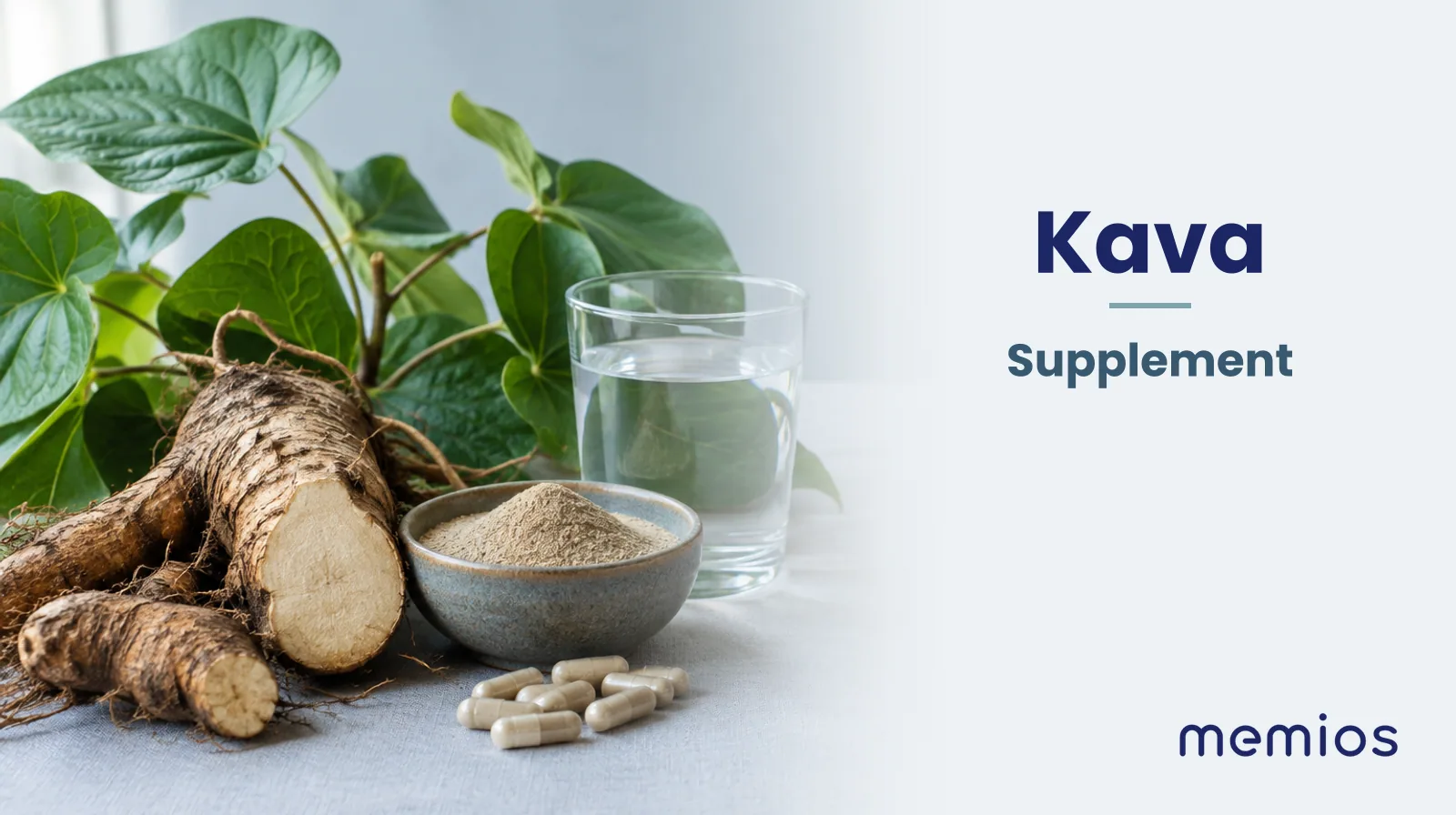
- What it is: Kava is a plant of the pepper family whose rhizome is prepared as a drink in the South Pacific and sold in Western countries as ethanolic, acetonic or aqueous extracts standardised to kavalactones.
- Main use, supported: A Cochrane review concluded that kava extract is an effective symptomatic treatment for anxiety compared with placebo, while describing the effect as small and lacking robustness. (low certainty)
- Other use, supported: In that review's meta-analysis of seven trials, kava extract reduced Hamilton Anxiety total scores more than placebo, at the edge of statistical significance. (low certainty)
- Claim NOT supported by research: A 16-week phase III randomised placebo-controlled trial of aqueous kava extract in generalised anxiety disorder found no reduction in anxiety compared with placebo. (moderate certainty)
- Another claim NOT supported: A 2018 systematic review of kava specifically for generalised anxiety disorder found effect sizes that did not reach statistical significance and judged the evidence insufficient. (low certainty)
- Recommended dose: not established. No reference intake (RDA or AI) exists for kava. It is a plant preparation used as an anxiolytic, not a nutrient.
- Studied dose (a trial dose, not a recommendation): A 16-week phase III trial gave an aqueous extract of dried kava root standardised to 120 mg of kavalactones twice per day. Findings citing that trial: 1 against, 1 on harm.
- Upper limit: No tolerable upper intake level or ADI was found in the sources searched.
- What goes wrong: 12 findings on harm. In the same trial, liver function test abnormalities were significantly more frequent with kava, alongside more reported memory problems and tremor.
- Common myth: Kava is a natural herb, so it is safe for the liver.
What it is
Kava is a plant of the pepper family whose rhizome is prepared as a drink in the South Pacific and sold in Western countries as ethanolic, acetonic or aqueous extracts standardised to kavalactones. The traditional preparation is an aqueous extract of the rhizome; commercial anxiolytic products use organic-solvent extracts. Products differ in solvent and in the quality of the raw plant material used.
What the research says
Kava is sold for anxiety, and the evidence is genuinely split. A Cochrane review of 12 double-blind randomised trials found a small, borderline reduction in Hamilton Anxiety scores versus placebo, while a 2018 review that pooled three placebo-controlled trials in diagnosed generalised anxiety disorder found effect sizes that did not reach statistical significance, and a 171-participant, 16-week phase III trial found no benefit over placebo at all. Against that sits a serious safety signal: kava is a recognised cause of clinically apparent liver injury, with published cases of acute liver failure, transplantation and death. LiverTox says it has been banned in many countries as an over-the-counter product for anxiety or mood disorders, and Germany banned ethanolic and acetonic extracts in 2002.
Evidence grade: Disputed.
What goes wrong
In the same trial, liver function test abnormalities were significantly more frequent with kava, alongside more reported memory problems and tremor. (Source 1)
- Randomized trial, Moderate certainty.
- Size: 171 participants.
- Who: adults with GAD.
- How long: 16 weeks.
- Result: poorer memory (Kava = 36 vs placebo = 23; p = 0.044) and tremor/shakiness (Kava = 36 vs placebo = 23; p = 0.024); liver function test abnormalities significantly more frequent with kava, though no case met criteria for herb-induced hepatic injury.
- Funding: not stated.
Liver function test abnormalities were significantly more frequent in the Kava group, although no participant met criteria for herb-induced hepatic injury.
A clinical review applying structured causality assessment to worldwide reports concluded kava is potentially hepatotoxic, with severe outcomes including death and liver transplantation among reported patients. (Source 2)
- Expert review, not systematic, Low certainty.
- Size: 31 patients with liver disease in primarily suspected causal relation to kava.
- Who: patients worldwide with liver disease reported after kava use.
- How long: varied; prolonged treatment was a listed risk factor.
- Result: causality highly probable (n = 1), probable (n = 4) or possible (n = 9) among 14 patients; severe course in eleven of 31 patients, with death (n = 1), death after liver transplant (n = 3), and transplant with good outcome (n = 7)
- Funding: not stated.
The clinical course was severe in eleven out of 31 patients and included death (n = 1), death after liver transplant (LTX) (n = 3), and LTX with good outcome (n = 7).
The same review identified overdose, prolonged use, co-medication and poor raw-material quality as risk factors, with hepatotoxicity occurring regardless of the extraction solvent. (Source 3)
- Expert review, not systematic, Low certainty.
- Size: 14 patients assessed by structured causality method.
- Who: patients with kava-associated liver disease.
- How long: not uniformly stated.
- Result: cases involved aqueous extracts (n = 3), ethanolic extracts (n = 5), acetonic extracts (n = 4) and mixtures containing kava (n = 2)
- Funding: not stated.
Risk factors included overdose, prolonged treatment, and comedication with synthetic drugs and dietary supplements comprizing herbal ones in most of the 14 patients.
LiverTox assigns kava its highest likelihood score, rating it a well known cause of clinically apparent liver injury. (Source 4)
- Expert review, not systematic, Low certainty.
- Size: not applicable; a summary rating of the published case literature.
- Who: people taking kava products.
- How long: not stated.
- Result: likelihood score A, the LiverTox category for a well known cause of clinically apparent liver injury.
- Funding: US government resource.
Likelihood score: A (well known cause of clinically apparent liver injury).
A controlled human phenotyping study found 28 days of kava supplementation inhibited CYP2E1 activity by roughly 40 percent, a plausible route to interactions with drugs metabolised by that enzyme. (Source 5)
- Blood level study, Low certainty.
- Size: Twelve healthy volunteers (6 women)
- Who: healthy adult volunteers taking probe drug cocktails.
- How long: 28 days of supplementation with 30-day washouts.
- Result: Kava produced significant reductions (approximately 40%) in CYP2E1 only (difference, -0.192; 95% CI, -0.325 to -0.060)
- Funding: not stated.
Kava produced significant reductions (approximately 40%) in CYP2E1 only (difference, -0.192; 95% CI, -0.325 to -0.060).
Position: Germany issued a regulatory ban on ethanolic and acetonic kava extracts in 2002, a decision the review describes as internationally contested. (Source 3)
- Official position, Certainty not rated.
- Size: not applicable.
- Who: German market for kava medicinal products.
- How long: regulatory action dated 2002.
- Result: market withdrawal; causality assessment disputed.
- Funding: national regulator.
A regulatory ban for ethanolic and acetonic kava extracts was issued in 2002 for Germany on the basis of reports connecting liver disease with the use of kava
Position: the NIH Office of Dietary Supplements reports that FDA linked kava-containing products to liver-related injuries, including hepatitis, cirrhosis and liver failure, in over 25 adverse event reports from other countries. (Source 6)
- Official position, Certainty not rated.
- Size: over 25 reports of adverse events in other countries.
- Who: US consumers of kava supplements.
- How long: advisory dated March 25, 2002; MMWR dated November 29, 2002.
- Result: reports of hepatitis, cirrhosis and liver failure; the page gives no denominator and no dates for the individual reports.
- Funding: US government agency.
kava-containing products have been associated with liver-related injuries, including hepatitis, cirrhosis, and liver failure, in over 25 reports of adverse events in other countries
LiverTox states that at least a dozen instances of acute liver failure have been reported in people taking kava, and that kava has been banned in many countries as an over-the-counter product for anxiety or mood disorders. (Source 7)
- Expert review, not systematic, Low certainty.
- Size: at least a dozen reported instances of acute liver failure; this Comment follows a single transplanted case.
- Who: people taking kava products.
- How long: not stated.
- Result: no denominator given for the acute liver failure reports; regulatory action limited to over-the-counter use for anxiety or mood disorders.
- Funding: US government resource.
Because at least a dozen instances of acute liver failure have been reported in patients taking kava, the agent has been banned in many countries as an over-the-counter product for therapy of anxiety or mood disorders.
Position: within the United States, the same page records that FDA received one report of a previously healthy young woman who needed a liver transplant, along with several other reports of liver-related injury. (Source 6)
- Official position, Certainty not rated.
- Size: one liver transplant case plus several further US reports.
- Who: US consumers of kava-containing products.
- How long: not stated on the page.
- Result: a single transplant case and an unspecified number of further liver-injury reports; no denominator given.
- Funding: US government agency.
In the U.S., FDA received a report of a previously healthy young female who required liver transplantation, as well as several reports of liver-related injuries.
LiverTox estimates clinically apparent liver injury from kava at fewer than 1 in 1,000,000 daily doses, while stating that spontaneous reporting captures less than 1% of severe supplement adverse events and that 50 to 100 cases have been published. (Source 8)
- Expert review, not systematic, Low certainty.
- Size: Between 50 and 100 published or discussed cases of clinically apparent liver injury.
- Who: people taking kava products.
- How long: not stated.
- Result: estimated frequency less than 1:1,000,000 daily doses, against a stated under-reporting rate of less than 1% for severe supplement adverse events.
- Funding: US government resource.
Limit of this finding: LiverTox gives a rate of fewer than 1 in 1,000,000 daily doses and, in the very next sentence, says spontaneous reporting picks up under 1% of severe supplement adverse events. The two statements pull in opposite directions: the rate is derived from the same reports that LiverTox says capture a small fraction of events, so it should be read as a lower bound, not as a measured risk. LiverTox also records that advocates of kava dispute both the numbers and the way causality was judged. A reader should not conclude that the true risk is known.
Based upon reported cases, the estimated frequency of clinically apparent liver injury due to kava is less than 1:1,000,000 daily doses.
LiverTox describes a typical latency of 2 to 24 weeks before kava-associated liver injury becomes apparent, with a hepatocellular pattern of enzyme elevation. (Source 9)
- Expert review, not systematic, Low certainty.
- Size: not stated; a description of the published case pattern.
- Who: people who developed liver injury while taking kava.
- How long: onset 2 to 24 weeks after starting the product.
- Result: hepatocellular pattern with marked serum aminotransferase elevations and minimal alkaline phosphatase increases; severe cases show massive or submassive necrosis.
- Funding: US government resource.
Patients typically present with fatigue, nausea, elevations in serum aminotransferase levels, and jaundice 2 to 24 weeks after starting use of the product.
An annotation in the LiverTox bibliography records that the European Agency for Evaluation of Medicinal Products identified 30 cases of liver injury, including 6 cases of liver failure, attributable to kava. (Source 10)
- Expert review, not systematic, Low certainty.
- Size: 30 cases of liver injury, including 6 cases of liver failure.
- Who: people taking kava products in countries covered by the European Agency review.
- How long: not stated.
- Result: 30 cases of liver injury including 6 cases of liver failure; UK retailers removed kava from shelves.
- Funding: US government resource.
Limit of this finding: This sentence is a note attached to a 2002 Lancet letter inside the LiverTox bibliography, not part of the LiverTox narrative, and the underlying tally is from 2002. It is a count of reported cases with no denominator, so it says nothing about how often liver injury happens per person taking kava.
The European Agency for Evaluation of Medicinal Products has identified 30 cases of liver injury, including 6 cases of liver failure attributable to kava; UK retailers have removed kava from shelves.
What the evidence supports
A Cochrane review concluded that kava extract is an effective symptomatic treatment for anxiety compared with placebo, while describing the effect as small and lacking robustness. (Source 11)
- Systematic review, Low certainty.
- Size: Twelve double-blind randomised controlled trials involving 700 participants; 7 studies (n = 380) in the meta-analysis.
- Who: adults with anxiety symptoms in placebo-controlled trials.
- How long: short-term treatment, 1 to 24 weeks.
- Result: authors' conclusion of an effective symptomatic treatment with a small effect that 'lacks robustness and is based on a relatively small sample'
- Funding: not stated.
Compared with placebo, kava extract is an effective symptomatic treatment for anxiety although, at present, the size of the effect seems small.
In that review's meta-analysis of seven trials, kava extract reduced Hamilton Anxiety total scores more than placebo, at the edge of statistical significance. (Source 12)
- Systematic review, Low certainty.
- Size: Twelve double-blind RCTs (n=700) met the inclusion criteria; the meta-analysis pooled seven studies (n = 380)
- Who: adults with anxiety in double-blind placebo-controlled trials.
- How long: short-term treatment, 1 to 24 weeks.
- Result: weighted mean difference 3.9 on the HAM-A, 95% confidence interval 0.1 to 7.7; p = 0.05; n = 380.
- Funding: not stated.
Limit of this finding: The confidence interval runs from 0.1 to 7.7 points and the p-value is exactly 0.05, so this result sits on the boundary of statistical significance. The true average effect could be as small as a tenth of a point on the Hamilton scale, which no patient would notice. It should not be read as a firm demonstration that kava works.
The result suggests a significant effect towards a reduction of the HAM-A total score in patients receiving kava extract compared with patients receiving placebo (weighted mean difference: 3.9, 95% confidence interval: 0.1 to 7.7; p = 0.05; n = 380).
What the evidence does not support
A 2018 systematic review of kava specifically for generalised anxiety disorder found effect sizes that did not reach statistical significance and judged the evidence insufficient. (Source 13)
- Meta-analysis, Low certainty.
- Size: Twelve articles reviewed; meta-analyses of three placebo-controlled trials (n=130)
- Who: adults with diagnosed generalised anxiety disorder.
- How long: short-term therapeutic use, 4 to 8 weeks in the trials considered.
- Result: meta-analyses of three placebo-controlled trials (n = 130) favored Kava for GAD treatment with effect sizes between 0.59 and 0.99 (standard mean difference) without reaching statistical significance.
- Funding: not stated.
Limit of this finding: The pooled effect sizes point in kava's favour but the result is not statistically significant, because only three small trials totalling 130 people were combined. A reader should take this as too little evidence to judge, not as proof that kava does or does not work.
Current evidence, although promising, is insufficient to confirm the effect of Kava for GAD treatment beyond placebo.
A 16-week phase III randomised placebo-controlled trial of aqueous kava extract in generalised anxiety disorder found no reduction in anxiety compared with placebo. (Source 1)
- Randomized trial, Moderate certainty.
- Size: 171 currently non-medicated anxious participants with diagnosed generalised anxiety disorder.
- Who: adults with diagnosed GAD, multi-site, Australia.
- How long: 16 weeks.
- Result: a relative reduction favouring placebo of 1.37 points; p = 0.25; remission 17.4% kava versus 23.8% placebo (p = 0.46)
- Funding: not stated.
An analysis of 171 participants revealed a non-significant difference in anxiety reduction between the Kava and placebo groups (a relative reduction favouring placebo of 1.37 points; p = 0.25).
Where the evidence is mixed
The same Cochrane review reported that adverse events in the reviewed trials were mild, transient and infrequent, but said long-term safety studies were still required. (Source 12)
- Systematic review, Low certainty.
- Size: twelve double-blind RCTs, n=700.
- Who: adults in short-term placebo-controlled kava trials.
- How long: 1 to 24 weeks.
- Result: no rates given; adverse events described as mild, transient and infrequent.
- Funding: not stated.
Adverse events as reported in the reviewed trials were mild, transient and infrequent.
Where the research disagrees
Whether kava reduces anxiety more than placebo
- Cochrane review of kava extract for anxiety, systematic review of 12 double-blind randomised trials, 700 participants: Compared with placebo, kava extract is an effective symptomatic treatment for anxiety although, at present, the size of the effect seems small. (Source 11)
- Sarris and colleagues, 16-week phase III trial, randomised, double-blind, placebo-controlled trial in 171 participants: this particular extract was not effective for diagnosed generalised anxiety disorder (Source 1)
Why kava causes liver injury, and whether the product or the plant is at fault
- Teschke, Annals of Hepatology clinical review, clinical review with structured quantitative causality assessment of 14 of 31 reported patients: in a few individuals kava may be hepatotoxic due to overdose, prolonged treatment, comedication, and probably triggered by an unacceptable quality of the kava raw material (Source 3)
- LiverTox, LiverTox's summary causality rating of the published case literature: Likelihood score: A (well known cause of clinically apparent liver injury). (Source 4)
How much
- Reference intake: No reference intake (RDA or AI) exists for kava. It is a plant preparation used as an anxiolytic, not a nutrient. (Source 3)
- Upper limit: No tolerable upper intake level or ADI was found in the sources searched. Instead, regulators acted against the products: Germany banned ethanolic and acetonic kava extracts in 2002, and LiverTox records that kava has been banned in many countries as an over-the-counter product for therapy of anxiety or mood disorders. (Source 7)
- Studied: A 16-week phase III trial gave an aqueous extract of dried kava root standardised to 120 mg of kavalactones twice per day. (Source 1)
- Studied: A systematic review described short-term therapeutic use at 120-280 mg per day of kavalactones over 4 to 8 weeks. (Source 13)
A common belief, and what the research shows
The belief: Kava is a natural herb, so it is safe for the liver.
What the research shows: It is a recognised cause of liver injury. LiverTox assigns "Likelihood score: A (well known cause of clinically apparent liver injury)." and a clinical review of reported patients records that "The clinical course was severe in eleven out of 31 patients and included death (n = 1), death after liver transplant (LTX) (n = 3), and LTX with good outcome (n = 7)." Even in a modern controlled trial, "Liver function test abnormalities were significantly more frequent in the Kava group, although no participant met criteria for herb-induced hepatic injury."
Questions and answers
What is it?
Kava is made from the rhizome of Piper methysticum, a shrub in the pepper family grown across the South Pacific. Traditionally it is prepared as a water extract and drunk; Western products are usually ethanolic or acetonic extracts standardised to kavalactones. The active compounds are the kavalactones. (Source 3)
What does it do in the body?
Kava is used as an anxiolytic. A Cochrane review of 12 randomised trials found a small reduction in Hamilton Anxiety scores versus placebo, borderline at p = 0.05. A later, larger 16-week trial in diagnosed generalised anxiety disorder found no benefit, so the effect is not settled. (Source 11)
Is it good or bad for you?
Both sides are documented. Short-term trials show modest or no anxiety benefit and generally mild side effects, but the liver risk is taken seriously: LiverTox places kava in its highest causality category, a well known cause of clinically apparent liver injury, and published cases include acute liver failure, transplantation and death. (Source 4)
How do you get more of it?
Kava comes only from the plant, as a traditional water extract of the rhizome or as commercial capsules and tablets standardised to kavalactones. Trials have used 120 mg of kavalactones twice a day for 16 weeks, and reviews describe 120-280 mg of kavalactones a day for 4 to 8 weeks. That is what was studied, not advice. (Source 1)
If it is harmful, what reduces it?
Where kava has caused liver injury, the described response is to stop the product; the clinical reviews identify overdose, prolonged use, combining it with other drugs and supplements, and poor raw material quality as the factors that raise risk. There is no antidote specific to kava. (Source 3)
Why might someone be low in it or missing it?
Does not apply. Kava is not a nutrient or a body constituent, so nobody is deficient in it. Availability instead depends on regulation: Germany banned ethanolic and acetonic kava extracts in 2002 after reports connecting liver disease with kava use. (Source 3)
Which whole foods contain it or feed it?
No ordinary food contains kava. In the Pacific islands it is consumed as a traditional beverage made by steeping the ground rhizome in water; elsewhere it is sold as extract capsules rather than as food. (Source 3)
What happens if you do not have it?
Nothing happens from not taking kava; there is no deficiency state. For anxiety specifically, reviewers judge the evidence too weak to say a person is missing out on a confirmed treatment effect. (Source 13)
How can you test for it?
There is no test for kava status. What trials and case reports monitor is the liver: in a 16-week randomised trial, liver function test abnormalities were significantly more common on kava, though none met criteria for herb-induced liver injury. Liver enzyme tests detect injury, not kava exposure or response. (Source 1)
References
- Australian and New Zealand Journal of Psychiatry (SAGE). Kava for generalised anxiety disorder: A 16-week double-blind, randomised, placebo-controlled study. 2020. PMID 31813230, DOI 10.1177/0004867419891246. Read the source
- Annals of Hepatology (Elsevier). Kava hepatotoxicity. A clinical review (article body). 2010. PMID 20720265. Read the source
- Annals of Hepatology (Elsevier). Kava hepatotoxicity. A clinical review. 2010. PMID 20720265. Read the source
- National Institute of Diabetes and Digestive and Kidney Diseases (NCBI Bookshelf). Kava Kava - LiverTox: Clinical and Research Information on Drug-Induced Liver Injury (Likelihood score line). 2020. Read the source
- Clinical Pharmacology & Therapeutics (abstract reproduced by DrugBank). In vivo effects of goldenseal, kava kava, black cohosh, and valerian on human cytochrome P450 1A2, 2D6, 2E1, and 3A4/5 phenotypes (abstract, RESULTS section). 2005. PMID 15900287, DOI 10.1016/j.clpt.2005.01.009. Read the source
- Office of Dietary Supplements, National Institutes of Health. Kava (Office of Dietary Supplements consumer information page). 2002. Read the source
- National Institute of Diabetes and Digestive and Kidney Diseases (NCBI Bookshelf). Kava Kava - LiverTox: Clinical and Research Information on Drug-Induced Liver Injury (Case Report, Case 1, Comment). 2020. Read the source
- National Institute of Diabetes and Digestive and Kidney Diseases (NCBI Bookshelf). Kava Kava - LiverTox: Clinical and Research Information on Drug-Induced Liver Injury (Hepatotoxicity section, opening paragraph). 2020. Read the source
- National Institute of Diabetes and Digestive and Kidney Diseases (NCBI Bookshelf). Kava Kava - LiverTox: Clinical and Research Information on Drug-Induced Liver Injury (Hepatotoxicity section, clinical course). 2020. Read the source
- National Institute of Diabetes and Digestive and Kidney Diseases (NCBI Bookshelf). Annotation on Ernst E. Safety concerns about kava. Lancet 2002; 359: 1865 - in the Annotated Bibliography of LiverTox: Kava Kava. 2020. Read the source
- Cochrane Database of Systematic Reviews (Cochrane). Kava extract for treating anxiety (Authors' conclusions). 2003. PMID 12535473, DOI 10.1002/14651858.CD003383. Read the source
- Cochrane Database of Systematic Reviews (Cochrane). Kava extract for treating anxiety (Main results). 2003. PMID 12535473, DOI 10.1002/14651858.CD003383. Read the source
- The Journal of Alternative and Complementary Medicine (SAGE/Mary Ann Liebert). Kava for Generalized Anxiety Disorder: A Review of Current Evidence. 2018. PMID 29641222, DOI 10.1089/acm.2018.0001. Read the source