Medications · September 30, 2026 · Memios · 21 min read
Ibuprofen
For short-term pain, the evidence is strong and quantified: a Cochrane review of 72 placebo-controlled trials found that about 54% of people given ibuprofen 400 mg after surgery got at least 50% pain relief.
TLDR
- Boxed warning: This risk may occur early in treatment and may increase with duration of use.
- Well established. For short-term pain, the evidence is strong and quantified: a Cochrane review of 72 placebo-controlled trials found that about 54% of people given ibuprofen 400 mg after surgery got at least 50% pain relief, giving a number needed to treat of 2.5.
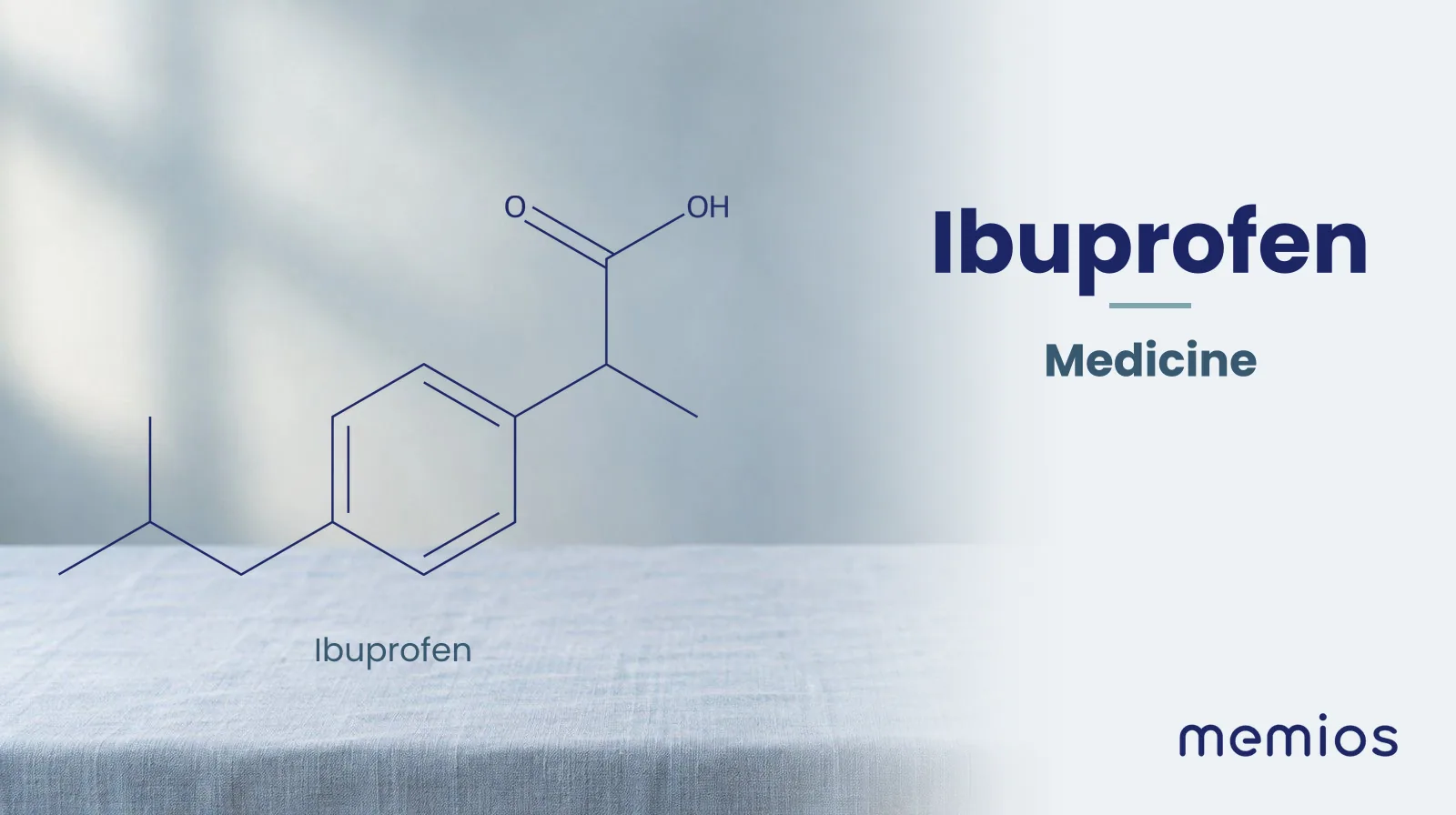
- What it is: Ibuprofen is a propionic-acid non-steroidal anti-inflammatory drug (NSAID) with painkilling, fever-reducing and anti-inflammatory activity.
- Main use: Acute pain (including post-operative pain) (well supported).
- Other approved uses: Rheumatoid arthritis and osteoarthritis (well supported); Fever and minor aches (over-the-counter use) (well supported); Primary dysmenorrhoea (period pain) (well supported).
- Off-label uses (not on the FDA label): Chronic low back pain (limited evidence).
- Recommended dose (official position): There is no reference intake for a drug. As a position, the US prescription label for IBU (ibuprofen) tablets states the indication as relief of the signs and symptoms of rheumatoid arthritis and osteoarthritis, and dosing is set by the prescriber; over-the-counter strengths are set by the package.
- Studied dose (a trial dose, not a recommendation): Cochrane's single-dose post-operative pain review pooled trials giving 200 mg and 400 mg as a single dose. Findings citing that trial: 2 for.
- Upper limit: Position, not a reference upper limit: the US prescription label instructs that the total daily dose should not exceed 3200 mg.
- What goes wrong: 8 findings on harm. In a meta-analysis of individual participant data from randomised trials, ibuprofen significantly increased major coronary events but did not significantly increase major vascular events overall.
- Interactions: 5 recorded, including Low-dose aspirin taken for heart protection, Alcohol, Ginkgo biloba (and, by the same mechanism, other platelet-affecting supplements), Lithium.
- Common myth: Ibuprofen is a mild drug because you can buy it without a prescription.
What it is
Ibuprofen is a propionic-acid non-steroidal anti-inflammatory drug (NSAID) with painkilling, fever-reducing and anti-inflammatory activity. Its label states that its mode of action is not completely understood but may relate to inhibition of prostaglandin synthetase (the cyclo-oxygenase enzymes). It is sold over the counter at lower strengths and on prescription up to 3200 mg a day, and it carries a boxed warning for cardiovascular thrombotic events and gastrointestinal bleeding.
What the research says
For short-term pain, the evidence is strong and quantified: a Cochrane review of 72 placebo-controlled trials found that about 54% of people given ibuprofen 400 mg after surgery got at least 50% pain relief, giving a number needed to treat of 2.5. For period pain, NSAIDs beat placebo with an odds ratio of 4.37. For chronic low back pain the benefit is small and the evidence low quality. The harms are the reason for the boxed warning: in randomised trials pooled by the CNT Collaboration, ibuprofen roughly doubled major coronary events and quadrupled upper gastrointestinal complications, and all NSAIDs roughly doubled hospitalisation for heart failure. Kidney injury is a real risk in dehydrated children.
Evidence grade: Well established.
How it works
Drug class: Non-selective cyclo-oxygenase inhibitor; propionic-acid non-steroidal anti-inflammatory drug (NSAID)
Ibuprofen blocks the cyclo-oxygenase enzymes that build prostaglandins - signalling molecules that amplify pain, drive fever and promote inflammation. Damping prostaglandin production reduces pain and temperature. The same enzymes also protect the stomach lining and help platelets clot and kidneys manage blood flow, which is why blocking them causes ulcers, bleeding and kidney injury. The label itself is careful to say the mechanism is not fully understood. (Source 1)
Boxed warning
Nonsteroidal anti-inflammatory drugs (NSAIDs) cause an increased risk of serious cardiovascular thrombotic events, including myocardial infarction and stroke, which can be fatal.
(Source 2)
What it is used for
- In 72 placebo-controlled trials with 9,186 participants, 46% of people given 200 mg and 54% given 400 mg achieved at least 50% pain relief, with numbers needed to treat of 2.7 (2.5 to 3.0) and 2.5 (2.4 to 2.6). Adverse events in these single-dose studies were uncommon and no different from placebo. Evidence: established. (Source 3)
- This is the labelled prescription indication, up to 3200 mg a day. In the PRECISION trial, 24,081 arthritis patients took a mean 2045 mg/day of ibuprofen for years; cardiovascular events were comparable to celecoxib and naproxen, but gastrointestinal and renal events were significantly more frequent than with celecoxib. Evidence: established. (Source 2)
- The label describes ibuprofen as possessing analgesic and antipyretic activities. We did not retrieve dedicated antipyretic outcome trials in this run, so the fever indication is recorded here on the label and on the acute-pain trial evidence rather than on fever trials we have read. Evidence: established. (Source 1)
- A Cochrane review of 80 randomised trials in 5,820 women found NSAIDs much more effective than placebo for pain relief (OR 4.37, 95% CI 3.76 to 5.09), with the reviewers rating most of the evidence low quality and noting more adverse effects than placebo (OR 1.29, 95% CI 1.11 to 1.51). Evidence: established. (Source 4)
- A Cochrane review of 13 trials found low-quality evidence that NSAIDs beat placebo by a mean 6.97 points on pain intensity (95% CI -10.74 to -3.19) and 0.85 points on disability - the reviewers themselves called the magnitude small and the evidence low. Evidence: limited. (Source 5)
Interactions
- Low-dose aspirin taken for heart protection (pharmacokinetic study): Ibuprofen and aspirin compete for the same site on the platelet enzyme. Aspirin blocks it permanently; ibuprofen blocks it temporarily and can get there first, so aspirin never locks on. Pharmacodynamic modelling in healthy volunteers predicts that a typical repeated ibuprofen schedule would substantially block aspirin's antiplatelet effect. (Source 6)
- Alcohol (case-control study - none of the listed evidence values fit exactly; see notes): Alcohol and ibuprofen each independently raise the risk of a major upper gastrointestinal bleed, and people who both drink heavily and use ibuprofen had the highest incidence in a 1,224-case hospital study. (Source 7)
- Ginkgo biloba (and, by the same mechanism, other platelet-affecting supplements) (case reports): Ginkgo has been linked to spontaneous bleeding in published case reports, including intracranial bleeds, and measured bleeding times were prolonged in the few reports that checked. Combining it with an NSAID that also impairs platelet function is a theoretical additive bleeding risk; the human evidence is case reports with heavy confounding, not trials. (Source 8)
- Lithium (pharmacokinetic study): Ibuprofen raised plasma lithium levels and reduced how fast the kidneys cleared lithium in a small volunteer study, which can push lithium towards toxic concentrations. (Source 2)
- Foods and drinks in general (no specific food interaction retrieved) (label): We did not find a documented food-specific pharmacokinetic interaction for ibuprofen in this search beyond alcohol. The label's own food-related statements concern taking it with food to reduce stomach upset, not a change in drug levels. (Source 1)
Stopping it
- Ibuprofen has no recognised withdrawal syndrome and is not a drug of dependence; nothing in the label's abuse or dependence sections, or in the reviews we read, describes tolerance or withdrawal. What the evidence does say about duration is that risk accumulates with continued use: the cardiovascular risk may occur early and may increase with duration of use, and ulcers, gross bleeding or perforation occur in about 1% of patients treated for 3 to 6 months and in about 2 to 4% of those treated for one year. (Source 1)
- The Cochrane reviewers of chronic low back pain said explicitly that they could not make firm statements about whether NSAIDs are safe for long-term use, so the case for continuing versus stopping in chronic pain rests on thin trial evidence. (Source 5)
What goes wrong
In a meta-analysis of individual participant data from randomised trials, ibuprofen significantly increased major coronary events but did not significantly increase major vascular events overall. (Source 9)
- Meta-analysis, Moderate certainty.
- Size: 639 trials, over 300,000 patients.
- Who: Participants in randomised trials of NSAIDs and coxibs, mostly with arthritis.
- How long: Trial durations varied, typically months to years.
- Result: Major coronary events with ibuprofen: rate ratio 2.22 (95% CI 1.10 to 4.48). Major vascular events with ibuprofen: rate ratio 1.44 (95% CI 0.89 to 2.33), which is not statistically significant. Naproxen did not significantly increase major vascular events (rate ratio 0.93, 95% CI 0.69 to 1.27).
- Funding: not stated in the record.
Limit of this finding: The words quoted here are from the CRD/DARE quality-assessed abstract of this meta-analysis on the NCBI Bookshelf, not from The Lancet paper itself, so they are the CRD abstractors' summary wording. The underlying meta-analysis is The Lancet 2013;382:769-79 (PMID 23726390).
Ibuprofen significantly increased major coronary events (rate ratio 2.22, 95% CI 1.10 to 4.48), but not major vascular events (rate ratio 1.44, 95% CI 0.89 to 2.33).
Ibuprofen roughly quadrupled upper gastrointestinal complications, mostly bleeds, in those same randomised trials. (Source 9)
- Meta-analysis, Moderate certainty.
- Size: 639 trials, over 300,000 patients.
- Who: Participants in randomised trials of NSAIDs and coxibs.
- How long: Months to years.
- Result: Upper gastrointestinal complications (mostly bleeds) versus placebo: ibuprofen rate ratio 3.97 (95% CI 2.22 to 7.10); naproxen 4.22 (2.71 to 6.56); diclofenac 1.89 (1.16 to 3.09); cyclooxygenase-2 inhibitors 1.81 (1.17 to 2.81). This is a gastrointestinal outcome, not a cardiovascular one.
- Funding: not stated in the record.
Limit of this finding: The words quoted here are from the CRD/DARE quality-assessed abstract of this meta-analysis on the NCBI Bookshelf, not from The Lancet paper itself, so they are the CRD abstractors' summary wording. The underlying meta-analysis is The Lancet 2013;382:769-79 (PMID 23726390).
All NSAID regimens significantly increased upper gastrointestinal complications (mostly bleeds), compared with placebo; cyclooxygenase-2 inhibitors rate ratio 1.81 (95% CI 1.17 to 2.81), diclofenac rate ratio 1.89 (95% CI 1.16 to 3.09), ibuprofen rate ratio 3.97 (95% CI 2.22 to 7.10), and naproxen rate ratio 4.22 (95% CI 2.71 to 6.56).
Hospitalisation for heart failure was about doubled by all NSAIDs studied, ibuprofen included. (Source 9)
- Meta-analysis, Moderate certainty.
- Size: 639 trials, over 300,000 patients.
- Who: Participants in randomised NSAID and coxib trials.
- How long: Months to years.
- Result: Risk of hospitalisation for heart failure approximately doubled.
- Funding: not stated in the record.
Limit of this finding: The words quoted here are from the CRD/DARE quality-assessed abstract of this meta-analysis on the NCBI Bookshelf, not from The Lancet paper itself, so they are the CRD abstractors' summary wording. The underlying meta-analysis is The Lancet 2013;382:769-79 (PMID 23726390).
The risk of hospitalisation, due to heart failure, was approximately doubled by all NSAIDs.
In dehydrated children with acute gastroenteritis, ibuprofen exposure was an independent risk factor for acute kidney injury. (Source 10)
- Cohort study, Low certainty.
- Size: 105 dehydrated children prospectively enrolled; 63 received ibuprofen.
- Who: Children with acute gastroenteritis and dehydration.
- How long: One-year enrolment period; AKI assessed at presentation.
- Result: AKI prevalence 44%; 34 of 63 ibuprofen-exposed children (54%) developed renal impairment; adjusted odds ratio 2.47 (95% CI 1.78-3.42, p < 0.001). No child required dialysis and all recovered.
- Funding: not stated.
Limit of this finding: This was a prospective observational cohort, not a randomised trial, so the authors' phrase 'Drug exposure increased the risk' is their interpretation of an association: dehydrated children who were given ibuprofen may have differed from those who were not. All the children recovered and none needed dialysis. Note that the published abstract contains a typographical error, 'All cases fulled recovered from AKI.', which we reproduce exactly as the journal printed it rather than silently correcting it inside quotation marks.
ibuprofen exposure remained an independent risk factor for AKI (p < 0.001, odds ratio 2.47, 95 % confidence interval 1.78–3.42)
The label reports that NSAID-caused upper GI ulcers, gross bleeding or perforation occur in about 1% of patients treated for 3 to 6 months and in about 2 to 4% of patients treated for one year. (Source 1)
- Official position, Certainty not rated.
- Size: Not stated; a summary figure in the prescribing information.
- Who: Patients taking ibuprofen.
- How long: 3 to 6 months, and one year.
- Result: Approximately 1% of patients treated for 3 to 6 months and about 2 to 4% of patients treated for one year; gastrointestinal complaints reported by 4% to 16% of patients in controlled clinical trials.
- Funding: manufacturer (label)
Upper GI ulcers, gross bleeding, or perforation caused by NSAIDs occur in approximately 1% of patients treated for 3 to 6 months, and in about 2 to 4% of patients treated for one year.
Regular use of ibuprofen was associated with acute major upper gastrointestinal bleeding at every level of alcohol intake, and the risk was highest in heavy drinkers who also used it. (Source 7)
- Case-control study, Low certainty.
- Size: 1,224 hospitalised cases and 2,945 neighbour controls.
- Who: Adults hospitalised with acute major upper gastrointestinal bleeding from new peptic ulcer or gastritis.
- How long: Not stated.
- Result: Regular ibuprofen use (all doses): relative risk 2.7 among all drinkers combined; occasional use 1.2 (not associated). Compared with people drinking less than one drink a week, bleeding risk rose with alcohol intake to 2.8 among those drinking 21 or more drinks a week.
- Funding: not stated.
Limit of this finding: This is a case-control study, so it shows associations and not cause. The authors also note that their data for ibuprofen specifically were more limited than for aspirin, so the ibuprofen estimates are less firm than the headline numbers suggest.
the incidence of UGIB is highest among persons who are both heavy drinkers and users of aspirin or ibuprofen.
Ibuprofen blocks the site on platelets that aspirin needs, and modelling of healthy-volunteer data predicts that regular ibuprofen dosing would block aspirin's antiplatelet effect. (Source 6)
- Blood level study, Low certainty.
- Size: 10 healthy volunteers.
- Who: Healthy adults.
- How long: Single-dose, three-way crossover.
- Result: Aspirin 325 mg produced about 77% inhibition of platelet aggregation within 2 hours with return to baseline over 72-96 hours; ibuprofen 400 mg produced transient inhibition with complete recovery in 6-8 hours.
- Funding: not stated.
predicts a significant inhibition of aspirin antiplatelet effects in the presence of a typical ibuprofen dosing regimen
Case reports link ginkgo biloba to bleeding events, which matters when a drug that also impairs platelets is taken alongside it, but the evidence is weak and confounded. (Source 8)
- Case report, Very low certainty.
- Size: 15 published case reports.
- Who: People taking ginkgo, many with other bleeding risk factors.
- How long: Not applicable.
- Result: 15 case reports; 8 episodes of intracranial bleeding; 13 of the reports identified other risk factors for bleeding; bleeding times elevated in the 3 reports that measured them.
- Funding: not stated.
A structured assessment of published case reports suggests a possible causal association between using ginkgo and bleeding events.
What the evidence supports
A single 400 mg dose of ibuprofen gave at least half of the maximum possible pain relief to roughly one in two people after surgery, with a number needed to treat of 2.5. (Source 3)
- Systematic review, High certainty.
- Size: 72 studies comparing ibuprofen and placebo, 9,186 participants.
- Who: Adults with moderate to severe acute post-operative pain.
- How long: Single dose, 4-6 hour outcome window.
- Result: NNT for at least 50% pain relief: 200 mg 2.7 (2.5 to 3.0) in 2,690 participants; 400 mg 2.5 (2.4 to 2.6) in 6,475 participants; 46% and 54% achieved at least 50% relief.
- Funding: not stated.
For at least 50% pain relief compared with placebo the NNT for ibuprofen 200 mg (2690 participants) was 2.7 (2.5 to 3.0)
In those single-dose surgical pain trials, adverse events were uncommon and did not differ from placebo. (Source 3)
- Systematic review, Moderate certainty.
- Size: 72 studies, 9,186 participants.
- Who: Adults with acute post-operative pain.
- How long: Single dose.
- Result: No difference from placebo in adverse events.
- Funding: not stated.
Adverse events were uncommon, and not different from placebo.
NSAIDs relieved period pain far better than placebo, but with more side effects, and the reviewers rated most of the evidence low quality. (Source 4)
- Systematic review, Low certainty.
- Size: 80 randomised controlled trials, 5,820 women.
- Who: Women with primary dysmenorrhoea.
- How long: Typically one to three menstrual cycles.
- Result: Pain relief OR 4.37 (95% CI 3.76 to 5.09); overall adverse effects OR 1.29 (95% CI 1.11 to 1.51); if 10% on placebo have side effects, 11-14% on NSAIDs will.
- Funding: not stated.
NSAIDs were more effective for pain relief than placebo (OR 4.37, 95% CI 3.76 to 5.09
What the evidence does not support
In the same Cochrane review of chronic low back pain, no NSAID type worked better than another, including selective versus non-selective NSAIDs. (Source 5)
- Systematic review, Low certainty.
- Size: 13 trials in the review; 6 placebo-controlled studies with 1,354 participants.
- Who: Adults with chronic low back pain.
- How long: Varied across trials.
- Result: No difference in efficacy between NSAID types was identified. The review also reports that adverse events were not statistically significantly more frequent than placebo (RR 1.04, 95% CI 0.92 to 1.17).
- Funding: not stated.
We identified no difference in efficacy between different NSAID types, including selective versus non-selective NSAIDs.
Where the evidence is mixed
In a large head-to-head arthritis trial, ibuprofen was not worse than celecoxib or naproxen for the primary cardiovascular endpoint, but had significantly more gastrointestinal and renal events than celecoxib. (Source 11)
- Randomized trial, Moderate certainty.
- Size: 24,081 patients randomised.
- Who: Patients with osteoarthritis or rheumatoid arthritis at increased cardiovascular risk.
- How long: Mean treatment about 20 months, mean follow-up about 34 months.
- Result: Primary outcome: celecoxib 2.3%, naproxen 2.5%, ibuprofen 2.7%; hazard ratio celecoxib vs ibuprofen 0.85 (95% CI 0.70 to 1.04), P<0.001 for noninferiority. Gastrointestinal events lower with celecoxib than ibuprofen (P = 0.002); renal events lower with celecoxib than ibuprofen (P = 0.004). Mean ibuprofen dose 2045±246 mg/day.
- Funding: industry-funded (Pfizer)
the risk of renal events was significantly lower with celecoxib than with ibuprofen (P = 0.004)
For chronic low back pain, NSAIDs beat placebo only by a small amount and on low-quality evidence. (Source 5)
- Systematic review, Low certainty.
- Size: 13 trials in the review; 6 placebo-controlled studies with 1,354 participants.
- Who: Adults with chronic low back pain.
- How long: Varied across trials.
- Result: Pain intensity mean difference -6.97 (95% CI -10.74 to -3.19); disability mean difference -0.85 (95% CI -1.30 to -0.40); adverse events RR 1.04 (95% CI 0.92 to 1.17)
- Funding: not stated.
the magnitude of the effects is small, and the level of evidence was low.
Where the research disagrees
How much ibuprofen raises cardiovascular risk compared with other NSAIDs
- CRD/DARE quality-assessed abstract of the Coxib and traditional NSAID Trialists' (CNT) Collaboration meta-analysis, 2013, meta-analysis of individual participant data from 639 randomised trials: Ibuprofen significantly increased major coronary events (rate ratio 2.22, 95% CI 1.10 to 4.48), but not major vascular events (rate ratio 1.44, 95% CI 0.89 to 2.33). (Source 9)
- PRECISION investigators, 2016, single large randomised head-to-head trial, industry-funded, with high discontinuation: At moderate doses, celecoxib was found to be noninferior to ibuprofen or naproxen with regard to cardiovascular safety. (Source 11)
How much
- Reference intake: There is no reference intake for a drug. As a position, the US prescription label for IBU (ibuprofen) tablets states the indication as relief of the signs and symptoms of rheumatoid arthritis and osteoarthritis, and dosing is set by the prescriber; over-the-counter strengths are set by the package. (Source 2)
- Upper limit: Position, not a reference upper limit: the US prescription label instructs that the total daily dose should not exceed 3200 mg. Over-the-counter labelling sets a much lower daily maximum. (Source 2)
- Studied: Cochrane's single-dose post-operative pain review pooled trials giving 200 mg and 400 mg as a single dose. (Source 3)
- Studied: PRECISION gave a mean daily dose of 2045±246 mg of ibuprofen over a mean of about 20 months. (Source 11)
- Studied: The aspirin-interaction pharmacodynamic study used single oral doses of aspirin 325 mg and ibuprofen 400 mg. (Source 6)
A common belief, and what the research shows
The belief: Ibuprofen is a mild drug because you can buy it without a prescription.
What the research shows: Its label carries a boxed warning stating that "Nonsteroidal anti-inflammatory drugs (NSAIDs) cause an increased risk of serious" "cardiovascular thrombotic events, including myocardial infarction and stroke, which" "can be fatal. This risk may occur early in treatment and may increase with duration". In randomised trials pooled by the CNT Collaboration, "Ibuprofen significantly increased major coronary events (rate ratio 2.22, 95% CI 1.10 to 4.48)" and "The risk of hospitalisation, due to heart failure, was approximately doubled by all NSAIDs."
Questions and answers
What is it?
Ibuprofen is a manufactured non-steroidal anti-inflammatory drug, not a nutrient. It relieves pain, brings down fever and reduces inflammation. It is sold over the counter at lower strengths and on prescription up to 3200 mg a day for arthritis. (Source 1)
What does it do in the body?
It reduces the body's production of prostaglandins, the signalling molecules that amplify pain, drive fever and sustain inflammation. The label is explicit that the mechanism is not fully pinned down. Because the same enzymes protect the stomach lining, help platelets clot and help kidneys manage blood flow, blocking them is also the source of ibuprofen's main harms. (Source 1)
Is it good or bad for you?
Both, depending on dose, duration and who is taking it. For a single dose of short-term pain the benefit is large and the harm negligible: about 54% of people got at least half their pain relieved by 400 mg, with adverse events no different from placebo. Taken at high dose for months, the picture reverses: major coronary events roughly doubled and upper gastrointestinal complications roughly quadrupled in randomised trials. (Source 3)
How do you get more of it?
This does not apply as it would to a nutrient - ibuprofen only enters the body when the medicine is taken, and there is no food source. The doses studied range from a single 200-400 mg tablet for acute pain up to a mean of about 2045 mg a day in the long-term arthritis trial, and the prescription label caps the total daily dose at 3200 mg. (Source 11)
If it is harmful, what reduces it?
Stopping the drug removes it - ibuprofen is short-acting and the single-dose trials measured its effect over roughly four to six hours. What does not disappear immediately is any damage already done to the stomach lining or kidneys, which is why the label concentrates its caution on elderly and debilitated patients, in whom most fatal gastrointestinal events are reported. (Source 1)
Why might someone be low in it or missing it?
Nobody is naturally low in ibuprofen. People stop or avoid it for good reasons: the boxed warning contraindicates it around coronary artery bypass graft surgery, and prior peptic ulcer disease, older age, heart failure and reduced kidney function all raise the harm side of the ledger. (Source 2)
Which whole foods contain it or feed it?
No whole food contains ibuprofen. The food-and-drink question that matters is alcohol: in a study of 1,224 people hospitalised with major upper gastrointestinal bleeding, the highest incidence was among those who both drank heavily and used ibuprofen or aspirin. (Source 7)
What happens if you do not have it?
Nothing is lost physiologically, since it is not a nutrient. What is lost is the pain relief: in the placebo arms of the post-operative trials, far fewer people reached 50% pain relief, and in period pain the odds of relief with an NSAID were over four times those with placebo. (Source 4)
How can you test for it?
There is no routine blood test for ibuprofen in ordinary care. What is monitored is harm: kidney function, because ibuprofen exposure was an independent risk factor for acute kidney injury in dehydrated children (odds ratio 2.47), and signs of gastrointestinal bleeding. Platelet aggregation testing exists but is a research measure. (Source 10)
References
- FDA-approved prescribing information republished by Drugs.com. Ibuprofen tablets - Package Insert / Prescribing Information (professional label, revised 07/2024). 2024. Read the source
- DailyMed, US National Library of Medicine (label version dated August 13, 2020). IBUPROFEN tablet, film coated (IBU tablets) - label with boxed warning. 2020. Read the source
- Cochrane Database of Systematic Reviews. Single dose oral ibuprofen for acute postoperative pain in adults. 2009. PMID 19588326, DOI 10.1002/14651858.CD001548.pub2. Read the source
- Cochrane Database of Systematic Reviews. Nonsteroidal anti-inflammatory drugs for dysmenorrhoea. 2015. PMID 26224322, DOI 10.1002/14651858.CD001751.pub3. Read the source
- Cochrane Database of Systematic Reviews. Non-steroidal anti-inflammatory drugs for chronic low back pain. 2016. PMID 26863524, DOI 10.1002/14651858.CD012087. Read the source
- Clinical Pharmacokinetics. Population Pharmacodynamic Modelling of Aspirin- and Ibuprofen-Induced Inhibition of Platelet Aggregation in Healthy Subjects. 2008. PMID 18193919, DOI 10.2165/00003088-200847020-00006. Read the source
- The American Journal of Gastroenterology. The risk of acute major upper gastrointestinal bleeding among users of aspirin and ibuprofen at various levels of alcohol consumption. 1999. PMID 10566713, DOI 10.1111/j.1572-0241.1999.01517.x. Read the source
- Journal of General Internal Medicine (the Springer page also carries a publisher-migration DOI, 10.1007/s11606-005-0114-4, for the same article; the DOI recorded here, 10.1111/j.1525-1497.2005.0121.x, is the one confirmed against the PubMed record). Spontaneous bleeding associated with Ginkgo biloba: a case report and systematic review of the literature. 2005. PMID 16050865, DOI 10.1111/j.1525-1497.2005.0121.x. Read the source
- Centre for Reviews and Dissemination (CRD), Database of Abstracts of Reviews of Effects (DARE), NCBI Bookshelf. The wording quoted here is the CRD abstractors' summary, not the Coxib and traditional NSAID Trialists' (CNT) Collaboration's own text; the underlying paper is PMID 23726390, DOI 10.1016/S0140-6736(13)60900-9.. Vascular and upper gastrointestinal effects of non-steroidal anti-inflammatory drugs: meta-analyses of individual participant data from randomised trials - DARE quality-assessed abstract (record NBK142947) of the meta-analysis published in The Lancet 2013;382(9894):769-79. 2013. Read the source
- Pediatric Nephrology. Ibuprofen-associated acute kidney injury in dehydrated children with acute gastroenteritis. 2015. PMID 25895445, DOI 10.1007/s00467-015-3105-7. Read the source
- New England Journal of Medicine (author copy hosted by the University of Alabama at Birmingham). Cardiovascular Safety of Celecoxib, Naproxen, or Ibuprofen for Arthritis (PRECISION). 2016. PMID 27959716, DOI 10.1056/NEJMoa1611593. Read the source