Supplements · September 29, 2026 · Memios · 14 min read
Huperzine A
Disputed. The evidence is disputed rather than settled.
TLDR
- Disputed. The evidence is disputed rather than settled.
- What it is: Huperzine A is a single purified alkaloid, not a whole herb: it is extracted from the clubmoss Huperzia serrata, long used in Chinese medicine.
- Main use, supported: In healthy men, a single oral dose of huperzine A produced nanogram-per-millilitre plasma concentrations with a half-life of roughly 12 hours and no adverse events. (moderate certainty)
- Other use, supported: A systematic review and meta-analysis of 20 randomised trials found huperzine A improved MMSE scores versus placebo in Alzheimer's disease at 8, 12 and 16 weeks. (low certainty)
- Claim NOT supported by research: A United States phase 2 randomised trial of huperzine A in mild-to-moderate Alzheimer's disease failed on its primary endpoint. (moderate certainty)
- Another claim NOT supported: The only included trial that used the ADAS-Cog scale found no significant change in cognition or in daily living activities. (low certainty)
- Recommended dose: not established. No reference intake (RDA or AI) exists for huperzine A anywhere, because it is not a nutrient: it is a plant alkaloid with drug-like activity that is regulated as a medicine in some countries and sold as a supplement ingredient in the US.
- Studied dose (a trial dose, not a recommendation): Across 20 randomised trials in Alzheimer's disease the dose ranged from 0.2 mg to 0.8 mg per day, averaging about 0.37 mg (370 micrograms) per day. Findings citing that trial: 2 on harm.
- Upper limit: No tolerable upper intake level or acceptable daily intake has been set by any body we could find; the US Department of Defense supplement safety programme states that safety data are lacking and long-term use is not well understood.
- What goes wrong: 6 findings on harm. A laboratory analysis of retail brain-health supplements found the measured huperzine A content bore little relation to the label.
- Common myth: Huperzine A is a gentle natural memory booster, safer than Alzheimer's drugs because it comes from a moss.
What it is
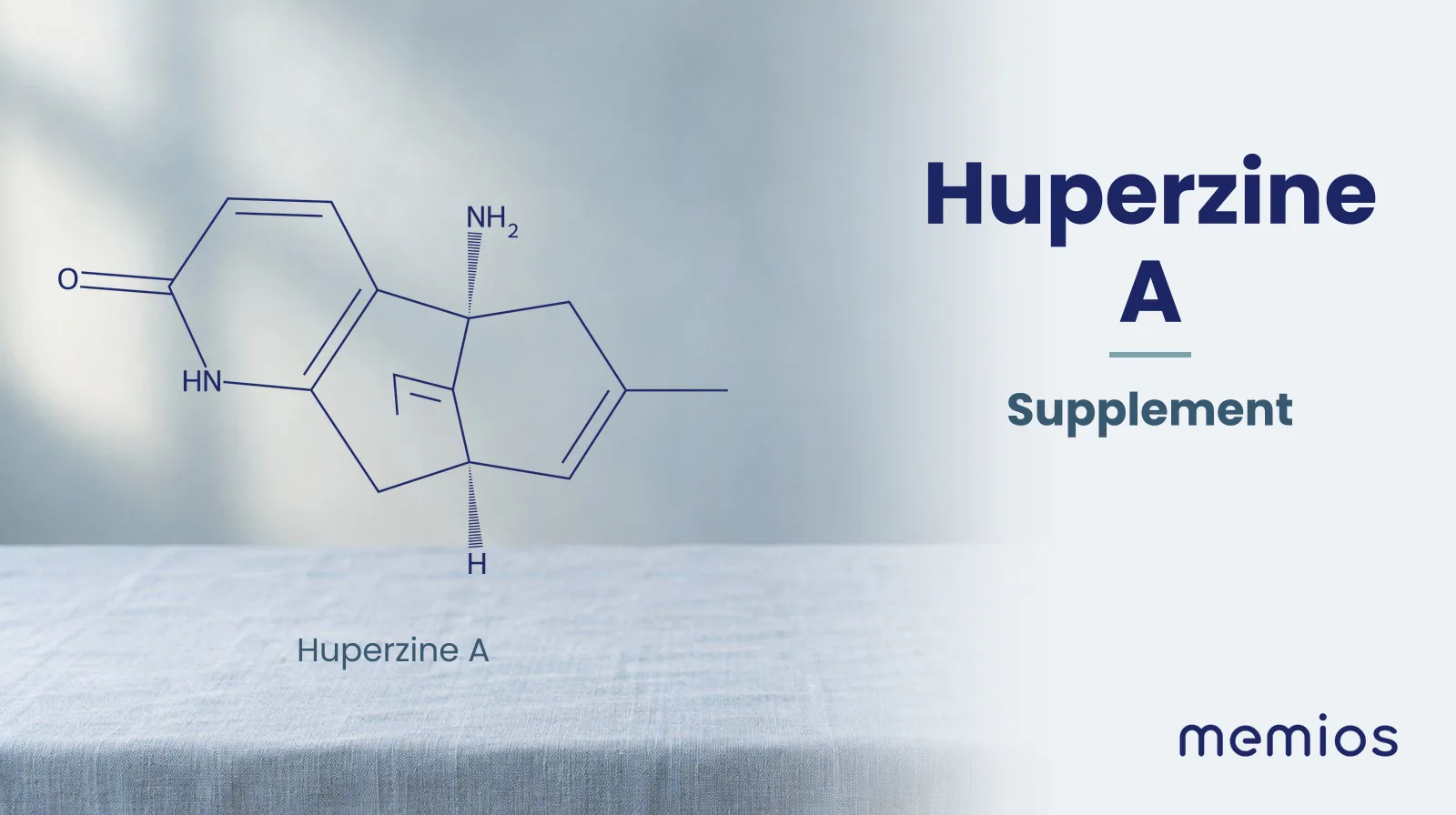
Huperzine A is a single purified alkaloid, not a whole herb: it is extracted from the clubmoss Huperzia serrata, long used in Chinese medicine. Chemically it is a reversible, selective inhibitor of acetylcholinesterase, the enzyme that breaks down the neurotransmitter acetylcholine. That places it in the same pharmacological class as prescription Alzheimer's drugs such as donepezil, even though in the United States it is sold on supplement shelves. Its legal status is not settled in the US, and it is an approved medicine in some other countries.
What the research says
The evidence is disputed rather than settled. Meta-analyses pooling mostly Chinese randomised trials report better MMSE scores in Alzheimer's disease against placebo, but the same reviews say most of those trials were at high risk of bias, and the one trial using the ADAS-Cog scale found no change. A US phase 2 trial in mild-to-moderate Alzheimer's disease missed its primary endpoint. There is no good evidence in healthy people, which is how most supplements containing it are marketed. Because it is a cholinesterase inhibitor, its side-effect profile is cholinergic (nausea, vomiting, slowed heart rate), and analyses of retail products have found the amount in the bottle often does not match the label.
Evidence grade: Disputed.
What goes wrong
Adverse events across the trial literature were cholinergic and common, with nausea reported in over a third of trials, and a third of trials reported no adverse event information at all. (Source 1)
- Systematic review, Low certainty.
- Size: 20 randomised controlled trials, 1,823 participants.
- Who: People with Alzheimer's disease.
- How long: 8 to 24 weeks.
- Result: Nausea in 7/20 trials (35%), anorexia 5/20 (25%), dizziness 4/20 (20%), vomiting 4/20 (20%), constipation 3/20 (15%), insomnia 3/20 (15%), bradycardia 2/20 (10%); 7/20 trials (35%) reported no adverse-event information.
- Funding: not stated.
The adverse events were mild and included nausea (7/20, 35%), anorexia (loss of appetite) (5/20, 25%), dizziness (4/20, 20%), vomiting (4/20, 20%), constipation (3/20, 15%), insomnia (3/20, 15%), excitability (2/20, 10%), thirst (2/20, 10%), sweating (2/20, 10%), bradycardia (2/20, 10%), abdominal pain (2/20, 10%), somnolence (1/20, 5%), hyperactivity (1/20, 5%), nasal obstruction (1/20, 5%), diarrhea (1/20, 5%), and edema (1/20, 5%).
Under-reporting of adverse events was itself a problem: seven of twenty trials gave no adverse-event information. (Source 1)
- Systematic review, Low certainty.
- Size: 20 trials.
- Who: People with Alzheimer's disease.
- How long: n/a.
- Result: 7/20 trials (35%) did not report adverse events; 1/20 (5%) reported none; 12/20 (60%) described them.
- Funding: not stated.
Of the 20 trials, 7 trials (35%) did not report information on adverse events, one trial (5%) reported no adverse events, and the remaining 12 trials (60%) described the adverse events in detail.
A laboratory analysis of retail brain-health supplements found the measured huperzine A content bore little relation to the label. (Source 2)
- Survey study, Moderate certainty.
- Size: 22 dietary supplement products claiming to contain huperzine A.
- Who: Retail dietary supplement products marketed for brain health (US)
- How long: n/a.
- Result: Huperzine A measured from below the limit of quantification up to 267.1 micrograms per serving; only two products were within 10% of the declared amount; 16 (73%) products had at least one labelled ingredient not detected, and 16 (73%) contained compounds not on the label.
- Funding: not stated.
Only two supplements showed huperzine A content within 10% of the declared amount.
Ingredients declared on the label were frequently absent, and undeclared compounds were frequently present, in products containing huperzine A. (Source 2)
- Survey study, Moderate certainty.
- Size: 22 products analysed.
- Who: Retail brain-health supplements.
- How long: n/a.
- Result: 16 of 22 (73%) products had at least one labelled ingredient not detected; compounds not reported on the label were detected in 16 (73%) products.
- Funding: not stated.
Compounds not reported on the label were detected in 16 (73%) products analyzed.
The Alzheimer's Association is reported as advising against taking huperzine A, particularly alongside prescription medicines. (Source 3)
- Official position, Certainty not rated.
- Size: n/a.
- Who: People with or at risk of Alzheimer's disease.
- How long: Position as reported on a page updated 18 January 2024.
- Result: Advice against use, on the grounds that combining it with prescription drugs could increase the risk of serious side effects.
- Funding: US Department of Defense / Uniformed Services University (page publisher)
Currently, the Alzheimer's Association recommends not taking huperzine A, especially with prescription drugs, because the combination could increase the risk of serious side effects.
Long-term safety data for huperzine A are lacking. (Source 3)
- Official position, Certainty not rated.
- Size: n/a.
- Who: General supplement users.
- How long: Position as published, page updated 18 January 2024.
- Result: No long-term safety dataset identified by the publisher.
- Funding: US Department of Defense / Uniformed Services University.
Overall, safety data is lacking and long-term use is not well understood.
What the evidence supports
A systematic review and meta-analysis of 20 randomised trials found huperzine A improved MMSE scores versus placebo in Alzheimer's disease at 8, 12 and 16 weeks. (Source 4)
- Meta-analysis, Low certainty.
- Size: 1,823 participants across 20 randomised controlled trials.
- Who: People with Alzheimer's disease; most trials conducted in China.
- How long: 8 to 24 weeks (benefit reported at 8, 12 and 16 weeks)
- Result: Statistically significant benefit on MMSE at 8, 12 and 16 weeks versus placebo; the review's abstract does not report a pooled mean difference with confidence interval for these timepoints. Doses ranged 0.2-0.8 mg/day.
- Funding: not stated.
Compared with placebo, Huperzine A showed a significant beneficial effect on the improvement of cognitive function as measured by Mini-Mental State Examination (MMSE) at 8 weeks, 12 weeks and 16 weeks
In healthy men, a single oral dose of huperzine A produced nanogram-per-millilitre plasma concentrations with a half-life of roughly 12 hours and no adverse events. (Source 5)
- Blood level study, Moderate certainty.
- Size: Healthy Chinese male volunteers (number not stated in the abstract we could read)
- Who: Healthy Chinese men.
- How long: Single dose, three-period six-sequence crossover, sampling to 72 hours.
- Result: Reference formulation Cmax 1.550 (SD 0.528) ng/mL; t1/2 12.092 (1.898) h; AUC0-72h 17.550 (3.794) ng*h/mL.
- Funding: not stated.
The mean (SD) pharmacokinetic parameters of the reference drug were Cmax, 1.550 (0.528) ng/mL; t1/2, 12.092 (1.898) h
What the evidence does not support
The only included trial that used the ADAS-Cog scale found no significant change in cognition or in daily living activities. (Source 4)
- Systematic review, Low certainty.
- Size: 1 trial within the 20-trial review.
- Who: People with Alzheimer's disease.
- How long: not stated in the review abstract.
- Result: No significant change on ADAS-Cog or ADCS-ADL in the huperzine A group.
- Funding: not stated.
One trial demonstrated no significant change in cognitive function as measured by Alzheimer's disease Assessment Scale-Cognitive Subscale (ADAS-Cog) and activity of daily living as measured by Alzheimer's disease Cooperative Study Activities of Daily Living Inventory (ADCS-ADL) in Huperzine A group.
A United States phase 2 randomised trial of huperzine A in mild-to-moderate Alzheimer's disease failed on its primary endpoint. (Source 6)
- Randomized trial, Moderate certainty.
- Size: Phase 2 trial (Rafii and colleagues, 2011); participant count not stated on the page we could reach.
- Who: US adults with mild to moderate Alzheimer's disease, 200 and 400 microgram twice-daily doses versus placebo.
- How long: 16 weeks.
- Result: Negative on the primary cognitive endpoint; only a non-significant trend at the higher dose in secondary analysis.
- Funding: not stated.
This trial was negative on its primary endpoint, but secondary analyses indicated a trend toward cognitive improvement on the higher dose
Where the evidence is mixed
The same review judged most of the trials behind that benefit to be at high risk of bias, and said its conclusions could not be firm. (Source 4)
- Systematic review, Very low certainty.
- Size: 20 randomised controlled trials.
- Who: People with Alzheimer's disease.
- How long: n/a.
- Result: Risk-of-bias assessment: most included trials at high risk of bias; heterogeneity of scales, durations and reporting left few or single trials per subgroup.
- Funding: not stated.
The methodological quality of most included trials had a high risk of bias.
The US Department of Defense's supplement safety programme states that it is unclear whether huperzine A can legally be sold as a dietary supplement in the United States, while it is an approved drug elsewhere. (Source 3)
- Official position, Certainty not rated.
- Size: n/a.
- Who: US consumers and service members.
- How long: Position as published, page updated 18 January 2024.
- Result: Regulatory status contested in the US; approved as a drug in some other countries.
- Funding: US Department of Defense / Uniformed Services University.
Although it is marketed in the U.S. as a dietary supplement ingredient, huperzine A is an approved drug in some other countries.
Where the research disagrees
Whether huperzine A improves cognition in Alzheimer's disease
- Yang and colleagues, PLOS ONE 2013 meta-analysis, meta-analysis of 20 RCTs, mostly conducted in China, judged at high risk of bias: Huperzine A appears to have beneficial effects on improvement of cognitive function, daily living activity, and global clinical assessment in participants with Alzheimer's disease. (Source 4)
- The same authors, on their own findings, risk-of-bias assessment within the same review: However, the findings should be interpreted with caution due to the poor methodological quality of the included trials. (Source 4)
- Alzforum's account of the US phase 2 trial (Rafii and colleagues, 2011), randomised, placebo-controlled phase 2 trial conducted in the United States: This trial was negative on its primary endpoint, but secondary analyses indicated a trend toward cognitive improvement on the higher dose (Source 6)
How much
- Reference intake: No reference intake (RDA or AI) exists for huperzine A anywhere, because it is not a nutrient: it is a plant alkaloid with drug-like activity that is regulated as a medicine in some countries and sold as a supplement ingredient in the US. (Source 3)
- Upper limit: No tolerable upper intake level or acceptable daily intake has been set by any body we could find; the US Department of Defense supplement safety programme states that safety data are lacking and long-term use is not well understood. (Source 3)
- Studied: Across 20 randomised trials in Alzheimer's disease the dose ranged from 0.2 mg to 0.8 mg per day, averaging about 0.37 mg (370 micrograms) per day. (Source 1)
- Studied: The US phase 2 trial tested 200 and 400 micrograms twice daily against placebo over 16 weeks and was negative on its primary endpoint. (Source 6)
A common belief, and what the research shows
The belief: Huperzine A is a gentle natural memory booster, safer than Alzheimer's drugs because it comes from a moss.
What the research shows: It is a purified alkaloid that works the same way prescription Alzheimer's drugs do - the review describing it calls it 'a potent, reversible, selective inhibitor of acetylcholinesterase (AChE)' - and its side effects are the cholinergic ones you would expect, with nausea reported in 35% of trials and bradycardia in 10%. It is also not reliably present in the amounts labelled: in an analysis of retail products, 'Only two supplements showed huperzine A content within 10% of the declared amount.'
Questions and answers
What is it?
Huperzine A is a single purified alkaloid extracted from the clubmoss Huperzia serrata, also called Chinese club moss. It is not a whole-herb extract but one isolated chemical. In the United States it is sold as a dietary supplement ingredient, while in some other countries it is an approved medicine. (Source 3)
What does it do in the body?
Huperzine A blocks acetylcholinesterase, the enzyme that breaks down the neurotransmitter acetylcholine, so more acetylcholine remains available at nerve endings. This is the same mechanism used by prescription Alzheimer's drugs such as donepezil. Whether that translates into a meaningful cognitive effect in people is where the evidence is contested. (Source 1)
Is it good or bad for you?
It depends heavily on which evidence you look at and on who is taking it. Pooled Chinese trials in Alzheimer's disease show MMSE benefit, but the reviewers themselves say the trials were poor quality, and the US phase 2 trial was negative. There is no good evidence for healthy people, and the cholinergic side effects and interaction potential with prescription drugs are real. (Source 4)
How do you get more of it?
There is no dietary route: intake comes only from extracts of Huperzia serrata, sold as capsules or as one ingredient among many in nootropic blends. In the Alzheimer's trial literature the doses given ranged from 0.2 to 0.8 mg per day. This is a description of what trials used, not a suggestion to take any amount. (Source 1)
If it is harmful, what reduces it?
Huperzine A is not made by the body and does not accumulate in the way a mineral does; the only source is what is swallowed. In healthy male volunteers a single oral dose had a half-life of about 12 hours, so blood levels fall over roughly a day once dosing stops. Anyone experiencing cholinergic effects would be discussing that with a clinician, particularly if they take other medicines. (Source 5)
Why might someone be low in it or missing it?
Nobody is deficient in huperzine A. It is not an essential nutrient and the body has no requirement for it; a person has none in their system unless they have taken a product containing it. The relevant question is regulatory rather than nutritional: in the US it is unclear whether it may legally be sold as a supplement at all. (Source 3)
Which whole foods contain it or feed it?
No ordinary food contains huperzine A. It occurs in the clubmoss Huperzia serrata, which is not a food plant, and reaches people only through extracts sold as supplements. In the United States it is available commercially as a food supplement but has not been approved as a treatment. (Source 6)
What happens if you do not have it?
Nothing is known to happen, because there is no deficiency state to be in. The meaningful question is the reverse one - whether taking it adds anything - and the best-conducted Western trial in Alzheimer's disease did not show a benefit on its main measure. (Source 6)
How can you test for it?
There is no validated clinical test of a person's huperzine A status, because there is no status to have. Huperzine A can be measured in blood by laboratory assay in pharmacokinetic studies, and it can be measured in products, where analyses have shown the content often does not match the label. Neither is a health test for an individual. (Source 2)
We searched: Searched PubMed, PLOS ONE, Frontiers, Springer and the US Department of Defense OPSS pages for huperzine A assays, biomarkers, blood tests and monitoring; found only pharmacokinetic plasma assays in volunteers and quantitative product analyses, no clinical test.
References
- PLOS ONE. Huperzine A for Alzheimer's Disease: A Systematic Review and Meta-Analysis of Randomized Clinical Trials (introduction, results and discussion text). 2013. PMID 24086396, DOI 10.1371/journal.pone.0074916. Read the source
- Clinical Toxicology (Philadelphia, Pa.). The scoop on brain health dietary supplement products containing huperzine A. 2020. PMID 31990212, DOI 10.1080/15563650.2020.1713337. Read the source
- Operation Supplement Safety (OPSS), Consortium for Health and Military Performance, Uniformed Services University; page updated 18 January 2024. Huperzine A: Dietary Supplements for Brain Health. 2024. Read the source
- PLOS ONE. Huperzine A for Alzheimer's Disease: A Systematic Review and Meta-Analysis of Randomized Clinical Trials (abstract). 2013. PMID 24086396, DOI 10.1371/journal.pone.0074916. Read the source
- Current Medical Science. Pharmacokinetics and tolerability of oral dosage forms of huperzine A in healthy Chinese male volunteers: a randomized, single dose, three-period, six-sequence crossover study. 2017. DOI 10.1007/s11596-017-1807-8. Read the source
- Alzforum; page last updated 30 October 2012. Huperzine A (Therapeutics database entry). 2012. Read the source