Supplements · October 3, 2026 · Memios · 16 min read
Guggul
Disputed. The state of the evidence: it is genuinely split.
TLDR
- Disputed. The state of the evidence: it is genuinely split.
- What it is: Guggul is the oleo-gum resin of a small tree used for thousands of years in Ayurveda, where extracts are given alone or combined with other botanicals.
- Main use, supported: A meta-analysis of seven placebo-controlled trials reported that guggulu lowered total cholesterol and LDL cholesterol, with the reviewers rating the overall evidence moderate to high. (moderate certainty)
- Other use, supported: In rats with chemically induced knee osteoarthritis, oral guggul resin prevented cartilage damage in a dose-dependent way. (very low certainty)
- Claim NOT supported by research: In a double-blind placebo-controlled trial in US adults, guggulipid raised LDL cholesterol rather than lowering it. (moderate certainty)
- Another claim NOT supported: The trial's authors concluded guggulipid did not improve serum cholesterol and might in fact raise LDL. (moderate certainty)
- Recommended dose: not established. No body has set a reference intake for guggul, because it is a plant resin rather than an essential nutrient. The evidence base is described by a cancer-centre monograph as limited, with additional research needed to determine safety and efficacy.
- Studied dose (a trial dose, not a recommendation): The JAMA trial gave standardised guggulipid containing 2.5% guggulsterones as 1000 mg or 2000 mg three times daily, or matching placebo, for 8 weeks. No finding here cites that trial.
- Upper limit: No tolerable upper intake level or acceptable daily intake has been set for guggul.
- What goes wrong: 4 findings on harm. Guggulipid caused a hypersensitivity rash in 9% of treated participants, with a suggestion of dose dependence.
- Common myth: Guggul is a proven natural alternative to cholesterol medication.
What it is
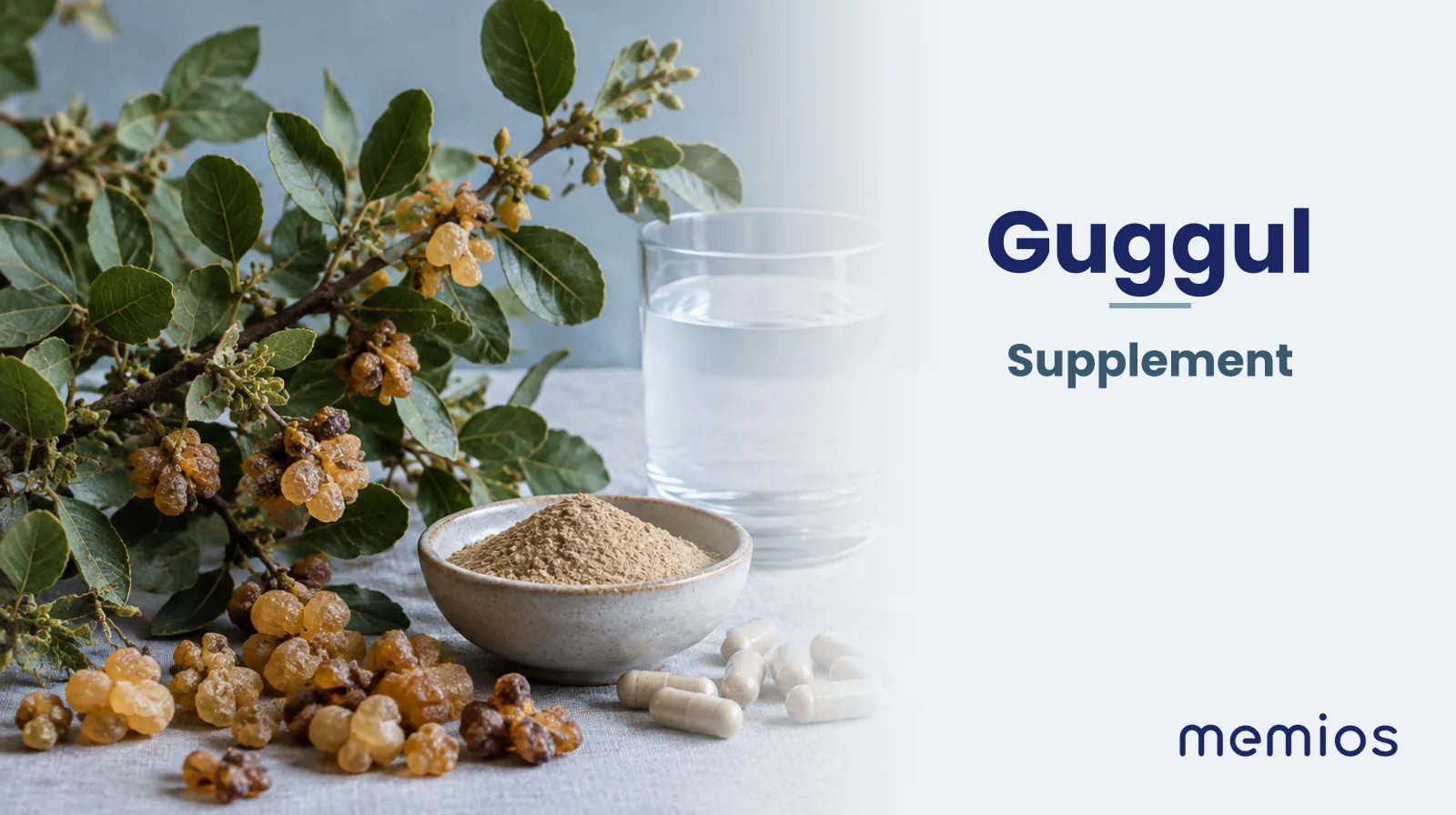
Guggul is the oleo-gum resin of a small tree used for thousands of years in Ayurveda, where extracts are given alone or combined with other botanicals. The compounds held to be active are the guggulsterones, which act as antagonists of nuclear hormone receptors involved in cholesterol metabolism. Products differ a great deal: some trials used purified crude gum guggulu prepared according to Ayurvedic texts, others a solvent extract called guggulipid, standardised in the largest Western trial to 2.5% guggulsterones.
What the research says
The state of the evidence: it is genuinely split. A 2021 systematic review and meta-analysis of Ayurvedic herbs for high cholesterol pooled seven placebo-controlled trials of guggulu in 380 participants and reported total cholesterol down 16.78 mg/dL and LDL down 18.78 mg/dL, calling the evidence moderate to high, while also documenting poor reporting of randomisation and blinding in most included trials. The best-conducted Western trial found the opposite: guggulipid raised LDL cholesterol by 4 to 5% against a 5% fall on placebo, and caused a hypersensitivity rash in 9% of those treated. Guggul cut the blood levels of propranolol and diltiazem in a crossover study, and one in five Ayurvedic products bought online in a JAMA survey contained detectable lead, mercury or arsenic.
Evidence grade: Disputed.
What goes wrong
Guggulipid caused a hypersensitivity rash in 9% of treated participants, with a suggestion of dose dependence. (Source 1)
- Randomized trial, Moderate certainty.
- Size: 6 of 67 guggulipid-treated participants; 0 of 36 on placebo.
- Who: adults with hypercholesterolaemia.
- How long: rash appeared within 48 hours of starting.
- Result: 5 of 34 (15%) on high dose, 1 of 33 (3%) on standard dose, none on placebo (P=.02), overall incidence 9%; 5 of 6 dropped out and 1 needed oral steroids; all resolved within a week of stopping.
- Funding: NIH grants plus additional support and product from Sabinsa Corp.
In all 6 participants the rash occurred within 48 hours of starting guggulipid and was associated with itching, and in 5 of the 6 cases, led to dropout from the study.
A single 1 g dose of gugulipid significantly reduced peak plasma concentration and exposure to propranolol and diltiazem in healthy volunteers. (Source 2)
- Blood level study, Very low certainty.
- Size: 10 volunteers for propranolol, 7 for diltiazem.
- Who: normal healthy male volunteers.
- How long: single dose, blood sampled hourly to 8 hours.
- Result: significant reduction (P < .01) in Cmax and AUC 0-8 h for both drugs; no numeric magnitudes given in the record.
- Funding: not stated.
Gugulipid significantly reduced (P < .01) peak plasma concentration (Cmax) and area under curve (AUC 0-8 hrs) of both the drugs in normal volunteers.
A cancer-centre herb monograph lists reported adverse reactions to guggul and case reports of contact dermatitis, severe hypertransaminasemia and acute hepatic failure in products containing guggul alongside other ingredients. (Source 3)
- Expert review, not systematic, Very low certainty.
- Size: individual case reports.
- Who: adults taking guggul-containing products, including multi-ingredient supplements.
- How long: one case after 6 months of use.
- Result: no rates; reported effects include headache, mild nausea, eructation, hiccups, loose stools and hypersensitivity rash; liver injury cases involved co-ingredients (red yeast rice extract in one, usnic acid and green tea in another), so causal attribution to guggul is not established.
- Funding: not applicable.
Severe hypertransaminasemia: In a 63-year old woman after using an over-the-counter lipid-lowering product for 6 months that contained guggulsterol and red yeast rice extract. Symptoms resolved after product discontinuation.
One fifth of Ayurvedic medicines bought over the internet contained detectable lead, mercury or arsenic, and every metal-containing product exceeded at least one acceptable daily intake standard. (Source 4)
- Survey study, Moderate certainty.
- Size: 193 of 230 randomly selected products received and analysed, from 25 websites.
- Who: Ayurvedic medicines for oral use manufactured in the US and India, purchased August-October 2005.
- How long: single-timepoint product survey.
- Result: 20.7% of products contained detectable metals (95% CI 15.2%-27.1%); rasa shastra products 40.6% versus 17.1% (P = .007), with median lead 11.5 microg/g versus 7.0 and mercury 20,800 microg/g versus 34.5; 75% of metal-containing products claimed Good Manufacturing Practices.
- Funding: not stated in the abstract.
All metal-containing products exceeded 1 or more standards for acceptable daily intake of toxic metals.
What the evidence supports
A meta-analysis of seven placebo-controlled trials reported that guggulu lowered total cholesterol and LDL cholesterol, with the reviewers rating the overall evidence moderate to high. (Source 5)
- Meta-analysis, Moderate certainty.
- Size: 32 studies and 1,386 participants overall; 7 randomised trials in 8 arms and 380 participants for the guggulu comparison.
- Who: adults with hypercholesterolaemia.
- How long: average intervention 12 weeks; minimum exposure 3 weeks.
- Result: the published abstract prints total cholesterol 16.78 mg/dL lower (95% C.I. 13.96 to 2.61; p = 0.02) and LDL 18.78 mg/dL lower (95% C.I. 34.07 to 3.48; p = 0.02); the paper's own results table gives total cholesterol -16.78 mg/dL (95% CI -30.96 to -2.61) from 8 trial arms and 380 participants, and LDL -18.78 mg/dL (95% CI -34.07 to -3.48) from 5 arms and 266 participants; heterogeneity among the guggulu studies was 75%.
- Funding: not stated.
Limit of this finding: The confidence intervals in this quotation are printed wrongly in the paper's own abstract, and the quote reproduces them faithfully rather than silently repairing them. For total cholesterol the abstract prints "95% C.I. 13.96 to 2.61" around a 16.78 mg/dL reduction, which cannot be right: the reported effect sits outside its own interval and the minus signs are missing. The same paper's results table gives -16.78 mg/dL (95% CI -30.96 to -2.61) for total cholesterol and -18.78 mg/dL (95% CI -34.07 to -3.48) for LDL, and its discussion prints the total-cholesterol interval two different ways again. What a reader can take from this is the rough direction and size - cholesterol somewhat lower on guggulu than placebo in these trials - and not the precision: the intervals as published are unusable, the authors' own numbers disagree with each other, and heterogeneity between the guggulu trials was 75%.
Meta-analysis of the trials showed that guggulu reduced total cholesterol and low-density lipoprotein levels by 16.78 mg/dL (95% C.I. 13.96 to 2.61; p-value = 0.02) and 18.78 mg/dL (95% C.I. 34.07 to 3.48; p = 0.02), respectively.
In rats with chemically induced knee osteoarthritis, oral guggul resin prevented cartilage damage in a dose-dependent way. (Source 6)
- Animal study, Very low certainty.
- Size: not stated in the abstract.
- Who: rats given a single intra-articular injection of monoiodoacetate (1 mg)
- How long: histopathology assessed after two weeks.
- Result: chondrocyte damage significantly prevented and proteoglycan less affected, especially at the high guggul dose, with no synovial cell proliferation or inflammatory cells detected; no numeric effect sizes reported in the abstract.
- Funding: not stated.
Administration of guggul prevented the negative effects of iodoacetate, dose dependently. Chondrocyte damages were significantly prevented and proteoglycane were less affected, especially in high guggul dose and no cell proliferation and inflammatory cell were detected in synovial.
What the evidence does not support
In a double-blind placebo-controlled trial in US adults, guggulipid raised LDL cholesterol rather than lowering it. (Source 7)
- Randomized trial, Moderate certainty.
- Size: 103 participants randomised (placebo 36, standard dose 33, high dose 34)
- Who: ambulatory community-dwelling healthy adults with hypercholesterolaemia in the Philadelphia area, eating a typical Western diet.
- How long: 8 weeks.
- Result: LDL fell 5% on placebo but rose 4% on standard-dose guggulipid (P=.01) and 5% on high dose (P=.006), a net positive change of 9% to 10%; no significant change in total cholesterol, HDL, triglycerides or VLDL.
- Funding: NIH grants K-23 AT-00058 and M01-RR00040, with additional financial support from Sabinsa Corp, which also donated the guggulipid and placebo capsules.
Compared with participants randomized to placebo (n=36), in whom levels of LDL-C decreased by 5%, both standard-dose guggulipid (n=33) and high-dose guggulipid (n=34) raised levels of LDL-C by 4% (P=.01 vs placebo) and 5% (P=.006 vs placebo), respectively, at 8 weeks, for a net positive change of 9% to 10%.
The trial's authors concluded guggulipid did not improve serum cholesterol and might in fact raise LDL. (Source 8)
- Randomized trial, Moderate certainty.
- Size: 103 participants.
- Who: adults with hypercholesterolaemia.
- How long: 8 weeks.
- Result: no improvement in serum cholesterol; possible increase in LDL.
- Funding: NIH grants plus additional support and product from Sabinsa Corp.
Despite plausible mechanisms of action, guggulipid did not appear to improve levels of serum cholesterol over the short term in this population of adults with hypercholesterolemia, and might in fact raise levels of LDL-C.
Where the evidence is mixed
The same review reported that most of its included trials failed to describe randomisation and allocation concealment and that fifteen were prone to attrition bias, although both participants and investigators were blinded in 22 of the studies. (Source 9)
- Meta-analysis, Low certainty.
- Size: 32 studies, 1,386 participants.
- Who: adults with hypercholesterolaemia.
- How long: average 12 weeks.
- Result: only 6 of 32 studies explained random sequence generation; 2 had high risk of bias in blinding and 7 did not specify their blinding status, while both participants and investigators were blinded in 22 studies; 15 did not include dropouts in the final analysis.
- Funding: not stated.
Although the majority of the studies were randomized and double-blind, they failed to provide details of random sequence generation and allocation concealment.
A cancer-centre monograph summarises the human evidence for guggul as limited and inconsistent, including trials showing uncertain benefit or a rise in cholesterol, and no benefit when combined with Triphala. (Source 10)
- Expert review, not systematic, Very low certainty.
- Size: not stated.
- Who: adults, and preclinical models for the mechanism claims.
- How long: not stated.
- Result: no pooled estimate; the monograph states additional research is needed to determine safety and efficacy.
- Funding: not applicable.
Studies in humans are limited, but suggest guggul may be effective for hypercholesterolemia. However, other trials indicate uncertain benefit or that guggul may actually raise cholesterol levels.
Where the research disagrees
whether guggul lowers cholesterol at all
- Gyawali and colleagues, 2021 systematic review and meta-analysis in Medicina, meta-analysis: There is moderate to high level of evidence from randomized controlled trials that the Ayurvedic herbs guggulu, garlic, and black cumin are moderately effective for reducing hypercholesterolemia. (Source 5)
- Szapary and colleagues, 2003 randomised controlled trial in JAMA, rct: Despite plausible mechanisms of action, guggulipid did not appear to improve levels of serum cholesterol over the short term in this population of adults with hypercholesterolemia, and might in fact raise levels of LDL-C. (Source 8)
- Gyawali and colleagues, on why the two disagree, meta-analysis: The study by Szapary et al., which showed negative effects of guggulu, did not mention if the product was purified as per the Ayurvedic protocol or not. Additionally, the study included an extracted version of guggulu prepared by a commercial manufacturer. (Source 11)
How much
- Reference intake: No body has set a reference intake for guggul, because it is a plant resin rather than an essential nutrient. The evidence base is described by a cancer-centre monograph as limited, with additional research needed to determine safety and efficacy. (Source 10)
- Upper limit: No tolerable upper intake level or acceptable daily intake has been set for guggul. When the largest Western trial was run, its authors recorded that no safety or efficacy data for guggul extracts in Western populations had been published; that trial then found a 9% incidence of hypersensitivity rash. (Source 12)
- Studied: The JAMA trial gave standardised guggulipid containing 2.5% guggulsterones as 1000 mg or 2000 mg three times daily, or matching placebo, for 8 weeks. (Source 13)
- Studied: The 2021 meta-analysis pooled trials with an average intervention of 12 weeks and a minimum exposure of 3 weeks, using preparations ranging from purified crude gum guggulu to the guggulipid extract. (Source 11)
A common belief, and what the research shows
The belief: Guggul is a proven natural alternative to cholesterol medication.
What the research shows: The one trial conducted in a Western population on a typical Western diet found the reverse direction of effect: "Compared with participants randomized to placebo (n=36), in whom levels of LDL-C decreased by 5%, both standard-dose guggulipid (n=33) and high-dose guggulipid (n=34) raised levels of LDL-C by 4% (P=.01 vs placebo) and 5% (P=.006 vs placebo), respectively, at 8 weeks, for a net positive change of 9% to 10%." A meta-analysis of mostly Indian trials does report reductions, but its own risk-of-bias assessment notes that "Although the majority of the studies were randomized and double-blind, they failed to provide details of random sequence generation and allocation concealment."
Questions and answers
What is it?
Guggul is the resin of a small tree, Commiphora mukul, long used in Ayurvedic medicine. The resin is given as a crude purified gum or as a solvent extract known as guggulipid, and the compounds thought to be active are the guggulsterones. It is a botanical preparation, not a nutrient, and products differ widely in how they are made. (Source 10)
What does it do in the body?
The mechanism that made guggul interesting is receptor-level: guggulsterones act as potent antagonists of two nuclear hormone receptors involved in cholesterol metabolism, which gave a plausible route to lowering lipids. Laboratory work points to inhibition of FXR, a bile-acid-activated receptor, and guggulsterone also activates pregnane X receptor and may induce CYP3A genes, which is the basis of the drug interaction concern. Plausible mechanism did not translate into benefit in the one Western trial. (Source 12)
Is it good or bad for you?
Unresolved, and the two bodies of evidence point in opposite directions. Pooled mostly-Indian trials report total cholesterol and LDL falling by roughly 17 and 19 mg/dL, but with weak reporting of trial methods. The one double-blind trial in US adults found LDL rose by 4 to 5% on guggulipid while falling 5% on placebo, and 9% of treated participants developed a hypersensitivity rash. Guggul also reduced blood levels of two cardiovascular drugs. (Source 8)
How do you get more of it?
Only through the supplement itself: guggul is a tree resin and does not occur in the diet. Trials have used either purified crude gum guggulu prepared as Ayurvedic texts direct, or the solvent extract guggulipid. The JAMA trial gave guggulipid standardised to 2.5% guggulsterones at 1000 mg or 2000 mg three times a day for eight weeks. That is what was studied, not a recommendation. (Source 13)
If it is harmful, what reduces it?
The reported adverse effects reversed on stopping the product. In the JAMA trial all six hypersensitivity rashes resolved within a week of discontinuing guggulipid, although one participant needed oral steroids. In a case of severe liver enzyme elevation on a guggul-containing lipid product, symptoms resolved after the product was discontinued. Stopping the supplement is the only intervention the literature describes. (Source 3)
Why might someone be low in it or missing it?
Does not apply. Guggul is not an essential nutrient and there is no such thing as being low in it or deficient in it; nobody requires it. It is a traditional Ayurvedic plant preparation given for a list of conditions, and absence of it is simply the normal state. (Source 10)
Which whole foods contain it or feed it?
None. Guggul is a tree oleo-gum resin, not a food component, and no whole food contains it or feeds it. The only forms in the literature are preparations of the resin itself, and these differ substantially between studies, which is part of why trial results conflict. (Source 11)
What happens if you do not have it?
Nothing happens, because there is no deficiency state for guggul. The relevant question is the reverse one, whether taking it does anything, and on that the literature is thin and conflicting: when the JAMA trial was designed its authors noted that no safety or efficacy data existed for guggul extracts in Western populations at all. (Source 12)
How can you test for it?
There is no test for guggul status, and none would be meaningful since it is not a nutrient. What can be measured are the outcomes trials used, principally serum lipids, and the contaminants product surveys found, principally lead, mercury and arsenic by x-ray fluorescence spectroscopy. No validated clinical assay for guggul or guggulsterone exposure appears in the sources we searched. (Source 10)
We searched: the JAMA 2003 randomised trial, the 2021 Medicina systematic review and meta-analysis, the Memorial Sloan Kettering herb monograph, and the JAMA 2008 Ayurvedic metals survey; none describes a test of guggul status in a person.
References
- JAMA. Guggulipid for the treatment of hypercholesterolemia: a randomized controlled trial (adverse events in Results). 2003. PMID 12915429, DOI 10.1001/jama.290.6.765. Read the source
- Journal of the Association of Physicians of India (J Assoc Physicians India 1994;42(6):454-5). Effect of gugulipid on bioavailability of diltiazem and propranolol. 1994. PMID 7852226. Read the source
- Memorial Sloan Kettering Cancer Center. Guggul (About Herbs, Botanicals and Other Products) - Adverse Reactions and Case Reports. undated web page, accessed 2026-09-30. Read the source
- JAMA. Lead, mercury, and arsenic in US- and Indian-manufactured Ayurvedic medicines sold via the Internet (Results). 2008. PMID 18728265, DOI 10.1001/jama.300.8.915. Read the source
- Medicina. A Systematic Review and Meta-Analysis of Ayurvedic Herbal Preparations for Hypercholesterolemia (Results and Conclusion). 2021. PMID 34071454, DOI 10.3390/medicina57060546. Read the source
- Pakistan Journal of Medical Sciences. Influence of commiphora mukul resin on the knee articular cartilage of rats in experimental osteoarthritis induced by iodoacetate. 2009. Read the source
- JAMA. Guggulipid for the treatment of hypercholesterolemia: a randomized controlled trial (Results). 2003. PMID 12915429, DOI 10.1001/jama.290.6.765. Read the source
- JAMA. Guggulipid for the treatment of hypercholesterolemia: a randomized controlled trial (Conclusions). 2003. PMID 12915429, DOI 10.1001/jama.290.6.765. Read the source
- Medicina. A Systematic Review and Meta-Analysis of Ayurvedic Herbal Preparations for Hypercholesterolemia (risk of bias). 2021. PMID 34071454, DOI 10.3390/medicina57060546. Read the source
- Memorial Sloan Kettering Cancer Center. Guggul (About Herbs, Botanicals and Other Products) - Clinical Summary. undated web page, accessed 2026-09-30. Read the source
- Medicina. A Systematic Review and Meta-Analysis of Ayurvedic Herbal Preparations for Hypercholesterolemia (discussion of preparation differences). 2021. PMID 34071454, DOI 10.3390/medicina57060546. Read the source
- JAMA. Guggulipid for the treatment of hypercholesterolemia: a randomized controlled trial (Context). 2003. PMID 12915429, DOI 10.1001/jama.290.6.765. Read the source
- JAMA. Guggulipid for the treatment of hypercholesterolemia: a randomized controlled trial (Objective, Design, Participants and Setting, Intervention, Main Outcome Measures). 2003. PMID 12915429, DOI 10.1001/jama.290.6.765. Read the source