Supplements · September 29, 2026 · Memios · 14 min read
Glutathione
Glutathione's role inside cells is not in doubt; what is disputed is whether swallowing it changes anything.
TLDR
- Disputed. Glutathione's role inside cells is not in doubt; what is disputed is whether swallowing it changes anything.
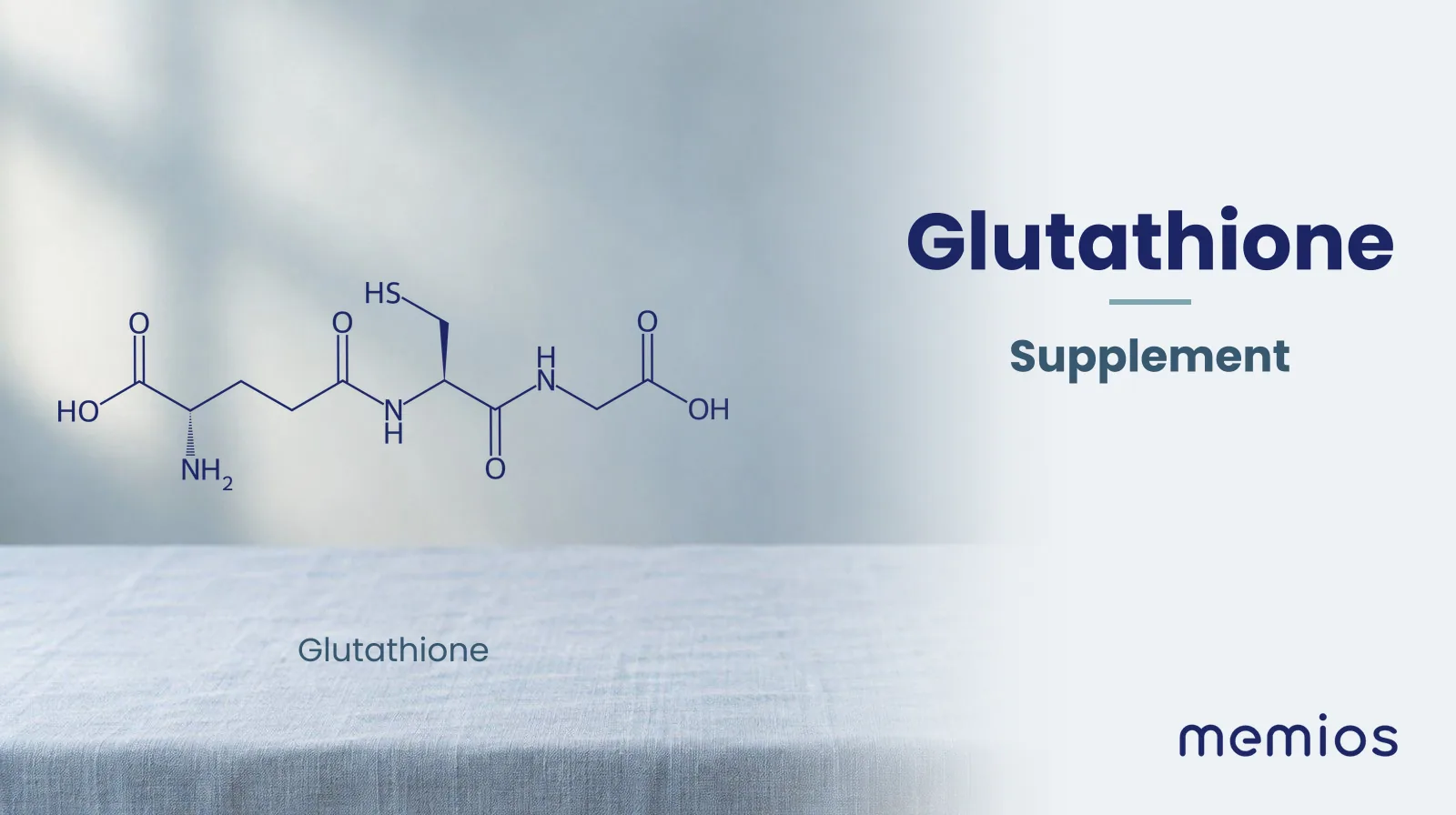
- What it is: Glutathione is a tripeptide built from three amino acids, described in review as glutamine, cysteine and glycine.
- Main use, supported: A six-month randomised placebo-controlled trial reported that oral glutathione raised glutathione levels in several body compartments, but that levels returned to baseline after a one-month washout. (low certainty)
- Other use, supported: A small two-phase pilot study in 14 healthy adults found a micellar glutathione formulation produced higher short-term blood glutathione exposure than a standard preparation, at unequal doses of 300 mg versus 500 mg. (very low certainty)
- Claim NOT supported by research: A systematic review and meta-analysis of randomised trials found glutathione supplementation did not significantly raise erythrocyte or plasma glutathione, though the authors add that higher doses and longer durations might. (low certainty)
- Another claim NOT supported: A narrative review of oral glutathione concludes that dosing, long-term benefit and side effects remain undetermined. (very low certainty)
- Recommended dose: not established. No reference intake exists for glutathione. It is synthesised in the body, mainly by the liver, from glutamine, cysteine and glycine, and is not classed as an essential nutrient.
- Studied dose (a trial dose, not a recommendation): A six-month randomised trial gave 250 or 1,000 mg/day of oral glutathione to 54 non-smoking adults. Findings citing that trial: 1 for.
- Upper limit: No tolerable upper intake level has been set by any nutrition body that we could reach.
- What goes wrong: 4 findings on harm. Measured glutathione values in published work are frequently distorted by sample-handling artefacts, which undermines tests that claim to report glutathione status.
- Common myth: Taking glutathione capsules or drips floods the body with the master antioxidant.
What it is
Glutathione is a tripeptide built from three amino acids, described in review as glutamine, cysteine and glycine. It is made mainly in the liver and is the body's principal intracellular antioxidant and a central part of its detoxification chemistry. It is present in food, particularly in green vegetables such as asparagus, avocado, cucumber, green beans and spinach. As a supplement it is sold orally in standard, liposomal and micellar forms, and, outside regulatory approval in many countries, injected for skin lightening.
What the research says
Glutathione's role inside cells is not in doubt; what is disputed is whether swallowing it changes anything. A 2024 systematic review and meta-analysis of randomised trials found no statistically significant increase in erythrocyte or plasma glutathione with supplementation. A six-month randomised trial at 250 and 1,000 mg/day did report increases in body stores, and a 2026 crossover pharmacokinetic trial found a micellar formulation raised blood glutathione more than a standard one. Skin trials report reductions in pigment measures that are mostly described as tendencies. The clearest harms come from injected glutathione, which regulators warn against and which has been linked to severe reactions.
Evidence grade: Disputed.
What goes wrong
A case report describes systemic inflammatory response syndrome with shock and hyperpyrexia within an hour of a high-dose unregulated intravenous glutathione infusion given for skin lightening. (Source 1)
- Case report, Very low certainty.
- Size: 1 patient.
- Who: a previously healthy woman on tirzepatide with prolonged low nutritional intake.
- How long: collapse within one hour of the infusion.
- Result: shock and hyperpyrexia above 41 degrees Celsius requiring emergency care.
- Funding: not stated.
A previously healthy woman presented with shock, hyperpyrexia (>41°C), and collapsed within an hour of receiving the infusion for skin lightening.
The Philippine FDA warns that injectable glutathione used for skin lightening carries liver, kidney and nervous system toxicity and a risk of Stevens-Johnson Syndrome. (Source 2)
- Official position, Certainty not rated.
- Size: not applicable.
- Who: consumers of injectable skin-lightening products.
- How long: FDA Advisory No. 2019-182.
- Result: listed risks include organ toxicity, Stevens-Johnson Syndrome, theoretical long-term skin cancer concern and transmission of HIV and hepatitis B and C.
- Funding: Philippine government regulator.
Side effects on the use of injectable glutathione for skin lightening include toxic effects on the liver, kidneys, and nervous system.
The same advisory warns that unregulated injection carries a risk of transmitting bloodborne infections, a contamination-type harm distinct from the molecule itself. (Source 2)
- Official position, Certainty not rated.
- Size: not applicable.
- Who: people receiving injectable glutathione and paired vitamin C infusions.
- How long: FDA Advisory No. 2019-182.
- Result: transmission of infectious agents including HIV and hepatitis C and B.
- Funding: Philippine government regulator.
Other potential risks include transmission of infectious agents, such as HIV, hepatitis C and B.
Measured glutathione values in published work are frequently distorted by sample-handling artefacts, which undermines tests that claim to report glutathione status. (Source 3)
- Expert review, not systematic, Low certainty.
- Size: not applicable.
- Who: laboratory measurement of glutathione in blood and tissue.
- How long: not applicable.
- Result: measured values can be one to two orders of magnitude higher than actual, mainly in blood, because of oxidation during acid precipitation of proteins.
- Funding: not stated.
Hundreds of papers report GSSG concentrations much higher than 1% of GSH, likely due to artifacts in sample manipulation (i.e., oxidation).
What the evidence supports
A six-month randomised placebo-controlled trial reported that oral glutathione raised glutathione levels in several body compartments, but that levels returned to baseline after a one-month washout. (Source 4)
- Randomized trial, Low certainty.
- Size: 54 non-smoking adults.
- Who: healthy non-smoking adults.
- How long: 6 months, with a 1-month washout.
- Result: at 6 months, 30-35 % higher in erythrocytes, plasma and lymphocytes and 260 % in buccal cells on 1,000 mg/day (P < 0.05); 17 % in blood and 29 % in erythrocytes on 250 mg/day (P < 0.05); levels returned to baseline after a 1-month washout.
- Funding: industry-supported; the glutathione and placebo were supplied by a commercial glutathione manufacturer.
GSH levels in blood increased after 1, 3 and 6 months versus baseline at both doses. At 6 months, mean GSH levels increased 30–35 % in erythrocytes, plasma and lymphocytes and 260 % in buccal cells in the high-dose group (P < 0.05). GSH levels increased 17 and 29 % in blood and erythrocytes, respectively, in the low-dose group (P < 0.05). In most cases, the increases were dose and time dependent, and levels returned to baseline after a 1-month washout period.
A small two-phase pilot study in 14 healthy adults found a micellar glutathione formulation produced higher short-term blood glutathione exposure than a standard preparation, at unequal doses of 300 mg versus 500 mg. (Source 5)
- Blood level study, Very low certainty.
- Size: 14 healthy adults; phase 1 randomised double-blind crossover, phase 2 single-arm.
- Who: healthy adults, crossover then a 30-day single-arm follow-up.
- How long: single doses with 24-hour sampling.
- Result: iAUC0-24 1287.5 vs 517.8 µg·mL·h, p = 0.0064; peak response 103.9 vs 42.8 µg/mL, p = 0.0003; about 2.49-fold and 2.43-fold higher at the administered, unequal doses.
- Funding: industry; the study evaluates a named commercial formulation and was registered as NCT06345950.
Limit of this finding: The two products were not compared at the same dose: the micellar product was given at 300 mg and the standard one at 500 mg, so the fold-differences are not a like-for-like comparison. This was a pilot study in 14 people measuring blood levels only, not health outcomes, and it tested a named commercial formulation.
Compared with STD (500 mg), LMG (300 mg) produced significantly higher baseline-adjusted systemic GSH exposure and peak response (iAUC0–24: 1287.5 ± 179.0 vs. 517.8 ± 180.0 µg·mL·h; p = 0.0064; ΔCmax: 103.9 ± 11.8 vs. 42.8 ± 11.5 µg/mL; p = 0.0003), corresponding to ~2.49-fold higher incremental exposure and ~2.43-fold higher peak response at the administered doses.
In the same pilot study, routine liver and kidney blood markers did not change over 30 days of 600 mg/day. (Source 5)
- Blood level study, Very low certainty.
- Size: 14 healthy adults, single-arm second phase.
- Who: healthy adults who had completed the crossover phase.
- How long: 30 days at 600 mg/day.
- Result: no significant changes in ALT, AST, ALP or creatinine.
- Funding: industry; the study evaluates a named commercial formulation and was registered as NCT06345950.
Limit of this finding: Thirty days in 14 healthy adults is far too small and too short to detect uncommon harms; unchanged blood tests here are not evidence of long-term safety.
No significant changes in clinical safety markers (e.g., ALT, AST, ALP, creatinine) were observed following 30 days of daily LMG administration at 600 mg/d.
What the evidence does not support
A systematic review and meta-analysis of randomised trials found glutathione supplementation did not significantly raise erythrocyte or plasma glutathione, though the authors add that higher doses and longer durations might. (Source 6)
- Meta-analysis, Low certainty.
- Size: 5 studies met inclusion criteria; 3 pooled in the meta-analysis.
- Who: participants in randomised controlled trials of glutathione supplementation versus placebo or control.
- How long: varied across included trials.
- Result: erythrocytes SMD 0.74, 95% CI -0.44 to 1.91, P = 0.22; plasma SMD 0.44, 95% CI -0.21 to 1.09, P = 0.19.
- Funding: not stated; reviewers noted high risk of bias in selection of the reported result.
This study concluded that glutathione supplementation does not significantly increase glutathione levels in erythrocytes or plasma. However, higher doses and longer durations of supplementation may potentially lead to increased glutathione levels in the body.
A narrative review of oral glutathione concludes that dosing, long-term benefit and side effects remain undetermined. (Source 7)
- Expert review, not systematic, Very low certainty.
- Size: not stated; no systematic method reported.
- Who: people supplementing oral glutathione across several conditions.
- How long: not stated.
- Result: no quantitative pooling; the review states further research is needed on dosage, long-term benefit and side effects.
- Funding: not stated.
Limit of this finding: This is a narrative review: it states no search strategy, no number of studies and no assessment of study quality, so its confident list of conditions oral glutathione 'can be useful' for is an expert summary rather than graded evidence, and should not be read as proof of benefit in any of those diseases.
Further research is needed to determine the best dosages, potential long-term benefits, and possible side effects of GSH supplementation in these conditions.
Where the evidence is mixed
In a 12-week randomised trial in healthy women, skin pigment measures only tended to be lower with glutathione, with significant wrinkle reduction at some sites only. (Source 8)
- Randomized trial, Very low certainty.
- Size: 57 healthy female subjects randomised (3 withdrew)
- Who: healthy women, three arms: GSH 250 mg/d, GSSG 250 mg/d, placebo.
- How long: 12 weeks.
- Result: melanin index and ultraviolet spots tended to be lower than placebo; significant wrinkle reduction at some sites; a tendency toward increased skin elasticity.
- Funding: not stated.
In generalized estimating equation analyses, melanin index and ultraviolet spots of all sites including face and arm when given GSH and GSSG tended to be lower than placebo. At some sites evaluated, subjects who received GSH showed a significant reduction in wrinkles compared with those taking placebo.
Glutathione concentrations are reported to be lower in many diseases where oxidative stress is thought to play a part, but this is an association and not evidence that low glutathione causes those diseases. (Source 9)
- Expert review, not systematic, Very low certainty.
- Size: not stated.
- Who: people with age-related and chronic disease.
- How long: not applicable.
- Result: GSH concentration reported as significantly reduced in most such diseases; no causal direction established.
- Funding: not stated.
In most diseases where oxidative stress is thought to play a pathogenic role, GSH concentration is significantly reduced, making cells more susceptible to oxidative damage.
Where the research disagrees
Whether swallowing glutathione raises glutathione in the body
- Richie and colleagues, European Journal of Nutrition 2015, single randomised double-blind placebo-controlled trial in 54 adults, with product supplied by a manufacturer: GSH levels in blood increased after 1, 3 and 6 months versus baseline at both doses. (Source 4)
- Mangkalopakorn and colleagues, Journal of Current Science and Technology 2024, systematic review and meta-analysis of randomised controlled trials: This study concluded that glutathione supplementation does not significantly increase glutathione levels in erythrocytes or plasma. (Source 6)
How much
- Reference intake: No reference intake exists for glutathione. It is synthesised in the body, mainly by the liver, from glutamine, cysteine and glycine, and is not classed as an essential nutrient. (Source 7)
- Upper limit: No tolerable upper intake level has been set by any nutrition body that we could reach. The highest prospectively monitored oral dose we found was 600 mg/day for 30 days, after which routine liver and kidney blood markers were unchanged. (Source 5)
- Studied: A six-month randomised trial gave 250 or 1,000 mg/day of oral glutathione to 54 non-smoking adults. (Source 4)
- Studied: A 12-week skin trial gave healthy women 250 mg/day of GSH or 250 mg/day of GSSG against placebo. (Source 8)
A common belief, and what the research shows
The belief: Taking glutathione capsules or drips floods the body with the master antioxidant.
What the research shows: Pooled randomised evidence does not show that. The 2024 meta-analysis reports "Three articles were included in the meta-analysis, which found no statistically significant difference in glutathione levels in erythrocytes" and concludes that "This study concluded that glutathione supplementation does not significantly increase glutathione levels in erythrocytes or plasma." Injected glutathione is not a safer shortcut: the Philippine FDA states that "Side effects on the use of injectable glutathione for skin lightening include toxic effects on the liver, kidneys, and nervous system."
Questions and answers
What is it?
Glutathione is a small protein-like molecule, a tripeptide, assembled from three amino acids. Reviews describe those as glutamine, cysteine and glycine. It is made mainly in the liver and is present in every cell. It exists in a reduced form, GSH, and an oxidised form, GSSG, and the ratio between them is used as an index of oxidative stress. (Source 7)
What does it do in the body?
Inside cells glutathione neutralises reactive molecules and takes part in detoxifying drugs and other compounds, including the toxic metabolite formed in paracetamol overdose. It also participates in immune function and in recycling other antioxidants. Its importance inside the cell is not the same as a demonstrated benefit from taking it by mouth. (Source 7)
Is it good or bad for you?
Glutathione made by your own cells is essential. Glutathione taken as a supplement is a different question: pooled randomised evidence does not show it reliably raises blood levels, and a narrative review of oral use says dosing, long-term benefit and side effects are still undetermined. Injected glutathione, sold for skin lightening, is where documented serious harm sits. (Source 6)
How do you get more of it?
Trials have used oral doses of 250 to 1,000 mg/day for up to six months, and 600 mg/day of a micellar formulation for 30 days. Diet contributes through glutathione-containing foods and through cysteine-rich protein. Reported blood-level results are inconsistent between individual trials and pooled analyses. This describes what has been studied, not a recommendation. (Source 4)
If it is harmful, what reduces it?
Reducing your own glutathione is not a goal; it is protective inside cells. What regulators say to avoid is the injected route used cosmetically. The Philippine FDA's advisory lists liver, kidney and nervous system toxicity, Stevens-Johnson Syndrome and infection transmission as risks of injectable glutathione for skin lightening. (Source 2)
Why might someone be low in it or missing it?
Glutathione concentrations are reported to fall in ageing and in many chronic diseases where oxidative stress is involved, and synthesis depends on a supply of cysteine, which is usually the limiting amino acid. These are associations, so low glutathione may be a consequence of illness rather than its cause. (Source 9)
Which whole foods contain it or feed it?
Glutathione occurs in plant foods, and a dietary review singles out green foods such as asparagus, avocado, cucumber, green beans and spinach. Protein foods supply cysteine, the limiting building block; whey protein has been shown to raise lymphocyte glutathione in a dose-dependent way. (Source 10)
What happens if you do not have it?
Cells cannot function without glutathione, and reduced concentrations are reported alongside diabetes, cardiovascular disease, COPD, cognitive decline, macular degeneration and sarcopenia. Those are associations in which oxidative stress is thought to play a part, not proof that low glutathione causes them. (Source 9)
How can you test for it?
Blood glutathione and the GSH to GSSG ratio can be measured, and research trials use them as outcomes, but the measurement is notoriously unreliable. A methods review reports that hundreds of published papers give oxidised glutathione values distorted by oxidation during sample handling, with measured values up to one or two orders of magnitude too high. A consumer glutathione test should be read with that in mind. (Source 3)
References
- Cureus. Systemic Inflammatory Response Syndrome Following High-Dose Intravenous Glutathione-Containing Revitalising Solution in a Patient on Tirzepatide: A Case Report. 2025. DOI 10.7759/cureus.84736. Read the source
- Food and Drug Administration (Philippines). FDA Advisory No. 2019-182: Unsafe Use of Glutathione as Skin Lightening Agent. 2019. Read the source
- Antioxidants. How to Increase Cellular Glutathione (measurement artefacts passage). 2023. DOI 10.3390/antiox12051094. Read the source
- European Journal of Nutrition. Randomized controlled trial of oral glutathione supplementation on body stores of glutathione. 2015. DOI 10.1007/s00394-014-0706-z. Read the source
- Antioxidants. A Targeted Metabolomic Assessment of Oral Glutathione Bioavailability and Safety in Humans: A Randomized Crossover Clinical Trial. 2026. DOI 10.3390/antiox15030354. Read the source
- Journal of Current Science and Technology. Glutathione Levels after Glutathione Supplementation: A Systematic Review and Meta-analysis. 2025. DOI 10.59796/jcst.V15N1.2025.90. Read the source
- Inflammopharmacology. A review of the potential benefits and limitations of oral glutathione supplementation. 2026. DOI 10.1007/s10787-026-02336-w. Read the source
- Clinical, Cosmetic and Investigational Dermatology. Glutathione and its antiaging and antimelanogenic effects. 2017. DOI 10.2147/CCID.S128339. Read the source
- Antioxidants. How to Increase Cellular Glutathione (glutathione depletion in disease passage). 2023. DOI 10.3390/antiox12051094. Read the source
- Nutrients. A Review of Dietary (Phyto)Nutrients for Glutathione Support (plant foods passage). 2019. DOI 10.3390/nu11092073. Read the source